



Abstract
In order to correct the error data contained in the sequential data collected by sensor nodes, in the relatively harsh deployment environment of sensor nodes, limited sensor nodes make WSN (Wireless Sensor Network) have monitoring blind areas. Based on Kriging interpolation method and natural neighbourhood interpolation algorithm, the problems of data specification and spatial interpolation in WSN network are solved. The research results show that the algorithm divides irregular meshes into regions to be interpolated, and then the k-hop neighbour nodes of the prediction points are determined as the parameter set of Kriging interpolation. Finally, the Kriging coefficients are solved, and the prediction data of the points to be interpolated are calculated according to the Voronoi area and the observation values of the neighbour nodes, thus the value of the prediction points is calculated. It can be seen that this saves time and space greatly, and simulation experiments show that the natural neighbourhood interpolation results are closer to the real value.
Introduction
At the end of the 19th century, with the continuous expansion of the application field, WSN (Wireless Sensor Network) technology, as a new direction of scientific research, has been widely concerned by the scientific research community [1]. At the same time, WSN technology is considered to be the key technology of the fourth IT technological revolution (among which personal PC, Internet and wireless communication are called the first three technological revolutions in IT industry) and the top ten technologies affecting human beings.
If information is taken as a person, then Intrnert and wireless communication can be compared to their arteries and veins, and WSN network is the indispensable capillary of this person [2, 3]. True and complete information system needs not only the information superhighway built by Intrnert and wireless communication technology, but also the technology like WSN which can capture the relevant information of the outside world in real time and dynamically and transmit it to the communication backbone network to merge with it.
But for WSN network, there is a difficult problem. Its energy source is different from that of previous detection nodes, which can obtain energy infinitely through wiring, but mainly through their own batteries to maintain daily work consumption. Therefore, how to make more effective use of the battery energy of sensors has become the core issue of WSN network research [4, 5]. The three states of sending, receiving and idle of WSN are the most energy-consuming. In this paper, the idea of WSN network data fusion is proposed based on the sending state. By predicting and sorting out the collected data, the frequency of data transmission can be reduced, and the energy carried by nodes can be effectively saved.
Method
Figure 1 shows the energy consumption of WSN network in the working process. Using Kriging interpolation algorithm to complete the sensor data set in WSN network attracts the attention of researchers. A local Kriging interpolation algorithm for predicting the blind area of WSN observation is proposed. The search radius is determined by using the variogram interpolation model and the relationship between the spatial correlation of sensor nodes and the distance. The predicted value is estimated based on the sampling value of the known nodes in the search radius. In order to reduce communication overhead, a Kriging interpolation algorithm is proposed. The search radius is enlarged only when the absolute difference between the estimation error and the real value is greater than the error threshold, thus reducing the complexity of the Kriging interpolation algorithm [6]. Generally speaking, Kriging interpolation algorithm takes into account the spatial correlation between more nodes, and its interpolation is more accurate than other algorithms, but correspondingly increases the computational complexity, which will consume more energy of sensor networks.
Energy consumption in sensor node communication.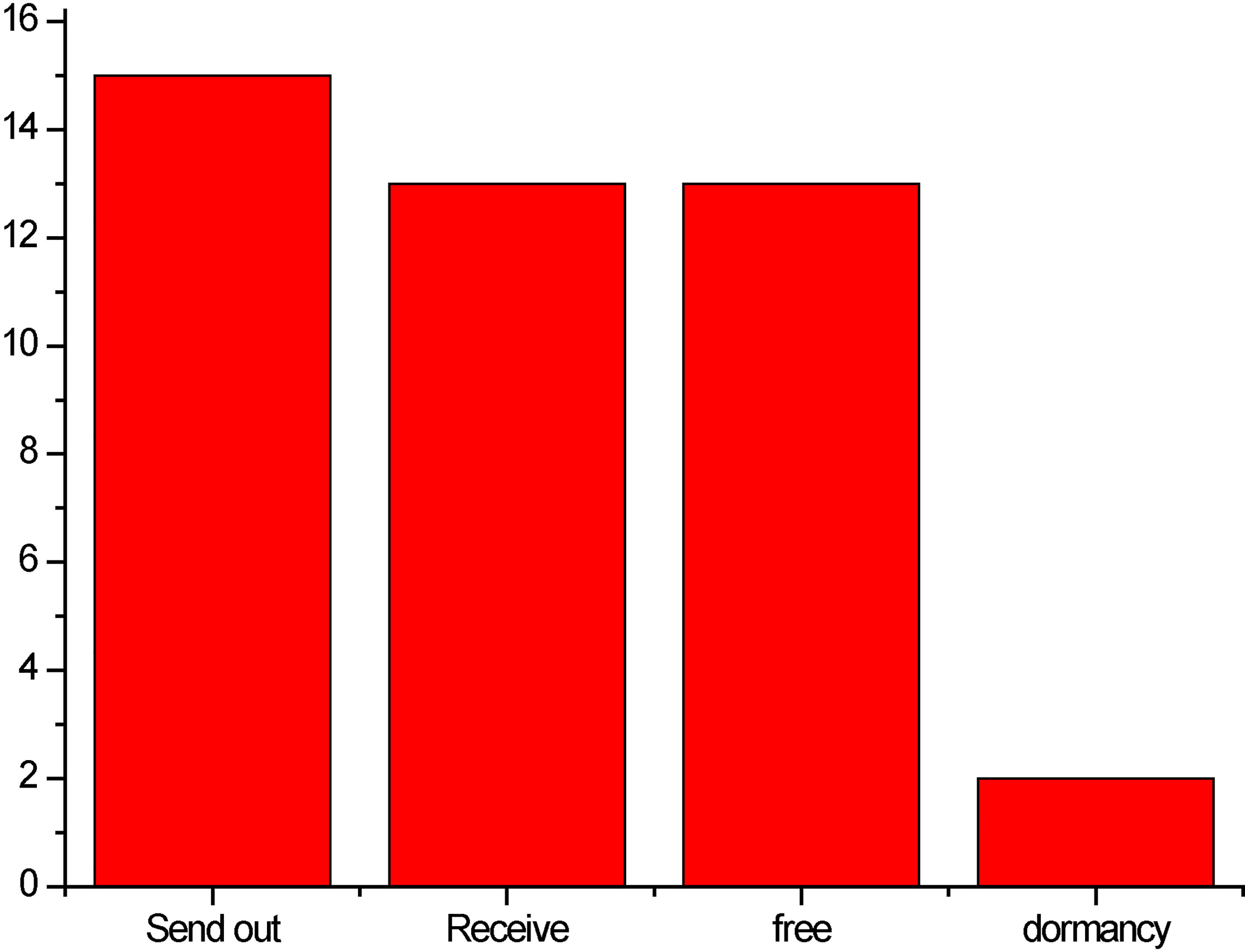
Let the research area be A, and the regionalized variable (that is, the physical attribute variable to be studied, which can be used to represent a natural phenomenon by its spatial distribution) be
In WSN network, a limited number of sensor nodes cannot cover every corner of the monitoring area, and it is difficult to deploy sensor nodes in river, abyss and other areas. Therefore, there are monitoring holes in WSN network, and the collected sensor data sets are incomplete, which need interpolation to supplement. IDW is a representative interpolation algorithm in WSN network. IDW algorithm is simple and easy to calculate, but because only considering the distance between nodes, the accuracy of interpolation is not high.
The problem of data interpolation in WSN network is studied, and an interpolation algorithm based on Voronoi graph is proposed. Firstly, the algorithm uses the neighbouring point query method to find the relevant neighbouring nodes of the nodes to be interpolated; secondly, the local Delaunay triangulation network is constructed by the neighbouring nodes, and the local Voronoi graph is formed accordingly; then, the point to be interpolated is considered as a virtual node and the local Voronoi graph is updated; finally, the prediction data of the nodes to be interpolated are calculated based on the Voronoi area and observations of the neighbouring nodes; experiments are carried out to verify the results of the algorithm.
In the process of getting 16 nodes by querying the neighbouring points (the neighbouring point query method), the time complexity is O (n) because all data can be traversed once. In the process of generating local Voronoi diagrams and calculating the data values of the nodes to be interpolated, only 16 nodes participate in the calculation, so this operation can be completed in a constant level time. To sum up, the time complexity of natural neighbourhood interpolation algorithm is only O (n).
Compared with the traditional construction of global Voronoi graph (time complexity O (nlogn)) and then interpolation calculation, it saves a lot of time and space.
Intel-Berkeley sensor layout.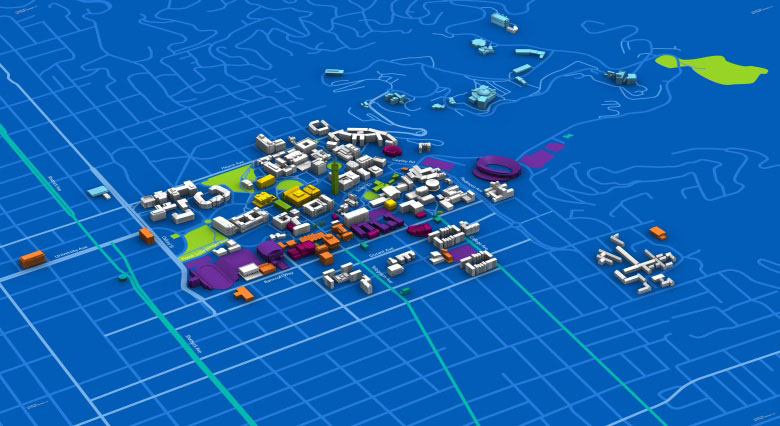
A fast Kriging interpolation algorithm based on irregular mesh partition is proposed for sensor data set Kriging interpolation. Compared with ordinary mesh generation methods, irregular mesh generation can sufficiently adapt to the irregularity of sensor node deployment. Based on irregular grid to search the set of evaluation points, the complexity of searching is reduced, and the execution speed of Kriging algorithm is accelerated. In the construction of environmental map, different levels of color blocks are used to represent interpolated data, and realize the visualization of interpolated data [7, 8]. Compared with IDW, the Kriging interpolation algorithm proposed has better interpolation accuracy. Considering the waste of resources in constructing global Voronoi in time and space, we first construct local Voronoi graph by querying nodes with neighbour point query method, and then interpolate natural neighbour points, which saves time and space very well. In addition, by comparing the natural neighbourhood interpolation results with the original data and IDW data, and through the corresponding error analysis, it is found that the natural neighbourhood interpolation results are closer to the real value [9]. This further proves that the use of natural neighbourhood interpolation algorithm can solve the problem of data completion in monitoring blind area.
Time series
In time series, there is a very effective stochastic model which is often used, which is the autoregressive model. In the representation of this model, the current value depends on the linear combination of values over the past period and the sum of a response. Here we can use
It is called P-order autoregressive (AR) equation. Equation (6) is called an autoregressive equation due to a linear model:
A dependent variable
Equation (8) is an autoregressive operator of order
There are
Suppose that what we are concerned with is the value of the next period
The value
The sensor nodes collect the historical data in a certain period, and according to the collected historical data, the next period of the collected data is predicted by the algorithm. Users can set a threshold of error according to their own needs. When the error between prediction results and actual results is less than the threshold set by users, sensors do not send data. On the contrary, sensor nodes send collected data and update the original prediction model. By setting the threshold, we can greatly reduce the number of data transmission, which can reduce the energy consumption of nodes and improve the lifetime of the whole WSN network.
Relevant parameters and implications
Relevant parameters and implications
The WSN network studied in the experiment consists of two parts: the first part is composed of ordinary nodes, and the second part is only for sink nodes. Prediction model is added to common sensor nodes and sink nodes. Before each sampling cycle, common nodes will first determine whether there is enough historical data. If the number of historical data does not meet the requirements, they will continue to collect and upload data without prediction. When the number of historical data is enough to start judging the prediction, the node will predict the data collected in the next cycle according to the historical data. At the end of the next sampling period, the data predicted by the model will be compared with the data actually monitored. If the error between the two is within acceptable range, that is, when the error value does not exceed the threshold set by users according to their own needs, the data need not be transmitted to the sink node; otherwise, the data actually monitored will be uploaded and the prediction model data of the node will be updated. In the sink node, the data of several sampling periods are stored, and the prediction model is added at the same time. If the sink node does not receive the data sent by the ordinary node, the prediction data of the prediction algorithm will be used; otherwise, the measured data sent from the ordinary node will be used. For this system architecture, it can effectively reduce the transmission times between ordinary nodes and sink nodes, while meeting the accuracy requirements of users. At the same time, the system can also dynamically observe the target and has the ability of self-regulation.
Sink node workflow.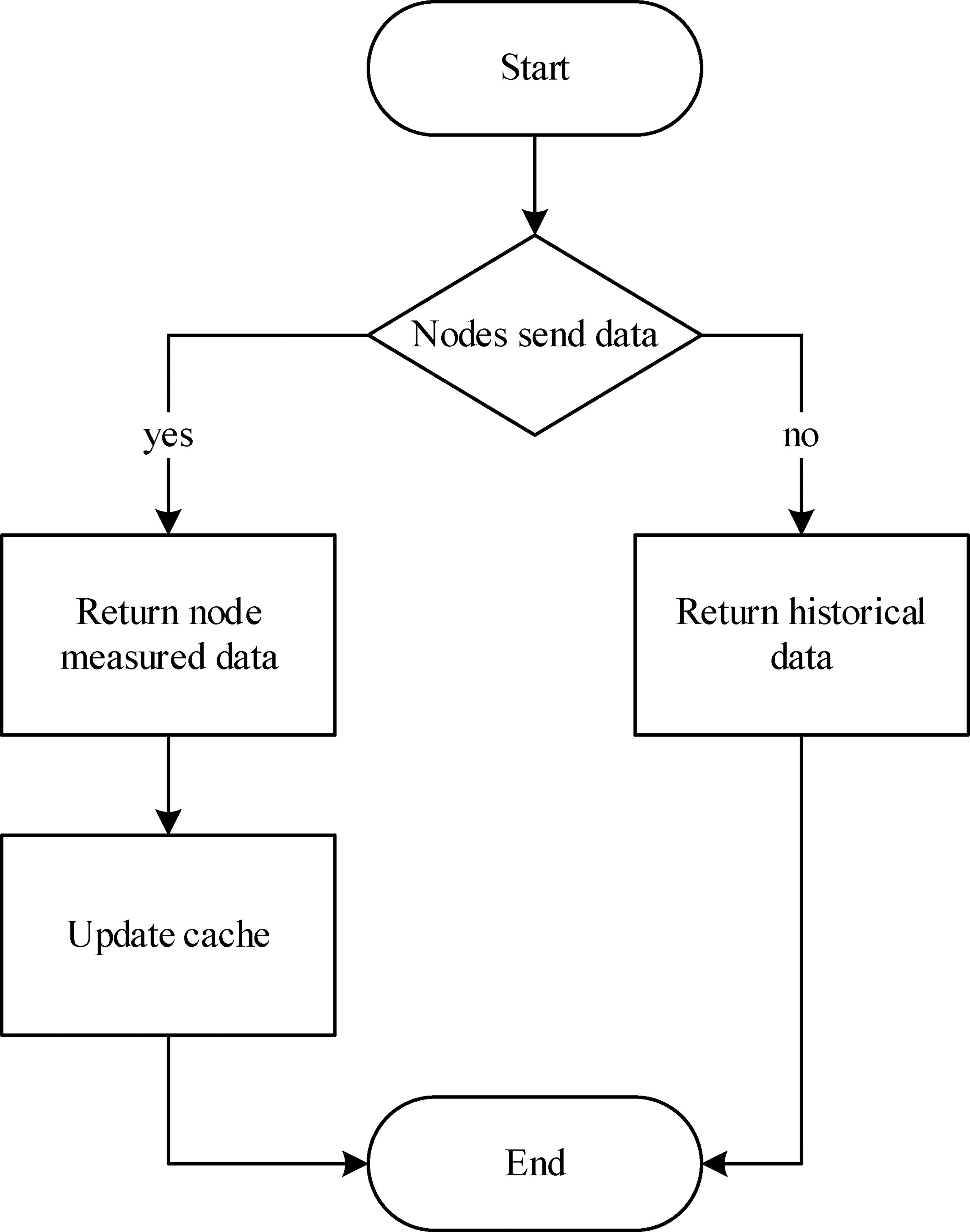
The regression prediction algorithm is applied to WSN network. By analyzing and processing the original data collected, the regression model of prediction is established. After calculating the coefficients of the model, the temperature data in the next few days are predicted through simulation experiments, and different thresholds are adopted in the experiments. Finally, the experimental results are compared. The proposed grid-based fast Kriging interpolation algorithm makes use of the spatial correlation between sensor nodes to reduce the complexity of parameter search points, and achieves good results in speeding up the implementation of Kriging algorithm and saving network energy. Generally speaking, the proposed Kriging interpolation algorithm has smaller interpolation error than IDW. The proposed natural neighborhood interpolation algorithm based on Voronio saves a lot of time and space by constructing local Voronoi diagrams to calculate the data values of interpolation points compared with the traditional global Voronoi diagrams. Then interpolation calculation is carried out, which saves a lot of time and space. From the experimental results, compared with IDW algorithm, the data processed by natural neighborhood interpolation algorithm is closer to the original data.
When blind areas are covered in WSN, the monitoring data collected by the network are incomplete, and incomplete data will not provide strong support for the decision-making of the command and control center. Therefore, blind areas should be avoided as far as possible. When blind areas are generated in the network, blind area detection algorithm should be activated immediately to find these blind areas and repair them.