



Abstract
The purpose of this paper was to investigate the operation condition of a solar photovoltaic ventilation glass window and to perform simulation study on an indoor environment of a building. The method adopted was to perform temperature analysis of a photovoltaic battery through data simulation of the solar photovoltaic ventilation glass window. Results indicated that under the condition that the transmittance of the photovoltaic battery became higher and higher, the absorbing capacity of the photovoltaic battery for solar radiation was gradually reduced, and indoor heat and outlet flow rate were also correspondingly reduced. When a wind speed was overlarge, the human body will experience discomfort, and the heat generated by systems and the heat dissipated by equipment both affected the indoor environment. A conclusion can be drawn that by combining the solar photovoltaic ventilation glass window with the buildings, the indoor warm environment can be effectively utilized.
Introduction
Under the political and economic environment of energy conversation and emission reduction, the application of the solar photovoltaic ventilation glass window is wider and wider. Energy conversion is mainly performed by the photovoltaic battery to provide electric energy for people. However, the photovoltaic battery needs to be cooled in the system operation process, which may cause an adverse influence on working efficiency. This paper mainly took the solar photovoltaic ventilation glass window as a study object, and explored the operation condition and the indoor environment. In the aspect of specific application study, the flow rates and temperatures in related positions under different states were mainly compared and analyzed so as to study how to reduce the consumption of system electric energy and guarantee the indoor environment temperature. Figure 1 shows application of integrated technology in a photovoltaic building.
Application of integrated technology in a photovoltaic building.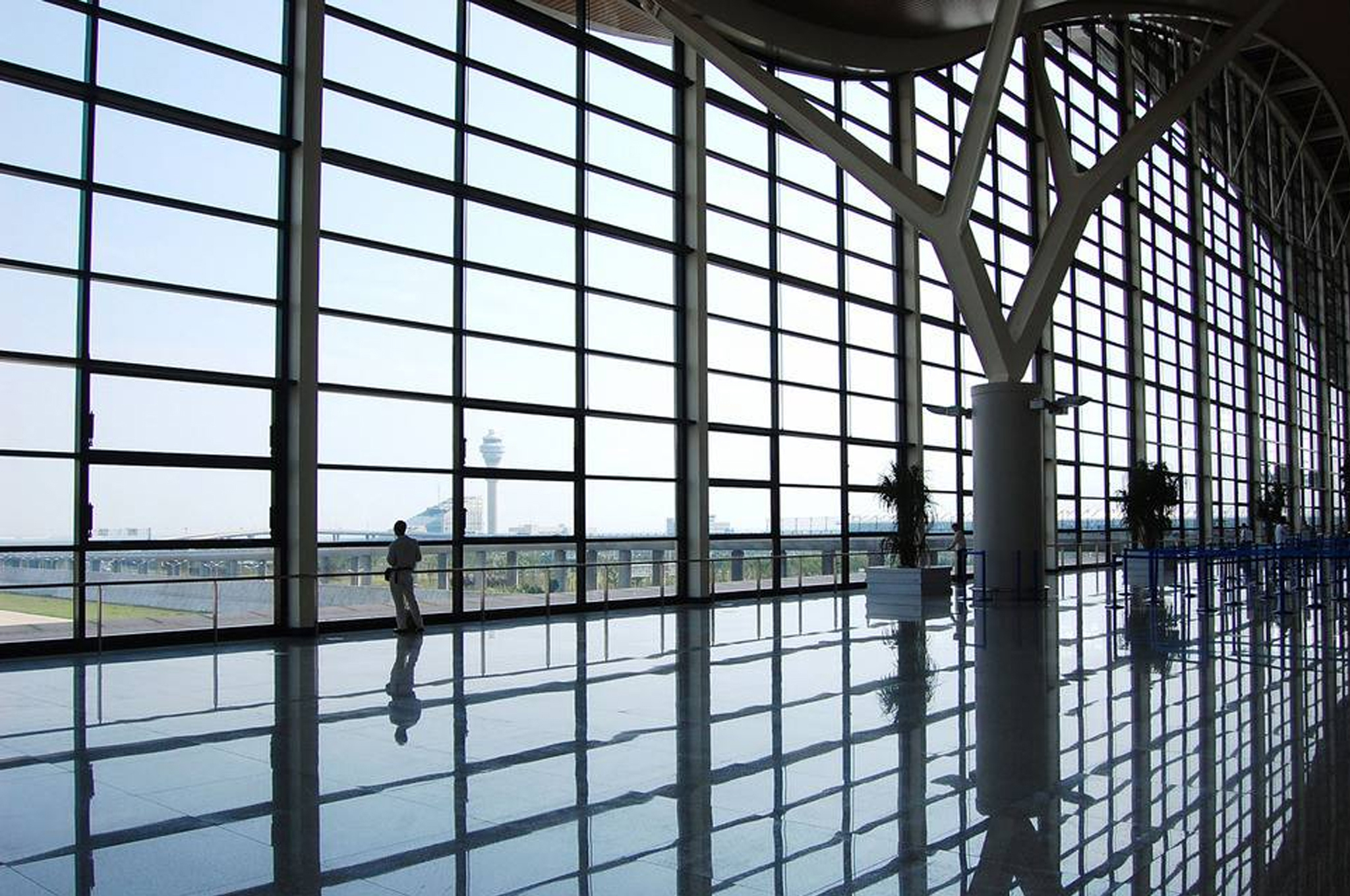
The most common form of photovoltaic cells in daily life is to combine them with buildings. Photovoltaic solar cells can be placed on roofs of buildings, skylights and even glass curtain walls. When solar photovoltaic cells are combined with windows, they become what we call solar photovoltaic windows. When a photovoltaic cell is combined with a window, the traditional opaque carbon – silicon battery is obviously not in accordance with the particularity of the lighting facilities in the enclosure. Early studies by Japanese scholars showed that translucent photovoltaic cells were more suitable for use in combination with glass. At the same time, its research also preliminarily verified the excellent performance of the solar PV window in providing fresh air to the interior while using the solar radiation reasonably. In order to create certain ventilation conditions (natural ventilation or mechanical ventilation) for photovoltaic cells to reduce the temperature rise during the working period of photovoltaic solar cells, the structure of the form needs to be adjusted to meet the ventilation needs when the utilization of photovoltaic cells depends on the combination of the photovoltaic cells with the window structure. The glass window used is a double glazing window. The hollow interlayer between the two layers of glass allows the air to flow freely.
Max and other cited Canada’s Friedrich and Kelton studies in their study. They pointed out that the study of Friedrich and Kelton done in the 2011 ventilated glass window showed that the structure had the potential to provide enough fresh air for the indoor environment. By replacing one layer in a double window structure with a glass material having strong heat absorption capacity, this method made the outdoor fresh air flowing into the room under the action of hot pressing. It was verified that the system can work normally in practical application, and the width and space of the air interlayer under the running condition were determined. The limitation of the air exit height and the window height was that the efficiency of the natural ventilation system and the reliability of the system needed to be further verified. At the same time, in order to strengthen the effect of natural ventilation in the experiment, the window air interlayer width was larger (7.5 cm), the space was larger, and the window structure was naughty. Under the premise of achieving the same effect, how to use the new window structure combined with solar ventilation windows should be further considered [1]. Teodosiu and so on studied the application of the CFD simulation of the internal heat source buoyancy driving cavity in the heating chamber [2]. Two other Canadian scholars, Skaff and Gosselin studied the thermal insulation performance of a ventilated glass window combined with different endothermic materials in a paper on ventilated glass windows published in 2014 [3]. Han and so on studied the numerical calculation of the mixed convection heat transfer between the double window and the low-ecoated a-Si photovoltaic cells [4]. Gaillard and Giroux studied the experimental evaluation of the natural ventilation PV double skin enclosure structure under actual operating conditions. A prototype natural ventilated PV double skin vertical skin was proposed. The experimental evaluation of the surface was aimed at cooling the PV module by stacking effect while improving the thermal performance to maintain good electrical performance under operation conditions. In addition, under the condition of natural ventilation, the performance of the system is particularly prominent when the solar radiation is strong and the ambient temperature is low. The research was also done by CFD software simulation. The parameters of different endothermic materials that used in combination with window glass could be used by other research institutes [5]. Syamimi and other focused on the simulation of the photovoltaic/thermal (BIPV/T) envelope of natural ventilated buildings, focusing on the summer cooling (natural convection) and numerical simulation designed for a partially transparent and ventilated PV FAV [6]. Teuscher and others studied the photoinduced interface electron injection kinetics under the working conditions of the dye sensitized solar cells. The emphasis was on the pump probe spectroscopy of the electron injection rate in the dye sensitized solar cell (DSSC) devices [7]. Sohel and so on studied the dynamic model of photovoltaic thermal system based on air under actual operating conditions. A dynamic model suitable for simulating the actual working conditions of the air based photovoltaic thermal (PVT) system was proposed. The performance of the model was verified by using operational data collected from a building integrated photovoltaic (PVT) system installed in two unique buildings. The simulated outlet temperature and power were in good agreement with the experimental data [8].
To sum up, at present, the related research at home and abroad is mainly focused on the structure of ventilated glass windows, solar photovoltaic systems, models, and so on. These studies have mentioned the effects of the outdoor wind speed, temperature and solar radiation energy on the outdoor environment. However, taking into account the effects of the three parameters on the system, the operation of photovoltaic ventilated glass windows and the indoor environment simulation process are still unclear, which has certain limitations. In general, few scholars have studied the operating conditions of solar photovoltaic windows and the simulation of indoor environment when they are combined with buildings. Therefore, this point is taken as the starting point, the operating conditions of the solar photovoltaic window are studied and the internal environment simulation in conjunction with the building is carried out.
Method
Simulation study of single operation of solar photovoltaic ventilation glass window
The generation of certain heat in the operation process is a prominent characteristic of the operation of the photovoltaic battery combined with an outer layer window glass. The heat was accumulated around the photovoltaic battery to cause the surface temperature of the photovoltaic battery to rise, and further the power generation efficiency of the system was affected. Therefore it was necessary to ventilate and cool the photovoltaic battery. In a combination process of the photovoltaic battery and a window structure, the hollow interlayer of dual-layer window glass may provide a condition for air cooling of the photovoltaic battery. By analyzing air flowing in the air interlayer and observing a temperature change of the window outer layer glass in the air flowing process, the system operation condition can be analyzed.
Data process of solar photovoltaic battery
The operation of the solar photovoltaic battery can only generate direct current which needs to be converted into alternating current for use by families or other industries, and such job needs to be finished by an inverter. Obviously, not only the photovoltaic battery cannot convert all absorbed solar energy into electric energy, but also part of the energy is lost in the converting process from the direct current into the alternating current, and by analyzing and processing related data, the operation efficiency of the inverter and the whole system can be obtained. By original data processing and effective data statistics, the everyday electric quantity yield of the photovoltaic battery component, the conversion efficiency of the inverter, the conversion efficiency of the photovoltaic battery panel and the whole system as well as the system operation efficiency in the whole observation period can be obtained by calculation.
Results of system operations
Results of system operations
As Table 1, The conversion efficiency of the inverter in the photovoltaic battery component is larger in fluctuation range, and is between 80% and 97%, and the value should be about 90% generally. Since the efficiency of the inverter is calculated by taking days as a unit in the calculation process, in an actual operation process, the alternating current cannot be stably generated till the system starts working for a period of time, and the time when the generation of the alternating current is ended is also earlier than the time when the working is stopped, while the environment where the system is positioned every day is also changed to some extent, therefore, the everyday actual operation efficiency value of the inverter is greatly differenced. Table 2 shows summary of system operations.
Summary of system operations
The simulation study was performed with respect to small offices using a photovoltaic solar ventilation glass window system. The building was located in London with a floor area of 12 m
Based on the study object, the simulation study of this chapter was mainly developed around two sections: on one hand, the influence of difference in absorption of solar radiation energy by the photovoltaic battery on the indoor environment of the building under different transmittances needed to be explored; and on the other hand, the building was simulated by using different mechanical ventilation and air feed rates, the minimal air feed rate required for maintaining a better indoor thermal environment was obtained.
Assumption of constant indoor heat release
In a case that the calculation capacity of the software calculating fluid mechanics was limited, related assumptions should be made before the simulation, thereby simplifying a simulation model to shorten time required by the calculation process. When the solar photovoltaic ventilating glass window was singly simulated, the related assumption of an unchanged temperature of air entering the interlayer air was still used in the simulation of the whole building. In addition, in the simulation process, it was assumed that the heat value of heat radiation of the indoor environment was kept constant. In the content (Section 3.4.2) about a speed boundary condition that has been mentioned, the total amount of the heat released by personnel in an office and the equipment in the office and the indoor heat were 50 W/m
Results and analysis
Analysis of numerical value simulation results
With the increase of the transmittance of the photovoltaic battery, the absorbing capacity for the solar radiation was reduced, and the rise amplitude of the temperature of an inner and outer layer window glass and an air flow rate at an outlet of the air interlayer in the system operation process was also reduced accordingly. Thus it can be concluded that different transmittances of the solar photovoltaic battery had an influence on the system. However, in terms of the parameters of a fluid rate and the temperature rise of the photovoltaic battery, the results obtained by different transmittances were slightly different. Specifically speaking, the temperature calculated by theoretical estimation in the operation process of the photovoltaic battery could reach 296 K, and the temperature rise was about 20 K; and in the air-cooling case, the temperature of the photovoltaic battery was about 280 K, and the temperature rise was merely about 6 K, and mechanical ventilation had an obvious cooling function on the photovoltaic battery. The result obtained by data analysis was consistent with the assumption that the air flowing by the air interlayer would bring away part of heat generated in the photovoltaic battery operation when ventilation was performed to the photovoltaic battery, and reliability in the simulation was verified. Related documents pointed out that the operation efficiency of the photovoltaic battery was linearly decreased along with the temperature rise of the photovoltaic battery, and therefore, it was necessary to ventilate and cool the photovoltaic battery in the operation process.
When the air temperature and the air flow rate at the inlet and the outlet of the hollow interlayer were analyzed by using the computational fluid mechanics software, related parameters of reasonable positions had to be obtained, therefore, central section positions of flowing air were selected for observation at the bottom and top of a vertical section of the window. The selected positions should avoid a horizontal air flowing section to avoid the influence of adverse air flow at the inlet and outlet on the results. Table 3 shows ventilation flow rate and temperature in winter.
Ventilation flow rate and temperature in winter
Ventilation flow rate and temperature in winter
In related simulation performed in this section, the photovoltaic batteries with the transmittances of 15%, 20% and 30% were still selected for simulation to explore the influence of different transmittances of the photovoltaic battery on the indoor environment. A ventilation rate was set to be 2 m/s. Other related parameters of the solar photovoltaic battery ventilation glass window per se were the same as those when the system was singly simulated. The related parameters were set in a boundary condition setting column of the computational fluid mechanics software. The temperature, air flow rate and airflow direction in a selected indoor measuring position can reflect the state of the indoor thermal environment. Specifically speaking, related parameters simulating working regions in the office need to be observed with emphasis to ensure the comfort level of an office environment of the personnel. Generally speaking, a vertical distance between the head of an adult in a sitting gesture and the ground was 1.2–1.4 m. Therefore, a horizontal plane in a central region away from the ground by 1.2 m in the office was set to measure the temperature, air flow rate and the direction, and the obtained parameters were used to evaluate the comfort level of the indoor thermal environment.
The flow rate of the air passing by an opening of inner layer window glass was obviously increased, and this conclusion was consistent with the conclusion drawn when the solar photovoltaic ventilation glass window was singly simulated. Besides that, by observing an indoor airflow distribution state, it was discovered that the air flowing in an indoor space presented a turbulent state, air back flows occurred in part of regions, and the air finally flowed outdoors by an air returning port in an opposite side of the window body. The heat generated during operation of the photovoltaic battery was taken away by the air in such a manner. The air flow rate in the selected indoor measured position was 0.4 m/s, and this rate would not cause discomfort to a human body.
Similarly, with the increase of the transmittance of the photovoltaic battery, the heat generated by operation of the photovoltaic battery was reduced correspondingly, the heat carried indoors by air was also reduced accordingly, and in the case of a higher air feed rate in mechanical ventilation, the indoor temperature was further reduced, and the indoor discomfort feeling was aggravated. Table 4 shows air flow rate and temperature at relevant locations with different transmittance.
Air flow rate and temperature at relevant locations with different transmittance
Air flow rate and temperature at relevant locations with different transmittance
The above numerical value simulation results proved that when the mechanical ventilation air supply speed was 2 m/s, the indoor thermal environment obviously did not meet the comfort requirements. In winter, according to the relevant standard stipulated in Table 1.5 of England Heating, Ventilation and Air Conditioning (HVAC) Handbook A, the temperature more comfortable for human body in the general office places was from 21 to 23
Gas temperature and flow velocity at relevant locations
Gas temperature and flow velocity at relevant locations
The heat generated during the operation of the photovoltaic battery can be utilized to maintain a thermal indoor environment when combined with a building. When combining photovoltaic batteries with windows, many factors, including ambient temperature, window orientation, amount of solar radiation, photovoltaic battery transmittance, air flow rate, etc., that affect their operation also affected the overall system operation. Among them, the impact of photovoltaic battery transmittance on the system was essentially the impact of the amount of solar radiation the system can get.
It was found that with the increase of the transmittance of photovoltaic battery, the solar radiation energy that it can absorb decreased, and the temperature rise of photovoltaic battery and the flow rate of the air flowing indoors decreased. When the selected photovoltaic battery transmittance was changed, the amount of ventilation should be adjusted to maintain a certain indoor environment. A supply mode was selected for winter operation, the air entered indoors through the air inlet on the window and flowed outdoors through the air outlet arranged on the wall of the opposite side of the window; a consumption mode was selected for summer operation, the air entered indoors through the air inlet on the wall of the opposite side of the window, and flowed outdoors through the air outlet on the window.