



Abstract
Aiming at the nonlinear and coupling phenomena of temperature and humidity changes in the course of tea fixation, this paper proposes the FNN algorithm and its hardware implementation technology in the process of making tea. STM32F107 microcontroller is as the core of the whole system and the multi-point detection system is used in real-time collection of two parameters of temperature and humidity . In addition, data transmission is implemented between PC and I2C, SPI bus. FNN control is adopted to meet the process requirement of temperature and humidity change in process. The method improves the control precision of temperature and humidity and the quality of tea.
Introduction
Tea fixation is the most important step in the process of making tea which directly affects the quality of tea [1], but the nonlinearity and coupling of temperature and humidity changes in tea fixation process make traditional tea fixation machine not precise control of the temperature and humidity inside, nor on the fixing process precise control, which makes low fixing-tea industrial utilization rate. Aiming at this problem, a high precision temperature and humidity control system is designed based on a FNN algorithm with STM32F107 microcontroller. The system can detect and show temperature and humidity in real time by analyzing the testing data, combining the temperature regulation of tea polyphenol oxidase and formulating the control rules and parameters of the controller. Then, the temperature, humidity, speed (fixing time) multivariate joint control in green fixing process are built so that the tea can realize the purposes of high-quality and high-yielding. This system has strong fault-tolerant ability with easy expansion [2]. The method can help to reduce the labor of workers and improve the tea quality, it has high application value.
System hardware
The system uses STM32F107 as the master CPU and the peripheral circuit comprises a temperature and humidity sensor (including dry temperature and wet temperature), exhaust fan, motor, encoder, heater, humidifier, LCD display, keyboard, E2PROM, sound and light alarm. The system hardware structure is shown in Fig. 1. STM32F107 is a microcontroller based on CORTEX-M3 kernel with high performance, low cost, low power consumption and is compatible with other STM32 series processor in software and pin packaging. The Cortex-M3 kernel is specifically designed to meet the requirements of embedded areas which has abilities of high performance, low power consumption, real-time applications and competitive price. The highest working frequency of the chip can be 72 MHz. Furthermore, the flash memory is 512 K bytes and the SRAM is 64 K bytes that rich on-chip resources, simplify the hardware system and reduce the power consumption of the system. What is more, STM32 Series MCU has complete control over all peripherals that it can turn off any or all peripherals to save power consumption. These characteristics make the chip used widely in automatic control system [3].
Structure diagram of system hardware.
Considering the accuracy of system and the environment corrosion resistance of tea fixation, temperature and humidity sensor SHT10 is selected. The temperature and humidity sensor, A/D converter and a digital interface are seamlessly integrated by the CMOSens technology so that the sensor has the advantages of small volume, fast response speed, simple interface and high performance price ratio [2]. Each sensor chip dose for calibration in extremely precise humidity chamber taking chilled mirror hygrometer as reference. The calibration coefficient stored in the OTP memory is in the form of program and is used in the process of calibration [3, 4]. Two wire serial interface system integration becomes rapid and simple.
FNN PID parameter adjust structure consists of input layer, fuzzy layer, fuzzy deduction layer and output layer [5]. Network output is proportional parameter
FNN network topology.
All nodes of input layer is connected with all input component and transmitted to next layer. The input and output of input layer node
The Gaussian function is acted as a membership function in the fuzzy layer,
Where
The fuzzy regulation matching is completed by connecting with fuzzy layer in fuzzy deduction layer, fuzzy calculating is realized among all nodes, namely, corresponding ignition intensity is obtained by all fuzzy nodes combination. Output of each node
Where
Network output layer is the result of
Where
The control algorithm is realized by Eq. (4).
Where
Increment PID control algorithm is used by Eq. (5).
Adjustable parameter is revised by Delta learning rule, goal function is defined by Eq. (6).
Where
Where
FNN controller structure.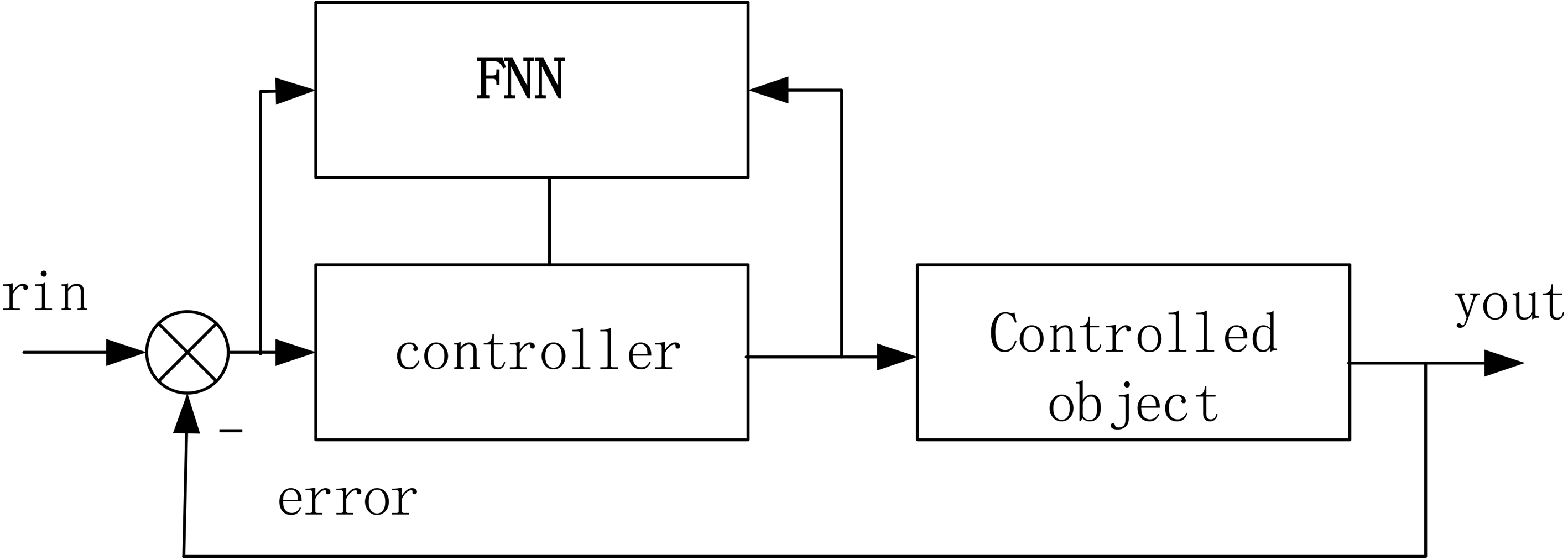
Where
The FNN control algorithm based on STM32F107 microcontroller was applied to of temperature and humidity control in the course of tea fixation, dynamic characteristics was simulated and analyzed. The experiment results are shown in Figs 4 and 5. Step response based on pure PID is shown in Fig. 4. The comparison of dynamic characteristics for step response are shown in Fig. 5.
PID control.
Control comparison.
It is clear from Figs 4 and 5 that FNN control makes dynamic characteristic of temperature and humidity control in the course of tea fixation be improved greatly, frequency bandwidth is increased greatly, and the method has higher precision, smaller overshoot and stronger robustness, compared with common PID control and BPNN control. Good tracking and control effect is reached in condition of high frequency response, and it can meet the requirements of high frequency response [8, 9].
The temperature and humidity control system of tea fixation based on FNN control regards the temperature difference, humidity difference, the rate of change of temperature difference and the rate of change of humidity as inputs of the FNN controller. Combine the temperature regulation of tea polyphenol oxidase and formulate the control rules and parameters of controller. Then the temperature, humidity, speed (fixing time) multivariate joint control in green fixing process are achieved so that the quality of tea can realize the purposes of high-quality and high-yielding. Experiments verify that the system greatly improves the accuracy of temperature and humidity control. When conventional tea fixation techniques adopted, the fluctuations of dry and wet temperature is up to 7
Footnotes
Acknowledgments
This work is supported by Natural Science Foundation of Zhejiang Province in China (No. LY14F020013), and supported by technology plan public project of Zhejiang province in China (No. LGG18F040002). The authors thank the members of the research team for their support of this work.