



Abstract
To simulate the wind speed time series of the whole wind turbine, the mean wind part and the fluctuating wind part are both considered. For the component of turbulence, the different between blade and tower should be taken into consideration. The rotationally sampled spectrum is adopted to simulate the fluctuating wind speed of blade points. The wind simulation method of conventional tall buildings is used to accomplish the simulation process of the tower points. In order to consider the blade-tower interaction, a modified method including the spatial coherence between blade and tower is proposed in this paper. Then, the wind shear model with tower shadow is used to calculate the mean wind speed. Finally, the numerical example is given, and the target spectrum is compared with the calculation spectrum. This paper provides a more applicable and feasible method for the wind speed simulation of wind turbine.
Keywords
Introduction
Wind simulation is the first step to study the dynamic response of wind turbine. Although many researchers take use of CFD techniques to simulate the three-dimensional wind speed, traditional methods of wind simulation still have some advantage and are needed for the wind turbine design.
Usually, wind speed can be decomposed into a mean wind speed and a fluctuating wind speed [1]. For the part of the mean component, the wind shear model is the classical method for the simulation. As for the fluctuating component, the difference between blade and tower should be noticed. The blade rotates around hub in the wind field, which causes the energy distribution of wind power spectrum of the blade change. Conell [2] found that the power spectrum of along-wind speed fluctuation of blade is unlike the power spectrum at a fixed point in space. The rotational effect must be taken into account for the wind simulation of blade. The rotationally sampled spectrum (RSS) is a solution for this phenomenon. There are two important RRS model: the PNL (Pacific Northwest Laboratory) model [3, 4] and the SNL (Pacific Northwest Laboratory) model [5, 6]. Because tower cannot rotate or move, the fluctuating wind simulation for the tower part is the same as the way of the conventional tall buildings.
Many works have been done for the wind simulation of wind turbine. In order to consider the rotational effect of blade, Murtagh et al. [7] assumed that 30% of the total energy of wind spectrum is localized into peaks at 1
However, the fluctuating wind simulation of tower part or the coherence effects of blade and tower are neglected in those studies mentioned above. Based on the work of He and He, a modified method of fluctuating wind speed simulation including the spatial coherence between blade and tower is proposed in this paper.
In this paper, the wind speed simulation of wind turbine is divided into two part, the mean wind and the fluctuating wind. The modified method is used to simulate the fluctuating component. Based on the work of Dolan and Sorensen, the wind shear model including the effect of tower shadow is used to calculate the mean wind speed.
The paper is structured as follows: the formula of RSS is deduced and the modified method including the spatial coherence between blade and tower is proposed in Section 2. Section 3 shows how to simulate the fluctuating wind speed by the harmony superposition method. Section 4 deals with the calculation of mean wind speed. Section 5 presents a numeric example of the wind simulation of wind turbine. A conclusion section is found at the end of this paper.
The analysis of fluctuating wind
When calculating the component of turbulence, the different between blade and tower should be noticed. The fluctuating wind speed of blade and tower should be calculated respectively through the RSS and conventional wind spectrum. Besides, the spatial coherence of two parts need to be included. This paper mainly discusses the along-wind wind speed fluctuations due to its dominance in wind energy distribution.
The blade part
The fluctuating component of a point on the rotating blade shows the characteristic of Spatial periodicity and the RSS should be used rather than the conventional wind spectrum to calculate the fluctuating wind speed.
The rotational Fourier auto-power spectrum
The wind speed
where
The blades rotate at a constant frequency
Schematic diagram of the rotating blade.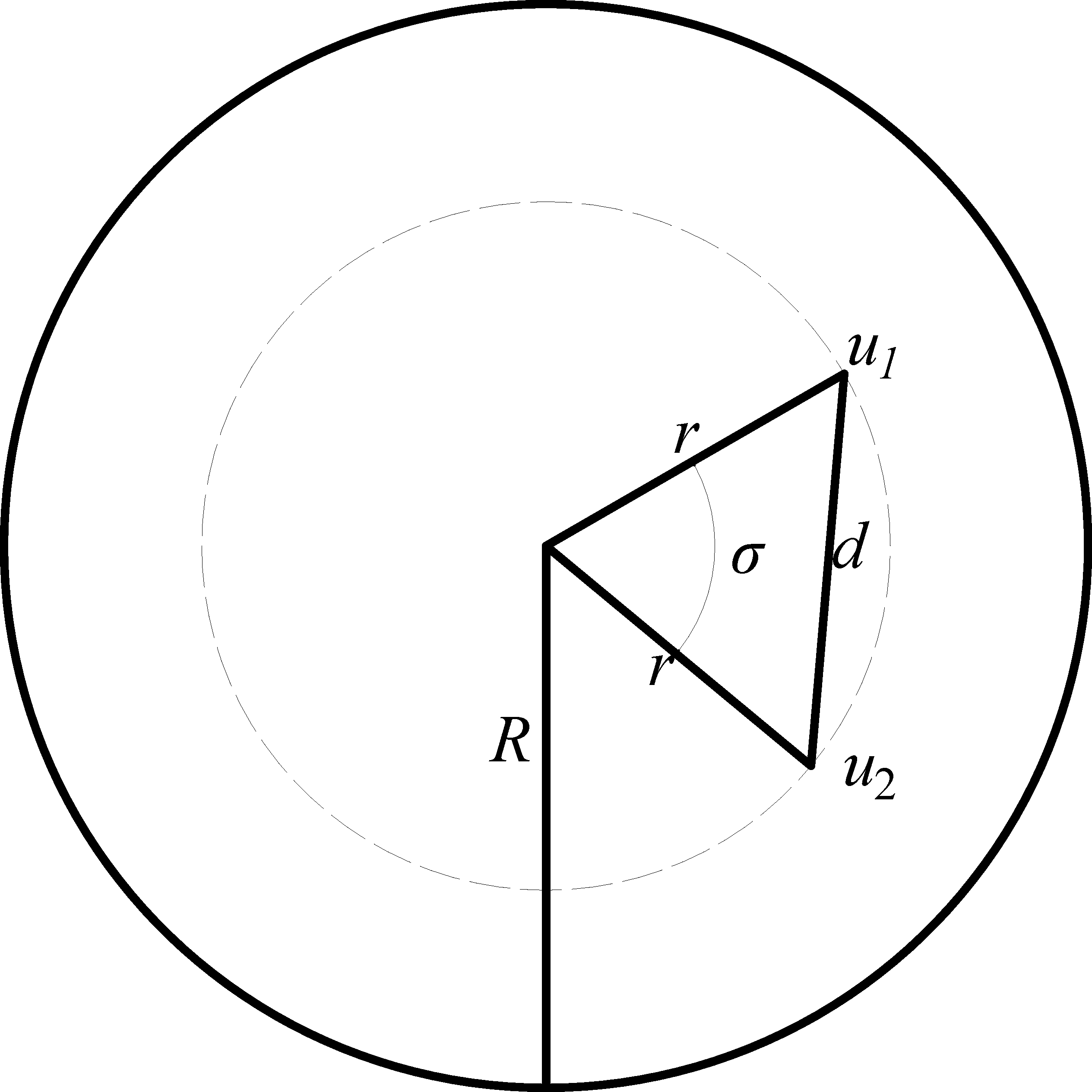
For
Where
The cross-power spectrum-
The wind speed power spectrum,
where
From Taylor’s ‘frozen turbulence’ hypothesis [10], it can be known that the wind speed of a point at radius
Using the Fourier transform and yielding the following expression for the rotational autospectrum of a point on the blade:
Since the coherence function is periodic function of
where
Finally, the rotational Fourier auto-power spectrum is obtained by substituting Eq. (7) in Eq. (6) and using the property of
Following the rotational Fourier auto-power spectrum example, the expression of rotational Fourier cross-power spectrum also can be obtained [8]:
where
The conventional wind spectrum is adopted to simulate the fluctuating wind speed, this paper will not discuss in details, just gives the formula of the cross-power spectrum of two points on the tower:
where
The spatial coherence between blade and tower cannot be neglected if the fluctuating wind speeds of several points on blades and tower are to be simulated. Thus, the cross-power spectrum of blade and tower need to be calculated.
First, point
where
The cross-power spectrum between blade and tower is obtained by using the Fourier transformation pair of Eq. (3):
Because
where
Finally, like the rotational Fourier auto-power spectrum, the cross-power spectrum between blade and tower can be derived by substituting Eq. (14) in Eq. (13) and using the property of
Once, the RSS of blade and the conventional wind spectrum of tower are calculated, including the spatial coherence between blade and tower, the fluctuating wind speeds of wind turbine can be simulated by the method introduced in next section.
The harmony superposition method is a discrete numerical method to simulate the steady randomprocess. The RSS is adopted for the blade points and the conventional wind spectrum for tower, taking the spatial coherence between blade and tower into account. The fluctuating wind power spectrum matrix of one dimensional multivariate zero mean random process can be written,
where
The method of Cholesky factorization is used to obtain
The fluctuating wind speed can be regarded as a random process determined by wind power spectrum. With the theory presented by Shinozuka [16, 17], the fluctuating wind speed time series can be simulated by the Eq. (20):
where
To increase the period of the simulated sample, Shinozuka [16] suggested that
The calculation spectrum approaches the target spectrum when
Based on wind shear model, this paper calculates the mean wind speeds of points on the blades and tower. Besides, the tower shadow effect of blades is also included.
Wind shear
A common wind shear model can be written by the power law as follows [14]:
where
For the points on blades:
Where
Structure of upwind horizontal axis wind turbine.
The tower shows the interference of the wind flow and reduces the wind speed, which is called tower shadow effect. There are three models to consider this effect [18]: the potential flow theory is adopted for the upwind wind turbine; the empirical model fits well for the downwind wind turbine; the combination of potential flow theory and empirical model is used when wind turbine enters and leaves the downwind areas because of yawing.
In nowadays, most wind turbines are constructed with a rotor upwind of the tower to reduce the influence of tower shadow. Therefore, the upwind horizontal axis wind turbine is mainly studied in this paper and the potential flow theory is adopted for this paper.
As it is shown in Fig. 2, the formula of mean wind speed, including tower shadow, can be expressed as follows [1, 13, 14]:
where
From the Eq. (24), it can be known that only when
Because the values of
From Fig. 2, the boundary angle
Thus, the formula of mean wind speed of four areas and boundary conditions can be expressed as follows:
Area 1:
Area 2:
Area 3:
Area 4:
where
The mean wind speed of blade points can be calculated through Eqs (4.3)–(4.3), the mean wind speed of tower points can be calculated by Eq. (22).
Once, the fluctuating component and the mean component of wind speed are both calculated, the wind speed time series of wind turbine can be obtained by add the fluctuating wind speed to the mean wind speed.
A three-bladed upwind horizontal axis wind turbine is taken for example in this section. The height of hub is 65 m; the blade radius is 35 m; the rotational frequency
Simplified calculating model of the wind turbine.
The wind speed time series of 6 points (3 points on blades and 3 points on tower) on the wind turbine, referring to Fig. 3, are simulated through the method mentioned above. During the process of simulation, The von Karman spectrum is chosen as the origin spectrum of RSS and the wind spectrum of tower. The power spectrum of the along-wind wind speed fluctuations at a fixed point in space is given by Eq. (32) [1]:
where
The coherence function adopted in this paper is from ‘IEC61400-1 Third edition 2005-08 Wind Turbines-Part 1: Design requirements’ and written as follows [20]
During the process of simulation, the upper limit frequencies of fluctuating wind is set to 10 Hz,
The simulation process of wind speed time series of the wind turbine was carried out with the param- eters mentioned above.
Fluctuating wind speed time series at point 1–3 on blades.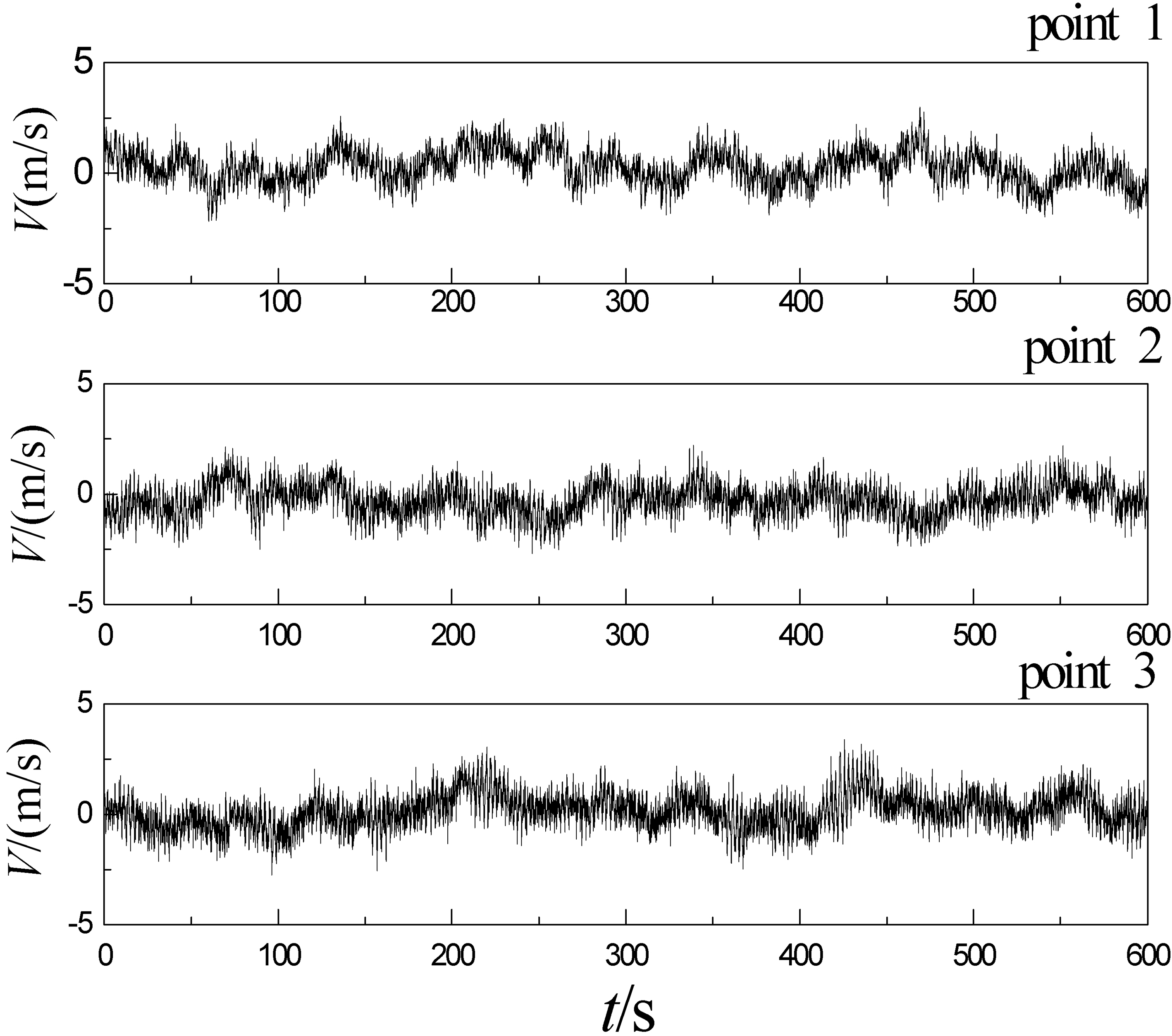
Fluctuating wind speed time series at point 4–6 on tower.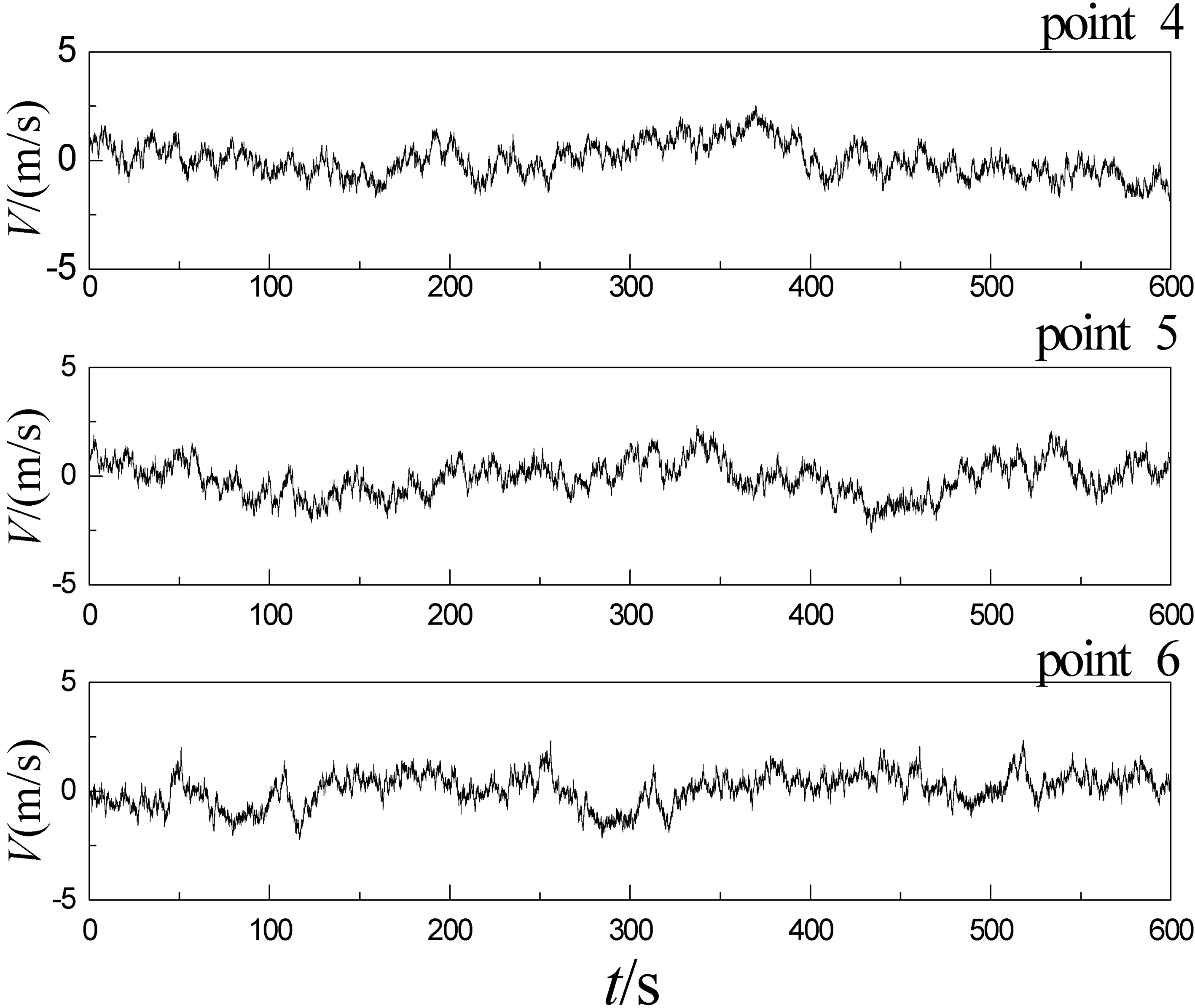
Comparison between simulated spectrum and target spectrum of point 1.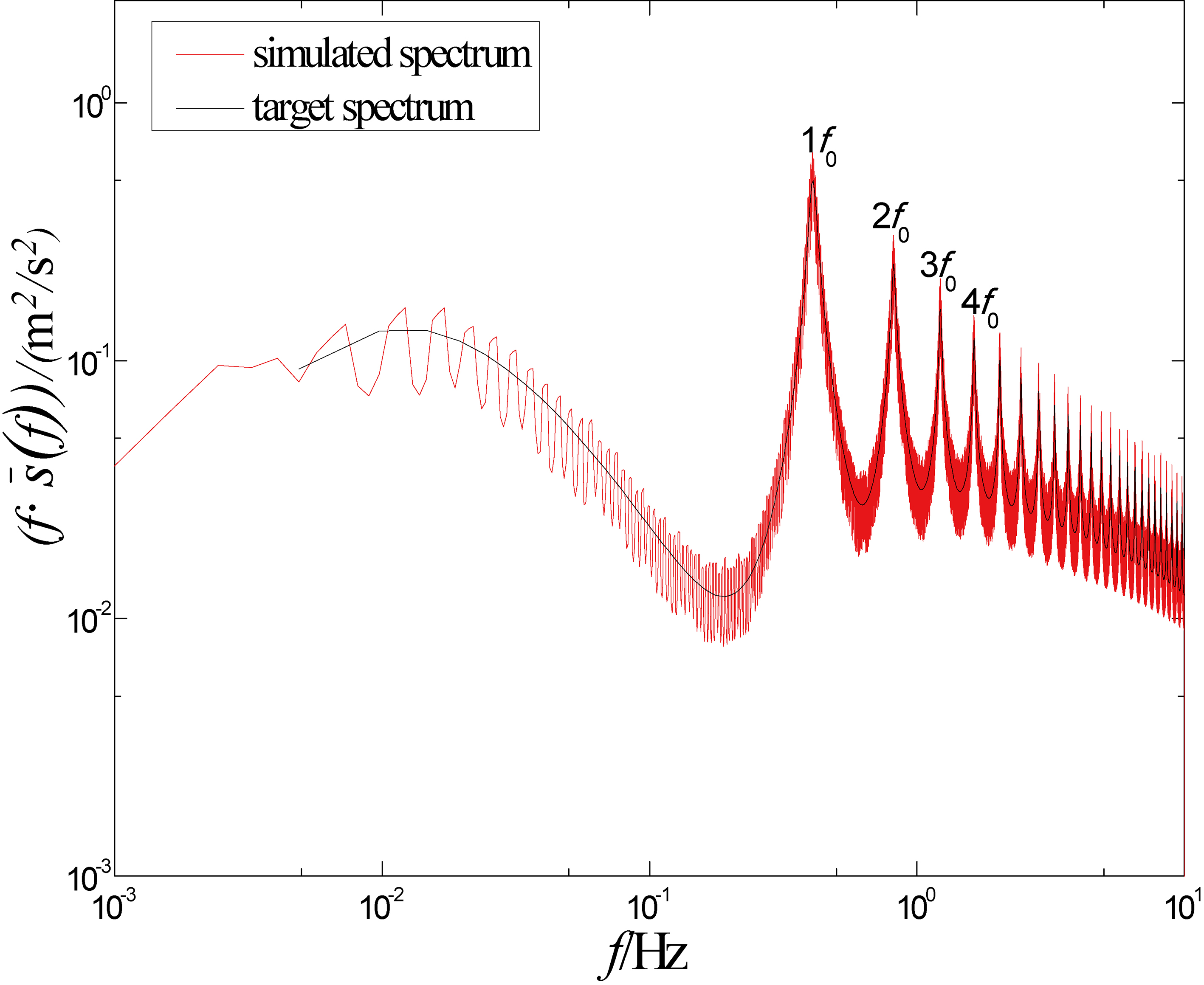
Comparison between simulated spectrum and target spectrum of point 4.
Mean wind speed time series at point 1–3 on blades.
Mean wind speed time series at point 4–6 on tower.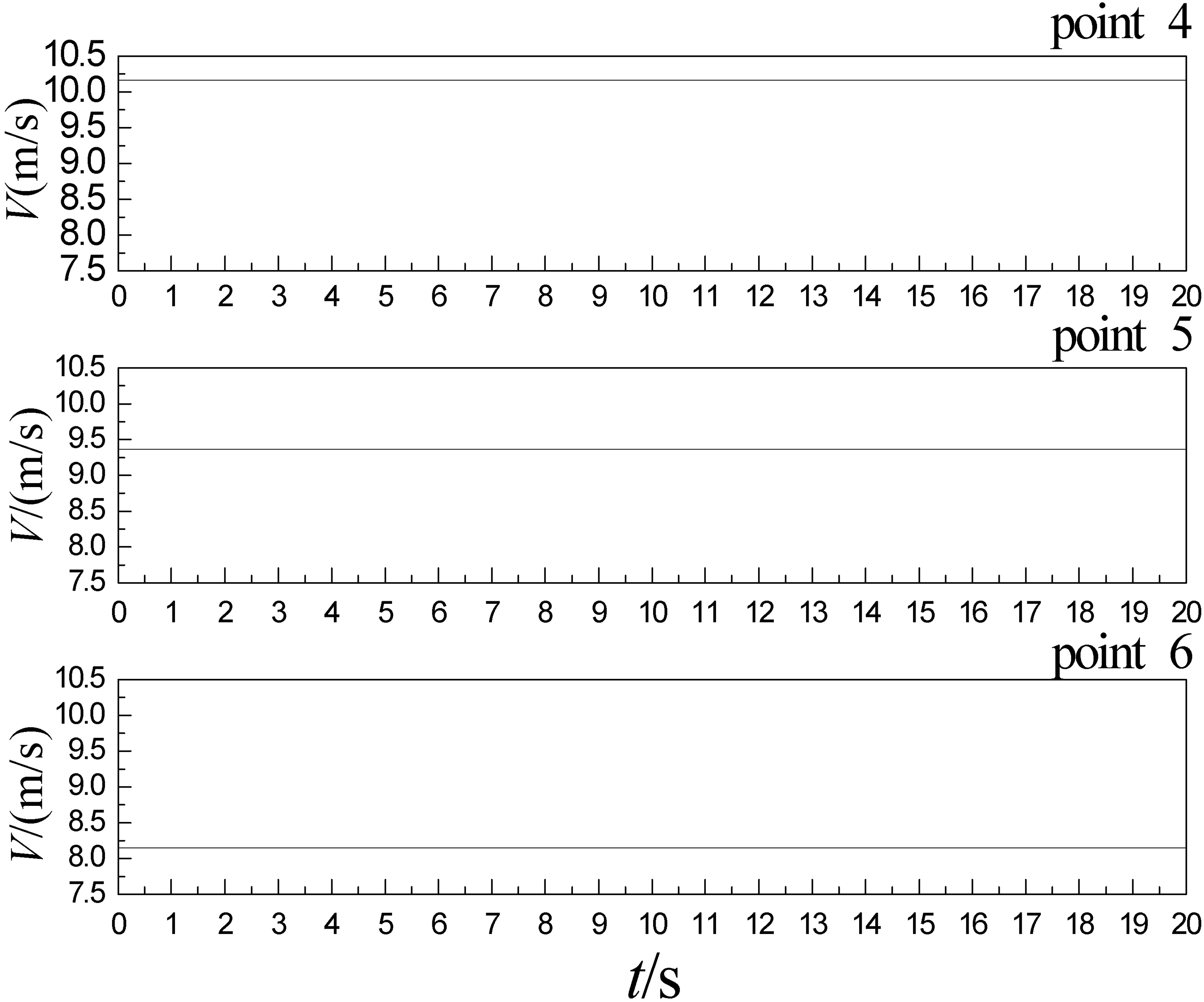
Wind speed time series at point 1–3 on blades.
Wind speed time series at point 4–6 on tower.
Figure 4 presents the fluctuating wind speed time series at point 1–3 on blades and Fig. 5 shows the fluctuating wind speed time series at point 4–6 on tower. The time range of two figures are both 600 seconds. From these two figures, it can be found that the fluctuation ranges of fluctuating wind speed of blade points are larger by contrast with fluctuating wind speed of tower points. This is because blades rotate around hub and the energy distribution of wind spectrum is changed.
Figure 6 is the comparison between the simulated spectrum and the target spectrum calculated by Eq. (9) of point 1 with a logarithmic scale. This fit is quite good. The comparison between the simulated spectrum and the target spectrum of point 4 is shown in Fig. 7 with a logarithmic scale, the target spectrum is calculated by Eq. (31). These two part are also fitted well.
Besides, as it can be seen from the two figures that the energy distribution of RSS is quite different from the conventional wind spectrum’s, these peaks of RSS are localized at 1
Figure 8 presents the mean wind speed time series at point 1–3 on blades and Fig. 9 shows the mean wind speed time series at point 4–6 on tower. Time lag
The mean wind speeds of tower points keep the same all the time in Fig. 9. However, the mean wind speeds of blade points in Fig. 8 change periodically. Point 3 has the maximum and minimum mean wind speed among the three points due to the largest radius. Another phenomenon seen in the Fig. 8 is that the mean wind speeds decrease quickly and increase rapidly during a short time in every period. It is because blade points are affected by the tower shadow. When entering Area 2 and Area 3, the mean wind speeds of these points begin to decrease. Then, the mean wind speeds increase rapidly after leaving these two areas. The tower shadow effect shows great influence on the mean wind speeds.
The 600 seconds wind speed time series of 6 points on wind turbine are shown in Figs 10 and 11. The wind speeds are the combination of the mean component and the turbulence component. The fluctuating ranges of blade points, as can be seen in the two figure, are wider than the ranges of tower points. There are two main reasons, one is that the fluctuating wind speeds of blade points change more fiercely. Another is that mean wind speeds of blade points change periodically, but the wind speeds of tower points are not changed.
The simulation of the wind speed time series of the whole wind turbine need to be divided into the mean wind part and the fluctuating wind part. As for the mean wind speed simulation, this paper uses the wind shear model with the tower shadow effect to calculate the mean wind speed. During the simulation process of fluctuating wind speed, the RSS should be adopted to simulate the fluctuating wind speed of blade points. The conventional wind spectrum is used to simulate the fluctuating wind speed of tower points. In order to consider the wind fields’ spatial coherence of blade points and tower points, this paper proposes a modified method including the spatial coherence between blade and tower to calculate the cross-power spectrum between blade points and tower points. Finally, the numerical example is given.
The presented method in this paper combines the two simulation processes. It is more applicable and feasible for the wind speed simulation of wind turbine.
Footnotes
Acknowledgments
The present work was supported by Yu Bian.
Conflict of interest
The authors declare no conflict of interest.