



Abstract
Beam column is an important structure of a building, and its mechanical properties can directly affect the quality of buildings. The traditional wooden beam-column structure has defects in quality and dimension; to avoid the defects, laminated wood emerges. To prove the mechanical properties of plywood beams and columns, the three-layer plywood beam-column structure was made using larch wood and taking melamine resin as adhesive. The beam-column structure was divided into three groups, group A, B and C, 5 each group, for compression resistance, bending resistance and ultimate load tests. The results showed that the larch plywood beam-column structure had favourable compression and bending resistance and had an ultimate load which was close to the theoretical one, but was slight small. To sum up, the beam-column structure which was made of the three-layer larch plywood that is glued using melamine resin has good mechanical properties.
Introduction
With the rapid development of society, the demand of the construction industry also rises. Modern building materials [1] are mostly steel and concrete, while traditional wooden building materials can give people an unexpected feeling. The traditional wooden structure [2] has the advantages of easy processing and high strength ratio, besides perfectly blending with nature visually. However, compared with the modern reinforced concrete and other building materials, the extent of promotion of the traditional wooden materials is not large. The main reason is that the original wood itself has certain defects, it is difficult to provide a stable section size in line with the requirements. At the same time, wood is flammable and susceptible to moth [3]. However, with the development of relevant technologies and people’s demand for environmental protection, wood building was put forward again. A new type of wood structure was designed to solve the original defects. Plywood is one of the new wood structures. By gluing laminated logs together with adhesives, different sizes and shapes can be made as required without being affected by log section rings [4]. Compared with traditional wood structure and reinforced concrete, the advantages of glued wood are as follows [5]. The first advantage of plywood is that it uses adhesives to hold the wood together and eliminate natural defects by screening and adjusting the wood. At the same time, the combination of different wood can improve the strength and mechanical properties of plywood. Second, glued wood has high toughness and light structure, which can effectively absorb shocks. Thirdly, the fire-treated plywood can form a carbonization barrier during the combustion process to reduce the spread of fire. Finally, the plywood can be recycled for secondary processing after it reaches its service life, and has little impact on the environment. Yang et al. [6] took Douglas fir plywood beam as the experimental beam. They used a simple support scheme to perform a four-point bending test on unreinforced, passively stiffened and prestressed plywood beams. The results showed that the ultimate fiber tensile strain of wood beam could be significantly increased and the effect of local defects could be overcome. Anshari et al. [7] established the prestressed finite element model of prestressed wood block insert-type plywood beam, and further numerical simulation of the structural performance of the prestressed beam under the subsequent destructive bending. The results showed that there was a good correlation between free expansion, precamber, initial stress and load-deflection. Glikhovivic et al. [8] conducted failure tests on 20 reinforced beams and 8 unreinforced control beams for four-point bending structures. They analyzed the bending behavior of the beam from the aspects of load back reflection relation, failure mode, ultimate bearing capacity, stiffness and strain distribution. The results showed that adding CFRP bars to the tensile zone of plywood beam improves the strength, stiffness and ductility of the beam. The distance between the CFRP plate and the center of the section has a very high influence on the reinforcement effect. In the paper, the three-layer plywood beam-column structure was made using larch wood and taking melamine resin as adhesive, which was tested for compression, bending and ultimate load.
Larch plywood beam-column structure
Larch is one of the fast-growing trees. In China, it mainly grows in northeast and north China. Larix gmelinii has straight and beautiful trunk, high density of wood core, high strength and corrosion resistance. It is very suitable for building materials. Compared with beams and columns made from wood of other tree species, larch after processing has high strength of bending and compression resistance. Larch plywood beams and columns are made by bonding larch wood with adhesive, pressing them into glued laminated timber and combining timber together. The cross-sectional shapes of plywood beams and columns which commonly used are shown in Fig. 1.
Common section of the plywood beam-column structure.
The surface-treated plywood beam-column structure has no different with the beam and column processed with the whole log in appearance, and even slightly exceeds. At the same time, it has better structural mechanical properties and is not limited by log size. Glued wood beam columns include fire protection during the manufacturing process. When the building encounters a fire, the surface of the beam will form a carbonized layer to block the air and heat, delaying the spread of the fire. The use of plywood beams and columns in the building is the same as that of reinforced concrete. Its load-bearing and load-transferring system is similar to the frame system of common cement.
Sample processing materials
Basic information of plywood processing materials
Basic information of plywood processing materials
As shown in Table 1, the main material of the specimen glues wood was larch, and the adhesive was melamine resin [9].
Sample processing process.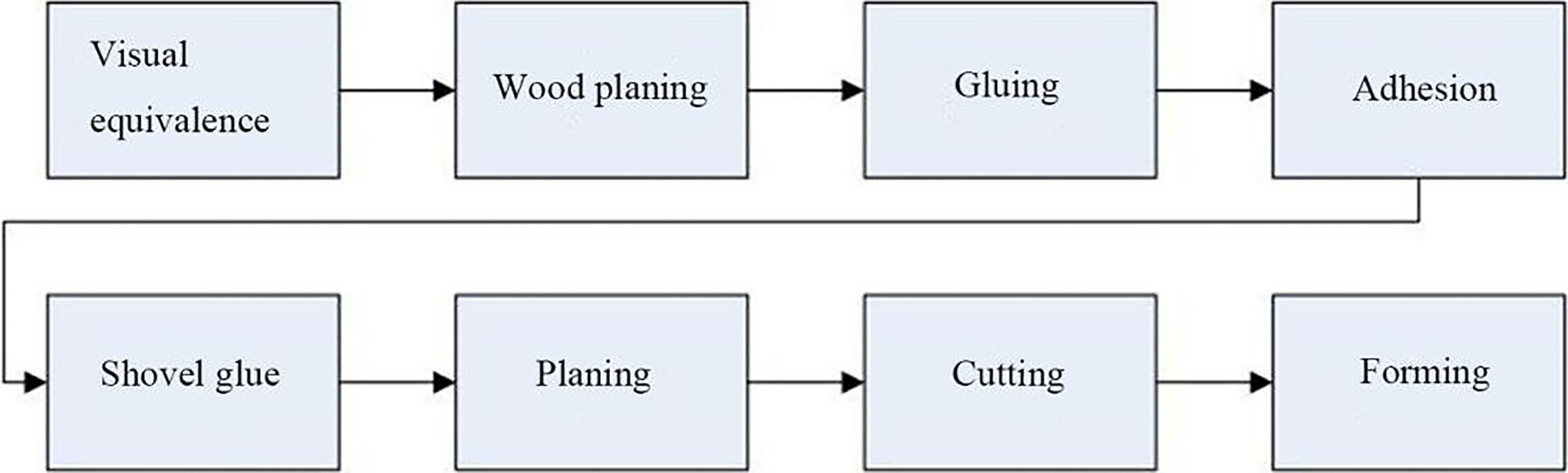
As shown in Fig. 2, firstly, the wood was visually divided according to the provisions of the standard for testing methods of wood structure [10], defects in larch wood, including decay, moth and cracks, were removed. After that, wood planing was carried out according to the cross-section size of the specimen laminate (130
Schematic diagram of beam and column dimensions of the specimen.
Major instruments and specimens
The main instruments include micro-machine electro-hydraulic servo press [12], jack press and static strain test system.
Main specimens: The specimen in Fig. 2 was cut with a size of 75
Test method for compression resistance of plywood
Firstly, the sizes of five series A specimens were measured by vernier calipers [13] according to their numbers. Then mark the position of strain gauge paste with marker. The strain gauges were washed with ethanol and pasted to the corresponding positions, and then coated with silica gel to protect the strain gauges.
Zero the test system before the formal test. Firstly, the microcomputer hole electro-hydraulic servo press was used to preload the specimen to 2% of the estimated failure load, and the strain value at this time was measured. Then it was increased the load and measured the strain value. Next it was unloaded to 2% of the estimated damage load. Repeat 5 times to compare whether the strain value of each time is stable. If the change was large, adjust the placement of the specimen on the pressure machine until the change was stable.
Formal test: The load started from 2% of the predicted failure load and loaded the specimens at a rate of 0.4 mm/min and collected strain data. The estimated ultimate load of test piece A series was 70 kN. Within the load range, three loading operations were repeated for each test piece, and the mean value was taken as the measurement data.
Result calculation: The incremental method [14] was applied to calculate the collected data in the paper, so as to obtain the compressive modulus of elasticity of the specimen. The formula was:
where
Loading diagram of flexural performance test.
As shown in Fig. 4, strain gauges were pasted at 20 mm apart from each side of the specimen. One strain gauge was pasted on the pressed top surface and one strain gauge was pasted on the pulled top surface, totaling 10 strain gauges. The displacement meter was set at the middle part of the specimen and the corresponding position of the specimen on both sides of the distribution beam, and the percentage meter was set at the support of the specimen to prevent damage of the displacement meter caused by excessive loading.
Loading began with a step-by-step loading [15]. Ten stages of loading at a loading rate of 2 kN/level until the load was 20 kN. Each stage of loading lasted for 4 min, and then the data were read.
Result calculation: In the paper, two point loading method was used to measure the bending resistance of the specimen. The flexural modulus of elasticity was calculated by measuring the deflection of the specimen under load. The formula of flexural modulus of elasticity was:
where
The calculation formula for the theoretical ultimate load of plywood is:
where
The detection method of ultimate bearing capacity of c-series specimens was the same as that of bending resistance, both of which were two-point loading methods. The loading diagram was the same as Fig. 4. The loading was loaded by grading loading and loaded to 26 kN at a loading rate of 2 kN/level. After the loading rate was 1 kN/level until the beam and column break. Each stage of loading lasted for 3 min, and then the data were read.
Compressive performance
Statistical table of compressive elastic modulus of the plywood beam-column structure
Statistical table of compressive elastic modulus of the plywood beam-column structure
Modulus of compressive elasticity of the plywood beam-column structure.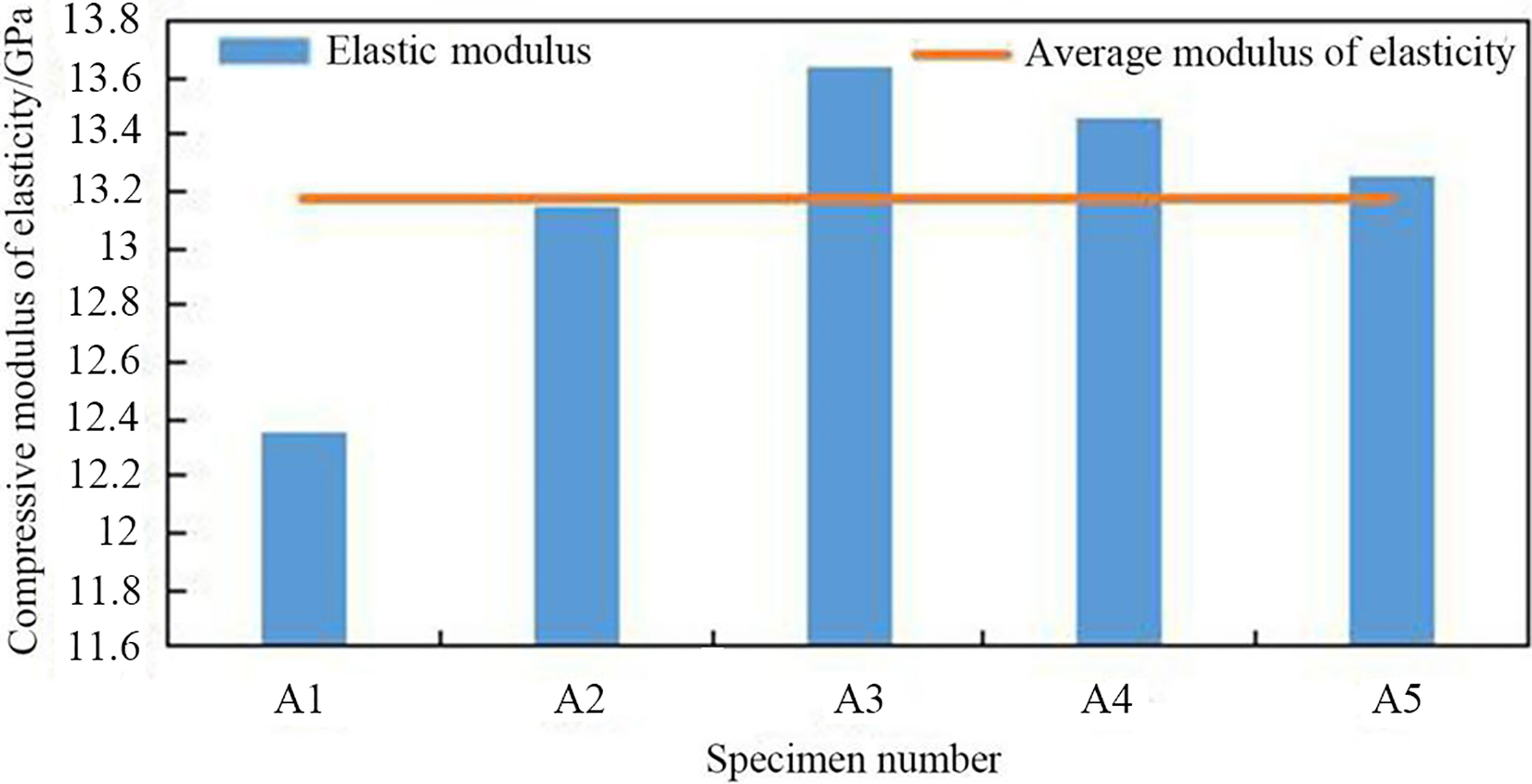
As shown in Table 2 and Fig. 5, the compressive modulus of elasticity of A1, A2, A3, A4 and A5 were 12.36 GPa, 13.15 GPa, 13.64 GPa, 13.46 GPa and 13.25 GPa, respectively. The average modulus of compressive elasticity of this batch of plywood beam-column structure was 13.17 GPa.
Deflection – load curve of the plywood beam-column structure.
Regression coefficient and modulus of flexural elasticity of plywood beams and columns
Test results of ultimate load of plywood
As shown in Fig. 6 and Table 3, within the load range of 20 kN, the load-deflection data of the specimen were in good agreement with its linear trend line.
The slope of the regression equation was substituted into Eq. (2). The flexural modulus of elasticity of specimens B1, B2, B3, B4 and B5 was obtained through calculation 15.28 GPa, 16.15 GPa, 15.46 GPa, 14.69 GPa and 15.05 GPa, respectively. The average compressive modulus of elasticity was 15.33 GPa.
Deflection – failure load curve of the plywood beam-column structure.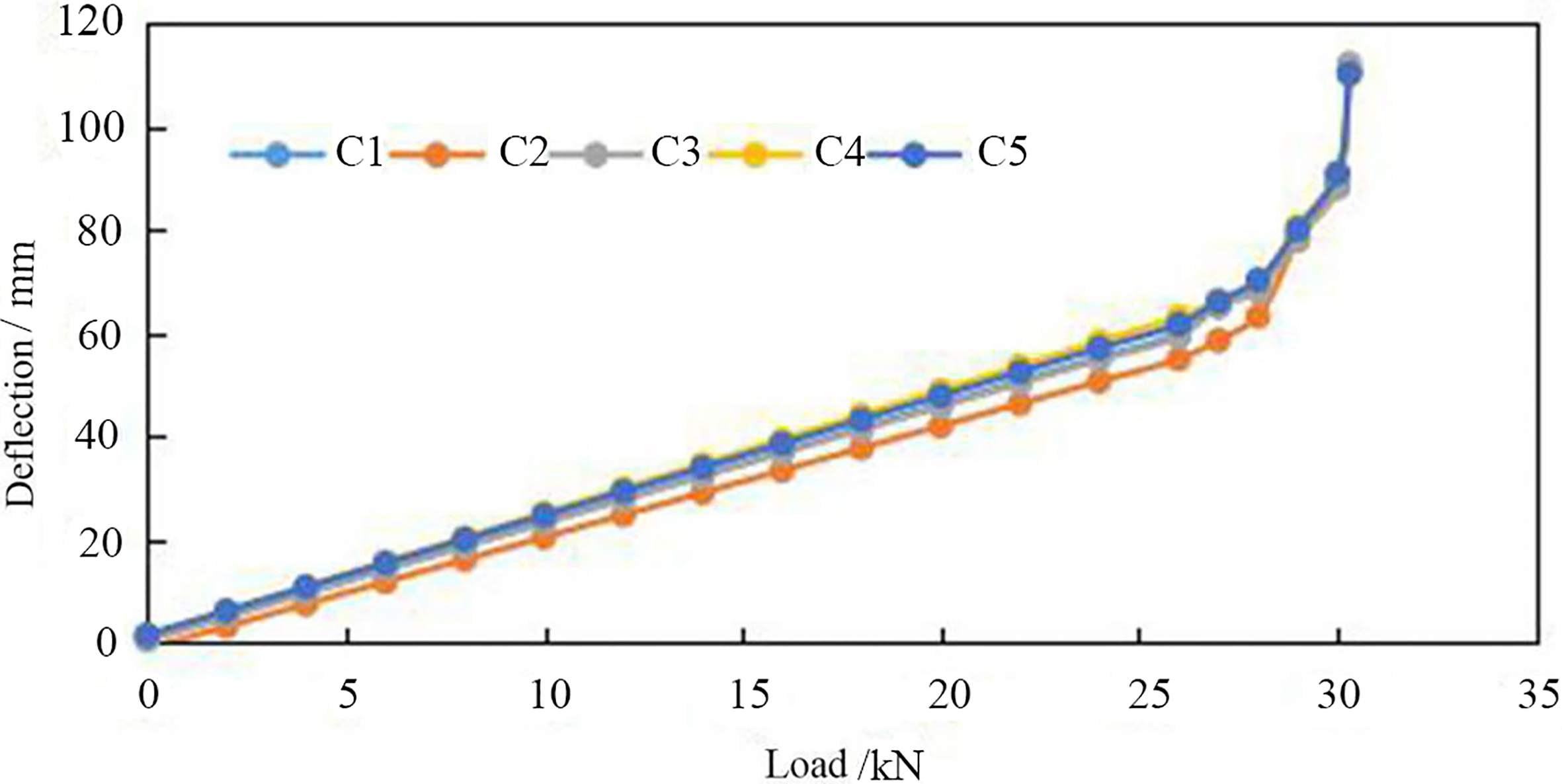
As shown in Fig. 7, there was a difference in the ultimate bearing capacity between the C-numbered test pieces, but the difference was not large. Under 25 kN load, the deflection – load curve was basically linear. After 25 kN, it begins to yield, at this time, the deflection increment under unit load was greatly increased. When the ultimate load was reached, the specimen beam and column broke.
As shown in Table 4, the ultimate loads of C1, C2, C3, C4 and C5 were 29.45 kN, 30.05 kN, 29.56 kN, 29.87 kN and 30.02 kN, respectively. The average ultimate load of the plywood beam-column structure was 29.79 kN. In the whole process of loading failure, the specimen was in the elastic stage before the 25 kN load, and the plastic stage was between the 25 kN and the limit load. The former lasted longer than the latter.
There were differences in compressive modulus of elasticity between different test specimens in the compression test of the larch glulam beam columns in the bar structure in group A, which was contributed to the natural defects and error in visual division. Although the texture of the wood was overall the same and the part of obvious worm damages has been removed, the texture was not completely the same. Moreover the unobvious structural damages caused by worms or other reasons might not be completely eliminated in visual division, leading to the difference of compressive properties.
In the compression test of the larch glulam beam columns in the bar structure in group B, it was found from Eq. (2) that the slope of the regression equation was related to the flexural modulus of elasticity of the specimen, and in theory, there should be no constant term in regression equation. But the actual regression equation had constant terms. The reason was that there was friction between the specimen and the support, and the uneven contact between the specimen and the support or the loading point was also one of the reasons. Besides the above reasons, the difference of the compressive modulus of elasticity between the test specimens in group B was also related to the different density and complexity of larch wood and the different amount of glue.
In the ultimate load test of the larch plywood beam columns in the bar structure in group C, the ultimate load of different test specimens had difference. Compared to the theoretical ultimate load obtained by computational formula, the actual ultimate load was smaller, which might be because of the larger size of the test specimen and the reasons that were the same with those for the difference of different compressive modulus of elasticity and flexural modulus of elasticity.
Conclusion
The paper adopted the larch wood, and melamine resin was used as adhesive to make the three-layer plywood beam-column structure. The plywood beam-columns were divided into three groups of A, B and C, 5 each group. Group A was tested for compression resistance, group B was tested for bending resistance, and group C was tested for ultimate load. Results were as follows. Firstly, the compressive modulus of elasticity of different specimens was different due to the wood and amount of adhesive applied, but the difference was not significant. The average compressive modulus of elasticity of plywood was 13.17 GPa. Secondly, the flexural modulus of elasticity of different specimens was different, but the difference was not significant. The average flexural modulus of plywood was 15.33 GPa. Finally, the ultimate loads of different specimens were different, but the difference was not significant, and the average value was credible. The average ultimate load of plywood was 29.79 kN, which was smaller than the theoretical ultimate load.