



Abstract
PCB is an important component for electronic devices – Mechanical connections and electrical transmission, thermal failure is its main failure mode, the heat flow analysis and thermal design is the basis and premise to improve thermal characteristics of PCBs. In this paper, based on the principles of fluid mechanics, using the finite volume method, the thermal characteristics of the PCB is modeled, and we obtain the maximum junction temperature of the PCB, PCB’s thermal distribution and effect of different ambient temperatures on the PCB thermal characteristics. The study provides a theoretical basis for the PCB thermal design.
Introduction
PCB is an important part of electronic equipments, it plays roles of mechanical connections and electrical transmission. The thermal stress will generated in the cyclic temperature change, as can cause thermal fatigue failure of components. Thermal analysis and thermal design of PCBs are the basis way to improve the fundamental failure due to overheating, it has attracted great attention of domestic and foreign scholars and research departments. In early 1970s, the thermal analysis and the thermal measurements were carried out on the PCBs, in the 1990s, Japan’s electrical appliance companys, such as Tosbiba, Sachio and Yasufufu, have done the research, PCB thermal analysis techniques and quality control were evaluated.
In recent years, many researchers has also done a lot of work on thermal failure mechanisms and characteristics. However, whether domestic or foreign, thermal analysis and thermal design modeling of PCBs are mostly static, unitary and certain models, as can not meet the thermal design requirements of the motherboard system fundamentally [1, 2, 3, 4].
In this paper, based on the principles of fluid mechanics, using the finite volume method, Samsung S5PV PCB as the research object, the thermal characteristics of the PCB is modeled, and obtained the maximum junction temperature of the PCB at different ambient temperatures, PCB heat flow field distribution and effect of different ambient temperatures on the PCB thermal characteristics, the study provides a theoretical basis for PCB thermal design.
Heat flow modeling on S5PV PCB board
Solid model of the PCB
S5PV PCB board exterior dimensions is 130 mm
Device parameters
Device parameters
In accordance with the PCB design drawings, geometry modeling will be placed in the proper position for all device, at the same time, a good chip package parameters should be set. The power and PCB’s geometry structure has been built on the basic model, as shown in Fig. 1. In PCB’s solid model, the green part is PCB board with 8 layers, the yellow surface of PCB board is copper clad of interconnections, the black squares are the main IC devices of the PCB.
PCB’s solid model.
We use Atair FLUX software to built thermal model, after considering the computational efficiency, computer configuration and simulation accuracy level of several factors, the PCB surroundings provided 12,000 base mesh, and the PCB set up 560,000 base mesh, the central area of ICs is locally subdivided for the mesh, and a smooth transition and the grid are obtained [7, 8, 9], the grid is shown in Fig. 2.
Maximum junction temperature of each chip
Maximum junction temperature of each chip
Meshing of the PCB model.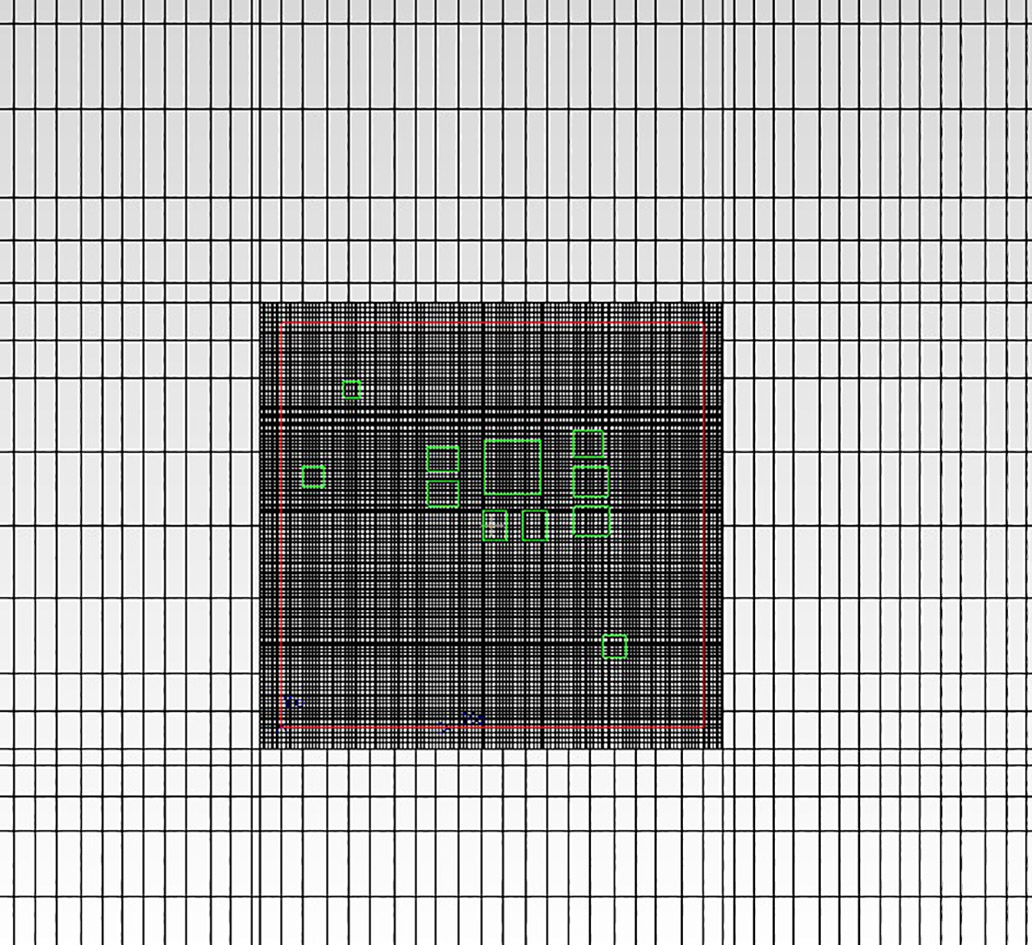
PCB temperature distribution at 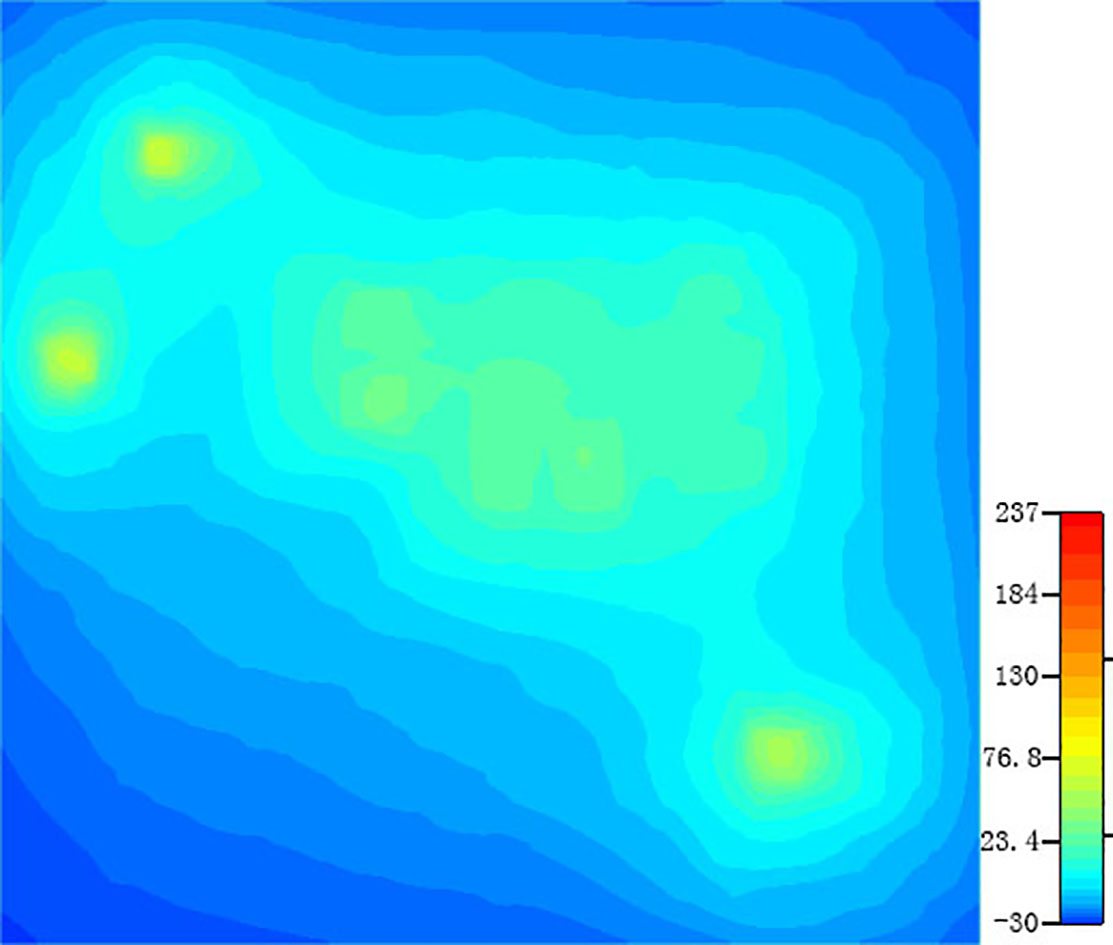
PCB temperature distribution at 25
PCB temperature distribution at 80
PCB temperature distribution at 125
The PCB ambient temperature is set,
U2:1, U2:2 and U2:3 are three small SDRAM ICs, U3:1 is a small FLASH IC in Table 2.
Between
Equation (1) is a temperature range of
The relationship between ambient temperature and maximum junction temperature of the PCB.
PCB is an important component for electronic devices – Mechanical connections and electrical transmission, thermal failure is its main failure mode, the heat flow analysis and thermal design is the basis and premise to improve thermal characteristics of PCBs. In this paper, based on the principles of fluid mechanics, using the finite volume method, the thermal characteristics of the PCB is modeled, and we obtain the maximum junction temperature of the PCB, PCB’s thermal distribution and effect of different ambient temperatures on the PCB thermal characteristics. The study provides a theoretical basis for the PCB thermal design.
Footnotes
Acknowledgments
This work is supported by technology plan public project of Zhejiang province in China (No. LGG18F040002), and supported by Natural Science Foundation of Zhejiang province in China (No. LY19F020035). The authors thank the members of the Center for Advanced Life Cycle Engineering at the University of Maryland for their support of this work.