



Abstract
A solid model of electrostatic separation between mechanical cotton harvesting and residual plastic film is established. The mechanized harvesting degree has been improved year by year. 90% of the cotton harvesting has been achieved in the southern Xinjiang reclamation area of Xinjiang Production and Construction Corps. However, there are a lot of impurities in the machine harvesting cotton, and it is difficult to remove them. Machine-picked cotton cleaning is an important part of cotton processing. Its cleaning effect directly affects the processing efficiency and lint quality of cotton. In this paper, a solid model of electrostatic separation between mechanical cotton harvesting and residual plastic film is established. Through CFD method, the particles of mechanical cotton harvesting and residual plastic film fly into the electric field at the speed of 3 m/s, 4 m/s, 5 m/s and 6 m/s respectively, and the movement process of different electric field forces is loaded on the particles, in order to reveal the mechanism of electrostatic separation between mechanical cotton harvesting and residual plastic film. The test results show that with the increase of the speed of cotton picker flying into the electric field area, the shorter the residence time of cotton picker in the electric field area, the electric field force required for the film to be captured by the upper plate will gradually increase; the trajectory of particles in the electric field area has less influence on the airflow, and the inlet airflow velocity is the most important factor affecting the airflow distribution in the box. This study is expected to provide a reference for the application of electrostatic technology in the study of the cleaning process of mechanical cotton picking.
Introduction
The agriculture of Xinjiang Production and Construction Corps is mainly jujube cotton all the time, especially the planting area of long stapled cotton is increased year by year. With the acceleration of mechanized process, machine harvesting gradually replace traditional manual harvesting method. Xinjiang Production and Construction Corps is the largest machine-harvested cotton base in China. Under the policy guidance and developmental demand, the cotton in the reclamation area is basically harvested by cotton picker machine. However, there are a lot of impurities in the machine-harvested cotton, and it is difficult to remove them. This seriously restricts the development of deep processing of quality cotton [1, 2, 3, 4, 5]. In particular, the residual plastic film in the machine-harvested cotton is very difficult to remove. In recent years, many researchers and scholars have devoted to finding an effective way to remove residual plastic film, but make little achievement yet.
Now, there are several methods to remove the residual plastic film in machine-harvested cotton: manual cleaning, traditional mechanical cleaning [5, 6, 7, 8], machine visual inspection and cleaning [9, 10, 11, 12, 13, 14, 15], electrostatic adsorption, etc. Traditional manual cleaning method featured by high work strength, low efficiency and bad operating environment can not meet the cotton production requirements in current situation any more. Wen et al. [15] adopted independently developed mechanical equipment to open and scutch various impurities in machine-harvested cotton by manipulator, reduce the combination between cotton and impurities and facilitate further cleaning, but the cleaning effect was not good, and what’s the worse was that it brought great damage to cotton velvet and especially largely affected the quality of long stapled cotton. Zhang et al. [16] proposed a machine visual cleaning method, but because CCD has a low resolution ratio for the small impurities in area and morphology and the control accuracy of using mechanical arm execution unit control system is very low, so there is a serious lag, low impurities cleaning ratio, high requirements on work environment and high operating cost of cleaning process, which does not conform to actual requirement; Guo et al. [12] proposed to clean the machine-harvested cotton by electrostatic adsorption method, which did not produce pollution or noise, had a low requirement on work environment, and did not affect cotton quality. However, they only used electrostatic method to make a separation test on specific residual film under certain condition, but did not analyze the separation test on residual film and machine-harvested cotton, and did not make clear of the mechanism of separation movement of machine-harvested cotton and residual film, so the cleaning effect is still unsatisfactory. Some foreign researches utilize the electrostatic characteristics of agricultural products to remove impurities: French scholars Tiberiu et al. [17] studied the cleaning of wheat seed and the separation of wheat seed from other seed mixture from the perspective of electrical engineering, Gontran et al. [18] used the electrostatic absorption method to separate polyethylene film from metallic mixture, showing a good result. In summary, compared to above three cleaning methods, the electrostatic cleaning method has a prominent advantage and is noteworthy.
From above literature research, it is known that the machine-harvested cotton and the mixed residual film have special physical properties and different from general agricultural and sideline products, so it is different to clean them [19, 20, 21, 22, 23, 24]. The mechanism of electrostatic separation movement of machine-harvested cotton from residual film is rarely studied by people [25, 26, 27, 28, 29, 30]. The research team has studied the feasibility of electrostatic cleaning of machine-harvested cotton in the early stage, but what kind of process is followed in the electrostatic separation between residual film impurities and cotton is not yet revealed. Specific to this problem, the paper used the electrostatic method to make a cleaning simulation and analysis on the residual film mixed in machine-harvested cotton. The CFD method was used to analyze the movement process that the machine-harvested cotton and residual film particles which flied to electric field region at different speeds and that different electric field force were loaded to particles, and analyzed the movement mechanism in the electrostatic separation of machine-harvested cotton from residual film. The research results will provide reference basis for the structural optimization design and power distribution of machine-harvested cotton cleaning device and the improvement of electrostatic cleaning effect.
Electrostatic separation model of machine-harvested cotton and residual film and its solution
This section which electrostatic separation model of machine-harvested cotton and residual film and its solution contains computation target and simulation scheme design. The machine-harvested cotton and residual film CFD analysis is a very complicated process, involving complex flow, multiphase flow, electric field and other physical phenomenon.
Computation target
The design purpose of residual film electrostatic separation device is to realize the separation of machine-harvested cotton from residual film. Under the action of electric field, the machine-harvested cotton pass through high voltage field and fly out of the box, while the residual film is absorbed on the graphite plate on the upper end of the separation device, so that the cotton is successfully separated from impurities.
Simulation scheme design
The machine-harvested cotton and residual film CFD analysis is a very complicated process, involving complex flow, multiphase flow, electric field and other physical phenomenon. Both the machine-harvested cotton and residual film are negatively charged, and the charged mediums fly to electric field at the speed of 3 m/s, 4 m/s, 5 m/s and 6 m/s. The design of physical model parameters is based on the principle of body parabolic motion. This simulation scheme used standard K-
Physical model. Air and particle inlet; Upper polar plate; Outlet Air inlet; Lower polar plate.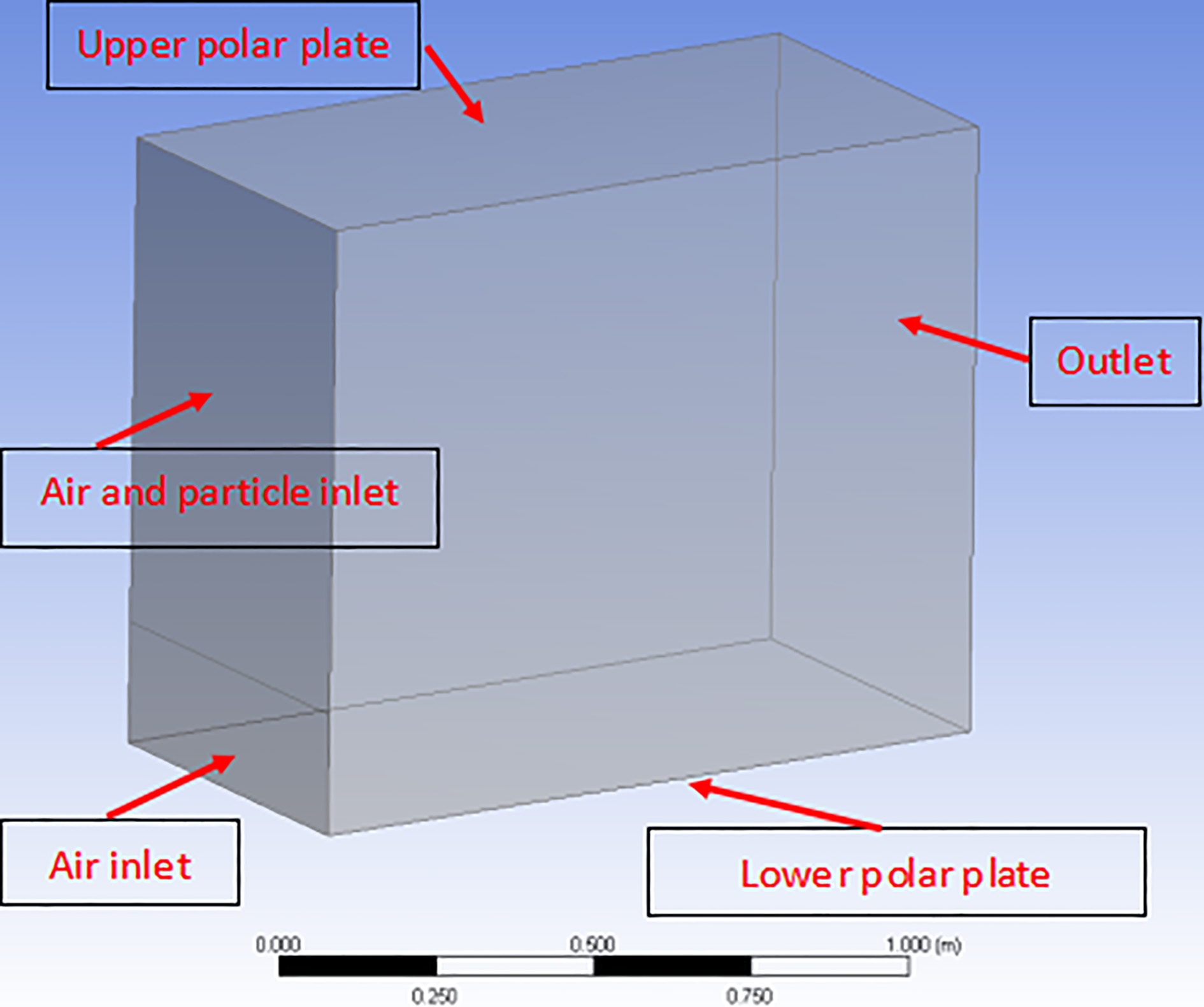
When electric field is not applied, the density of machine-harvested cotton particle is far more that of residual film. So, under the action of gravity, the flying range of cotton in horizontal projectile motion will be shorter, while that of residual film will be longer. In this work condition, the used separation method is to capture the machine-harvested cotton on lower polar plate and make the residual film to fly out of the separating device.
Work condition when electric field is applied
After electric field is applied, the adopted separation method is as follows: under the action of electric field force, the residual film is absorbed(captured) by upper polar plate, while the cotton fly out of the high voltage field region. The electric field force is defined by the macro of DEFINE_BODY_FORCE( ) in UDF.
Boundary condition processing and analysis process
This part contains two aspects. They are respectively boundary condition processing and analysis process.
Boundary condition processing
During the analysis of residual film electrostatic separation device, the processing of boundary condition is of great importance, because whether the processing is appropriate will directly influence the correctness of computation results. In this paper, the boundary conditions of numerical computation mainly includes inlet and outlet boundaries, DPM boundary and solid wall boundary, as shown in Fig. 2.
Boundary conditions under electric field.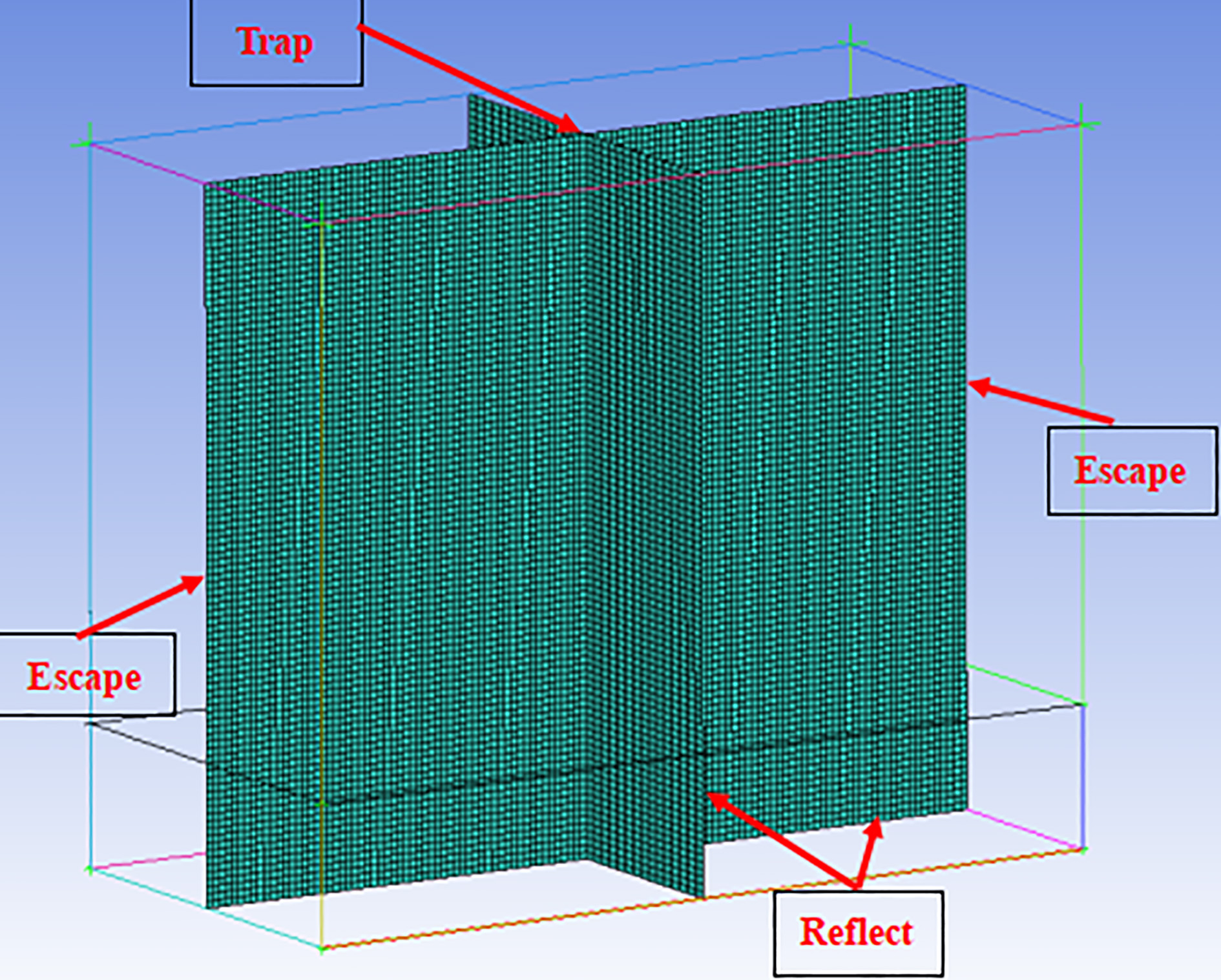
The inlet boundary adopts speed inlet. The air and particles enter the electric field at a certain speed, and takes the DPM boundary of particles at inlet surface as the escape, i.e. the particles can flow in.
The outlet boundary adopts pressure outlet, with outlet pressure as the atmospheric environment. The DPM boundary of particles is escape, through which particles can flow out.
The DPM boundaries of upper and lower polar plates. When electric field is not applied, the lower polar plate is the trap boundary, i.e. the particles would be captured at this boundary. The upper polar plate is the reflect boundary, i.e. the particles would be rebounded when touching the upper polar plate. But when electric field is applied, the DPM boundaries of upper and lower polar plates will be inverted, that’s, the upper polar plate will be trap boundary and the lower polar plate will be reflect boundary.
The left and right sides of the box are solid wall surface, with DPM boundary as reflect type.
Import grid and check its quality. Open the gravity option, set gravitational acceleration. Its magnitude is set as 9.8 m/s Choose standard K- Choose DPM model to describe the trajectory of particles. Set the material. The fluid adopts the air, and the particles uses machine-harvested cotton and residual film. Set particle parameters. In which, residual film is divided into four grades according to particle size, and parameters are provided respectively. Set boundary conditions. Initialize and solve it.
Simulation without electric field
Fluent was used to figure out air distribution and DPM particle trajectory, then the overall situation inside the box and all cross-section diagrams are as below.
Trajectory of particles in the box.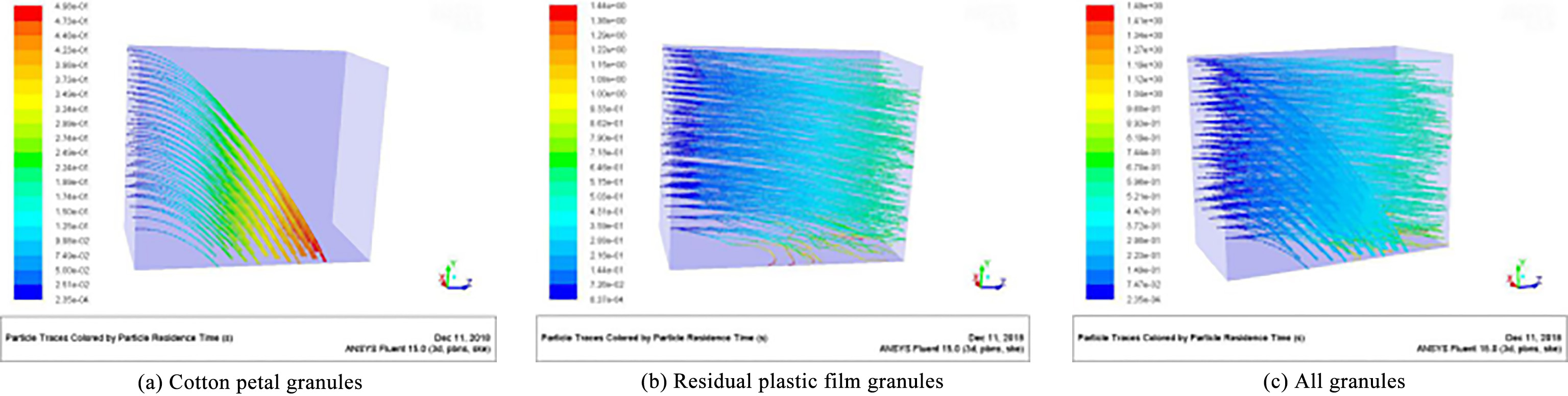
Streamline diagram in box.
It is known from Figs 3 and 4 that, within a certain range of speed, the fly trajectory of cotton petal is shorter, so all of them can be captured by the lower polar plate; while due to smaller density of residual film, they can fly a longer distance, and most of them can fly out of the box, while some may fall between the polar plates.
Through calculation, under no electric field, when the machine-harvested cotton material fly into the box at a speed of 1.5
The simulation results indicate that, the method without electric field could only separate machine-harvested cotton from residual film to a certain extent, and the separation effect is greatly influenced by flying-in speed.
Suppose the cotton petal is under electric field F1, residual film is under electric field F2, both of which directions are upward. When the machine-harvested cotton fly into electric field at the speed of 3 m/s, 4 m/s, 5 m/s and 6 m/s, only under a certain range of electric field force, the flying-in cotton petals can successfully fly out of the box. A specific simulation was carried out at the speed of 3 m/s and 5 m/s.
Simulation of work condition under the fly speed of 3 m/s
With different F1 and equal F2, the separation effect of machine-harvested cotton is as below.
When the machine-harvested cotton fly into electric field at a speed of 3 m/s, when 0.013 N
Particle separation effect under the action of electric field force with different F1 and equal F2.
With different F1 and equal F2, the pressure distribution on typical section of the box is as below:
Pressure distribution on typical section of box under the action of electric field force with different F1 and equal F2.
It is known from Figs 5 and 6 that, when the airflow speed equals at inlet, under different electric field forces, the pressure distribution of fluid in the box basically remain unchanged. This indicates that the movement of cotton petal particles and residual film particles under electric field has little impact on the fluid pressure field of the whole field, so it can be ignored.
With different F1 and equal F2, the streamline distribution on typical section in the box is as below.
Streamline distribution on typical section in box under the action of electric field force with different F1 and equal F2.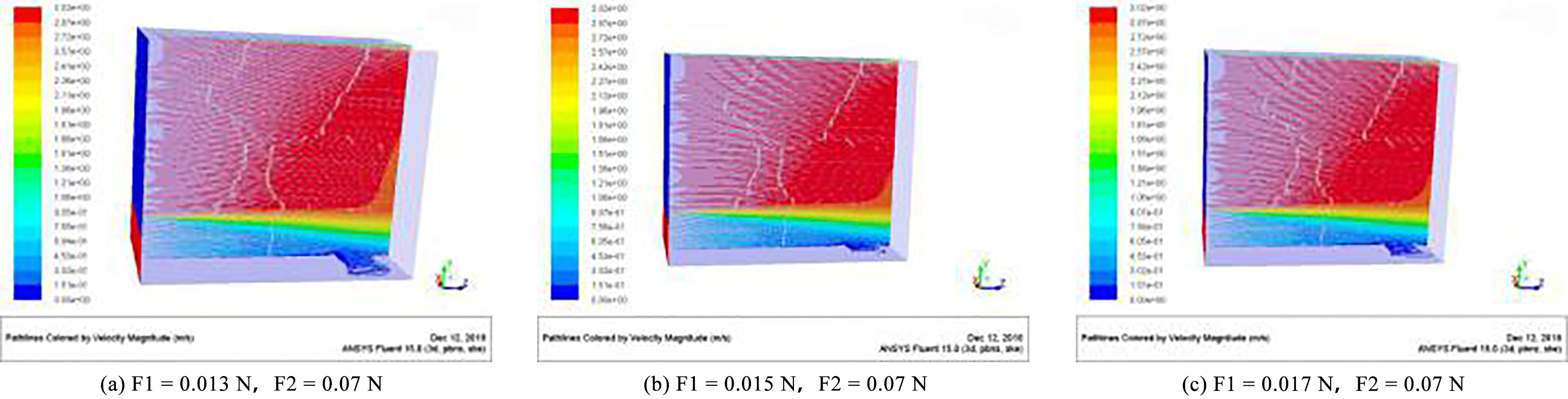
It is known from Fig. 7 that, when the air flow speed equals at inlet, under different electric field force condition, the streamline distribution of fluid in box is basically unchanged. This indicates that the movement of cotton petal particle and residual film particle in electric field has little impact on the fluid speed field, so it can be ignored.
When the machine-harvested cotton fly into electric field at the speed of 3 m/s, and the cotton petal bears an electric field force less than 0.013 N, due to the influence of gravity and aerodynamic force, the fly trajectory of cotton petal will be shorter, and cotton petal will be captured by lower polar plate; when the electric field force is larger than 0.017 N, the action of electric field force will be more prominent, making cotton petal particles to deflect up and be absorbed on upper polar plate. Therefore, only when cotton petal bear an electric field force between 0.013 N
With different F1 and equal F2, the separation effect of machine-harvested cotton is as below:
Particle separation effect under the action of electric field force with different F1 and equal F2.
It is known from Fig. 8 that, when the machine-harvested cotton fly into electric field at the speed of 5 m/s, and 0.006 N
With different F1 and equal F2, the pressure distribution on typical section of box is as below:
Pressure distribution on typical section of box under the action of electric field force with different F1 and equal F2.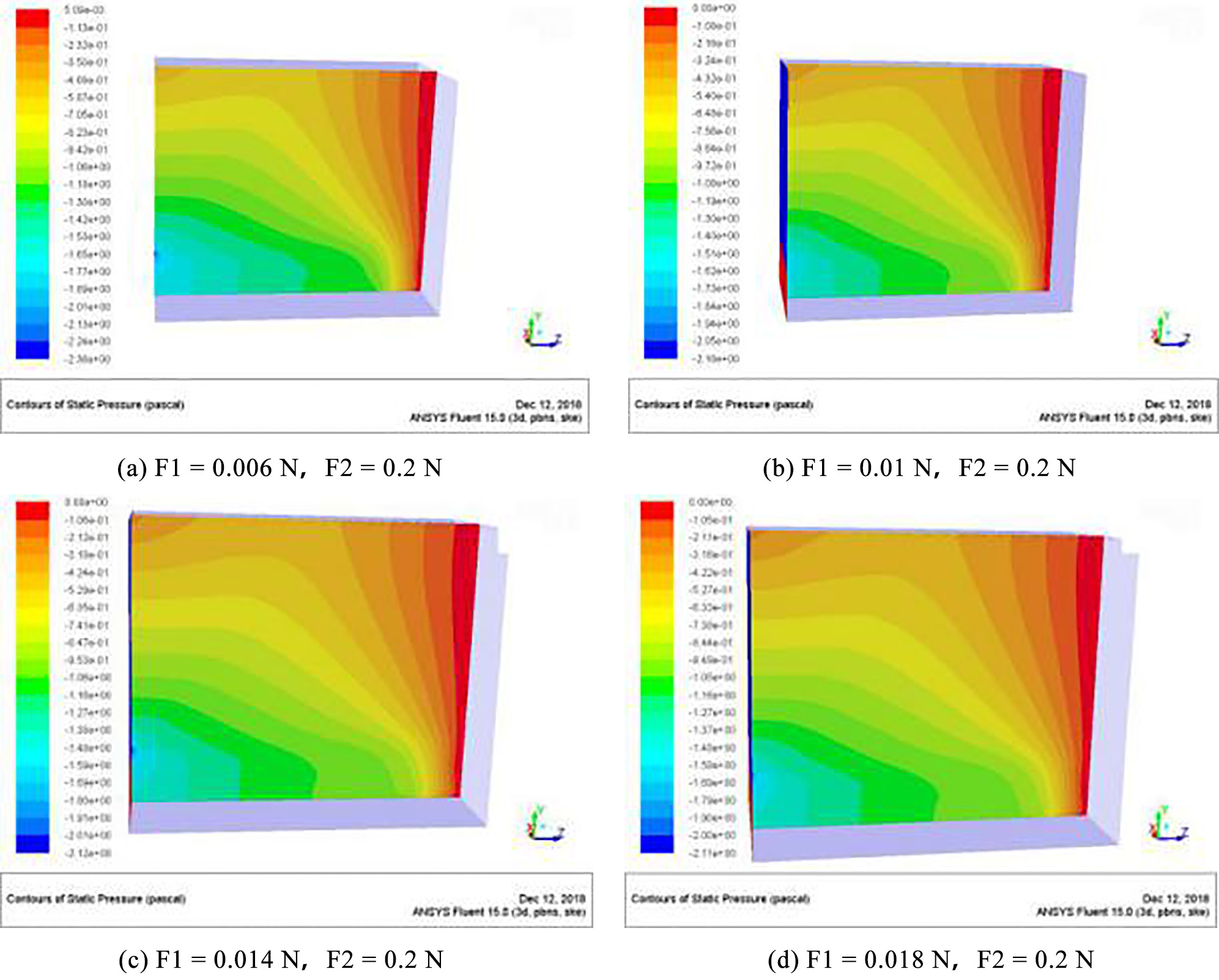
It is known from Fig. 9 that, when the air flow speed equals at inlet, under different electric field force condition, the pressure distribution of fluid in box will basically remain unchanged. This indicates that the movement of cotton petal particle and residual film particle in the electric field has little impact on the pressure field of fluid in the whole field, so it can be ignored.
With different F1 and equal F2, the streamline distribution on typical section of box is as below:
Simulation results under different working conditions
Streamline distribution on typical section in box under the action of electric field force with different F1 and equal F2.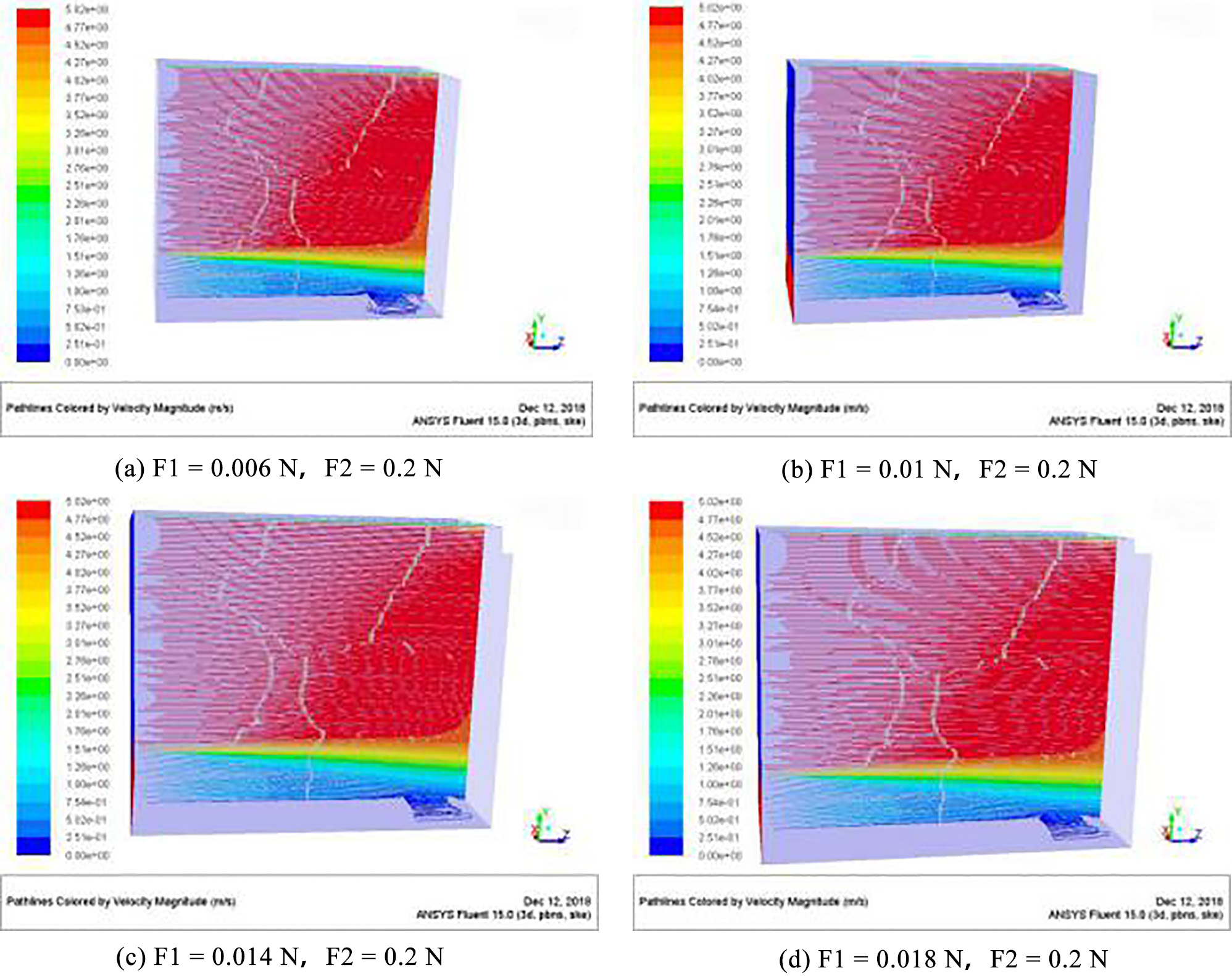
Graph of impurity removal rate and separation voltage.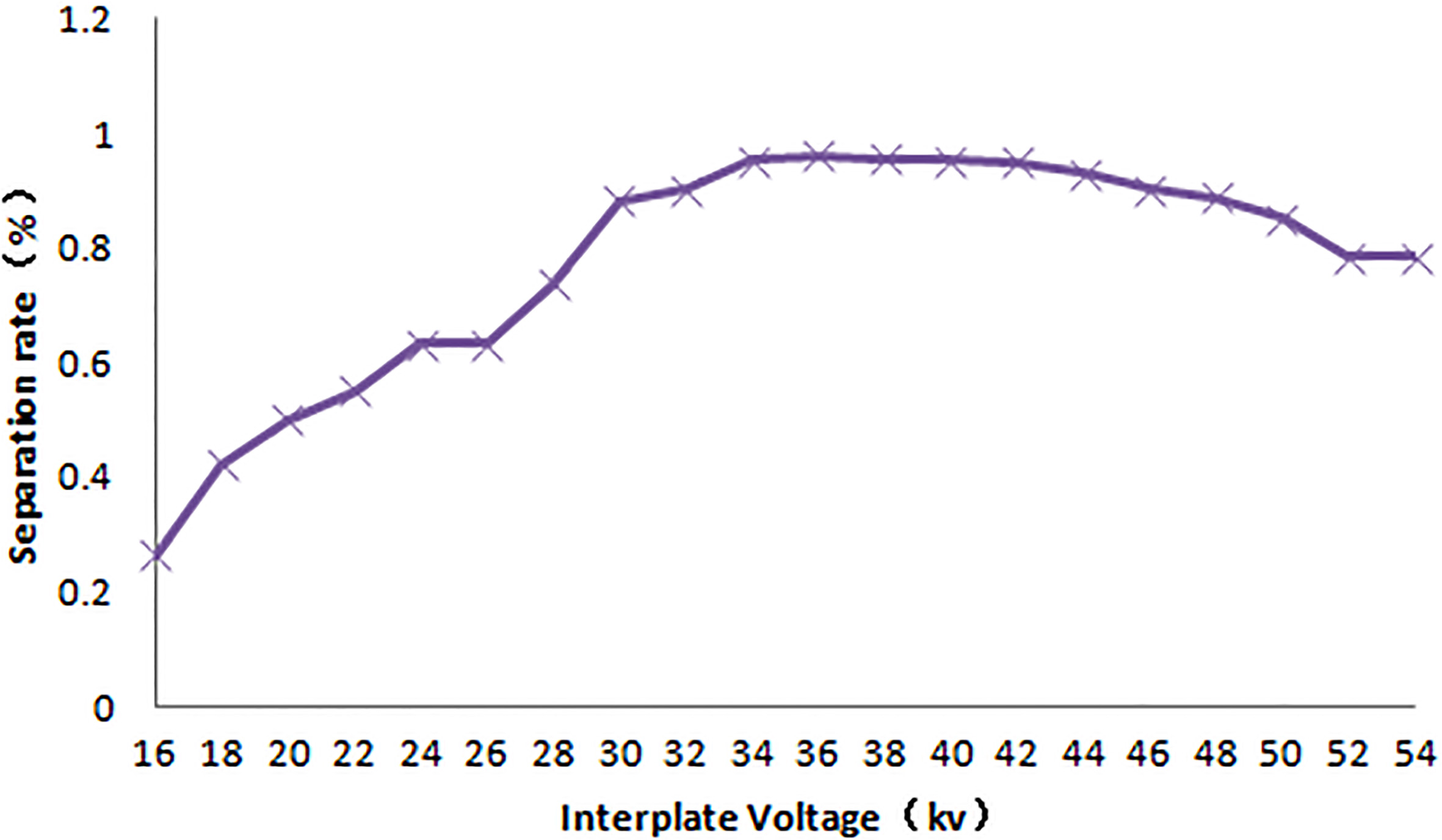
It is known from Fig. 10 that, when the air flow speed equals at inlet, under different electric field force condition, the streamline distribution of fluid in box is basically unchanged. This indicates that the movement of cotton petal particle and residual film particle in the electric field has little impact on the speed field of fluid, so it can be ignored.
When the machine-harvested cotton fly into the electric field at the speed of 5 m/s, and the cotton petal bears an electric field force less than 0.006 N, due to the influence of gravity and aerodynamic force, the fly trajectory of cotton petal will be shorter, and cotton petal will be captured by lower polar plate; when the electric field force is larger than 0.018 N, the action of electric field force will be more prominent, making cotton petal particles to deflect up and be absorbed on upper polar plate. Therefore, only when cotton petal bear an electric field force between 0.006 N
The method used at the fly speed of 4 m/s and 6 m/s is similar, and the simulation results of four fly speeds are shown in Table 1. In which, A is the upper polar plate region, B is the lower polar plate region, C is the region out of electric field; that the residual film fully falls in the electric field and cotton petal fully falls in the region out of electric field is considered as fully separation; that the residual film and cotton petal fall in the same region is considered as not separated; other conditions are considered as partial separation.
Without electric field force, when the machine-harvested cotton fly into the box at the speed between 1.5
With electric field force, when the machine-harvested cotton fly into electric field at the speed of 3 m/s, the condition that residual film can be separated from machine-harvested cotton is that cotton petal shall bear an electric field force between 0.013 N
In order to verify the simulation results of electrostatic separation movement of machine-harvested cotton and residual film, an experimental verification was conducted on the originally designed experimental platform by research group. The charging time of machine-harvested cotton is 25 s, the fly speed is 5 m/s, the graph of impurity removal rate and separation voltage is shown in Fig. 11. Figure 11 shows that, when the separation voltage changes between 34 kv and 42 kv, the impurity removal rate exceeds 95%. Through estimation, in such condition, the cotton petal bears an electric field force between 0.005 N
Conclusions
Machine-harvested cotton cleaning is an important step in cotton processing, as the mixed residual film seriously affects impurity cleaning effect. The paper used finite element method to analyze the movement behavior of residual film and cotton in electrostatic separation field, and the simulation results can provide reference for the optimization of machine-harvested cotton electrostatic cleaning system.
With the fixed electric field intensity and the fixed fly speed of machine-harvested cotton, the larger the difference between electric charge of cotton and residual film is, the easier it will be to realize separation.
With a fixed electric charge, the higher the fly speed of machine-harvested cotton is, the greater the electric field intensity will be required for separation.
The movement trajectory of particles in box has little impact on air flow, and the air flow speed at inlet is the major factor that can influence air flow distribution in box.
Footnotes
Acknowledgments
This work was support by National Natural Science Foundation of China (31760340); Southern Xinjiang key industrial science and technology support program of Xinjiang Production and Construction Corps (2018DB001); Special fund for basic scientific research operating expenses of Central Universities (2662017PY120); Tarim University-Huazhong Agricultural University joint fund program (TDHNLH201703); Autonomous region level modern agricultural engineering open topic program of Tarim University (TDNG20170101).