



Abstract
This work presents a model for the simulation of plasmatic transmembrane ionic transport that may be exposed to a static gradient magnetic field. The simulation was carried out using the Monte Carlo method to simulate the transmembrane cell transport of five types of ions and obtain observables such as membrane potential, ionic current, and osmotic pressure. To implement the Monte Carlo method, a Hamiltonian was used that includes the contributions of the energy due to the cellular electric field, the electrostatic interaction between the ions, the friction force generated by moving the ion in the center and the contribution given by subduing a cell to a magnetic field gradient. The input parameters to carry out a simulation are the intra and extracellular concentrations of each ionic species, the length of the extracellular medium, the number of Monte Carlo steps (MCS) and the value of the magnetic gradient. The model was validated contrasting it with Gillespie’s algorithm to obtain variations less than 3 % in terms of membrane potential. The Monte Carlo Method combined with the Metropolis algorithm were considered for recreating the stochastic behavior of ion movement.
Introduction
To understand the structure and functioning of living organisms, it is essential to know the structure and operation of cells. For this reason, since the end of the 18th century some experimenters raised the need to study transmembrane cell ionic transport [1, 2]. This study started with the identification of the structure of the cell wall [3] and subsequently it was found that a thin layer of oil exhibits a behavior similar to that of a semipermeable membrane and similar to the plasma membrane [4] which allows the construction of physical parameters of the plasma membrane based on the values determined for the oil layer. Additionally, it was established that any substance entering or leaving the cell must be at least soluble in oil [5]. In 1941 it was determined that the membrane is permeable to the ions of K
Regarding the theoretical studies of transmembrane cell ionic transport, analytical advances were proposed initially. One of these studies was conducted by Nernst-Planck (NP) and subsequently modified from the theories of Poisson and Boltzmann. Since the end of the 20th century, with another approach, studies have been carried out using stochastic methods [8] such as the Molecular Dynamics (MD) method with which the total time interval of simulation is a limitation [9]. To extend the simulation times, the Brownian Dynamics (BD) method has been applied, having a lower computational cost compared to the MD method. This improvement was achieved by modeling the process applying a spherical ionic system, an impermeable membrane system and a system of cylindrical pores [10]. On the other hand, Wonpil Im et al. [11] carried out an algorithm to simulate the movement of ions in membrane channels implementing boundary concentration conditions. Recently, Bo et al. [12] simulated the transport for the case of Ca
The focus of this work provides a framework to simulate ion permeability to the ions. Using the Monte Carlo (MC) method with the canonical ensemble, a system of biological channels of Na
The contribution of this work lies in the integration of various phenomena in transmembrane ionic transport of cells, including the influence of the magnetic field which has been poorly modeled despite the fact that several works are reported experimentally. The few models developed to understand the influence of the magnetic field on this phenomenon generally use deterministic methods, and very little literature is found with the Monte Carlo method. Furthermore, this study included simulation of the movement of the five ions with the highest concentration in the intra and extracellular regions, which is not frequent due to complexity.
For the above reasons, the objective of this work is to propose a model to simulate the process of transmembrane ionic transport and its relationship with variables of interest such as membrane potential, ionic current and osmotic pressure. It also aims to observe the effect on the biophysical parameters mentioned when they have been exposed to a magnetic gradient in the Direct Current (DC).
Model description
The model used attempted to include several contributions that force the ions to move through the cellular membrane. These contributions are included in the energy equation (Hamiltonian). Before starting with the description of the Hamiltonian in a more detailed way, the list of parameters used in this work and a brief description of them, including units, is presented in Table 1, These parameters will appear not only in the model, but also in the simulation process.
List of parameters included in the work, with their definitions and units
List of parameters included in the work, with their definitions and units
On the other hand, the Hamiltonian that expresses the energy of the system and from which the observables were derived, is shown in Eq. (1). This equation integrates several contributions that are present in transmembrane transport of ions. Four contributions of energy were included depending on the phenomena presented. The integration of these four contributions was developed in this work since, to the researchers’ knowledge, there are no works that contain all these terms including the influence of the external magnetic field. The first term refers to the contribution of the cell own electric field [17]; the second term is due to the electrostatic interaction between the ions [18]; the third term is the contribution due to the friction force that the ions undergo by movement [19]; and the last term is the contribution due to the interaction of the biological system with the energy of the magnetic gradient based on the work of Azanza et al. [20]. In this work, the authors made an experimental and theoretical comparison in neutral networks exposed to the magnetic field
In the equation,
in which
Once the model was built and all the contributions were considered, the required parameters were determined and identified and the simulation process was developed divided into three main parts: sample construction, ion movement and calculation of observables. To visualize the simulations, according to computational time and the Monte Carlo methodology, the following assumptions were considered
The cell was considered as an isolated part of the rest of the organism. The cell was considered to be spherical in shape, with a cross section of 5 Å. The channel was considered to have a cylindrical structure. Although in the real experiment several ions could be transported at the same time, only one ion could be moved at each time because of the essence of the model and Monte Carlo simulations.
All simulation processes are represented in Fig. 1, which contains a flow diagram. This figure shows stages such as sample construction, Hamiltonian construction, ion movement including the Monte Carlo Method and the Metropolis Algorithm, and finally, the observable calculation (resting potential unaffected and affected by the magnetic field, and osmotic pressure)
Flow diagram where all the stages of the simulation process are included.
Each stage of the simulation process is described below.
As mentioned above, the model used an isolated spherical cell with the nucleus inside. The extracellular radius (
The intracellular and extracellular medium were subdivided into square unit cells side of 5.0 Å. These spaces have limits that determine how far the model perceives the ions. The intracellular compartment has a fixed depth (
Structural detail of the modeled cell segment. Ions and channels of potassium (green), magnesium (pink), sodium (red), chloride (cyan) and calcium (dark blue).
Regarding the temporal parameter, the equivalence of an MCS at 10 ps was taken based on the DM studies [25].
Ionic transmembrane transport is a stochastic phenomenon. Like many natural phenomena, ion movement does not follow a deterministic behavior and a specific sequence. For this reason, the Monte Carlo method, combined with the Metropolis algorithm, which is based on the probability of occurrence of some event, is an adequate method to simulate this ionic movement. After deciding to use the Monte Carlo method, the ion movement was defined according to established biological conditions [26], that is to say, in a cell the ions were highly diluted in the extracellular and intracellular medium, the movement of the ions went from the site of higher concentration to lower concentration and, furthermore, the channels were active during the simulation . Concentrations in the intracellular and extracellular medium were calculated to estimate the value of the membrane potential for each MCS and, from this value, to calculate its contribution to the Hamiltonian and, ultimately, to determine the displacement for each ion generating a movement by concentration gradient. To determine the movement of ions in both media, the fact that only one ion can be located for each unit cell and the electrostatic interactions of the ion selected with the ions around it were considered (first, second, third, fourth up to the nth neighbor). Each attempt to move an ion equaled one MCS. The membrane potential and the concentration for each ion type were calculated by running each MCS:
A position The probability of movement was calculated based on the electrostatic interactions with the other ions to determine the new position The energy values were compared and, if If
and a random number ( The stop condition was defined by the scope of the amount of MCS established. This was an input parameter of the simulation.
The validation of the implemented model was based on the comparison of the model with Gillespie’s algorithm. This method was selected due to its constant use in chemical or biochemical systems and because it is additionally useful to simulate reactions within cells, as it is the most appropriate when this type of processes occurs in biological systems [28]. This algorithm consists in generating a statistically correct trajectory (possible solution) of a stochastic equation. The algorithms are framed by a density function that determines the probability of an event or reaction occurring.
As mentioned before, using the model and simulation process, it is possible to calculate observables as ionic concentration, resting potential without the effect of the magnetic field, which represents the potential difference that exists between the inside and the outside of the cell and generating the action potentials also known as electrical impulse, which are a wave of electrical discharge that travels along the cell membrane that modifies its distribution of electrical charge and other electrical signals by activating the flow of transmembrane ions [29]. This potential was determined from Eq. (4):
where:
On the other hand, resting potential with the effect of the magnetic field gradient was calculated using to the Eq. (5)
where
taking
Osmotic pressure is the difference between extra and intracellular pressure and was calculated as follows:
where
Membrane potential
Figure 3 shows the comparison of the membrane potential as a function of time using the Monte Carlo method and Gillespie’s algorithm. As can be observed, the same trend is maintained for both, which shows that the implemented model adapts to Gillespie’s algorithm and, furthermore, it can be seen that the variations barely reached a maximum value of 3%. The differences can be attributed to the way the Monte Carlo steps were calculated in Gillespie’s algorithm since, every time a Monte Carlo step was fulfilled, the difference between the steps was recalculated. The constant fluctuations of the membrane potential are due to the constant transmembrane movement of the ions. To define the moment in which the concentrations were going to change direction, a limit for the variation in the concentration was calculated to preserve the homeostatic equilibrium. The limit of the variations in the concentrations were defined randomly at the beginning of the simulations in order to resemble the stochastic behavior that occurs in nature. This type of behavior was previously reported by Ramírez et al. [32] who studied conical pores covered with amphoteric lysine groups.
Membrane potential as validation of the model proposed with Monte Carlo using Gillespie’s algorithm.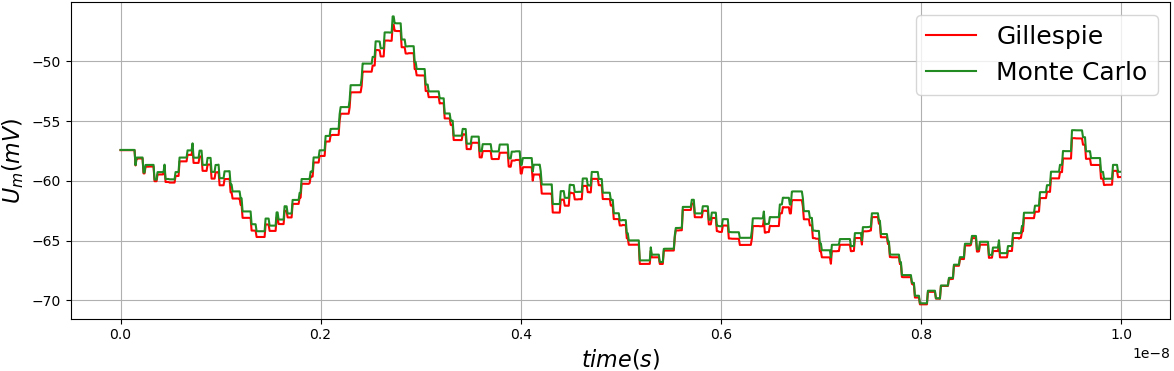
A model was obtained that allows simulating the transport of five types of ions through passive channels whose activation or inactivation status is independent on the intracellular voltage values. As proposed in the methodology, the model allows observing the behavior of the membrane potential (Fig. 3) and the ionic concentration (Fig. 4).
Figure 4 shows the behavior of ionic concentration for five species as a function of time. To carry out the simulations, the cell was considered to be initially in electrochemical equilibrium. The concentrations of Ca
Behavior of the intracellular concentration of each ionic species over time.
Osmotic pressure in function time.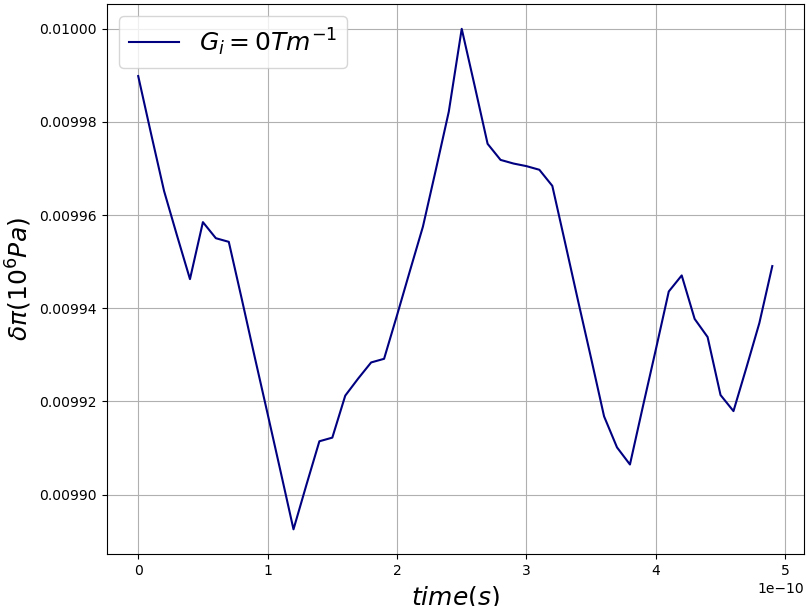
Figure 5 shows the osmotic pressure as a function of time. Fluctuations can be observed, that correspond to changes in the concentrations of the different ionic species. Biologically, these changes in the osmotic pressure generated changes in the membrane permeability as reported by Stange et al. [18]. Additionally, these variations accelerated the chemical processes related to the hydrolysis.
The addition of other geometric shapes is considered for the magnetic field generating source. Also, not just a section of the cross section of the cell, but the whole cell can be taken. In addition, a process that allows showing the trajectory that the particles follow in their movement must be considered which will allow glimpsing possible effects that the magnetic gradient has on the transmembrane ionic transport, which requires significant computational time and the implementation of an advanced algorithm.
Conclusions
The Monte Carlo Method combined with the Metropolis algorithm were considered to recreate the stochastic behavior of ionic movement showing that, using the Monte Carlo method, it is possible to model ionic transport due to its stochastic nature. Furthermore, the proposed model was validated with the evaluation of Gillespie’s algorithm. To develop the model of transmembrane ion transport, cellular dimensions (
Footnotes
Acknowledgments
The authors would like to thank La Facultad de Ciencias Exactas y Naturales at the Universidad Nacional de Colombia- Sede Manizales, for the economic support by means of the postgraduate students’ scholarship. Also, to the “Desarrollo de un sistema automático de tratamiento magnético de semillas asociado a un entorno integrado de simulaciones y optimización del diseño de experimentos” project developed by Universidad de Caldas and Universidad Nacional de Colombia- Sede Manizales.
Annex 1: Calculation of number of channels and number of ions
The average density of the channels was defined as proposed by Ferrero et al. [24]. The cell surface section area that was taken into account for the simulation is The number of ions of each species in the intracellular and extracellular medium was determined as follows:
where