



Abstract
This paper presents the model of integrated halal supply chain in food manufacturing industries. There is global increase in the demand for halal products by Islamic countries as well as by non-Islamic countries. Halal food consumers are presently more alert and concern about the integrity of Halal status. Furthermore, they also curious about all the activities involved along the supply chain whether the products that they purchased were truly halal from the beginning to the end. The need of halal supply chain is crucial in ensuring that the concept of halal is not only applicable for the food itself but also for the whole supply chain starting from the farm to the customer. This project attempts to develop an integrated halal supply chain system that can be used by food manufacturers that are developing halal products for better productivity and quality. The identified supply chain components are human resources, process, environment, accreditations, logistics and traceability.
Introduction
Food industry grows each year, in line with increases in world population. It is one of the largest manufacturing sectors in the world-wide economic system. One segment of the food industry, halal food is capturing the interest of the world’s population globally. Halal food is defined as a food allowed or permitted in accordance to Islamic law. Products certified as halal are products that comply with the religion aspect but include cleanliness, sanitation, and safety qualities which are important quality aspects of food.
The halal food segment contributes about 16% share of the whole global food industry [1]. It receives positive response not merely from the Muslims worldwide, but interestingly, some minority Muslims population countries are now attracted to the segment due to its high quality and safety standards in preparing the food. Due to this situation, there is an increase in the demand for halal products not only by Islamic countries but also by non-Islamic countries. Hence, as halal is applicable not just to the Muslim people, but also to the others, this causes the products to turn well recognized globally as well as emphasizes the demand for a halal supply chain. In view of that, a halal supply chain is vital in ensuring that the concept of halal is not entirely applicable to the food itself, but as well for the entire supply chain starting from the farm to the customer.
Halal food supply chain involved the operation of managing halal food products along the supply chain from the source of the supply to the customers. The operation must adhere to the halal concept stipulated under Islamic law. The halal products should not be mixed with other non-halal products during the supply chain process as to sustain the products’ halal status.
In halal food supply chain, the main goal is not just to ensure that satisfaction of the customer is achieved, but also to see to it that the halal status of the food product remains intact throughout the whole process of the supply chain. The integrity of the halal food product must be protected by all means and all necessary steps must be considered by all parties involved in the supply chain to avoid any cross contamination that will direct to product becoming non-halal, or haram. The food products must not only be halal at the supply chain starting point, but throughout the supply chain until it gets to its final destination.
Thus, it is important to make the right awareness and better understanding among the parties involved in the halal food supply chain on the importance of protecting the halal integrity of the food products. Failure to address this will contribute to dissatisfaction of the halal food consumers and unnecessary wastage of non-consumable halal food products. Furthermore, to cope with the rising demand of halal food from whole over the world, a comprehensive and well managed supply chain management approach need to be embraced to guarantee the accessibility of the halal food product.
Halal food sector is no longer only an industry that complies with religious requirements. It is becoming an economic force in its own right domestically and globally. The flow of halal food supply chain is critically vulnerable to hazards of food safety contamination and cross-contamination with non-halal materials or products. Halal needs a supply chain approach where the value chain and its supply chain activities totally align with the Shariah requirements.
Previously, consumers care only about halal foods, but today they are more aware and concern about the integrity of halal status and also curious about all the processes involved along the supply chain whether the products that they purchased were truly halal all the way. In order to ensure that the product is completely halal, it requires a specific procedure of handling, transporting, storing and manufacturing. Therefore, to ensure the halal status of a product, it should be considered from a total movement of the product rather than from a fragmented view.
Based on the article that have been reviewed [2, 3, 4, 5], there are limited numbers of academic publications discussing the area of halal food supply chain and halal integrity, despite an increase in academic publications in the knowledge area of the halal industry for the past few years. Until today, there is no unified halal standard exist in the market, thus providing room for unethical fabrication of halal logos taking place. Therefore there is potential for a halal food product traceability system to provide transparency of information surrounding food processing and allow customers to be able to track and trace the procedure involved in food preparation.
Thus, this research is concentrated to study food supply chain components and develop a conceptual integrated manufacturing halal supply chain system in order to enhance the integrity of halal food supply chain in the current complex food trade scenario.
Research details
The aim of this research work was to identify food supply chain components and to develop a conceptual integrated manufacturing halal food supply chain system model. This section is divided into three main part. First is the identification of halal supply chain field, next is the identification of halal supply chain standard and lastly the development of integrated model.
Identification of supply chain field
The first step to develop the model is by identifying the project field. There were various field that implement supply chain system such as food, cosmetics, transportation and medical. The focus in this study is on food supply chain in a food manufacturing company. Food supply chain is a bit complex compared to other supply chain because of their different attributes associated with ingredients and process of the product to produce a product with good quality.
There are three categories in food industries that have been considered in this study.
Manufacturer/producer. Contract manufacturing (original equipment manufacturer). Repacker.
In order to develop a halal supply chain model, a halal standard must be set up from the beginning. This standard prescribes practical guidelines on halal food manufacturing from the stage of obtaining the raw material followed by preparation, handling, screening, packaging, labelling, management, transportation, distribution, storage service including food components, processing aids and manufacturing process must according to Islamic law. Therefore, previous journal are referred to identify the standard.
JAKIM halal standard is chosen as the main standard and guidelines in this study. This is because it is highly recognized and recommended in international market. JAKIM’s halal logo is now among the most widely recognized and respected symbols of halal compliance in the world. Therefore, Manual Procedure for Malaysia Halal Certification (Third Revision) 2014 from JAKIM is used as one of the reference in this study [6].
Another two standards are Hazard Analysis Critical Control Point (HACCP) and Good Manufacturing Practice (GMP) are also referred in order to reinforce the framework. HACCP and GMP were known as Food Safety Assurance Program and have been recognized internationally as a tool towards the production of quality and safe food. In this case, HACCP and GMP Certification Scheme introduced by Ministry of Health Malaysia is referred so that the food production is safe and suitable for consumption along the food chain from incoming raw materials to the customer.
Development of integrated model
After project field and standard has been determined, the next step is to develop an integrated supply chain model. Besides from literature review, three model from previous research is used as references and guide to develop a new integrated model.
Model 1 [7].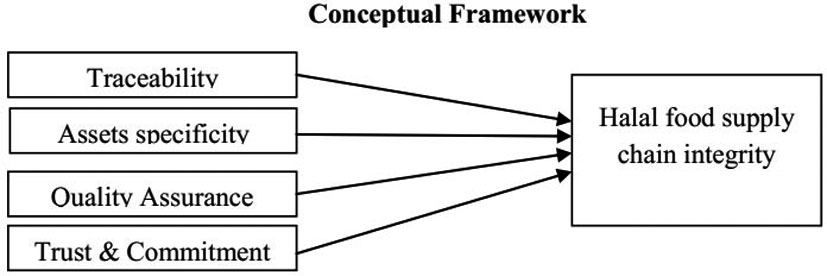
Model 2 [5].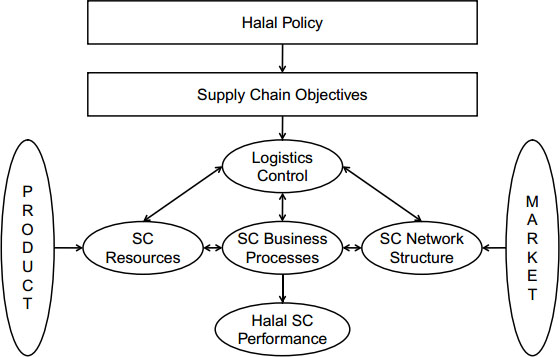
Model 3 [8].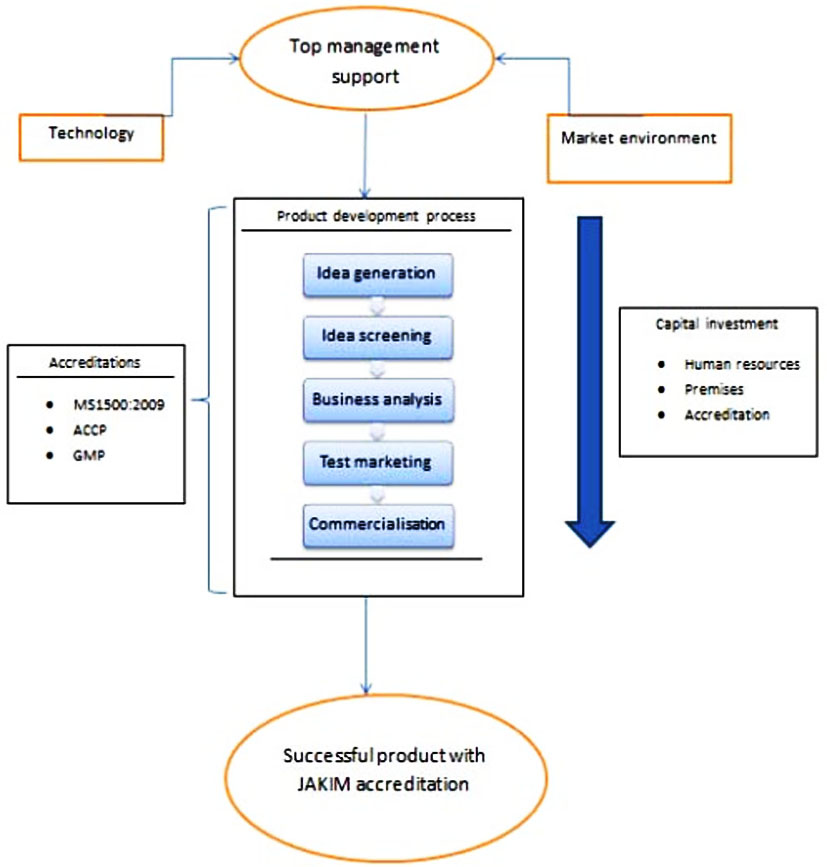
All of the three model is evaluated based on the six components. This method is to find the weakness and strength of each model and then adapted a new robust model that integrate all different functions of the supply chain.
This section is divided into three main part. First is the previous supply chain model evaluation, next is the integrated supply chain model and lastly the verification of integrated model.
Previous supply chain model evaluation
As being explained earlier, there are three model that are used as reference and adaptation to develop a new integrated model. The components of the model is evaluated as Table 1.
From Table 1, Model 1 by Mohd Hafiz Zulfakar featured three components of supply chain including accreditations, logistics and traceability. The author discussed about the benefits of having halal certificate on the product and point out that halal certification can be used as the new marketing tool to different one’s product from the other in the highly competitive market. Besides that, he also stated that it is necessary to have a dedicated infrastructure in logistics service to avoid unnecessary human mistakes and cross contamination. Moreover, this model asserts the importance of traceability to trace halal food products movement along the supply chain. This is to ensure that the halal integrity can be protected and lead to the successful implementation of halal food supply chain. However, the author did not include other three important components which are human resource, process and environment, as well as the importance of GMP and HACPP certification in the model. These factors also plays important role in achieving an effective halal supply chain model.
Supply chain model evaluation
Supply chain model evaluation
“X” denotes that consideration is included in the model.
Next is Model 2 proposed by Marco Tieman, there are five components being considered which are human resources, environment, accreditations, logistics and traceability. This model explain the responsibility of halal committee in protecting halal integrity along the supply chain, environment in logistics service, halal standard and implementation of HACCP, the flow of goods from the development process to the end customer in logistics, and tracking and tracing system in logistics. Most of the components discussed is focusing on logistics service only and not covering the entire supply chain. Halal standard is mentioned in the model but the author did not consider a Malaysian Halal standard and the implementation of Good Manufacturing Practice (GMP).
Lastly is Model 3 developed by Norizah Mohamad who considered most of the components excluding traceability. The model encourage the manufacturers to be halal oriented and investing in providing appropriate and trained personnel and establish a halal committee. Then, providing premises that will help to ensure the halal requirements can be adhered during the processing, handling, packing and distribution of the halal food product. Author also stated that by obtaining halal certification from JAKIM, manufacturers are getting the assurance that their ingredients and all the processes included are satisfy with HACCP and GMP standards. After all, there is inadequate discussion about warehousing and transportation in logistics service and one of the most important component which is traceabilty.
Based on the results from the table, the weakness and strength of each model can be identified clearly. Therefore, a further improvement is made by adapting these three model and considering all the components to design a new integrated halal supply chain framework in food industry. This model is more robust and reliable compared to the three model because it comprise all of the six components and subcomponents. A few factors is added into the component in order to enhance the model. The model is presented in Fig. 4.
Integrated halal supply chain system model.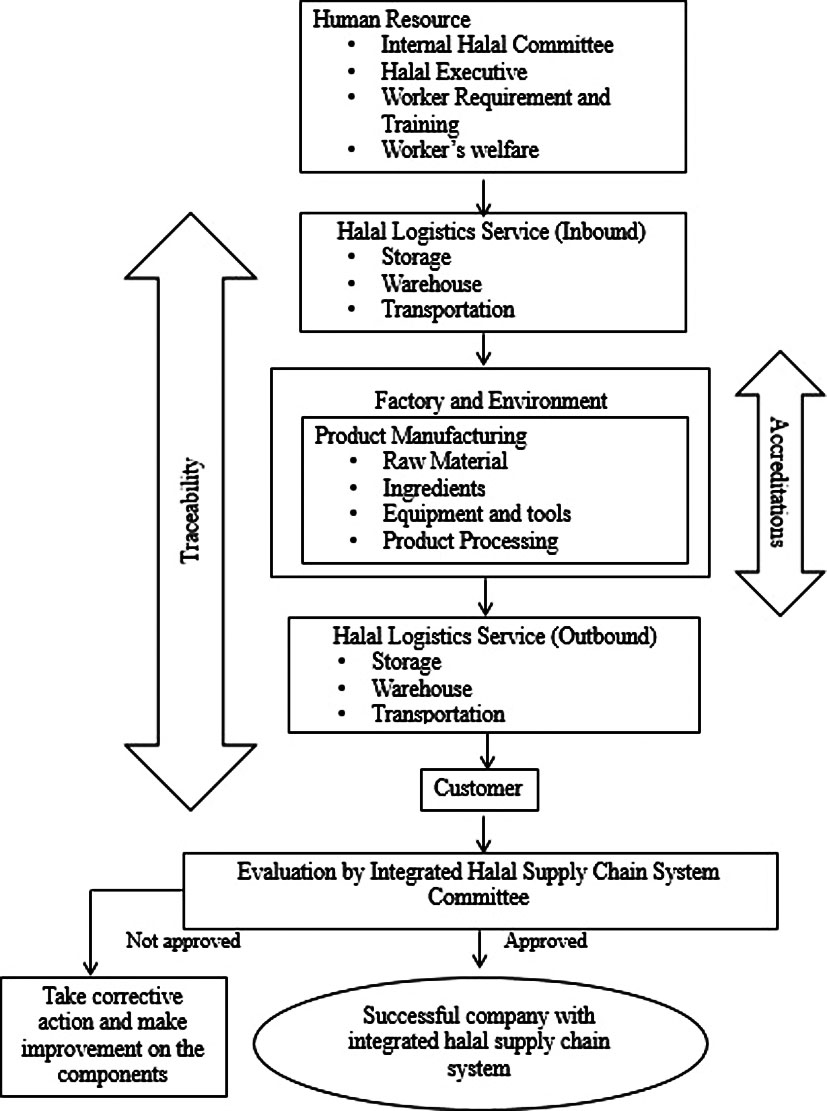
Figure 4 shows the conceptual model of halal integrated supply chain system. There are six main components that are critical towards obtaining an integrated halal supply chain system. Each of the component plays different role in contributing to a robust and credible conceptual model.
It is important for food manufacturing company to establish an internal halal committee within the organization. The committee member should be a Muslim from various disciplines to be responsible for all matters pertaining to halal compliance. The committee should have representatives from all stages of the production of products such as from selection of raw material, manufacturing up to delivery to ensure all processes adhere to the halal requirements for present and future products.
There is also need to appoint a halal executive within the organization. They responsible and serve as a halal coordinator for the company, maintain and keep a record to track the halal status of all the raw ingredients and food products certification, ensure all the raw materials and processing meets the standards of halal requirement, develop and implement Halal Assurance System and manual, manage training throughout companies in creating proper halal workforce and having a good liaison with JAKIM officers, relevant authorities and suppliers.
Next is the workers requirement, workers should practise code of ethics and Good Hygienic Practices (GHP) as stated in the Food Hygiene Regulations 2009 and other related regulations. All the workers should wear proper and suitable attire. With respect to the practice of cleanliness, the workers should wear proper attire when handling food. Specifically, workers are enforced to wear apron, hat cover, and gloves. The workers are expected to make sure that their finger nails are clean and short when handling food at the premise. The management should ensure that all workers attended halal related training. The training provides the workers with some understanding on the definition and basic concepts of halal certification, halal food preparation and other halal related issue as well as increase the halal awareness among the worker.
Besides of that, employers should take care of employees’ amenities and welfare. This includes providing suitable praying area for Muslim workers, giving permission to perform daily fardhu and Friday prayers, men and women changing room and also a pantry. The provision of adequate amenities and welfare is important both in terms of complying with the law, and keeping the workforce happy. People tend to perform better and be happier at their work if they are working in a safe and healthy environment. This could provide better life and health to the workers and relieve workers from industrial fatigue and to improve intellectual, cultural and material conditions of living of the workers.
Process
Starting from the raw materials, additives, preservatives, emulsifiers, enzymes and all other ingredients used in the product should be halal and safe. Raw material or ingredient which are sourced from animal for example gelatine should have a valid halal certificate. Sources of imported animal-based raw materials should come from approved plants by JAKIM and Department of Veterinary Services (DVS). In addition, raw material without halal certification need to be accompanied with complete specification which indicating material composition, flow chart and its raw material sources. Correspondingly, non halal raw material or ingredient is not allowed to be stored in the premise.
Besides that, processing stage is also one of the important factor in achieving a halal certified product. During preparation, handling, processing, packaging, storage or transfer of products, they should be in compliance to requirements by the Shariah law and remain clean as well as comply to Good Manufacturing Practices (GMP) of Good Hygienic Practices (GHP). There must be no mixing between raw materials or products with non-halal materials or sources or those with uncertain halal status. The transportation used should be for halal products only.
The equipment used in the production process should be free from najs, any hazardous materials and does not result in side effects to the products produced. The arrangement of the equipment and goods in the factory should be neat, tidy and safe during working operations in producing the product. The use of appliances and brushes from animal hair is prohibited. This is to avoid cross contamination as well as maintain the halal integrity of the product through the production process.
The subsequent process is packaging and labelling. Every packaging label should be printed prominently, clearly and indelible. The packaging label should contain information according to the rules, act and related standards, amongst which are name of product, Malaysia Halal Logo with the Malaysia Standard (MS) number and the file reference number (the last 10 digits), net content should be stated in metric measurement (SI unit), name and address of the manufacturer, importer and or distributor and its trade mark, list of ingredients, coding number to show the date and or production batch number and expiry date, and country of origin.
Environment
Environment is the third component which is important in developing an integrated halal supply chain. A proper management in factory or premises is a must to avoid contamination and maintain the cleanliness. The factory compound should be fenced or having a control mechanism to prevent pets or wild animals from entering or remain in the factory area. In addition, workers are not allowed to live in the factory compound. If it is necessary, living quarters for the workers should be in separate building, or if it is in the same building, there should be separate entrance to the processing area, no direct passage way from the workers’ living quarters to the processing area, and there is a mechanism for controlling the movement in and out of workers.
In order to avoid cross contamination between the halal product and non-halal substance, non-halal food or beverages are not allowed to be brought into the factory compound. The factory should have an effective control system from contamination of animal rearing centres, sewerage plant and premises that process non halal materials, and the most important part is liquor and materials sourced from liquor is strictly prohibited to be in the factory compound.
As for the environment, the environment shall be clean and its cleaning schedule shall be properly regulated and free from pollution. The equipment used must be clean and sanitary. Equipment, machine appliances and processing aids which have been used or in contact with najs mughallazah shall be religiously cleansed (sertu) and appliances or brushes from animal hair are not allowed. There should be a cleaning schedule to maintain the cleanliness in the factory compound and also the surroundings to prevent the possible biological hazard such as bacteria, fungi and viruses. The schedule should be prepared and properly monitored.
Accreditations
There are a few ways that the owner of food premises can adopt to ensure the production and provision of halal and quality food. One of the ways is to seek for accreditation from different agencies responsible for food preparation services, such as the Malaysian Halal Certification, Good Manufacturing Practices (GMP), Hazard Analysis and Critical Control Points (HACCP). In this regard, Halal Certification Malaysia has gained acknowledgement among food manufacturers in Malaysia. One of the possible reasons, is that food products that display the halal certification and halal logo has a competitive advantage over other products since they have become the choice of preference among customers. Other than the halal products being processed in accordance with the principles of Islam, halal certification also indicates the production of quality product since the product has undergone specific process to avoid cross contamination and errors during processing. Companies that are involved in food production need to use product development agenda capped with halal accreditations as a competitive weapon and for some companies it is necessary for their survival.
Logistics service
Halal supply chain implies that the wholesome of halal products covers cleanliness, safety and quality in the whole supply chain, from farm to fork. There is a gap in the research and lack in literature survey about logistics service. The major limitation of the review is it is only focused to identify the process, information flows and actors involved in the halal certification process. Therefore, the adoption of a halal logistics service is unexceptional since it is the final stage in halal supply chain flow.
Halal logistics is the process of dealing with the procurement, movement, storage and handling of materials, parts livestock and semi-finished inventory both food and non-food through the organization and the supply chain in compliance with the general principles of Shariah Law. There are three principles of halal logistics which are halal products are segregated from non-halal products to avoid cross contamination, to avoid making mistakes and to ensure consistency with Shariah and the expectation of the muslim consumer.
Majority of the halal manufacturers are unconscious of halal logistics services and they did not see the advantages of adopting the services. Most of their customers is not looking for halal transportation and halal warehousing, even they are halal manufacturers. Since they are already halal certified by JAKIM, they trust that they are not required those halal logistics services at the mean time. The majority of them only adopts halal transportation and halal warehouse services after being informed by the providers that they have halal services and explain to halal manufacturers the advantages of the adoption of halal logistics services for their products.
The utilization of transportation to carry or bring halal food must not be contaminated and must not be mixed with non-halal food in order to avoid contamination. Same idea connected to storage or warehousing which is used to keep the inventories during the logistics process. During the process of logistics, the segregation of halal and non-halal foods must be isolated. If the food is kept in a cold room, the non halal food must be kept in a different cold room. Regardless of the possibility that the temperature of the cold room is being maintained and will not contaminate each other, the non-halal food must should at present not be kept together in the same place. Consequently, in this case, proper segregation which includes the handling, packaging, transporting and storing of the food product must be properly segregated between halal and non halal food so as to guarantee halal food is supplied to the consumer.
As to complete the integrated model, the halal supply chain will start from the raw material, and production process in the factory, to transporting and storing of the food products before they reach the customers. This is to ensure that halal is not only applied for products or food but also for all the activities in the supply chain which include the handling and managing of the products which incorporates of inventory management and material handling.
Traceability
Traceability can be used to trace the halal status of a particular food product at every stage of the supply chain. It includes all the information regarding the activities that the halal food products have went through including activities involved before the production of that particular food product such as origin of the ingredients. Halal critical control points can be completely monitored and detailed information can be easily retrieved if the product is suspected to be cross contaminated with non halal elements. Further action can be taken to correct the incident by eliminating the root of the contamination and doing sanitation and samak at the affected area. Preventive action can be planned to avoid the occurrence of the incident in the future. Existing innovation such as Radio Frequency Identification Device (RFID), barcode and Internet can be utilized and controlled to build up a reliable tool for halal traceability.
This can reduce the cost of product removal from the market. Food manufacturers can implement product recall management that can effectively ensure the safety and halal status of food products in their own approaches. Preventing the occurrence of product recalls, especially in terms of halal assurance, will lead to the level of customer trust and confidence in the integrity of halal industry. This in turn will build the positive advancement of the halal food manufacturing industry.
Integrated halal supply chain system committee
This committee is proposed to evaluate all the components of supply chain that has been implemented by the company. Integrated halal supply chain committee member should be a Muslim professionals from various area such as human resources, manufacturing process, environment, accreditations, logistics and traceability technology. The member will be responsible in evaluating each of the supply chain component whether it is pertaining to halal compliance or not. If the company is successfully implementing all the supply chain components according to requirements, the company will be given a certification stated that the company is having an integrated halal supply chain system. By getting an approval from this committee, it will increase the halal reliability of the company and minimize down the risk of cross contamination. The company will gain more trust and confidence from the customers. Furthermore, this will differentiate the company from other company that their product is not only halal, but also safe, hygienic and shariah compliance.
Verification of integrated model
The final step is to verify the completed halal integrated supply chain system so that the developed system is credible and accurate. This step is to ensure that the conceptual model can be correctly implemented into the actual manufacturing industry for future use. A few food manufacturing company in Malaysia are chosen as a subject to verify the conceptual model. A simple interview with the company’s employee from various positions has been done to compare the elements of their halal with the conceptual model.
Six food company’s employees are agreed to be interviewed, they are ranged from various positions such as production line leader, quality assurance and quality control executive, research and development executive, quality control process technology executive and production executive. Table 2 shows the summary of result from the interview.
Summary of interview with employee in food manufacturing company
Summary of interview with employee in food manufacturing company
Based on the interview, there were six dimensions of question that have been asked. The dimensions are the six components of the conceptual model which are human resource, process, environment, accreditations, logistics and traceability.
First dimension of the question is the human resources, all the company have their specific halal department or halal team. The roles of the department or team includes, ensuring all section comply with halal requirements and needs, fulfil all requirements in halal certification, applying for the certification online, ensure the processes and ingredients used abide to halal certification, conduct training regarding halal and cleanliness for the worker, and ensure compliance of halal system according to standard.
For the process dimension, all the six company used raw materials and ingredients from halal source and the process and equipment involve in producing the products are in compliance to requirements by the Shariah law and remain clean as well as comply to Good Manufacturing Practices (GMP). Their packaging also from halal material and is made according to the standard stated by JAKIM. This shows that their production process is fully satisfies JAKIM requirement.
As for the environment of the company, all of the company make sure to monitor the cleanliness of the factory and surroundings by having a cleaning schedule. Five out of six company paid attention for the possible contamination that can occur by preventing the worker from bringing non halal food or material from the outside. Only one company stated that their company did not have rule to prohibit non halal food or material into the factory compound. The workers of each company also live in their own residence or provided hostel and prohibited to live inside the factory compound.
Before getting the halal certification, four companies already obtained GMP and HACCP accreditation from Ministry of Health and two of them have an accreditation from ISO. Only two of the company did not have GMP and HACCP accreditations but they do have accreditation from ISO and GHP. However, the two companies is a halal certified company. They admit that by having these accreditations make it easier from them to get the Malaysia halal certification. Other than that, this enhance their customer’s confidence and made their product being recognized in the market. Having these certification also made them being competitive in international market.
Next, is the logistics services which is neglected by many halal food manufacturer. From the interview, all the company is aware about using the halal logistic service in transporting their product. They also aware about the cross contamination with non halal product during storage and warehousing. Therefore, they already adopted a halal logistics service in transporting the products domestically and internationally. The marketability of the certified product will be improved as well as the increase the recognition and confidence among the international Muslim customers.
Lastly is the traceability, four companies are already implementing traceability system into their company, one company is still in the process and another one company is not implementing traceability. The implementation of the system will cost the company in term of information technology, software, hardware, and experts. Traceability will help the company to trace and track the movement of their products along the supply chain in Malaysia or even internationally. Potential hazard can be eliminated and corrective action can be done effectively if any accidents occur.
From the interview, it shows that all the companies successfully implementing almost all the six components of the integrated model in their company to obtain and maintain the halal certification. Some of the aspects cannot be implemented due to some constraints such as budget, manpower and time. However, if all of these components can be totally implemented in the company, it will gives a positive influence to the company. It is guaranteed that the company will become a successful vanguard in food industry and continue to grow domestically and globally.
Halal industry has grown rapidly even in this country or international. However, there are still lack in progression in halal supply chain system. Halal supply chain is a novel approach to handle the halal food products. This is because of the demand from the customers and the halal industry itself as well as aligning the system with the Shariah requirements. This study has taken a broad look at the components of integrated halal supply chain model and has identified six significant components in completing the integrated model. The components are human resource, process, environment, accreditations, logistics and traceability. All of these components must be given serious attention in order to ensure a halalan thoyyiban food products which covers from farm to fork.
A conceptual integrated halal supply chain system model has been developed. It is found that it is necessary for an organization to establish the internal halal committee and appoint a halal executive to ensure all processes adhere to the halal requirements for present and future products. All the workers should fulfill certain requirements and trainings in order to directly involve with the halal food production. Welfare of the workers should be taken care by employers. All production process starting from raw materials, ingredients, tools and equipment used should be halal and not contaminated with non halal elements.
Other than that, cleanliness of factory and environment is also important in maintaining the halal integrity of the products. JAKIM, HACCP and GMP accreditations play important role in gaining customer confidence and marketing tool to promote the product internationally. Adapting logistics service into the supply chain will give many advantages to the company as well as protecting the halalness of the product until it reach the customer. Lastly, traceability can help in reducing product removal cost by monitoring the flow of the products along the supply chain.
It is hope that this conceptual framework will be beneficial to other food manufacturer to use this as their guidelines in producing a halalan thoyyiban food and to other researcher in their studies regarding halal industry and halal food supply chain.
Footnotes
Acknowledgments
This work was supported by Department of Mechanical and Manufacturing Engineering, Faculty of Engineering, Universiti Putra Malaysia.