



Abstract
In middle and low voltage distribution networks, single-phase grounding fault is most like to occur, so the mathematical model to accurately reflect the characteristics of grounding arc is the basis of network fault analysis. Based on arc-gap balance theory, this paper analyzes the characteristics of the classic Mayr model and Cassie model, establishes an arc model with reasonable combination of Mayr and Cassie, and further studies the influence of arc length parameters on arc characteristics, and reflects the physical characteristics of the grounding arc. Finally, the arc model is simulated in a 10 kV distribution network in the fault form of intermittent arc grounding. By comparing the results with the actual situation, the correctness of the arc model is verified, which lays a good foundation for the following fault analysis of distribution network.
Introduction
With the continuous upgrading and transformation of the distribution network, the grounding fault of traditional indirectly grounding system becomes much more serious because of the increase of the fault current of the system [1, 2, 3, 4, 5]. Therefore, to obtain the electrical characteristics under the single-phase grounding fault require accurate and reasonable researches on the grounding arc, so the establishment of an accurate and blameless arc model is the beginning of the grounding fault analysis of the distribution network.
In the early research, the grounding arc is equivalent to the ground arc part as the metal grounding or by a fixed value resistor grounded by the ordinary switch, which can’t accurately reflect the power system transient fault characteristics of the arc grounding. In fact, the arc formed by fault point is a time-varying nonlinear resistor, which changes with various factors inside and outside the arc. Paper [6] the use of control switch and fixed value of small resistance to simply simulate intermittent grounding arc, which makes the arc current-voltage characteristics not perfectly correct; Paper [7] the Mayr and Cassie arc model simply combined, can be used to select lines easily for multi-class arc faults, so there is some space to improve; The variable arc resistance model proposed in the Paper [8] is similar to the Paper [7], has verified the advantages of the neutral-point ground mode; Paper [9] proposes a comprehensive dynamic arc model with comparison of varied arc models, but the formula and digital simulation is complex; The arc model proposed in the Paper [10] tends to the single-phase arc grounding of urban cable transmission network. Paper [11, 12] build and make improvement in a new arc model, which uses the arc voltage constant and the time constant as the main constants. This work is on the basis of the previous article, according to the principle of Arc Gap Energy balance.
On the basis of the above-mentioned existing arc model, this paper analyses the characteristics and deficiencies of the traditional Cassie model and the Mayr model, to which using ATP-EMTP to carry on the simulation analysis, with taking the traditional neutral point non-effective grounding mode as the background. On the basis of paper [13], the two arc models are combined organically according to their own characteristics, and the parameter setting and theoretical derivation are optimized and improved. For this reason, a comprehensive arc model with the combination of the Mayr-Cassie is proposed, and the arc model is applied to the distribution network of integrated transmission lines. It verifies its rationality, and lays an essential foundation for the following fault analysis of distribution network.
Grounding arc model
The Arc Gap Energy balance theory regards the arc as a medium channel of the sort of cylinders, and its conductivity changes with energy. The equation relation is deduced, and the mathematical model equation of arc can be obtained:
Where
By The Mayr theory believes that when the arc input power is greater than the output, i.e., the arc conductivity to the time derivative is positive, tends to increase. The thermal inertia of the arc will cause the arc conductivity increasing more slowly, at this time the arc dissipation power is treated as a constant. The Mayr Arc Model can be expressed as:
Where,
The Cassie model holds that the arc energy is proportional to the size of cross section of the arc, and the energy dispersion is also proportional to the size of cross section. This model applies the situations when the current is large, the current is expressed by voltage and conductivity, and the arc model associated with the voltage can be expressed as:
Where,
Through the above analysis, the Mayr Arc Model conforms to the situation when the arc conductivity is relatively small and the arc current is smaller. While the Cassie Arc Model simulates the situation where the arc is completely combusted and the arc current is stable. As shown in Fig. 1, the equation is expressed as:
The arc model diagram.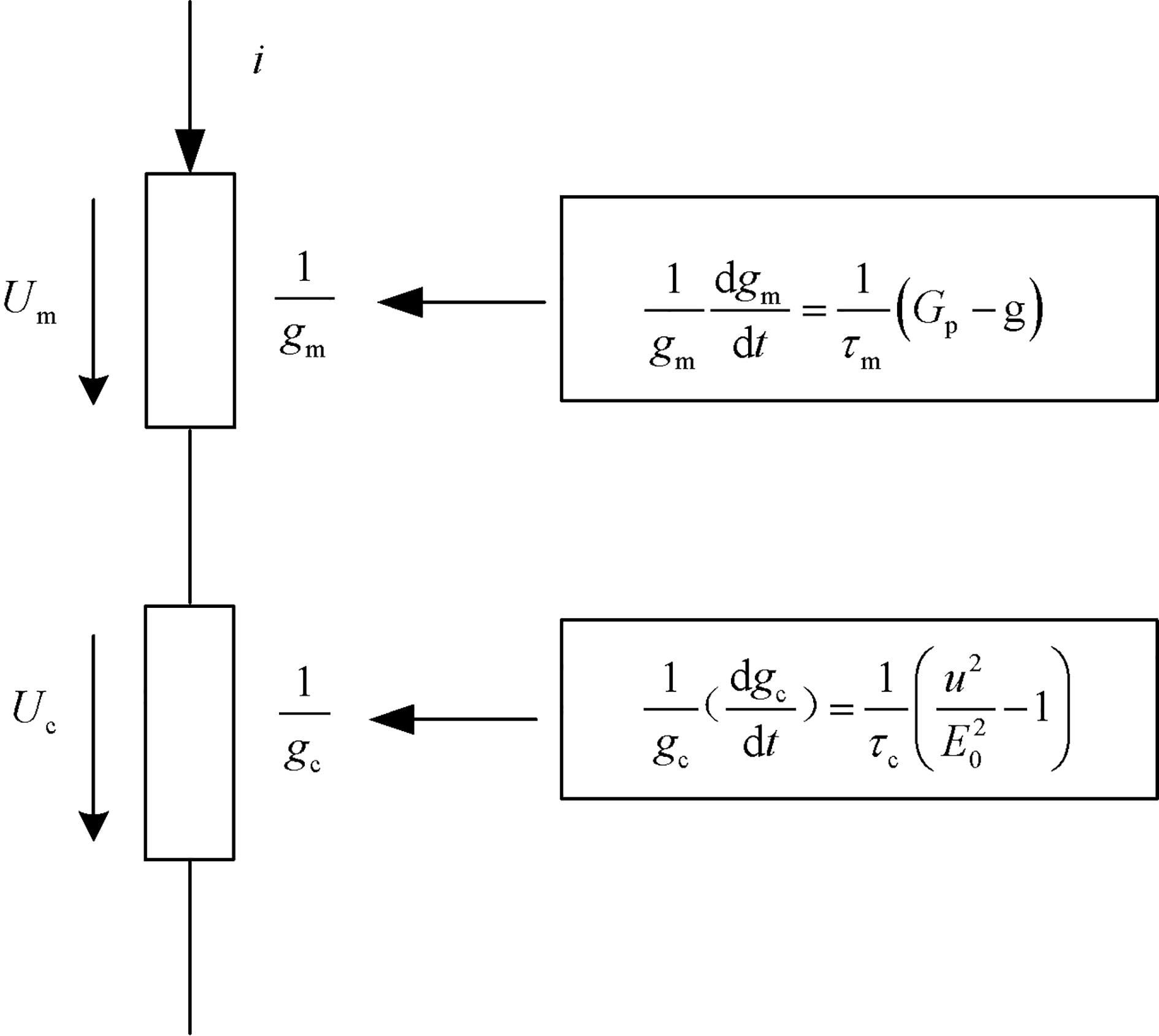
In this paper, the influence of arc length factor on arc time constant and primary arc steady conductivity constant is considered, to define the main parameters of the equation. For the arc time constant
Where
The arc conductivity of arc combustion
Where,
The arc simulation model is constructed by the TACs module in the simulation software, ATP-EMTP, and the nonlinear time-varying arc equivalent resistance is simulated by the controllable resistor module, and the mathematical characteristics are reflected by the calculation module, which can easily modify the key parameters and intuitively reflect the electrical characteristics of the arc. After defining the arc length, because of the arc voltage drop is a fixed value, the absolute value of the current of the arc access point is introduced, that is, the absolute value of the fault point current, which can define
Mayr-cassie simulated arc model diagram.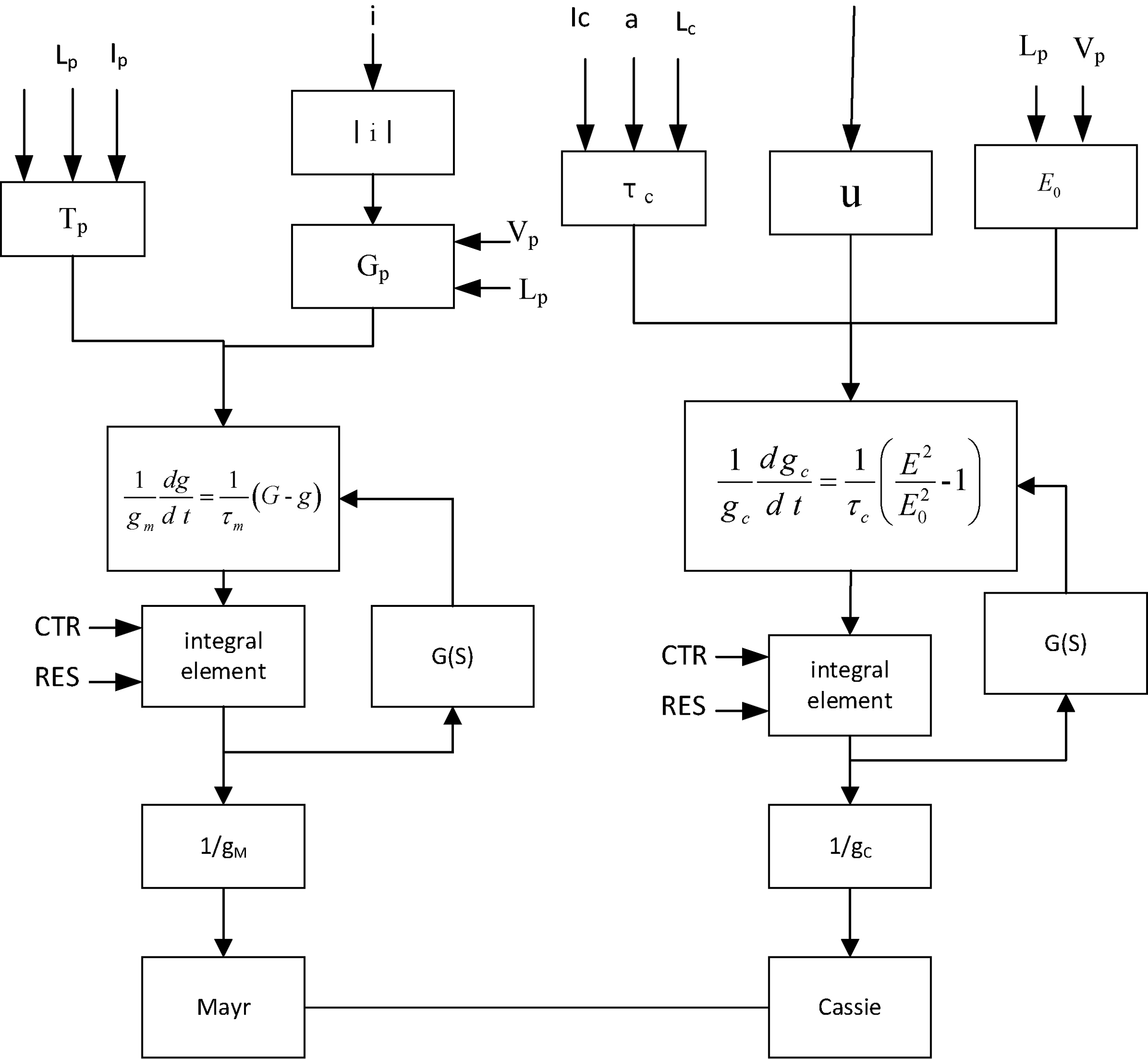
The arc model computes concept.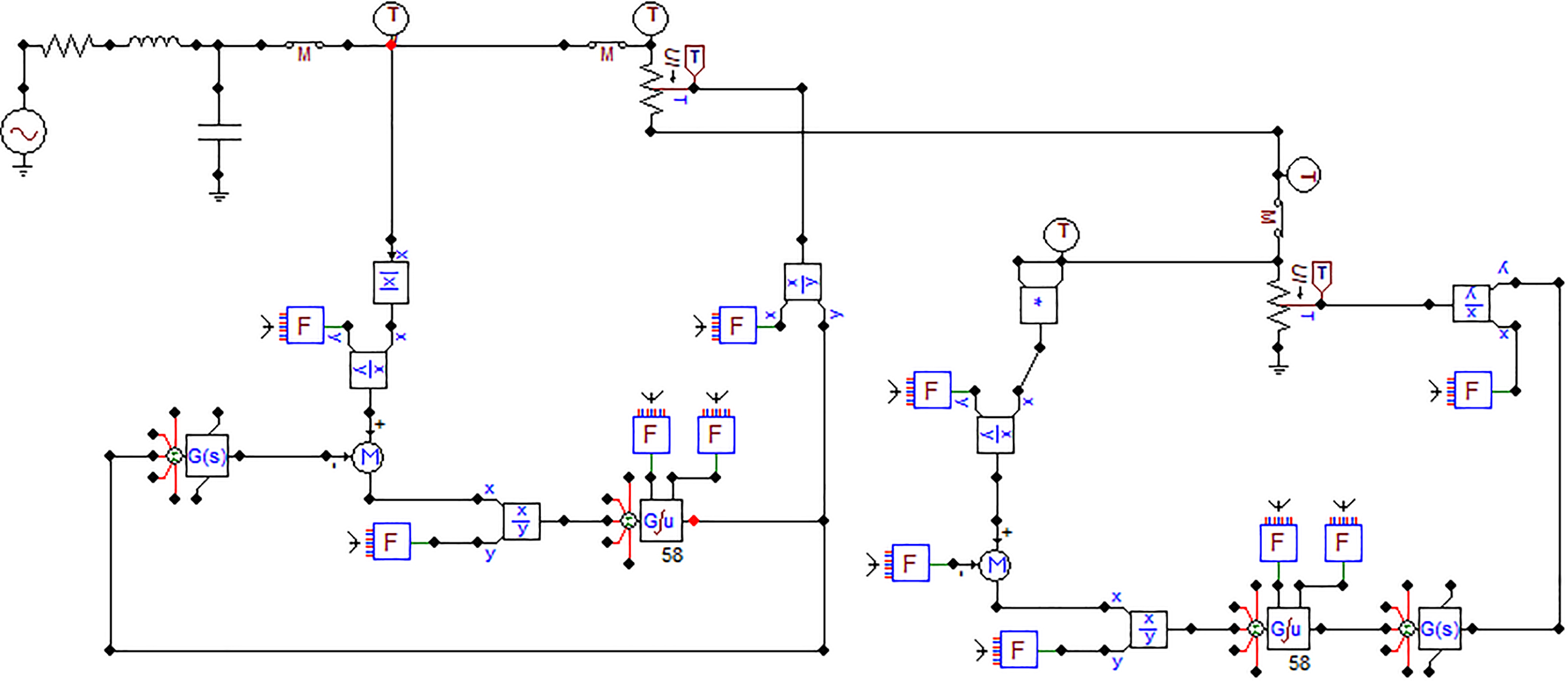
Three arc models simulate voltage waveform.
Arc simulation results under different arc length parameters
Three arc models simulate current waveform.
A circuit model for verifying the arc characteristics is established in ATP-EMTP, as shown in Fig. 3. Experimental circuit parameters: power supply voltage
As can be observed from the comparison of the voltage waveforms in Fig. 4, the arc voltage distortion is serious and it can be simply regarded as a square wave. Before the current zero point, the arc once again arc and the voltage continues to decrease with a clear spike phenomenon, which is also called “saddle” characteristics. The reduction is accompanied by the increase of the arc constant, and this situation causes a more obvious spike phenomenon.
As can be observed from the comparison of the voltage waveforms in Fig. 5, the arc current is approximately a sine wave. But before and after the natural zero crossing of the current, the current change speed drops intensely, showing a close to zero trend. This situation behaves obvious as the arc length parameter increases. When the arc length is 150 cm, obvious “zero rest” time will appear in the current simulation waveforms of the integrated arc model. When the arc length is less than 130 cm, the “zero rest” time is not particularly obvious. At this time, the arc current changes with another law. And the current is limited by the arc resistance to a small value close to zero. It can be seen from Fig. 6. The arc resistance is time-varying, and it will be shown a significant periodic peak protrusion because the value of the arc resistance is higher at the “zero rest” time.
According to the simulation analysis, with the increasing of the arc length, the arc steady conductivity decreases; corresponding arc voltage increases; the “zero rest” phenomenon of the arc becomes stronger, and the average resistance of the arc also increases. In the meantime, the arc dissipation power increases with the increasing of the arc length, so that the arc is easier to be extinguished when it crosses zero. The arc simulations of different arc length parameter are shown in the Table 1.
Three arc models simulate resistance waveform.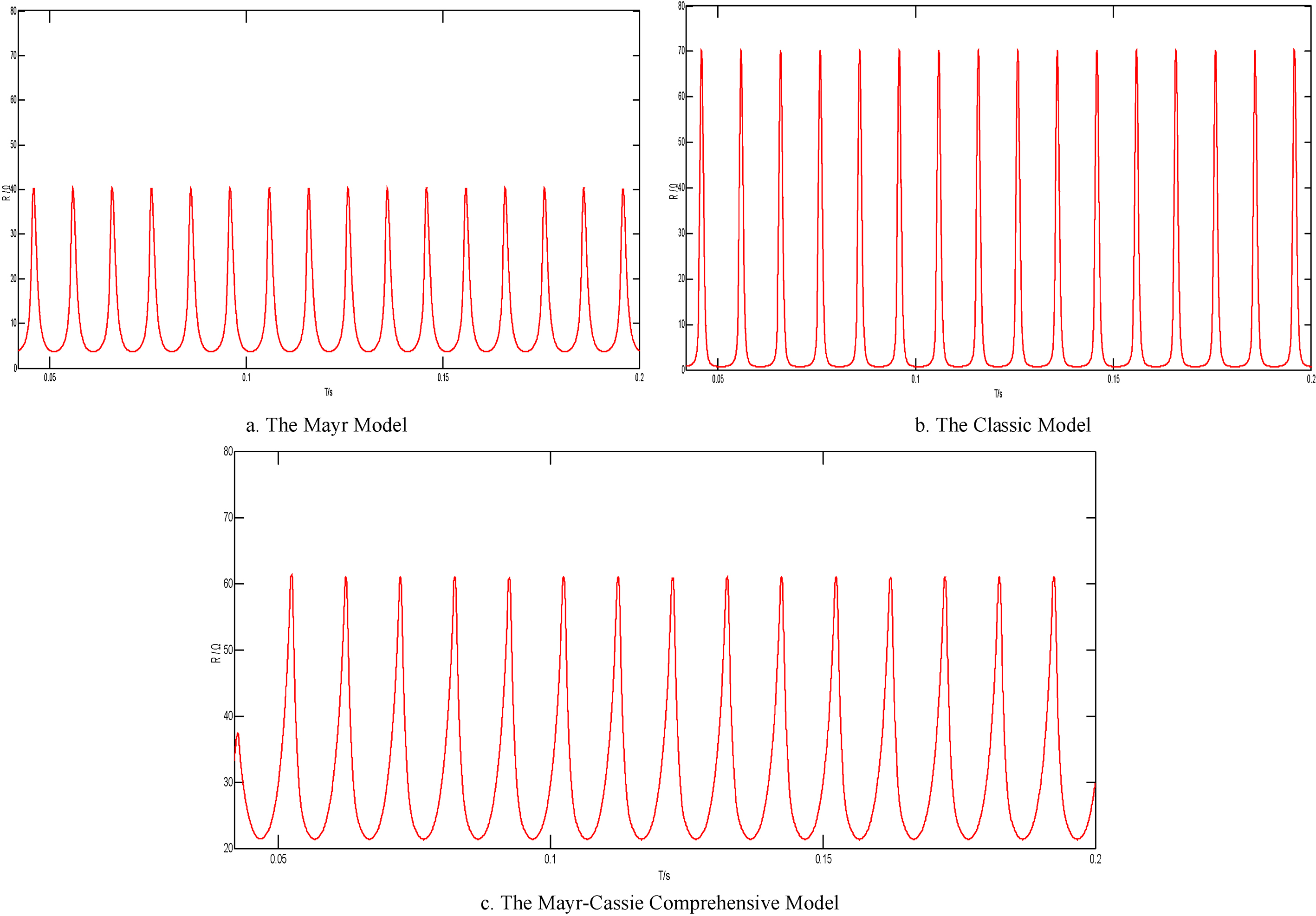
The overvoltage value obtained from the analysis of the power frequency theory is close to the actual situation [15]. Therefore, in this paper, the power frequency extinguishing arc theory is used to analyze the arc grounding overvoltage. In order to verify the effectiveness of the simulation, a 10 kV distribution network system is introduced, as shown in (Fig. 7). To reflect the characteristics of the actual distribution network structure, the four feeder lines in the models are full overhead lines, full cable lines, overhead line-cable hybrid lines, and cable branch lines. The system to ground capacitance current is about 70 A, 150 A, 100 A, the excessive regulation degree of the arc suppression coil is 9%, the small grounding resistance is 0
Overhead line parameter
Overhead line parameter
Cable route parameter
Fault connection simulation model of distribution network based on integrated arc model.
Three-phase and neutral point voltage waveform of intermittent arc grounding.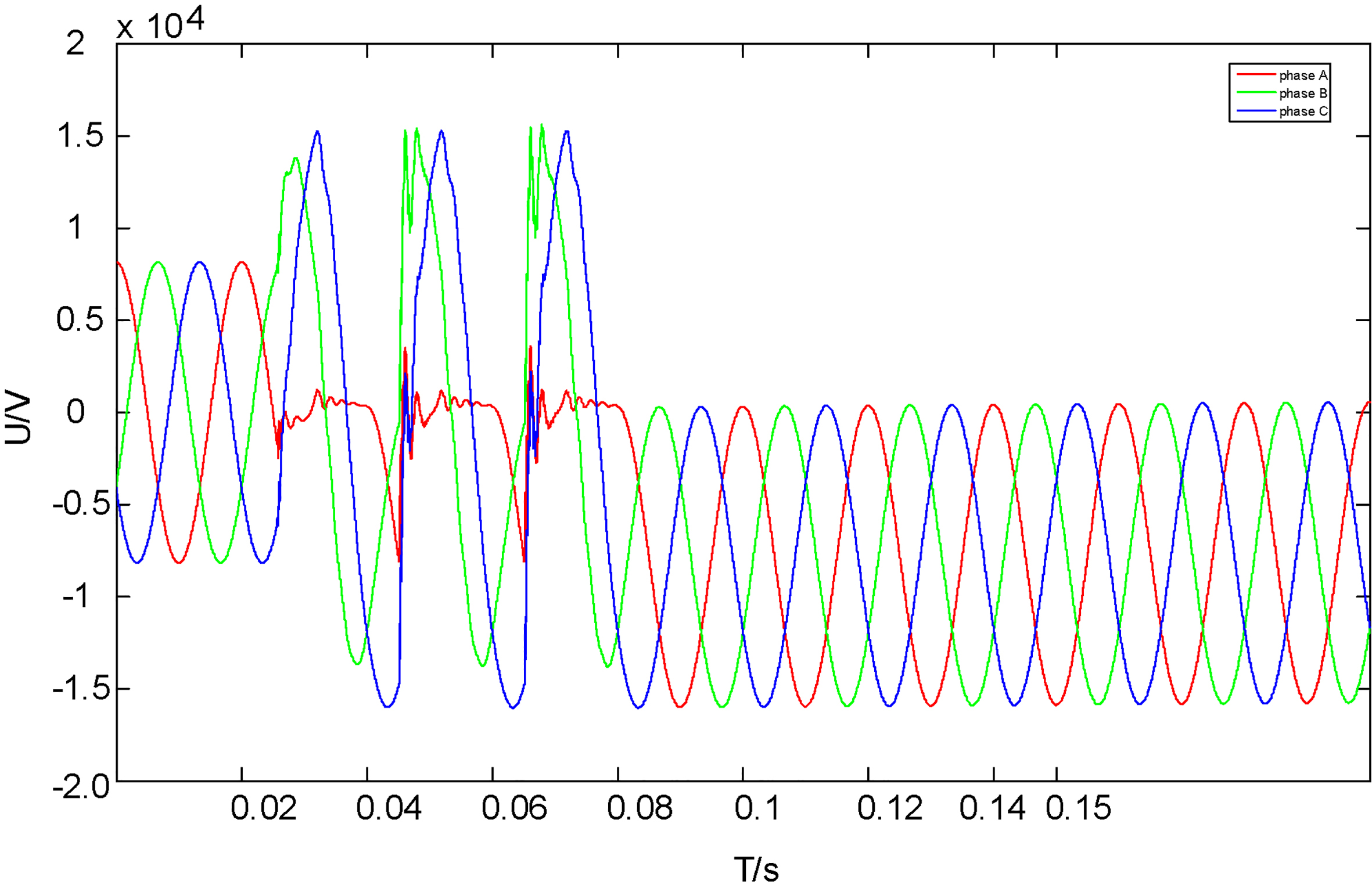
Fault current waveform of intermittent arc grounding.
Based on the theory of power frequency extinguishing arc, it is assumed that phase A is first grounded when the power frequency voltage is up to peak, the design switch logic sequences are designed, and the fault reignition and arc gap of intermittent arc grounding fault are simulated. The system occurs three times of restriking arc to the ground, two times of extinguishing processes in which current goes to zero. After the first grounding half of the power frequency cycle period (0.01 s), the current zero is considered to be the power frequency current is zero passage, at this time the switch disconnect to simulate arc off; The arc is restriked at the first peak moment of the fault phase after the arc is extinguished, at which point the switch closes. The switching control arc restriking time is: the first arc and arc extinguishing time is, tcl
It can be known from Figs 8 and 9, in the process of restriking arc and quenching arc, with the increase of reburning times, the system accumulates energy so that the network insulation is easy to be broken through and the arc is not easy to be extinguished. Each time the system has arc grounding, it causes high frequency oscillation, resulting in overvoltage, and the voltage also increases with the increase of the number of restriking.
In the paper, through analysing the Cassie arc model and the Mayr arc model, considering the influence of the arc length on grounding fault and modifying the expression of the arc dispersion power and the arc time constant, the original arc model is improved according to the actual situation. To simulate the actual situation precisely in the case of mixed distribution network with an organic combination of the two models.
The Cassie model, the Mayr model and the Mayr-Cassie comprehensive arc model are simulated by electromagnetic transient simulation software ATP-EMTP, and according to the simulation results of arc current, arc voltage and arc resistance, the arc models can truthfully and directly reflect the characteristics of the grounding arc of distribution network. The influence of steady arc conductivity and arc time parameters on the electrical characteristics of the arc is analyzed and summarized as following. When the arc length is above 130 cm, the “zero rest” time is particularly obvious and the arc resistance increases. The arc is simulated in a 10 kV low voltage distribution network, and using logic components to realize intermittent arc grounding. By analyzing the results, the correctness of the arc model is verified, which lays a good foundation for the following fault analysis of different ways of neutral-point ground in distribution network.