



Abstract
Express Logistics produced big express tracking data in E-commerce Environment, however, express tracking has a significant weakness due to the lack of an industry-wide standard for archiving and exchanging the tracking information of the basic express item. It was difficult for express company to share and exchange express data with each other. In this paper, we introduced XML to describe data and analyzed data exchange mode of tracking information of express logistics, the data dictionary was draw up first, and then put forward a data describe language based on XML, which called express logistics tracking information markup language (ELTIML), ELTIML was intended to be a common “language” for describing express tracking data, and proposed a schema of ELTIML. At last, with regard to tracking information heterogeneous in four express logistics information management system, we designed an information tracking application framework using ELTIML. The results indicates that data exchanging model based on ELTIML shields heterogeneity of data resources and it is a efficient method of data exchange.
Keywords
Introduction
The rapid growth of E-commerce and online shopping have simulated the enthusiastic development of express logistics in China. The business volume of express service enterprises in China completed 50.71 billion pieces in 2018, there was an increase in production of 26.6% above that of the corresponding period of last year, the revenue of express delivery business reached 603.84 billion yuan, an increase of 21.8% over the same period last year [1]. Express delivery realized the door to door service, the tracking of express delivery had become more important. Express delivery covered almost every aspect of logistics from door pick-up to door delivery service, the exchange and mining of logistics information was the core business to improve the satisfaction of customer service in the whole express logistics production activities. Due to the high timeliness requirements of customer for express delivery, the logistics enterprises provided customers with detailed express tracking information through a variety of ways, and transmitted express real-time information in time. An important way to improve the quality of service lied in express tracking transparent service for the express enterprise alliance.
XML has been widely used for data sharing and exchange in the domestic and foreign research present situation. Jong and Kim proposed the ebXML [2], Ahn et al. solved the problem of data integration in agile supply chain based on XML [3]. The trace food markup language is a language designed to share and exchange tracking information [4]. Because express is a rapidly expanding industry in China, each enterprise establishes its own express logistics management information system, although our country has developed the express tracking query information service specification (YZ/T0131-2013), however, the e-commerce systems of different express delivery enterprises adopt different information formats, which leads to the prominent problems of system interoperability and interconnection in express information exchange. The lack of unified information exchange specification is the key cause of the problem. To solve this problem, this paper discusses the express tracking data flow demand and summarizes real time express data model, and puts forward the design flow of express logistics tracking data describing language from the point of data exchange standardization. express logistics tracking information markup language (ELTIML) is brought forward based on XML. The paper also gives the definition, data architecture and XML schema of ELTIML. At last, we designs an information tracking application framework using ELTIML.
Background and related work
Extensible markup language (XML) is an intermediary meta-markup language that defines data structures in an open, self-describing manner, without going into a long history, the XML is becoming increasingly popular as a method for exchanging data between incompatible data base management systems and presenting data in a manner that can be readily absorbed by other software. It is a method of encoding data in a text file whereby all data items are identified with their own tags. The emergence of XML technology enables any data to be distributed among web-site systems. XML can allow individuals and organizations to create their own system markup language, they can exchange information freely based on applying these markup languages in their own areas. We summarize the related studies dealing with new markup language development using XML as the method of representing data in transportation logistics fields, some professional markup language based on XML had been put forward, such as Logistics e-commerce Markup Language (TranXML), Agricultural Product Information Markup Language (argoML), Trace core extensible Markup Language, Traffic Model Markup Language and road network information Markup Language [3, 4, 5, 6]. We put forward the signalxml and vrp-XML [7, 8, 22]. XML own the characteristics of independent the platform and equipment, and of describing data content separated from its format, the data described using XML is very suitable to exchange between different loosely coupled systems. Therefore, it provides the data description method for real-time or non-real time express tracking data which is the key data requirement of the express delivery system.
Metadata model for tracking information of express logistics
Metadata model requirement
It is very important to provide customers with support for a variety of information query terminals to obtain timely and accurate express real-time information for express logistics enterprise, that is an express tracking information. The express tracking information of providing customer mainly includes the time information, the space position and the state information of the express [9]. The express tracking information was produced by logistics node workstation, the information includes sending, transporting, keeping, delivering and so on express disposal data, the other network transportation information, such as transportation mode, timetable information, location information, etc. At present, there are differences in software and hardware environment, data format, form structure and database structure of each express logistics enterprise management information system. Although the various data migration tools available can meet the one-time conversion requirements for general data and large amounts of data, However, when the online operation of the system database needs to isolate the data exchange, it is difficult to meet the demand of real-time data information acquisition. Therefore, a structured and marked description model is required for the express tracking information, and data exchange is carried out with the aid of document transmission and sharing, at the same time, the system can be flexibly integrated based on this model.
Data Model Design needs formal description of data exchange process, which includes defining a data entity, an exchanging process, and a logical relationship between the data entity [10, 11, 12, 13]. The exchanging data entity is a basic unit that describes the express tracking information exchange requirements, which comprises a query terminal system to subscribe to a message request from a central system, a central system cancels a subscription message request and the central system pushes the tracking information to the customer. The schematic diagram of express tracking information sharing exchange is shown in Fig. 1.
The schematic diagram of express tracking information sharing exchange.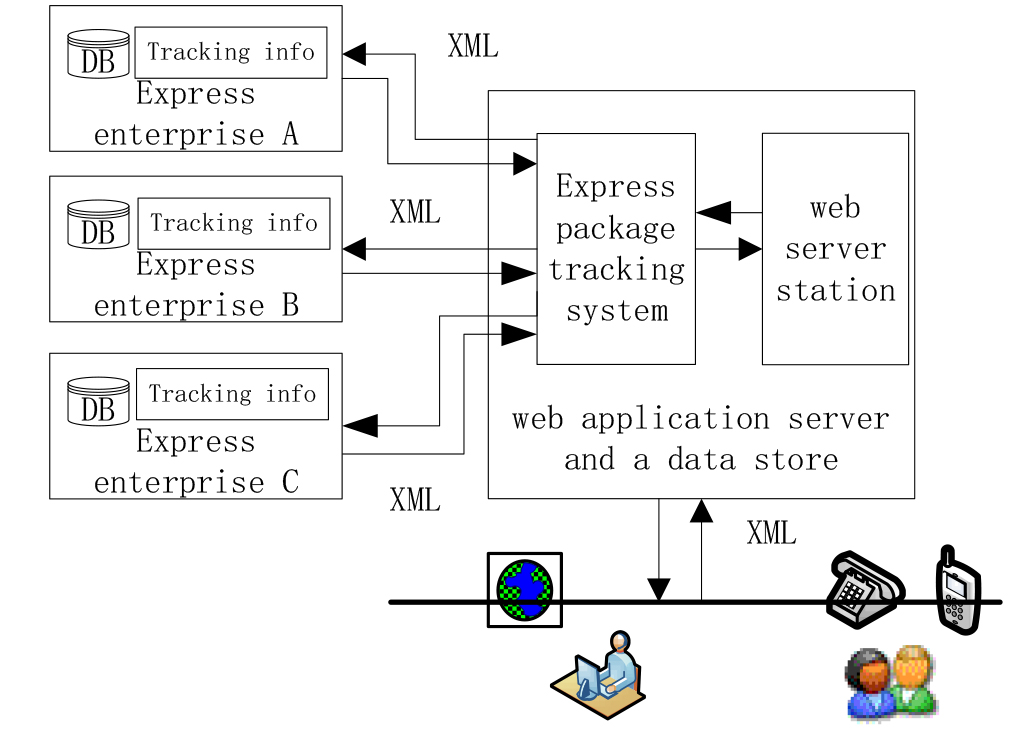
The express logistics tracking information data dictionary includes general terminology, data definition, tag naming and metadata needed for system data exchange, the dictionary used to describe the express tracking information query system to complete the corresponding functions, which is data models of the minimum set of basic units, it constructs the definition of data elements, the construction of data entities, and logical relations, exchange process.
Express tracking information data dictionary is a structured data model, which is the basis of information sharing and software development platform. It builds a unified terminology name, definition, and format for the data element of any one of the languages [9]. The basic structure of the express tracking data element is as follows: data element
Name: express number. Category Name: No. Definition: composed of a set of Arabic numerals and English letters and printed on the express waybill for identifying the unique code of the express. XML Tag: waybill _ No. Data type: string (16). Value range: Constraints: Required (M).
Express logistics tracking information markup language-ELTIML
Definition of ELTIML
ELTIML (Express logistics tracking information markup language) is an specialized markup language based on the XML, which is one kind of data format to describing, packing, storing and as well as transmitting express tracking data needed by express enterprise management system. It is a solution for sharing express item tracking data from different traffic database. The content of the element is limited by the XML tag, and the tag name is marked by the data dictionary standard, which makes the ELTIML document have the greatest consistency and readability. ELTIML is consistent with the current industry standard express tracking query information service specification (YZ/T0131-2013) [9], but ELTIML does not include how data documents are parsed by the program, nor does it describe the application of the data.
Mode of ELTIML
ELTIML is a standard on the application level based on the XML, which is based on the characteristic data of express tracking and the requirement of information tracking and transmission [14]. Therefore, the structural model of ELTIML is not only in line with the basic standards of XML, but also reflects the requirements of express tracking query information service. An ELTIML document can be viewed as the largest entity of the express tracking data entity, i.e. the root node of the entire data tree, which is a data entity of a multi-dimensional structure. Each data element contained in this ELTIML document can be used as a child of the root node, and the data element contains specific data content. The model mathematical description of the ELTIML basic document structure is as follows:
Where Ent represents the main data entity information that constitutes the XML document of express tracking information.
Ent
Design flow of ELTIML
ELTIML is the express tracking information describing method, it is a top-down object-oriented data model which is established according to the express item tracking data demand and data sharing demand of the system [15, 16, 17, 18]. The data model includes object type, object internal attribute and related level relation among different object. Its main purpose aims to describing express item tracking data needed by item traceability based on XML. The design flow diagram shown in Fig. 2, the key process of design flow includes the system requirements analysis, the data dictionary and the system data model. The important step is to extract the primitive describing the information of the express item to set up the metadata model of the data dictionary and to build the data model of the system.
The design flow diagram of ELTIML.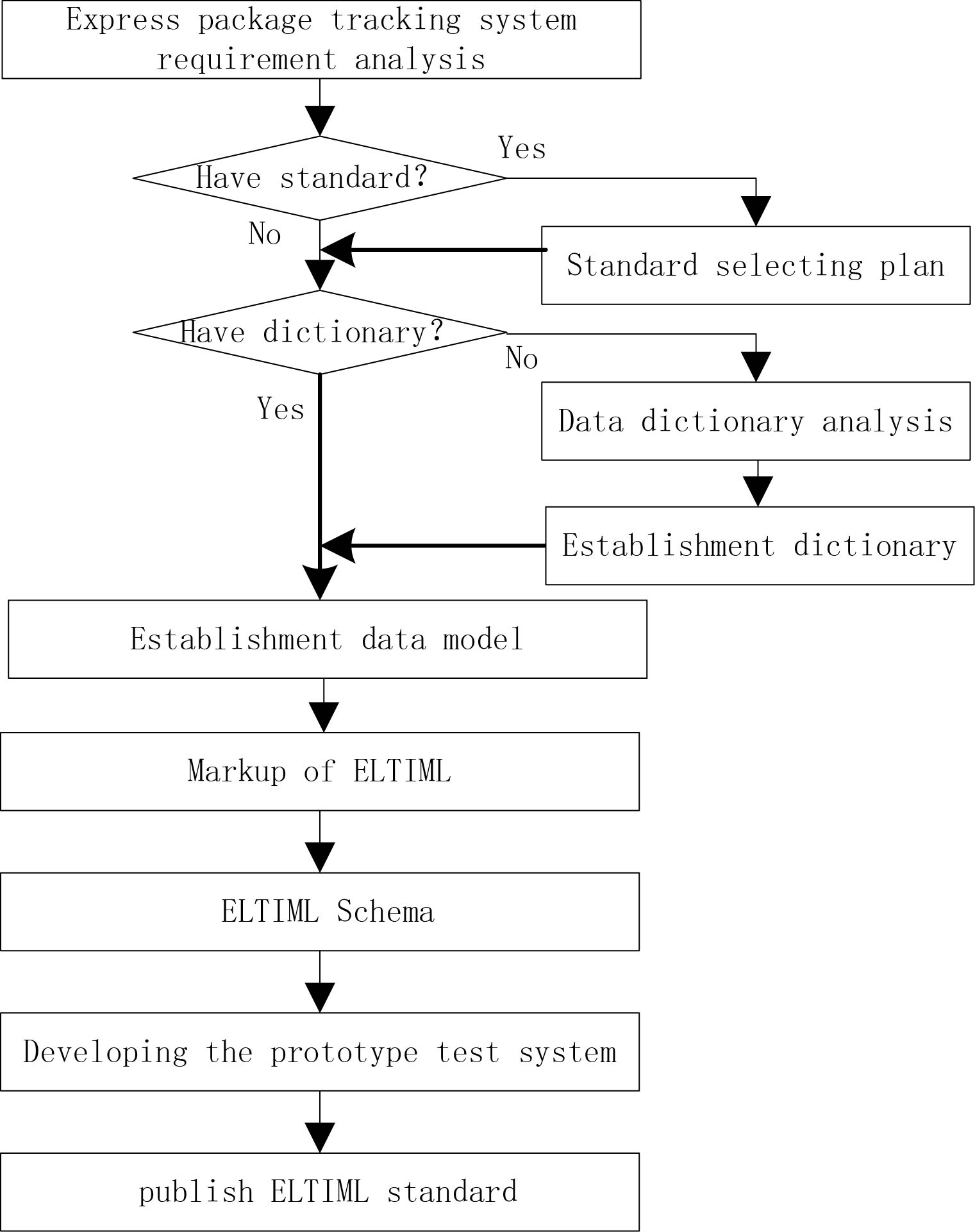
According to Fig. 2, the express logistics tracking information, which needed by the item tracking system, is organized a hierarchical structure based on object oriented method. The subclass of express logistics tracking both inherits the characteristic of the upper class information and has itself particular information. In this way, the ELTIML model forms a layer upon layer containing and layer restraint relations family data structure tree, Fig. 4 the partial content of the ELTIML family tree is programmed in Altova XMLSpy software.
ELTIML family tree.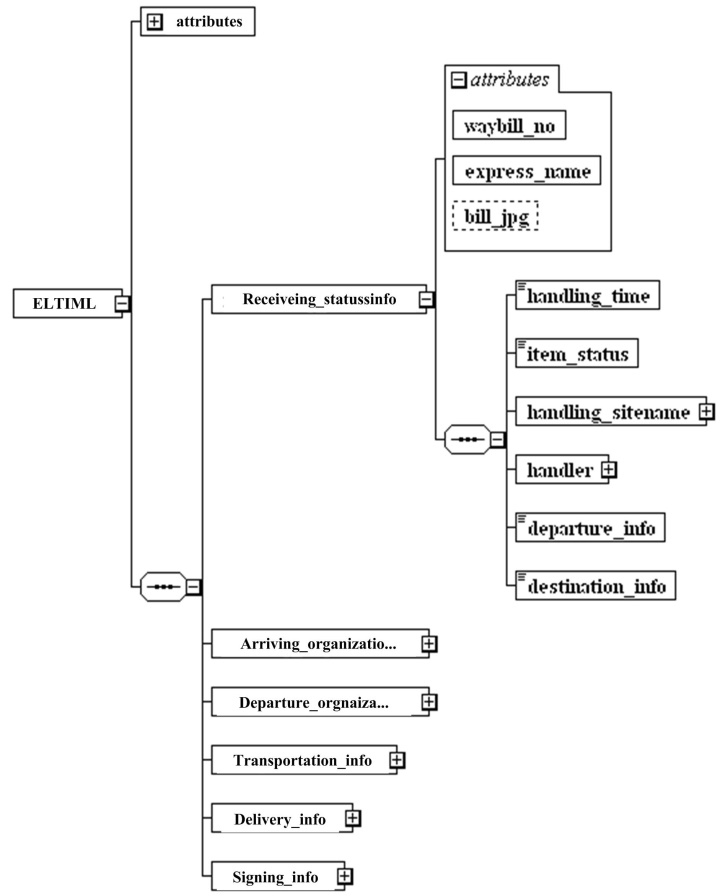
ELTIML as a standard document format for express item tracking information exchange, which is mainly used to describe the processing information of express delivery link, including processing time, processing place, processing status and processing results, etc. It is used to define the standard data structure independent of different express enterprise management information systems, and to provide a unified XML tag format. The logical structure of the document depends on the corresponding ELTIML Schema at the software layer. However, it does not include the internal algorithm description of each express logistics information management system for application. On the basis of this model, different express logistics information systems can share information or interoperating.
ELTIML Schema is a set of rules that defines the grammar of an XML document, which specifies the tagging structures of the ELTIML. The schema defines the ELTIML document logic structure through built-in elements, attributes, simple and complex data types, attribute groups, and so on. To define the ELTIML document reference rules and models, it can better standardize and verify the data exchanging validity of both ELTIML document [9, 10, 11]. ELTIML Schema is a common standard protocol followed by the data information related ELTIML document of the express tracking information system, which can ensure that the ELTIML is a standard data format to realize the data exchange function.
ELTIML data Model is a topological structure, the document tree can be described by a qualified model of the data content: receiveing_status info
<?xml version="1.0" encoding="GB2312"?>
<ELTIML nsxsi_noNamespaceSchemaLocation="ELTIML.xsd" ver="1.0" system="Express Logistics">
<receiveing_statusinfo waybill_no="905214773168" express_name="SHUNFENG EXPRESS"
bill_jpg="waybill001.jpg">
<handling_time>2019-08-2709:30:47</handling_time>
<item_status>pickup completed</item_status>
<handling_sitename>
<Node_name>NAN DA STREET department</Node_name>
<contactor_name>manager Wang</contactor_name>
<address>no 77</address>
<phone_NO>13612349999</phone_NO>
<delivering_scope>zhifu area</delivering_scope>
</handling_sitename>
<handler phone_NO="13612349999" ID="9050"/>
<departure_info> NAN DA STREET department </departure_info>
<destination_info>CHAOYANG district</destination_info>
</receiveing_statusinfo>
ELTIML application
At present, the express tracking information can obtain from the website of express logistics enterprise, it can also be inquired through the third party platform, in addition, there are short message push, voice inquiry and mobile phone app and so on. By comparing the data formats of tracking information of Shunfeng Express, Shentong Express, Zhai Express and EMS, the standard of tracking information service basically meets the requirements of YZ/T0131-2013. However, there are differences in information content and data heterogeneity among different enterprise. As shown in Table 1.
The difference of express tracking information structure
The difference of express tracking information structure
For the problem of information sharing and query of express tracking information, there is a general reluctance to open the information management application system of express logistics enterprises, or the database is not accessible directly due to system restrictions. Sharing express tracking information in compliance with ELTIML can solve the above-mentioned problems.
According to the Express Tracking Query Information Specification, the application architecture is shown in Fig. 4. No matter what query terminal customers use to submit tracking query requests. Different express logistics enterprise information systems provide tracking information documents according to ELTIML Schema. The document analysis is independent of each different system, which can guarantee the independence of data access and data pattern, and shield the difference of the data structure of the bottom layer.
The application of ELTIML.
Figure 4 show that the heterogeneous problem of express tracking information in Table 1 can be solved according to the ELTIML specification, such as the partial code of the ELTIML delivery document for the tracking information in Table 1 are as follows.
<……>
<arriving_organization_info waybill_no="862229432100">
<handling_time>2019-06-09 09:30:47</handling_time>
<item_status>arrived at</item_status>
<handling_sitename> Beijing distributing center </handling_sitename>
<form_sitename> Weifang distributing center </form_sitename>
<Noteinfo>normal</Noteinfo>
</arriving_organization_info>
<……>
From the above example we can see that ELTIML describes the application of data sharing in the field of express tracking information in full accordance with YZ/T0131-2013, and the standard data description format for different data owners is determined. As long as the express tracking information is transmitted according to ELTIML in data sharing and exchange, the seamless data integration application with low cost and no cost can be realized completely. Next, if ELTIML becomes the standard of data exchange in the field of express tracking information service, express logistics management application system can easily realize express tracking information sharing and query in the development or external information sharing. ELTIML-Manager prototype has been developed in Java under an MS Windows environment for delivery document tracking express. According to ELTIMIL schema, multi-express enterprises temporal XML data in a schema versioning context, through a graphical user interface. Due to space limitations, we do not provide here all information on ELTIML-Manager.
In the area of express item tracking the needs of a specific markup language has put forward. In this paper we analyzed the status of express item tracking information requirement, the model of express tracking data exchange was built for logistics enterprise management system. We put forward the architecture of the ELTIML, by a detailed description of the scopes of the language and its mail features. The ELTIML is an XML-based language that aims at generalizing the system description in software. The Schema of ELTIML was developed by XMLSPY platform. This markup language has been used to a set of experiments in order to demonstrate its flexibility in describing different express tracking scenarios. Finally, we have demonstrated the architecture of ELTIML, which may exchange and share express tracking information effect by means of ELTIML files, and shield the difference of the data structure of the bottom layer.
An interesting future development of this activity is the standardization of ELTIML, this would allow designing applications that can combine the express item tracking information service specification with express item tracking information modeled by ELTIML. Since ELTIML does not have any annotation framework, a first step towards this integration require the definition of an ontology for ELTIML in big data application and cloudy data environment [19, 20, 21].
Footnotes
Acknowledgments
The authors acknowledge the Shandong science and technology plan project of Shandong education department of China (Grant: J17KA199), the National Natural Science Foundation of China (Grant: 61201432).