



Abstract
In the field of concrete materials in the construction industry, manufactured sand gradually replaces natural sand in order to cope with the shortage of natural sand resources, thus leading to the problem of energy consumption in producing manufactured sand. In this paper, single particle shear crushing test of three kinds of manufactured sand aggregates of granite, limestone and diabase were taken as the research object. The energy consumption in single particle shear crushing was measured and the fractal theory was introduced to analyze the mass distribution of crushed particles. With the help of crushing specific energy consumption, a fractal prediction model of crushing energy consumption was established, and R-R model was used to correct the model. Finally, this paper verified the effectiveness of the corrected model by a series of tests that compare actual measured values, predictive values from the uncorrected model and predictive values from the corrected model. The method is well worth considering and learning from when it comes to energy saving in producing manufactured sand.
Keywords
Introduction
Infrastructure construction in China is thriving with the development of the economy, leading to a sharp increase in the use of concrete, an important base material of which is sand aggregate. Since natural sand is a non-renewable resource, many parts of China have been short of natural sand. Therefore, manufactured sand, with its advantages, has gradually become a substitute for natural sand in the development of the industry. However, in the crushing process of producing manufactured sand, energy consumption is a problem that cannot be neglected.
Currently in the field of crushing, energy saving and consumption reduction remains a significant goal. Traditional “three major crushing theories” are partial because they are merely based on the particle sizes before and after crushing and cannot scientifically determine the energy consumption of crushing [13]. In the 1970s, Mandelbrot [17] proposed the fractal theory. The fractal theory is studied on the unsmooth and irregular geometry of the nonlinear system. It doesn’t change as the system zooms in or out. The fractals are self-similar objects that allow the fractal fragment size distribution to be predicted at any size [18]. A large number of scholars have studied the fractal theory of the particle crushing. Mandelbrot [17] established a fractal model of two-dimensional spatial particle distribution. Tyler et al. [20] established a fractal model of particle size distribution in 3d space. Xu [19] has established the model of the rockfill sample from the numerical simulation and test. Zhao et al. [21] and Tian et al. [22] applied fractal theory to engineering materials from the perspective of theory and experiment. And they established the model of fractal dimension represented by mass.
Dynamic compression tests were carried out on layered rocks with different bedding dips under different impact velocities, and fractional dimension was used to quantitatively characterize the fragmentation distribution characteristics, which indicated the energy utilization rate [1]. Zhang et al. studied the fracture and energy partitioning of rock specimens under various loading rates [2]. Li et al. [3] analyzed the proportion of absorption energy to input energy of bedding sandstone which was crushed under impact loading. It was regarded that the maximum energy absorption ratio was reached when bedding plane was parallel to loading direction. However, the above-mentioned approaches are applied to the field of rock mining and tunnel excavation. Xu [4] put forward that shear crushing strength could be deduced by using fractal model for particle breakage and size effect of single particle crushing strength, but its relationship with energy consumption was not mentioned. In Crushing tests were carried out on granite and the relationship between particle crushing energy consumption and fractional dimension was determined through the use of fractal theory [5]. The feasibility of the method was proved by verification tests, however, the variables concerned were in a complex relationship and fitting based on more than one hundred times of crushing tests was necessary.
On the basis of single particle shear-crushing tests of manufactured sand aggregates, granite, limestone and diabase’s crushing energy consumption and mass distribution of broken particles were measured respectively. Then fractal model and crushing specific energy consumption were introduced to build crushing energy consumption fractal prediction model. Measured values and predictive values were compared to verify the feasibility of the plan. The method proposed in this paper is easy to be copied and can be applied to other manufactured sand aggregates. It is well worth considering and learning from when it comes to energy saving in producing manufactured sand.
Experimental procedure
Test bed for sandstone crushing
Sandstone particle crushing test bed, shown in Fig. 1a, was used to carry out single particle crushing experiment. The vertical impact of the equipment is driven by pneumatic control system. The upper plate and the lower plate will stop squeezing after they contact with the sheared stone. In the horizontal direction, the screw is driven by the motor to move the lower plate. There is a force sensor in each of the horizontal and vertical directions, and is connected with the data collecting sheet to collect force data. The maximum transverse shear force of the test equipment is 2 KN and the maximum longitudinal extrusion pressure is 18 KN. The actual machine is shown in Fig. 1b.
Test bed for sandstone particle crushing.
Initialization: enter manual mode after booting the test bed, then choose Mode II. First press Mode II for 3 seconds and then 5 seconds. When the screw moves to the leftmost point and the detecting sheet to the limit sensor in the middle, the initialization is completed. Selecting automatic mode: when all parts return to their initial positions, choose Automation and then press Start. In Mode II, the screw moves and powers the crushing.
Diagram of particle breakage test.
As shown in the Fig. 2, there are two main cases of particle breakage in the shear process.In the first case, the particles break into two pieces, and in the second case, the particles break into several pieces. The characteristic diameter of a single particle was recorded in the test bed before the test began. And the data of shear force was collected automatically. When the device began to work, the upper panel did not move, and the lower panel loadde horizontally at the speed of 0.1 mm/s. After the particle was completely broken, the test bed stopped, the experimental data was recorded and the broken particle was collected.
The shearing bed runs at a constant velocity
Above,
Principles of fractal model of crushing specific energy consumption
Crushing specific energy consumption
According to statistics, most crushing machines have an energy utilization rate of less than 30% [6], meaning that much of energy consumed by sand making factories has been wasted. For this reason, energy consumption is an indicator to evaluate crushers’ operating quality [7]. Crushing specific energy consumption is used to evaluate manufactured sand aggregate firmness and to determine the method and the strength to be applied to crush sandstone. It means per unit mass energy consumption for crushing manufactured sand aggregate:
Above,
In the 1980s, Mandelbrot [8] established Fractal Theory. The theory mainly deal with problems that Euclidean geometry cannot measure and describe. It is used to characterize that complicated or discrete geometries do not change even the whole system has been expanded or reduced. This property is referred to as “self-similarity” and “scale-invariance”. Manufactured sand aggregate, having and not having been crushed, has the property from the perspective of microcosmic morphology, so it can be analyzed by fractal model.
Manufactured sand aggregate having been sheared, the particles were sorted by sieves of mesh diameters from small to large
In three-dimensional space, as mesh diameter increases, the number of particles passing through the sieve declines. The volume of the remaining particles that do not pass through the sieve can be expressed as:
Here,
and the whole particle mass can be defined as:
The largest particle diameter after crushing is assumed as
Take a logarithm of each side:
From Eq. (8), we know that
The mass distribution function of manufactured sand of size fraction
Here,
Then total mass
From Eqs (2) and (11), crushing specific energy consumption fractal prediction model can be deduced:
Equation (11) shows the relationship in crushing specific energy consumption
In the above model, sieve size fraction
Here,
Then fractal model for predicting crushing specific energy consumption in Eq. (12) can be corrected as:
This corrected fractal model for predicting crushing specific energy consumption can not only reflect the relationship between crushing specific energy consumption
Fitting of fractional dimension
The following were the parameters of the three particles in this experiment. The density of granite is 2.79 kg/m
Thirty-group specimens of granite, limestone and diabase with particle diameters of 35–65 mm were selected respectively to carry out single particle crushing test on shear bed. After the aggregates were crushed, sieves with mesh diameters of 2, 5, 8, 11 and 30 mm (diameters of particles to be crushed were all below 30 mm) were used to sort and record mass distribution of different size fractions. The results are shown in Table 1.
Size fraction mass distribution
Size fraction mass distribution
Statistical calculation was carried out according to size fraction mass distribution from Eq. (8) and Table 1. With horizontal coordinate
Fractional dimension fitting curves of three manufactured sand aggregates.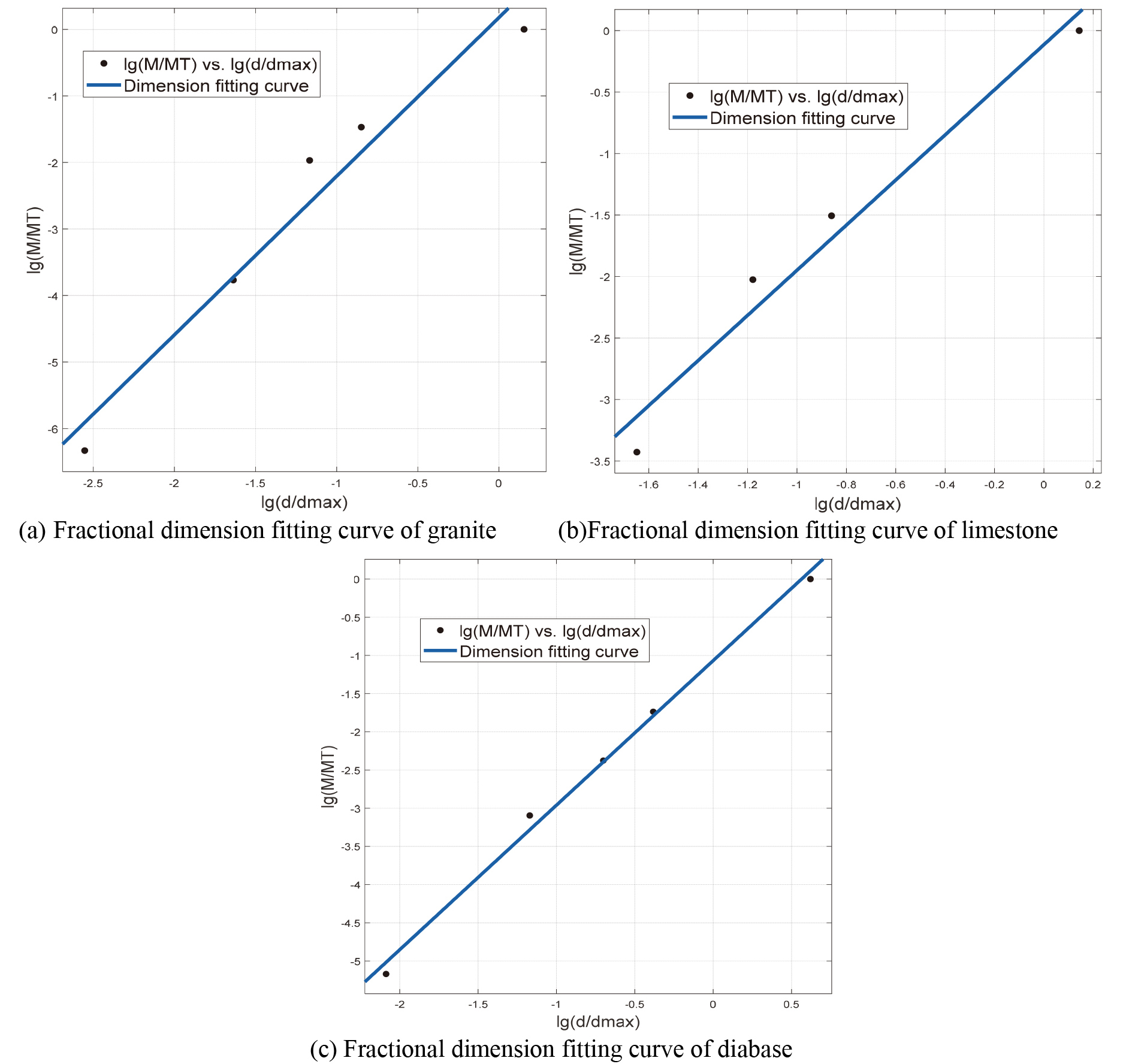
From the fitting results in Fig. 3, it is known that the fractional dimension fitting curve of granite is expressed as
In Eq. (14) – fractal model for analyzing crushing specific energy consumption, there was an undetermined coefficient
According to Eq. (2), the crushing specific energy consumption
Coefficient
fitting data
Coefficient
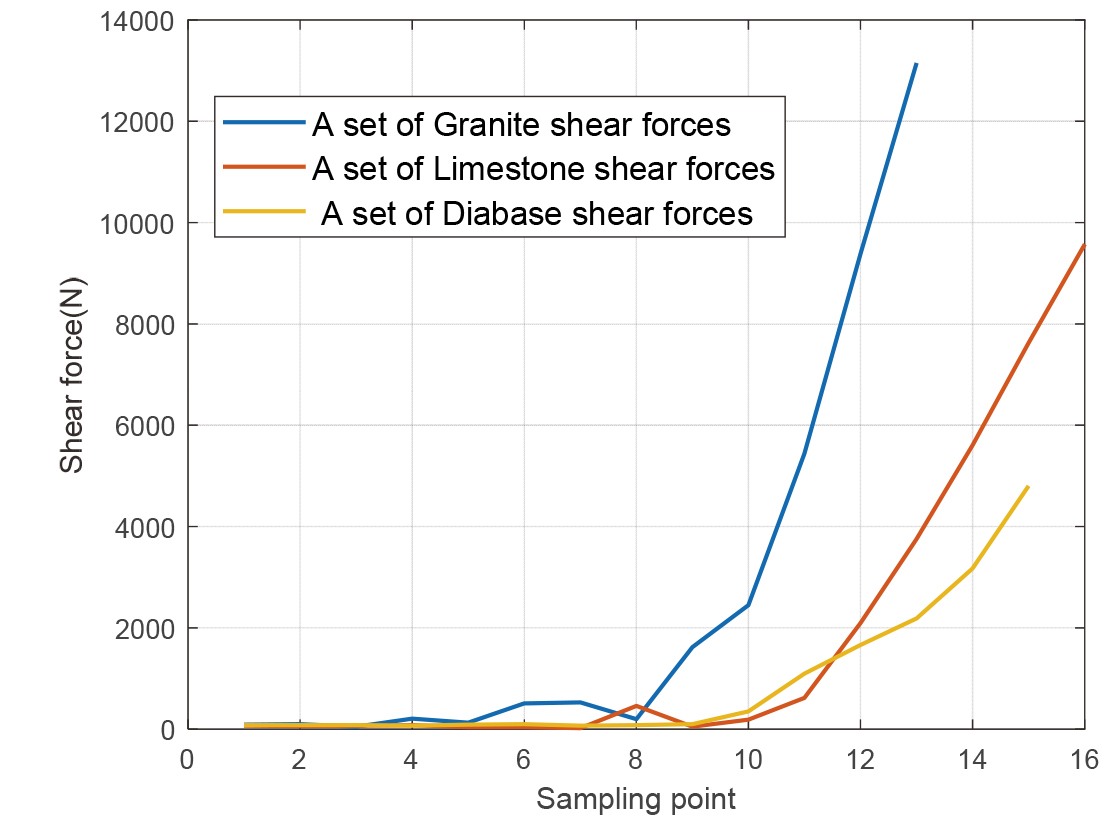
Fitting of constant C of three aggregates respectively.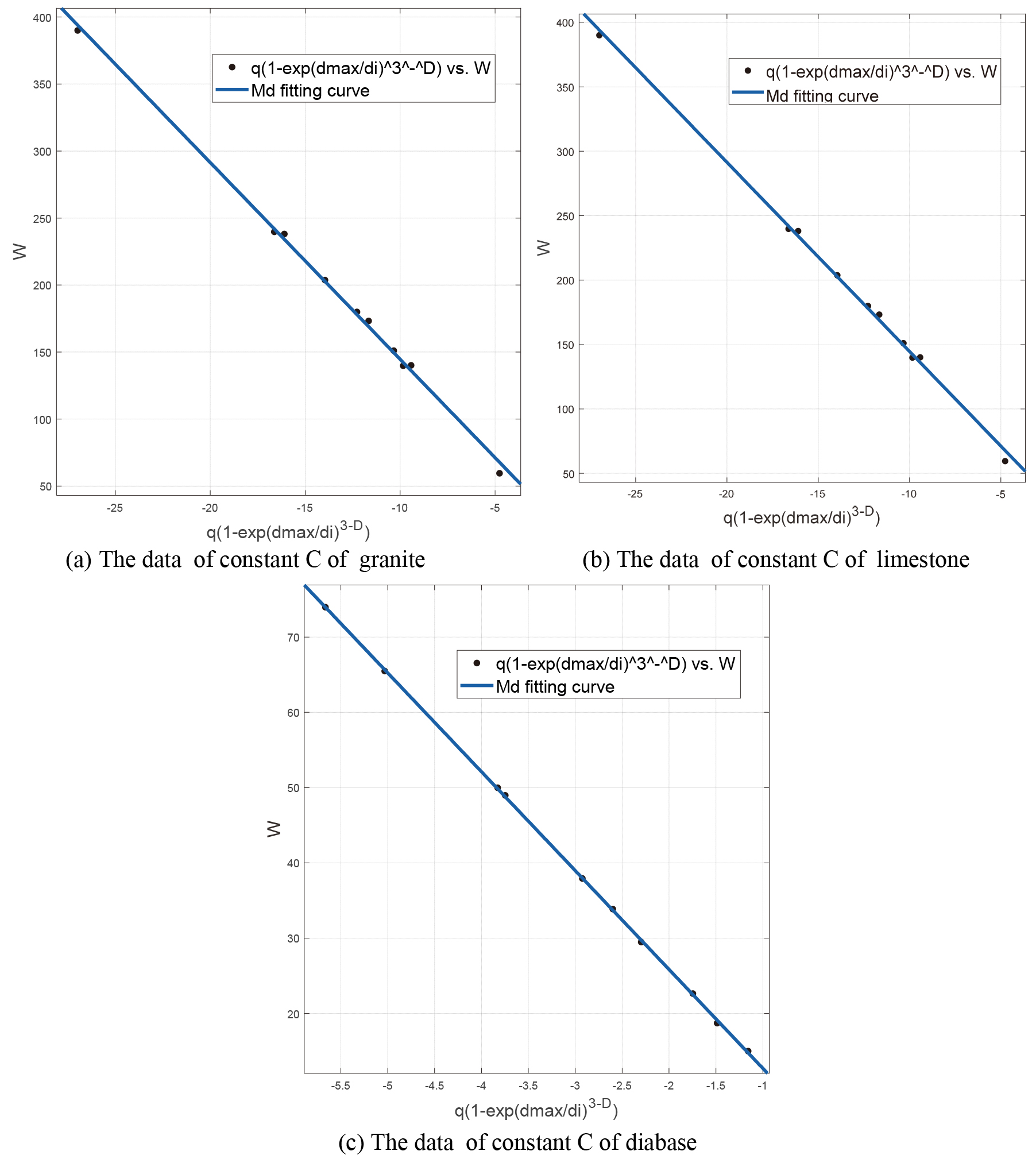
In Session 4.1 we have fractional dimension of each type of aggregate. And from Eq. (12) we know:
From Eq. (13) we know that energy consumption
From Fig. 5 it is known that
To sum up, corrected fractal prediction model of crushing specific energy consumption for granite, limestone and diabase can be expressed as Eqs (16)–(18) respectively:
In the model for these three aggregates, the average diameters of crushed particle
By the same method, constant
To verify the accuracy of corrected fractal prediction model of crushing specific energy consumption in Eqs (13)–(15), another 5 groups of specimens of each type of aggregate respectively were selected as verification data set, shown in Table 3.
Verification data set
Verification data set
Error value
Put the verification data into Eq. (2) to obtain actual crushing specific energy consumption
Crushing specific energy consumption predictive values vs actual measured values.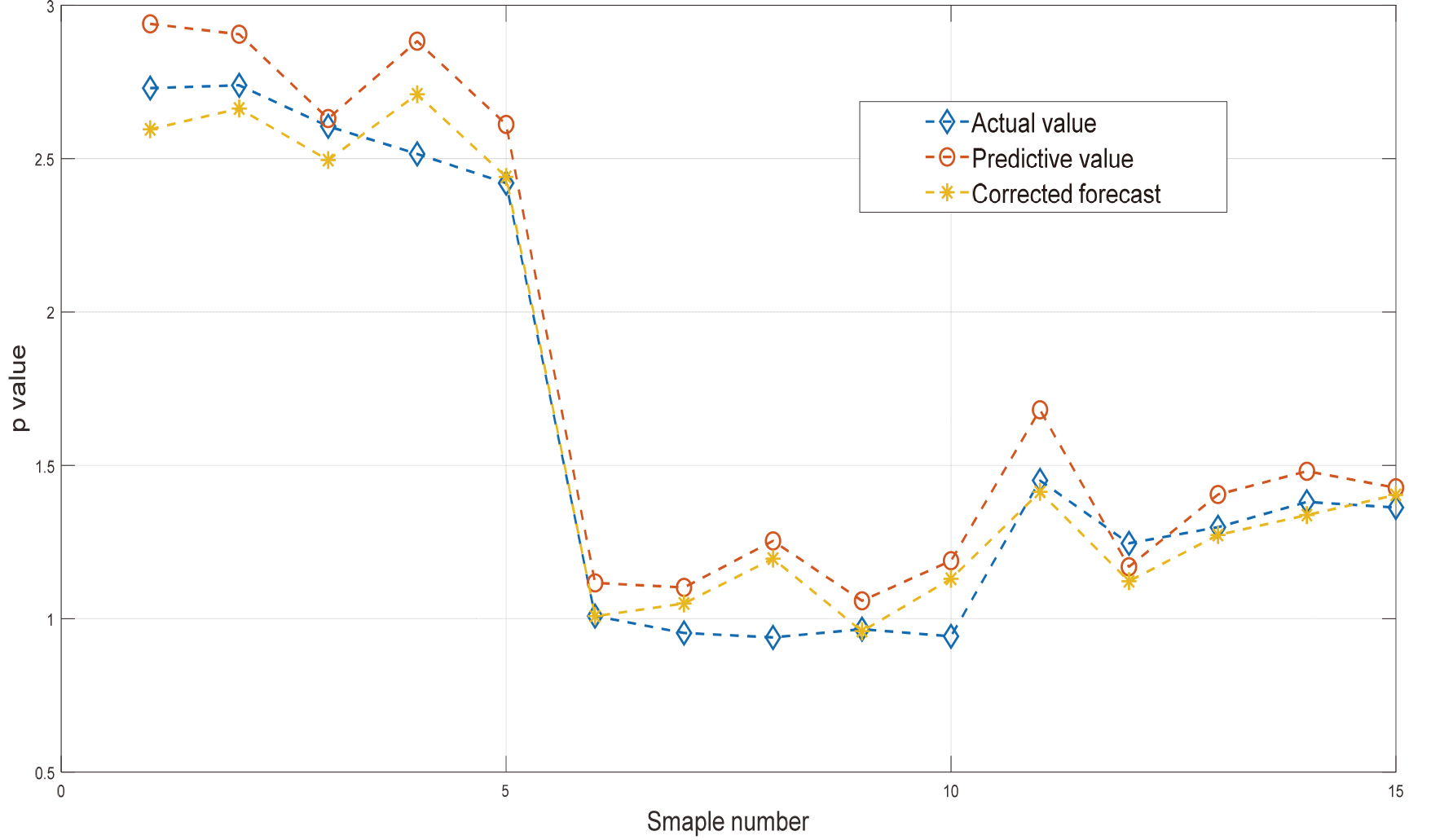
According to error formula
The average error of the uncorrected model to actual value
By single particle shear crushing tests and based on the introduction of crushing specific energy consumption and fractal model theory, this paper proposed a corrected fractal prediction model of crushing specific energy consumption. The relationship between crushing specific energy consumption, fractional dimension, the largest diameter of particles crushed, the average diameter of particles crushed and the mass of particles crushed was established. It is worth considering and is of certain application value in terms of manufactured sand shear crushing technology of different aggregates. In our future studies, power consumption model of shear crushing machine will be included in order to provide a more scientific design for shear crushing machine.
Footnotes
Acknowledgments
The authors acknowledge the National Natural Science Foundation of China (Grant: 51905100) and the Young and middle-aged teachers project of Fujian province (Grant: JAT190429).