



Abstract
The short-term load forecast is an important part of power system operation, which is usually a nonlinear problem. The processing of load forecast data and the selection of forecasting methods are particularly important. In order to get accurate and effective prediction for power system load, this article proposes a hybrid multi-objective quantum particle swarm optimization (QPSO) algorithm for short-term load forecast of power system based on diagonal recursive neural network. Firstly, a multi-objective mathematical model for short-term load forecast is proposed. Secondly, the discrete particle swarm optimization (PSO) algorithm is used to select the characteristics of load data and screen out the appropriate data. Finally, the hybrid multi-objective QPSO algorithm is used to train diagonal recursive neural network. The experimental results show that the hybrid multi-objective QPSO for short-term load forecast based on diagonal recursive neural network is effective.
Keywords
Introduction
Multi-objective load forecast is a large-scale complex problem, and the load forecast accuracy will affect power production and safe operation of the power grid. The predictions in the power system mainly focus on short-term predictions, which are used to forecast the load per hour in the next few days [1]. Weather is one of the common factors that affect power load forecast, which is random and can make the forecast model to be non-linear. Therefore, load forecast technology is crucial.
At present, the main load forecast methods and theories include the multiple regression analysis (MRA) [2], support vector machines (SVM) [3, 4], artificial neural networks (ANN) [5], etc. However, most methods have certain defects. The regression analysis model is too simple to bring a good fitting effect for complex problems. The support vector machines is advantageous for small samples and high dimensional data, however, it does not fit power load with mass data due to its slow calculation, and it does not meet the real-time requirement of power load. The traditional neural network is static network, which needs to assume model order and falls into over fitting easily [6].
A diagonal recurrent neural network (DRNN) [7] is a feedback neural network that relies on internal feedback between neurons to describe dynamic behavior. It can vividly reflect the dynamic characteristics of the system without storing all input information, and the dynamic characteristics of the nonlinear system can be reflected using fewer memory units. There is no need to assume the order and type of the model. So, DRNN is more appropriate for industrial training, simulation modeling and power system’s load prediction. Xu et al. [8] used grey correlation to analyze the influencing factors, and then used DRNN to predict power load of cell, which achieved good effect. Zhang [9] used DRNN to fit and identify the characteristic curves of voltage, which significantly improved the monitoring effect. Wang [10] used RPROP-SVR algorithm to train DRNN and excellently identified nonlinear systems.
With the development of computing technology, intelligent optimization algorithms are widely used in complex engineering. The quantum particle swarm optimization algorithm (QPSO) [11] has been applied to load forecast in recent years and become one of the hot topics in the field. Load forecast is a complex multi-objective optimization problem. In recent years, multi-objective particle swarm optimization algorithm (MOPSO) has also been used to solve load forecast problem. Yang et al. [12] proposed a combined power load forecast model, and then used multi-objective particle swarm optimization to solve the load forecast problem. Combined with the advantages of NNIA algorithm [13] and QPSO algorithm, Zhang [14] presented a new hybrid multi-objective QPSO algorithm.
In this article, an improved multi-objective QPSO algorithm is used to train the diagonal recursive neural network and applied to the load prediction of power system. The main idea of this article is to propose a short-term load forecast model and use a hybrid multi-objective QPSO algorithm to solve it. The framework is as follows: Section 2 introduces the multi-objective quantum particle swarm optimization algorithm. Section 3 briefly introduces the diagonal recurrent neural network. Section 4 puts forward discrete QPSO algorithm to extract features of load data. An improved multi-objective QPSO algorithm is used to train diagonal recurrent neural network. Section 5 uses the algorithm to solve the actual problem.
Hybrid QPSO-NNIA2 algorithm
Introduction of quantum particle swarm optimization algorithm
The QPSO algorithm is an improved particle swarm optimization (PSO) algorithm [15] developed by Sun et al. [11] in 2004. The particle in QPSO algorithm has quantum behavior. All particles can be searched throughout quantum space, and so it is better to seek out a global optimal solution. The position of particles can be expressed as wave functions. The optimal position of individual is denoted by pbest, and the optimal position of group is denoted by gbest. Each particle will focus on the local point
The average optimal position of each particle is denoted by mbest with the following formulas.
Suppose
Where:
In recent years, many studies use intelligent optimization algorithms to solve multi-objective problems. Among many scholars [17, 18, 19], Coello and Lechuga [16] firstly proposed the multi-objective particle swarm optimization algorithm (MOPSO) in 2002. But few literatures were about multi-objective quantum particle swarm.
The design of multi-objective optimization should pay attention to the diversity of Pareto solutions while maintaining them. When QPSO algorithm is used to solve multi-objective optimization problems, its faster convergence speed often leads to the loss of diversity of solutions prematurely. Therefore, when using QPSO algorithm to find the Pareto optimal solution for multi-objective optimization problems, it is necessary to introduce a diversity maintenance mechanism.
The NNIA2 algorithm is an improved immune genetic multi-objective algorithm, which can improve crowding distance of the algorithm to achieve dynamic linked lists and adaptive rank cloning, maintaining Pareto solution diversity. Combined with the advantages of NNIA algorithm [12] and QPSO algorithm, Zhang [11] presented a new hybrid multi-objective QPSO algorithm.
In the hybrid multi-objective algorithm, the proximity distance is used instead of the crowded distance, and the external archive set of the QPSO algorithm is used to accelerate population convergence, so as to get better convergence and improved diversity of Pareto optimal solutions. The flow diagram of the hybrid multi-objective algorithm is given in Fig. 1 [11].
Flow diagram of hybrid multi-objective algorithm.
Multi-objective model for short-term load forecast
The purpose of power load short-term forecast is to predict the load in the recent period. According to the evaluation index of power load forecasting error, the multi-objective load forecast model is constructed as follows.
Mean Squared Error (MSE). The expectation value for the squared of variance between forecast value and real value is shown in Eq. (5).
Where, Mean Absolute Error (MAE). The trend of power load in 24 hour is often a smooth continuous curve, which corresponds to the distribution of a certain complex model. Therefore, there should be no obvious difference between adjacent sample values in load forecast of electric power loads. After a certain study on the load values of a certain area, a large threshold is set to obtain the target 2 as shown in Eq. (6). The fitness is the mean of target 2 of the corresponding sample. It can be found that when the load forecast value is smaller than the threshold target, it is 0. If the value is greater than the threshold value, the larger the difference is, the larger the objective function value will be.
According to two fitness functions above, the NNIA2-QPSO algorithm can be used to optimize and obtain the optimal frontier solution, that is, a series of non-dominated weighted sequences. These weighted sequences become “tiny resource” based on DRNN short-term power load forecast. Since only a set of optimal weights are needed to perform DRNN prediction, it is necessary to find the most suitable weighted sequence for the current stage, local domain and current season from the “tiny resources” before the forecast.
Calculate the mean and variance of each series of weights in the “tiny resources” obtained by training historical data. According to the 24-hour load curve in the past week, calculate the corresponding mean and variance of MAE. Find out the “tiny resource” weight series with the smallest difference from the mean. Compare the variance under the same condition. The smallest weighted sequence is the optimal sequence suitable for local load forecast.
Diagonal Recurrent Neural Network (DRNN) has a triple neural network covering the input, output and regression layers, which can be divided into forward propagation and backward propagation. Forward propagation refers to the signal that finally obtains the correct result at the output end after a series of analysis and calculation. If an error exists in the result, the reverse propagation will start, that is, the difference between the previous and expected results will be taken as a negative result. The signal from input end, in turn, is imported from the output end. To make error signal smaller, the gradient descent method can be adopted to adjust the network parameters and weights at various levels [19, 20]. The details of the architecture are shown in Fig. 2.
The structure of DRNN.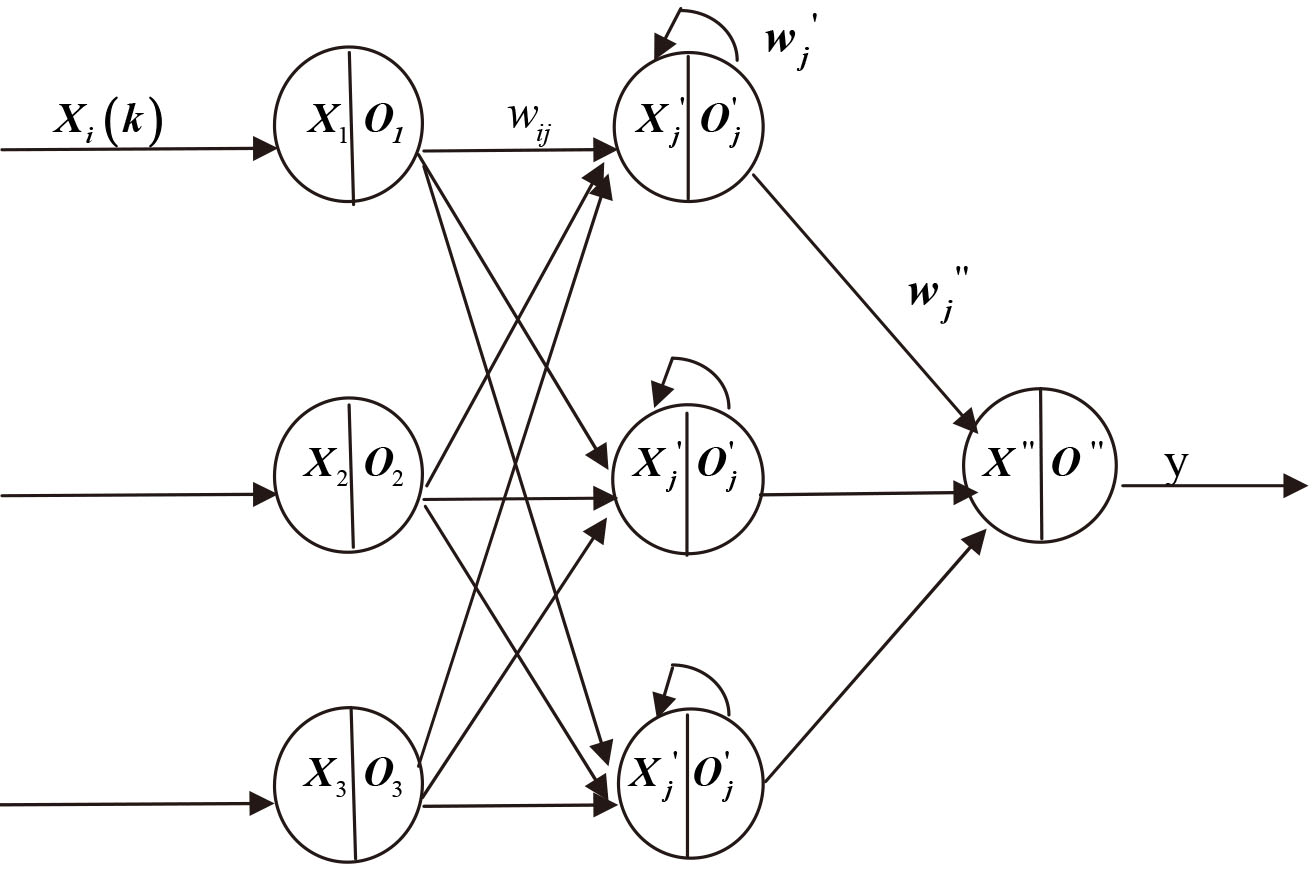
In this network, the external input includes:
From the above expressions, we find that there are two differences between the DRNN network and the most commonly used layer of back propagation (BP) neural networks. On the one hand, the DRNN lacks a threshold value and only contains the weights of the neurons that connect the layers. But on the other hand, the DRNN regression layer is more than a delay link compared with the hidden layer of BP neural network, which is equivalent to adding another hidden layer on the hidden layer of BP neural networks. The input of each latent layer node will be fed back to the previous stage. The input of the nodes, which has a good effect on the fitting approximation of the data, is also an important reason why the DRNN does not fall into over fitting like the BP neural networks.
BP neural networks algorithm is the most common learning convergence method for diagonal recursive neural networks. The main idea of this algorithm is similar to the iterative convergence process of BP neural network. The main idea is still to update each layer in a gradient descent manner according to the principle of minimum mean square error. The connection weights eventually achieve the effect of fitting convergence.
The DRNN network contains only the weights but no thresholds, and the weights between the layers are randomly initialized. Since the core concept of parameter correction is the gradient descent method, the initial value of the weights still greatly affect the accuracy of the results. In order to effectively optimize the weights among the layers of the DRNN network, the following multi-objective prediction model is established to optimize it using NNIA2-QPSO. The flow is as follows:
Set the parameters of the NNIA2-QPSO algorithm, such as the number of populations denoted by Initialize the population, and each individual Iteration starts when According to the QPSO’s positional iteration formula, operate the population Combine N- POP with Q-POP, and select the individual POP to enter the next iteration based on proximity distance and non-dominant level. Judge whether the algebra reaches
The load forecast is usually based on the days before the first few days of the week to predict the day, and the daily load data is generally in units of hours. Therefore, the dimension of input data is often higher while performing load forecasting, and it is easy to cause “dimensional disasters”. Therefore, it is necessary to determine using the data of previous day in load forecast. And the results will be more accurate. In this article, the algorithm of feature selection is designed using discrete binary particle swarm to achieve data deletion. The previous PSO algorithm is only suitable for the optimization of continuous variables. As for discrete variables, the traditional PSO algorithm becomes ineffective. In order to solve the sorting and combination in real projects, Eberhart proposed a binary version based on traditional particle swarms, namely, binary particle swarm optimization (BPSO) [21]. Each dimension of the particle is made up of variables 0 and 1; however, there is no limitation for the velocity. The expression detail is as follows:
Where:
Initialize the parameters of PSO with 6 dimensions Initialize and calculate the fitness. The fitness level is based on the MSE of the prediction of DRNN. Each dimension of the particle is made up of variable such as 0, 1, which represents the data for each day, while the output adopts the load data of the day after selected consecutive days under the current particle. When Compare the current optimal fitness level with historical optimality and local optimal fitness level, update the fitness level and optimize individual one. Determine whether the result is met at the maximum number of iterations or with the minimum error. If the conditions are met, iterations of the output can be stopped. Otherwise, go to step 3 at Obtain the optimized particle, and select the load data corresponding to the number of days according to the particle result. Then, the corresponding output data is added into the subsequent optimization prediction.
Feature selection numerical experiment
The data used in this experiment came from an industrial zone in Xi’an city. The zone is mainly engaged in the production and assembly of electronic devices, with large annual electricity consumption and small fluctuation. Therefore, it is of high reference value to choose the load data of the zone within one year as the source of experimental data in this article. In order to eliminate the weather, seasons and noise interference and other accidental factors, we chose the data from those within one year at intervals of 6 months. Then the selected load data were normalized. The data were selected according to the BPSO screening process for 20 times a week.
In this article, parameters are set as follows: the maximum iterations is 1000, the population number is 50; the dimension is 6; the learning factor
We can find from Table 1 that smaller mean square deviation was obtained in all 20 experiments of 6 sample groups when optimization of BPSO algorithm was used. The volatility of the mean square deviation has strong robustness. From Fig. 3, using the data of five consecutive days is the best choice.
Numerical results of feature selection case study
Numerical results of feature selection case study
The optimal feature statistics.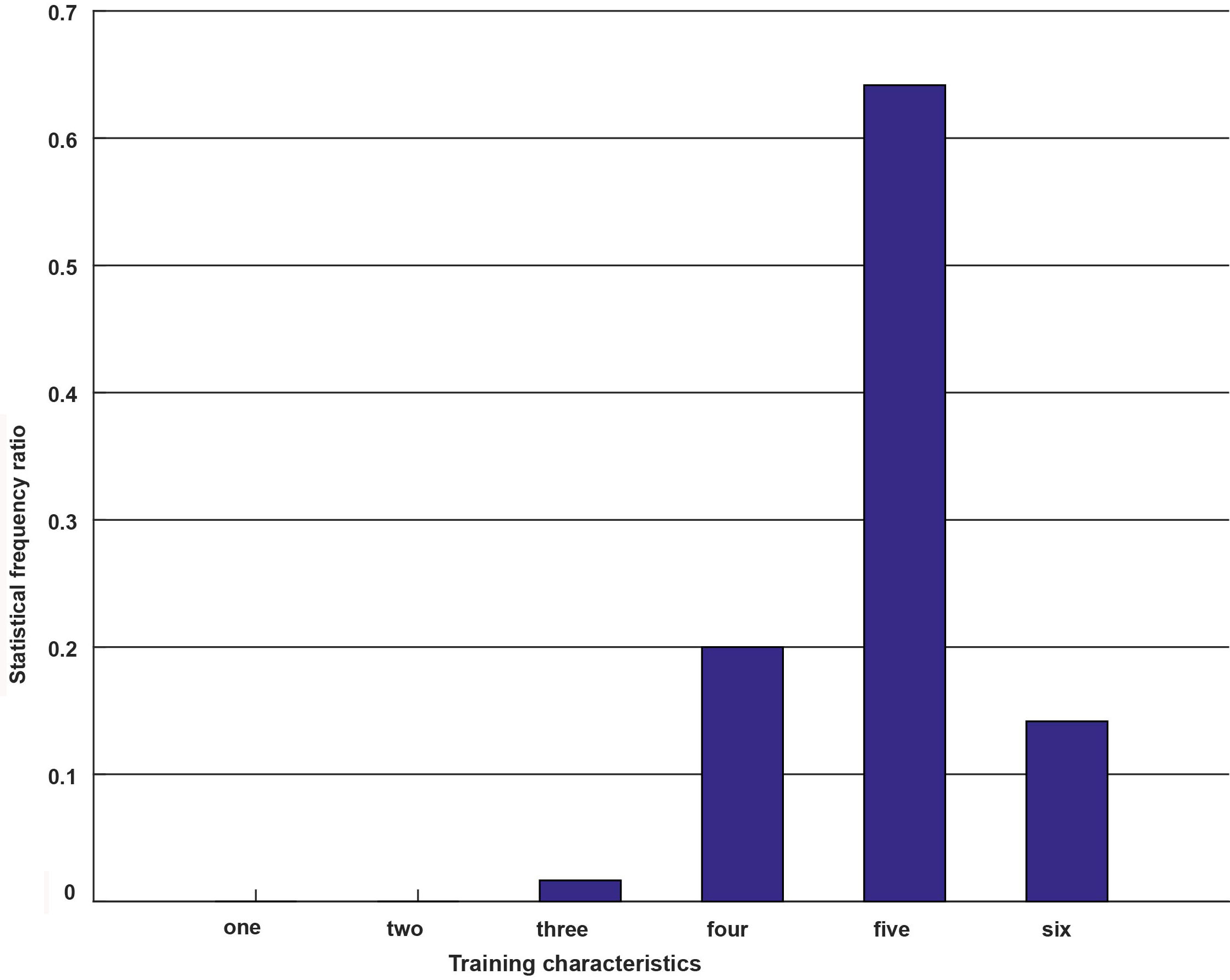
The best feature extraction data in the previous section was used as the data basis for the research comparison in this section. Then the DRNN network was optimized and the results of data prediction were compared. The load data of this week was provided by a power company in Shanxi province. The load was collected and recorded every hour from May 10 to 16 in 2017. The training data is shown in Table 2.
The number of neurons is 5 in the input layer, 1 in the output layer and 12 in the regression layer. The antibody dimensions
Optimizing training data case study
Optimizing training data case study
According to the above parameters, DRNN is optimized with multi-objective optimization. The Pareto curve of the optimal frontier is obtained as shown in Fig. 3 below.
The optimal frontier Pareto curve.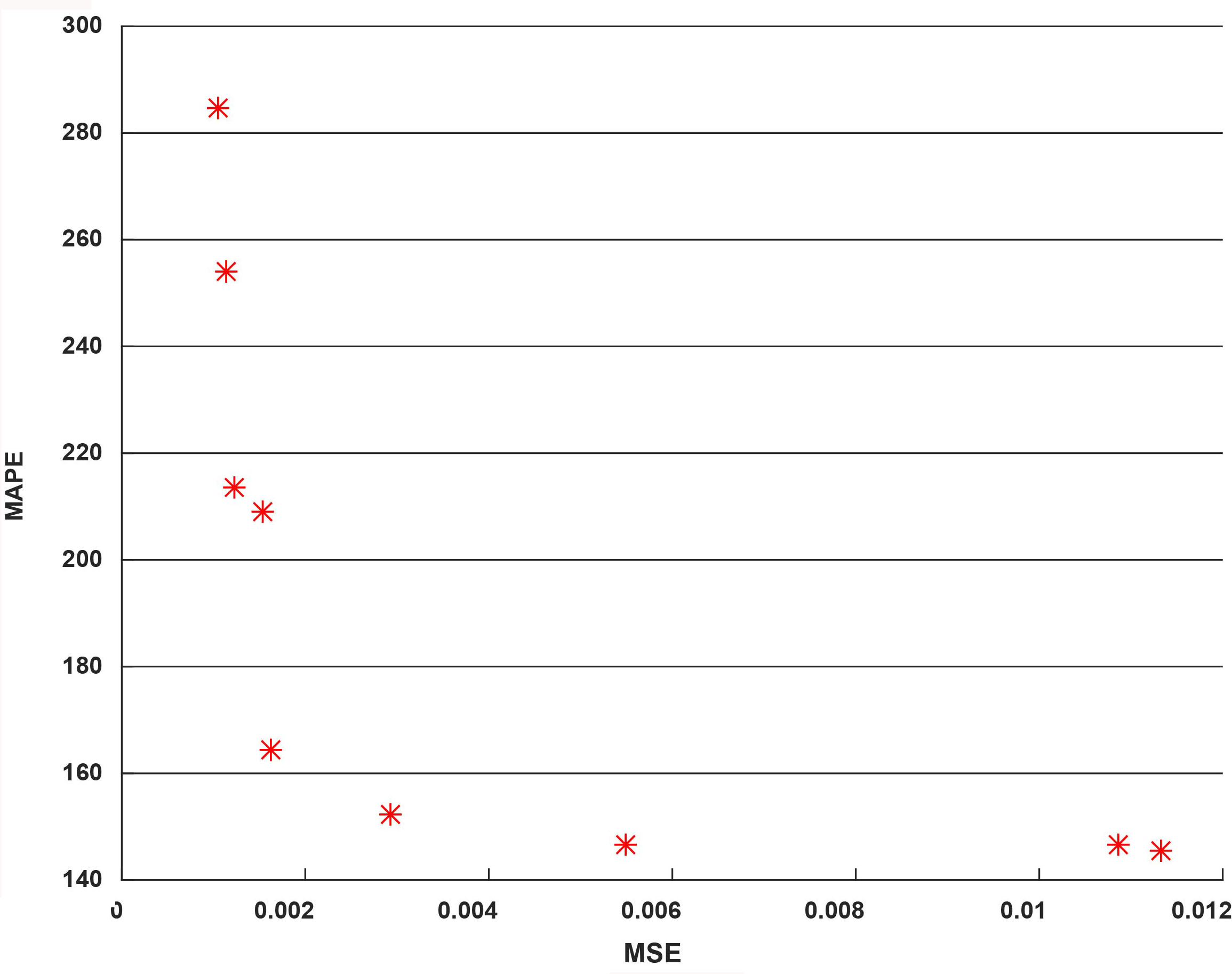
The MSE of the non-dominant points is concentrated between
Load forecast comparison.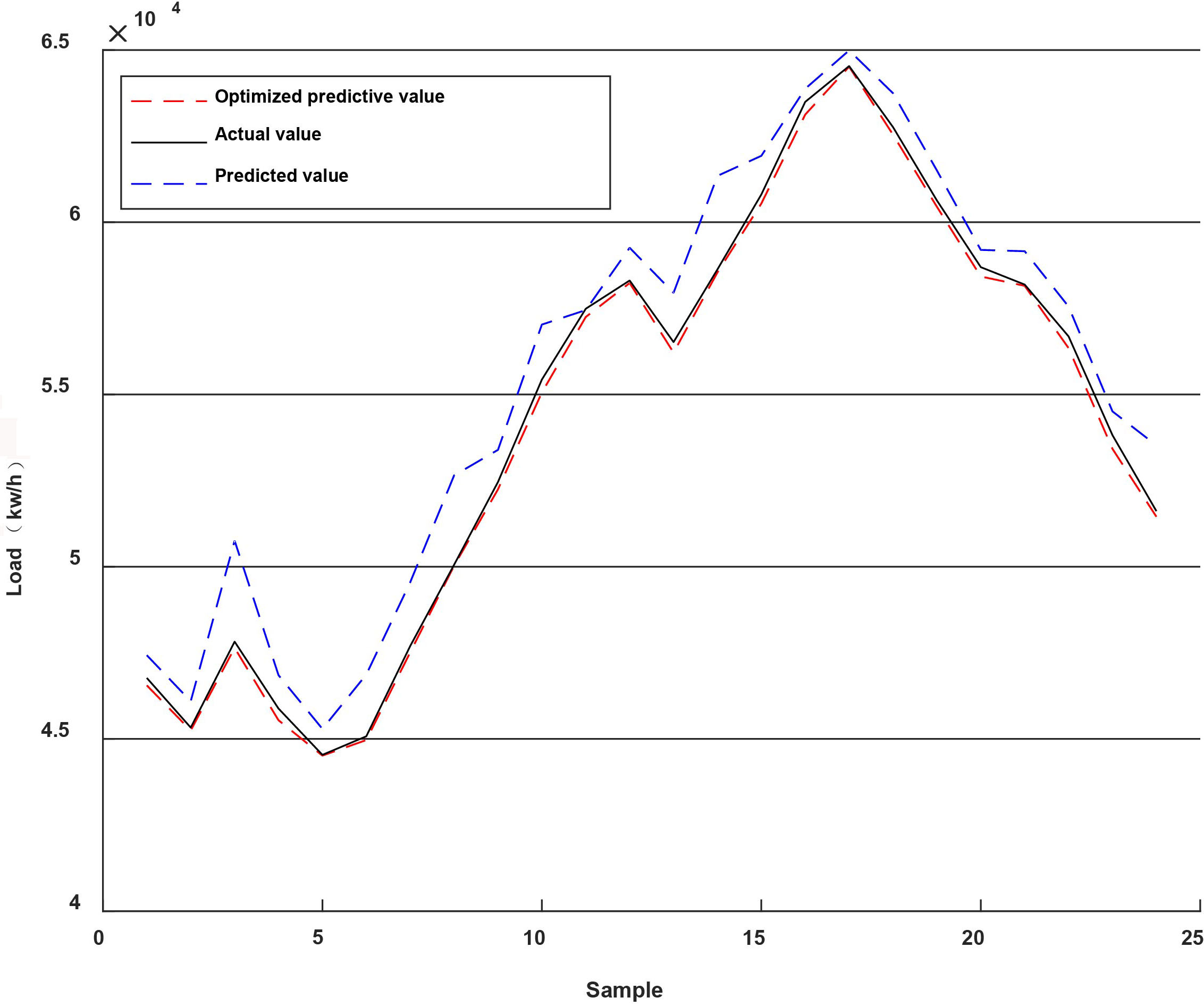
From Figs 5 and 6, it can be found that the DRNN prediction effect of the optimized weight obtained from the “resource” using QPSO-NNIA2 algorithm is very good. The predicted 24-hour load is very close to the actual load. The relative error rate for each hourly forecast is kept within a small range. This demonstrates that the optimization strategy of QPSO-NNIA2 algorithm proposed is effective in this article.
Error comparison.
This article presents an approach to find the optimal load forecast configuration for short-term power electricity using multi-objective QPSO based on DRNN for power management strategy. The main idea of this article is to propose a short-term load forecast model and use a hybrid multi-objective QPSO to train DRNN. In terms of data processing, we used a discrete particle swarm optimization algorithm for feature extraction and selected appropriate data for numerical experiments. The experimental results show that the data of five consecutive days is the best. Finally, hybrid multi-objective QPSO for short-term load forecast based on diagonal recursive neural network is carried out to solve practical problems. The experimental results indicate that the relative error rate for each hourly forecast is kept within a small range. This suggests that the method presented is effective in this article. In future work, we will continue to study better algorithms for load forecast solutions.
Footnotes
Acknowledgments
This work is supported by the Fund of Shaanxi province 2020 Natural Science Basic Research Project funding (No. 2020JQ992), the Education Department of Shaanxi province 2019 science research project funding (No. 19JK0436) and the research project funding in Xi’an Aeronautical Polytechnic Institute (No. 17XHZH-018).