



Abstract
Temperature gradient significantly affects the production of surrounding rock stress in mining engineering. The mechanics and deformation characteristics of the rock will change under the temperature gradient, thereby increasing the probability of accidents in the roadway. This paper conducts uniaxial compression tests on granite at different temperatures from room temperature to 250
Introduction
As the mining goes deeper and deeper, the influence of temperature on the properties of surrounding rock become increasingly obvious, and temperature gradient may be generated in a certain range. The appearance of temperature gradient can significantly affect the surrounding rock stress in deep roadway and change the rock’s mechanical and deformation characteristics, thereby increasing the probability of the occurrence of accidents in deep roadway.
In recent years, the international scholars have conducted a great deal of researches on the rock’s mechanical properties under temperature gradients and gained many valuable results. Yang et al. [1] focus on the thermal-mechanical fracturing behaviors of granite after thermal cycling treatment by fully coupled dynamic method based on general state. Yin et al. [2] Studied the pore characteristics, permeability, Critical Reynolds Number and flow nonlinearity of granite exposed at 100
As stated above, a lot of achievements have been made worldwide regarding the granite’s mechanical property under high-temperature conditions; however, the granite’s mechanical properties under temperature gradient are poorly investigated. Therefore, in this study, we conducted uniaxial compression tests on the granite for systematically investigating the stress – strain characteristics under different temperature gradients within a temperature range from roomtemperature to 200
Tests
Sample preparation and instrument
The rock samples used in this study were the sesame white granite collected from Daye, Hubei, China. The granite shows a grainy texture in black and white, with an average density of 2.766 g/cm
The uniaxial compression tests were carried out by electro-hydraulic servo universal testing machine (WAW-1000). During the tests, the samples were heated in an electro-thermostatic forced air drying oven (DHG-9030A, Shanghai Feixue Experimental Instrument Co., Ltd., China) and the stainless steel heating plate.
Test method and process
The whole test process is described as follows. First, before the test, therock samples were numbered and the sizes were measured. Then, the samples were divided into four groups, and each group had four samples. After division, the samples were placed in a thermostatic drying oven for 12-hour heating, and then taken out and insulated after reaching the preset-temperature. The bottom of the sample was placed on a heating plate with the same temperature as the thermostatic drying oven, whereas the top was exposed to the air for natural cooling. Next, uniaxial compression tests were conducted on the rock samples at room temperature (17
Working conditions in the tests
Working conditions in the tests
Stress–strain curve
Figure 1 shows the granite’s stress – strain curve at different temperatures, indicating that the granite underwent four phases during the compression from 17
Initial compaction phase: In this phase, the stress – strain curve was concave upward; with increasing stress, the deformation became violent because of the closure of some micro-fractures in the granite under compression. Approximately elastic deformation phase: In this phase, the stress – strain curve was almost a line, and the slope can be approximated as the rock’s average tangent elastic modulus. Micro-crack evolution phase: In this phase, with increasing axial compressive force, the broken line appeared in the rock’s stress – strain curve and the stress on the tip of the cracks increased steadily. Moreover, the stress even reached the tip stress intensity factor of the cracks, which would gradually destroy the micro-elements in the rock with low intensity and producing new cracks. Overall, the rock’s mechanical property decreased and the internal losses developed more rapidly, leading to the instantaneous release of some energy. Failure phase: In this phase, the stress reached the maximum and the rock underwent obvious brittle failures.
As shown in Fig. 1, the increase in temperature from 17
Granite’s stress – strain curves at different temperatures.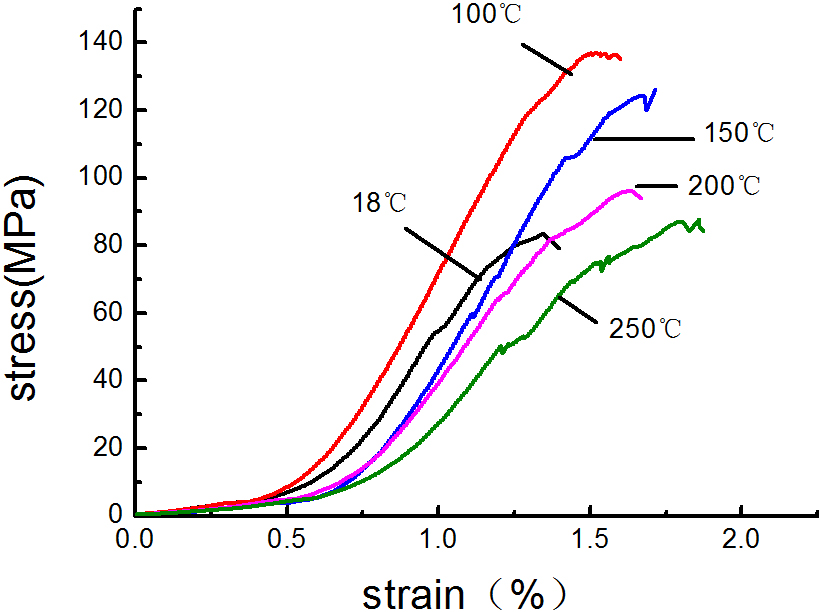
Granite’s stress – strain curves at different temperatures under different cooling conditions.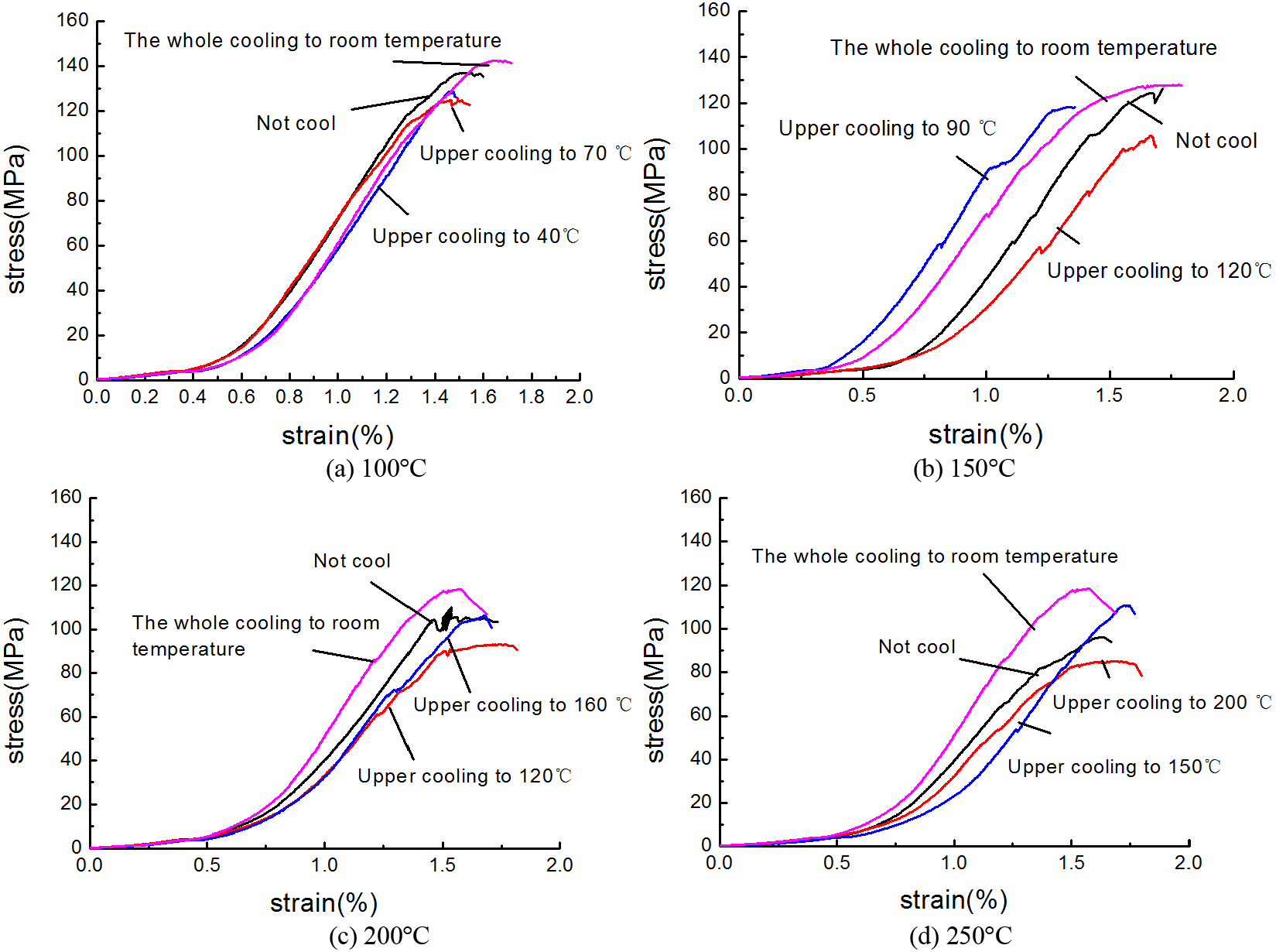
Figure 2 shows the granite’s stress – strain curves at different temperatures under different cooling conditions, indicating that (1) at 100
Granite’s peak stress characteristics at different temperatures
Figure 3 shows the rock’s peak stresses under uniaxial compression test at different temperatures. Obviously, the granite’s peak stresses at each temperature are discrete; overall, the peak stress decreased with increasing temperature. The maximum peak stress at 100
Granite’s peak stresses at different temperatures.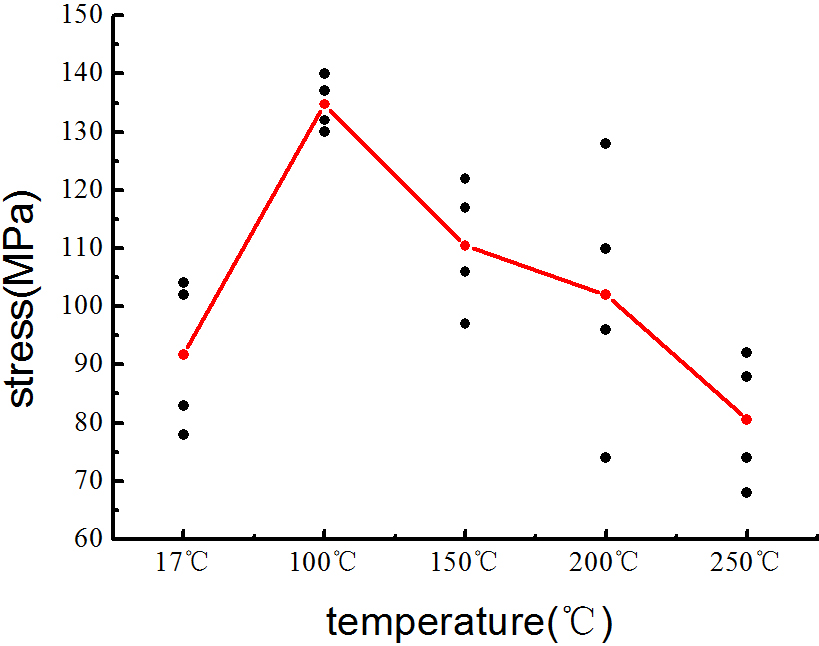
The following conclusions were obtained. (1)The average peak stress increased as the temperature increased from 17
Figure 4 shows the variations between the rock’s peak stress and temperature under uniaxial compression test under different temperature gradients,indicating that the granite’s peak stresses at each temperature are discretely distributed; overall, the peak stress first decrease and then increase with increasing temperature gradient.
Granite’s peak stress at different temperatures under different cooling conditions.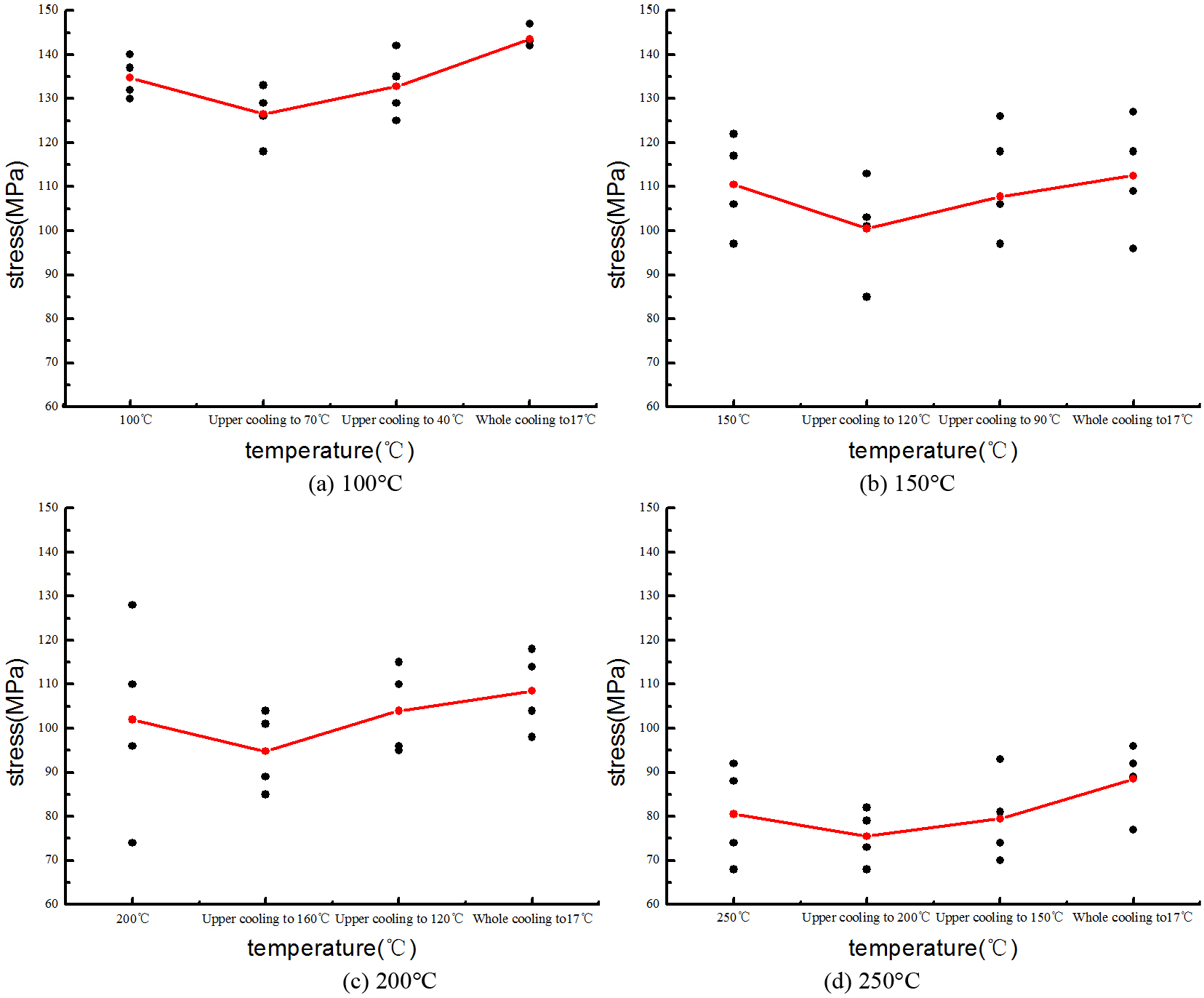
The following conclusions can be reached from Fig. 4.
The rock’s average peak under a smaller temperature gradient is smaller than that under high-temperature condition; The rock’s average peak under a large temperature gradient is greater than that under a small temperature gradientand is also smaller than that under high-temperature condition;
Granite’s peak strains at different temperatures.
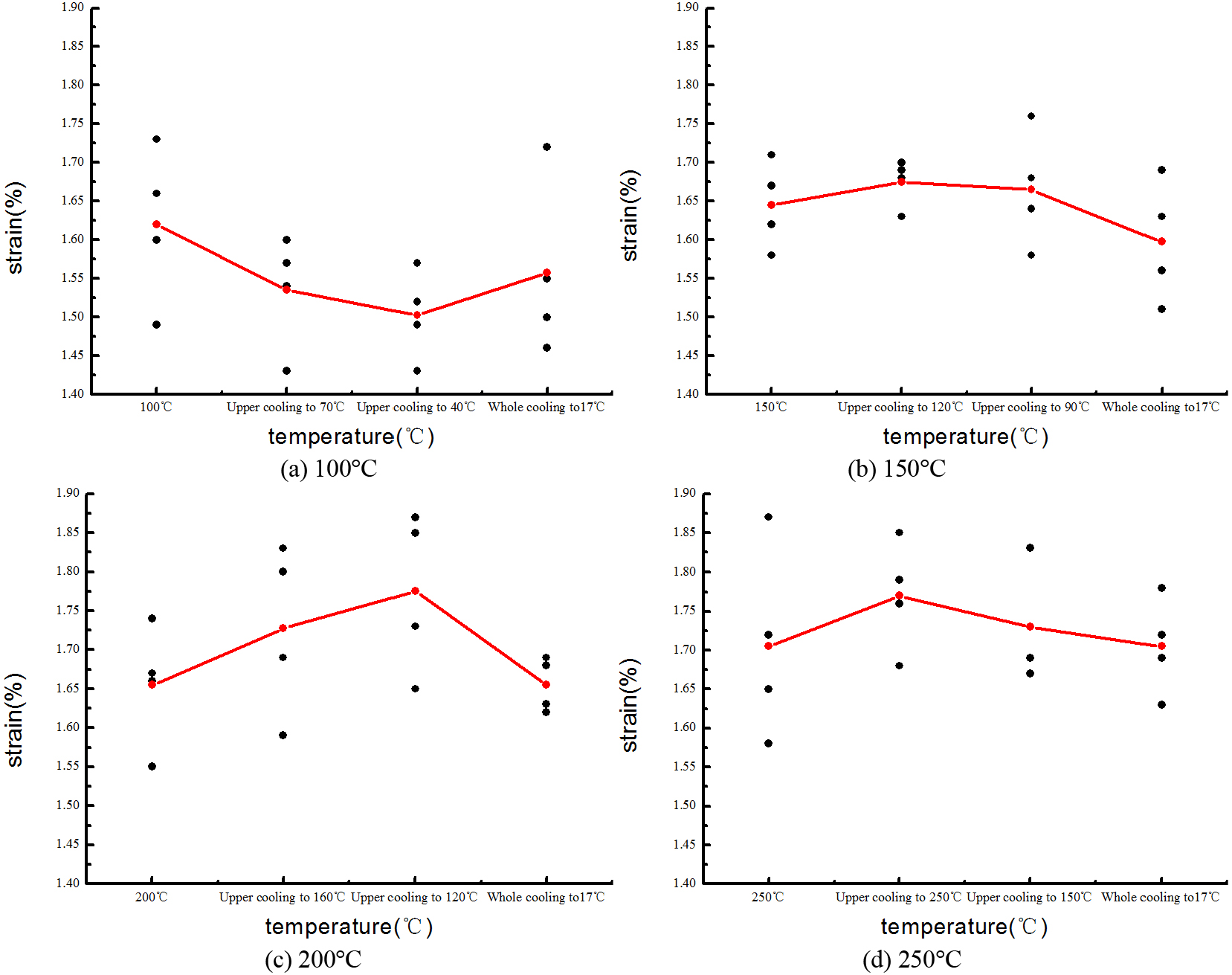
Granite’s peak strains at different temperatures under different cooling conditions. As the rock was heated from cooling to room temperature, the average peak stress was larger than the average value under a large temperature gradientand was not slightly larger than the value after cooling; As the temperature gradient increased, the rock’s average peak stress first dropped and then increased,preliminarily indicating that from high-temperature to small-temperature gradient, then large temperature gradient and finally room temperature, the micro-fractures in the rock grew gradually because of the heat-expansion and cool-contraction action induced by the variations in the temperature and temperature gradient, thereby decreasing the rock’s strength. However, when temperature/temperature gradient increased to a certain value, the rock strength can be improved.
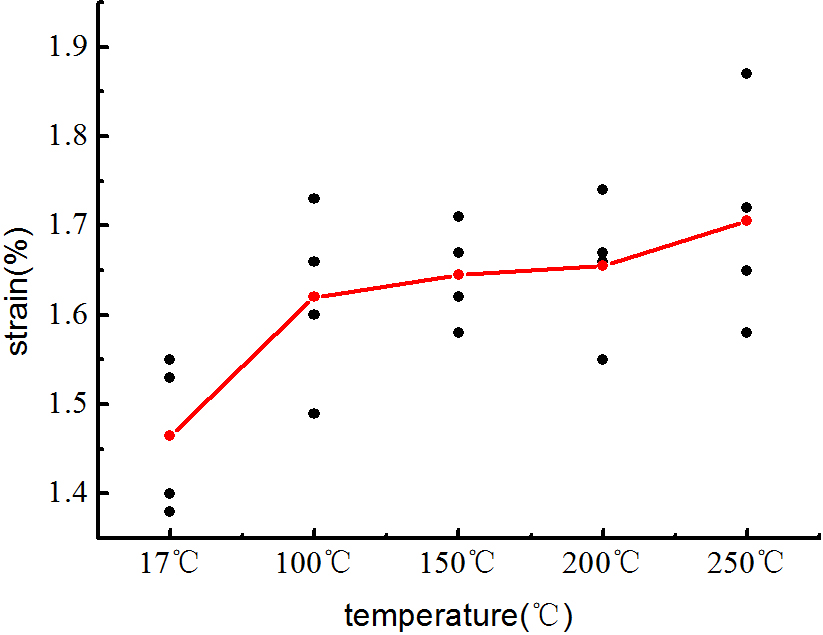
Granite’s peak strain characteristics at different temperatures
Figure 3 shows the rock’s peak strains under the uniaxial compression test at different temperatures. The granite’s peak strains at different temperatures are all discrete; however, the overall peak strain increased with increasing temperature.
Granite’s tangent modulus values at different temperatures.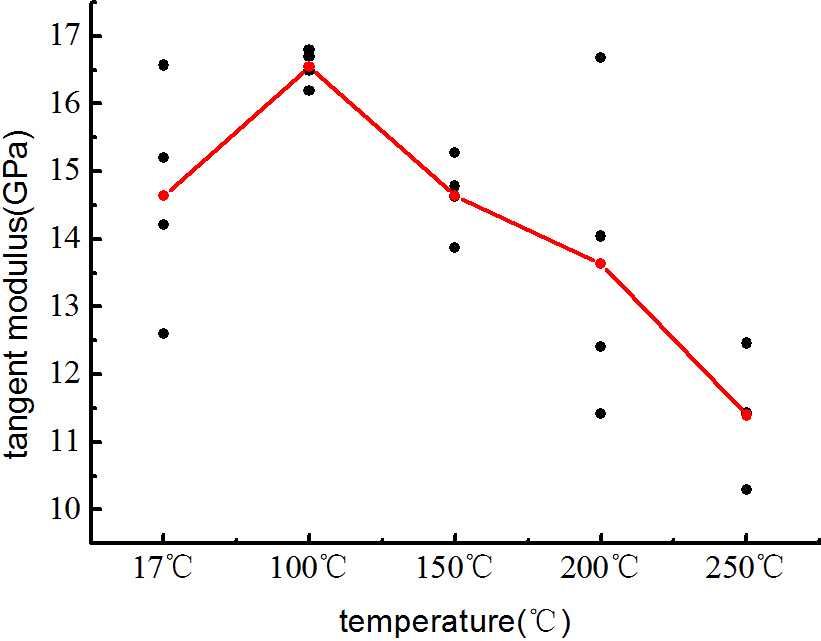
Figure 6 displays the variations between the rock’s peak strain and temperature under the uniaxial compression test at different temperature gradients.
Overall, under uniaxial compression, the granite’s peak strain first increased and then decreased with increasing temperature gradient except at 100
Tangent modulus
Granite’s peak tangent modulus characteristics at different temperatures
We then selected the straight line segment in stress – strain curve and calculated the slope of the tangent line of this segment. The slope can thus be regarded as the granite’s tangentelastic modulus.
Figure 7 shows the rock’s tangent modulus values under the uniaxial compression test at different temperatures. Similarly, the tangent modulus values discretely distributed at each temperature; however, the granite’s tangent modulus overall decreased with increasing temperature and reached the maximum of 16.545 GPa at 100
The observations under the uniaxial compression test are as follows.
The granite’s average tangent modulus increased as the temperature increased from 17
The granite’s average tangent modulus decreased as the temperature increased from 100
Granite’s peak tangent modulus characteristics under different temperature gradients
Figure 8 shows the variations between the rock’s tangent modulus and temperature under the uniaxial compression test at different temperature gradients. Overall, under temperature gradient, the granite’s tangent elastic modulus first decreased and then increased with increasing temperature gradient.
Granite’s tangent modulus values at different temperatures under different cooling conditions.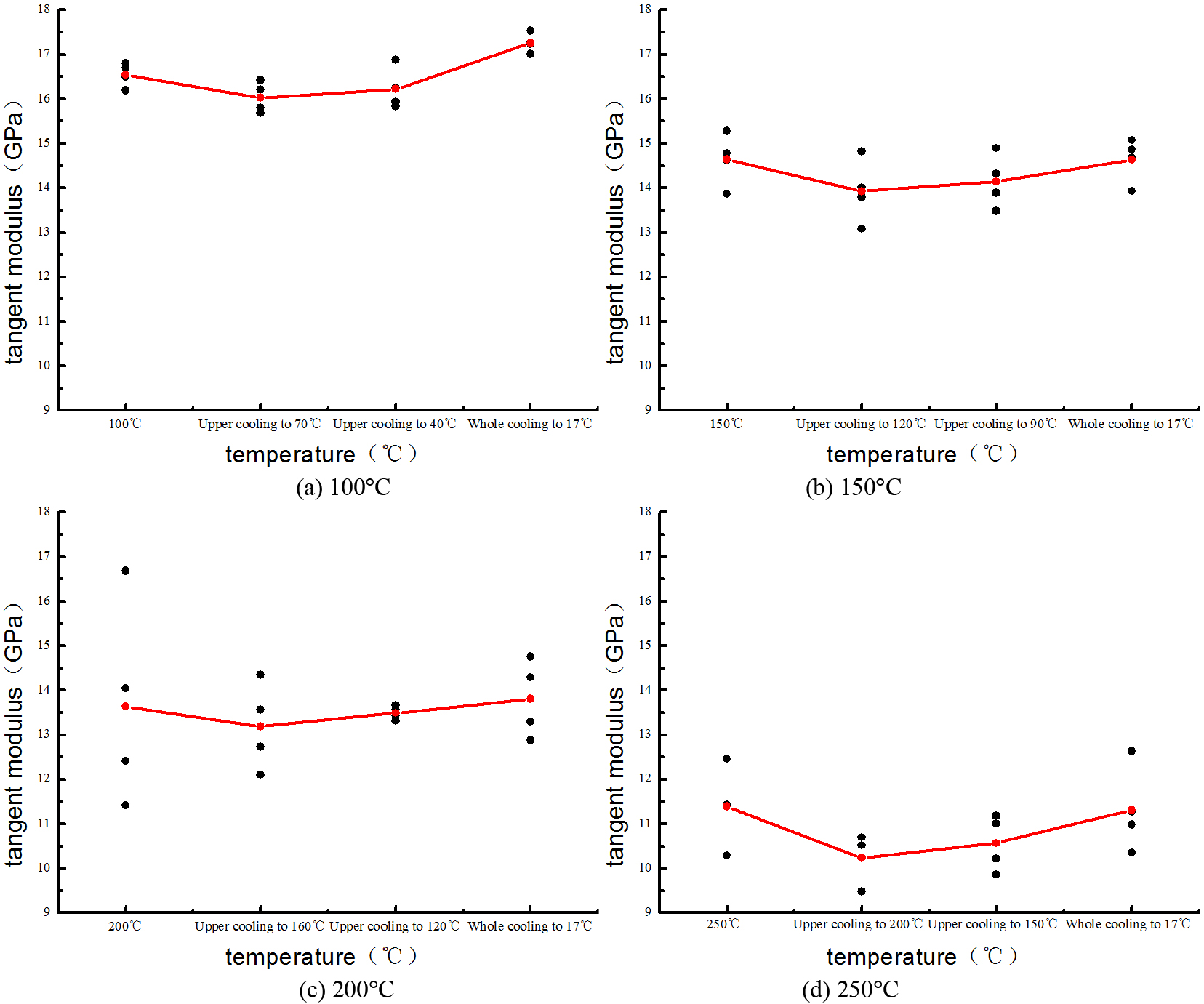
In this study, the granite was subjected to uniaxial compression test at different temperatures and temperature gradient conditions. The conclusions of this study are as follows.
During the uniaxial compression process, the granite’s failure can be divided into the following four phases – initial compaction phase, approximately elastic deformation phase, micro-fracture evolution phase, and failure phase. At high temperature, the granite’s peak stress first increased and then decreased with increasing temperature and reached the maximum at100 At high temperature, the granite’s peak strain increased with increasing temperature. After cooling, the granite’s peak strain at 100 At high temperature, the tangent elastic modulus of granite first increases, then decreases with the increase of temperature, and reaches the maximum value of 100
Footnotes
Acknowledgments
This work was financially supported by the Natural Science Foundation of Hubei Province, China (Grant No: 2014CFB879).