



Abstract
The driver’s selection process of parking lot will consider a variety of influencing factors, and consider different influencing factors for different travel purposes. In this paper, the driver’s travel purposes were divided into three categories according to the degree of emergency: emergency, routine and leisure. Four influencing factors of parking lot selection including walking distance, charge, parking index and parking convenience were selected, and ranked according to their sensitivity, and their sensitivity was analyzed by using the BP (back propagation) neural network, which provides a basis for the development of differentiated parking guidance and parking management measures to avoid the uneven parking due to random selection of parking lot and realize the maximum utilization of parking resources.
Introduction
The driver’s selection process of parking lot will consider a variety of influencing factors. Different influencing factors will affect the driver’s selection of parking lot to different extents and ranges. When the selection process needs to be expressed through more influencing factors, it needs to be determined according to the importance of the influencing factors. In this paper, four influencing factors of parking lot selection were selected, and their sensitivity was analyzed according to their importance [1].
The neural network system can study independently and feedback judgment continuously to accurately simulate the nonlinear influence of variables on the target variable. The neural network operation process is similar to that of human brain processing information. Repeated training can get different driver’s preference to parking lots, and judge and select the main influencing factors.
In this paper, the influencing factors of parking lot selection including travel purpose, walking distance, charge, parking index and parking convenience were selected, and ranked according to their sensitivity, and their sensitivity was analyzed by using the BP neural network, which provides a basis for the development of differentiated parking management measures.
BP neural network principle and data acquisition
BP neural network principle
The BP neural network is the most widely used multi-layer feedforward neural network for reverse propagation, structurally including the input layer, hidden layer and output layer in Fig. 1. This paper used the three-layer neural network to select the influencing factors [2, 3].
Structure diagram of three-layer neural network.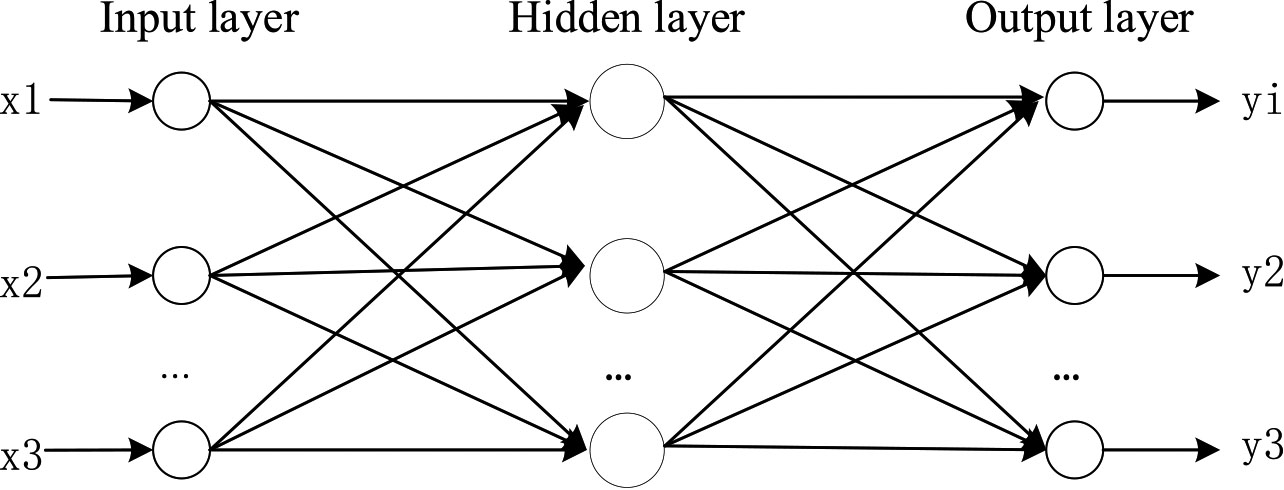
The basic principle of BP algorithm is that you can estimate the error of the previous layer through the error of the output layer [4]. Then you can estimate the error of the layer before the previous layer using this error. After the calculations, you can obtain the error of each layer. And you can obtain the expected result through repeated training and error adjustment. The steps are as follows:
Input the variable
Initialize, and randomly give the weight Calculate the input signal of each layer in the system according to the training sample Calculate the error Repeat the training until the error is within the allowable range. Verify the training results using test samples.
The influencing factors of parking lot selection include region category, walking distance, charge, parking index, parking purpose, and parking convenience [5]. This paper divided the parking lot region into four categories: Class I, Class II, Class III and Class IV regions according to the regional traffic conditions, economic conditions and land use in Table 1 [1]; The walking distance of parking lot was measured by the time the driver walks to the destination from the parking lot; The charge of parking lot was read directly according to the charge sign; The parking index of parking lot was calculated according to the electronic data of vehicles in and out of parking lot; The parking purpose and parking convenience were acquired through the parking behavior questionnaire [6, 7]. The common driver’s travel purposes include medical treatment, commuting, school, home, shopping, catering, entertainment, friends, travel, transfer, and others; They include emergency (medical service), regular (commuting, school, home), leisure (shopping, catering, entertainment, visit, travel), others (transfer, etc.) according to the emergency of travel purpose.
Class of parking lot region
Class of parking lot region
In this paper, 140 parking lots in Beijing were selected, and their basic data was obtained through questionnaires, field surveys and the collection and collation of electronic data.
In this paper, four influencing factors of parking lot selection were selected, and ranked according to their sensitivity, and their sensitivity was analyzed, which provides a basis for the development of differentiated parking guidance and parking management measures [8].
Sensitivity analysis procedure.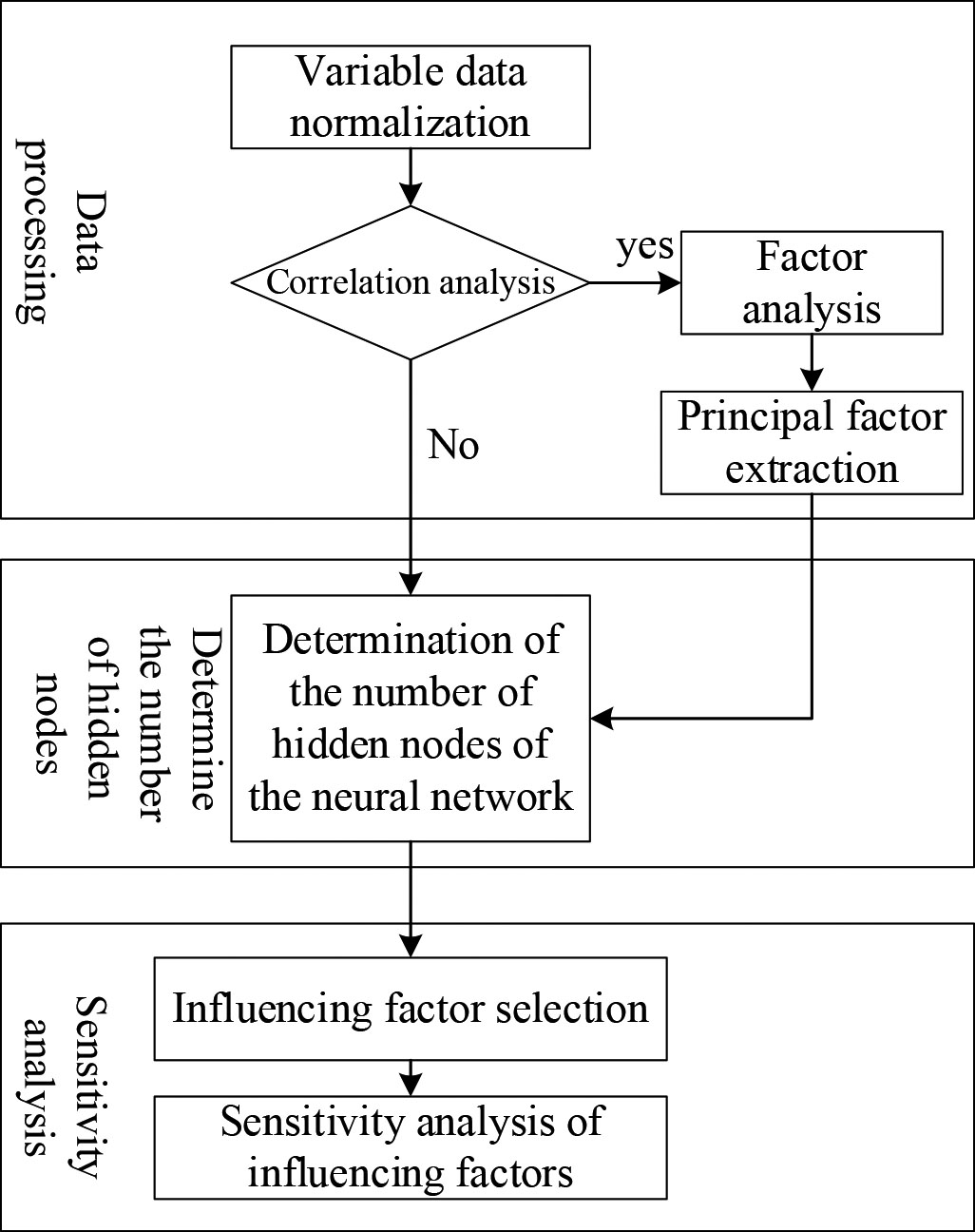
The sensitivity of the influencing factors of parking lot selection was analyzed by using the BP neural network, which included three steps, as shown in Fig. 2.
In this study, 140 parking lots covering the second ring road to the sixth ring road in Beijing were selected, which were evenly distributed and had certain regional representativity. The 140 parking lots include commercial, office, residential, hospital, school and so on, which are fully representative of the parking types. Their basic data was obtained through questionnaires, field surveys and the collection and collation of electronic data. The normalization and correlation analysis of the data of influencing factors were performed before their selecting using the BP neural network.
(1) Normalization
To ensure the accuracy of the neural network analysis, the differences between the different target variables must be eliminated. Therefore, independent variables needed to be dimensionless to unify the criteria, as shown in Eq. (2) [9].
The normalized data is shown in Table 2. Due to the large data, only the screenshot of partial normalized data was selected.
Screenshot of partial normalized data
(2) Correlation analysis
There may be some correlation between the independent variables if they were two or more. Before the analysis, the correlation between the independent variables needed to be tested first. If relevant, the public factor needed to be extracted to remove the correlation to ensure the accuracy of the results.
In this paper, the influencing factors of parking lot selection including walking distance, charge, parking index, parking purpose and parking convenience were selected and analyzed by means of KMO (Kaiser-Meyer-Olkin) and Bartlett tests in SPSS (Statistical Product and Service Solutions) [10]. The results are shown in Table 3.
Correlation test
The data in the table showed that the KMO statistic qubit was 0.201, which was less than 0.5. The value of the sphericity test of Bartlett was large, indicating that the selected 5 variables were not suitable for factor analysis. The Sig was 0.001
The determination of the number of hidden nodes is an important link in the variable selection of BP neural network, which directly affects the accuracy of the BP neural network analysis results. So far, there is no unified standard for calculating the number of hidden nodes. Considering the advantages and disadvantages of several common methods, this paper used the empirical and enumeration methods to determine the number of hidden nodes, which can effectively avoid the error of the analysis results due to the different number of hidden nodes. First, the number of hidden nodes was calculated, as shown in Eq. (3). Then, the hidden nodes were verified one by one using the enumeration method to determine the number of optimal hidden nodes [11, 12].
where
Based on the above analysis, the influencing factors of parking lot selection included region category, walking distance, charge, parking index, parking purpose, and parking convenience. To study the parking lot selection in different region category, take 5 variables outside the region category as the input variables for the BP neural network training samples and the test samples, the number of variables for its input layer was 5, and the output layer was whether to select the parking lot. Therefore, the output variables for the BP neural network training samples and the test samples was 2, and the number of hidden nodes was 4 to 13 calculated according to Eq. (3). Then, the enumeration method was used to calculate the prediction accuracy and error under the condition of different number of hidden nodes one by one and judge the optimal number of hidden nodes.
In this paper, the neural network in SPSS was used to analyze the data. The data was randomly divided into two categories of training samples and test samples according to a 1:1 ratio. 4 to 13 hidden nodes were selected in turn [13]. Through calculation, the square sum error and prediction accuracy were obtained, as shown in Fig. 3.
Prediction analysis. Note: In the figure, the horizontal axis represents the number of hidden layer nodes, and the vertical axis represents the error rate and accuracy respectively.
The optimal number of hidden nodes corresponded to small square sum error and high prediction accuracy of training samples and test samples. As can be seen from Fig. 3, the optimal number of hidden nodes in different region category is shown in Table 4.
Optimal number of hidden nodes
Taking Class I region as an example, its basic neural network was constructed in Fig. 4. Considering the influence of different region categories, the four region categories needed to be analyzed to compare the sensitivity of the influencing factors in different region categories.
Importance of influencing factors
Importance of influencing factors
Construction of BP neural network.
The basic data was randomly divided into two categories of training samples and test samples according to a 1:1 ratio. Through BP neural network analysis, the selection results of the influencing factors in four region categories were obtained, as shown in Table 5.
It can be seen from Table 5, for Class I region, the walking distance and charge had the greatest influence, and the charge had the highest sensitivity; For Class II region, the walking distance and charge had the greatest influence, and the walking distance had the highest sensitivity; For Class III region, the parking purpose and charge had the greatest influence, and the parking purpose had the highest sensitivity; For Class IV region, the walking distance and parking index had the greatest influence, and the parking index had the highest sensitivity.
Through sensitivity analysis of the influencing factors of parking lot selection in different region categories, the ranking of the sensitivity of influencing factors was obtained in Table 6.
Ranking of the sensitivity of influencing factors
Combined with the influencing factors of parking lot selection in different region categories, the recommendations for parking lot management were proposed from two aspects of parking lot characteristics and driver’s parking behavior in Table 7 to maximize the parking lot effectiveness and efficiency and achieve a win-win situation between the parking lot management party and the parking lot users [14].
Recommendations for parking lot management
Recommendations for parking lot management
In this paper, the sensitivity of the influencing factors of parking lot selection was analyzed by using the BP neural network. The number of hidden nodes in different region categories was determined, and the sensitivity of the influencing factors in different region categories was obtained. On this basis, the recommendations for parking lot management were proposed from two aspects of parking lot characteristics and driver’s parking behavior. Considering the difference of the sensitivity of the influencing factors of parking lot selection in different region categories, different parking management policies should be formulated for different regions, which provides a basis for alleviating the uneven utilization of parking resources and the difficulty of parking.
Footnotes
Acknowledgments
The work was financially supported by Doctoral Research Fund project of Shandong Jianzhu University in 2018 (X18054Z).