



Abstract
At present, the situation of coal mine safety production is still grim. The key to solve the problem is to analyze the risk of management activities in the process of coal mine safety production. This paper takes the management activities in the process of coal mine safety production as the research object. Firstly, according to the coal mine safety production standardization management system, the safety production management activities are carried out layer by layer. Then, the Failure Mode and Effect Analysis (FMEA) is used to identify the human errors that lead to the failure of management activities at all levels of coal mine. Furthermore, the Fuzzy Set Theory is used to determine the evaluation results of experts on the risk level of coal mine safety production management activities. Combined with Bayesian network (BN), the risk assessment model of coal mine safety production management activities is established. Through the model, the risk probability of coal mine enterprise management activities is accurately calculated. According to the evaluation results, the risk of management activities in coal mine safety production is analyzed.
Introduction
The safety of coal mine is a result of reliability, which must be attributed to rigorous management. Today, coal mine safety management is biased towards the middle and late stages of supervision and governance, such as emergency handling, and rehabilitation, etc. As the main body of responsibility, the coal mine has not paid enough attention to the active safety management activities that are integrated into each process [1].
The causes of coal mine safety accidents can be divided into the unsafe behavior of human and the unsafe state of objects. The causes of coal mine safety accidents can be divided into the unsafe behavior of human and the unsafe state of objects. Coal mine accidents such as gas, water damage, rock bursts, etc., are triggered by surface source problems, and must be caused by some deep root causes that have not been resolved. Research shows that human unreliability is easy to produce human error, which is difficult to improve in a short time. If there are “incomplete operation standard”, “insufficient guidance of the site manager”, “the operator mental and technical body disorder” and other situations, people will appear “memory error”, “error of judgment”, “abnormal movement” and other states. Data shows that more than 85% of industrial accidents are directly or indirectly caused by human factors. According to scholars’ research, 90% of coal mine accidents are caused by human’s unsafe behavior, and 10% of the unsafe state of objects are also caused by human errors in the final analysis [1, 2]. Therefore, it is necessary to fully identify the human errors in the process of coal mine safety production in order to effectively prevent accidents.
Ma thought that it was the wrong behavior of people that led to the failure to achieve the expected results, which caused the adverse consequences [1]. Yin believed that only by evaluating and managing human’s unsafe behaviors could the safety production level of modern coal mining enterprises be further improved. After research, Fu proposed a behavior safety model, which believed that there were two main reasons for the occurrence of safety accidents: the unsafe behavior of employees in enterprises and the unsafe behavior of enterprise organizations [2, 3]. Lan used the CREAM theory to trace the antecedents of human error in coal mine accidents considering the human error mode as beginning, constructed the index system of human error causative factors from the traced reasons, established the fuzzy complementary matrix, obtained the index weight and made a comprehensive evaluation on it [4]. Based on the statistical results of 362 major coal mine accidents, Liu et al. established the human factor analysis and classification system of coal mine (HFACS-CM), and analyzed the unsafe behaviors of coal mine workers and their related influencing factors [5].
The deep cause of coal mine safety risk is that the safety management activities at all levels and processes in the enterprise system deviate from the target, resulting in functional failure; While the safety management activities have abnormal deviations, the traceability mechanism is caused by the injection of human errors. The root causes of coal mine accidents are mostly caused by the failure of functions caused by errors in the management activities of all levels and processes. The propagation and spread of human errors in the system will continue to cause the failure of management functions at all levels. Problems and omissions in each process will not only diverge horizontally, but will also evolve step by step, even cross-coupling, and follow the evolution path of “error
Risk identification of coal mine safety production management activities based on FMEA
Failure mode and effects analysis
In the initial stage of error prevention in coal mine safety management, it is necessary to identify and evaluate errors first, and the most critical thing is the characterization and description of error mechanism. In the past, the traditional HRA models are generally based on human decision and behavior models, which can only evaluate and predict human error probability in a certain type of scenario, but fail to fully consider the impact of error mode on the system and the severity of consequences. FMEA can make up for this deficiency, and has advantages in hierarchical quantitative evaluation. FMEA is a reliability analysis tool, which was first applied to the Apollo moon program of the United States [7, 8]. In this paper, FMEA is used to analyze all the possible failure modes of management activities in the process of coal mine safety production and their causes and effects.
FMEA adopts risk priority number (RPN) to assess the risk of failure, and RPN is the mathematical product of three parameters: Severity (S), Occurrence (O) and Detection (D).
Coal mine safety production management activities
The establishment of a coal mine safety management error identification and risk assessment framework shall cover all aspects of human, machine, environment, and shall cover all technological processes, equipment and facilities and workplaces. The State Administration of Coal Mine Safety promulgated the “Basic Requirements and Scoring Method for Coal Mine Safety Production Standardization Management System (2020)”. The system is the latest coal mine management system, based on the ISO9000 management system, more emphasis on the management of safe production. The system ensures the comprehensiveness of the evaluation, and also reflects the hierarchy and structure of the causal chain of risk factor transmission. That is, the potential management function failure risk caused by each management activity error under each level and each process can be considered. The basic requirements of the framework of this management system can realize the unification of software and hardware, dynamic and static, process and result, which is more conducive to the safety management of the system.
The FMEA method is integrated into the standardization management system of coal mine safety production, and the identification and analysis framework of coal mine safety management errors is constructed [6]. FMEA is used to analyze the multi-attribute of each management activity error, and then follow the thought that the fault attribute causes the failure of the management function, and evaluate the risk of the management activity through the fuzzy Bayesian method integration.
There are eight elements, including concept objectives and mine manager’s safety commitment, organization, safety production responsibility system and safety management system, employee quality, safety risk hierarchical management and control, accident hidden danger investigation and management, quality control, and continuous improvement.
First of all, according to the semantic structure of the basic requirements of coal mine safety production standardization standard, according to the three relative levels from high to low (strategic layer, managerial layer, operational layer), the enterprise safety management activities are decomposed and expanded step by step. The sub-project management activities of the eight categories are grouped into the strategic activities, then the requirements of the next level are the managerial activities, and the specific activities of the basic requirements under the terms are the operational activities. Here, the first category is taken as an example: the concept objectives and mine manager safety commitment, as shown in Table 1.
Decomposed and expanded table of coal mine safety production management activities
Decomposed and expanded table of coal mine safety production management activities
When the failure mode of management functions is traced back, it is generally that one error is caused by multiple errors. For ease of presentation, after the safety management activities are decomposed into three levels of management activities, the inconsistency between the lower-level management activities and the requirements of the clause is used to describe the reason why its upper-level management activities do not conform to the clauses. That is, the failure of the upper-level management function is caused by the inconsistency of the requirements caused by the errors of the lower-level management activities. See Fig. 1 for an example. For specific activity requirements, please refer to coal mine safety regulations and other documents.
Example of FMEA analysis of three level management activities.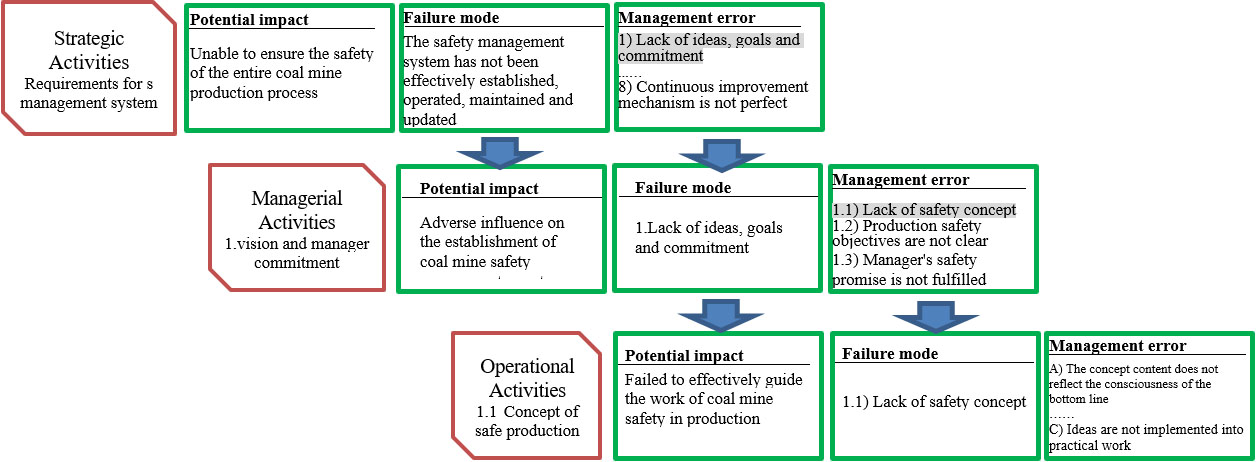
The evaluation team is composed of coal mine safety management experts. They will complete the analysis for three-level management activities based on the FMEA analysis framework table. Taking a managerial layer indicator as an example, the management function requirement is the attribute requirement of managerial activity indicator, the function failure of managerial activity is the potential failure mode, and the error of operational activity is the potential failure reason of managerial activity, as shown in Table 2.
FMEA analysis form
Management error and management function failure is a fuzzy topic, but we try to use scientific methods to quantify as much as possible, so as to get risk prevention and improvement ranking. Management errors cause a failure probability of management function that is different from industrial operation, can use clear representation on the experimental data, the involved person’s activities, because it is not intuitive survey and statistics, and because of the different industries, and the characteristics of the enterprise, more difficult to quantify and unification, so, can only be combined with their own characteristics, invite 4–5 experts from key activities to conduct comprehensive evaluation. So fuzzy mathematics and Bayesian integration are used here. Because of the advantages of fuzzy theory in knowledge representation and the excellent reasoning ability of Bayesian network, the organic combination of the two can greatly improve the application range of FMEA analysis method. According to the basic requirements of coal mine safety production standardization standard, the management activity errors of each level and each process are identified. Further, the S, O, D and other attributes of each error are quantitatively analyzed by means of quantitative method, and then integrated into RPN of the errors, so as to determine the work focus and priority for the next step of error prevention.
Bayesian network model
There are several shortcomings of traditional FMEA analysis. It is difficult to obtain objective values of the three parameters. In addition, the product of the three parameters may lead to rank reversal, that is, the less severe failure mode may obtain higher RPN than the severe failure mode. In essence, FMEA is only suitable for single point fault analysis, but not for multi-point or combined fault analysis [9]. Therefore, it is better to combine FMEA with other failure mode analysis methods in risk diagnosis and assessment.
BN is a kind of uncertainty processing model that simulates the human reasoning causal relationship [10]. Bayesian network expresses the relationship between variables in the form of causal graph, and realizes the failure mode and effect analysis of complex system, which is suitable for fault cause tracing and failure risk evaluation. According to the conditional independence hypothesis and chain rule among variables, the joint probability distribution of variable set represented by BN is as follows:
where,
Fuzzy evaluation of safety production management activities failure
(1) Definition and expression of fuzzy evaluation standard
The traditional FMEA gives a definite value for the attributes S, O and D of each failure mode according to engineering experience and criteria. In the evaluation of the failure mode of management functions, it is difficult to give a definite value because of a lot of fuzziness in this process, or the definite value loses a lot of fuzzy information. FMEA evaluation using fuzzy set theory is more consistent with the actual situation. According to the agreed criteria and their own experience, the experts give a fuzzy score, which is a range of grades, which is used to form a fuzzy number.
According to the recommended rating standards for the three attributes in references [10, 11, 12], the fuzzy rating standards are jointly agreed upon by an experienced FMEA expert group responsible for mining, tunneling, machinery, transportation and ventilation after consultation. The language variables of these ratings are represented by trapezoidal fuzzy numbers. Compared with traditional FMEA, these language variables have good continuity. The basic knowledge of trapezoidal fuzzy numbers is not described here.
The risk degree R of management activity failure is mainly divided into four grades {
Fuzzy rating standard
Fuzzy rating standard
(2) Expert fuzzy rating expression and fuzzy transformation
Triangular fuzzy number is used to represent expert’s fuzzy rating because of its simple expression and convenient operation. After the FMEA expert group rated the S, O, and D of the activity error in a certain failure mode, the results of each expert are summarized, and through the appropriate algorithm to synthesize the expert evaluation opinions, and the comprehensive evaluation result of the expert group is finally obtained.
The evaluation fuzzy number given by the expert group intersects with the corresponding evaluation language variable set. According to the membership function equation of the trapezoidal and triangular fuzzy numbers, the trapezoidal membership function intersects with the triangular fuzzy number, obtains the membership degree of the highest point of the intersection, and obtains the fuzzy language set evaluated by the experts for S, O and D. In fact, it is to transform the fuzzy subset form on 0–10 continuous score interval into discrete fuzzy subset form under the corresponding language variable rating.
For example, the FMEA expert group gave a rating opinion on the risk identification degree D. After calculating the comprehensive rating result D
Fuzzy IF-THEN rules can simulate the general thinking logic of human and replace the expression of uncertain information data [14, 15]. In the fuzzy IF-THEN rule Eq. (5),
In practical application, the slight change of fuzzy rating results given by FMEA expert group is likely to result in completely different conclusions. Therefore, this paper used the confidence structure to increase the confidence for the conclusion of fuzzy rules, so as to reflect the relative importance of the relationship between events.
Safety management activity decision-making is originally a soft science, which has the characteristics of complexity, ambiguity, uncertainty, and difficulty in objective quantification. It also means that the prior probability of various management errors cannot be objectively observed directly from experimental data. Therefore, it is necessary to focus on the fuzzy comprehensive evaluation opinions of experts. Here is only one kind of working idea. In practice, the failure evaluation grading standard of management activities should be formulated according to the actual work of each unit.
In order to rank all error risk evaluation, the fuzzy evaluation opinions of expert group are first converted into discrete fuzzy subset based on rating standard by fuzzy transformation, and then the RPN confidence rule base of management activity failure is established. The three parameters S, O and D obtained from the FMEA table can be used as the premise attribute of the confidence rule, error RPN is the output result, the premise attribute is determined as the parent node, and the result is its common child node, so as to build the Bayes network model of RPN confidence rule, and use the Probabilistic reasoning technology of Bayes network to synthesize and defuzzy the rules. Therefore, the RPN clear value of each error is obtained, and the priority of error prevention is determined after considering the decision criterion of maximizing cumulative revenue within the cycle.
According to the actual situation of a coal mine enterprise, FMEA expert group formulates the following rules according to the fuzzy rules of RPN confidence structure:
According to the established fuzzy rules of RPN confidence structure, the fuzzy rule base of RPN confidence structure for FMEA analysis of safety production management activities failure in coal mining enterprises is established, as shown in Table 4.
RPN confidence structure fuzzy rule base
In FMEA analysis, the determination of RPN value by S, O and D is a nonlinear problem, which can be solved by BN reasoning [16]. After the BN model is built, its network structure and network parameters have been learned, so that according to different structure levels, based on the prior probability of nodes, the probability of other nodes can be calculated by reasoning [17, 18].
The steps of BN Reasoning of Confidence Structure Fuzzy Rules are as follows.
(1) Construct BN structure
The root node is defined as S, O, D of coal mine safety production management activity failure, and these three parameters have the premise attribute of confidence structure fuzzy rules. The leaf node is defined as risk degree R, and it has the conclusion attribute of confidence structure fuzzy rules in Fig. 2.
Bayesian network structure construction diagram.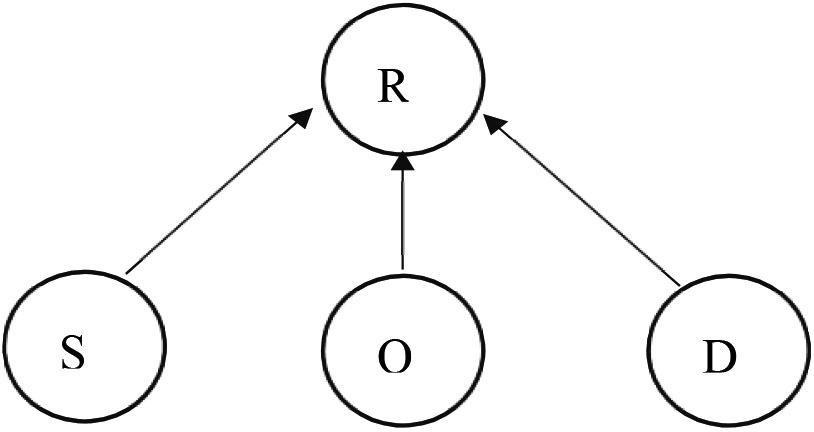
(2) Determine BN conditional probability table
The prior probability and conditional probability tables of BN nodes are obtained from the confidence structure fuzzy rule base. According to Table 4, the transformation from fuzzy rule base of RPN confidence structure to BN structure can be realized in Table 5. The evaluation of risk degree is to calculate the marginal probability of sub node R. The conditional probability
Conditional probability table of R
After obtaining the conditional probability table of node R, the probabilities of nodes S, O and D need to be calculated. In BN structure, all nodes need to satisfy that the sum of the probabilities of any node at all different states is 1. In order to make
where
(3) Calculate RPN value
After normalization, the probabilities of S, O and D nodes are
(4) De-fuzzy and get the clear number of RPN
The weighted average method is used to de-fuzzy, that is, according to the level of risk in the fuzzy rule base of RPN confidence structure, the appropriate weight coefficient W
Taking the actual production management of TX coal mine in Shanxi Province as an example, through risk identification and evaluation, the human error in the management activities is judged, and the risk degree of each management activity is sorted to determine the key risk factors, so as to facilitate the enterprise to put forward the error prevention scheme in the next production management process [6, 19, 20].
(1) According to the Basic Requirements and Scoring Method for Coal Mine Safety Production Standardization Management System (2020), the FMEA expert group is composed of four experts in charge of safety and quality work to evaluate the potential failure modes of management activities, and the comprehensive rating results of the expert group are obtained by arithmetic average method in Tables 6 and 7.
Experts’ assessment of the S, O, and D levels of risk layer
Experts’ assessment of the S, O, and D levels of risk layer
FMEA analysis table comprehensive rating results
(2) The comprehensive rating results are transformed into discrete fuzzy language subsets, then
Partial RPN confidence structure fuzzy rule base
(3) Establish the RPN confidence structure fuzzy rule base. The RPN confidence structure fuzzy rule base involved in this section is shown in Table 8. Convert it into conditional probability, and then calculate the marginal probability
The risk level of
(4) Select the risk degree weight coefficient matrix (
Risk ranking of errors in management activities
Analysis model of risk layer indicator 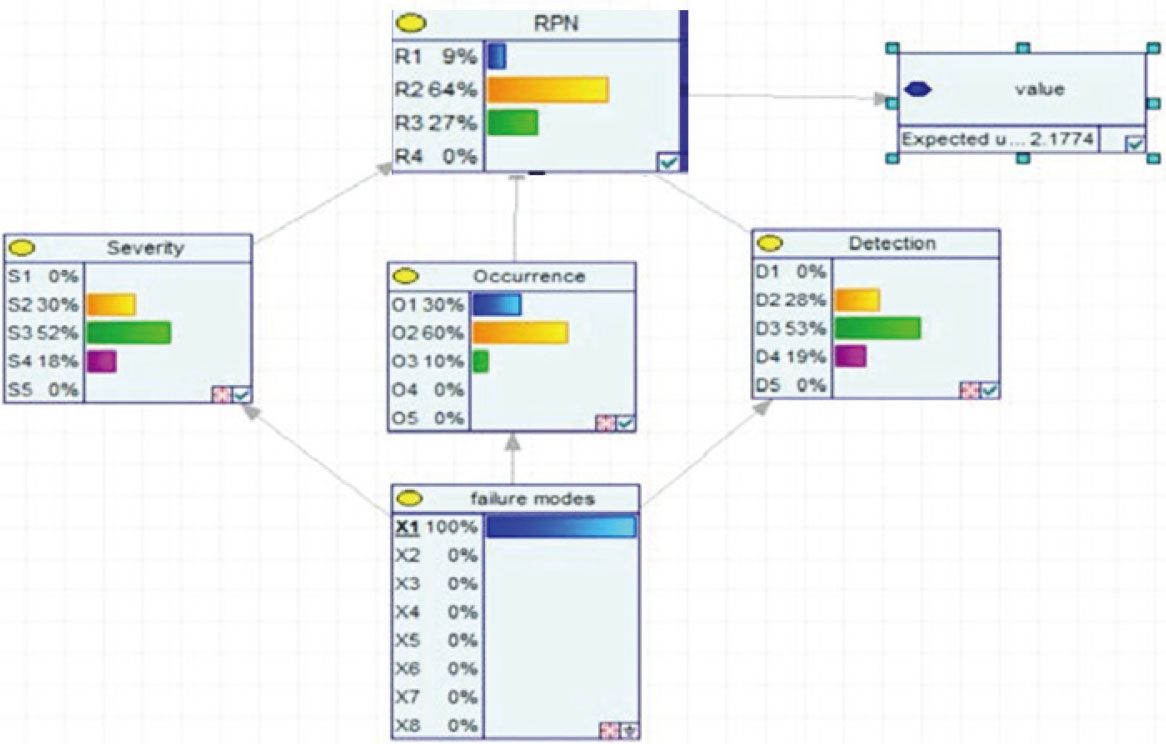
The BN model in Fig. 3 is constructed by using the Bayesian tool GeNIe, and the FMEA-BN analysis model is carried out on the risk layer index
Similarly, the above process can be applied to other management elements of coal mine safety production standardization. By using FMEA method combined with fuzzy BN, the risk degree of the indicators at all levels can be analyzed after level expansion, so as to effectively and accurately locate the management activities with high risk, and prevent the possibility of their failure, thus to lay the foundation for the error prevention work in the next step.
Managing activity errors and functional failures is a murky topic, but managers try to quantify as much as possible in a scientific way to rank risk prevention and error prevention improvements. In traditional FMEA analysis, by calculating the product of Severity (S), Occurrence (O), and Detection (D), the RPN of each error cause is obtained, which is to indicate the priority of improvement measures. However, the relative importance of the three parameters cannot be defined, and the subjective factors are strong. In risk diagnosis and assessment, it is better to combine the FMEA with other analysis methods.
In this paper, BN theory is applied to FMEA analysis of coal mine safety production management activities. BN reasoning can be used to effectively realize the synthesis of RPN confidence structure fuzzy rules. The efficient reasoning ability can also solve nonlinear problems well. The fuzzy set theory is used to conduct fuzzy treatment for each risk factor assessment, to obtain the prior probability of BN node, which increases the objectivity.
Firstly, according to the coal mine safety production standardization management system, the basic framework of indicators is constructed, and the safety production management activities are carried out step by step. With the help of FMEA analysis, the failure modes of coal mine safety production management activities at all levels are identified. The managerial activities in the three levels of the basic framework is used as the failure mode in FMEA, and the operational activities is used as the failure mechanism leading to the failure mode. Then, through the fuzzy transformation of trapezoidal membership function and triangular fuzzy number, the three parameters S, O and D are comprehensively evaluated, and the evaluation results are transformed into fuzzy subsets. Furthermore, the fuzzy rule base of RPN confidence structure is established and BN reasoning is carried out to get the risk degree of various management activities failure. Finally, the weighted average method is used to de-fuzzify, and the clear number of each risk degree is obtained. Through objective probability reasoning, the order of human error risk in safety production management activities is obtained, that is, the priority of next step improvement, so as to achieve accurate, efficient and comprehensive coal mine safety production risk management.
This method can be widely applied to other engineering fields. The reason is that the management activities of each industry run through the whole process. The need for management risk control and improvement of management level is universal to any industry. This article is mainly to prevent potential management errors, rather than post-accident analysis, so it only provides a kind of daily operation management ideas and tools based on management architecture, and each enterprise should combine its own characteristics and management procedures to use.
The procedures of “Basic Requirements and Scoring Method for Coal Mine Safety Production Standardization Management System (2020)” may not be applicable to other industries, but other industries must also have the corresponding management system and procedures. As long as there are systems and procedures, this method is suitable. The probability in this paper is the relative probability obtained by using expert evaluation language to resolve ambiguity, not the real probability of risk events, and with the implementation of error prevention measures, the probability is expected to decline. Therefore, it is still necessary to continuously revise the coal mine safety management risk based on the real statistical probability of accidents to improve the persuasiveness of conclusions.
Coal mine safety management research at present, still generally focuses on “result control”, “process control” is relatively small, insufficient “source control”, this study is to prevent and services, through active model for management errors lead to the failure of safety management functions of feedforward control and prevention, to reduce force failure. In future studies, sensitivity analysis and most probable chain analysis are considered. Methods to reduce RPN value need to be further studied and summarized. For management errors with higher RPN value and higher risk level, and explore how to reduce the interference of human error, reduce the severity and frequency of each failure mode, and make it easy to detect and control. The methods of risk prevention will be discussed from these perspectives, and the ability of quality and safety management will be further improved.