



Abstract
This paper proposes a spray control system with variable particle size to address the inaccuracy of droplet size control in the existing spray dedusting system. A PID control algorithm with stable air and water pressure is adopted to ensure droplet size uniformity. An experimental device of the droplet control system is built in the laboratory to verify the algorithm’s effectiveness. Experiments were conducted using PLC as the core controller to verify the influence of different types of nozzles on the droplet size under the same air pressure and water pressure through experiments. The results show: (1) the systems droplet size range is 8–200
Introduction
With the continuous expansion of the industrial production scale, a large amount of dust has been produced in the production process. Dust is a critical factor that causes production safety hazards and occupational diseases, and dust control has become a critical problem that should be solved [1, 2, 3]. The most common dust removal methods are wet dust, filter dust, and electrostatic dust removal methods. The wet dust removal method has the advantages of simple equipment, convenient use, and good dust removal. Therefore, spray dust removal is commonly used to control the dust produced at coal production sites [4, 5, 6].
Presently, industrial research on spray dust removal systems mainly focuses on the adsorption mechanism of fog drops and dust, structure design of spray heads [7, 8, 9, 10], dust removal medium, and so on. Zhou et al. [11] conducted an in-depth study on the coupling relationship between dust and fog drop fields in fully mechanized caving faces with respect to the study on the adsorption mechanism of fog drops and dust. Through experimental study, it was found that the best particle size of fog drops for capture dust was 15–75
To summarize, the spray dust removal system has been thoroughly studied with respect to spray nozzle and mediums, etc., and a good dust removal effect has been obtained. However, studies for the different sizes of fine droplets of the dust removal system are still limited, and the study of spray dusting automation intelligent system design is also limited. Most of the spray dust removal systems currently in use in engineering are based on a fixed water pressure or a fixed air-to-water ratio, and they cannot perform adaptive control of droplets in response to changes in the particle size and concentration of environmental dust. Therefore, the design, and development of spray dusting intelligent automation system, to improve the underground dust removal equipment automation and intelligent level, has good practical significance according to the standard of national mine construction requirements. By combining existing research results, this paper proposes to design a spray system that can automatically adjust the air-water ratio, and the particle size distribution of the spray system can be changed at any time as needed, which will provide a more flexible solution for the existing dust removal system.
General system scheme
Based on the above analysis, a spray dust removal scheme with variable sizes of fog drops is proposed. The spray dust removal system with variable particle size is mainly composed of a gas system, water system, control system, and human-computer interaction system. According to the literature [2, 3], the best dust removal effect occurs when the fog size drops to the particle size of dust. To achieve optimal dust removal efficiency, the size of fog drops can be changed according to the distribution of dust particle size by adjusting the water or air pressure in the system.
Spray generation system
Figure 1 shows the spray-generating device of the spray dust removal system. The system is divided into two parts: the water system and the air system. The water system consists mainly of a water tank, pump, electromagnetic valve, water flow measuring meter, water pressure gage, and check valve. The gas path system consists mainly of an air compressor, gas storage tank, air drying device, gas proportional valve, gas flow meter, barometer, and check valve. The water pump in the water tank transports compressed gas to the spray system’s passage at a certain pressure, and the air compressor transports compressed gas to the spray system’s passage at a certain pressure. The gas-liquid two-phase nozzle ejects droplets because of the synergistic action of the water and gas passages.
Schematic diagram of spray dust removal system. 1 – Water tank; 2 – Pump; 3 – Electromagnetic valve; 4 – Water flow; 5 – Water pressure gauge; 6 – Check valve; 7 – Air compressor; 8 – Air storage tank; 9 – Gas drying device; 10 – Gas proportional valve; 11 – Gas flow meter; 12 – Barometer; 13 – Gas-liquid two-phase nozzle.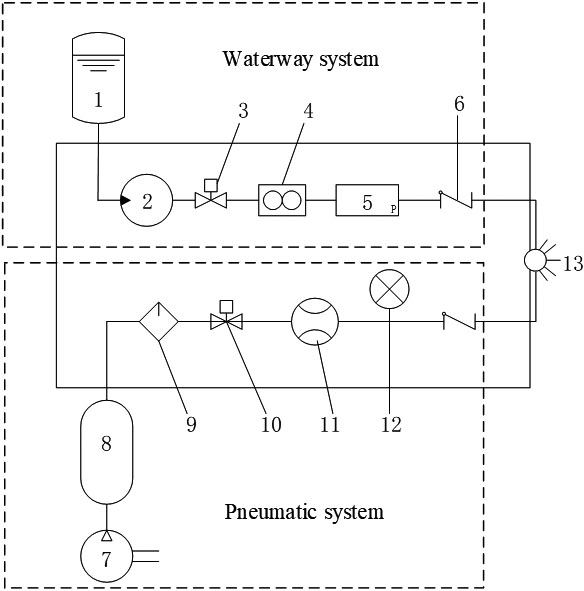
Based on the aforementioned control requirements, the system uses the Delta DVP-20SX2IIT PLC as core controller. The ITV1050-312L gas proportional valve is used to control the air pressure in the gas path. The PM-02 solenoid valve is used to control the water pressure in the waterway. The XTL-3210 directing current water pump is used to provide a continuous and stable water source for the waterway. The water and gas pressures are monitored using an HY-131 pressure gage. The gas flow meter, model CAFS 4000–500, is used to realize the measurement of gas flow. To realize the waterway water flow monitoring function, a pulse-type water flow meter is used. To realize the remote monitoring function, the Delta DX-2300LN Ethernet cloud router is used in the design.The hardware figure of the control system is shown in Fig. 2.
Hardware figure of control system.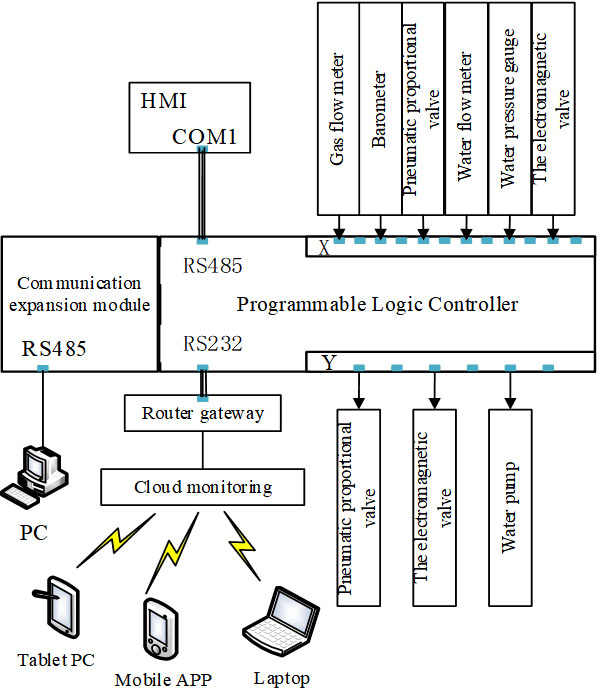
Water and air pressures should be controlled to spray droplets with uniform particle sizes. The air-water ratio (the ratio of air pressure to water pressure) is a critical factor that affects the size of fog droplets. A PID control algorithm based on the change of air pressure with water pressure is proposed to produce droplets with stable particle sizes. Water pressure control is realized by changing the working voltage of the DC water pump, and the air pressure is realized by changing the opening of the gas proportional valve.
First, the current water pressure
Where,
Second, the pressure value has a coefficient
Finally, the pressure sensor collects the current pressure value
Where,
Then, redo all the steps above. Its control block diagram is shown in Fig. 3.
Control block diagram of fog droplet.
We set up an experimental device for fog droplet size control in the laboratory to verify the effectiveness of the system, as shown in Fig. 4. Using aluminum and tarpaulin, we built a confined space with length, width and height of 2200 mm, 1200 mm, and 1200 mm respectively to simulate the spray of water mist. We selected the Rise-5001 spray laser size analyzer to accurately measure the particle size of fog drops, as shown in Fig. 5. It is a laser size analyzer that was specially designed and developed to meet the requirements of the droplet measurement, which adopts the Fraunhofer diffraction principle and full-range Mie scattering theory. It can measure the particle size distribution of droplets in real-time and has the advantages of fast test speed, wide measurement range, and automatic operation. The droplet size can be measured in the range of 0.1–1200
Influence of different air pressure and water pressure on droplet particle size distribution
Influence of different water pressure on droplet size distribution under the same air pressure
Under different experimental conditions, the size distribution produced by the atomizing nozzle will change. When the SK508 atomizing nozzle is used at an air pressure of 0.6 MPa, the size distribution table under different water pressures is shown in Table 1. Among them, D10 represents the droplet size corresponding to 10% of the volume distribution, D50 represents the size corresponding to 50% of the volume distribution, D90 represents the size corresponding to 90% of the volume distribution, D3 represents the size corresponding to 13% of the volume distribution, and D99 represents the volume. The droplet size corresponds to 99% of the distribution, and Dav represents the average droplet size. Figure 6 shows the distribution of fog droplet size under different water pressures at the air pressure of 0.6 MPa.
Distribution of fog drop particle size under different water pressure conditions at 0.6 MPa
Distribution of fog drop particle size under different water pressure conditions at 0.6 MPa
Physical diagram of an experimental device for particle size control of droplet.
Rise-5001 Spray laser particle size meter.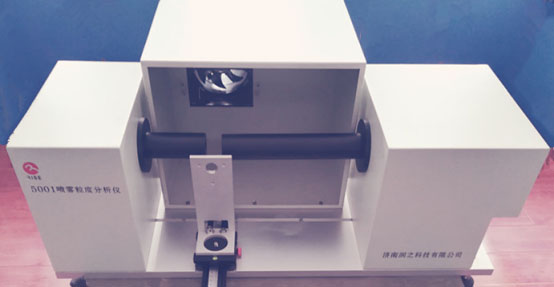
As shown in Table 1 and Fig. 6, when the air pressure is constant, as the water pressure increases, the size distribution of fog drops will shift to the right. This shows that the size of fog drops is increasing. When the water pressure changes from 0.1 to 0.2 MPa, the size distribution diagram of fog drops does not shift to the right, indicating that when the water pressure changes from 0.1 to 0.2 MPa, the particle size of fog drops does not change. When the water pressure changes from 0.2 to 0.3 MPa, the particle size distribution of fog drops will change dramatically, and the particle size of fog drops will change significantly.
Diagram of fog droplet size distribution under different pressures at a water pressure of 0.1 MPa
Distribution of fog drop particle size under different water pressure conditions at 0.6 MPa.
Table 2 shows the distribution of fog droplet particle size under different air pressures when the water pressure is 0.1 MPa. Figure 7 shows the distribution of fog droplet particle size under different pressures at a water pressure of 0.1 MPa.
As shown in Table 2 and Fig. 7, when the water pressure is constant, the size distribution of fog drops shifts to the left as air pressure increases. This shows that the size of fog drops is decreasing. When the air pressure changes from 0.1 to 0.2 MPa, the size distribution diagram of fog drops shifts to the left significantly, indicating that when the air pressure changes from 0.1 to 0.2 MPa, the size of fog drops decreases significantly. When the air pressure changes from 0.2 to 0.6 MPa, the size distribution map of fog drops will change slightly, and the size of fog drops remains constant.
Distribution of fog droplet particle size under different air pressures at a water pressure of 0.1 MPa.
When the ratio of air-water pressures is different, different particle size droplets are produced. Therefore, the scope of water pressure was selected at 0.1
The test result of droplet size
The test result of droplet size
Change in droplet size under different air and water pressures.
According to Table 3, we drew a line chart of fog droplet particle size changes under different air and water pressures, as shown in Fig. 8; when the air pressure is constant, the average size of fog drops increases as water pressure increases. For example, in the use of SK508 type 80
In addition to air and water pressures, the structure of the spray nozzle influences the particle size of fog drops. Therefore, the present study investigates the influence of spray nozzle angle on the droplet size using three commonly used two-fluid air atomizing nozzles (SK508, SK882, and SK980), of which the spray angle of SK508 nozzle is 80
Measurement results when using different sprinklers
Measurement results when using different sprinklers
Influence of different spray nozzles on droplet size.
According to Table 4, For sk980 nozzle, when the nozzle angle is 30 degrees and the gas-water ratio is 0.6/0.1, the average size of liquid particle size is 20.69
We draw the following conclusions from the analysis of the experimental results:
The particle size analyzer can be used to measure the spray particle size of the system. The particle size range of the spray droplets produced by the system is approximately 8 When measured under the same experimental conditions, the droplet size decreases as the nozzle angle increases. The combination of multiple nozzles in the spray system can achieve a wider coverage of fog droplet size and improve dust removal efficiency.
In this paper, PLC is used to achieve intelligent control of fog drop particle size, and the next step is to use a dust particle size distribution as the research object to realize the purpose that the spray system produces fog drop particle size can change as dust particle size changes. Compared with the traditional method of fixed water pressure and fixed air-water ratio, it provides a solution for the existing dust removal system to flexibly change the droplet size according to the dust size.
Footnotes
Acknowledgments
The author thanks the internal scientific research project of the North China Institute of Science and Technology (No. 3142015036, 3142020049), National key R&D project (No. 2020YFC1511805), and the Key Laboratory of Coal Safety Monitoring Technology.