



Abstract
With the construction of smart grid, increasing number of smart devices will be connected to the power communication network. Therefore, how to allocate the resources of access devices has become an urgent problem to be solved in smart grid. However, due to the diversity and time-variability of access devices at the edge of the power grid, such dynamic changes may lead to untimely and unbalanced resource allocation of the power grid and additional system overhead, resulting in reducing the efficiency of power grid operation, unbalanced workload and other problems. In this paper, a grid resource allocation scheme based on Gauss optimization is proposed. The grid virtualization application resources are managed through three main steps: decomposition, combination and exchange, so as to realize the reasonable allocation of grid resources. Considering the time-variability of the grid topology and the diversity of the access device, the computational complexity of the traditional data analysis model is too high to be suitable for time-sensitive power network structure. This paper proposes an MPNN framework combined with the Graph Convolutional Network (GCN) to enhance the calculation efficiency and realize the rapid allocation of network resources. Since the smart gateway connected by the grid terminal has certain computation ability, the cloud computing used in distribution model in deep learning to find the optimal solution can be distributed in the cloud and edge computing gateway. In this way, The entire electricity network can efficiently manage and orchestrate virtual services to maximize the utility of grid virtual resources. Furthermore, this paper also adopt the GG-NN (Gated Graph Neural Network) which is based on the MPNN framework in the training. Finally, we carry out simulation for the Gauss optimization scheme and the MPNN-based scheme to verify that the convolutional diagram neural network is suitable for virtual resource allocating in multi-access power Internet-of –Things (IoTs).
Introduction
With the extensive use of electricity and the rapid development of the IoTs, the concept of smart grid is proposed and put into use. Based on physical grids, smart grids are new grids which are formed by integrating modern advanced sensing techniques, communication technologies, information technology, computer technology and control technology and physical grid. Among them, Advanced Metering Infrastructure (AMI) [1, 2, 3] is an automatic bidirectional circulation architecture between smart meters with IP addresses and electricity companies. AMI is considered an important part of the intelligent network plan, which is widely deployed into grid devices.
The rapid development of productivity in our country has exponentially increased the demand for electricity consumption in various industries in daily life and the amount of relevant data that AMI needs to collect. At the same time, with the development of high-speed communication technologies, such as 5G communications, various applications in AMI, such as real-time monitoring of electricity usage information, have increasing requirements for time delay. In order to solve the problem of long delay caused by insufficient local computing resources [4], edge computing has begun to be used in smart grids [5, 6]. Edge computing, as an extension of cloud computing, provides users with nearby services near the edge infrastructure or a large number of data terminals, and transfers the tasks to be processed to the edge service side to shorten the system delay. Edge computing has the characteristics of focusing on real-time response, and is especially suitable for delay-sensitive smart grid applications [7]. The closed network elements of traditional edge computing communication networks, rigid networks, and tightly coupled software and hardware defects make it impossible to meet the rapid iteration of new services and the development of future services. Therefore, we introduced Network Function Virtualization (NFV) [8]. We virtualize network services running on proprietary hardware, and combine various proprietary network equipment with software and general-purpose hardware to standardize the function realization, computing, storage, and network equipment.
The structure of edge-based smart grid.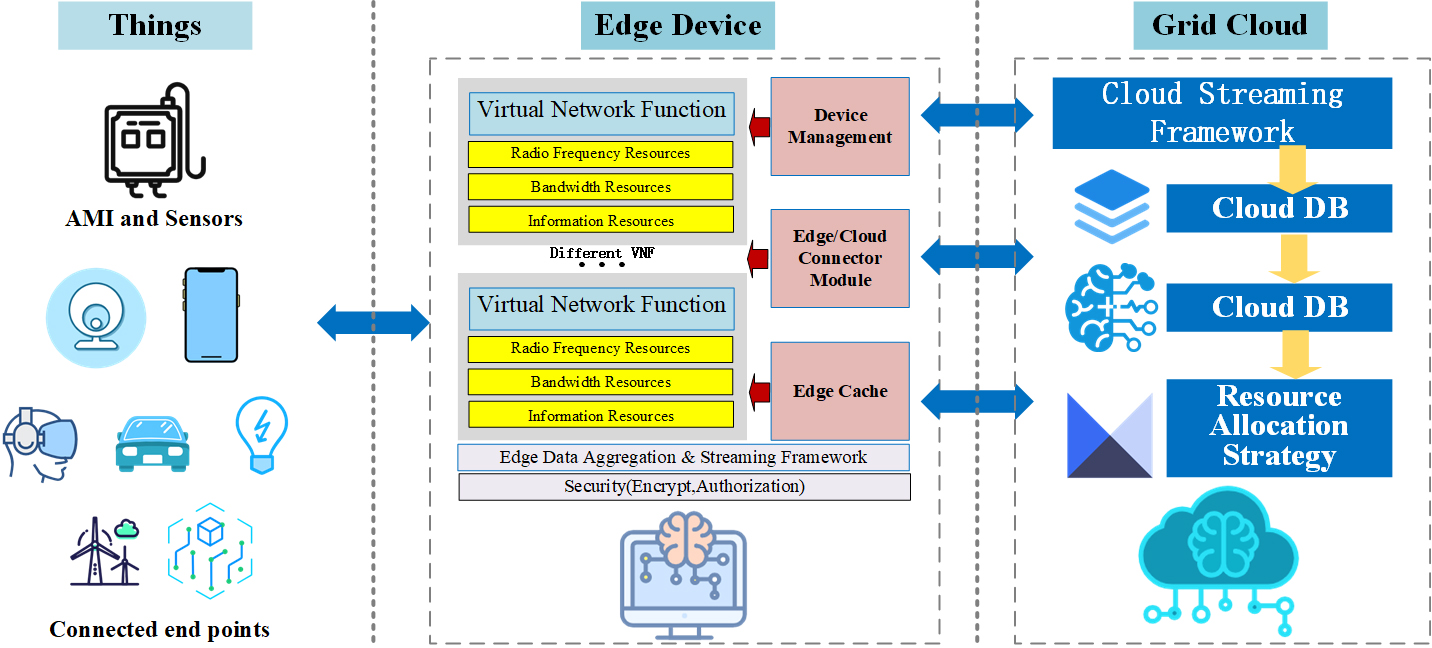
The main challenge of deploying NFV at the edge is the problem of service resource allocation [9]. At present, the methods to solve this problem are mainly devoted to shortening user delay, balancing resource load, and improving user quality of service (QoS). What is critical but often overlooked is that during the transmission of edge-based grid systems, the transmission of NFV service data between users and edge nodes requires bandwidth. Therefore, in the edge node with limited bandwidth, the limitation of bandwidth brings new challenges to the resource allocation problem. Chen et al. proposed a method to reduce the energy consumption of edge systems in literature [4], but they did not consider decreasing the system delay and enhancing resource utilization. In the existing literature [5, 6], the authors proposed a method based on integer linear programming (ILP) to minimize the system delay for the resource allocation problem of NFV service system. Bernardo et al. [7] proposed the COMPARE method to maximize the system throughput, but none of them considers the bandwidth limitation of the computing system.
However, the existing algorithms have high computational complexity, and the power IoTs formed by multiple edge devices may also be a non-convex optimization problem. The system is easy to fall into the local optimal solution, resulting in low resource utilization [14, 15]. In response to this situation [16], developed a green resource allocation mechanism based on deep reinforcement learning (DRL), which aims to effectively allocate resources while meeting the needs of mobile users. However, due to the frequent disconnection of edge devices in the power IoTs, deep learning with a fixed structure cannot achieve good generalization.
With the continuous development of deep learning, convolutional neural networks and recurrent neural networks can no longer satisfy the solution of dynamic structural problems [28]. In 2008, Scarselli et al. [17] proposed a graph neural network model, which aims to solve problems under specific topologies. In 2017, the Google Brain team first proposed the Message Passing Neural Network (MPNN) to solve the deep learning problem under the dynamic network and use it for the inference of biomolecular structure [18]. Since then, the MPNN framework has been widely used in various scenarios, especially in communication networks with strong time-varying topologies [19, 20] and edge cloud computing [21].
Therefore, in this article, we design a NFV resource orchestration scheme for edge computing of the power IoTs based on the MPNN framework. We modelled the resource orchestration of power IoTs based on edge computing, and compared the molecular diffusion model to a clustering network function unit. Since the algorithm is self-adapted, we arranged the NFV services under the condition of limited cloud applications and limited link bandwidth and realized the resource allocation strategy of maximizing resource utilization. In order to further improve the allocation performance of edge computing resources, we use the MPNN framework to learn the allocation plan, reduce the allocation calculation complexity, ensure the timeliness of the orchestration plan, and improve the resource utilization of the overall network.
The rest of this article is organized as follows. The second section summarizes the related work of power Internet of Things resource orchestration modelling. The third section proposes an optimization algorithm for power Internet of Things resource scheduling based on the Gauss optimization. The fourth section proposes the use of MPNN framework graph convolutional neural network to solve the algorithm complexity of the optimization problem. In the fifth section, a simulation study is carried out to prove the effectiveness of the algorithm. This article is summarized in the sixth section.
System model
To model a smart grid with N terminal edge devices, we first define the virtual function request function required by the edge terminal
Among them,
Among them,
We define the cost of the power resource in a unit radio frequency as
Define the cost of unit information resources as
The cost of defining unit spectrum resources is defined as
While
The corresponding virtual network function deployment benefit function can be solved by Eqs (3), (4) and (6), which can be expressed as follows:
where
The purpose of network function virtualization management and orchestration(NFV MANO) is to minimize the workload that edge devices bring to the entire power network, that is, to minimize the resource cost caused by edge device access, which can be expressed as the following:
Among them,
Then we can obtain the specific mathematical expression of the cost function
Where
Due to the various types of virtualized network services and different requested resource attributes for the lower edge devices of the power network, it is difficult to accurately calculate the spectrum resources, transceiver power resources, and it information resources of virtual services in the time slot. Therefore, the traditional KKT optimization scheme or linear/non-linear programming is used at the same time to solve the high computational complexity [22]. Thus, in this section, we first construct the aforementioned mathematical model into a steady-state network structure, and then design an optimization scheme based on the Gauss optimization [23], using a dynamic loss function to optimize the demand change coefficient in the network.
In a steady-state network structure, the resources currently connected to the edge devices of the grid will not exceed the remaining resources that the cloud service can provide, and the following constraints can be added to the current model
Among them,
We assume that the initial state of the entire network is
Among them, Best represents the optimal solution in all possible stable network states, and
It can be found that the reason for the state change of the system is that the total loss of the system is greater than the loss after the change, which makes the entire network unstable, which is similar to the structural transformation of molecules after heating in biology. At the same time, we can get the initial loss trend of the entire system, expressed as the following form:
where
After the resource status in the network changes, the current service data needs to be rearranged to achieve the lowest global network resource cost. In service rearrangement, it is generally possible to decompose the service that takes up too much resources, merge the service that takes up less resources, and exchange a small amount of services to achieve global service load balancing [25]. In order to carry out service rearrangement, we have carried out mathematical expressions for the three general rearrangement methods in the power network.
Assuming that the power network after the state change is
At the same time, the solution satisfies the following conditions:
Among them,
Assuming that the power network services of different applications form
The corresponding iterative update calculation can be expressed by the following formula:
In order to balance the service load after decomposition, it is necessary to select the same virtual service application in different levels or subnets after decomposition for exchange. Let
Among them,
Finally, we use these three service management methods to minimize the resource loss under the power IoTs. The entire algorithm is as follows.
Algorithm 1
Although the above optimization algorithm can be used to find the optimal solution of the system in a limited number of iterations, the computational complexity is still relatively high. Also, when the above-mentioned algorithm is used to optimize the large-scale power IoTs, the calculation procedure takes too long to meet the requirements of delay-sensitive applications. This makes the service orchestration of applications of power IoTs an NP-hard problem. In this section, we innovatively propose a method based on MPNN to solve the complex hierarchical service topology under the power IoTs structure. At the same time, we take the cost of virtualized network service as the cost function of deep learning to achieve efficient and executable orchestration of virtual services in power IoTs.
Optimized algorithm based on MPNN.
In the figure, ECN represents a single edge computing terminal,
LSTM network structure.
The structure of the MPNN framework of the power IoTs based on edge computing is shown in Fig. 3. The entire training process is mainly divided into the information transmission phase and the information reading phase. In the message transfer phase, the virtual application resource request of the edge device
In this section, we abstract the current network structure into an undirected graph, expressed as
Among them,
Based on the MPNN framework, we use the most widely used GG-NN [26] to simulate the entire power edge computing IoTs. The forgetting mechanism of the gate can ensure the generalization of our neural network, make the neural network adapt to different node information and different network structures, and increase the calculation speed of the network to prevent the network from converging to the local optimal solution. The mathematical expression of the information transmission process becomes the following form:
The matrix
GRU() is a very effective variant of the LSTM network. It has a simpler structure than the LSTM network but is more effective. Thus, it is also a very manifold network structure at present.
Its general mathematical expression can be written as follows:
We use GG-NN for the virtual service orchestration of the edge computing terminal of the power IoTs. Through the pre-training of the network orchestration results, the output layer uses Softmax and L2loss for regularization, and uses Adam [27] for the gradient descent. This makes the GG-NN converge quickly and realize the identification of changes in virtual application resources in terminal devices and it helps in making a rapid resource allocation plan.
This section studies the computational utility performance of both the optimal resource allocation scheme based on Gauss optimization and the MPNN-based GG-NN optimized resource allocation scheme.
During the simulation process, we deployed the model under the MPNN framework on a Linux server for 150 training sessions. The model was built using Pytroch and Deep Graph Library packages. The server was equipped with a GTX1080 ti graphics card and 32G memory. The parameter settings in the simulation process are as shown in the table below.
Parameter settings
Parameter settings
In the process of MPNN model training, we used three different data sets, the maximum number of access edge devices is 20, 60, and 100 respectively. The experimental results are shown in Fig. 4. Through the training curve, we can clearly find that due to the increase in the number of access devices, the complexity of the system is also increasing, and the overall training decline curve becomes slower. At the same time, the convergence point of the curve after training also becomes higher as the number of access devices increases. This is in line with common sense, because the number of edge devices increases, the optimal value of the cost function that the entire system needs to pay will also become higher.
The loss curve of the MPNN framework after training for 150 times. The dashed line is the original value, and the solid line is the curve after the softness coefficient is increased by 0.5.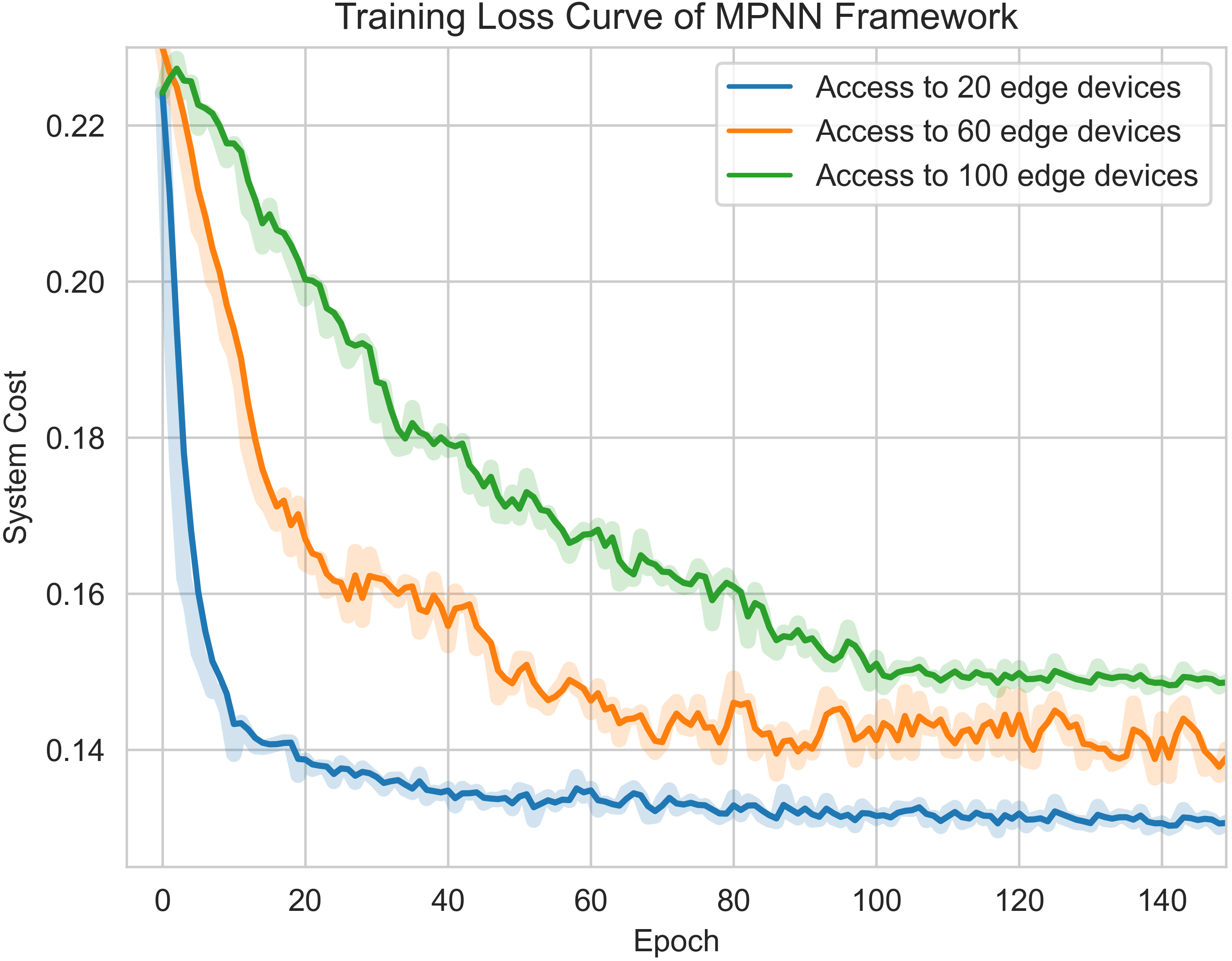
After the training of the MPNN framework, we used 20 fixed access devices to compare the experimental results based on the MPNN framework algorithm and the Gauss optimization method. The experimental results are shown in the following figure.
Comparison of the cost of two systems.
It can be seen from the experimental results that the method based on the MPNN framework can achieve the optimal resource allocation scheme of the system in a shorter number of iterations under the same number of devices connected, and the result will fluctuate in a small range when approaching the optimal solution. The reason is that a gated neural network is used, and in order to ensure the generalization of the model, a forget gate is used to prevent the model from overfitting, so that the model has a small range of oscillations when it is close to the optimal solution.
When the number of connected devices is not limited, we compared the optimization time of the two solutions. The results are shown in the figure. It can be found that when the number of connected devices continues to increase, the time delay based on the Gauss optimization resource arrangement increases exponentially. This is because when the number of devices in the power IoTs increases, the three steps based on the Gauss optimization resource arrangement plan need to analyse each edge device under the current network, resulting in the exponential increase in computational complexity. When there are a large number of edge devices at the access end, the current resource allocation scheme becomes an NP-hard problem. However, the MPNN-based GNN optimization resource allocation scheme extracts features in various situations during pre-training. Thus, this scheme is equivalent to a heuristic optimization algorithm, which can quickly determine network optimization direction, and realize rapid optimization and arrangement.
Comparison of the delay of multi-device access under the two schemes.
In order to test the highest resource utilization rate that can be achieved under the two algorithms, we continuously increase the number of edge access devices, while setting that each edge access device will not repeatedly request 100 resource pool attributes. The cloud records the proportion of current resources provided for comparison, and the experimental results are shown in the figure.
Comparison of maximum resource utilization under the two schemes.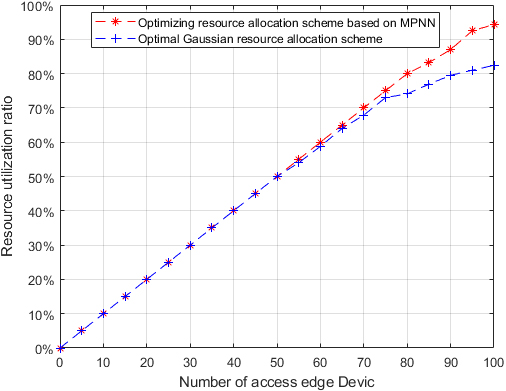
The experimental results show that the optimized resource allocation scheme of the GNN using MPNN can approximate the maximum server resource allocation usage. The resource utilization rate of the scheme will decay only when the cloud resources are about to be exhausted.
This paper designs a NFV resource allocation scheme for edge computing of power IoTs based on the MPNN framework. In particular, we propose the use of GG-NN to solve the problem of high computational complexity and model generalization of the optimal Gaussian resource allocation scheme. Considering that the power IoTs must ensure the access of a large number of edge devices, and at the meanwhile ensure that the virtualized network functional units of edge computing devices are not limited, we adopt the MPNN structure to achieve rapid resource allocation. At the same time, since the edge device access of the power IoTs are time-varying, which is the same to the power IoTs topology. Therefore, we choose the MPNN framework to achieve the optimal solution of resource scheduling under different network topologies, so as to truly realize power IoTs with cloud-edge integration and ubiquitous access.