



Abstract
With the raising popularity of digital devices in the current society, the present image detection system is becoming a great threaten. Especially the appearance of the recaptured images. It can be used in traditional invalid digital image detection algorithm. There is a new algorithm in this paper is presented to detect the recaptured and real image. The algorithm obtains low-frequency images, directional filtering images and high-frequency images by multiple application frequency domain filtering. Then the proposed algorithm analyzes the directional filtering images and high-frequency images by means of LBP algorithm to extract features. At last, the recaptured images were classified by the SVM. The experimental results demonstrated the algorithm in this paper could be effectively identify in the recaptured images.
Research background
With the development of computer technology and the digital equipment, the post-processing of digital image is becoming more and more popular. Even non-computer professionals can easily use software to modify the outcome and results that they want. However, this also brings a great threat to our daily life. Now, the criminals can easily use digital images to commit crimes.
With the rapid development of the digital camera and telephones, there is a new kind of tampered image called the recaptured image, which uses digital cameras to re-construct the existing image. With the improvement of the fidelity of the recaptured image, it is becoming more and more difficult to distinguish the recaptured and the real image for our naked eyes, as shown in Fig. 1.
The visual contrast images.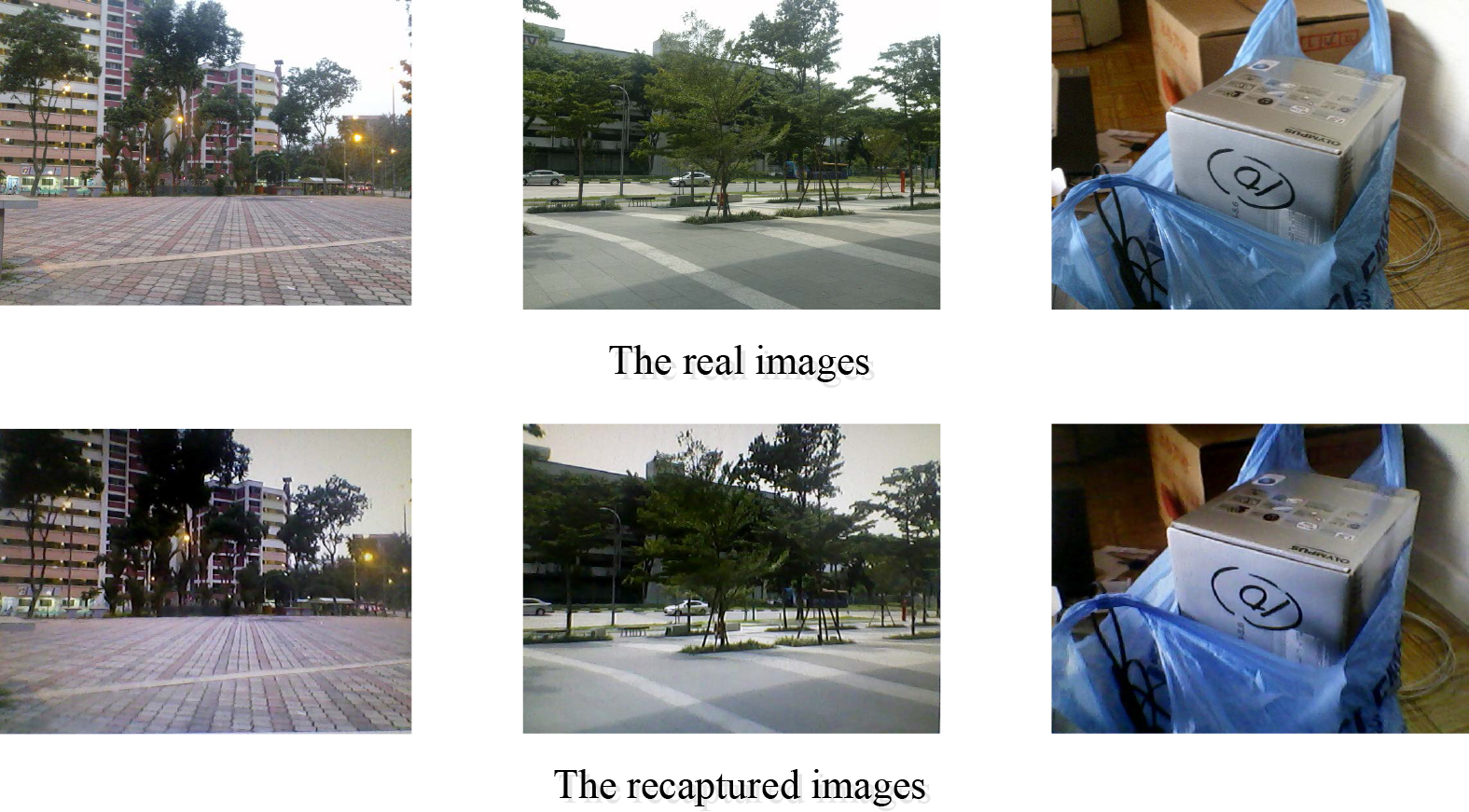
Images in Fig. 1 all came from the recaptured image library of the Columbia University [1]. Because the recaptured images come from digital equipments and cameras, they are difficult to distinguish on a virtual level. Thus the high quality recaptured image can bring great threats to our lives. Therefore, it is important to obtain evidence of the recaptured images and the real images.
Due to the fact that the recaptured image is only appeared with the popularity of smartphone in recent years, it has relatively less research on the recaptured image. The forensics technology mainly focuses on image textures, multi-dimensional features and characteristics.
Cao and Kot [2] proposed a forensics algorithm for the recaptured image that comes from LCD re-imaging. The method that how to get high-quality recaptured images will be presented in this paper, however, this technique has some limitations. Gao et al. [3] proposed a forensics algorithm of the recaptured images based on the images’ physical features. The algorithm starts from the physical features of the image. It extracts the physical features of the image, including reflection features [4], gradient features, color features [5], contrast features, chroma features and image fuzzy features [6]. This method provides a way to identify the recaptured image, and there are many subsequent articles based on this method in order to further analyze the physical features to forensics the recaptured images. Sun et al. [7] proposed the differences between recaptured image and real image in both high- frequency and low-frequency, which provides a new way to identify the two different kinds of images, as well as proposing two different kinds of forensics algorithms. One of them is based on local plane linear points [8], and the other is based on co-occurrence matrix [9]. Both of them have achieved good results successfully. Wei et al. [10] proposed the JPEG recaptured images detection algorithm. The compressed JPEG recaptured image is used for DCT quantization in this paper. However, the high-frequency components of the pixels at the boundary of the image block will be discontinuous and it will cause the grid offset phenomenon. Although the algorithm achieves a high identification rate, it only aims at a single image format thus having a lack of universality. Wang [11] presented an LCD Screen recaptured images forensics algorithm. The algorithm uses two smoothing templates and there will be to convolute the images to get some smoothed images. Then the residual image will be acquired from the smoothed images and original images. At last, in every block it will be get the same location elements that comes from the residual image extracted to form the collaboration matrix. Xie et al. [12] presented a detection method of recaptured images based on homomorphic compensation. On the other hand, Liu and Wang [13] presented a detection method based on the DCT features, however this method is mainly be applied to face recognition.
Although the recaptured image and the real image both come from the digital equipment, the real image forms images by re-constructing the real scene with digital equipment, while the recaptured image forms images by re-constructing the existing real image again. This process can be seen in Fig. 2.
The imaging process of the recaptured image and real image; (a) The imaging process of real image was on first line; (b) The imaging process of recaptured image was on the below line. There has huge gap on the imaging process.
It thus causes a huge difference between the recaptured images and real images in the image forming process, which is also called the object distance. As shown in Fig. 3.
It has different object distance between two types of images; (a) the real image object distance; (b) the recaptured image object distance. There has a great difference between the image object distances. 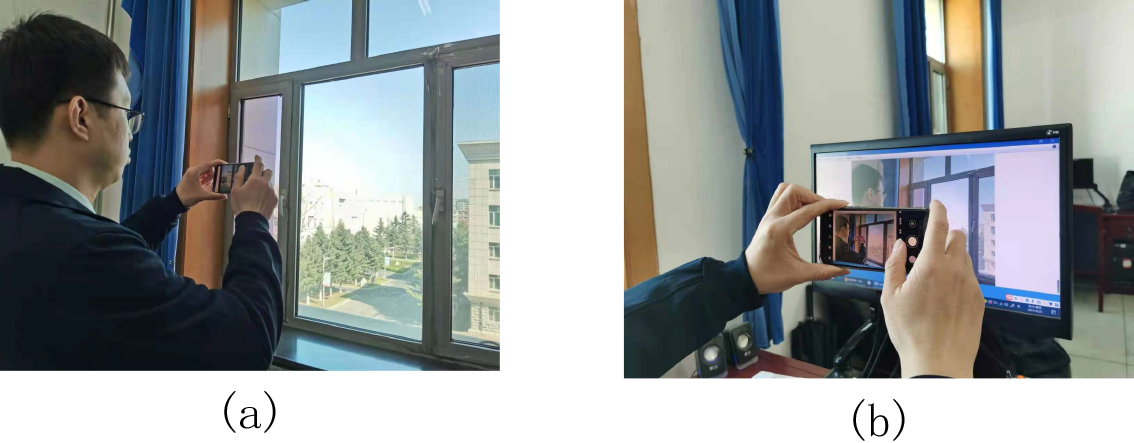
Figure 3 shows the image forming process of both the recaptured images and real images. The difference of the object distances are reflected in the image, which causes less energy to be obtained from the recaptured image, thus leads to several texture difference of the image.
The imaging process of the real image can be described that the real scene information is transformed into the image by the camera. Assume that the mapping function of the camera is
Flow chart of frequency domain filtering; (a) The original image; (b) The gray image; (c) The Fourier transform image in frequency domain; (d) The high frequency filtered image in frequency domain; (e1 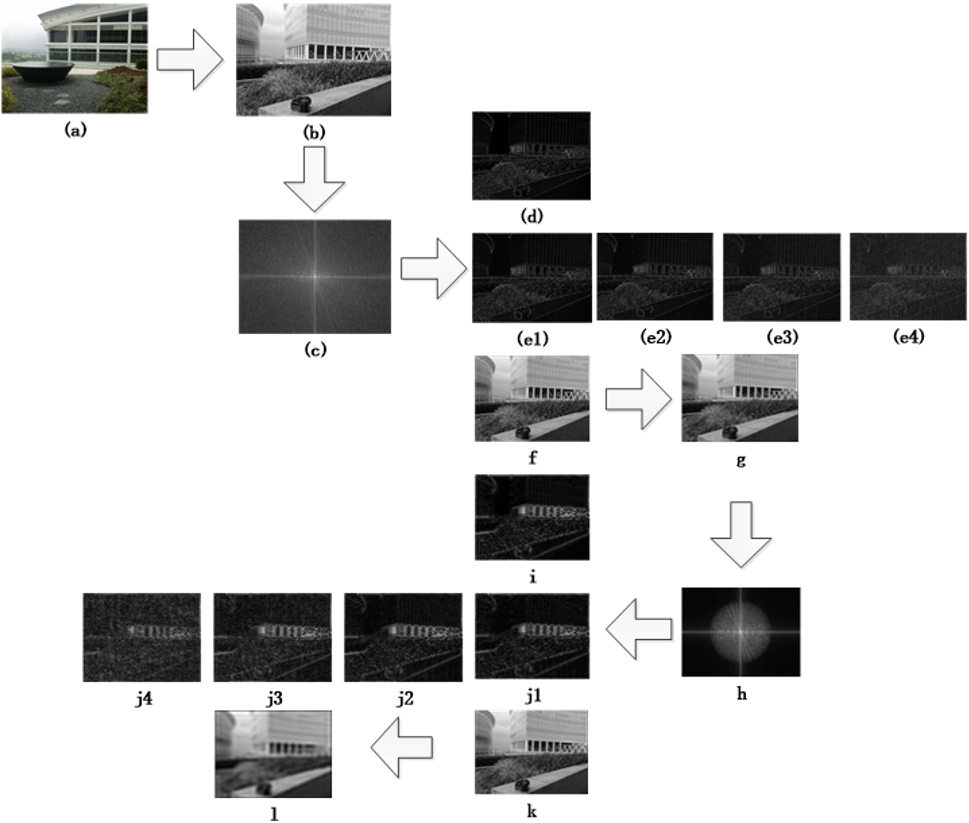
In Eq. (1),
In the process of the second re-imaging, the information of the real image is mapped by the camera function again, which leads to the difference between the real image, as well as the difference between the low-frequency information and high-frequency information in the recaptured images. This difference was used to do image identification in this paper.
There are differences in the texture features between the recaptured images and the real images [7], which is reflected by a high proportion of high-frequency information in the real image. In this paper, the frequency domain-filtering algorithm is used to separate the low-frequency and high-frequency information of the image. Then the low-frequency image is decomposed by down sampling. At the same time, the high-frequency features are extracted by the directional filtering from the high-frequency image. Finally, the SVM classifier will be used.
In this paper the frequency domain-filtering algorithm presented belongs to the linear filtering algorithm, and its core operations mainly include low-pass filtering, high pass filtering, high-frequency direction transformation and scale transformation, which operate in the frequency domain. The algorithm flow is shown in Fig. 4.
Figure 4 shows the process of frequency domain. First, the image is converted to a gray image, and the above process is performed on the gray image. In the process of filtering, three filtering forms are used that are low pass filter, high pass filter and directional filter. The low pass filter formula is shown in Eq. (3).
In Eq. (3), the parameters
In Eq. (5), parameter
In Eqs (5) and (6), The value range of the parameter
Flow chart of frequency domain filtering.
Because the difference between the real image and the recaptured image is mainly reflected in the high-frequency information, directional filtering is used to further analyze after obtaining the high-frequency information. The third-order frequency-domain filter is used in the paper. The local binary pattern (LBP) algorithm will be applied to extract the features for further analyzing the feature image.
The gray image will be get in the first step. The gray images obtained in step 1 are used to get Fourier power spectrum by Fourier transform The Frequency domain filtering is used to extract directional filtering images, the high frequency images and low frequency images from the grey image got in step1. The low-frequency image obtained in step3 is repeated by step2 and step3. The equivalent LBP algorithm is used to extract the feature values for the high-frequency images and directional filtering images obtained in step3 and step4. The features, which got from the test images are obtained from the above step (1–5). Those features will be used to classify the images by the trained model, and the detail flow chart is shown in Fig. 6.
Algorithm flow chart.
The different recaptured datasets detection results
The experimental images came from the open image library [1] were provided by the Columbia University. In order to get accurate results, the three kinds of image from different databases will be used in this paper, and the images used have different characteristics. The images in database A have information from the original image. The images in database B have great visual effect, which hard to distinguish with the naked eye. The images in database C were processed, which were cut processing and mapping transformed. The recaptured images in library B has high quality. The detection result will be shown in Table 1.
Detection results
Detection results
The results can be seen that though the recaptured image in library B has high quality, it has great detection rate. However, the presented algorithm has less detection result for images from library A, it because that the images in library A has some original image information which impacts on results. However, those recaptured images has low quality. This detection result does not affect the image recognition.
In this paper, PCA is used to reduce the dimensions of the feature, and then the images in image library A, B and C are detected. The results are shown in Table 2.
Detection results
Detection results
In Table 2, The detection rate will descend with the decline of the dimensions. Although it does not reach the highest value, in the end, the classification time is still greatly reduced. It shows that the method proposed in this paper is feasible.
The algorithm of LPLP algorithm was presented to detent the recaptured images in literature [8]. the difference model of recaptured image proposed in algorithm, it has high comparative value. In literature [14], the higher-order statistical feature is applied to detent the recaptured image. In literature [3, 15, 16] the recaptured image was identified by the texture features. As to test the performance of the presented algorithm, the comparison the proposed algorithms in literature [3, 8, 14, 15, 16] were implemented. It is shown in Table 3.
Comparison results
Comparison results
There can be seen that the results of the presented method is higher than those of other existing algorithms from Table 3. Although the dimension of the features of this algorithm are higher than other algorithms, they can be ignored for the current computing power.
The threat of tampering recaptured images are increasing, the new image forensics method is urgent needed. Therefore, this paper proposes a new algorithm to forensics recaptured image on the frequency domain filtering. The algorithm focused on the difference two types of images in frequency domain. In this paper, the directional filter information and high-frequency information part of the image are extracted and analyzed. The results show the forensics accuracy of the presented in this paper can effectively identify tampering recaptured image.
Footnotes
Acknowledgments
The authors would like to do the Scientific Research Projects of Jilin Provincial Department of Education (Grant: JJKH2021134KJ) and the Youth Scientific Funds of the Air Force Aviation University for financial support.