




Abstract
Edge computing has emerged for meeting the ever-increasing computation demands from delay-sensitive Internet of Things (IoT) applications. However, the computing capability of an edge device, including a computing-enabled end user and an edge server, is insufficient to support massive amounts of tasks generated from IoT applications. In this paper, we aim to propose a two-tier end-edge collaborative computation offloading policy to support as much as possible computation-intensive tasks while making the edge computing system strongly stable. We formulate the two-tier end-edge collaborative offloading problem with the objective of minimizing the task processing and offloading cost constrained to the stability of queue lengths of end users and edge servers. We perform analysis of the Lyapunov drift-plus-penalty properties of the problem. Then, a cost-aware computation offloading (CACO) algorithm is proposed to find out optimal two-tier offloading decisions so as to minimize the cost while making the edge computing system stable. Our simulation results show that the proposed CACO outperforms the benchmarked algorithms, especially under various number of end users and edge servers.
Keywords
Introduction
With the surging applications of Internet of Things (IoT), e.g., smart grid, industrial automation, and so on, the requirements for high performance computing with low latency increase exponentially [1, 2]. Edge computing is a promising computing paradigm for the ever-increasing demands of these IoT applications. By deploying computing-enabled devices, including computing-enabled end users (e.g., intelligent terminals in smart grid) and edge servers [3, 4], at the network edge close to data source, the computation tasks could be performed quickly, since task upload delay in edge computing could be explicitly reduced in comparison with cloud computing.
However, due to the fact that, first, the computation resource of an edge device is quite smaller in comparison with a cloud, second, there are massive amounts of tasks generated from IoT applications over time and over space, task process at only a single edge device may be low efficient [5, 6]. Therefore, computation offloading, which allocates tasks among computing devices, would be more feasible. Recently, a few existing literature have come up with computation offloading algorithms [7, 5, 8]. Liu et al. in [7] explored the trade off between latency and reliability in task offloading in a mobile edge computing environment. Guo et al. in [5] considered offloading decisions among IoT devices and neighboring edge servers for energy efficiency. Chalapathi et al. in [8] has studied the task assignment problem in a multi-cloudlet network connected via a wireless software-defined networking (SDN) network for reducing the task latency. However, most of proposals are one-tier offloading policies. That is, they only make offloading decision at the lowest layer of an edge computing system. The collaboration of end user and edge server, edge server and edge server is not fully explored for edge computing capability maximization.
Indeed, computing capability of an end user is far smaller than that of an edge server, for example, one end user process one task per time while an edge server can process multiple tasks in parallel [1]. However, an end user is closer to data source than an edge server. Besides, task generated from end users are typically based on the usage of the users, the task generation rate from different users will be non-independent and identical distribution (non-IID). Some end users and edge servers closer to those busy end users would be heavily loaded while others may be idle. Therefore, a two-tier end-edge collaborative offloading, where the end user makes the first-tier offloading to demonstrate whether to compute the task locally or to offload it to the closest edge server, which makes the second-tier offloading decision on whether needs to further offload the task to a neighbor edge server, is deserved study for maximizing the resource utility of an edge computing system. However, at the same time, considering the heterogeneous computing capability and distinct processing and offloading cost of end users and edge servers, it becomes a challenging issue: how to make a two-tier offloading decisions in end users and edge servers in sequence for arrival tasks to satisfy the one-shot performance objective?
In this paper, our main objective is to minimize the cost of task processing and offloading while make the queues of both end users and edge servers stable. How to find the one-shot optimum two-tier offloading policies that minimizes the cost of task processing and offloading while making all distributed queues stable is studied in this paper. We first formulate the two-tier end-edge collaborative offloading problem with the goal of cost minimization, constrained to the stability of all queues, including queues of end users and edge servers in the edge computing system. Then, the Lyapunov drift-plus-penalty properties of the problem was dissected, where the drift is the queue vector and the penalty is the cost. In terms of the theoretical results, a two-tier cost-aware computation offloading (CACO) algorithm is proposed to achieve the one-shot objective of cost minimization with queue stability. The simulation studies have conclusively proved that our proposal is effective.
The remainder of this paper is organized as follows. Section 2 gives an overall description of the system, task offloading and queuing as well as cost models. The problem is then formulated and solved in Section 3. Section 4 carry out simulations which illustrate the advantage of the proposed algorithm. This paper is concluded in Section 5.
Model description
System model
This paper considers an edge computing network formed a set of end-users (e.g., smart grid terminals) and a set of edge servers, which are represented by
As illustrated in Fig. 1, a two-tier computation offloading decision is considered. For any task, the end user that generates it makes the first-tier decision on whether to compute the task locally or offload it to the primary edge server, where the primary edge server refers to the edge server that has the shortest communication distance from that end user. If offloading, then the primary edge server would make the second-tier decision on local computing or offloading to a neighbor edge. Accordingly, all users who choose the
Two-tier offloading model.
Assume that end users and edge servers have distinct task service capabilities. Let
Consider a system which is time-slotted and indexed by
Let
The queue evolution of the
The queue evolution of the
where
where
First-tier local task processing at end user
Generally, the long the queue length, the long queueing delay a task experiences, and the cost would also increase with the increasing queuing delay. Accordingly, we define the cost of local processing at an end user as the following
where
When a task is determined to offload, it has to be uploaded from the data source to one-hop distant primary edge server, which consumes transmission resource. Accordingly, we denote the cost of first-tier offloading as
where
Generally, the less time of offloading, the less waste of network transmission resource. However, if the workload of the primary edge server are too heavy, the offloaded tasks may experience intolerable queuing delay. In this case, second-tier offloading would be a good choice. Accordingly, we define the cost of second-tier offloading to edge server
where
We also denote the cost of local processing at primary edge server
where
Problem formulation
The cost of the task
This paper aims to find out the optimal two-tier offloading decisions
Minimize:
Subject to:
where Eq. (10) follows Eq. (9); Eq. (12) is the constraint of system stability, where
Let
The one-step conditional Lyapunov drift is calculated by
Every slot
where According to Eq. (1), we have
Similarly, according to Eq. (2), we have
Substituting Eqs (21) and (22) into Eq. (19), we have
Since
On the otherhand, we have
according to Eq. (3). Similarly,
holds according to Eq. (4). Therefore,
Let
and substituting into Eq. (23), we have
Since
∎ Then the statement follows..
Proof..
The stability of the queues of both users and servers in the system satisfies the inequality in Eq. (20). However, it ignores the cost of task processing and offloading. Therefore, to consider the cost, the Lyapunov drift-plus penalty function is set as
.
Under any two-tier offloading policy, the Lyapunov drift-plus-penalty satisfies the following for any
where
[b] CACO
Every slot
Observe
where
Observe
Lemma
2 follows by subtracting
Base on Lyapunov drift theory [9], when the Lyapunov drift-plus-penalty term
Performance evaluation
In section, the efficiency of the proposed CACO algorithm is evaluated. The default parameter settings are as follows:
The main parameters and variables of evaluation
The main parameters and variables of evaluation
The effect of 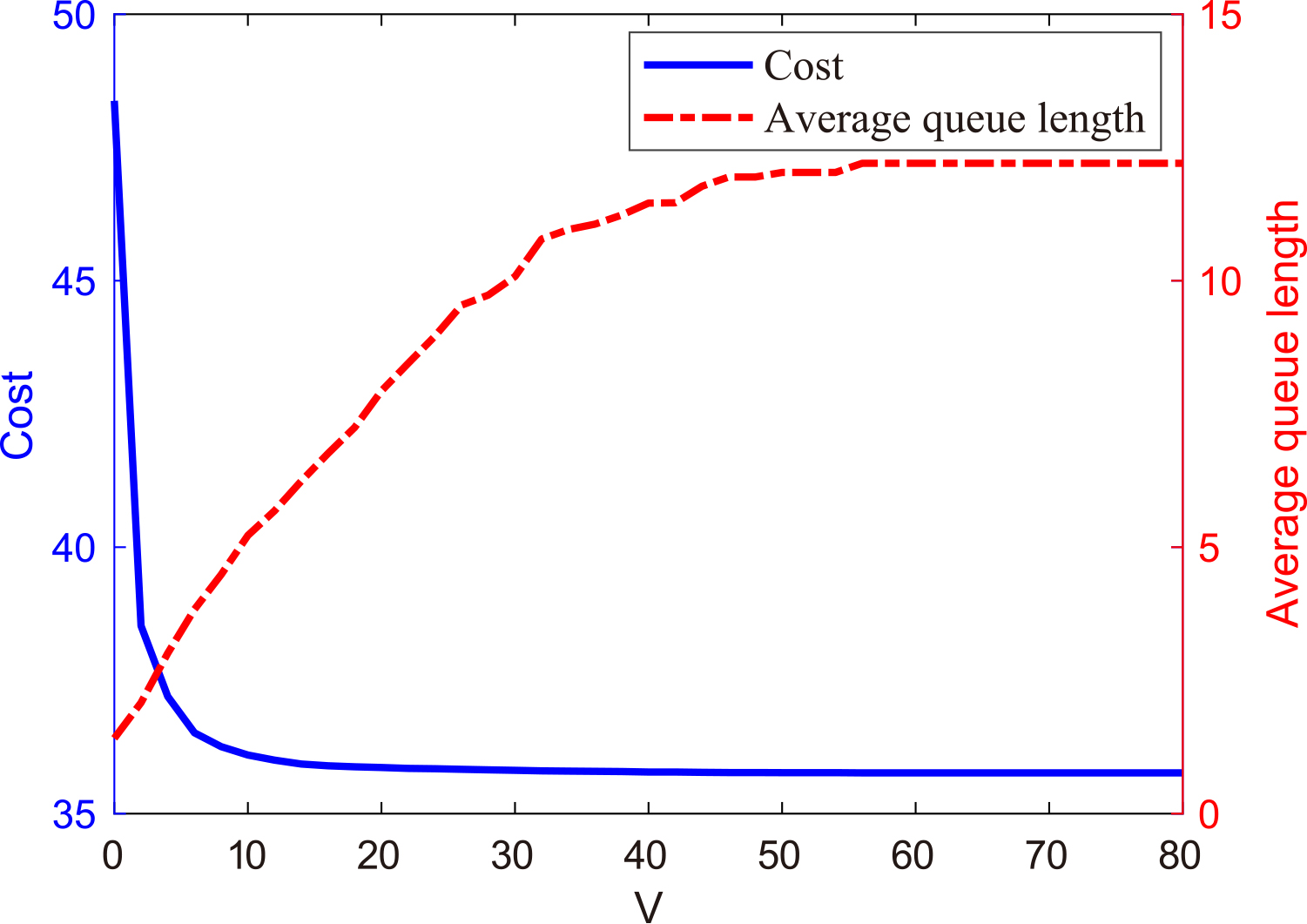
Figure 2 evaluates the tradeoff between the queue length and the cost under CACO algorithm with control parameter
Cost performance, 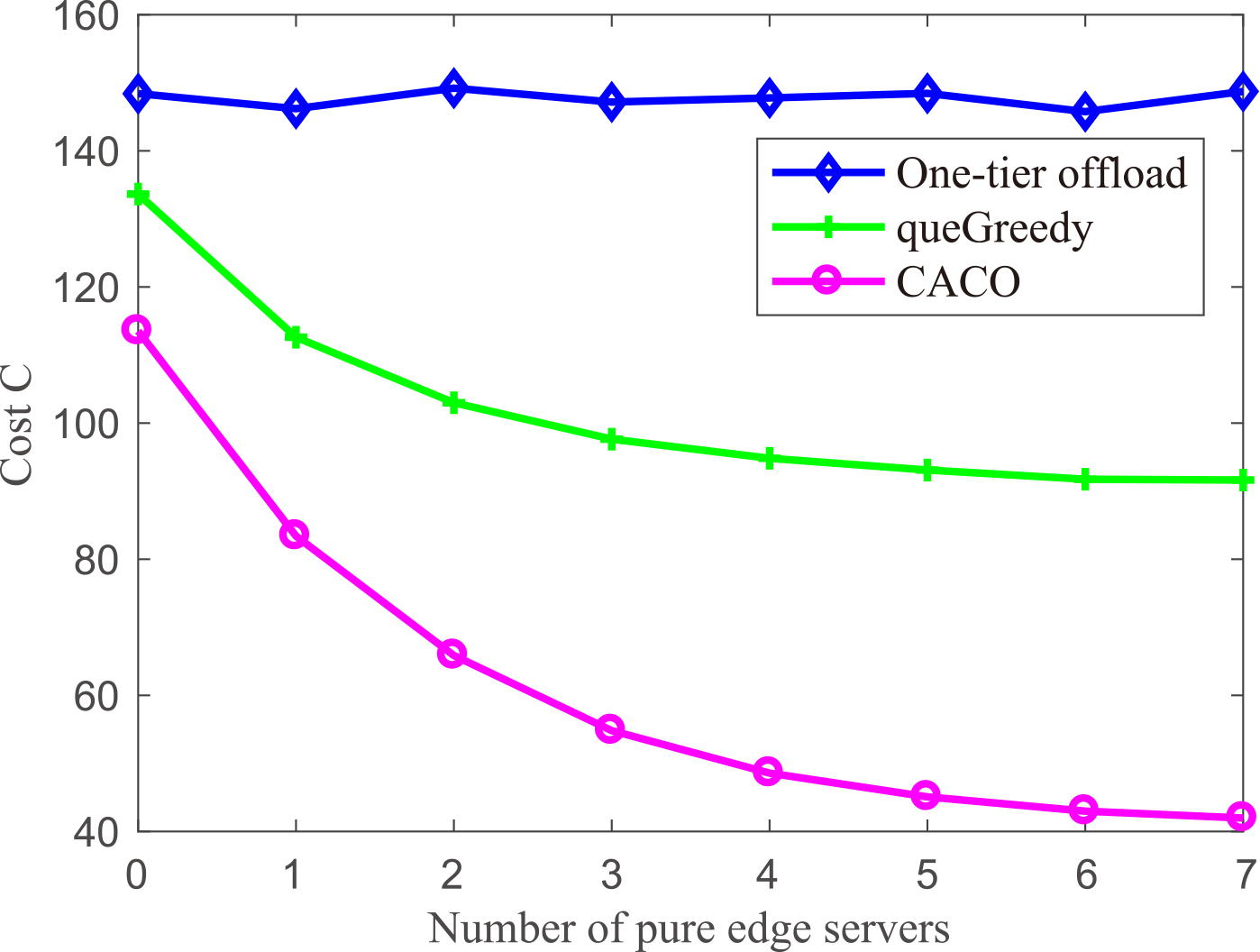
Cost performance, 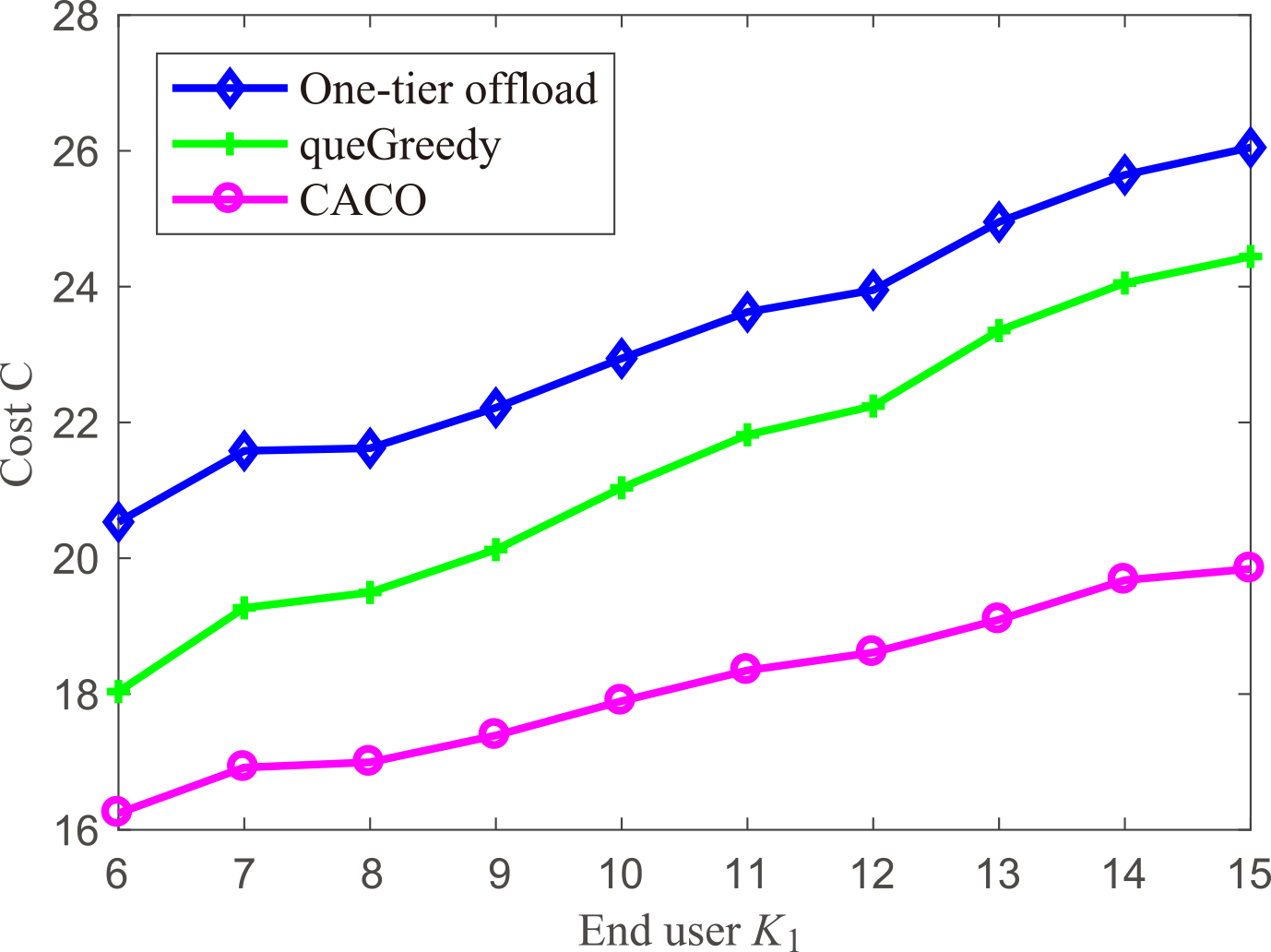
To appraise the efficiency of the CACO algorithm in the aspects of cost efficiency and queue stability, we compare the performance of CACO with two benchmarked algorithms, including one-tier offload and queue-length-minimization greedy (queGreedy), which are variant offloading algorithms from reference [11]. Specifically, in one-tier offload, we only consider the collaboration among end users and their primary edge servers. That is, the task offloaded to a primary edge server is not allowed to further offload to other edge servers for computing. Under one-tier offload,
We first evaluate the adaptation of the proposal to end user-edge server collaboration by fixing the end users of
Finally, Fig. 4 shows how the number of end users affects the cost performance and thus the offloading decisions of the investigated schemes. Under all investigated algorithms, the cost increases with the increasing number of end users. This is because, the arrival tasks increase with the increasing number of end users. The cost efficiency of the proposed CACO is again illustrated by providing the lowest cost increasing rate and lowest cost under various number of end users, as shown in Fig. 4.
This paper has studied the end-edge collaborative computation offloading problem in the background of edge computing. The problem is constructed as a two-tier collaborative offloading problem. By analyzing the Lyapunov drift-plus-penalty properties, a CACO algorithm is put forward, which aims at minimizing the drift-plus-penalty so as to achieve the objective of cost minimization with queue stability. Results of the simulations clearly demonstrated the efficiency of the proposal in enhancing both cost efficiency and queue stability.