



Abstract
The lineshapes of collision-induced absorption (CIA) at room temperature are computed quantum mechanically for gaseous binary mixtures of helium with xenon using theoretical induced dipole moment and interatomic potentials. Empirical and literature models of the induced dipole moments which reproduce the experimental spectra and the first few spectral moments are given. Good agreement between the computed and experimental lineshapes of absorption is obtained when the potential parameters which are fitted well to the vibrational energy levels, thermophysical and transport properties are used.
Keywords
Introduction
In a recent paper, we calculated at room temperature, the collision-induced light scattering (CILS) spectra of krypton (Kr) gas using an empirical induced trace and anisotropy polarizability [1]. Also, in a previous works, we calculated at various temperatures, the collision-induced absorption (CIA) spectra of gaseous mixtures Ar-Xe and He-Ar using an empirical induced dipole moment and interatomic potentials [2, 3]. The derivation of these quantities is based on classical physics and relies on the first three even moments of scattering and absorption [1, 2, 3]. Due to the observed agreement for scattering and absorption spectra of these systems, we extend this treatment of absorption to He-Xe pairs. We use the available literature and experimental thermophysical, transport properties and vibrational energy levels for this mixture to construct the parameters of the relevant interaction potential and induced dipole moment.
In the far infrared region of the spectrum, mixtures of dense phase noble gases show an absorption band which is due to the induced dipole moment arising from the deformation of the electronic clouds during the collision of two unlike atoms [4, 5]. As the induced dipole moment depends on the distance between the colliding atoms, the translational state of the system can change owing to the interaction of the induced dipole with the electromagnetic field, resulting in a translational absorption band. From the early observation of this phenomenon in spectra of mixtures of noble gases, substantial effort has been dedicated to their study, because the parameters involved in the construction of the interatomic potential and the induced dipole moment may be deduced from measurements of the translational band [5, 6, 7].
For He-Xe mixture, no accurate potential is available. We calculated an approximate interatomic potential using mostly the methods outlined in a previous papers [2, 3]. As the relevant details and references were given therein [2, 3], we will only restate the equations when it is necessary for the sake of continuity. To reiterate, the basic strategy in this paper is to include collision-induced (CIA) absorption data in addition to mixtures viscosity, diffusion, thermal conductivity coefficients, isotopic thermal factors and second pressure virial coefficients data at various temperatures, to fit the simple functional form of modified Tang-Toennies model (MTT) and Barker, Fisher and Watts (BFW) interatomic potentials for the He-Xe interaction.
The thermophysical, transport and collision-induced absorption properties used in the fitting are complementary. For this mixture, viscosity, thermal conductivity, isotopic thermal factor and diffusion data are most sensitive to the wall of the potential from
We present in this paper at room temperature a new analysis of the translational band of collision-induced absorption spectra (CIA) of He-Xe, based on fitting the spectral moments of the profiles of the measurements. Spectral profiles are calculated with the help of a quantal computer program numerically and compared with the measured spectra. The comparison of calculated and measured spectra provides valuable insights concerning the quality of existing models of both the interatomic potential and induced dipole moments. Analysis of spectral moments of CIA to determine the parameters of the induced dipole moments adopted is given in Section 2. The theoretical method for calculating the intensity of the lineshapes and the associated spectral moments of absorption are briefly given in Section 3, together with the computational implementation. The calculations of the different properties using the present interatomic potentials are presented in Section 4. Results are presented and discussed in Section 5 and the concluding remarks are given in Section 6.
Analysis of spectral moments of CIA to determined the induced dipole moments
In order to calculate the spectral line profiles of absorption and the associated zeroth, first and second moments one needs the induced dipole moment. Results with different models can be compared with experiment to assess the quality of the induced dipole moment. In this paper and for the sake of comparison and discussion, we considered six models of the induced dipole moment which are the dispersion type [11, 12], the exponential function models [13, 14, 15], the analytical dipole moment models [16, 17], the higher-order polynomial model [18], the empirical dipole model [12], the ab initio SCF, MP
Below, we shall use the analytical dipole moment model to see if the induced dipole moment can be approximated by such a simple model. Particularly in the case of the He-Xe gas mixture, for which the fundamental theory is at present of limited value, this model will be seen to provide a useful empirical basis description of the interaction-induced dipole.
Over a broader range of separations [16, 17], it has been argued that an analytical dipole model like
should be expected to approximate the dipole moment more closely.
Suitable values for the coefficients
The method of detailed analysis of the first three even moments of the polarized and depolarized light scattering spectrum (CILS) has been used by Meinander et al. [20] and El-Kader [1, 21] for the determination of the extra-dipole-induced dipole (DID) contribution to the pair-polarizability trace and anisotropy of inert gases and CH
In order to proceed, it is convenient to rewrite the induced dipole moment
where
Substituting Eq. (2) into the moment expressions of absorption spectrum [22] make it feasible to rewrite them in the form of quadratic equations for the unknown
where
at any step
Comparison of experimental and theoretical spectral moments of HeXe mixture at
The advantage of this method to obtain
Table 1 gives the numerical results of the spectral moments at room temperature while Fig. 1 shows the different regions of the dipole moment behavior which are consistent with the experimental results. Here the remaining theoretical and the ab initio induced dipole models [19] are reported as well.
Parameters of the different interatomic potentials and the associated values of
Whatever the atoms considered, del
The empirical pair potentials BFW and MTT with the different parameters are given in Table 2 for the considered mixture. The moment analysis program was easily modified to calculate the moments of the absorption spectra as functions of
The quantum mechanical calculations for collision-induced absorption (CIA) are described. The atomic wavefunctions, which enter the computation of the matrix elements, are obtained by numerical integration of the radial Schrödinger equation [32] using the energy density normalization.
From quantum mechanical theory, collision-induced absorption spectra (CIA) can be computed if the interaction potential is known along with a suitable model of the collision-induced dipole moment [33]. The absorption coefficient
Here,
for
Empirical induced dipole moment 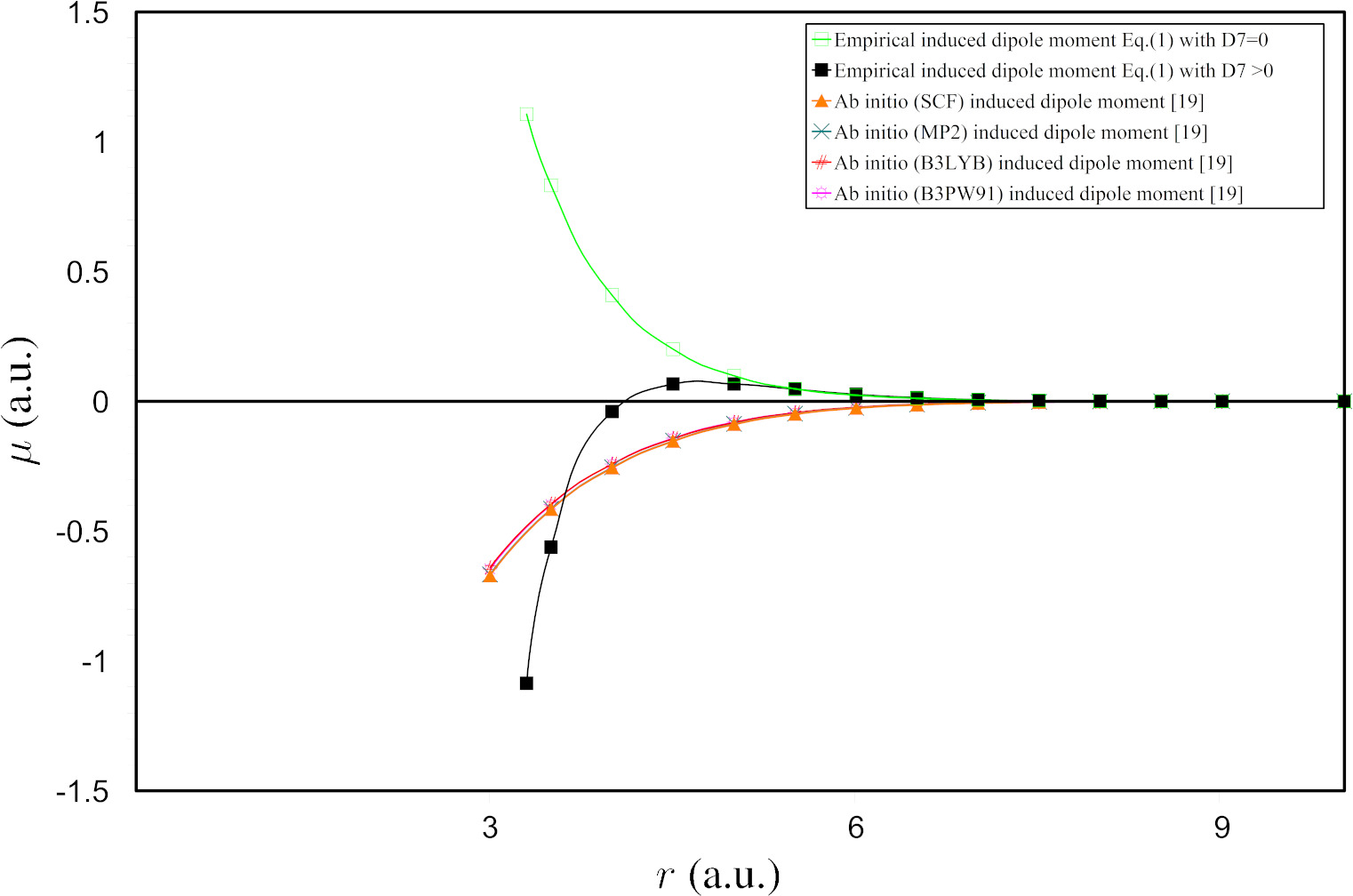
Comparison between the calculated translational collision-induced absorption spectra of He-Xe at 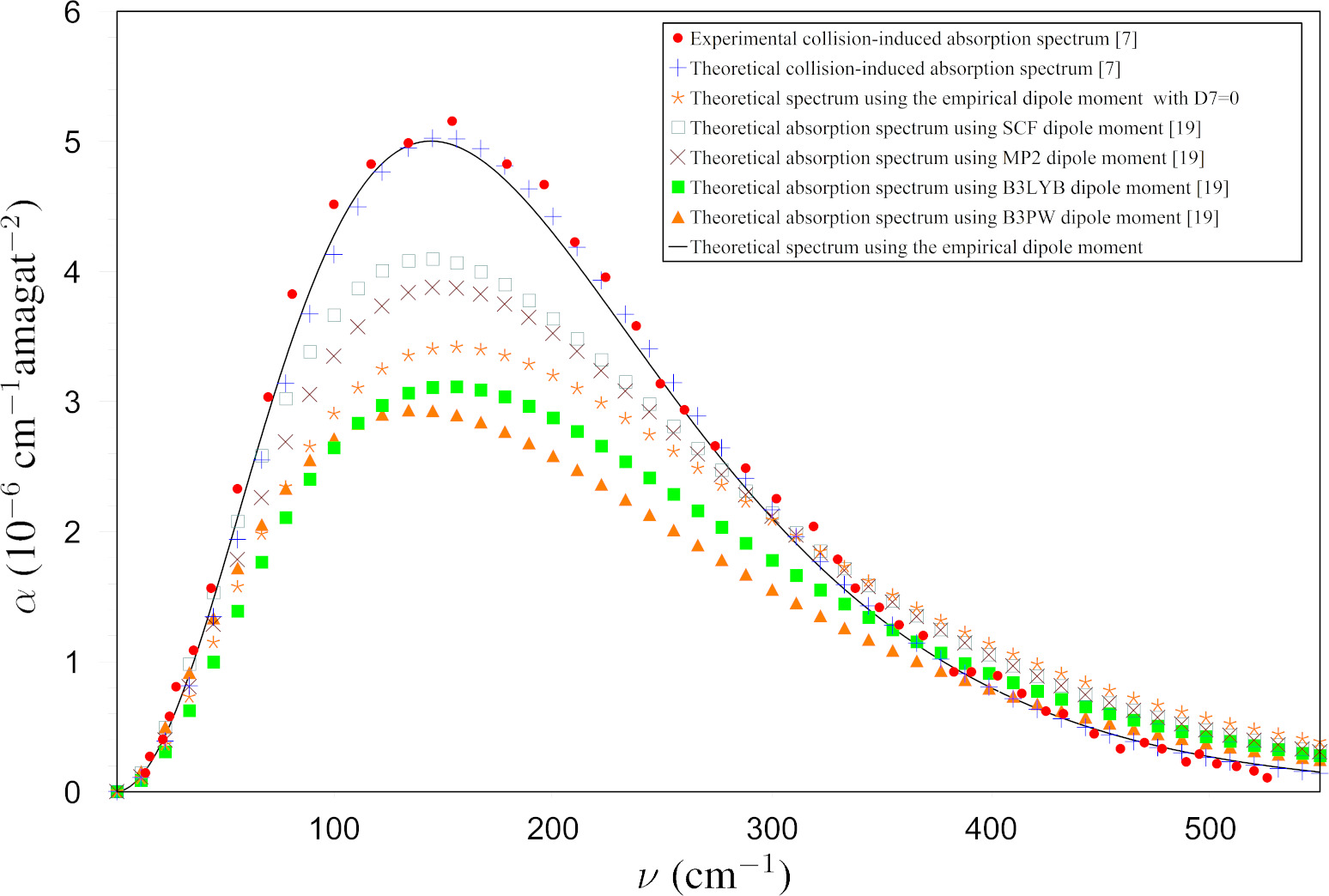
It is often inconvenient to use tabular data in spectral moments and line shape computations. Therefore, we have obtained an analytical model of the exchange or overlap dipole in the range of interest (near 0.3 nm) by a least mean squares fit. It is of the form Eq. (1).
Range and strength are the parameters determined by the analysis, with the results 0.0075
As a first step and for He-Xe gas mixture, we used the exponential dipole, Eq. (1) with
Since an accurate determination of these spectral integrals requires knowledge of the absorption coefficient
The interatomic potentials we provide here are obtained through the analysis of the vibrational energy levels [36, 37, 38, 39, 40, 41, 42, 43, 44], pressure second virial coefficients [25, 26, 27, 28, 29, 30, 31, 45, 46, 47, 48, 49, 50, 51, 52, 53, 54, 55, 56, 57, 58, 59, 60, 61, 62, 63, 64, 65, 66, 67, 68, 69, 70, 71, 72, 73, 74] and a set of gaseous transport properties [25, 29, 30, 75, 76, 77, 78, 79, 80, 81, 82, 83, 84, 85, 86, 87, 88, 89, 90, 91, 92, 93, 94, 95, 96, 97, 98, 99, 100, 101, 102, 103, 104, 105, 106, 107, 108, 109, 110].
For the analysis of all these experimental data, we consider the following potentials:
A. MTT potential
The modified Tang-Toennies model (MTT) which in the whole range of interactions can be represented by the formula [111]:
where
and
B. BFW potential
The empirical Barker, Fisher and Watts (BFW) interatomic potential [113] is represented by the following formula:
where
Even at the present (MTT) level, there are seven free parameters (
With the above obtained interaction potentials, the vibrational energy levels can be calculated by solving the radial one-dimensional Schrödinger equation. In the present paper, this equation is solved numerically. The interaction potentials of homonuclear and hetronuclear rare-gas dimers with the internuclear separation between 3.0 a.u. and 200 a.u. are used to do the calculation. The size of the grid points is 1600. Table 2 presents the calculation results for He
The experimental and other theoretical results are also listed in the Table 3 for comparison [36, 37, 38, 39, 40, 41, 42, 43, 44]. It is gratifying to find that the spacings of these dimers predicted by the MTT and BFW potential models are in excellent agreement with the experimental results if the experimental error bar are taken into consideration.
Analysis of second pressure virial coefficients
Comparison of our computed vibrational energy levels for He
, Xe
and He-Xe gases with experimental and other theoretical data. All values are given in cm
Comparison of our computed vibrational energy levels for He
An effective means for checking the validity of the different potential parameters can be made using second pressure virial coefficient data [25, 26, 27, 28, 29, 30, 31, 45, 46, 47, 48, 49, 50, 51, 52, 53, 54, 55, 56, 57, 58, 59, 60, 61, 62, 63, 64, 65, 66, 67, 68, 69, 70, 71, 72, 73, 74] at different temperatures. The interaction second pressure virial coefficient
where
and the first three quantum corrections
Temperature dependence of the Helium gas interaction pressure second virial coefficients 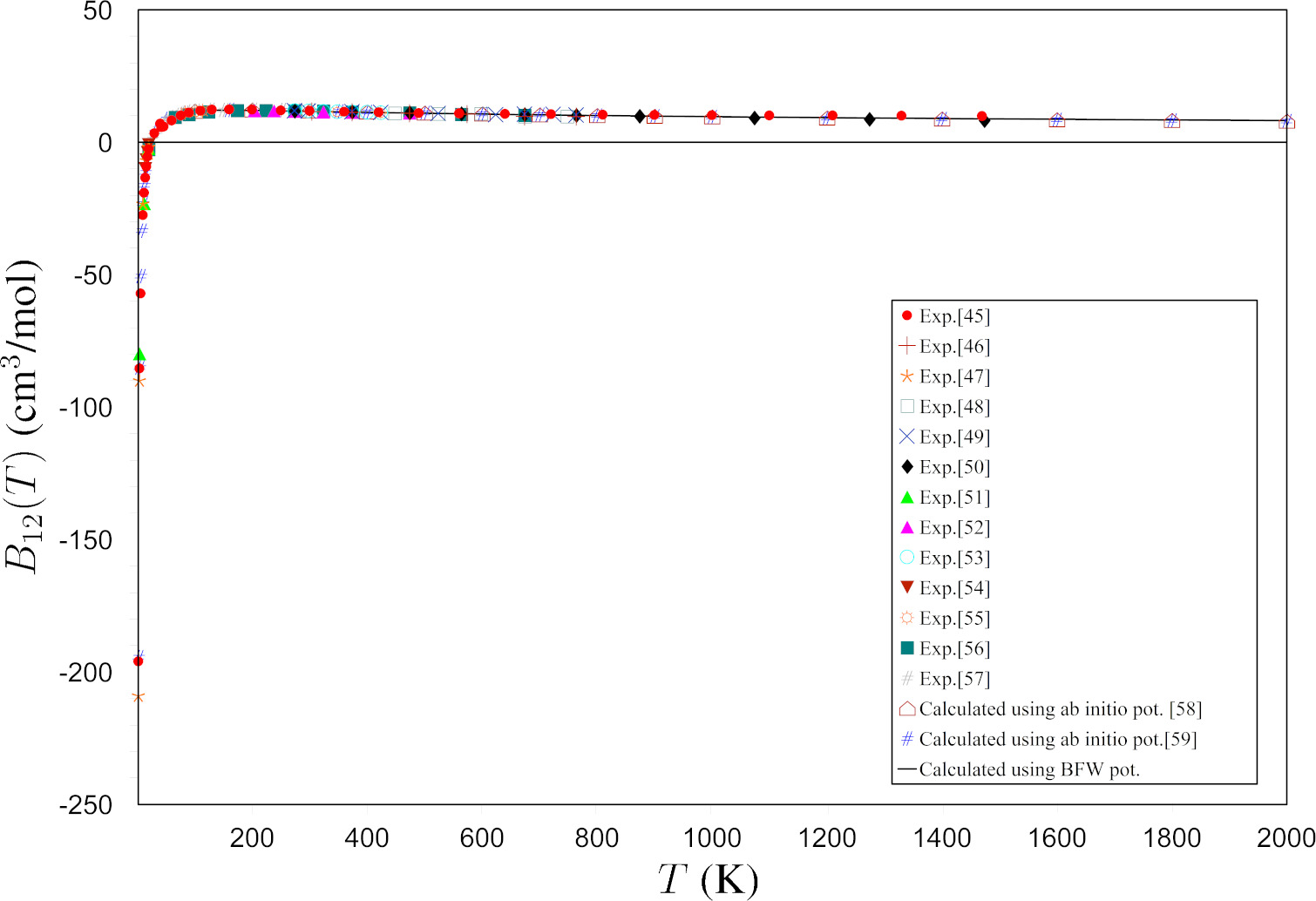
The same as in Fig. 3 but for Xenon.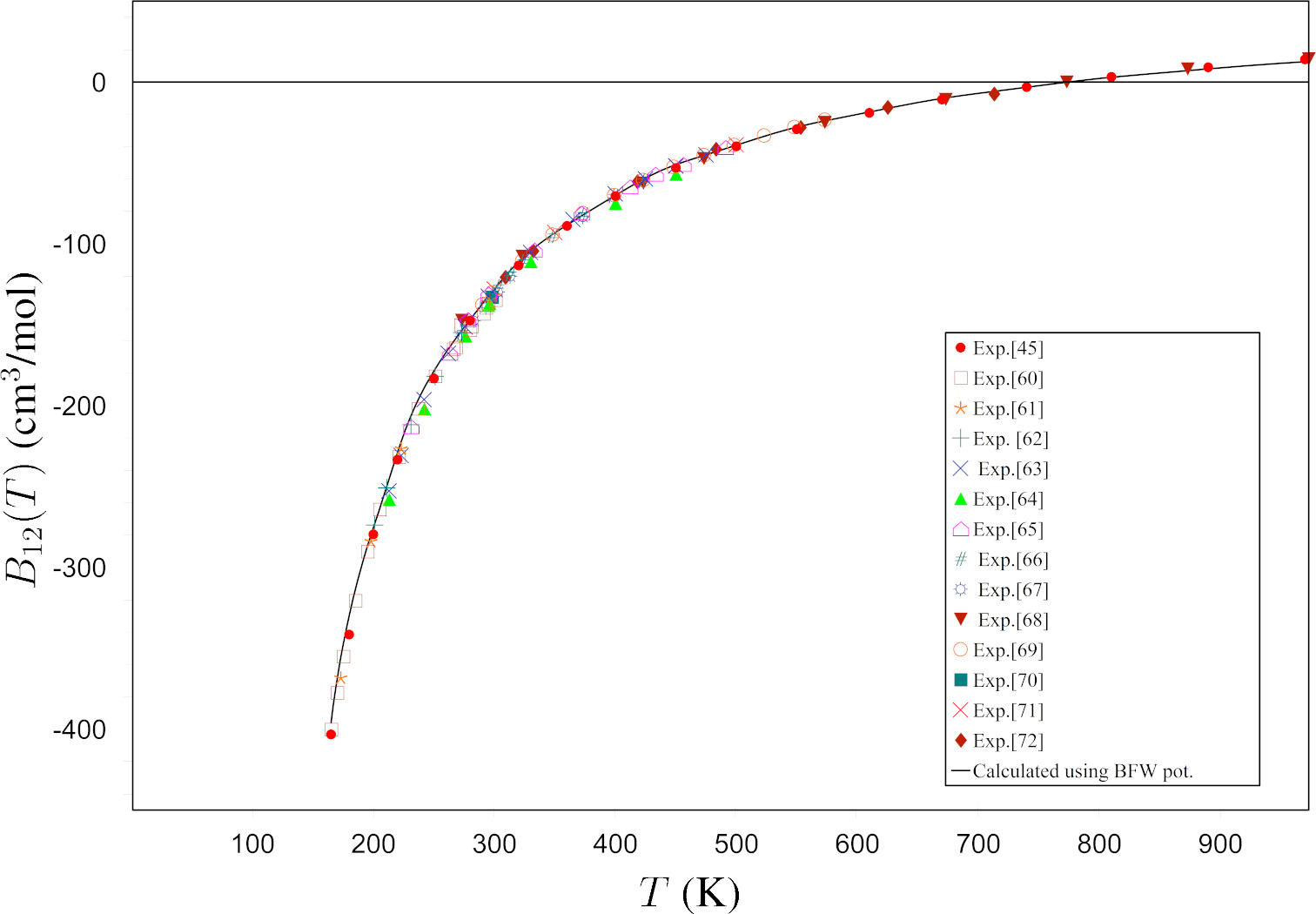
The same as in Fig. 3 but for He-Xe mixture.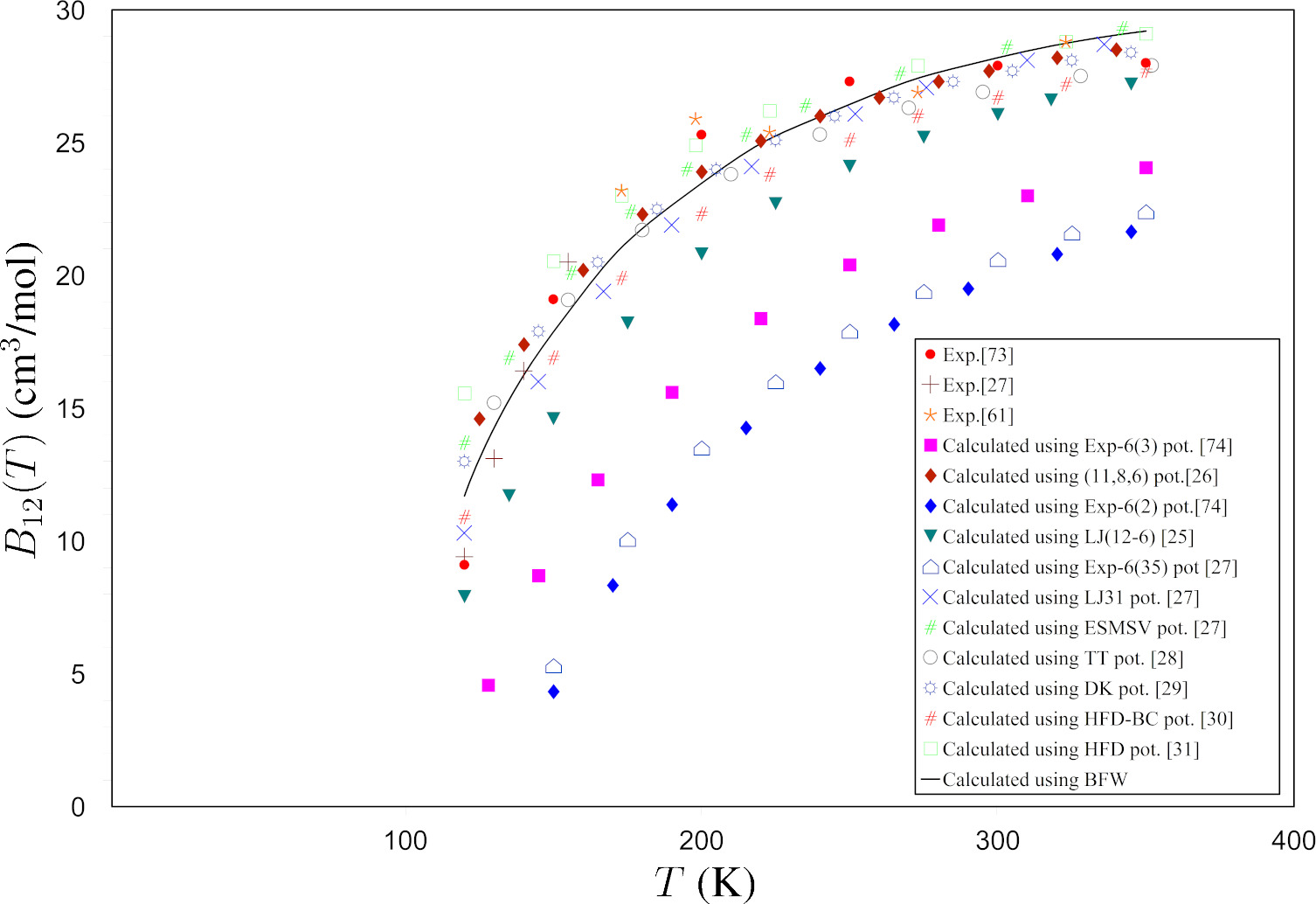
An additional check on the proposed potential consists of the calculation of the transport properties, i.e., mixture viscosity
In addition to the inversion of spectroscopic observations and bulk properties, there are other sources for the determination of intermolecular forces. These are: 1) quantum mechanical calculations (ab initio method) and 2) molecular-beam scattering. In this work, we restricted our efforts to the extraction of information about the interatomic potential energy from the transport properties. In this respect, according to the kinetic theory of gases at low density and the Chapman-Enskog solution of the Boltzmann equation, the transport properties can be expressed with the help of a series of collision integrals that depend on the intermolecular potential energy, and are defined as [118]:
where
The reduced collision integral is defined by:
and
The potential energy would serve as the input information required in calculating the collision integrals, and consequently the transport properties. Kinetic-theory expressions for the transport properties (viscosity, thermal conductivity and diffusion coefficient) in terms of the collision integrals for the binary gas mixtures are given by the following equations [25]:
where
In the above expressions the interaction viscosity
In addition, the mixture diffusion coefficient in (m
with the pressure
The expressions of the mixture thermal conductivity and isotopic thermal factors of pure gases and mixtures are defined in details in Appendix C of [25].
In order to calculate the transport properties of the mixtures considered, the viscosity and thermal conductivity of pure noble gases are determined using the present BFW and MTT interatomic potential models with the different parameters are given in Table 2.
In this section, we present the results of the analysis for noble gas mixtures and the empirical models for
Summarizing our analysis, we find that He-Xe inert gas mixtures develop an incremental induced dipole moment during collisions, besides the exponential one, which contributes substantially at intermediate-range distances and can be ascribed to other mechanisms of electron cloud distortion, such as overlap and electron-correlation effects.
Conclusion
We have developed a model for the induced dipole moment
It is clear that the two methods are complementary and could be used jointly to reduce the computational cost and allow the maximum of information to be extracted from measurements.
The present study further demonstrate that the present BFW and MTT models yield reliable approximations of the interatomic potential of He-Xe gas mixtures The treatment proposed in this study represents an improvement on the model from thermodynamical and transport properties over a wider temperature range. Also, it is interesting to note that the empirical model derived for the induced dipole agrees reasonably well with the ab initio results of Maroulis et al. for this mixture and produces lineshapes in good agreement with experiment.
Footnotes
Acknowledgments
We are grateful to Dr. J. Borysow, Dr. L. Frommhold and Dr. G. Birnbaum for making available their published Fortran code with the different results of the collision induced absorption (CIA) for various systems.