



Abstract
In view of the influence of vibration factors on the vibration characteristics of potato harvester, to study the effect of vibration parameters on the dynamic characteristics of the system and harvested potato quality, in this paper an indoor conveyor separation device for potato harvester with adjustable two-way synchronous conveying vibration parameters was designed. The device, with double-side chain drive to improve conveying efficiency and replaceable eccentric parts to change vibration parameters, allows the system to harvest potatoes under optimal working conditions. A simulation analysis of a dynamics model of the system, which was first established, was carried out. A potato soil separation test was conducted using the vibration testing system and acceleration sensor, and its data was compared with the simulation data to verify the correctness of the model. The results showed that the eccentricity, rotation speed, and inclination had an impact on the potato-soil separation rate and the vibration of the system. The analysis showed that the system had a higher potato-soil separation rate and slighter vibration under optimal working conditions, that is, eccentricity of 0.023 m, rotation speed of 130 r/min, and inclination of 26
Introduction
In the field of agricultural engineering, scientific and technological workers at home and abroad have conducted some research on design of potato harvester through kinematics. Lu et al. analyzed the main parameters of the secondary soil and potato separation and conveyor device of potato combine harvester using kinematics and dynamics, and obtained the optimal parameters for the inclination of the conveying surface, the height of the scraper and the conveying speed of the secondary potato soil separation conveyor device [1, 2, 3]. Lv et al. [4], Zhang and Wei [5], Shi et al. [6] realized the vibration of the digging shovel and vibrating separator mechanism in opposite directions by theoretically analyzing them, which partially offset the respective inertial forces, and increased the stability of the machine. Xie et al. [7], Shi et al. [8], Wu et al. [9] established a potato relative separation sieve movement speed model, analyzed the potato relative separation sieve movement process, and verified the potato relative separation sieve movement process through high-speed camera technology. Yang et al. [10], Gao et al. [11], Kang and Halderson [12] designed a roller push-type potato harvester, and studied the roller push-type separation conveyor device. The results showed that, compared with the ordinary separation conveyor harvester, the roller push-type potato harvester significantly increased the potato exposing rate, and slightly reduced the breakage rate. Li et al. designed a potato combine harvester with the function of lifting and loading, which can complete the digging, transportation, separation and side output loading at one time [13]. The potatoes after loading were directly conveyed back to the warehouse for cleaning and grading, placement and other operations [14, 15]. Feng et al. [16], Mcrae [17], Wang et al. [18]found that the rotation speed of the lifting chain of the separation mechanism remaining unchanged, the damage rate of potato was reduced by appropriately increasing the soil stock on the lifting chain, separating the cushioning materials such as bar chain, vibrating screen rubber, reasonably designing the output height and after-throwing drop height of the lifting chain, and optimizing the design parameters and operating parameters of the separation device. Lu et al. designed a lifting chain type separation conveyor, which can harvest potatoes in clay soil [19]. The design of the lifting chain length and the shaker structure increased the effect on the dispersion and separation of potato soil mixture, improved the ability of crushing and sieving the soil, and improved the efficiency of potato excavator [20, 21].
In view of the impact of the frictional vibration between the potato soil and the conveying parts on the dynamic characteristics of the system and the potato-soil separation rate in the process of potato conveying and separation, in this paper, an indoor conveyor separation device for potato harvester with adjustable two-way synchronous conveying vibration parameters was designed, which was then simplified. A dynamics model of the system was established, and solved by the Runge-Kutta method to study the influence of vibration amplitude and other parameters on the dynamic characteristics of the system. A potato soil separation test was conducted using the developed prototype to study the factors affecting the potato-soil separation rate by combining theory with practice.
Structure and working principle of the conveyor separation device for potato harvester
Vibration can reduce the bonding force between potato and soil, destroy the internal friction and cohesion of soil, so it can effectively separate it from the potato. To this end, in this paper an indoor conveyor separation device for potato harvester with adjustable two-way synchronous conveying vibration parameters was designed. Its structure is shown in Fig. 1.
The device, with double-side chain drive to improve conveying efficiency and replaceable eccentric parts to change vibration parameters, allows the system to harvest potatoes under optimal working conditions. It is mainly composed of rod conveying part, shaking part, side plate, motor, chain drive system, rack and movable plate.
When the device is working, the motor outputs the power and transmits it to the power system. The power system drives the rod conveying part to move, so that the potatoes and soil are conveyed upward from the bottom of the rod conveying part. During the conveying process, the shaking part is used to separate potatoes from soil, and shake soil loose, which then falls from the gap of the chain belt. The potatoes, driven by the rod conveying part, are further conveyed upward, falling from the rear. The side plates prevent the potatoes and soil from falling from both sides. Since the device is an indoor test prototype, it is necessary to conduct test analysis and data collection on the best conveying and separating state of the device. As a result, the movable plate is installed on the rack that supports the shaking device. It can be adjusted to change the amplitude of the shaking parts, carry out the test of conveying separation under different vibration conditions, and collect data. The research results can be applied into the mechanical design of actual potato harvester.
The structure of the conveyor separation device for potato harvester. 1. Rod conveying part 2. Shaking part 3. Side plate 4. Motor 5. Chain drive system 6. Rack 7. Movable plate.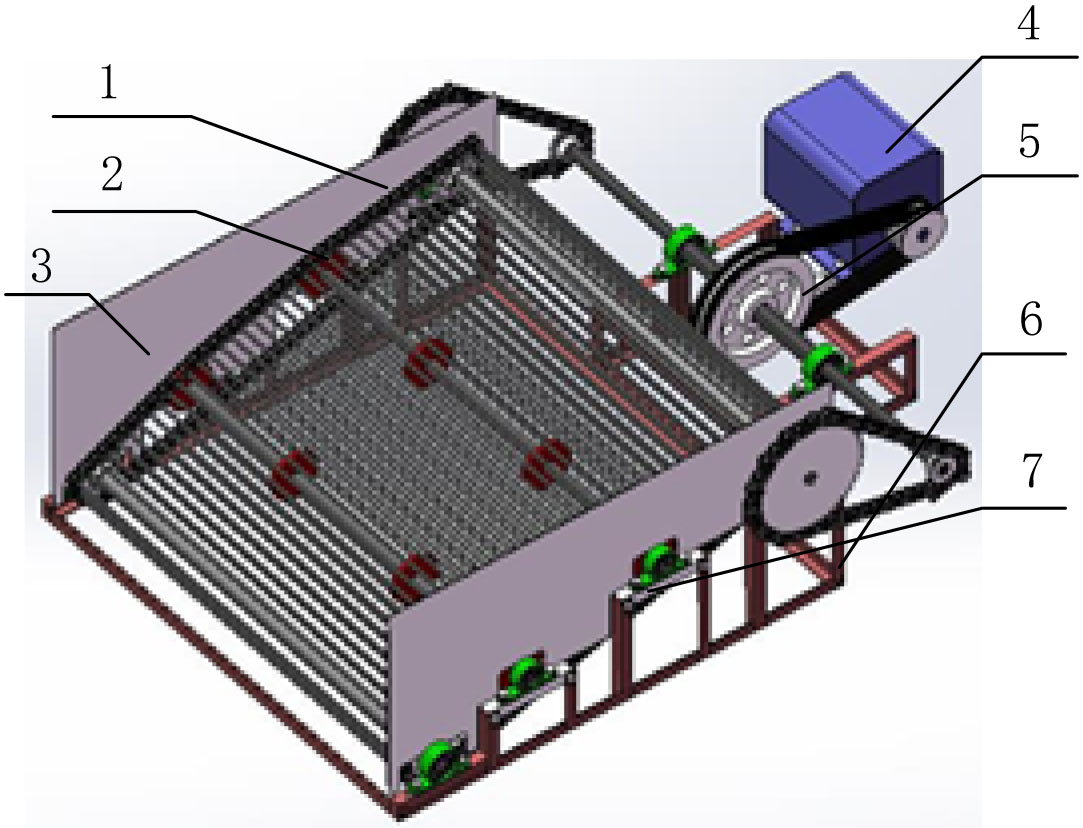
The structure of the shaking part. 1. Shaking rod 2. Shaking wheel.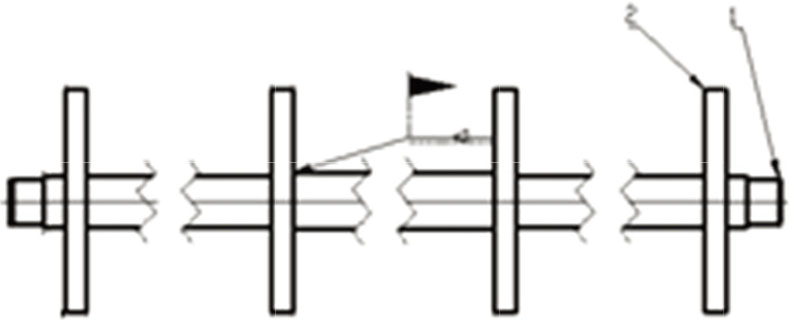
Structure of the shaking device. 1. Rack 2. Bearing 3. Shaking wheel 4. Bearing seat 5. Bolt 6. Movable plate.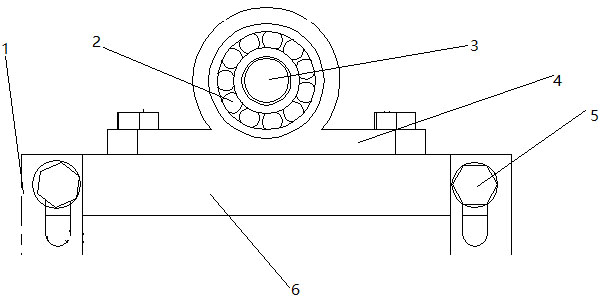
The function of the conveyor separation device for potato harvester is to separate and convey. Its working process is: When the unearthed potatoes and soil are conveyed upward, under the action of the friction between the rod and the potatoes and soil, the soil is shaken loose and sifted through the rod gap, while the potatoes are conveyed to the rear. To enhance the separation effect, four adjustable circular shakers are installed in the middle part of the upper conveying side of the device. Therefore, the rod conveying part vibrates under the action of the shaking device. At this point, the conveying surface does not move in a straight line, but along an arc. This shaking rod is equivalent to an annular movable mesh screen. During working, the pin shaft of the shaking separation device moves up and down due to the action of the shaking device, so that most of the soil becomes loose and falls to the bottom of the rod, and the potatoes are smoothly conveyed to the rear.
The mechanical parameters of the conveyor separation device for potato harvester directly affect the potato damage rate and the potato-soil separation rate. When the chain belt length is fixed, the parameters of the shaker play a decisive role in the above important indicators. The device is designed for test. And the test results are analyzed and compared to find out the optimal working conditions, so that the test data can be applied to the actual mechanical production design and provide a theoretical basis.
A single-shaft, disc welding type is adopted for the shaking device in this prototype, as shown in Fig. 2. An adjustable amplitude structure is cleverly installed on the rack of the shaking device. The shaking part is installed on the movable plate, which is connected to the adjustable elongated hole of the rack by bolts. Its upper and lower positions and shaking amplitude can be changed according to the test for comparison and data collection. The structure is shown in Fig. 3.
The simplified model of the potato conveying and separating system is shown in Fig. 4 [22]. In the model, potatoes with soil were chosen as a viscoelastic material.
The simplified model of the potato conveying and separating system.
The mechanical differential equation of the system in the y direction is:
where,
The fourth-order Runge-Kutta method was used for numerical simulation of the system.
All other parameters remaining unchanged, the eccentricity, rotation speed and inclination was respectively changed to 0.016 m, 0.019 m, 0.023 m; 90 r/min, 130 r/min, 164 r/min; 18
The acceleration-time curves.
Figure 5a shows that the system had a smaller acceleration and slighter vibration with inclination of 18
From the above, we can know the inclination, eccentricity and rotation speed had an impact on the dynamic characteristics of the system. And the inclination of 18
Potato conveying and separating device, electronic scale, acceleration sensor, and data acquisition system were used in the test. The electronic scale was used to test the potato mass before and after the separation, and the acceleration sensor and data acquisition system were used to test the system vibration under different vibration conditions. The test system is shown in Fig. 6.
The test system.
With eccentricity of 0.016 m, rotation speed of 90 r/min, and inclination of 18
The measured and simulation acceleration-time curves.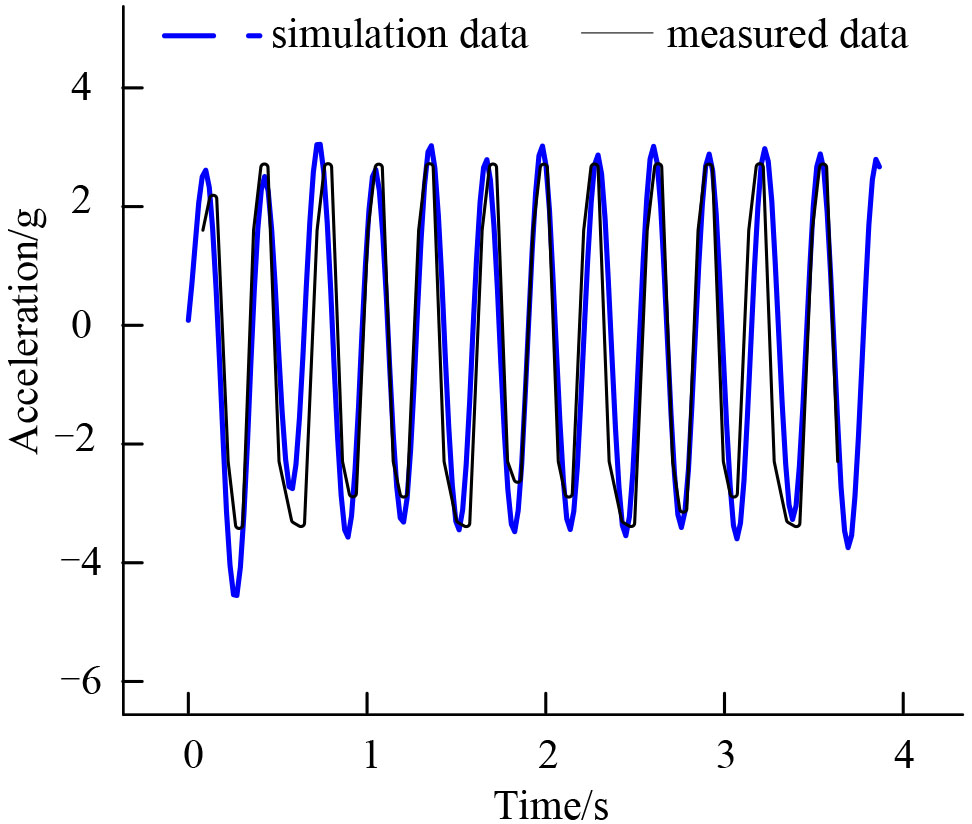
The measured potato separation data under different working conditions is shown in Table 1.
Potato mass before and after the separation
Measured acceleration data
It can be seen from Fig. 7 that the simulation data was slightly higher than the measured data, and the two curves changed similarly. It proves the correctness of the model.
Measured acceleration and potato soil separation data under different working conditions
Under different working conditions, the measured acceleration and potato soil separation data are shown in Table 1.
(1) With the same inclination and rotation speed, the potato-soil separation rate increased as the eccentricity increased.
(2) With the same eccentricity and inclination, the potato-soil separation rate was higher when the rotation speed was 130 r/min.
(3) With the same eccentricity and rotation speed, the potato-soil separation rate was higher when the inclination was 26
From the comparison of the acceleration and potato soil separation data, it can be seen that the system had the highest potato-soil separation rate and violent vibration with eccentricity of 0.023 m, rotation speed of 130 r/min, and inclination of 26
(1) In this paper, an indoor conveyor separation device for potato harvester with adjustable two-way synchronous conveying vibration parameters was designed. The system had a higher potato-soil separation rate and slighter vibration under optimal working conditions.
(2) The eccentricity, rotation speed and inclination were the main factors influencing the potato-soil separation rate. The theoretical analysis and test results showed that proper vibration can increase the potato-soil separation rate. With the same inclination and rotation speed, the potato-soil separation rate increased as the eccentricity increased. With the same eccentricity and inclination, the potato-soil separation rate was higher when the rotation speed was 130 r/min. With the same eccentricity and rotation speed, the potato-soil separation rate was higher when the inclination was 26
Footnotes
Acknowledgments
This work is financially supported by the Talent Plan of Shenyang Ligong University, by the Foundation for Young Talents of Liaoning Province (No. LG202023) and by the General Project of Liaoning Province.