



Abstract
The hidden danger of accidents seriously threatens the safety of the working face of coal mining. By digging the internal association rules of hidden danger, the construction of safety warning rule base can improve the ability of coal mining enterprises to deal with hidden danger as soon as possible. Coal mining work face hazards are analyzed with three types of hazard theory, and the types, attributes and dimensions of hidden accidents in coal mining face are studied, combined with the production practice of coal mining working face, and referring to the thought and method of “5W1H”. Then, the structure of safety early warning knowledge base is studied and the key of safety early warning knowledge base is put forward. On this basis, the paper designs the mining model of mining face data to mine the association rules of accident hidden danger data. The empirical analysis shows that the rule base of safety warning can be used to deal with hidden danger of coal mining working face, and realize the early warning of hidden danger of accident, providing a method for dealing with hidden danger of coal mine accident and managing dangerous source.
Keywords
Introduction
As the main coal production site, coal mining working face is usually operated in the natural area where coal mining is conducted and the environment formed together with the abrupt conditions. In the environment, gas, dust, radiation, heat, explosion, fire, water, noise and lighting [1], affecting the health of operators working on the coal mining face, and may cause accidents, such as gas explosion, fire, roof, flooding and other disasters, endangering the lives of miners at all times [2].
A large number of studies have been conducted by domestic and foreign scholars from the aspects of hazard determination, disaster warning and forecast, hazard assessment, etc., aiming at strengthening the effective management of working environment of coal mining face and accident prevention and control [3]. Han [4] used Lyapunov index to establish the mathematical model of chaotic prediction of gas emission, and calculated the warning threshold based on the prediction results of gas concentration and prediction interval, and divided the warning levels to realize gas outburst warning. In view of the shortcoming of clear structure or characteristics of data needed by fuzzy comprehensive evaluation and grey correlation method, Guan [5] proposed an operational environment evaluation model based on genetic projection pursuit method. Jin et al. [6] established the fracture mechanics criterion of crack instability and expansion induced water inrush and the monitoring and warning criterion of water temperature and water pressure, and discussed the basic technical problems, such as the monitoring condition, the monitoring and warning index system, the monitoring site and the selection basis of monitoring layer. Liu [7], Wang et al. [8] by extension evaluation method, the risk of dust in working face is evaluated and studied. With entropy weight theory to analyze the weight of evaluation index, Wang et al. [9] established the model of goaf coal spontaneous combustion. Wang et al. [10] used the analytic hierarchy process to determine the weight of each evaluation index of the factors causing goaf spontaneous combustion, and combined with the basic principle of the analysis method to analyze the spontaneous combustion of goaf gob, and rebuilt the analysis model based on the uncertain information. Zhu et al. [11] established the comprehensive evaluation model and knowledge base of coal seam spontaneous combustion risk by applying rough set theory and information entropy theory, and conducted data mining on the factors influencing coal seam spontaneous combustion risk. Li [12] and Zhao and Luo [13] respectively applied grey relational analysis and clustering analysis (fuzzy comprehensive evaluation) to evaluate and predict the water inrush risk of roof of coal mining face. These studies on the coalface to analyze and evaluate the risk factors for qualitative or model has certain application value, but more focused on the application of coal mine safety monitoring system of real-time data, is one-sided, and study working face of single risk factor index, the lack of a comprehensive consideration, the mining face no unearthed a large number of the deep value of hidden data.
In recent years, the application research of data mining method in coal mine safety monitoring data has started in the academic field, such as Zhang et al. [14], in the application of association rule technology in coal mine safety monitoring system, etc., the analysis of gas emission is the main factor affecting coal mine safety. Ding and Zhang [15] carries out association rule analysis on working face environmental parameters and mining strong rule between parameters. Regression prediction analysis is conducted on the gas concentration of a certain working face. Jia and Wei [16] applied Apriori algorithm of association rule algorithm in the coal mine safety warning system to mine the data of the coal mine safety monitoring system. These researches focus on coal mine gas or environmental safety monitoring on the basis of structured data, based on traditional data mining technology.
In addition to the real-time structured data collected by coal mine safety monitoring system and automatic control system, there are also a large number of daily hidden danger inspection records, regular safety inspection records of superiors and other text data. Traditional text mining technology, which was mainly based on statistics of word frequency, is difficult to analyze the rules [17]. These semi-structured data cannot be directly processed by traditional data mining models.
Big data technology has incomparable advantages over traditional data mining in processing massive amounts of unstructured and semi-structured data [18]. The application of data mining can be seen in medical and health care, finance, economy, education and other aspect [19, 20, 21, 22, 23, 24]. Many applications fully exploit the intrinsic value of big data [25].
Big data mining technology has also been applied in prediction and early warning, such as the application of in intelligent transportation system [26, 27], early warning model of oil field drilling data analysis [28], early warning of landslides, agriculture and electric power [29, 30, 31]. Big data analysis technologies such as data collection, transformation, mining, integration and storage are applied in risk disaster crisis management [32]. Above research for mine safety warning, provides the reference to big data technology and coal and gas outburst, mine, mine fire, mine water disasters combined roof disaster prevention mechanism, established the mine disaster warning model [33, 34, 35, 36], but big data technology in mine safety management applied research is relatively small, in terms of risk indicators, mainly considering the mine natural disaster warning indicators, ignore the influence of factors such as personnel, management; There are also a few researches on the unstructured text big data of coal mine safety management [37, 38, 39], which focus on the informatization application of the overall safety management of coal mine. However, there is almost no research field on the big data safety warning of coal mining face. The above research pays too much attention to the construction of theoretical methods and models of mining technology, but ignores the characteristics of hidden dangers in mining face.
Therefore, the paper comprehensively studies all kinds of risks and hidden dangers of coal mining working face, applies big data mining technology, deeply excavates the value of risk and hidden dangers data of coal mining working face, so as to realize safety early warning management of coal mining working face. First of all, we analyze the types of risks and hidden dangers of coal mining working face and the structural transformation of hidden dangers data, which lays a foundation for big data mining. Secondly, build a big data analysis platform, and build a big data mining model on this basis. Finally, the validity of the model is verified by an example.
Mining face risks and hidden dangers
Types of risks and hidden dangers
The coal face production system includes the following subsystems: coal mining system, transportation system, ventilation system, drainage system, power supply system, hydraulic support system, safety monitoring system, etc. There are three types of hazards classification of coal face hazards include the following types [40].
The first category of hazards refers to energy carriers or dangerous substances [41], gas content of coal seam, gas emission amount, unstable roof of working face, water, fire source, fault and other geological structural factors, as well as the loss rate of mechanical and electrical equipment such as coal mining machine, scraper transport machine and mobile substation.
The second category of hazards includes the failure of substances and physical environment factors, which mainly refers to the energy constraint measures and control ability of the first type of hazardous substances and individual human error etc., such as fault of coal mining machine and power supply equipment, failure of hydraulic system of hydraulic support, wrong action of post operators, etc. [42].
The third category of hazards refers to the organizational and management factors, including the organization structure, management rules and regulations, operation procedures, safety measures, miners’ skills, cultural level, training level and so on, such hazards depend on the defects of organizational management as well as the quality of the miners themselves [42].
Three types of hazards intersect and influence each other in time and space dimension, and together constitute the hazard source system of coal mining face, which is the hidden trouble affecting the safety of working face.
Among the three types of hazards, most of the hidden dangers in the first and second categories, such as gas concentration, ventilation speed, temperature, roof pressure, hydrology and equipment state, can be detected and collected through safety monitoring system and automatic system. This part of hidden hazards data is structured, such as the gas concentration and roof pressure are 16 bits of integral data.
The third category of hazards as well as some of the first and second categories of hazards, such as air return roadway side, coal mine mechanical and electrical machine protective cover off, work illegal operation, and so on, these hidden dangers need manual inspection. In accordance with Coal Mine Safety Regulations issued by China National Security Administration [43], every class should have special person to undertake safety hidden danger check, key position is on duty more than once, every time check has detailed record. In addition, the regular safety inspection organized by the safety management department of mining and mining groups and the safety supervision departments at all levels also generates hidden dangers.
These records are text-based data, unstructured data, and large amounts. Structural transformation is needed in the application of big data analysis.
Dimensions and attribute categories of hidden risks in coal mining face
Dimensions and attribute categories of hidden risks in coal mining face
By studying the hidden danger data of coal mining face, we can find out the relevant dimensions of hidden danger. According to the literature, the proposed “7W1H” structural transformation model can extract hidden dimensions and determine attribute categories [44].
The structure model of 7W1H is derived on the basis of Five Ws and One H (5W1H). The core idea of 5W1H is that any problem should be analyzed systematically from six aspects, such as What, When, Where, Who, Why and How [44, 45]. 7W1H divided the related responsible personnel of the problem into different levels, the regulatory body (who-1) is the one that leads the responsible person or management department, the subject of responsibility (Who-2) is the person directly responsible. This division accords with the actual situation of coal mine safety management in China.
According to this classification method, the dimensionality of text hidden danger data of coal mining face is divided as follows: What describes the nature of accident hidden danger, which belongs to the nature dimension; Which describes the professional nature of accident hidden danger, belonging to the professional dimension; Why describes the causes of accident hidden dangers, belonging to the causative dimension; When describes the time When the accident hidden danger occurs, belonging to the time dimension; Where describes the location Where the accident hidden danger occurs, which is classified as the spatial dimension; Who described the persons responsible for the potential accident and the subject of supervision as the subject dimension. How describes the level of accident hidden danger and corresponding treatment scheme, which is classified as the processing dimension.
For example, if a coal mining face has this hidden danger inspection record: “on July 20, 2015, the roof of the working face 16301 in the mining area was broken during the pressure coming from the transport trough return air inlet, and the support worker did not deal with it in time, resulting in the roof caking, which affected the production”. This hidden danger dimension property can be described as: the nature dimension is roof rupture and local roof caving, the professional dimension is roof control, the causative dimension is the periodic pressure of working face, the time dimension is July, and the spatial dimension is 16301 working face transport trough return air port; Main dimension direct responsibility main body adopts a work area support worker, supervise main body to adopt the first coal mining department, safety supervision station; Processing dimension is serious hidden danger, should strengthen support.
On the basis of literature retrieval and field investigation, Delphi method was used to extract the main evaluation indexes of safety early warning. The survey objects are experts who study coal mine safety and technical experts engaged in coal mining production, specializing in mining, geology, ventilation safety, mechanical and electrical, automation, etc. According to different dimensions, the hidden danger dimensions and attribute categories of coal mining face are coded, as shown in Table 1.
Big data of safe production of coal mining face
Safety production big data
Safety production big data refers to the production safety in the process of safety production activities, taking a certain way to get to reflect the nature of production safety law of the production safety of data sets [46].
Safety monitoring system in coal mining operations, real-time acquisition working face gas (CH4) and carbon monoxide (CO), wind speed, air volume, temperature and other environmental parameters, the roof pressure monitoring system for real-time collection and hydraulic support, automatic on-line monitoring system of shearer, scraper conveyor, along the trough belt conveyor, emulsion pump, such as mobile substation electrical equipment status data, system acquisition cycle is set to 30 ms or above 1 s, collected and enormous amount of data transferred. In accordance with the provisions on the administration and supervision of coal mine safety production, each shift shall carry out hidden dangers investigation on the environment and equipment of the working face to form the on-duty inspection record; The safety administration departments at all levels shall conduct regular safety inspections and evaluate the safety conditions to form reports; Special equipment and materials shall be subject to regular on-site test or inspection, and various inspection reports or test tables shall be available. With the continuous progress of coal mining face operations, a large number of data gradually accumulated, and finally collected into the coal mining face safety production big data. The development trend of data conforms to the characteristics of large data capacity, fast processing speed, diverse types and sparse value [47, 48, 49].
The big data sources of the early warning database of coal mining face safety mainly include: data of the design and construction stage of coal mining face, including various knowledge lists of coal mining face and various rules and regulations, data and documents [44]. Composition of working face environment, equipment operation, roof pressure and other state information; Daily maintenance, maintenance and related maintenance equipment materials, accident handling and management personnel, safety inspection records and other data and other related databases.
Big data analysis platform
Mining face safety warning big data analysis platform, focus on data collection and mining analysis. Due to the complex structure of security warning big data, including structured, semi-structured and unstructured data, ordinary information processing system is difficult to achieve data processing, which requires the use of big data processing technology to effectively store and process. Figure 1 shows the architecture of the early-warning big data system for coal mining face security. The distributed computing architecture is adopted to realize mass storage, maintenance and cross-level distributed business processing of safe big data.
Big data technology application architecture diagram of coal mining face safety warning system.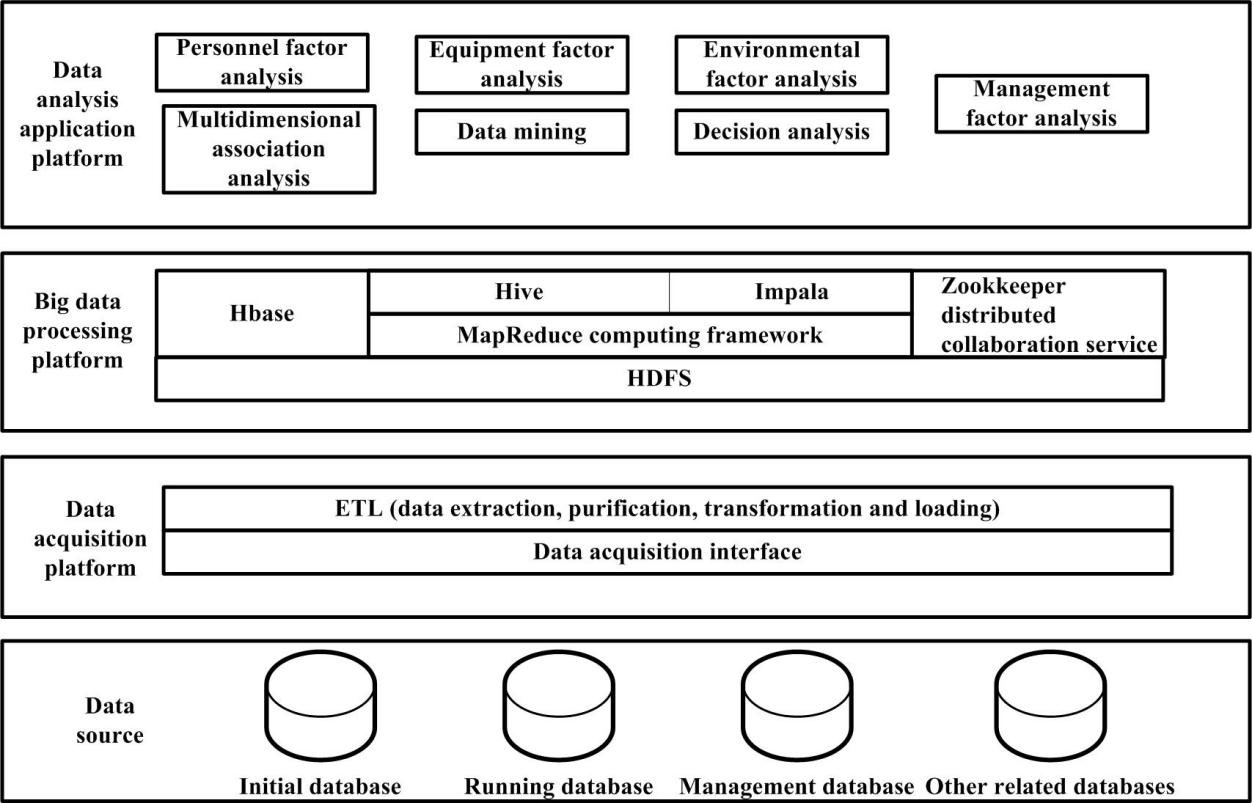
The data source layer provides the required data source for the security warning big data system, and provides various professional knowledge and parameters.
The data acquisition layer develops conversion adapters according to the characteristics of hidden data, extracts, purifies, transforms and loads the data according to the standards of the coal mine industry, and stores the processed data in the big data storage system. In the process of mining big data for safety early warning of mining working face, all data are extracted, converted and loaded by MapReduce platform, and converted into identifiable state data. A large number of data are continuously accumulated and collected to form the empirical big data of coal mine safety early warning.
The big data processing platform layer is the core of the System based on Hadoop, it is a computing platform capable of distributed processing a large amount of data. Distributed storage and Distributed processing are two core technologies. The mining process adopts distributed parallelization technology and Hadoop MapReduce platform to complete a series of data processing processes such as partitioning, mapping, sorting, merging and merging [47].
The application layer of data analysis is the functional implementation layer of the security early-warning big data system. It develops and applies different types of data and has intelligent decision-making, visual interaction and other functions.
Data preprocessing
The pretreatment of massive data is an important step for the safety warning of coal mining face, especially when the object containing incomplete data and abnormal data is excavated. In order to improve the quality of data mining, data pretreatment is needed, which generally includes structural processing, data cleaning and integration, selection and transformation [50].
Structured processing
The data of daily maintenance, maintenance and related maintenance equipment, materials, accident processing and management personnel of coal mining face are mostly stored in text form. These unstructured texts store abundant valuable information. The data mining model is difficult to directly process these unstructured information. It is necessary to conduct structural processing on these texts to form structured data so as to meet the requirements of data mining. This paper adopts the unstructured or semi-structured data preprocessing in the big data platform based on association rules, the main steps are as follows: logical structure extraction, document preprocessing, data extraction and data organization.
1) Logical structure extraction
The unstructured text logical structure can be expressed as Eq. (1):
where ID is the identity of the document, TupleID is the identity of tuples, Title is Title area, Type is title area Type {Single, Multiple}, where Single means “Single value area” and Multiple means “many value area”, and Parent is Parent header area for a header area.
The input extracted by logical structure is an unstructured table document that does not contain any actual data. By matching the data dictionary, the table’s header areas are extracted, and the logical relationship is established. Finally, the extracted results are saved in the logical structure library [51].
2) Data extraction
Data extraction is to extract data areas in the table and establish semantic relations with the header area according to the structural features of documents and tables and data flow features. Data extraction in single-value regions and multi-value regions, pre-defined extraction rules, and according to data characteristics, the corresponding algorithm is adopted to generate multi-group structured data sets.
3) Data organization and storage
The data extraction is completed to extract the header area and data area from the unstructured data flow. The task of data organization is to organize the data according to certain rules and transform it into structured data. Finally, structured data text documents are moved to Hadoop’s HDFS distributed file system.
The structured data model can be represented by multiple groups, as shown in Eq. (2):
where ID is unique identification of the document, TupleID is unique identity of tuples, TitleArea is title area value, DataArea is the value of a data area, which can be a header area string or a DataArea string; Where the Relation value is 1 or 0, when the value is 1, it means that the DataArea is the subtitle of TitleArea, when the value is 0, it means that the DataArea is the DataArea corresponding to TitleArea, and Foreign is the parent section of the header section.
According to the above treatment methods, combined with the hidden danger data attribute Table 1, the text hidden danger data of coal mining face can be transformed into the quantity expression form.
There is usually a large amount of abnormal data in the raw data collected, such as the deviation of the expected value of key indicators, missing key attribute information, error type data, etc., which will seriously affect the quality of the information if it is not cleaned up. The data is processed by smoothing noise data, filling in missing and missing data, removing abnormal data, and standardizing the data structure so that different data are integrated into a set.
The following issues need to be considered during data integration [52]:
1) Pattern integration problem
Entity setting problem, that is, the entities of multiple data sources match each other, such as whether the initial database shearer _ID of the coal face is the same entity as the coal miner _number in the run database. Solving this problem can be done through metadata contained in a database or data warehouse to avoid errors during schema integration.
2) Redundancy
In data integration, redundancy issues often arise. If an attribute can be inferred from other attributes, then the attribute is redundant, and inconsistent naming of attributes leads to redundancy. Correlation analysis can be used to identify the correlation between attributes, such as the correlation between attributes
where
If
If
When
3) Data value conflict detection and elimination
For the same entity, the attribute values from different data sources may be different. For example, in the roadway of the coal mining face transportation along the coal chute, the fracture of the hanging net led to the sheet gang, the security officer on duty recorded the area of the falling off of the net, and the mine safety supervisor calculated the volume of the falling off of the sheet gang. In this way, the same hidden danger comes from different records and descriptions in the coal mining area and the mine safety monitoring station, resulting in data value conflict.
Data selection is based on business requirements, data information is selected, then data formatting is conducted, and unified coding is adopted to form a security warning database for data mining.
Data transformation refers to transforming or merging data into a form suitable for data mining, which main tasks are smoothing, aggregation, data generalization, normalization and attribute construction.
The normalization of data is to drop the data of related attributes into a relatively small range, in order to eliminate the deviation of mining results caused by different sizes of numeric attributes. In this paper, the maximum-minimum normalization method is adopted. It is assumed that min
In the above equation,
Mining of association rules
The study of association rules is helpful for discovering the potential association between different items in the data set, which is represented by rules. After deduction and accumulation, the relationship model is obtained.
Setting the itemset is
Association rules have two important attributes: support degree and confidence degree. The association rules that meet the minimum support threshold and minimum trust threshold are called strong rules.
1) Support
The support of association rules is defined as the ratio of the number of transactions that contain both
It reflects the probability that the item set
2) Confidence
The association rule’s support degree (confidence) is defined as the ratio of the number of transactions containing object
It reflects the conditional probability of occurrence of item set
When the support and confidence of the mining association rules are satisfied (minsup, mincon), the rule can be considered valid, otherwise it is an invalid rule [52].
3) Lift
To verify the reliability of the rule, the lifting degree, as a complementary indicator of confidence, is described as:
When lift value is 1, it means that
Data mining association rules mainly include the following two steps, the first step is to select all the item sets that meet the minsup minimum threshold, the frequent item sets, and the second step is to find all rules that meet the mincon minimum confidence threshold from the frequent item set.
Through the above process, the information in the security warning database of the work face is transformed into different association rules. By using these rules, the safety manager can predict the possibility of other factors based on known factors and realize the security warning.
The commonly used algorithms for data mining association rules include Apriori algorithm, multi-level association rule algorithm and multi-value attribute association rule algorithm [25].
As mentioned above, the safety hidden danger data of coal mining face is in multi-dimensional space, which is more suitable for multi-level rule mining algorithm. The multi-level association rule mining is to find the association rules at each concept level. It can adopt a top-down strategy, starting from the first concept level and descending to the lower and more specific concept level, and calculate the frequent item sets at each concept level until the frequent item sets can no longer be found [53, 54, 55], each level can adopt Apriori algorithm. Taking some data of the hidden danger record for the safety inspection of coal mining face as an example, this paper explains the mining process using the multi-level rule algorithm.
The Fig. 2 is the hierarchical concept map corresponding to the above Table 1 (hidden danger description dimensions and attribute categories of coal mining face).
Concept hierarchy tree structure of coal mining face safety hidden danger.
The root node of the conceptual hierarchy tree is encoded with continuous integer encoding, and then the node of each tree is coded layer by layer. The code of the child node is the combination of the code of the parent node and the serial number in the subtree. The coded concept hierarchy tree is shown in Fig. 3.
After the hierarchical tree coding, the data of security hidden dangers are coded, such as the coded things database classified according to the professional dimension (denoted as pro-dim) specified in Table 1, as shown in Table 2.
Coded object database
Concept level tree coding of coal mining face safety hidden danger.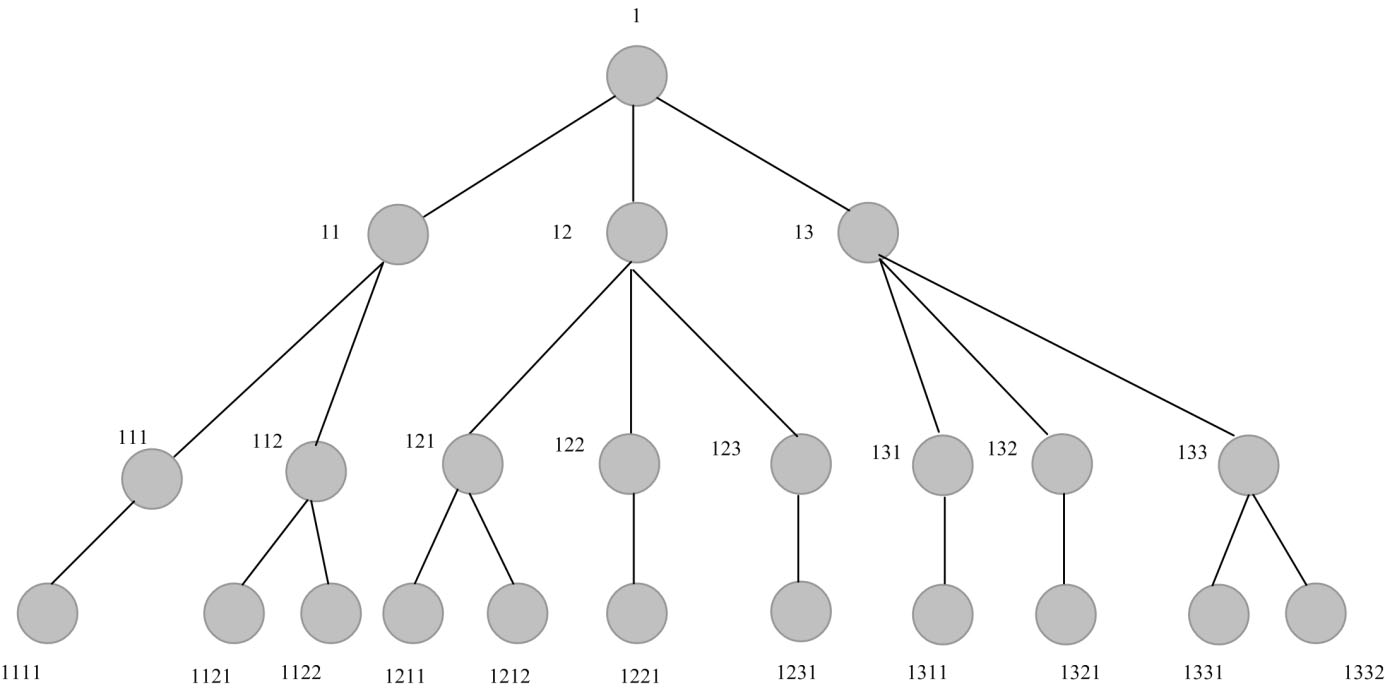
In order to verify the application effect of data association rule mining safety early warning model, with a fully mechanized working face of a mine as an example, and respectively to the working face in real-time dynamic data from the automatic monitoring system (structured data), artificial inspection record of the text as the test sample (unstructured or semi-structured data).
Working face safety monitoring data
Data acquisition
Taking the data of the safety monitoring system of the mining face in January 2018 as the research object, five parameters including gas, carbon monoxide, wind speed, temperature and daily output were selected based on the analysis of the geological structure and coal seam characteristics of the mine. The original monitoring data is shown in Table 3.
Original monitoring data
Original monitoring data
For the convenience and validity of data mining, the original data is first processed. The attributes of gas concentration, carbon monoxide, temperature, wind speed and daily output are
The preprocessed data
The preprocessed data
By applying Apriori algorithm, the maximum item set is found according to preset minsup
Table 5 is described as follows:
1)
2)
3)
4)
5)
Data mining and analysis table
Data mining and analysis table
The above association rules are further explained and analyzed as follows.
1) Rules (1) gas, carbon monoxide correlation between them, the gas concentration in the first level is lower, that face ventilation should be better, but carbon monoxide concentrations in second grade, specification on the high side, can be interpreted as the coal mining process continuously produce carbon monoxide oxidation, but lift
2) Rules (2) and (3) indicate the relationship between carbon monoxide concentration and the temperature and wind speed of the working face. If the temperature of the working face is too high, the carbon monoxide concentration will also be affected. Therefore, ventilation is better at the working face, reducing the temperature of the working face and reducing the generation and agglomeration of carbon monoxide.
3) Rules (4) and (5) indicate the relationship between gas concentration, carbon monoxide concentration, wind speed and coal daily output in the working face. The safety production of coal mine is required to be determined by wind, which means that sufficient air supply must be ensured in the production process of coal mine. The wind speed of the working face is at level 3 (1.35–
Safety risk assessment monthly report is an important content of coal mine safety management, according to the monthly investigation of the first three preventions, roof, mine machinery and electrical equipment, personnel, management and other hidden dangers statistics and analysis, and then make a coal mine safety production status evaluation. Taking the hidden danger data of the mining face in the safety risk assessment report of the mine from January to October 2018 as the research object, a total of 370 hidden danger records of dangerous sources were recorded, and Table 6 was the list of some dangerous sources of the mining face.
List of some dangerous sources and hidden dangers on the working face of coal mining
List of some dangerous sources and hidden dangers on the working face of coal mining
According to the modeling of data mining steps discussed above, firstly the data flow source node is set, and the hidden dager is sorted out and the data file is standardized as the data source. Secondly, 35 categories of hazard sources are set as independent fields according to the coding method defined in Table 2. When the hazard source exists, the value is 1, indicating that the hazard appears in the safety risk assessment. When the value is 0, it means no occurrence; Then the Apriori algorithm is used for data set mining and rule set generation. Set the minimum support threshold minsup
Visualization of association rules.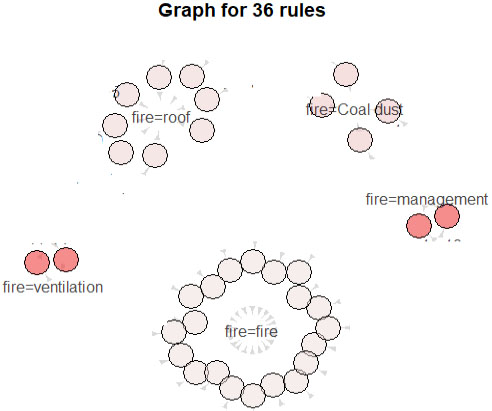
The first five rules are arranged in descending order according to the degree of promotion, as shown in Table 7.
Table caption
Take rules 1 as an example to explain the implication of prompt degree in Table 7: the ratio of the conditional probability that
Therefore, the association rules in the Table 7 are explained and analyzed as follows:
1) Rule1 indicates that when air leakage channel exists in the track groove, there is a hidden danger of spontaneous combustion and fire in the coal seam of the mining face, and there is a strong correlation between the two. Because the coal seam of this mine has spontaneous combustion risk, the air volume is insufficient due to air leakage, the working face temperature rises, and the residual coal contact with oxygen, which is easy to cause coal seam fire. If the hidden danger of spontaneous combustion tendency of coal seam in coal mining area is checked according to this rule, the maximum inspection efficiency can be increased by 35 times.
2) Rule2 means that there is air leakage in the track groove and the goaf is not treated with yellow mud grouting. The track groove is toxic and harmful and the concentration of low-oxygen and high-nitrogen gas increases. There is a strong correlation between the two. If the ventilation condition hidden danger is checked according to this rule, the inspection efficiency will be up to 35 times higher.
3) Rule3 indicates that when air leakage channel exists in the track groove, the concentration of coal dust in the exploratory roadway increases. Due to insufficient air volume, the coal dust cannot disperse in time and accumulates; If the hidden danger of coal dust is checked according to this rule, the maximum efficiency of inspection can be increased by 8.75 times.
4) Rule4 means that there are holes and cracks in the tunneling roof of the loose coal body of the coal exploration roadway, and the roadway is high in height and difficult to support, which will easily lead to the increase of the concentration of coal dust. Because the holes, cracks and roof support are not good, the ventilation resistance of the coal roadway will be increased and the ventilation condition will be poor, so that the coal dust cannot disperse in time and accumulate. According to this rule, the maximum efficiency of coal dust inspection can be increased by 8.75 times.
5) Rule 5 refers to the face after the retreat rail along side goaf grouting, not working face is easy to produce dust and the concentration of large, lead to pick up dust workers produce occupational disease, reaches explosion condition, there are coal dust explosion risk, because there’s no grouting mined-out area, there will be wind is burned into the mined-out area, cause face ventilation is not enough, then easy to increase coal dust concentration, excessive staff breathing dust and make the health damage, also increases the risk of coal dust explosion; According to this rule to check the hidden danger of coal dust explosion, the inspection efficiency will be increased by 6.57 times.
On the basis of discussing and studying the attributes and structure of mining face accident hidden danger data, we built a big data analysis platform, combined the traditional Apriori algorithm with big data technology, and proposed the algorithm model of mining horizontal association relation between mining face accident hidden danger data and mining vertical relation between data structure layers. It is used to reveal the relationship and change of accident data. It provides an auxiliary decision-making basis for dynamic diagnosis, safety prediction and early warning of mine production. From the perspective of data analysis, it enriches the research direction and emphasis of scientific management of coal mine safety. This research has the significance of theoretical and practical research, which is also the innovation of this paper.
The main contributions are as follows. Firstly, the types and attributes of the risks and hidden dangers faced by coal mines are analyzed by applying three kinds of risk source theory and six-way analysis method. Secondly, based on the analysis of large data sources of coal face safety production, a safety warning model of mining big data association rules of coal face is established. Furthermore, the concept hierarchy tree and coding method of hidden danger in coal mining face are established by using multidimensional hierarchical association rules.
The effectiveness of the model is verified through the practical case application of coal mining face. Compared with the manual screening of hidden dangers, the traditional information prediction system greatly improves the prediction efficiency of accident hidden dangers, and according to the relevant hidden dangers have been screened to the hidden dangers that can be excavated, providing decision-making basis for preventing and reducing the occurrence of accidents
The deficiency of this paper is that it does not consider the hidden dangers of management, which needs to be studied in the next step.