



Abstract
In order to improve the user access success rate, cloud service success rate and experiment resource sharing and retrieval efficiency of network virtual experiment environment, a network virtual experiment environment architecture based on cloud computing was proposed. Through the CVM cloud virtual experiment platform and LIMP Laboratory integrated management platform, the system architecture of network virtual experiment environment is designed. Based on cloud computing, the access control algorithm of network virtual experiment environment is designed, and the resource sharing of network virtual experiment environment is realized by data mining technology. The experimental results show that the architecture proposed in this paper has a high success rate of user access and cloud service, and a good efficiency of experimental resource sharing and retrieval, indicating that the architecture proposed in this paper has a good application effect.
Keywords
Introduction
Virtual machine software and network device simulation software are combined to construct the network virtual experiment environment architecture. It is a software-oriented operation during the running of experimental projects. By clicking the icon or button of the simulated device in the software, network connection, device addition, result verification and analysis can be carried out [1]. Compared with the real experimental environment, the virtual experimental platform has the advantages of simple operation, strong scalability, high simulation and low investment cost, which are unmatched by the real experimental environment. This network virtual experimental environment architecture can not only simulate the working principle of real network equipment, but also effectively solve the problem of shortage of experimental equipment [2]. In addition, due to the repeatability of virtual simulation software, it can avoid the influence of wrong operation and improve the experimental efficiency, which is conducive to the research in various fields.
The most outstanding advantage of network virtual experimental environment architecture is that it enables students to simulate various network scenes and network equipment configuration in the virtual environment, fully understand the experimental process, observe experimental phenomena, cultivate learning interest, and realize teaching and learning. Students can construct the network in the virtual environment, observe the operation of the network and configure the network environment. However, in open source software, there are difficulties in student management, audit and management of experimental reports and management of a series of experiment-related work. Therefore, it is urgent to design a comprehensive network virtual experiment environment architecture platform that can efficiently manage experimental teaching resources, expand third-party virtual experiment course resources and self-built course resources [3].
At present, relevant scholars have made research on the architecture of network virtual experiment environment. Li et al. [4] proposed a remote controllable virtual electronic experiment platform by combining three advanced technologies including virtual instrument, network technology and interactive multimedia. The new reform of experimental teaching idea and method has been realized. The constructed experimental platform breaks the limitation of time and space of experimental teaching, and effectively overcomes the shortcomings of traditional experimental teaching model, such as inflexible, single, outdated and backward experimental equipment. However, the experimental resource sharing efficiency and retrieval efficiency of the experimental platform are low, which affects the normal operation of the network virtual experiment environment. Chen et al. [5] set up a virtual simulation experimental teaching platform for the Internet of Things, focusing on experimental simulation teaching of core communication courses such as application development of single chip microcomputer, embedded Internet of Things gateway development and mobile application development. This experiment projects through the serial communication programming, network communication programming, database programming and other professional knowledge, as the Internet communication core experiment teaching of the course provides the powerful support, but the network virtual simulation experiment teaching platform security is poorer, vulnerable, and the efficiency is low, it is hard to meet the teaching requirements.
On the basis of previous research, this paper proposes a research on the architecture of network virtual experiment environment based on cloud computing. Firstly, the structure of network virtual experiment environment system is studied, and the CVM cloud virtual experiment platform and LIMP Laboratory integrated management platform are used to build the hardware structure of network virtual experiment environment platform, and the main modules and functions of the platform are planned. Secondly, based on cloud computing technology, the software part of the network virtual experiment environment platform is designed, and trust data is collected and updated to complete the access control algorithm. Then, based on the cloud computation-based network virtual experimental environment platform, the sharing and retrieval of experimental resources are completed. Finally, the application effect of this design platform is verified and analyzed through experiments.
System architecture of network virtual experiment environment
The network virtual experiment environment can not only simulate the working principle of real network equipment, effectively solve the problem of shortage of experimental equipment, but also better stimulate students’ enthusiasm for learning and improve the effect of experimental teaching. In the whole design process, the network virtual experiment environment should achieve three main experimental goals.
Simulate the real experimental environment to stimulate students’ interest in learning. The network virtual experimental environment can not only simulate the real experimental equipment, experimental environment and experimental operation, but also allow students to understand the connection, configuration and working process of network equipment in a virtual environment, and conduct computer network knowledge in a virtual environment. study and research. Record the experimental process and understand the problems existing in the students’ experimental process. Because most computer network experiments – whether virtual experiments or real physical experiments, it is difficult to understand the specific steps of students in the operation of the experiment. The lack of such information is very unfavorable for teachers to further understand the detailed learning process of students. Therefore, the computer network virtual experiment environment should be able to record students’ experimental operation links, such as physical connections, system configuration operations, and be able to objectively test and assess students. Extensible. Since different teachers have different teaching methods, the preset experiments on the platform cannot fully meet the needs of teachers in teaching. Therefore, the construction of network virtual experiment environment must meet the needs of teachers to design virtual simulation experiments independently.
The network virtual experiment environment platform is built on the basis of Ruijie Networks Lab. Following the principle of “combining the virtual and the real, being able to be true, and open and sharing”, it integrates software sharing virtual experiments, instrument sharing virtual experiments and remote control virtual experiments to realize multi-course, all-round, open and shared virtual simulation experiment teaching. The platform system architecture is shown in Fig. 1.
Laboratory Integrated Management Platform (LIMP). LIMP is a comprehensive virtual experiment management platform, which can realize the whole process management of experiment teaching, including six main functional modules, including laboratory management, experiment management, teaching monitoring, experiment result management, curriculum and user management.
System architecture of network virtual experimental environment. Cloud virtual experiment platform CVM is a virtual experiment platform based on cloud computing, which hosts multiple virtual machines and has built-in software to share the virtual experiment teaching resource library. It can flexibly and quickly deploy a virtual simulation experiment environment according to experimental projects. Virtual topology connector NTC is a virtual networking platform, which carries virtual design scenarios of network topology. The built-in instruments share the virtual experiment teaching resource library. You can select virtual components, build virtual logical racks, and construct complex network topology structures according to experimental requirements to realize visualization and customization. Virtual topology connections. Rack control management services RCMS is a physical mapping platform, which carries network equipment management and control commands. It has a built-in remote control virtual experiment teaching resource library. It can realize physical mapping and configure physical network topology according to virtual network topology. It overcomes the traditional manual connection between PC and network equipment for physical mapping. The disadvantage of networking is that it can remotely control and manage network equipment.

The architecture design of the network virtual experiment environment is based on hardware construction and focuses on resource construction, focusing on the open sharing of experimental resources, the virtual design of network topology and the remote physical mapping of virtual topology to achieve deep integration of virtual simulation and traditional experiments. The hardware of the network virtual experiment environment is as follows:
Build a network virtual experiment environment platform based on cloud computing and virtualization technology. Cloud computing is a resource usage model in which a shared pool of computing resources such as networks, servers, and storage provides services on demand. Virtualization is a resource management technology that enables flexible deployment of computing resources and improves their use efficiency. Cloud computing and virtualization are closely related. Cloud computing combined with virtualization technology can make resource deployment more flexible; and virtualization introduces the concept of cloud computing, which can enable virtualized resources to be used more effectively on demand. It is necessary to provide a rich virtual simulation experiment environment to support multi-user experiments at the same time to achieve the free switching of the experimental environment and the open sharing of virtual experimental teaching resources. Build a virtual topology connector based on virtual reality technology. Virtual reality technology is the integration of simulation technology and computer graphics, human-machine interface technology, multimedia technology, sensing technology and network technology. The constructed three-dimensional dynamic visual simulation system can provide students with vivid and realistic learning. Environment and virtual experience are an important leap in the development of experimental teaching informatization. NTC is equipped with 1 Console port, 2 1000Base-X SFP ports, 2 Ethernet ports and 48 Ethernet connection electrical ports. Through related configurations such as network IP, user name and password, it provides virtual topology design scenarios and builds virtual components Libraries and virtual experiment logic racks for visualization and custom topology connections. Based on reverse telnet technology, build rack control management service. Reverse telnet refers to the connection established from the asynchronous serial port outward (different from the general outward-inward connection), which is a commonly used management control technology in network system integration. The network device that supports this function in reverse telnet is configured as a terminal server, and its asynchronous serial port is used to connect the console port of the controlled device to realize remote control and management of multiple network devices. RCMS is an intelligent platform based on reverse telnet, equipped with 1 Console port, 1 AUX port, 2 Ethernet ports and 1 8-port asynchronous port, and connects to physical networks such as routers and firewalls through crystal head cables. The device provides a web-based operation interface through network IP, user name and password, etc. RCMS can realize virtual remote control and management of network equipment without plugging and unplugging control wires.
The network virtual experiment environment mainly includes six subsystems, including experiment resource management, experiment library management, experiment process management, experiment report evaluation, teacher-student interaction system, and experiment system management. The functional framework of the platform is shown in Fig. 2.
System function framework of network virtual experiment environment.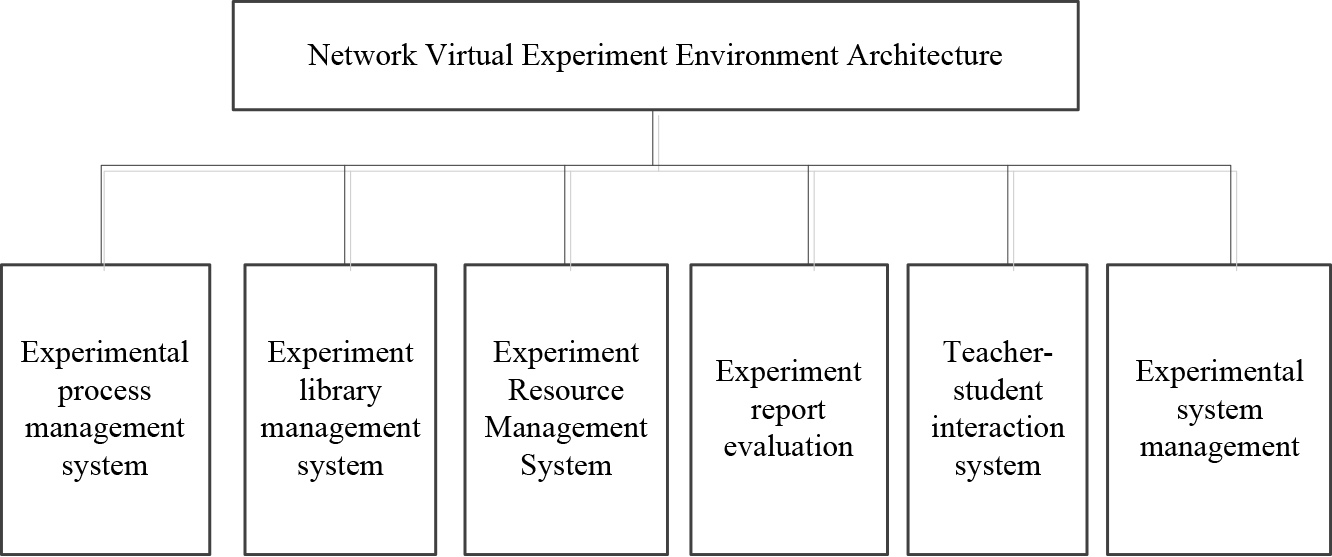
Experimental resource management subsystem The main function of the experimental resource management subsystem is to manage all kinds of resources used in the network virtual experimental environment, including the problem bank management module and the teaching resource management module. The purpose of setting up the problem bank management module is to enable students to understand the theoretical knowledge related to the experiment before doing the experiment, so as to better carry out the network virtual experiment environment. The experimental teacher needs to prepare a certain number of exercises for the exercise bank module. The teaching resource management module mainly manages teaching resource files such as picture resources, video resources, audio resources, and document resources. Uploaded resources need to be reviewed by an administrator before teachers can reference them in experiment settings. These teaching resources can be set up to be shared or dedicated to specific experiments. Experiment library management subsystem The experiment library management subsystem consists of an experiment management module and an experiment arrangement module. The experiment management module is the core of the whole system, which mainly provides teachers with the management function of teaching experiments. Experiment teachers can modify the experiments according to their own teaching requirements, such as modifying the exercises of the experiment, the content of the experiment, and the requirements of the experiment. The experiment management module also provides the function of teacher-defined experiment. When the preset experiment cannot meet the teacher’s teaching requirements, the teacher can define some special experiment content for students to use in class. The experiment arrangement module is the experiment that the teacher chooses to teach according to the teaching requirements, and sets the experiment time and class. Experimental process management subsystem The experimental process management subsystem includes two modules: experimental process management and student attendance management. The experimental process management module is an environment platform for managing students to do experiments. Students can see the experimental content and experimental requirements released by teachers on the experimental platform, and complete the experiment on their own platform. In addition, student lab process management provides students with online “lab help” documents from which students can get help in completing their labs. The function of the student attendance module is mainly to assist the experimental teacher to check the students’ class status. Experiment report evaluation subsystem The experimental report evaluation subsystem has intelligent review function module and manual review function module. The intelligent review module can automatically judge whether the students have performed the corresponding configuration and operation according to the points designed by the experiment, and automatically complete the review process. Due to the complex design of the intelligent review function, only some experiments in the experimental platform can complete automatic review, and the intelligent review of other experiments needs to be improved in subsequent versions. For manual review, teachers will grade according to the experimental steps, experimental results and results analysis stated in the students’ experimental report. Teachers can return unqualified lab reports to students and ask students to rewrite lab reports and submit them again. Teacher-student interaction subsystem The most important module of the teacher-student interaction subsystem is the experimental answering room module, which has a function similar to “group chat”. Using this module, students can ask teachers questions in time when they find problems during the experiment, and teachers can provide help online. On the other hand, students can learn about the common problems of their classmates during the experiment in the answering room, and teachers can also remind everyone of the matters needing attention in the experiment through the answering room. Experimental system management subsystem The experiment management subsystem is mainly used by system administrators. System administrators can create courses for teachers, create teacher accounts and student accounts according to teaching arrangements.
The access authority control method of the network virtual experiment environment can protect the resources existing in the cloud environment, improve the security of the network virtual experiment environment and the sharing of experiment cloud resources. However, cloud computing technology has the characteristics of development, large-scale and distributed. Therefore, on the premise of reasonably controlling data flow, it can effectively protect cloud resources and analyze the access control of network virtual experimental environment.
Cloud computing-based network virtual experiment environment access control algorithm
Collection and update of trust evidence
The multi-domain access control algorithm in the network virtual experiment environment in the cloud environment obtains the behavioral trust evidence generated by the user in the cloud environment in the following two ways:
Collect common data such as the number of unauthorized attempts, resource utilization, environmental status, service availability, time, user access frequency, and application behavior hidden dangers in the process of user-server interaction in the cloud environment [6]. Collect the mean time between failures, interaction success rate, self-defense capability and error repair rate of users and servers in the cloud environment.
According to the time point of evidence generation, the multi-domain access control algorithm in the network virtual experiment environment in the cloud environment divides the user behavior trust evidence existing in the cloud environment into current evidence
In the formula,
With the passage of time, the user’s trust in the cloud environment will gradually decrease, and the user’s trust evidence in the cloud environment will gradually decrease if they do not interact with the server for a long time. Therefore, the time factor will affect the update process of the trust evidence [8]. In view of the time characteristics of trust, the multi-domain access authority control algorithm of the network virtual experiment environment in the cloud environment is described by the time decay factor
In the formula,
The objective data obtained by the detection is usually the trust evidence of user behavior in the cloud environment. The subjective characteristics of the trust evidence are usually significant, so it is necessary to process the trust evidence in the cloud environment with information [9]. The multi-domain access authority control algorithm in the virtual experimental environment introduces subjective factors to divide the level of user behavior trust evidence [10].
The multi-domain access control algorithm in the network virtual experiment environment in the cloud environment uses the updated data to calculate the comprehensive trust value of the user behavior trust evidence. The specific process is as follows:
According to the user’s interaction history in the cloud environment, calculate the user’s direct trust value
In the formula,
According to the comprehensive trust value calculated by the above process, the trust degree is obtained, and the value of the trust degree is calculated. When the trust degree is not 0, it indicates that the node is a normal node in the cloud environment; when the trust degree is 0, it indicates that the node is a normal node. The node has no service contribution in the cloud environment. At this time, the cloud environment stops providing relevant resources for the selfish node. The demand degree of nodes should also be updated when the trust degree is updated, so that resources can be reasonably and fairly provided to more nodes in the cloud environment [11].
(1) Direct trust update
Let
(2) Recommended trust update
Before node
Let
The similarity takes a value in the interval [0, 1]. When the value is close to 1, it indicates that for the feedback evaluation value of node
When the demand degree is less than the service quality, the feedback evaluation value is
(4) Access control
The multi-domain access authority control algorithm in the network virtual experiment environment in the cloud environment combines the access control mechanism and the trust mechanism to realize the control of the access authority. In the cloud environment, assign the corresponding initial trust level to the newly added users, adjust the user trust level with the calculation result of the comprehensive trust value, and update the direct trust, recommendation trust, trust vector and demand vector, and use the comprehensive trust value to The user rights are adjusted to realize access rights control. The specific process is shown in Fig. 3.
Access control flow.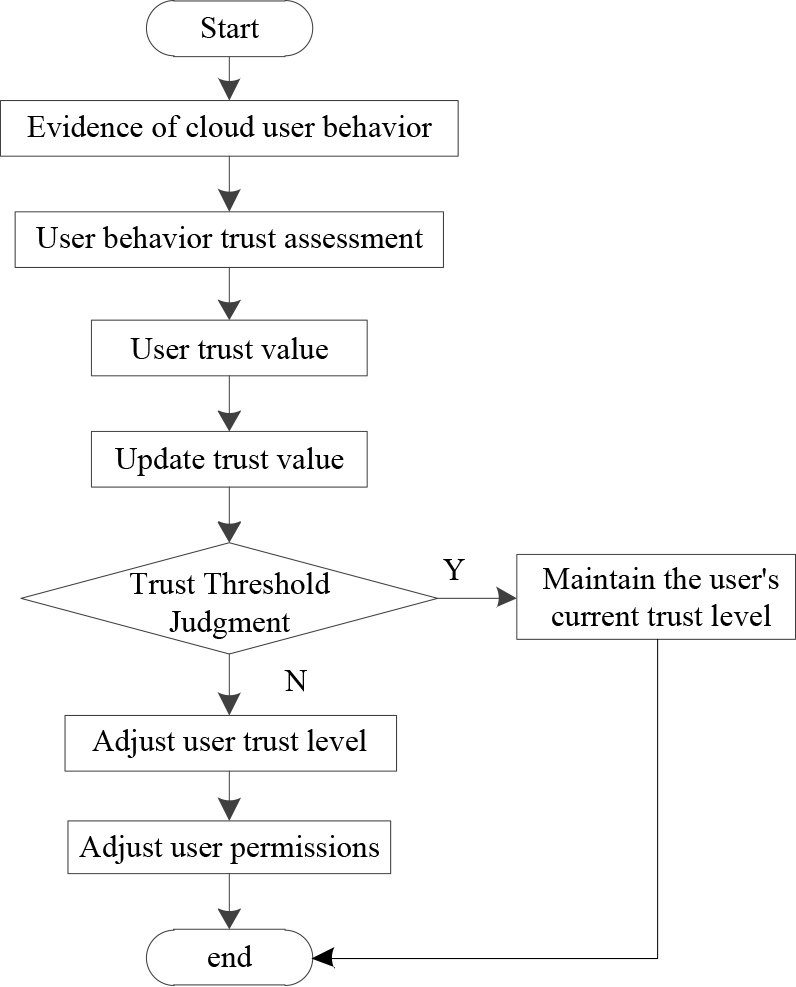
The network virtual experiment resources are large in scale, diverse in type and complex in content, so mining technology needs to be used to prepare for resource sharing [13]. The whole process is as follows:
Step1: Data set initialization. The initialization process is to process data with different dimensions or large orders of magnitude of experimental resources [14], and the calculation formula is expressed as:
In the formula,
Step2: Construct an adjacency matrix between data and data [15], and express the data adjacency matrix as:
In the formula,
Step3: Cluster adjacent data, the calculation formula is as follows:
In the formula,
Step4: Mining the required resources after clustering, and express the mining output as:
In the formula,
Through the above process, the experimental resources are mined to provide a basis for subsequent resource sharing. Abstract the information source model into a tuple as follows:
In the formula,
After the above processing, the association relationship between the resources is determined, and the resources are integrated together. Denote the resources that need to be shared as
In the formula,
Express the reception rate of the resource as:
In the formula,
After the above processing, for information exchange, the standard information sharing scheme is that only one data packet is transmitted in each time slot, and the utility function is expressed as:
In the formula,
In order to verify the overall effectiveness of the network virtual experimental environment architecture based on cloud computing, the network virtual experimental environment architecture needs to be tested.
Taking the experiment of “Windows Web Service and Configuration” as an example, this paper introduces the design and arrangement of the experimental course in the network virtual experimental environment architecture. The purpose of this experiment is to ask students to configure the Web server under IIS of Windows system, and to understand the working process of HTTP protocol in detail with the help of Wireshark software.
Because the network virtual experimental environment architecture is only preset with the configuration of the web server, and lacks the analysis of the HTTP protocol, teachers should select the web server configuration experiment under Windows in the network virtual experimental environment architecture in advance, and then refer the pre-made courses to their own in the newly created experiment, modify the purpose of the experiment, the experiment task and the requirements for the experiment report. Finally, the designed experimental course is released to the students. This paper verifies the access success rate and cloud service success rate of the network virtual experimental environment and the resource retrieval effect of the experimental course.
In order to ensure the reliability of the experimental data and calculation results, the experimental data are all selected from the teaching resource service platform of a certain website. The basic resources in the platform are shown in Table 1.
Basic educational resources in the experimental platform
Basic educational resources in the experimental platform
Taking the access success rate and cloud service success rate as the test indicators, the method in this paper, the method in Reference [4] and the method in Reference [5] are tested, and the test results are shown in Figs 4 and 5.
Access success rates of different methods.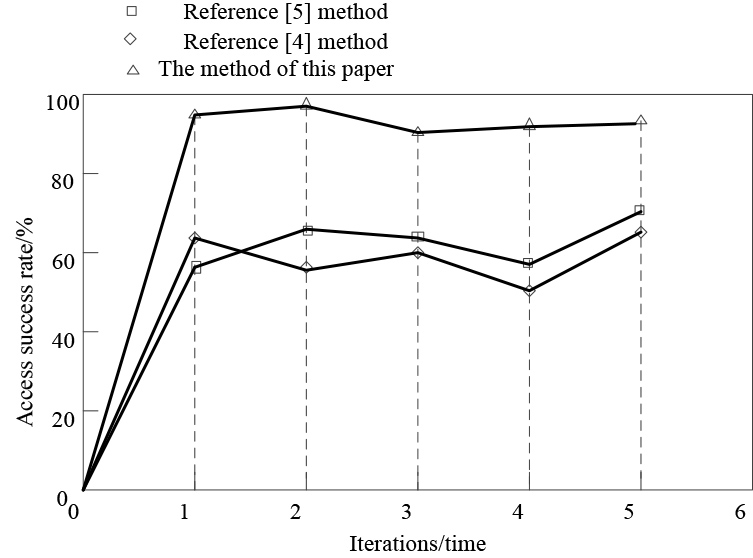
Cloud service success rate of different methods.
The data in Figs 4 and 5 shows that the access success rate and cloud service success rate of the method in this paper are much higher than the access success rate and cloud service success rate of the method in Reference [4, 5], indicating that the method in this paper. The access authority control effect is better because the method in this paper updates the obtained trust data, uses real-time data to calculate the comprehensive trust degree, ensures the real-time and accuracy of the comprehensive trust degree, and controls the user authority according to the calculation results. The success rate of access and cloud service in the cloud environment improves the accuracy of the control results. The reason why the success rate of user access and cloud service can be greatly improved is that the network virtual experimental environment platform designed in this paper has planned several subsystems, such as experimental resource management, experimental library management, experimental process management and experimental system management, in the design of functional modules.
Comparing the experimental resource retrieval time of the three methods, the comparison results are shown in Table 2.
Retrieval time of experimental resources
Retrieval time of experimental resources
The comparison results of the experimental resource sharing time of the three methods are shown in Table 3.
Experimental resource sharing time
Based on the comparison results of the above experimental resource retrieval time and experimental resource sharing time, it can be seen that the experimental resource retrieval time and experimental resource sharing time of the method in this paper are both less than the other two methods. The reason is that on the basis of hardware support, the proposed method uses cloud computing and big data technology to mine and process experimental resources, and integrates experimental resources, thereby greatly improving the processing efficiency of the platform for experimental resources. The reason why experimental resource sharing and retrieval efficiency can be greatly improved is that in the previous construction steps, the system architecture proposed in this paper studies and designs the access permission control algorithm of network virtual experiment environment based on cloud computing technology. Due to the large scale, variety and complexity of network virtual experiment resources, the application of this algorithm can make preparation for resource sharing.
This paper proposes a network virtual experiment environment architecture based on cloud computing. By designing the hardware structure and planning the main modules and functions, the virtual experiment environment of cloud computing network is constructed. The access control algorithm of network virtual experiment environment is designed based on cloud computing technology, and the resource sharing and retrieval of network virtual experiment environment are realized by data mining technology. Through experimental verification, the final results show that the user access success rate of the system designed in this paper is stable at more than 90% under different iterations, while the user access success rate of the system fluctuated between 50% and 70%. The success rate of cloud service of the system designed in this paper is stable at more than 80%, while the success rate of cloud service under the comparison system is concentrated between 40% and 60%. The retrieval time of experimental resources in this method is less than 25 s, and the lowest is only 7 s. The average retrieval time of experimental resources in the two comparison systems is about 30 s, and the lowest is 17 s and 19 s respectively, which are far higher than the retrieval time in this system. It indicates that the system architecture proposed in this paper has improved the success rate of user access and cloud service, and the efficiency of experimental resource sharing and retrieval is also high, which has certain practical applicability. In the future, further research will be conducted on the security and operation efficiency of the system architecture proposed in this paper, and it is expected to provide a secure and stable network virtual experiment environment architecture platform for the efficient management of experimental teaching resources, the expansion of third-party virtual experiment course resources and the integration of self-built course resources in the future.