




Abstract
A routing model about mobile agent in sensor networks was drawn out, and an optimization problem of mobile agent static route was derived. In order to optimize the route of mobile agent, a target location algorithm in wireless sensor networks was proposed. All the sensor nodes which know target compete to get the mobile agent in order to track the location of targets. Competition rules are defined by the remaining value of the energy and the distance between the nodes and the target. Simulation results showed that this algorithm could provide less energy consumption compared to other schemes and prolong survival cycle time. It balances the network energy, reduces the amount of data transmission in the network, reduces the network energy overhead, prolongs the lifetime of the entire network, and effectively reduces the network delay.
Introduction
Wireless sensor networks (WSNs) consist of a large number of data perception, information processing and wireless communication ability of the sensor nodes. Between nodes in a wireless multi-hop no way connected to the center, in the fields of military, civilian and industrial production has broad application prospects. Mobile agent is a software entity that can autonomously migrate from one host to another in a heterogeneous network environment and interact with other resources. Mobile agent can undertake processing, on-demand mobile and close to the data source for close perception and number in quality of WSNs, have attracted attention in the field of network protocol design and information processing. Because it has many advantages at the same time, mobile agent technology is very suitable for application in the field of WSNs, which can effectively improve the performance of them.
Mobile agent technology has been used to solve lots of routing problems of WSNs. In order to overcome the shortcomings of traditional distributed data fusion routing, Qi et al. [1] proposed a data fusion routing method based on Mobile Agent (MA). C/S mode is a widely used distributed computing mode in the current network. WSN is the traditional C/S mode. This mode is not suitable for the characteristics of WSN, such as dense node distribution, large data flow, limited energy and low bandwidth. MA mode is a computing method in which agent entities carry information such as execution code, running state, processing result and access path to autonomously migrate in the network and interact with the outside world. After MA migrates to the node to be visited, it can carry out local high-speed communication with the node, and this local communication does not occupy network resources. This is very effective for WSN nodes to save energy. In the MA model of WSN, MA is a program with the function of mobile, by identification, routing information, data cache and handling code, MA once sent by the information center, it can be according to the pre-determined routing or adaptive routing, active migration between different nodes, when MA migrated to a node, Using the local resources and sensing data of the node, the program code carried by MA is run for data fusion and information processing, and then the partial fusion results are carried for further migration. Finally, the Sink node processes the data fusion results returned by MA to obtain the information required by users.
Chen et al. [2] solved the routing problems. At present domestic and foreign researchers designed a number of different routing protocols. Based on the data plane routing protocol, typical representatives include Sensor Protocol for Information via Negotiation (SPIN), Directed Diffusion (DD) etc. [3]. Web-based hierarchical routing protocol, typical representatives includes Low Energy Adaptive Clustering Hierarchy (LEACH). Location-based routing protocol, typical representatives include GEAR etc. [4]. Vidhyapriya and Vanathi [5] proposes a multi-path routing algorithm, which only considers the energy level and signal strength of nodes, but ignores the impact and importance of hops for the routing of data, and it is not suitable for large-scale sensor networks. A multi-resolution data fusion algorithm based on MA is presented by Cai [6]. MA performs data fusion gradually in the process of migration. Compared with the traditional C/S model-based algorithm, the network delay is reduced by nearly 90%.
All kinds of algorithms are designed to reduce the amount of data transmission in the network, reduce the redundant information in the network, so as to reduce the energy consumption and prolong the network lifetime, but they have their own shortcomings. Based on these considerations, this paper presents a novel target localization algorithm based on mobile agent in wireless sensor networks. Similarly, all nodes sensing the target are allowed to compete for mobile agents. The competition rule is that nodes with a closer distance to the target and a larger residual energy value are allowed to compete for mobile agents successfully.
Model based on mobile agent for WSNs
WSNs usually consist of Sink node, sensor nodes and communication networks. Global optimization is in progress based on mobile agent by Sink node for WSNs. Sink node in the network has relatively strong processing, storage and communication capabilities, which can realize the communication between the sensor network and the task management node. Starting from Sink node, the mobile agent visits the nodes in the network along the route designed in advance, collects and fuses the data of each observation node, and then brings the data back to Sink node. Mobile agent routing needs to meet the required performance of the application at the minimum system cost, and obtain the desired precision data with the minimum energy consumption and minimum delay. According to the current network status, global of mobile agent optimal routing has decided and produced. The network structure has shown in Fig. 1.
Sensor network based on mobile agent.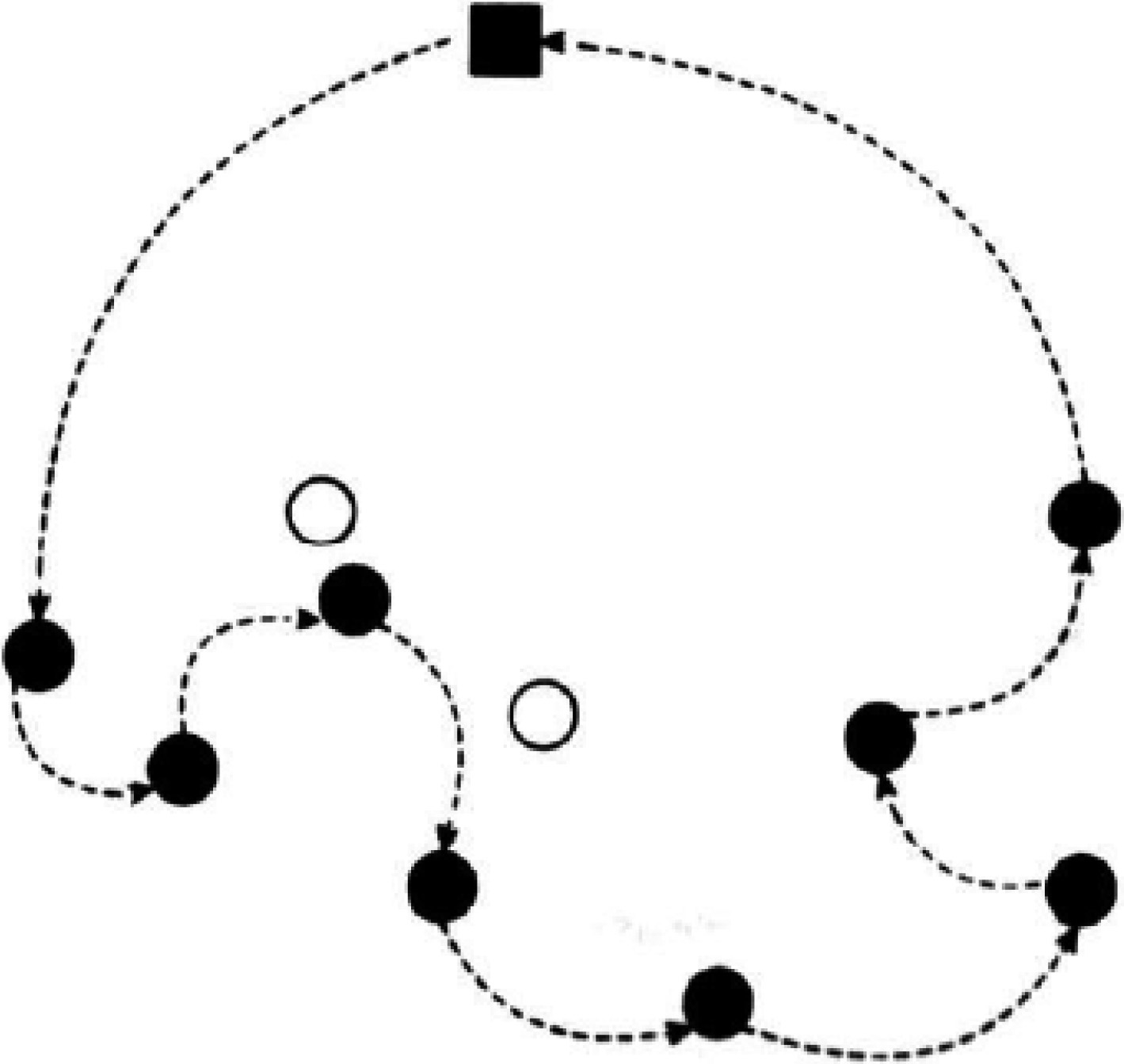
In WSNs, the target moves to the inspection area, nodes achieve the goal through collaboration signal processing in real time positioning, which collaborate with each other need to exchange lots of information. Since the target position transmitter to a data processing center after the fusion of information than the original probe sent information can significantly reduce the amount of data transfer, the mobile agent is the technology of choice to reduce network traffic and return real-time positioning results. Tseng et al. [7] proposed based on target locating and tracking mobile agents. Once the target appears in the network, a mobile agent has generated which selected a target from the nearest node to stay, and produce two subsidiary agents to work together calculating the position of the target. This reduces network traffic, and accurately locates the target, but it is the theoretical analysis which nodes in the network divided into a number of equilateral triangles ideal state [8]. If the node from the nearest of the target remaining energy rarely but work heavy burden, the network will make life ended prematurely [9, 10].
The election of moving agent based on the probability in induction approach to the target node can reduce conflicts arise in the course of elections in mobile agent. But when the target location has completed, if successful campaign node far away from the target causes ranging large error and the target location is not precise enough. In this paper, target location algorithm in wireless sensor networks is proposed, which also lets all nodes inducing to the target compete mobile agent target. Competition rule is to make the short distance to the target, the residual energy value of greater competition in the mobile node agent success.
The role of mobile agent model is to simulate the behavior of real mobile agent, such as the execution of scheduled tasks, visiting current nodes, and active migration. When the mobile agent runs on the node, it mainly executes the code in the member functions, and at the same time the node uses these member functions to access the mobile agent. Using induction model to describe the distances between the node and the target, the target in the affected area of all nodes and calculate the distance to the target based on the residual energy value of their own weight. Mobile agent options value larger node as resident node which called master agent [11, 12]. At the same time electing two nodes of other nodes within the target area of influence, resulting in two affiliated agents to assist the master agent on the target location, the main agent is responsible for the results back to the processing center [13]. Not only it reduces the flow of data on the network, makes use of balanced energy nodes to extend the life of the network, but also achieves the objectives of timely and accurate positioning.
Induction model
Supposing in the monitored area, n sensor nodes randomly deployed, node
where
In order to take into account the network lifetime and positioning accuracy, there are n nodes in WSNs. The known position coordinates (
wherein
Target setting is shown in Fig. 2. Nodes m1, m2 respectively distance from the target radius circle, intersect at s1, s2 points, and m3 using the same method to draw a circle, and cross the m2 circle intersection at s2, s3 points. Target position is certainly at s2. The mobile agent uses this information to triangulate the coordinate
Target setting.
Targets cannot stationary in the network, so if the target migration occurs at the present time, sensor nodes within the target range would re-compete in the mobile agent and the success of the competition node will become the next resident node in mobile agent.
Network lifetime
At a time, nodes consume and death because communication. If nodes of the target in the affected area less than 3, nodes cannot locate the target, so considering the end of the network lifetime. Energy consumption patterns include the free-space transmission and multipath fading, and choosing which way mainly lies in the distance d between the sender and the receiver. When d is less than the threshold value, the free space transmission is selected, otherwise multiple attenuation.
When data kb is sent and the transmission distance is d, the energy consumption of the node sending module is calculated as follows:
where
When receiving data, only the receiving module consumes energy, so the calculation formula is:
where
Movement speed effect of the network energy consumption.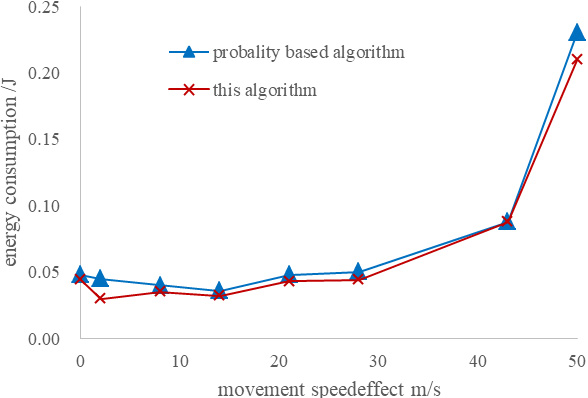
NS-2 is used to simulate the routing protocol of WSN. NS-2 has done a lot of modeling work for the designer in advance. It models some general entities in the network system, such as links, queues, groups, nodes, etc., and uses objects to realize the characteristics and functions of these entities, which is the component library of NS-2. Basic settings of NS-2 simulation parameters:
In probability based algorithm to facilitate the performance test algorithm, 500 sensor nodes are randomly distributed in a square area of 100 m
The protocol is simulated in NS-2 simulation environment, and the performance of the protocol in terms of average energy consumption and average network delay is evaluated accordingly. The simulation is carried out under different network scale and different conditions.
In the experiment, the target moving speed is changed from 0.4 m/s to 50 m/s, and the influence of the target moving speed on the network energy consumption, network lifetime and the number of migration hops of mobile agents is observed. The conclusion can be seen in Figs 3–5.
Movement speed effect of the network lifetime.
As can be seen from Fig. 3, the energy consumed by the proposed algorithm is similar to that of the probability-based election mobile agent algorithm.
However, as can be seen from Fig. 4, when the target speed is between 2.1 and 43.1 m/s, the overall lifetime of the network is much higher than that of the probability-based election mobile agent algorithm. Even when the target moves at a speed of 50 m/s, the network can still operate normally. This is because the algorithm designed in this paper selects nodes with higher energy to stay, so that the energy consumption of all nodes in the network is more balanced.
Movement speed effect of the hops in migration mobile agent.
In Fig. 5, when the target speed is 5–27.8 m/s, the number of hops migrated by the mobile agent is lower than that of the probability-based algorithm of electing the mobile agent. When the mobile agent migrates, it does not necessarily select the node closest to the target, and the number of hops migrated by the mobile agent is small, so the network traffic is reduced and the network life is prolonged.
The simulation is carried out by NS-2 simulation platform, and the simulation results show that the new algorithm has higher energy efficiency and better network latency. The results show that the proposed algorithm is superior to other intelligent algorithms in terms of optimization result, speed and operation time. The NS-2 simulation tool is further extended to support the communication between mobile agents, so as to achieve better cooperation.
Using mobile agent technology in target algorithm for WSNs, both has the existing advantages of mobile agent in target algorithm for WSNs, and has improvement aspects of choices of mobile agent resident nodes. It reduced the transmission of sensing data in wireless sensor networks, reduced the energy consumption of nodes, and extended the service life of the whole wireless sensor networks. That both balanced energy consumption of nodes in the network, but also took into account the targeting accuracy. Experimental results show that it not only has certain advantages in reducing energy consumption and network traffic network connection, but also more prominent in extending the network lifetime. It can reduce the amount of data transmission and improve the efficiency of data fusion through proxies. The network still operates normally even at high movement speed. The mobile agent is not strongly dependent on the network connection and can adapt to the unstable communication environment of wireless sensor network. It balances the network energy, reduces the amount of data transmission in the network, reduces the network energy overhead, and prolongs the lifetime of the entire network, and effectively reduces the network delay.
Although the improved routing algorithm proposed in this paper can effectively reduce the energy consumption of the network, increase the transmission times of the network, prolong the lifetime of the network and has important practical application value, the research work of this paper is not perfect enough, and further research needs to be carried out. Because the mobile agent migration ability in WSN, tracking, and routing direction has good performance, intelligent mobile agent technology and group technology can provide a variety of optimization scheme for WSN applications, autonomy ability under complicated environment. Therefore, mobile agent model based on wireless sensor network is an important research direction. The goal of author is to study a new wireless sensor network model based on random mobile agent, which will make full use of the mobility of mobile agent to reduce the management energy consumption. The reasons for the energy efficiency advantage of this model in large scale wireless sensor networks will be analyzed. Compared with other mobile agent models, it will be better to reflect the advantages of random mobile agent. And the relevant protocols in the mobile environment (mobile Sink or mobile Source) will also be studied as the next research content.