



Abstract
Under the influence of environment, enterprise index and other factors, the result of enterprise financial development path analysis is not ideal, so the development path of green enterprise financial development in coastal cities is studied. The regional differences of the green economy of coastal cities are analyzed. Under the premise of considering the differences, the competitiveness of the financial development of green enterprises in coastal cities is clarified, and the constraints that affect the financial development path are obtained. According to the development goal of enterprise financial integration, all the influencing indexes that affect the development path of enterprise finance are obtained, and the concrete path of enterprise financial development is finally gotten. A port city is selected as the experimental object to verify, under the condition of low impact degree and high change of index, using expert evaluation method to compare the design method and existing methods. According to the results, the average expert evaluation score of the proposed method is 87.8, higher than that of the control method. The results show that the proposed path analysis method is more suitable for the analysis of the current situation of green enterprise financial development, and has more practical significance.
Keywords
Introduction
Green enterprise means that in the whole marketing process of market research, product development, product pricing, promotion, etc., enterprises are guided by the green concept of maintaining ecological balance and attaching importance to environmental protection, so as to make the development of enterprises consistent with the interests of consumers and society [1]. The green marketing of green enterprises should include collecting green information, developing green technology, developing green products, implementing green packaging, paying attention to green promotion, setting green prices, selecting green channels, establishing green image, providing green services, etc. The environmental protection principles of resource conservation, regeneration and pollution reduction should be applied throughout the marketing activities. It can be seen that the main feature of green enterprises is to extend the characteristics of ecological process to the development of enterprises. From the comprehensive perspective of ecology and economy, the whole process of industrial products from green design, green manufacturing to green consumption is investigated to coordinate the relationship between enterprise ecology and enterprise economy. The main focus and goal are not to eliminate the consequences caused by pollution, but to use green technology so as to fundamentally eliminate the source of pollution and realize intensive, efficient, non waste, harmless and pollution-free green industrial production. Compared with general enterprises, green enterprises can make more efficient use of resources and energy, produce more green products with less material consumption and energy consumption, recycle the waste and waste heat discharged by general enterprises, and greatly improve the comprehensive efficiency of circular economy of green enterprises, rather than simply economic efficiency or ecological efficiency.
In the context of the development of green enterprises, the financial development of green enterprises in coastal cities is also concerned. First of all, coastal cities have a high level of openness and strong economic vitality, which is conducive to deeper green financial system and mechanism innovation. Second, the financial industry foundation of coastal cities is usually relatively solid, combined with regional advantages, which is conducive to the aggregation and radiation of green financial resources. Third, under the premise of controllable risks, coastal cities have given strong support to offshore wind power, photovoltaic projects, biomass energy, etc., which can guide financial institutions to establish a credit management mechanism that conforms to the characteristics of new energy enterprises and wind power photovoltaic projects. Qualified public welfare projects in the energy field can apply for special bond support from local governments. Insurance institutions are also encouraged to develop insurance products and services for new energy. Internationally, the development of green enterprise finance has a more authoritative definition. In the G20 green finance comprehensive report released in 2016, green finance is defined as “investment and financing activities that can generate environmental benefits to support sustainable development”. Goldsmith stressed that financial development can make the capital be allocated reasonably, promote the industrial upgrading and realize the optimization of economic structure.
On the domestic front, the People’s Bank of China, together with seven ministries and commissions, including the China Banking Regulatory Commission, issued the “Guiding Opinions on the Construction of a Green Financial System” in 2016, giving an official definition of green finance, which defines green finance as “to support environmental improvement, respond to climate change and Economic activities of resource conservation and efficient utilization, that is, financial services provided for project investment and financing, project operation, and risk management in the fields of environmental protection, energy conservation, clean energy, green transportation, and green construction”. Compared with the traditional financial activities, green finance takes social responsibility and environmental protection into account, and it is an important performance evaluation standard. From low-level to high-level, the financial market continues to develop and the types of financial products and tools continue to enrich, which have a variety of impacts on the ecological environment and economic development [2]. This method measures the development level of green financial in each region from the perspective of enterprises, and uses panel data of 31 provinces (cities, districts) in China from 2008 to 2017 to carry out empirical test. A panel vector autoregressive (PVAR) model between green financial development, technological progress and economic growth is established. Through impulse response analysis, it is found that green finance and technological progress have significant positive effects on economic growth, while the development of green finance has not effectively promoted the technological progress of enterprises.
Although the above theories or methods give a certain reference to the financial development of green enterprises, due to the neglect of the impact of the environment and enterprise indicators along with the lack of pertinence, the results of the path analysis of the financial development of enterprises is not ideal. Therefore, a new analysis method is proposed for the financial development path of green enterprises in coastal cities. Factor analysis theory is used to define the competitiveness of financial development of green enterprises in coastal cities to improve the effectiveness of multi-dimensional data so as to improve the comprehensiveness of measurement research. On this basis, the comprehensiveness will be improved when considering the constraints of financial development path, so as to propose a more perfect and reasonable path for the development of enterprise financial integration.
Approaches to the financial development of green enterprises in coastal cities
Coastal cities pay more attention to the development of green economy as a whole, but they still have their own development characteristics and performance. The analysis of the regional differences of green economy in coastal cities is conducive to defining the competitiveness of financial development of green enterprises in coastal cities. Competitiveness analysis is the basis of analysis of green finance development path in coastal cities. On this basis, the proposed constraints of financial development path provide guidance for the final path of enterprise financial integration development.
Regional differences of green economy in coastal cities
Differential development is always the key to the development of economic characteristics and competitive advantage of coastal cities, and also the core of green economy in practice. Synergy and difference have always been the contradictory unity throughout the economic development process of coastal cities. Therefore, to explore the financial development path of green enterprises in coastal cities, it is necessary to distinguish the regional differences of green enterprises in coastal cities [3].
Characteristic effect of green economy
The different division of labor and competition of economy is based on the development of their own characteristics and advantages. From the perspective of the role of green economy development and its promotion mechanism, it is a dynamic process from the ideological level to the policy and system level innovation, and then to the practical operation level. In this process, it can provide the low-level urban economy, especially the slow or backward enterprises, with new ideas and new ways to seek their own development, choose new forms to adapt to the needs of regional competition and market demand structure, and participate in differentiation and diversified division of labor. Economic development generally has objective conditions, which is the basis of differentiated development, but it is not necessarily able to form a competitive advantage. As an economic form and growth mode with great development potential and lasting vitality, green economy can integrate with the characteristics of coastal city economy in China, and provide competitive advantages, solid practical basis and practical needs for enterprise economic promotion. China’s coastal cities have strong green financial support and extensive investment and financing channels. As the economy of coastal cities is relatively developed and energy is relatively scarce, the development of offshore wind power is in line with the long-term interests of the region and is conducive to energy transformation and the realization of low-carbon goals. In addition to their own geographical advantages, domestic coastal cities often have the support of national preferential policies to play a role in driving the green economy, and also have rich foreign investment.
Nature of regional differences
To promote the differential development of green enterprises in coastal cities, need to grasp the essential attribute of “difference”. Difference refers to the difference, classification, differentiation and other attributes of things; difference refers to the unique advantages, colors and styles of things. That is to say, the difference attribute of a thing is the organic unity of the difference, uniqueness and characteristic with special significance formed by comparing this thing with other things. Materialistic dialectics holds that the world is material and material has differences. In the material world, there is a universal characteristic, which comes from the objective inevitability of the characteristic existence, that is, the difference of the objective world. The world is also unified, unified in materiality, which means that materials have diversity and things themselves contain differences. The universality of the financial development of green enterprises in coastal cities lies in the transformation of the economic development mode, the principle of saving and low carbon, and the harmonious development of economy and environment. The difference between coastal cities lies in the proportion of agriculture, industry and the tertiary industry and the combination with high-tech. Because of the universality of difference in the financial development of green enterprises in coastal cities, it has also become the essential attribute of green economy to give full play to its characteristics and enhance its advantages. The purpose of the formation of urban green economy difference lies in pursuing characteristics and advantages, obtaining effective development mode, seeking unique development path and forming competitive advantage, which plays a decisive role in the development of urban economy, especially in the underdeveloped and Backward Counties of coastal cities, as well as the key poverty alleviation and development counties.
Different performance of different development characteristics of coastal cities
The differential performance of green economic development is affected by differential development. Differentiated development is regional, it depends on a certain spatial area, and regional resource elements are the basis for the formation of differences and affect the positioning of regional development. Differential development has phases. The economic advantages and competitive advantages of cities are not static. Different development stages correspond to different advantages. The adjustment of the connotation of advantages reflects the evolution of development and affects differences in strategic orientation. The development of differentiation is systematic. The competition with advantages is the result of many internal and external factors converging in a certain region. Even values, culture and history can become the source of competitive advantage and influence the difference of mode and path selection. Differential development has advantages. It requires not only to maintain comparative and competitive advantages, but also to give full play to the leading role of the industry, so as to maintain a strong vitality of differential development and competitive advantage and affect the innovation of policies and systems [4].
Influenced by the characteristics of differentiated development, the differences of green economic development will be manifested in many aspects from different perspectives. The first is the difference of functional performance. The role of green economy in urban economic development is to promote the transformation of economic development mode, and to form a new economic development mode. The difference between the two is to rely on different development stages. The transformation of economic development mode is to transform the original traditional, extensive, high consumption and low efficiency economic development mode into a modern, intensive, efficient and green economic development mode, and to form a new economy The mode of economic development is a process of further improving the intensive and efficient mode of economic development to a higher level based on the existing development basis and facing the future development trend. Secondly, there are differences in competitive positioning. There are two aspects of urban green economic development in the performance of competitive positioning: internal and external space: on the one hand, internal space positioning pays more attention to the stage of development, and takes the advantages of local physical resources and human quality as the basis of green economic development in the early stage; on the other hand, in the middle stage, according to the constraints of limited space resources, strive for and gathering resource elements; In the middle and later stage, according to the trend of differentiated competition, the market mechanism, innovation mechanism, management mechanism, policy function and other resources are used to promote the development of the real resource factor economy to the innovative green economy. On the other hand, the external spatial positioning is based on the regional nature, according to the different resource endowment, industrial foundation and development level conditions, to create characteristic advantages, develop advantageous economy and enhance the competitiveness. In addition, there are also differences in strategic ways. In strategic ways, the development of green economy in coastal cities will comprehensively reflect the characteristics of differentiated development, with different strategic orientation, development mode and implementation path. The choice of strategic orientation will take different strategies such as centralized development, positioned development, centralized development and coordinated development due to the influence of different characteristics; The choice of development mode will choose different modes such as industry leading, ecological demonstration, resource intensive and environmental governance, depending on the actual situation and different types of development; the choice of implementation path will reflect different positioning differences, and choose different paths such as green investment, green production, green consumption, resource circulation, low carbon and high efficiency. Between different strategies, models and paths, due to the innovation and evolution of development, the ways and methods of their performance can be combined and interacted with each other, resulting in the superposition effect of comprehensive promotion [5].
Through the above analysis, can distinguish the regional differences of green economy in coastal cities reliably.
Define the competitiveness of financial development of green enterprises in coastal cities
In the process of analyzing the path of financial development of green enterprises in coastal cities, it is necessary to make clear the competitiveness of financial development of green enterprises in coastal cities. The 2017 China inclusive financial development report pointed out that inclusive finance is to tap or develop the potential capacity of “small and medium-sized weak” enterprises through finance. Therefore, in the current coastal city green enterprise financial system, under the background of bank development, to achieve the goal of development path analysis, need to strengthen the construction of financial institutions, improve the comprehensive ability of various factors such as inclusive financial operation quality, efficiency and results.
Under the influence of economic development, the coastal cities take the development of commercial banks and other financial enterprises as the premise, and analyze the development competitiveness of commercial banks and other financial institutions according to factor analysis theory. In statistical description, a large number of data are usually used to describe or evaluate a problem. Therefore, multidimensional data not only increases the difficulty of processing, but also increases the difficulty and complexity of analysis due to the correlation between dependent variables. How to effectively use multidimensional data has become the key to comprehensively measure the problem studied [6]. Factor analysis is one of the effective methods to solve this problem. Many variables are integrated into several comprehensive factors to reduce the data dimension. First of all, factor analysis should extract common factors and construct score function with variance contribution rate as the sum of weight and score:
where
To make clear the competitiveness of the financial development of green enterprises in coastal cities, it is necessary to analyze the inclusive financial competitiveness of all provinces, regions and cities in China. The first thing need to do is to evaluate the current development of inclusive finance in all provinces, regions and cities. In order to more objectively and comprehensively reflect the development of inclusive finance in all provinces, cities and districts of the country, analyzes the current and potential dynamic competitiveness evaluation and its influencing factors of inclusive finance in many provinces, cities and districts by using multidimensional inclusive financial data, wind database and relevant data of green financial enterprises in each year, so as to make clear the development of inclusive finance in enterprises, and then comprehensively divide them into analyze the sustainable development path of green enterprise finance, and provide theoretical and practical basis for its economic development [7]. The financial development path evaluation index of coastal green enterprises is calculated by Eq. (2):
where
Evaluation index of financial development path
Using the evaluation indicators of financial development path shown in Table 1, the evaluation results of financial comprehensive competitiveness among different regions in the same coastal city in the same year are clear, as shown in Fig. 1.
Evaluation results of comprehensive competitiveness of financial development.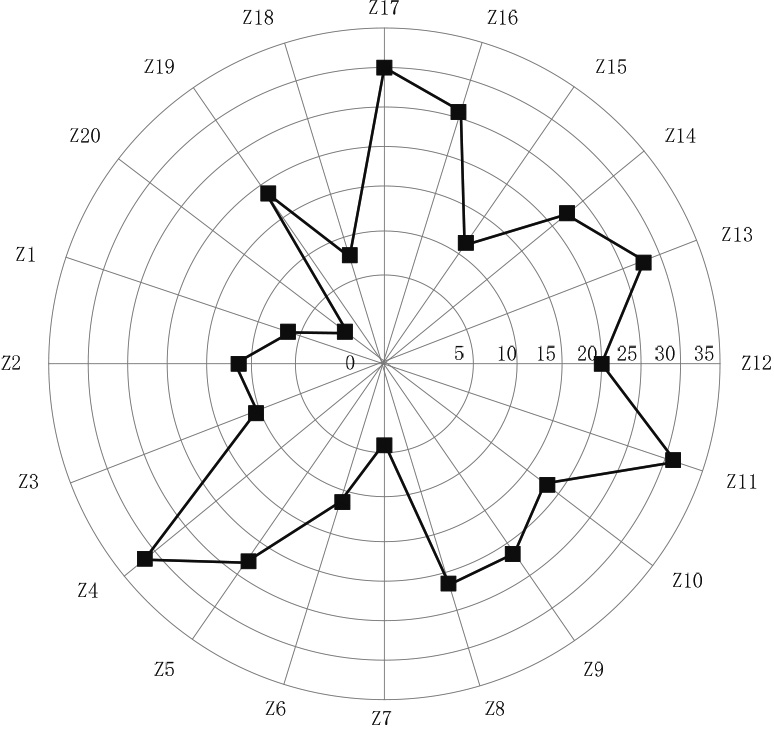
Z1–Z20 in the figure represents different regions. According to Fig. 1, it is shows know the actual situation of financial comprehensive competitiveness between different regions in the same coastal city in the same year. Relatively speaking, Z4 is more competitive in financial development. The financial development competitiveness of Z4, Z11 and Z17 is 30 or above. The competitiveness results of Z13 and Z16 are between 25 and 30. The competitiveness results of Z5, Z8, Z9, Z12 and Z14 is between 20–25. The competitiveness of the remaining nine regions is below 20. Through the evaluation of the financial development competitiveness of green enterprises in coastal cities, it can provide reference for the choice of financial development path and direction.
While clarifying the competitiveness of corporate financial development, it is also necessary to explore the constraints that affect the path of financial development to help coastal green companies avoid unnecessary risks in the development process. Financial data analysis such as commercial bank HP financial loan data can be used to study macro level policy support. By comparing the development status of local financial industry in different cities, the market constraints on the development of financial industry can also be analyzed. In the study of financial influencing factors, cities or regions are often taken as examples to summarize the factors affecting financial development. Then, by summarizing and refining these factors, the constraints that affect the path of financial development can be obtained including insufficient effective supply, imperfect guarantee system, lagging insurance development, and poor regional promotion of the financial system.
Insufficient effective supply
Different financial companies in coastal cities have their own responsibilities, such as the Agricultural Development Bank, whose business scope mainly focuses on grain and cotton oil purchases, agricultural and sideline products production and processing transformation, agricultural development and rural development medium and long-term loans, and county town construction loans And other businesses, with the special nature of special funds, narrow financial business, and single investment; Although the Postal Savings Bank develops rapidly and has a large number of outlets, there are still many difficulties in the commercial transformation of the Postal Savings Bank due to the fact that the postal savings and exchange bureau belongs to the administrative organization set up in the postal department and the postal savings outlets belong to the financial institution. The Central Bank has certain difficulties in its supervision, and the lack of professional financial talents; Some new financial institutions have low market awareness and it is difficult to find the main sponsor [8]; At the same time, due to the lack of social credibility, the new financial institutions are not well accepted in enterprises, and there are many problems such as difficult to absorb and store, less capital sources, too small scale, high operating cost and difficult to pay and settle accounts, which directly lead to the lack of financial support to meet the development requirements of most enterprises; the coverage of new financial institutions is narrow, and there are a large number of actual capital needs In the operation of the enterprise, there is a problem of inclined strategic objectives [9].
Imperfect guarantee system
Another constraint on the path of financial development is that the guarantee system is not perfect, and the root cause of the constraint on regional credit supply lies in the widespread information asymmetry between formal financial institutions and urban economic entities, although credit guarantee institutions make the information asymmetry between enterprises and financial institutions transparent to a certain extent. To reduce the loan risk of banks and other financial institutions and to alleviate the financing difficulties of some enterprises [10], but due to the imperfect guarantee system and the absence of credit guarantee institutions, the development of coastal green enterprises is still affected. It is mainly reflected in the following aspects: first, the rights and interests such as land use right and income right are restricted by many policies and regulations, and mortgage financing is limited; second, the collateral is difficult to choose, and the types of enterprises supported by loans are different, so the value of collateral is different, which brings great risks to mortgage; finally, the construction of credit guarantee system is lagging behind, and by the end of 2015, some economies In the relatively backward coastal cities, the number of credit guarantee institutions is less than 200, which causes substantial constraints on the financial development path.
Lagging insurance development
The lagging development of insurance also restricts the financial development of coastal green enterprises. In the urban development insurance system, it is very important for enterprises to insure. Although the insurance premium income of each coastal city has been increasing for several years, the overall scale is still small. Compared with the development of urban economy and the demand of diversified enterprises, the development of insurance is still seriously lagging behind. The scope of enterprise insurance is relatively large, and there is a lack of professional insurance technical personnel. Once the loss occurs in an enterprise, the insurer will invest personnel related to the type of enterprise development to deal with the loss event. Therefore, it is necessary to establish such insurance institutions with considerable economic strength and diversified technical background. At the same time, insurance is restricted by a variety of risks. The regular enterprise production is affected by the natural environment and social environment of this year and this region, and there will be different degrees of losses. Because of the large investment in operation and high loss ratio, insurance is often in the situation of low profit or even loss, and the development is relatively backward, which has a certain degree of constraints on the formation of the development path of green enterprises.
Poor regional promotion of the financial system
At present, the financial construction emphasizes more on the supply and innovation at the institutional level, without considering the construction at the overall level. The financial institutions lack the unified inclusive financial construction planning of the central government and the norms of relevant laws and regulations; the institutions lack internal links, unable to achieve the best allocation of advantages and resources. Secondly, there is a lack of hierarchical division of labor financial system, which can not meet the needs of financial services in the economic structure of coastal cities where multiple economic organizations coexist. Financial institutions have the phenomenon of service homogeneity, target customer groups are not clear, enterprises have no money to lend [11].
To sum up, the above constraints seriously restrict the orderly development of Chinese financial institutions. The urgent task is to clarify ideas, clarify service orientation, set up more financial outlets, increase financial support, and ease the constraints on the financial development path of coastal green enterprises.
Development path of enterprise financial integration
From the perspective of historical experience at home and abroad, the combination of industry and finance is an objective requirement for industrial capital to seek diversified operations and improve its capital operation capacity after a certain stage of development. Institutional arrangement is a common phenomenon in modern market economy and reflects the general trend of productive forces. At the same time, the combination of industry and finance is an important way to effectively allocate resources. Specifically, the combination of industrial capital and financial capital has the following development goals:
Saving transaction costs
Institutional economics believes that saving transaction costs is an important consideration for enterprises to determine their organization. Industrial and commercial enterprises and financial institutions are market players with different economic interests. The relationship between the two is a capital loan relationship based on the creditor’s rights and debt contract. Due to the uncertainty, market risks, and objective existence of opportunistic tendencies of capital lending transactions, both parties to the transaction face huge transaction costs. On the one hand, financial institutions issue credit funds to industrial and commercial enterprises. In order to avoid the risk of default, need to spend manpower and time to investigate and review the credit and production and operation status of the enterprise to assess the enterprise’s solvency. After many consultations, huge negotiation costs were paid. For financial institutions, transaction costs are represented by information search costs and monitoring costs and loss of profits due to information asymmetry. On the other hand, for industrial and commercial enterprises to obtain medium- and long-term credit funds from financial institutions, continuity and stability are crucial. If credit funds are stopped halfway, or financing costs rise sharply, companies will suffer huge losses. For business enterprises, transaction costs are reflected in the financing costs of enterprises and the “sinking costs” that enterprises face in the process of establishing long-term partnerships with financial institutions. With the continuous expansion of the development scale of enterprises, the demand for capital of enterprises will be greater; with the reduction of the number of enterprises and financial institutions due to monopoly, the frequency of transactions between the two parties has greatly increased. When the internal management costs of an enterprise are lower than the market transaction costs, industrial capital and financial capital will shift from external credit links to internal capital combinations, and eventually a relatively stable trading relationship will be established. Through the combination of industry and finance, both parties can reduce information asymmetry and transaction uncertainty, achieve the purpose of reducing transaction costs and improving resource allocation efficiency [12].
Reduce information asymmetry
According to the principles of information economics, it can be seen that information asymmetry will cause the information superior to obtain additional “information rent” in the transaction, which is not conducive to maintaining the principles of market fairness and equity and the efficiency of resource allocation. Looking for a mechanism that can break the information asymmetry between the two parties in the market transaction, and the combination of industry and finance is an important method [13]. For example, banks and enterprises, as two types of subjects in the loan market, have information asymmetry, enterprises occupy information advantages, and banks are in a disadvantaged position. To change this situation, banks must spend a lot of money to understand the enterprise. Under this background, through the integration of industry and finance, the integration of enterprises and banks can effectively reduce the cost of information asymmetry, maintain the security of loans, and establish a stable relationship between banks and enterprises. The integration between non-bank financial institutions and industrial and commercial enterprises also applies.
The nature of capital pursuing value-added
The pursuit of value-added is the original commonality of capital [14]. In recent years, although the average profit margin of the financial industry has declined, it still exceeds the average level of the general industry, which is determined by the scarcity of financial resources and the monopoly of the industry. In contrast, under the background of increasingly fierce competition in the product market, traditional entity enterprises are restricted by market saturation and other industry factors, and the return on investment in traditional projects is low. In this case, the investment finance industry can get more stable monopoly profits. The essential attribute of capital pursuing maximum profit promotes the development of industrial capital holding or holding financial institutions. By sharing the profits of monopoly industries, capital return rate can be improved and capital appreciation can be realized. Financial capital can also directly participate in the real economy and share the profits created by the real economy, rather than just obtain the income of the right to use funds.
Coordinated development of real economy and financial capital
The development of the real economy and financial capital are closely related and mutually reinforcing, but in the final analysis, the development of finance should serve the development of the real economy. From a practical perspective, the evolution of the real economy from a simple commodity economy to a modern market economy has gone through several different stages, and each stage has put forward corresponding requirements for the development of finance. Therefore, the development of financial industry and financial market must adapt to it. At the same time, the scale of real economy determines the scale of finance, financial capital and financial market. If the scale of the two does not match, either the financial market is flooded with funds or the financial supply is insufficient, both are not conducive to the development of the real economy. With the development of real economy, the effective combination of financial capital and industrial capital is required. The combination of industry and finance can shorten the distance between real economy and financial capital to a certain extent, so that the financial market can serve the healthy and sustainable development of real economy more effectively [15].
Green transformation path of industries in different types of areas
The rapid and highly concentrated industrial development in coastal areas leads to severe environmental pollution problems. It is necessary to formulate scientific industrial green transformation path and environmental regulation policy based on the comprehensive consideration of the characteristics of regional industrial transformation, the law of environmental pressure change and its coupling relationship. For enterprises with increased pressure and non green industry transformation, that is to say, coastal enterprises undertake national important energy and heavy chemical projects or industrial transfer bases. The focus of industrial transformation and environmental regulation in such regions is to do a good job in industrial access and spatial access. First of all, should do a good job in spatial optimization, according to the regional resources and environmental capacity, promote the optimization of industrial agglomeration layout, and form an industrial agglomeration area. In particular, it is necessary to delimit the spatial agglomeration area of major environmental risk industries with the environmental red line. Secondly, according to the bearing capacity of regional resources and environment and key ecological constraints, the negative list of industries and the scale of industrial development are formulated, and based on the principle of environmental short board effect, the scale of industrial development is determined according to the most restrictive indicators, and even the one vote veto system of environment is adopted to decide whether the project can be constructed.
For the enterprises with increased pressure but green industrial transformation, on the one hand, should improve the quality and efficiency of energy based raw material industry from the perspective of improving industrial competitiveness, eliminating excess and backward production capacity; on the other hand, should focus on cultivating and developing new materials, new energy, energy conservation and environmental protection based on the advantages of heavy-duty basic equipment for the development of local supporting energy based raw material industry. In terms of environmental control, considering that it is not only faced with existing cumulative environmental problems, but also has an increasing trend of pollutant emissions every year, it is necessary to first curb the growth of new pollutant emissions, strictly implement the total amount control indicators, set targets for capacity reduction in key industries, and promote the withdrawal of backward production capacity and the digestion of excess production capacity by combining market incentives and policy enforcement, so as to reduce the annual pollutant emissions. At the same time, should take the concentration control index as a constraint, and require enterprises to improve production technology, eliminate backward production capacity and equipment, and improve the resource and environmental benefits of unit production capacity.
Based on the above analysis process, the financial development path of green enterprises in coastal cities is explored.
Experimental analysis
In order to verify the effectiveness of the financial development path of green enterprises in coastal cities, a comparative test is conducted. Compare the path analysis method proposed in this paper with the path analysis method based on PVAR model, and verify the superiority of this method by comparing the differences of the results. PVAR (Panel Vector Autoregression) model does not need to assume the relationship between economic variables in advance, but regards all economic variables as endogenous variables, and then analyzes the impact of each variable and its lagging variables on other variables in the model. Although the PVAR model can unify the financial risk measurement standard, the consideration and selection of evaluation indicators for the financial development of green enterprises in coastal cities are not as comprehensive and systematic as the designed method.
Data sources and research objects
Taking a port city as the experimental object, because the sea transportation and export trade have brought great economic benefits to the city, the number of green enterprises in the city is relatively large, which meets the requirements of this test. Limited by data statistics, the experimental data selected in this paper is the financial development data of green enterprises in coastal cities in 2010–2018. Therefore, this paper mainly analyzes the financial development of green enterprises in coastal cities in 2010–2018. The data comes from Chinese urban statistical yearbook and the industrial sector data of the Chinese business statistical database. Figure 2 shows the geographical location of the coastal city.
Geographical location of survey objects.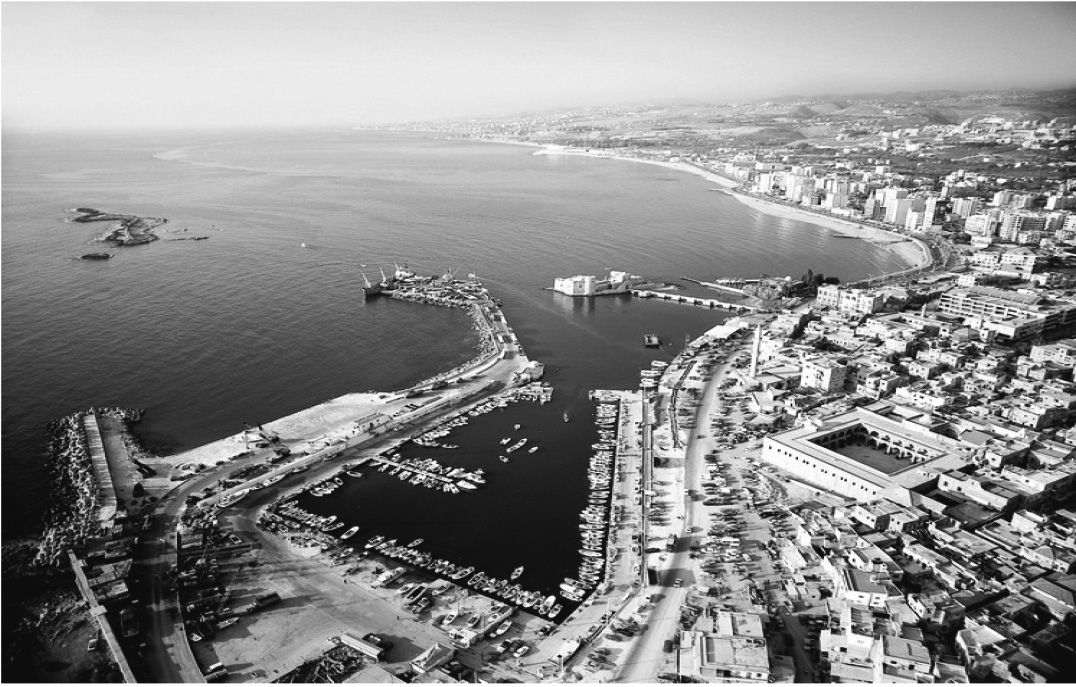
In the process of investigating the city, in addition to the development level of green finance, per capita real GDP and technological progress indicators, some regional green economy evaluation indicators are also selected. After evaluation by experts, their comprehensive scores are shown in Table 2.
Comprehensive scores of green economic indicators of respondents
In Table 2, S represents city level cities; X represents county level cities. According to the city comprehensive score in Table 2, it can be seen that the score
Take the path analysis method proposed this time as the experimental group, and the path analysis method based on PVAR model as the control group. Take the above experimental objects as the background, analyze the financial development path of green enterprises under different analysis methods. It is known that enterprises with high comprehensive score are less affected by similar indicators; enterprises with low comprehensive score are more affected by similar indicators. 1000 evaluation experts are selected to evaluate the results of path analysis. The formula for the evaluation score of experts is known as:
where
Path analysis and evaluation results when the impact degree of indicators is low.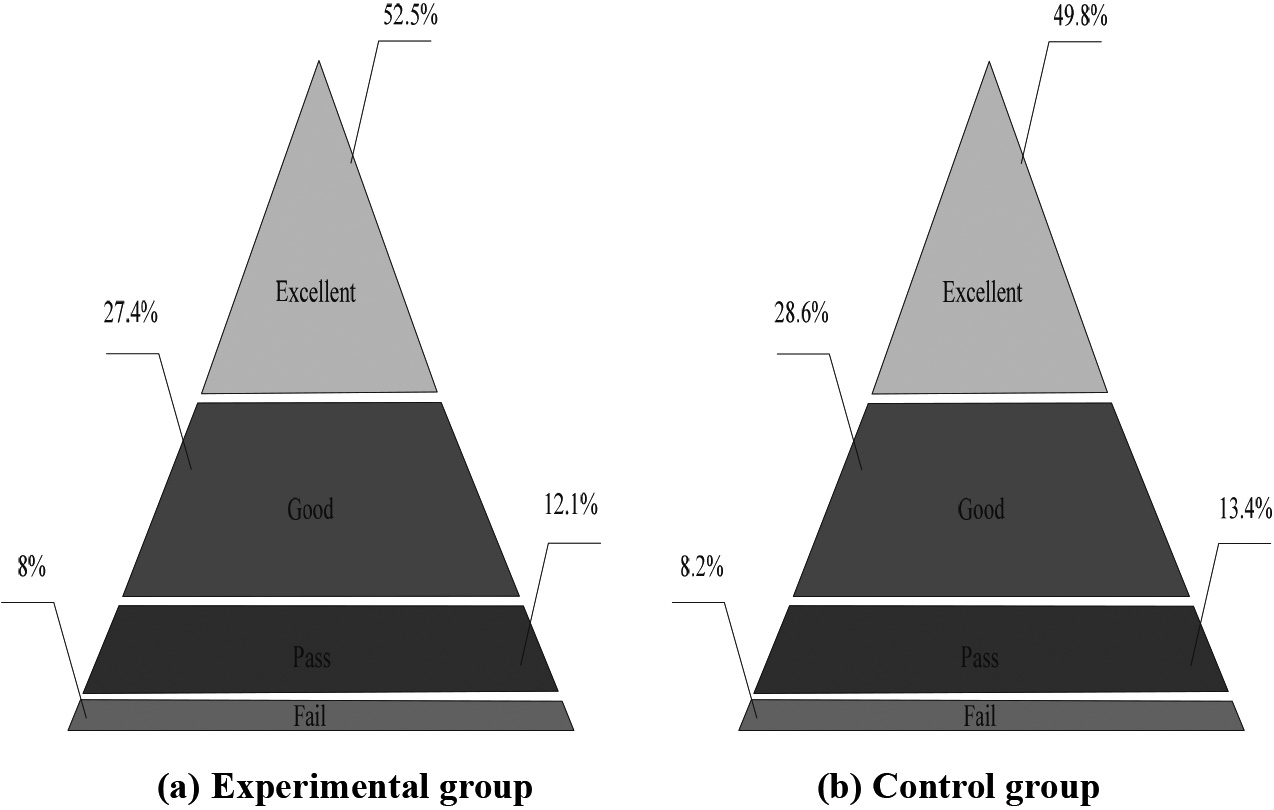
In the evaluation results of the experimental group, 52.5% of the experts scores were excellent, 27.4% were good, 12.1% were qualified, and 8% were unqualified. In the evaluation results of the control group, 49.8% of the experts scores were excellent, 28.6% were good, 13.4% were qualified, and 8.2% were unqualified. When the green enterprise is less affected by various indicators, the financial development path of the enterprise will not be greatly disturbed at this time. Therefore, according to the results of the two groups, can know that both the experimental group and the control group can get a suitable financial development path for the enterprise itself. Then the expert evaluation is carried out for the path analysis results when the impact degree of indicators is high, and the Fig. 4 is the evaluation results.
In the evaluation results of the experimental group, 51.2% of the experts scores were excellent, 27.7% were good, 12.8% were qualified, and 8.3% were unqualified. In the evaluation results of the control group, 8.7% of the experts scores were excellent, 10.9% were good, 25.5% were qualified, and 54.9% were unqualified. According to the above experimental test, when the impact of various indicators on green enterprises is deepened, the traditional analysis method is affected by the indicators, and the enterprise financial development path obtained is not reasonable in the opinion of experts, so the evaluation result is not ideal. However, the path analysis method in the experimental group is not affected by the index. It can be seen that the analysis method comprehensively considers the impact degree of the index, and the problem of the impact degree of the index has been thought of when exploring the path. Therefore, the financial development path obtained is more reasonable, and the final evaluation results of the experts have not changed much.
Select 10 experts from 1000 evaluation experts, and compare their specific evaluation scores for different methods. See Table 3 for the results.
Comparison of evaluation scores of 10 experts for different methods
Path analysis and evaluation results when the impact degree of indicators is high.
According to the data in Table 3, the average expert score of the path analysis method based on PVAR model is 63.2, and the average expert score of the designed method is 87.8. The evaluation scores of 10 experts for this designed method are significantly higher than that of path analysis method based on PVAR model, which further verifies the superiority of this design method. This is because in the statistical description, multidimensional data will increase the difficulty of data processing, and at the same time, the correlation between variables will increase the difficulty and complexity of analysis. In this paper, factor analysis method is used for multidimensional data processing, which integrates many variables into several comprehensive factors to reduce the data dimension, thus realizing the financial development of coastal enterprises The effective processing of a large number of data in the exhibition process improves the effectiveness of the development path.
With the rapid economic development of coastal cities, in order to comply with the concept of green development, green enterprises in coastal cities appear. Green enterprises take sustainable development as their own duty, bring the environmental benefits and environmental management of coastal areas into the whole process of enterprise operation and management, and achieve enterprise results, which is inseparable from the green marketing of enterprises. Therefore, it is of great significance to explore the financial development path of coastal green enterprises.
In this paper, the regional differences of green economy in coastal cities are analyzed, the competitiveness of financial development of green enterprises in coastal cities is clarified, and the constraints affecting the financial development path are analyzed. Finally, the specific path of enterprise financial development is obtained by integrating the enterprise development goals. Through the expert analysis method, a port city is selected as the experimental object for verification, and the designed method and the existing method are obtained under different conditions. According to the results, the proposed path analysis method obtains higher scores, and the method can adapt to the impact of different indicators, fully verifying the advantages of the method.
Conclusion
In order to solve the problems of poor pertinence and incomplete index analysis in the financial development path design of green enterprises in coastal cities, a new method of financial development path planning of green industries in coastal cities was proposed. The regional differences of green economy in coastal cities are analyzed, and factor analysis is used to define the competitiveness of financial development of green enterprises in coastal cities. The impact indicators at all levels of the financial development of green enterprises in coastal cities are fully considered, and the development path of green finance in coastal cities is finally analyzed. The experimental results show that the designed method in this paper can obtain higher expert scores, which shows that the method has practical application value. The proposed method improves the utilization effectiveness of multi-dimensional financial data and the comprehensiveness of measuring research issues. In the next step of research, quantitative processing on the influencing factors of financial development of green enterprises in coastal cities will be carried out by algorithm and the weight of the influencing factors will be clarified so as to provide basis for decision-making of green enterprises in coastal cities.
Footnotes
Acknowledgments
National Social Science Foundation (Project approval number: 18BJY028); Research Project of humanities and social sciences in universities of Jiangxi Province (Project approval number: JC18102).