



Abstract
In order to improve the economy of the multi energy system and the efficiency of energy utilization, the research adopts the non dominated sorting genetic algorithms II (NSGA-II) to expand the population space. The elite strategy is introduced to improve the intelligent algorithm, and then the diversity of the population is retained to improve the optimization accuracy of the algorithm. In addition, the adaptive operator is introduced to improve the NSGA-II algorithm to improve the global search efficiency. The performance test of fast non dominated sorting genetic algorithm shows that the improved algorithm using elite strategy has better performance in coverage index, diversity index and convergence index. For example, in terms of convergence index, the improved NSGA-II algorithm has improved 0.0159, 0.822, 0.0243 and 0.0171 in four ZDT test functions. On the energy optimization operation for the integration of wind and hydrogen, the improved NSGA-II algorithm has obtained lower cost, with a total configuration cost of 606 million yuan, while the total system configuration cost corresponding to the unimproved NSGA-II algorithm is 624 million yuan, so the total system cost after the algorithm improvement has decreased by 18 million yuan. Therefore, this method has a better economy and higher energy efficiency.
Keywords
Introduction
Multi-energy systems can coordinate various power supply and power consumption units, improve overall security, flexibility and reliability, improve energy efficiency, and promote large-scale development of renewable energy to effectively solve global climate problems [1]. Based on the security, stability and reliability of power supply, improving the configuration capability of system components and achieving a balance between system production efficiency and economy is the key to optimizing multi-energy systems [2]. For a multi-energy system incorporating wind energy, hydrogen energy and solar energy, reasonable hydrogen storage capacity configuration and scientific wind power consumption have a great impact on the stability and economy of the system. If the system capacity configuration is too large, the whole system will invest more funds and make the economic efficiency worse [3]. If the configuration capacity is too small, the entire system can only absorb a small amount of energy, which will not only cause energy waste, but also lead to peak consumption of power supply, resulting in reduced power supply reliability [4]. Therefore, it is extremely important to study the optimal operation of the wind hydrogen multi energy system. An improved NSGA-II algorithm is proposed to optimize the configuration of wind hydrogen integrated energy system. The optimization model of wind hydrogen integrated energy system proposed by the research creatively adds elite strategy and crowding selection operator to optimize the NSGA algorithm, and obtains the NSGA-II algorithm. In addition, considering the limitation that NSGA-II algorithm can not adjust adaptively according to external conditions, adaptive evolutionary operators are introduced to further improve NSGA-II algorithm to improve its global search efficiency.
Related work
Many scholars have made rich research in the field of energy system optimization. German-Galkin and Tarnapowicz [5] studied control methods that allow optimization of system energy characteristics, and developed corresponding models in the Matlab-Simulink environment to study steady-state and transient processes in STS systems. Experimental results show that this method can reduce losses in power lines and semiconductor converters. Li et al. [6] comprehensively considered the system cost and battery life, and used the multi-objective gray wolf optimization algorithm to analyze the offline optimal power distribution results of power distribution under different driving modes. The results show that the method can reduce the total energy loss by 0.74%–9.49% and the battery energy throughput by 0.5%–19.83% under unknown driving cycles. Li et al. [7] studied the charge-discharge management strategies of two energy storage components. Taking the life-cycle cost of the energy storage device as the optimization goal, they established a constraint model with comprehensive indicators such as power and capacity constraints. Optimal configuration method of hybrid energy storage system capacity based on genetic algorithm. The results show that this method improves the energy storage efficiency. Using an improved combination of genetic algorithm and particle swarm optimization algorithm to minimize cost, Mohamad and Subiyanto [8] defined a sustainable energy management system to analyze the characteristics of microgrid. The results show that this method has better convergence and lower cost than traditional methods. Demirhan et al. [9] used mixed integer linear programming methods to study the technical and economic feasibility of new energy system networks including solar photovoltaics, wind turbines, battery energy storage and dense energy carriers. Case study results show that this approach enables a 30–50% cost reduction for battery systems. Javed et al. [10] considered four configurations with self-discharge equal to 0% and 1%, optimized the established mathematical model using particle swarm optimization algorithm, and discussed the performance and results of the optimizer. The results show that self-discharge has a significant effect on the energy cost of all configurations. Yang et al. [11] had established two adaptive equivalent consumption minimization strategy algorithms based on fuzzy proportional-integral controller to improve the control effect of the vehicle. The simulation results show that compared with the conventional passenger car and the rule-based control strategy, the method improves the passenger car fuel economy by 41.70% and 5.29%, respectively.
Many scholars also have a lot of research results on the application of NSGA algorithm. A variant of the NSGA algorithm was developed by Podder et al. to simultaneously optimize its average thermal and electrical efficiency [12]. The experimental results show that the highest thermal and electrical efficiencies of 82.55% and 10.45% are obtained when the optimum mass flow rate is 0.02 kg/s, the inlet temperature is 32
To sum up, the optimization research for energy system mainly lies in the use of multi-objective gray wolf optimization algorithm or particle swarm optimization algorithm. When applying NSGA algorithm, it mainly focuses on the tuning of control parameters and feature selection, etc., it can be seen that there is little research on combining NSGA algorithm with optimization of energy system. Therefore, this paper aims to optimize the wind hydrogen multi energy system by improving the NSGA algorithm.
Wind-hydrogen energy system optimization model based on improved NSGA-II algorithm
Improved NSGA-II algorithm
Intelligent optimization algorithms, especially multi-objective algorithms, are used more and more frequently in power systems, which is beneficial to deal with energy systems with multiple optimization objectives. Multi-objective optimization algorithms are divided into Pareto optimal algorithms and non-Pareto optimal algorithms. The fast non-dominated sorting genetic algorithm II is a Pareto multi-objective optimization algorithm with an elite strategy added. It is an improved algorithm for NSGA algorithm. In the iterative process, the fast non-dominated sorting genetic algorithm will save the comparison results between each solution, and use the index mechanism as the search method to reduce the computational complexity [19]. In addition, the algorithm will also integrate the parent population and the child population to achieve the effect of expanding the population space, so that all high-quality individuals can be retained. The schematic diagram of the selection process of the elite algorithm of the NSGA-II algorithm is shown in Fig. 1.
Schematic diagram of elite algorithm selection process of NSGA-II algorithm.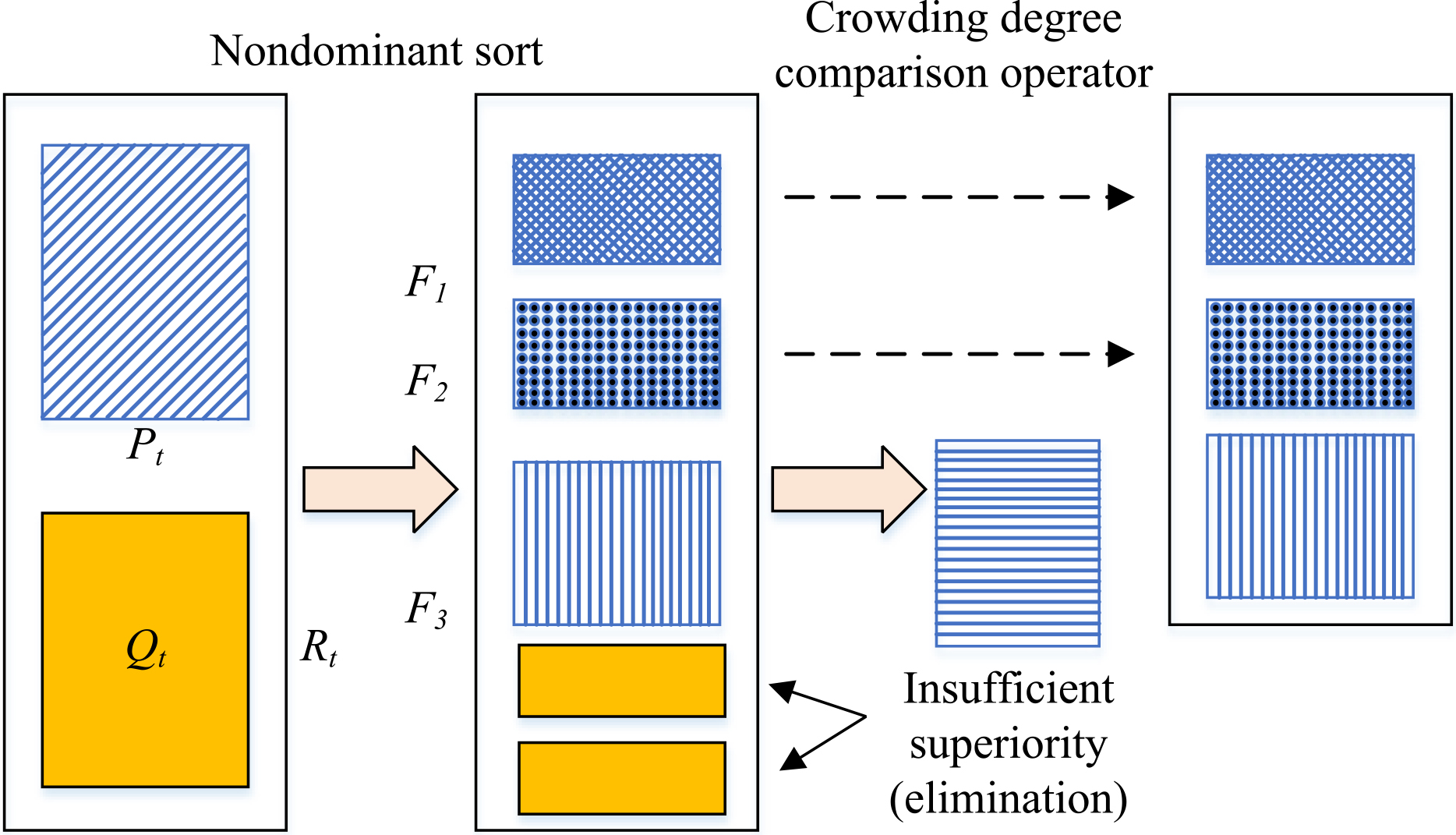
Observing Fig. 1, it can be seen that the temporary population
NSGA-II algorithm flow diagram.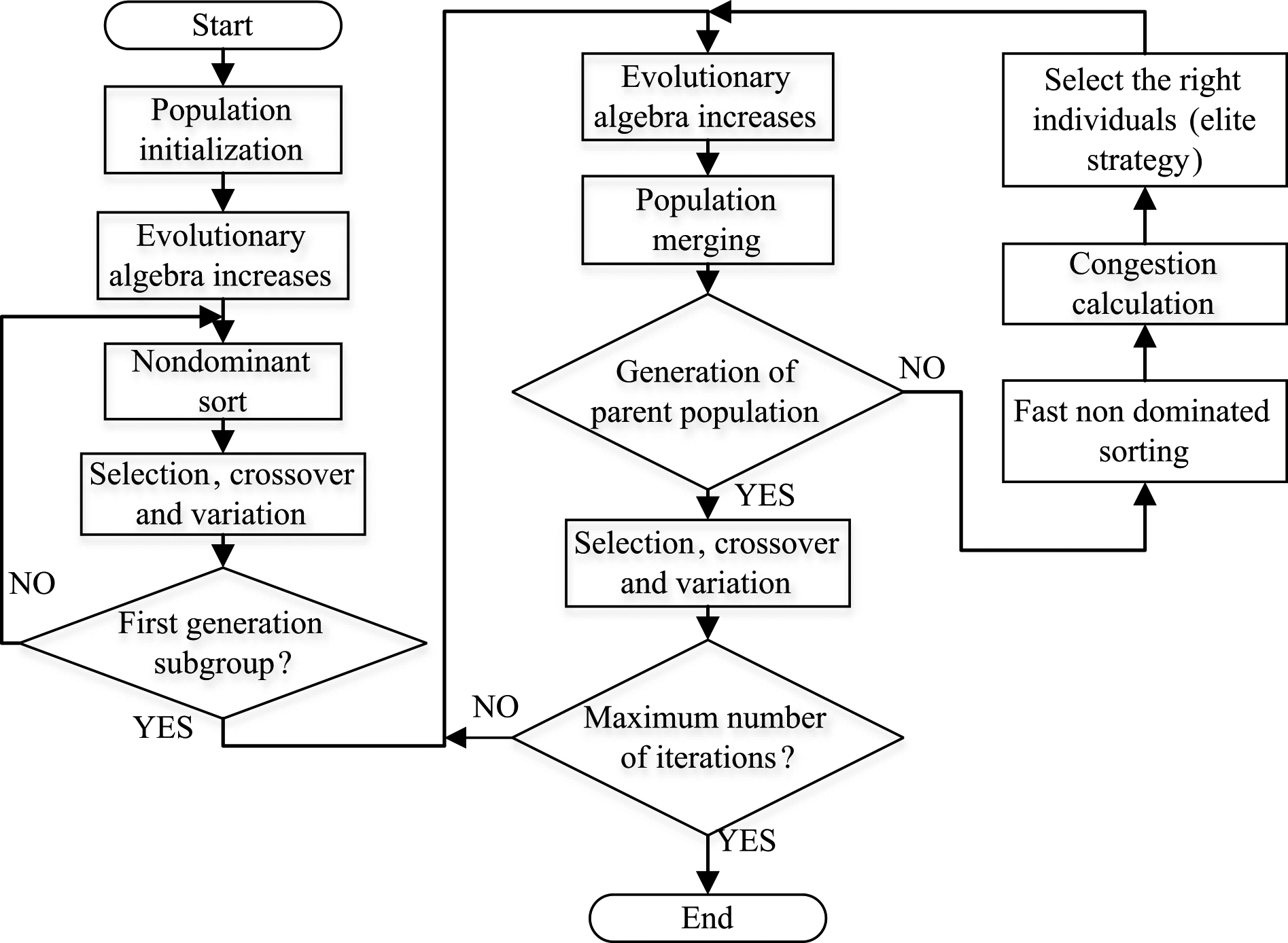
Figure 2 shows the detailed steps performed by the NSGA-II algorithm, including non-dominated sorting, crossover and mutation operations. It should be pointed out that the evolution operator of the NSGA-II algorithm cannot make self-adaptive adjustments through the number of iterations, the running stage of the algorithm and the external environment, which leads to the current situation of low search efficiency of the algorithm [22, 23]. Therefore, this research proposes an adaptive evolution operator to adjust the parameters at different stages of the algorithm to improve the global search efficiency of the algorithm. The crossover rate adjustment function corresponding to the improved NSGA-II algorithm is shown in Eq. (1).
In Eq. (1),
In Eq. (2),
In Eq. (3),
In Eq. (4),
Considering the intermittent characteristics of wind energy and solar energy complementary power generation, it is necessary to add energy storage modules to the system so that the whole system can meet the electricity demand in real time. As a popular clean energy, hydrogen energy is suitable for use as the energy storage unit of this system. In addition, considering that the stability of a single energy storage system is lower than that of a hybrid energy storage system, batteries and hydrogen energy are incorporated to form a hybrid energy storage system to optimize the wind and solar power generation system to improve energy efficiency [24]. The distribution state of wind speed can be described by Weibull function, such as Eq. (5).
In Eq. (5),
In Eq. (6),
VP characteristic curve of wind turbine.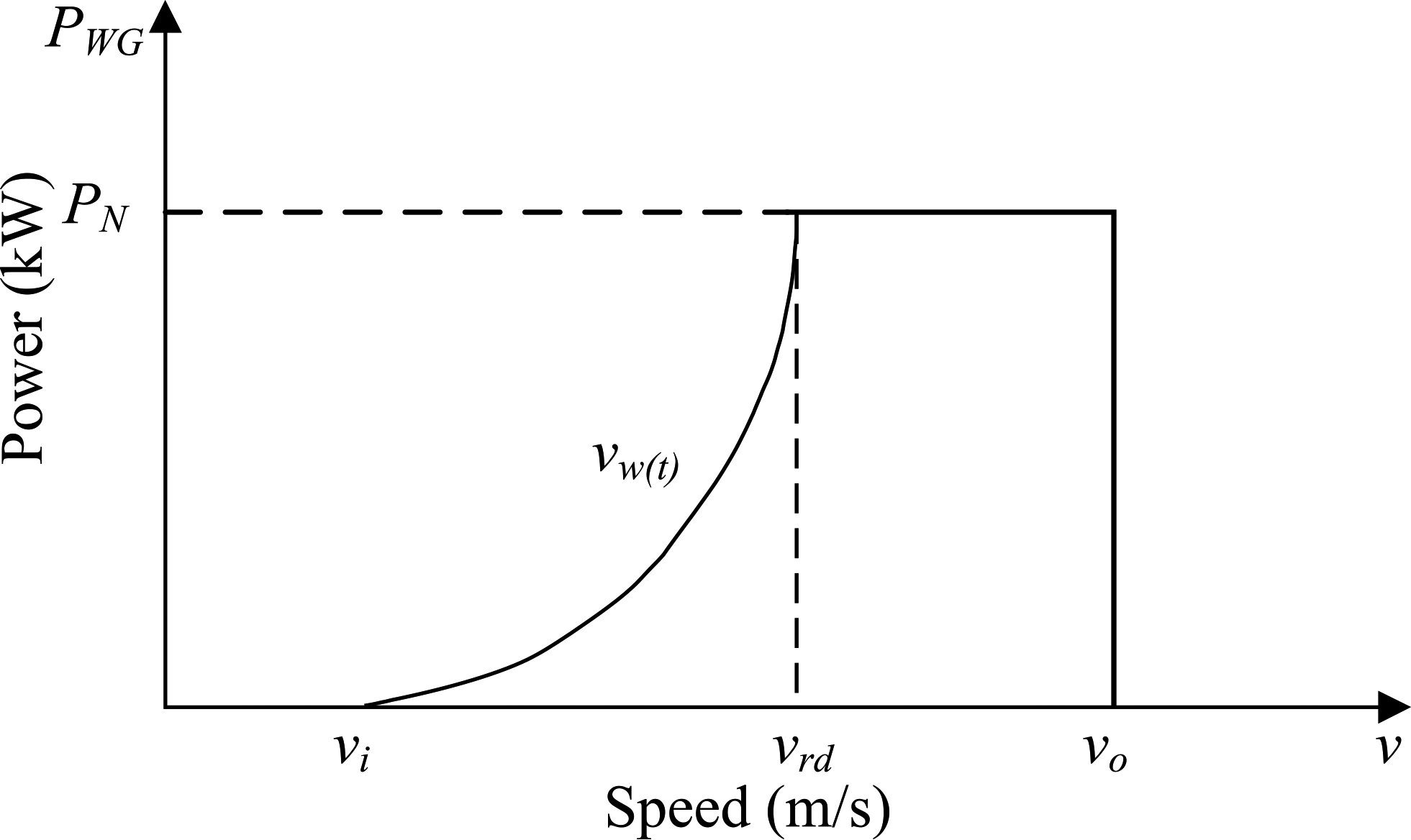
It can be seen from the characteristic curve in Fig. 3 that if the output power of the fan is to be non-zero, the minimum wind speed needs to be higher than the cut-in wind speed. At the same time, in order to prevent the wind speed from being too large to exceed the wind turbine’s consumption level and destroy the fan, the fan needs to be stopped when the wind speed is greater than the cut-out wind speed [25]. Due to the randomness of light intensity, the output power of photovoltaic modules is also uncertain, and its mathematical expression is Eq. (7).
In Eq. (7),
where
In Eqs (10) and (11), it
In Eqs (12) and (13), it
Schematic diagram of hydrogen fuel cell power supply.
It can be seen from the schematic diagram in Fig. 4 that the hydrogen fuel cell power supply system consists of eight parts, namely the hydrogen storage module, the fuel cell module, the DC conversion module, the oxidant supply module, the DC power distribution module, the energy storage module, the management unit and the load part. The expressions of the relationship between the output power of the fuel cell and hydrogen are shown in Eqs (14) and (15).
In Eqs (14) and (15),
It can be seen from Fig. 5 that the system takes photovoltaic and wind energy as the main power supply sources and converts them into batteries or hydrogen energy. The total configuration cost of the whole system is taken as the objective function of the wind-hydrogen energy system, shown in Eq. (16).
In Eq. (16),
Performance test of improved NSGA-II algorithm
For the multi-objective optimization algorithm in the form of NSGA-II, considering that the constraint variables of the ZDT function can be added artificially, the ZDT function is often selected as the test function to analyze the performance of the algorithm. In this study, four test functions, ZDT1, ZDT3, ZDT4 and ZDT6, were selected, and the two algorithms, the improved NSGA-II algorithm and the unimproved NSGA-II algorithm, were used to verify the coverage index, convergence index and diversity index. During simulation, the number of algorithm iterations is set to 200, and the four ZDT functions are run for 40 times. Table 1 shows the results of the coverage index of the two algorithms.
Coverage index results of two algorithms
Coverage index results of two algorithms
Comparing the coverage index values in Table 1, it can be seen that the average coverage index of the improved NSGA-II algorithm in ZDT1, ZDT4 and ZDT6 is 0.0000, and the coverage index variance is 0.0000, while the average coverage index of the unimproved NSGA-II algorithm is in ZDT1, ZDT4 and ZDT6 are 0.0112, 0.0498 and 0.0039, respectively, so the improved NSGA-II algorithm coverage index is better than the unimproved NSGA-II algorithm. Table 2 shows the diversity index results of the two algorithms.
Diversity index results of two algorithms
Schematic diagram of system energy flow.
Comparing the results of diversity indicators in Table 2, it can be seen that the average values of the diversity indicators obtained by the improved NSGA-II algorithm in the ZDT1 function, ZDT3 function, ZDT4 function and ZDT6 function are 0.4498, 0.7996, 0.8154 and 0.7689, respectively, while the unimproved NSGA-II The average values of the diversity indicators obtained by the algorithm in the ZDT1 function, ZDT3 function, ZDT4 function and ZDT6 function test are 0.3578, 0.5276, 0.7597 and 0.6158, respectively. The comparison shows that the improved NSGA-II algorithm has an increase of 0.092, 0.272, 0.557 and 0.1531. Therefore, on the four ZDT test functions, the diversity performance of the improved algorithm is better than that of the former algorithm, which indicates that the improved NSGA-II algorithm has more advantages in preserving the individual diversity characteristics of the population. Table 3 shows the index results on the convergence of the algorithm before and after the improvement.
The convergence index results of the improved and improved algorithms
Comparing the convergence indexes of the algorithms in Table 3, it can be seen that the average convergence of the improved NSGA-II algorithm on the four test functions of ZDT1 function, ZDT3 function, ZDT4 function and ZDT6 function is 0.0052, 0.2634, 0.0415 and 0.0018. The indicator variances are 0.0000, 0.0039, 0.1147 and 0.0000. The mean values of the four ZDT test functions of the NSGA-II algorithm before the improvement are 0.0211, 1.0854, 0.0658 and 0.0189, respectively, and the variances of the convergence indicators are 0.0048, 0.0547, 0.2135 and 0.0354, respectively. Because the smaller the convergence index, the better, so the comparison shows that the performance of the former is 0.0159, 0.822, 0.0243 and 0.0171 higher than the latter in terms of the average convergence, in terms of variance, the former is 0.0048, 0.0508, 0.0988 and 0.0354 higher than the latter. Therefore, the improved NSGA-II algorithm has advantages in convergence.
The NSGA-II algorithm and the unimproved NSGA-II algorithm are studied to conduct scheduling simulation experiments for the wind-hydrogen energy system. The size of the simulated experimental population is set to 200, the number of iterations is set to 100, the initial value of the mutation rate, the crossover rate and its corresponding distribution index is set to 1, and the final value is set to 28. The upper and lower limits of the state of charge of the battery are 0.9 and 0.1, and its initial SOC value is 0.5. Figure 6 shows the energy scheduling diagrams corresponding to the NSGA-II algorithm before and after the improvement.
Figure 6 reflects the dispatching situation of each unit of the wind-hydrogen integrated system with the two algorithms. Both algorithms can meet the power supply demand of the electric load. From Fig. 6a, it can be seen from the energy scheduling results of the improved NSGA-II algorithm that the wind is strong from 0:00 to 7:00 in a day. At this time, the main output power is the wind turbine, of which the highest output is 272 KW.
From 8:00 to 18:00 is the period of strong sunlight, at this time, the photovoltaic array is mainly used for power generation, and the maximum output power is 26 4 KW. It can be seen that from 0:00 to 3:00 when the wind is excessive, the battery starts to charge and the electrolyzer starts to consume electricity and store hydrogen. During this period, the maximum charging power of the battery is 72 KW, and the maximum power consumption of the electrolyzer is 38 KW. When there is excess photovoltaic power generation during the day, the system will store the excess electricity through electrolytic hydrogen storage. At this time, the maximum energy consumption of the electrolyzer is 98 KW. In contrast, the unimproved NSGA-II algorithm cannot handle the problem of excess energy well. As shown in Fig. 6b, the maximum energy storage of the battery is only 23 KW, and the energy consumption of the electrolyzer is only 31 KW, which is higher than that of the improved one. The algorithms are 15 KW and 11 KW lower, respectively. Table 4 shows the configuration of each unit of the system before and after the improvement of the NSGA-II algorithm. In addition, the proposed algorithm is tested and compared with the hybrid neural dynamics algorithm and the improved sparrow algorithm.
Configuration of each unit of the system before and after NSGA-II algorithm improvement
Configuration of each unit of the system before and after NSGA-II algorithm improvement
Scheduling of each unit of wind hydrogen integrated system based on two algorithms.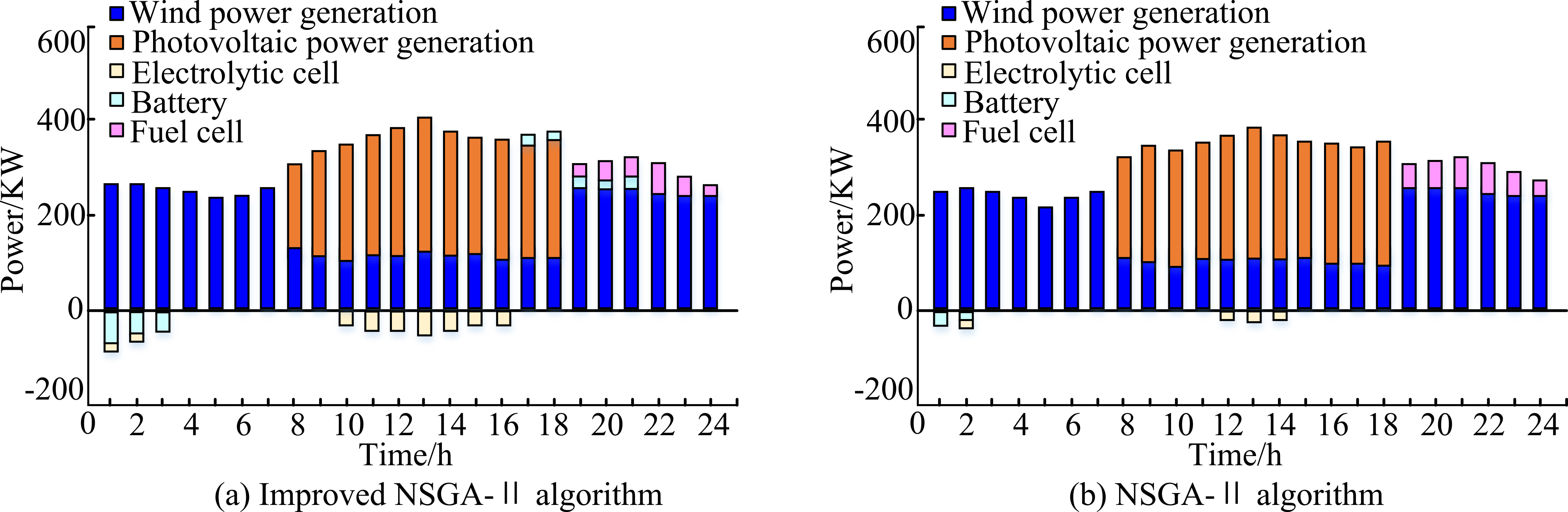
It can be seen from the unit configuration table in Table 4 that in the system optimized by the improved algorithm, the number of wind turbines is 112, the number of photovoltaic cells is 415, the number of batteries is 125, the number of hydrogen storage tanks is 115, and the number of fuel cells is 130. There are 24 pools, and the total configuration cost is 606 million yuan. The configuration results corresponding to the unimproved algorithm are as follows. The number of wind turbines is 90, the number of photovoltaic cells is 446, the number of batteries is 96, the number of hydrogen storage tanks is 98, the number of fuel cells is 164, and the number of electrolytic cells is 27. The total configuration cost is 624 million yuan. It can be seen that the improved system has 22 more fan configurations, 19 more batteries, and 17 more hydrogen storage tanks, while reducing the number of photovoltaic cells and fuel cells, so the final cost of NSGA-II. The cost of the II algorithm was reduced by 18 million yuan. Figure 7 is a change curve of the battery state of charge and a battery power distribution diagram in a day.
Change curve of state of charge of storage battery and power distribution diagram of storage battery in a day.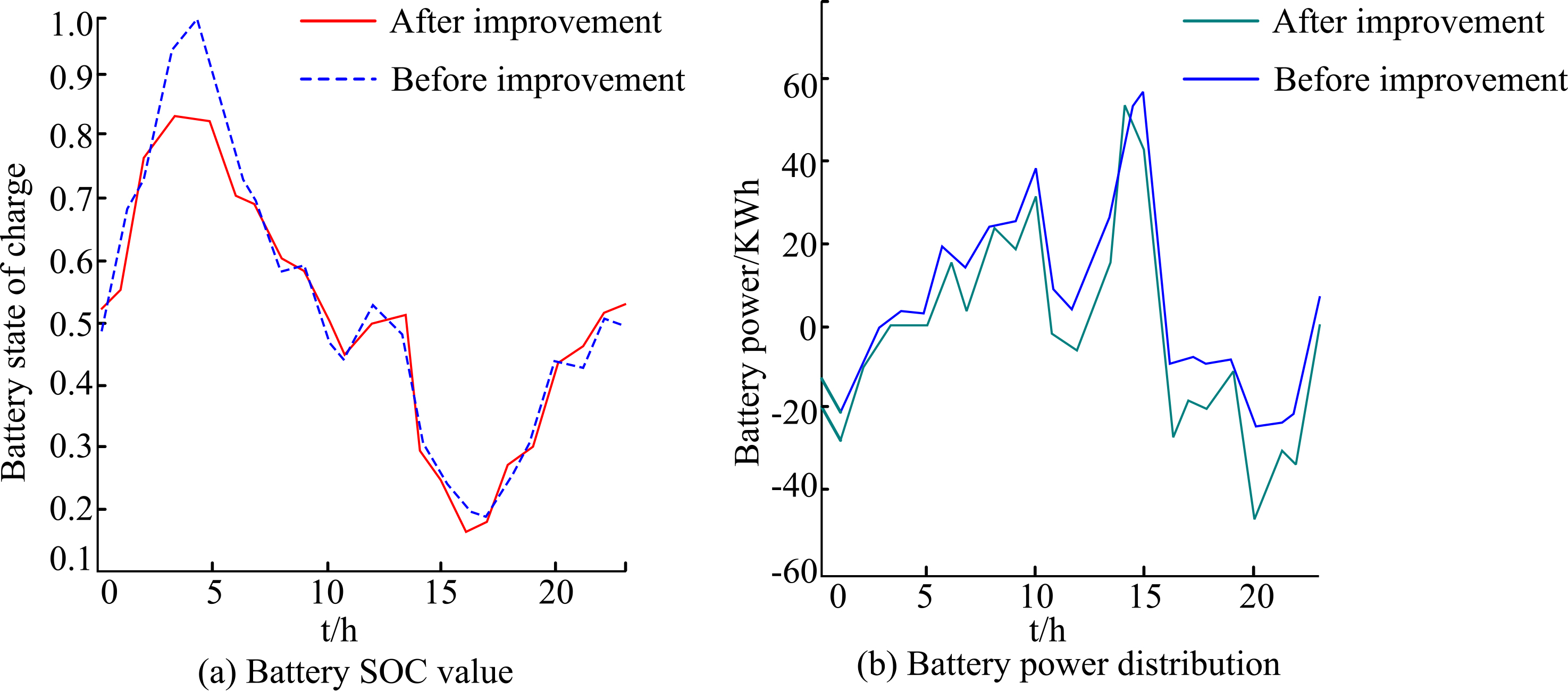
It can be seen from the SOC change curve of the battery in Fig. 7a that from 0:00 to 3:00, the state of charge of the battery is in a rising trend, and the instantaneous power of the battery is all negative, indicating that the battery is charging at this time. From 3:00 to 5:00, the SOC of the battery does not change, indicating that the battery is neither charged nor discharged at this time, and the instantaneous power is zero. From 5:00 to 11:00, the battery power is positive and is in a state of discharge, so the SOC value decreases. At the same time, it can also be seen that due to the improved control of the NSGA-II algorithm, the SOC size is always kept in the range of 0.1–0.9, and there is no negative phenomenon of over-discharge or over-charge, this shows that the algorithm can improve the stability of the system and increase the life of the energy storage system. However, according to the change curve of the battery charging state before the algorithm improvement in Fig. 7a, the curve shows the phenomenon of critical saturation charging, which occurs near the 4th hour, which is not conducive to the operation performance of the energy storage system.
The long-term use of large quantities of fossil energy has made the environment worse and worse. The energy supply and consumption patterns need to be changed urgently. The multi energy system incorporated into renewable energy has become the focus of attention. The improved NSGA-II algorithm can realize the optimal operation of the dual energy system, including wind and hydrogen. The results show that the improved NSGA-II algorithm outperforms the original algorithm in ZDT1, ZDT3, ZDT4 and ZDT6 functions on four test functions. For example, on the convergence index, the improved NSGA-II algorithm improves 0.0159, 0.822, 0.0243 and 0.0171 on four functions. The simulation results of energy dispatching optimization of wind hydrogen integrated system show that the improved NSGA-II algorithm can achieve more economical and efficient energy allocation results. For the optimized scheduling of the improved NSGA-II algorithm, the maximum output of wind power is 272 KW, the maximum output of photovoltaic is 264 KW, the maximum energy storage capacity of battery is 72 KW, and the maximum energy consumption of electrolytic cell is 38 KW. On the configuration of each unit of the system, the total system configuration cost of improved NSGA-II algorithm is 606 million yuan. The total system configuration cost obtained without improving NSGA-II algorithm is 624 million yuan, so the optimized algorithm cost is reduced by 18 million yuan. Considering that the study only focuses on independent power grids, it is hoped that the grid connection of multiple energy systems will be included in the scope of investigation in the future.
Footnotes
Fund
The work was financially supported by 2022 Open Fund Project of Beijing Key Laboratory of Demand Side Multi-Energy Carriers Optimization and Interaction Technique, (Research on Optimal Operation of Integrated Energy Systems with Hydrogen Storage Systems Considering Source-load Uncertainty, YDB51202201360).