



Abstract
CCHPs (Combined Cooling, Heating, and Power Systems) are capable of providing cold energy, heat, and electricity to users, allowing cascading utilization of energy and improving energy efficiency. The imbalance between cooling, heating, and electrical energy makes it difficult to accurately evaluate the performance of a CCHP system. Existing indices for evaluating the performance of the CCHP system do not account for the influence of time-sharing tariffs; therefore, the quantitative index of time-sharing is added and the time-sharing economic exergy efficiency of the radiator is established. Given that the electrical and thermal characteristics of the advanced absolutely hot compressed airheat storage system (AA-CAES) can complement the CCHP system, a model of the CCHP system with AA-CAES is established, which can be used to validate the validity of the quantitative evaluation index of time-sharing. A planetary search algorithm is proposed for solving the CCHP system model to address the multi-parameter solving characteristics of the CCHP system model and the disadvantages of the existing multi-objective optimization algorithms, which are prone to local optimality and poor optimization accuracy. Simulation validation demonstrates that the time-sharing economic exergy efficiency proposed in this paper can more accurately reflect the total energy consumption of the CCHP system than the existing evaluation indices. The performance of the CCHP system can be improved by using AA-CAES as a heat storage device.
Keywords
Introduction
Combined cooling, heating and power (CCHP) systems can be used to provide cooling, heating and electrical energy to customers simultaneously, enabling cascade utilization of energy and improving energy efficiency [1]. However, the relationship between cooling capacity, heat, and electrical energy is unequal. Therefore, when assessing the performance of CCHP systems, it is necessary to take into account the difference between different energy levels [2, 3]. CCHP systems are increasingly popular today. Additionally, research on the exergy efficiency of the CCHP system in terms of the electric field has never stopped. Yang Donghua, for example, proposed a definition for exergy efficiency of various types of thermal engineering equipment [4]. The exergy efficiency, however, examines the ability of energy to generate heat. In general, CCHP systems should provide users with suitable living temperatures (i.e., cold and heat), but these results are usually converted into energy generation efficiency, which does not represent the cooling and heat transfer functions of these systems. Using the economic exergy efficiency model, Rui-Hsien Tsai et al. evaluated the performance of CCHP systems [5], which specifically considered specifically the price difference between cold, heat, and electricity, trying to reflect the value difference between work and heat and the difficulty of production in the price differences.
This advanced adiabatic compressed air energy storage system (AA-CAES) is capable of storing and releasing cold energy, heat energy, and electrical energy during the heat storage and energy release phases. During the heat storage and energy release phases of AA-CAES, cold energy, heat energy, and electrical energy can be stored and released, thus providing the same cascade utilization of energy [6]. In addition, the AA-CAES system can release heat energy when storing heat, and consume heat energy and release cold energy when discharging it. The device can be used as a heat storage device and can be adapted to a CCHP system [7]. The AA-CAES system can be integrated into the CCHP system to improve its flexibility. At the same time, it can reduce the costs associated with wind abandonment and operation [8, 9].
Yet, until now there is little literature that discusses both heat energy and cold energy as participants in the operation of CCHP systems and analyzes the integrated energy utilization of the whole system [8, 9, 10]. Zhang Yuan analyzed the energy efficiency of the CCHP system after it was integrated into the AA-CAES system [10]. He verified that the energy utilization coefficient and the exergy efficiency of the system are maximized when the heat in the storage heaters is fully utilized by the heat users, but did not analyze the economic exergy efficiency of the system. Using the hierarchical analysis method, Sun Shuanzhu analyzed the existing efficiency weight parameters of the CCHP system, and adjusted the weight parameters between various energies by using the AHP method [1], but did not take into account the influence of time-sharing tariffs on the weighting parameters.
The task of evaluating the energy efficiency of the CCHP system requires establishing a model with many dimensions and many variables, and general mathematical algorithms are not sufficient to deal with the problem. Therefore, it is more commonly solved through population optimization algorithms. Nevertheless, the algorithms used to solve the model often fall into local optimality and have the disadvantage of having poor global search capabilities. In the literature, the algorithms have been improved [11, 12], but they do not satisfy the problem in terms of speed and accuracy.
In summary, the literature has not addressed the exergy efficiency of the AA-CAES system as a heat storage device for CCHP systems. A assessment of the economic exergy efficiency of the CCHP system under a time-sharing tariff has not been conducted due to the constraints of policy and metering equipment mismatch. Furthermore, the existing intelligent algorithm does not satisfy the solution of the multivariate CCHP system model.
In this work, we will consider the influence of time-sharing tariff, establish the mathematical model of economic exergy efficiency, and solve the CCHP system model with AA-CAES, and use the planetary search algorithm established based on the spiral search mechanism for the CCHP system model embedded in AA-CAES system. Then, simulation analysis and testing are performed to verify the rationality of the performance evaluation of the CCHP system using the index of time-sharing economy exergy efficiency.
Objective function and CCHP system model
Objective function
Common evaluation indicators
Currently, CCHP systems are evaluated based on three main criteria: primary energy utilization ratio, equivalent exergy efficiency, and economic exergy efficiency. The primary energy utilization ratio represents the ratio of the total energy output to the total energy consumption of the system.
Where,
As the name implies, this index is characterized by treating cold, heat, and electricity equally and reflecting the differences among different energy grades.
The equivalent exergy efficiency takes into account the differences between electric, thermal, and cold energy quality. Under electric energy quality, this index uses energy quality coefficients to combine different energy qualities into a single evaluation index.
Where,
As can be seen, the analysis index of equivalent exergy efficiency, the energy quality coefficient, reflects the relative size of the temperature deviation of cold and hot working fluids from ambient temperature, and characterizes the level of energy quality (i.e., the greater the energy quality coefficient, the greater the relative deviation of working fluid temperature from ambient temperature, the greater the energy quality). (i.e., as the energy quality coefficient increases, so does the relative deviation of working fluid temperature from ambient temperature, which in turn results in a higher energy quality.)
On the other hand, using energy quality coefficients to reflect the difference in energy quality does not reflect the difference in system efficiency intuitively. In order to express the conversion efficiency of the system energy in a more intuitive way, we can consider the value of different types of energy to represent the difference between different types of energy, which is why we propose the concept of the ’economic exergy efficiency.’
Economic exergy efficiency reflects the value of different energies in terms of their price differences and the ease of their output, and reflects the principle of energy cascade utilization. economic exergy efficiency refers to the ratio of the total energy benefits of the system power, heat, and cooling to the total power production of the same value to the total energy consumption of the system input.
Where,
We investigate the impact of time-sharing electricity prices from a practical point of view in this paper and propose an evaluation index of time-sharing economic exergy efficiency. According to the current electricity price, the conversion coefficient of heat energy and cold energy in different time periods is calculated. Its economic exergy efficiency is expressed as follows:
Where,
Compared with the value of
CCHP system structure and principle
As an integrated energy micro-grid, the CCHP system is capable of providing cooling, heating, and electricity. Essentially, it comprises wind power turbines, gas turbines, waste heat recovery devices, heat storage equipment, and absorption refrigerators. In addition to providing comprehensive energy for users and improving energy utilization of the system, it also enhances the role of the system in the consumption of scenery. Figure 1 illustrates the schematic diagram of the CCHP system.
CCHP system schematic.
As shown in Fig. 1, the main components of the CCHP system are the wind turbine, gas turbine, internal combustion turbine, the AA-CAES system, the boiler, and the absorption refrigerator. The wind turbine converts wind energy into electrical energy, which supplies power to the system; the gas turbine and the internal combustion engine convert natural gas into electrical and heat energy, respectively, to supply electricity and heat users; and the AA-CAES serves as a system heat storage to store surplus electricity in the low season, and release it during the peak season. The storage and release phases of electricity are also accompanied by changes in heat energy and cold energy, which can play an important role in comprehensive use of energy. Natural gas can be converted into heat energy by boilers, and exhaust gases from gas turbines, internal combustion engines, and boilers can be converted into cold energy by absorption refrigerators.
Wind power turbine model
Further, depending on the actual wind speed and the cut-in and cut-out wind speeds of the wind turbine, the wind turbine will demonstrate various power generation states: when the actual wind speed is lower than the cut-in wind speed, the fan will stop, and the wind turbine will not generate power. Wind turbines will output different levels of power according to the wind speed if the actual wind speed is greater than the cut-in wind speed and less than the rated wind speed. As the actual wind speed is greater than the rated wind speed and less than the cut-in wind speed, the wind turbine will continue to produce the rated power due to the limiting effect of the wind turbine. Due to the protection mechanism of the wind turbine, if the actual wind speed exceeds the rated wind speed, the air blower will stop and the wind power output will be zero. Equation (5) describes the relationship between the actual power output and the actual wind speed of the wind turbine.
Where,
Gas turbine model
Using the primary function, it is possible to calculate the generating power of a gas turbine, the thermal power of the output flue gas, and the corresponding consumption rate of gas, as shown in Eq. (6) below.
Where,
The maximum and minimum output constraints for a gas turbine are shown in Eq. (7) below.
Where,
The climbing constraint is shown in Eq. (8) below.
Where,
Mathematical model of gas-fired boiler
The gas-fired boiler power is calculated by the following Eq. (9).
Where,
The power rating constraint of the gas-fired boiler, as shown in the following equation
Where,
The working principle of AA-CAES
As shown in Fig. 2, the AA-CAES system consists of a compressor set, an expansion unit, a gas storage tank, a heat storage tank, a cold medium tank, a photothermal module, and a lithium bromide absorption refrigerator. With the addition of a photothermal module and a refrigeration module to the AA-CAES system, the CCHP system can improve its time-sharing economy exergy efficiency and its energy conversion efficiency.
Schematic diagram of the AA-CAES system.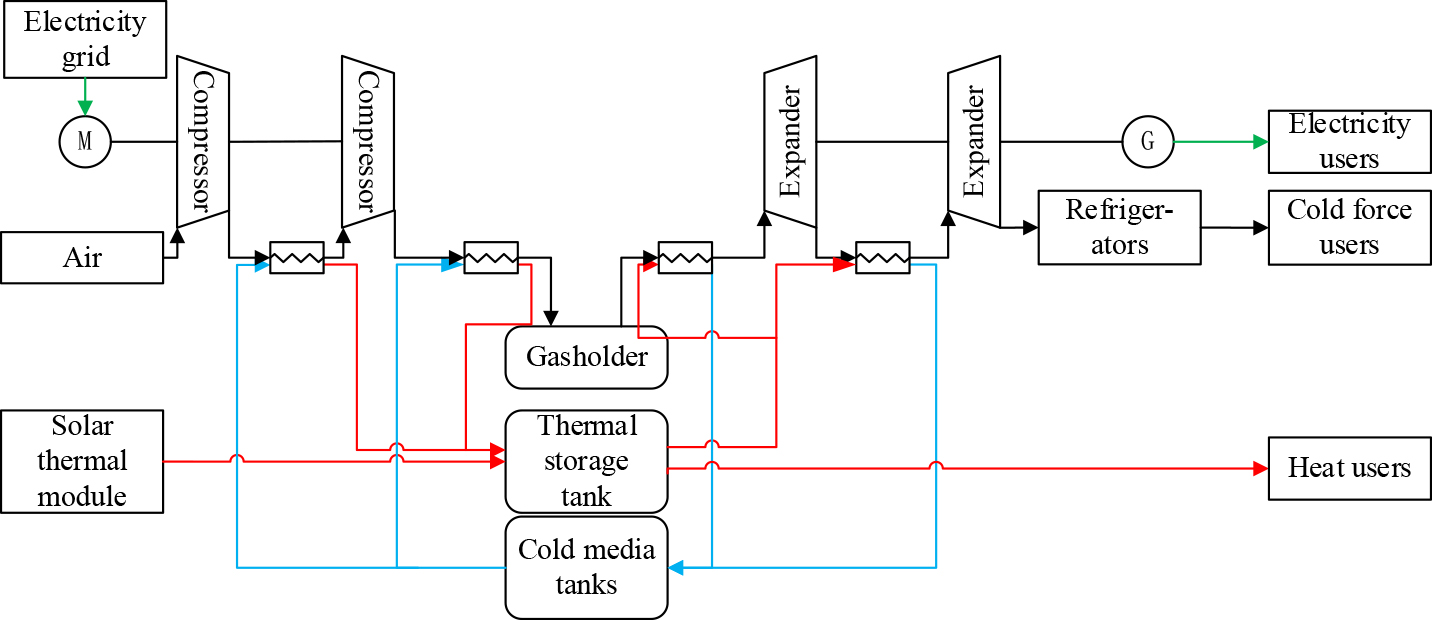
Heat storage process for AA-CAES system: excess power will be used to compress air through the multistage compression module into high-pressure air stored in the storage tank, the heat generated in the process is stored in the heat storage tank, and provides the heat energy requirements of the thermal system.
The AA-CAES system energy release process: the high pressure air stored in the system is transformed into low pressure air by the expander, and electrical energy is released, the heat energy required in the process is provided by the heat storage tank, and the low temperature exhaust gases produced in the energy release process are used to generate chilled water by the lithium bromide chiller to provide cooling for the users. In the thermal system, the photothermal module converts light energy into heat energy and stores it in the thermal storage tank to meet the heat energy demands of the process and of the thermal system.
During the heat storage stage, the air is compressed by the compressor. The actual compression process is irreversible; therefore, it is calculated as a multivariable process. As a result, the compressor outlet temperature is expressed as [9]:
Where,
The compressor compression process involves the following steps:
Where,
For a given input power
The temperature at the expander outlet during the energy release phase can be expressed as:
Where,
The amount of expansion work done per unit mass of working fluid can be expressed as:
For a given input power
The mathematical model of the pressure of the gas storage tank can be expressed as:
Where,
The mathematical model of the heat energy of the heat storage tank is expressed as:
Where,
The photothermal module is used as a module for storing heat to the thermal storage tank of the AA-CAES system, and its mathematical model is expressed as
Where,
The lithium bromide absorption refrigerator can utilize the exhaust gases from the expansion machine during its energy release phase as refrigeration, which can be utilized for cold power loads with a cooling capacity per unit time as follows:
Where,
At this stage, the activity patterns of swarming organisms are mostly used as the basis for the construction of population intelligence optimization algorithms. In fact, however, many other natural phenomena can also be utilized as a basis for the development of group optimization algorithms. The purpose of this paper is to propose a planetary search algorithm based on the spiral search mechanism in consideration of the solar system’s operation law.
Bionic principle
Mirjalili proposed the spiral search mechanism to characterize the mothballing algorithm as well as the whale search algorithm [14, 15]. A spiral search mechanism is a search mechanism in which the particles contract spirally around the current optimal point to find the optimal value. In comparison to the PSO algorithm, the algorithm utilizing the spiral search mechanism is more accurate. Nevertheless, once the spiral search mechanism determines the center of the spiral, the mechanism lacks the capability to jump out of the local optimality point, so it is very easy to fall into the local optimality point [16]. This paper attempts to address this limitation by proposing a planet search algorithm based on the spiral search mechanism.
In this paper, by referring to the operation law of the solar system, the optimal point under the current iteration number is used as the position of the star, and other particles move around the star in a spiral motion. In the next iteration, the new optimal point is used to replace the star position under the current iteration number, and finally a stable “galaxy” is formed, so as to find the optimal point.
Our paper presents a method for performing mutation operations on particles with poor adaptability in the search process to enhance the global search capability of the algorithm. This paper also provides local circular search to improve its local search capability by changing the iteration form of particles with better adaptability under the current number of iterations so that they can perform circular search in a small area. By virtue of this, the algorithm can be circumvented to fall into local optimality, and the algorithm’s accuracy will be increased in the spiral search mechanism.
Algorithm model
The aim of the planetary search algorithm proposed in this article is to eventually form stable galaxies from chaotic “planets”. Consequently, the “star” is determined as the best point of the current particle population,
Where,
When particle are running, particles with better fitness attract nearby “planets” as satellites and drive in a spiral movement, namely:
Where,
During the running, poorly adapted “planets” will be categorized as “meteors”. The iteration is expressed as follows
Where,
When
Where,
Distribution of “planets” after system stabilization.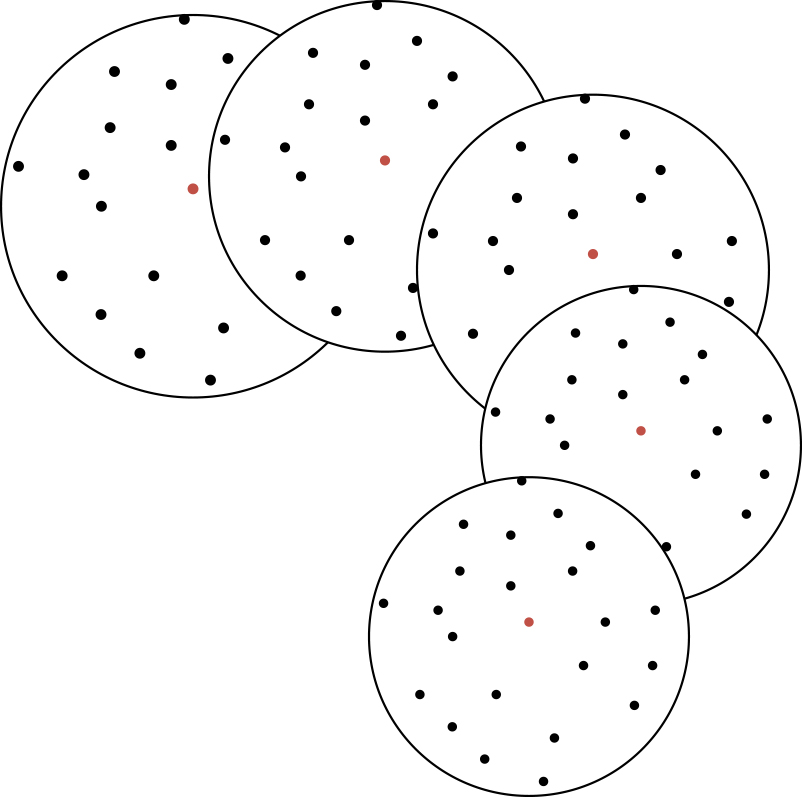
In Fig. 3, the dashed circle range represents the distribution of the “planet” after stabilization. When the system is stabilized, the particles move in spiral motion, which increases the local search capability of the system near the optimal point, and enhances its search accuracy.
initialization parameters: maximum number of iterations maxgen, number of “planet” planetary particles sizepop, etc.. Initialize the positions of the planets Determine the distance In this iteration, the “planet” particle with better adaptation will attract nearby particles as “satellites” and iterate. According to Eq. (22), the particle position is determined after iteration The planetary particles that are poorly adapted in this iteration are subjected to mutation operations in accordance with Eq. (23). Calculate the fitness of all particles and find the particle with the best fitness in this iteration as the “star”. Determining the end condition. A criterion for stopping an iteration is when it reaches the pre-set maximum number of iterations or has satisfied the minimum error requirement, in which case an optimal solution and an optimal individual are output. If it is determined that the end condition is not satisfied, then return to Step 3.
The simulation validation is divided into two parts, the first part tests the effectiveness and feasibility of the planetary search algorithm. In the second part, an evaluation index of economic exergy efficiency in consideration of time-sharing tariffs is utilized in order to determine whether the energy conversion process of AA-CAES can be more intuitively represented.
Simulation verification of the planetary search algorithm under the test function
Experimental environment and parameter setting of the algorithm
A total of 12 benchmark test functions are used to vertify the effectiveness and feasibility of the planetary search algorithm. MATLAB R2016b programming software is used to simulate the algorithm on an Intel(R) Core(TM) i7-8750H computer with 2.2 GHz main frequency, 8 GB RAM, Windows 10 (64-bit) operating system, and Intel(R) Core(TM) i7-8750H CPU. A population size of 30 is chosen for the algorithm along with a number of 500 iterations.
Test functions
Benchmark function
Benchmark function
The 12 typical benchmark test functions used to validate the algorithm are provided in Table 1, and they are taken from the literature [17]. The functions f1 to f7 are single-peak functions and f8 to f12 are nonlinear multi-peak functions. It is possible to test the optimization effectiveness and validity of an algorithm using various forms of test functions.
The dimension of the test function is set to 100 in order to verify the effectiveness of the proposed algorithm in the multivariate model. Multi-solutions of the test function are performed in order to verify the effectiveness of the function in both single-peak and multi-peak situations.
Performance comparison with other algorithms
Performance comparison with other algorithms
In the algorithm validation, the proposed planetary search algorithm is compared with Particle Swarm Optimization (PSO), Genetic Algorithm (GA), Moth-flame optimization (MFO), Whale optimization algorithm (WOA) and Sparrow Search Algorithm (SSA) at the same number of iterations, population size and number of runs. These algorithms (MFO), whale optimization algorithm (WOA), and sparrow search algorithm (SSA) [18] are compared. Using the simulation calculation results, their convergence curves and convergence accuracy were drawn, as shown in Table 2 and Fig. 4.
Convergence curve comparison rendering.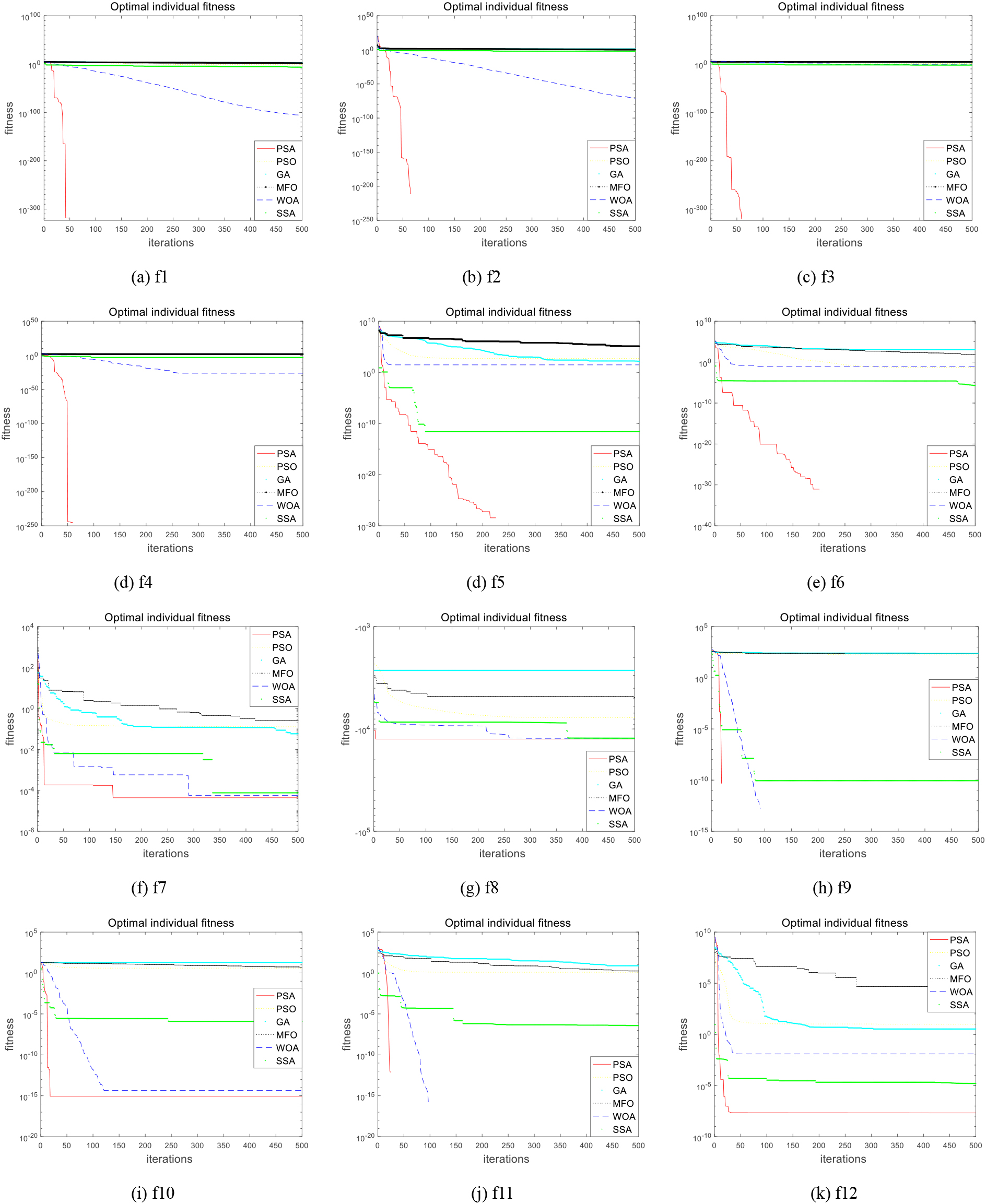
According to Table 2, the average convergence accuracy and optimal value of the planetary search algorithm presented in this paper are superior to those of the PSO, GA, MFO, WOA, and SSA algorithms. In addition, its variance is also much smaller than the variance of other algorithms, which indicates that the planetary search algorithm is more reliable and stable.
As can be seen from Fig. 4, in comparison with the classical PSO and GA algorithms, the planetary search algorithm, MFO, and the WOA algorithm, which employ the spiral search mechanism, can obtain results with higher convergence accuracy regardless of whether they are performed under single-peak or multi-peak conditions. Due to the spiral search mechanism, a powerful global search capability is available when seeking the optimum.
As can be seen in Fig. 4(c–f), compared with the MFO and WOA algorithms, which use the spiral search mechanism, the planetary search algorithm is less likely to fall into the local optimality point. A key reason for this is that the algorithm determines the “satellite” and “comet” search mechanisms, which can improve the system’s ability to deal with “planet” variation and can allow the algorithm to move beyond the local optimality point and improve its ability to reach the global optimal point.
In comparison with the WOA algorithm, which also utilizes the spiral search mechanism, the planetary search algorithm exhibits improved convergence accuracy. This indicates that the local spiral search mechanism proposed in this paper will enhance the search capability of the system “planet” in the vicinity of the optimal point, thus enhancing the local search capability of the algorithm. In comparison to the SSA algorithm, the planetary search algorithm can find the optimal value for a test function. The search accuracy is higher than that of the SSA algorithm. Accordingly, this indicates that the planetary search algorithm utilizing the spiral search mechanism is effective in solving the population optimization problem.
In comparison to other algorithms, the iterative “planet” step of the Planet Search algorithm is proportional to the distance between the “planet” and the “star” in the current iteration. Therefore, the more distant planet can be searched with a larger step size, thus increasing its ability to find the global optimum. The search for the closest “planet” can be performed in shorter steps to minimize oscillations near the optimal point, thereby accelerating convergence and achieving the optimal solution with fewer iterations. Moreover, it relies on the local spiral to enhance the algorithm’s ability to search for local optimizations. From Fig. 4(e), it can be seen that the local spiral search mechanism can enhance the local search capability of the algorithm when the search is close to the global optimal solution. By setting up “comet” to “planet” for variational operation, we can observe from Fig. 4(e–g) that the proposed planetary search algorithm has more folding points, which indicates that it is able to jump out of local optimality.
In summary, the planetary search algorithm proposed in this paper is capable of substantially improving the convergence accuracy and has a superior search effect than other algorithms.
Combined cooling, heating and power systems
The model developed in this paper is applied to a CCHP system consisting of two gas turbines of 3000 kW each, two internal combustion engines of 1800 kW each, and a 2000 kW wind farm. Gas turbines are connected to a lithium bromide chiller for the treatment of exhaust gases. Moreover, a 2400 kW energy storage device is also included in this system. The cooling, heating, and power load parameters are shown in Figs 5 and 7, the wind power output and light intensity are shown in Fig. 8, and the AA-CAES system parameters are shown in Table 3.
AA-CAES Parameters of the system
AA-CAES Parameters of the system
Cold and hot electrical load parameters.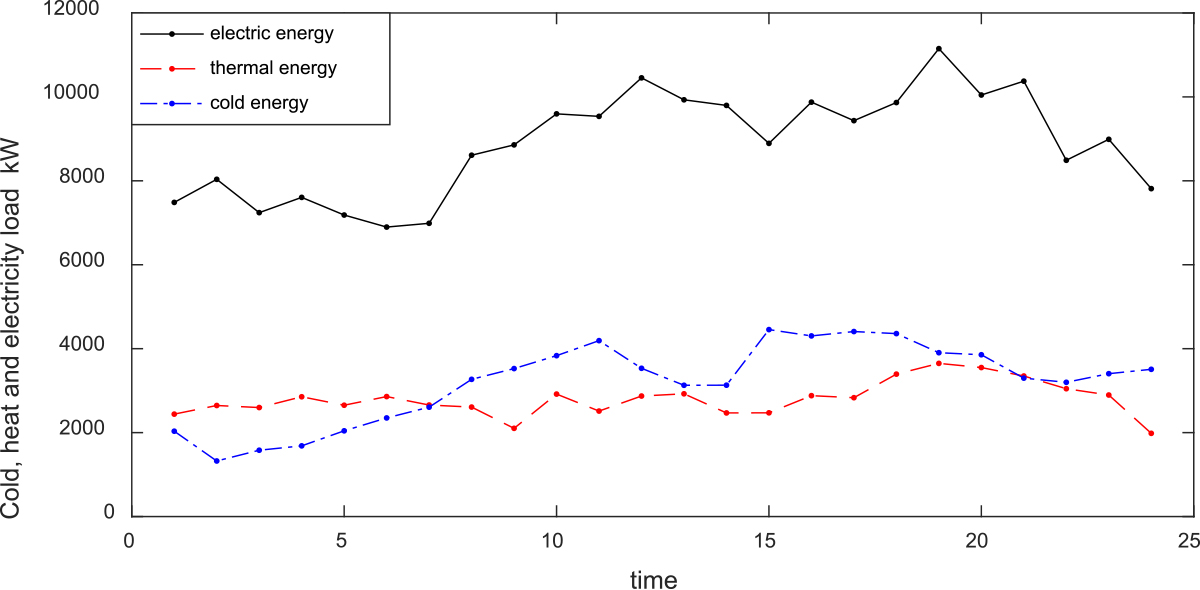
Wind power output.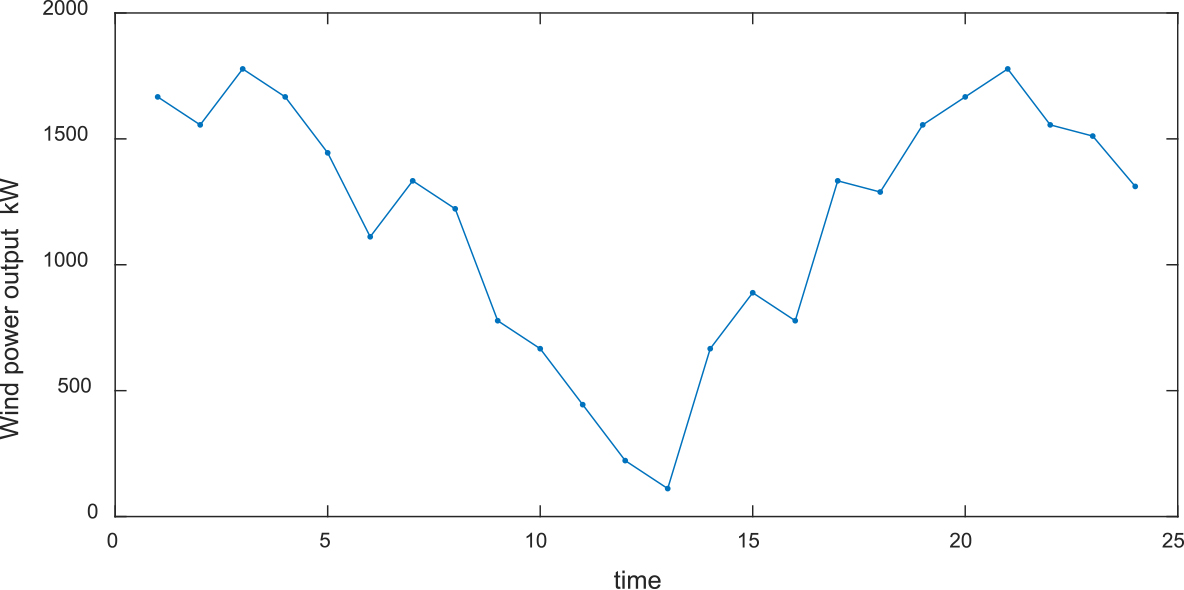
The time-sharing tariff billing model is used in this chapter. Peak hours are 7:00–15:00, 18:00–21:00, weekdays are 15:00–18:00, 21:00–23:00, and valley hours are 23:00–7:00. Time-sharing tariffs are shown in Table 4.
Time-sharing tariff table
Light intensity.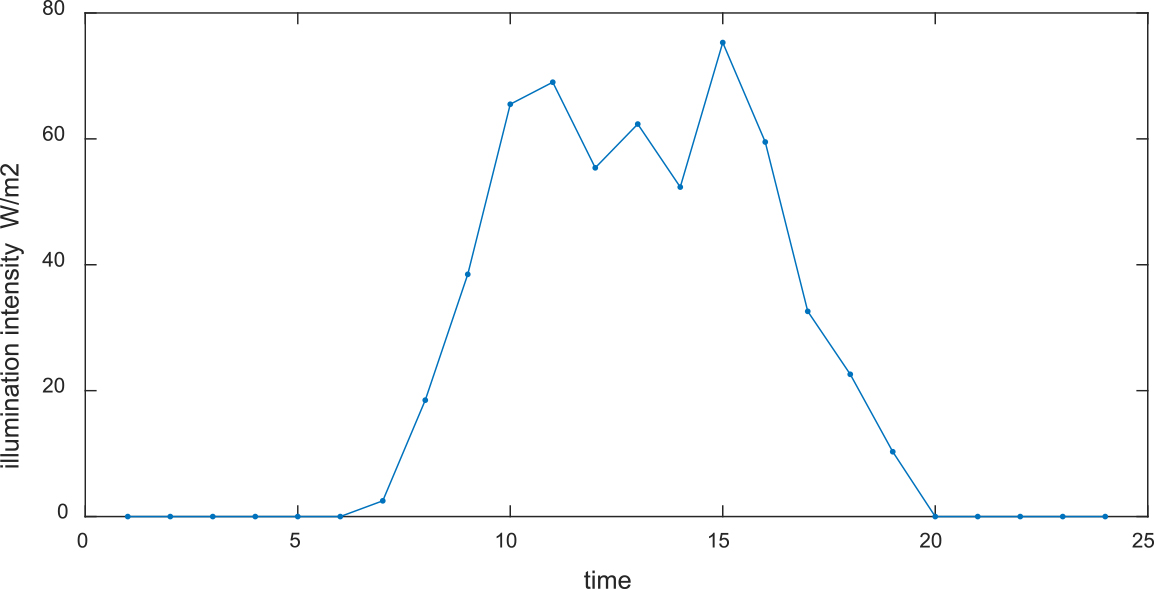
In order to evaluate the merits of the optimized CCHP system using time-sharing economy exergy efficiency, three scenarios are presented to validate the objectives. Scenario 1: The CCHP system utilizes a battery as a heat storage device. Scenario 2: The AA-CAES system without the use of photothermal and cooling modules is used as the heat storage device in the CCHP system. Scenario 3: The AA-CAES system with solar thermal and cooling modules serves as the heat storage unit of the CCHP system. The paper also analyses the economic exergy efficiency and time-sharing economy exergy efficiency under the three scenarios. Following are the results of the analytical calculations.
Exergy efficiency under different scenarios.
Figure 8 presents the different evaluation results obtained from the simulations for each scenario. It can be seent that the exergy efficiencies of scenarios 1 and 2 are similar and those of scenario 3 are higher than those of scenarios 1 and 2. Hence, the use of the AA-CAES system containing photothermal and cooling modules enables the full utilization of the heat and cold energy of the CCHP system, which in turn can improve the exergy efficiency of the CCHP system. The exergy efficiency of heat and cold energy of the CCHP system can be improved. The exergy efficiency of heat and cold energy in scenario 2 is lower than in scenario 1. Consequently, when the AA-CAES system is used solely for electrical energy storage without photothermal and cooling modules, the energy utilization is lower than when the battery is used as a heat storage device. This is due to the higher energy consumption occurring in the middle of the energy conversion process.
From Fig. 8, it is also found that the time-sharing economic exergy efficiency is the highest and the economic exergy efficiency is the lowest in the same scenario. This indicates that when economic exergy efficiency is used for the analysis, although the impact of electricity, heat and cooling prices on the exergy efficiency of the system is reflected, the impact of heat and cooling on the exergy efficiency of the system is also reduced. When time-sharing economic exergy efficiency is used, the overall efficiency is higher than economic exergy efficiency because different energy levels are used at different times, which can also reflect the influence of price and energy on system efficiency more reasonably. Moreover, the time-sharing economic exergy efficiency is higher than the equivalent exergy efficiency. This reflects the importance of heat and cooling in the exergy efficiency of the system. The time-sharing economic exergy efficiency can more clearly illustrate the relationship between system energy usage and economic exergy efficiency. Besides, the higher it is, the higher the economic exergy efficiency of CCHP system and the higher the energy conversion rate.
Electric output and load curve of each unit.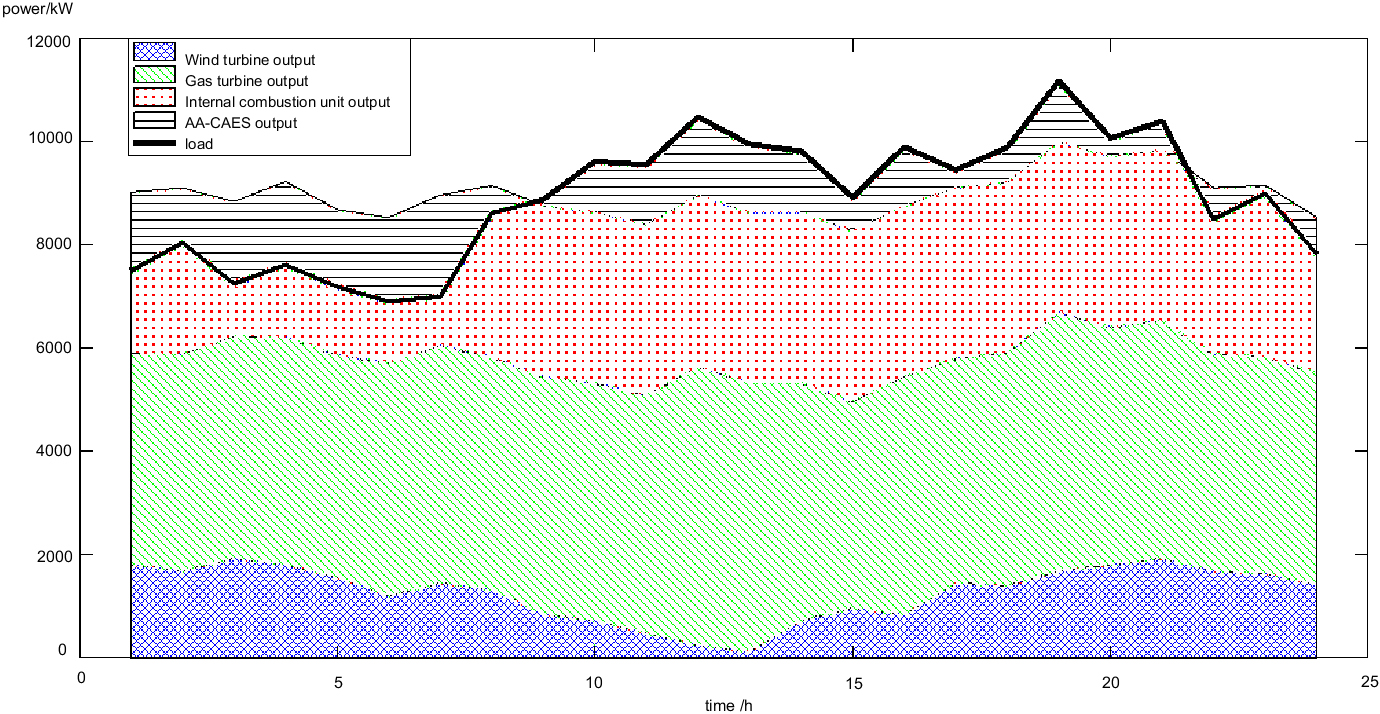
Figure 9 shows the time-sharing economy exergy efficiency selected for the analysis. In Fig. 9, the output curves of each unit of the CCHP system with the AA-CAES system, which contains solar thermal and cooling modules as heat storage units. A noticeable difference can be seen between the peak and trough of the load curve, and the difference between the peak and trough of electricity consumption is approximately 3000 kW. The peak of electricity consumption occurs in the evening, and the trough occurs early in the morning. In the AA-CAES system, the output is above the load curve, showing the system heat storage, and below the load curve, showing the energy released into the system. As can be seen, the load curve of the CCHP system becomes smoother after using the AA-CAES system as a heat storage device. Furthermore, the Figure illustrates how the embedding of the AA-CAES system allows the wind power to be used efficiently and reduces the waste of clean energy.
Thermal output and load curve of each unit.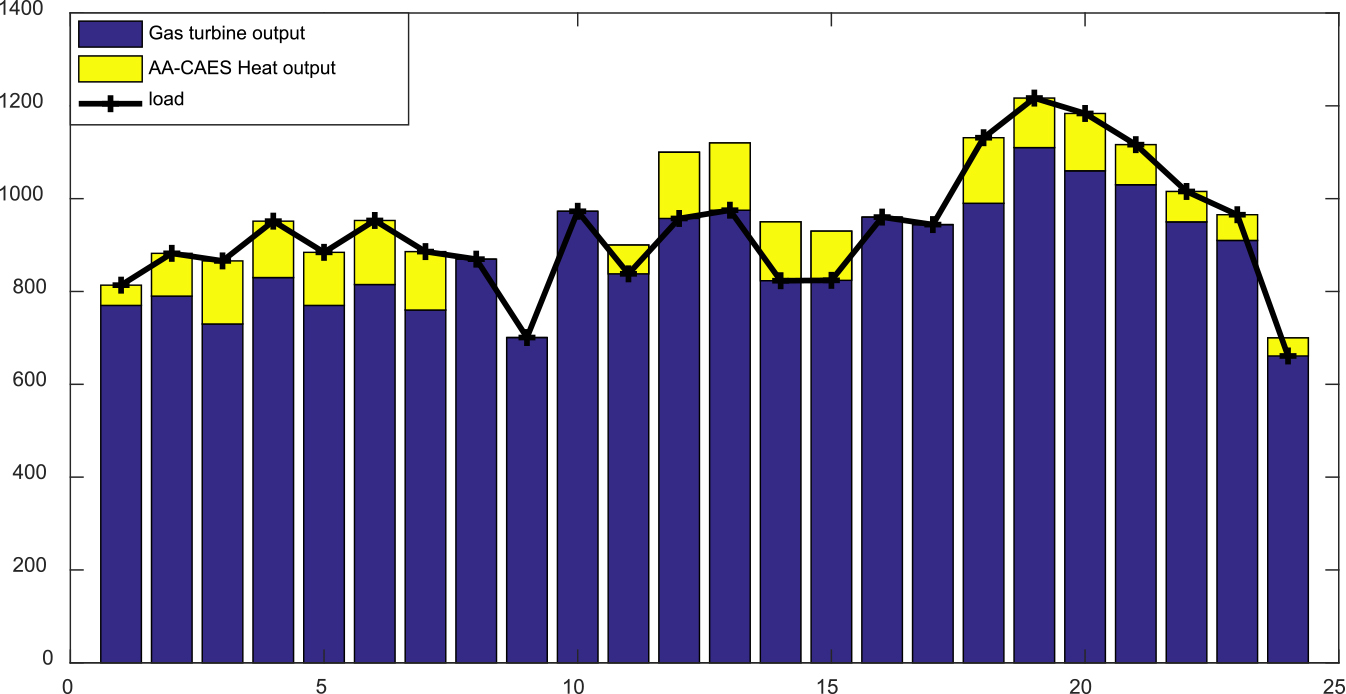
Electrical output of AA-CAES system.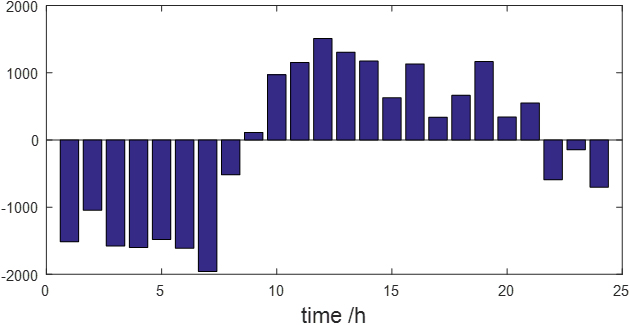
Figure 10 shows the characteristic curves of the heat load and heat output for the CCHP system, where the heat load is supplied by the gas turbine unit and the AA-CAES system. As AA-CAES system is embedded, it supplies heat energy outward during the peak heat load period and stores heat during the low heat load period. A photothermal module’s ability to store heat during periods of sufficient light intensity is very important to the dispatch of heat energy. Furthermore, the full utilization of solar energy to dispatch heat energy can undoubtedly reduce fuel consumption and allow solar energy to be consumed.
Figure 11 illustrates the outflow characteristic curve of the AA-CAES system. In this case, the positive output indicates the energy release to the CCHP system. Figure 9 illustrates that the heat storage time of the AA-CAES system coincides with the low load time. Energy release time corresponds to peak load time, i.e., the AA-CAES system contributes to peak and valley load reduction when the system is embedded in the CCHP system.
This paper proposes to embed an improved AA-CAES system as the heat storage device for a CCHP system that uses integrated energy, and to evaluate its performance based on time-sharing economy efficiency. Moreover, this paper develops a spiral search mechanism for the characteristics of CCHP system optimization involving an array of data and parameters, and proposes the use of variation to construct a “comet” so as to improve the global search algorithm. Moreover, this paper proposes a planetary search algorithm by using local spirals to improve the local search capability. Convergence analysis of the proposed algorithm for the test function is proved to be effective, i.e., the effectiveness and feasibility of the proposed planetary search algorithm is verified. In this paper, the proposed algorithm is used to simulate and analyze the CCHP system embedded in the AA-CAES system. Using the time-sharing economy exergy efficiency that is described in this article, the results show that the performance of the CCHP system can indeed be more comprehensively evaluated. Additionally, embedding the AA-CAES system not only improves the efficiency of the CCHP system, but also improves scenery consumption of the CCHP system.