



Abstract
In the research, an agricultural machinery reliability analysis method based on fusion algorithm is proposed, a optimal radial basis function neural network and M-C statistical test method are mixed to obtain an agricultural machinery reliability. This mixed model is used to reliability design and calculation of a cotton picker, the simulation model of reliability control and calculation for a cotton picker based on the mixed algorithm is set up, and reliability of the level spindle of a cotton picker is computed through the mixed method, and the effect of important factors on the cotton picker is predicted. The level spindle is critical force-bearing parts of a cotton picker and breakdown occurs frequently, their reliability control and optimization are key problems that need to be solved urgently, this study builds an innovative approach for the reliability optimization and design of agricultural equipments.
Keywords
Introduction
With the rapid development of agriculture, farmers have higher and higher requirements for agricultural machineries. Among the many characteristics of measuring the quality level of agricultural machineries, farmers are most concerned about reliability. Due to the large gap with foreign products, the reliability of agricultural machineries has become a key factor restricting the technical level and competitiveness of agricultural machineries in China [1, 2].
Improving the stability and reliability of agricultural machineries have been important in increasing operating efficiency and reduce failures, particularly for some force-bearing components, such as transmission parts and drive parts of agricultural machineries, they operate under changing and uncertain conditions and are in a dynamic and time-varying environment with a high failure rate, their reliability optimization and design are major and key technology for agricultural equipments [3, 4].
Reliability is the main factor determining the lifetime of agricultural machineries [5]. The literature has demonstrated that the reliability of an agricultural machinery system is the most important quality characteristics [6]. As agricultural machineries have gotten more and more complex, it was realized that reliability optimization and design were needed to prevent failures [7]. Therefore, it is necessary to apply reliab-engineering and reliability principle to FA analysis and optimization of agricultural machinery systems.
Many experts at home and abroad have done a lot of research and put forward some design and optimization models. Typical models are American military standard, Schneidewind model, Jelinski-Moranda model, Goel-Okumoto (NHPP) model, Wolverton-Schick model, Moranda model, Yamada-Ohba-Osaki model [8, 9, 10, 11]. The test and simulation methods include fatigue impact test (FIT) method, structural finite element method [12, 13, 14, 15, 16].
In recent years, reliability design and optimization models have also been developed for large and complex mechanical equipments. Babchenko et al. studied (durability, faultlessness and maintainability) how to maintain the tractor’s technical status and reliability control during the agricultural cycle, and lean maintenance methods during seasonal (winter) maintenance and before the agricultural work cycle, and established the relationship between the tractor’s technical conditions and reliability [17]. Durczak et al. proposed an innovative method to quantify the relative reliability index of agricultural tractors based on the subjective opinion of the owner. The ranking obtained by this method can make a purchase decision under uncertainty and risk [18]. Shao et al. established an accurate statistical model of mixed distribution dynamic stress spectrum. Using rain flow counting, the stress time history of the tractor is converted into a rain flow matrix with two parameters. The mean value and range of stress data in the rain flow field are modeled using the mixed Gaussian distribution and Weibull distribution, respectively. Genetic algorithm (GA) and generalized gradient gradient (GRG) are combined to search and identify unknown parameters quickly and accurately [19]. Kim et al. conducted accelerated life test (ALT) on three types of tractors under 120% of the rated engine load. The fatigue life of spiral bevel gear samples of tractor transmissions was obtained through the test, and the analysis and evaluation were carried out to obtain the optimal fatigue reliability design scheme [20].
FT-Bayesian network and displacement strain modal analysis methods are presented and applied to forecast and evaluate the fatigue reliability of agricultural machinery systems [21, 22].
The strength stress interference model is the most basic theory of structural reliability optimization and design. It clearly shows the basic cause of component failure and the essential attribute of reliability optimization. However, under dynamic time-varying working conditions, it is difficult to establish the joint distribution function of strength and stress. At present, most methods are empirical estimation and fitting models with low accuracy. In the study, a mixed method based on a neural network and statistical test method for reliability optimization and analysis is proposed, a radial basis function neural network and M-C numerical calculation are mixed to obtain higher calculation accuracy. The reliability of the level spindle of cotton picker is simulated by the fusion method, and the reliability effect of the important parameters on the level spindle of cotton picker are analyzed by the model.
Stress-strength interference model
Every component of mechanical parts will fail under various complex running conditions (uncertain static and variable loads) , these loads will cause ultimate tensile strength of material less than alternate stress, fatigue failure probability can be calculated through Eq. (1) and intensity and stress interference principle [23].
where
Reliability is the ability of a component to resist failure under a given operating condition, that is, the result of the interaction between stress and strength. If the stress applied on the component is greater than its strength, failure will occur, and the reliability of the component is the probability that the strength is greater than the stress. That is, a component will fail as
Stress-strength theory.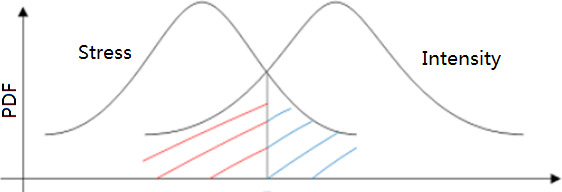
The fusion algorithm of reliability control and calculation for agricultural machinery systems is as follows [24].
One hundred groups of data for strength
When the input sample is
Let
where
where W
The topological structure of the optimal RBFNN is shown in Fig. 2.
The topological structure of the optimal RBFNN.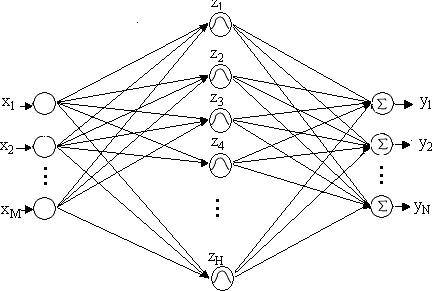
The reliability of agricultural equipments is calculated by M-C numerical simulation, the failure equation
where
where
Structural reliability simulation using NN-MC.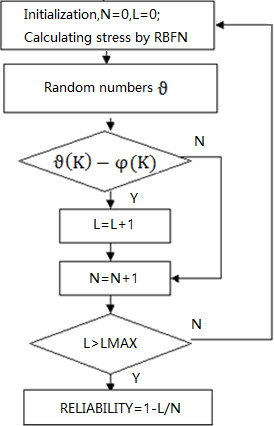
The Entity model of the level spindle of a cotton picker.
The Finite element model of the level spindle of a cotton picker.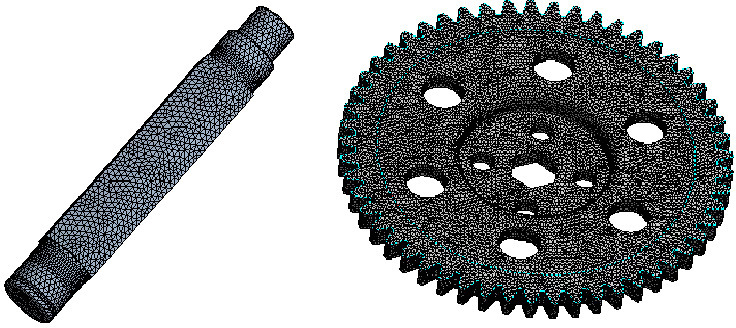
The key of Monte Carlo method to analyze structural reliability is to generate random numbers of known distribution variables. In order to quickly and efficiently generate the random number of a given random variable, it is usually divided into two steps that is, a uniformly distributed random number is firstly generated in the interval, and then it is transformed into a random number of a given distribution variable, as is shown in Fig. 3. The analysis accuracy of MC method is determined by the number of simulations the more simulations, the higher the accuracy, the analysis accuracy can be improved by increasing the number of sampling simulation. In order to reduce the number of sampling simulations, Latin superlegislation in MC method is adopted, and the number of simulations in this method is usually 20%
Add load and constraint of finite element model.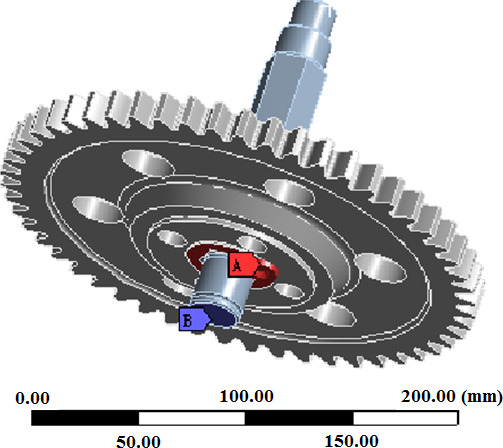
Whole stress cloud imagery of the level spindle of a cotton picker.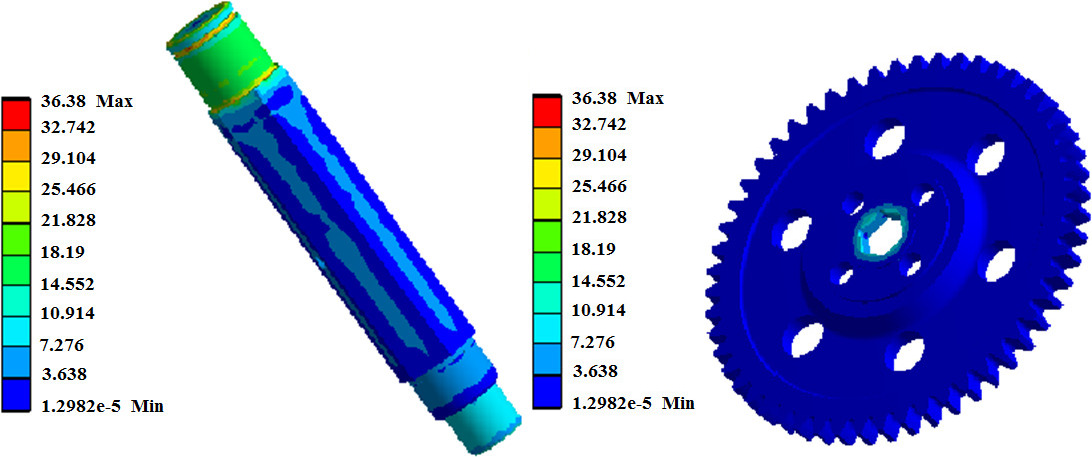
Deformation map of the level spindle of a cotton picker.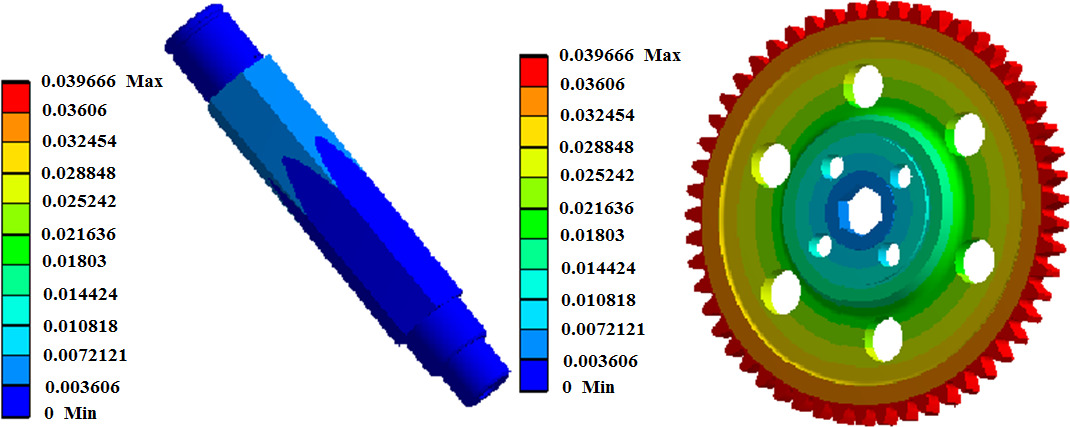
Test result
The training process of RBFNN.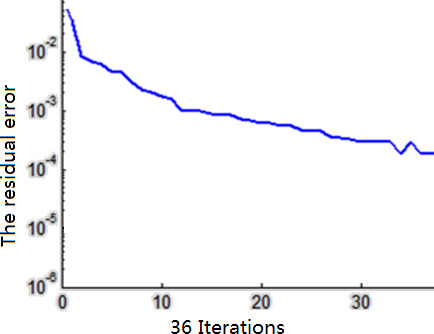
Forecast values of the RBFNN.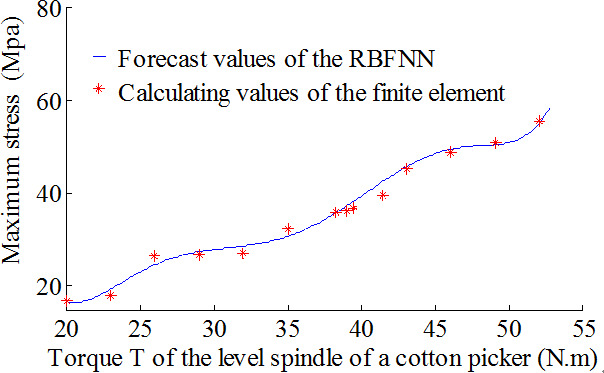
Relationship between deflection coefficients of torque T and reliability.
The finite element analysis model of the level spindle of a cotton picker is shown in Figs 4–7. It can be seen from the simulation figure that the maximum stress of the intermediate shaft and gear is at their joint, and the maximum stress of the intermediate shaft is 36.38 MPa, the gear stress value is 15.2 MPa. It can be seen from Fig. 8 that the maximum deformation part is at its root, the maximum deformation value is 0.039 mm. The maximum deformation of the intermediate shaft is at the shaft edge (joint with the gear), the maximum deformation value is 0.0072 mm. The deformation of other parts of the intermediate shaft is very small, and the displacement at both ends of the shaft is the smallest [25].
The training process of the optimal RADBAFUN neural network is shown in Fig. 9, the residual error of the optimal RADBAFUN neural network is 0.000173 by 36 iterations training. Forecast values of optimal NN is shown in Fig. 10, Table 1 is testing results after the optimal NN is trained, it is obvious from Table 1 and Fig. 10 that the theoretical values are very close to the optimal neural network output values.
In this study, the average values and the deflection coefficients of the material strength limits of the horizontal axis of the cotton picker are obtained through statistics, and then the reliability of the horizontal axis of the cotton picker is simulated using the mathematical model of the fusion algorithm. The reliability simulation value of the horizontal shaft of the cotton picker is 0.9912, the relative error is only 0.102% by comparing with the simulation value of the asymptotic integration method, and the relative errors are 2.908% and 1.870% respectively for the first order second moment method and JC method.
Through this method, the influence of distribution deviation coefficient of important parameters on the reliability of the horizontal axis of cotton picker is analyzed, and the change curve is shown in Fig. 11. The distributed deflection coefficient of torque T has a great influence on the reliability, so it is necessary to carry out reliability optimization design to reduce the failure of the horizontal shaft of the cotton picker.
The combination of Monte Carlo method and radial basis function neural network can be applied to complex structural reliability analysis, and the error is only related to the sampling number and variance. Theoretically, the probability distribution type of design variables and enough samplings are given, the fusion algorithm can obtain the true failure probability and component reliability. This paper first introduces how to use Monte Carlo method to simulate the load and material parameters in the area, generate their respective random numbers, then we use finite element method to calculate the maximum stress of the component, and use radial basis function neural network to obtain the relationship between the parameters and the stress, and finally use the fusion algorithm to predict the structural reliability of the complex cotton pickers. The reliability simulation value of the horizontal shaft of the cotton picker is 0.9912, the relative error is only 0.102% by comparing with the simulation value of the asymptotic integration method, and the relative errors are 2.908% and 1.870% respectively for the first order second moment method and JC method.
This method avoids the mathematical problems in structural reliability analysis and solves the key technology in reliability design and optimization of agricultural machineries.
Footnotes
Acknowledgments
This work is supported natural science foundation of Xinjiang autonomous region in China (No. 2020D01A48), and by Basic Research Foundation of Wenzhou city in Zhejiang province (No. 2020G0018). The authors thank the members of the Center for Advanced Life Cycle Engineering at the University of Maryland for their support of this work.