




Abstract
Football has always been a traditional item in sports colleges and universities in China, and is loved by teachers and students, but the traditional teaching mode of football general course has failed to meet the requirements of contemporary high-quality teaching. The author introduces the “match lead-in training” mode into the general football course to carry out teaching experimental research. Through the comparative analysis of the statistics of technical data and the test of special skills in four-person and six-person matches, the author finds that this teaching mode is more conducive to the improvement of students’ football technology, skill level and competition ability than that of the traditional football general course.
Introduction
The basic principles of modern football matches lie in “collective cooperation, unity of opposition between individuals and teams, complexity and intensity of confrontation, competition and restriction between time and space around the ball, mobility and non-repeatability of the situation, speed and accuracy of attack and defense” [1]. Football training is all based on the game, and should not be separated from the framework of the game to learn to play football, just as the best way to learn to drive is to drive on the road [2]. Like in the 90-minute training (excluding coordination training time) of the French U15 team, the non-confrontational technical practice is no more than 15 minutes [3]. In July 2019, the Ministry of Education issued the Work Report of National Youth Campus Football (2015–2019), which clearly put forward that “campus football should be taught, practiced and played regularly, and take it as the core of teaching and training reform”. Teaching and training has also become a key factor for the high-quality development of campus football.
Pedagogy is the backbone on which sport practice must be sustained. For this reason, one of the tasks of the Physical Education teacher when planning sport lessons is to consider the pedagogical method that will be used in order to help students learn in the most efficient and effective ways [4]. At present, most sports colleges and universities in China still follow the traditional football teaching mode, which takes the mastery of “three bases” as the main teaching goal and carries out teaching through “practice-match” as the basic way. This teaching mode mainly focuses on the football skills, but lacks the training of football skills and competition ability. It is customary to teach according to the four stages of theoretical teaching, teacher demonstration, students practice and teacher evaluation. Therefore, in order to improve the quality of teaching, it is particularly important to find a new teaching mode to change the status quo.
The “game situation” comes from the complicated and rapidly changing regular football matches, that is, the miniature, regular and fragmented reproduction of football matches. Match-lead-in training mode originates from the “situation-lead-in mode” of educational theory; that is to say, at the beginning of teaching, students’ learning enthusiasm and potential should be aroused through vivid scene display, so as to better achieve the purpose of teaching [5]. Closely around the effective development of football players’ unique competitive ability of “technical and tactical ability to dominate the antagonism of the same field”, scientific planning and implementation should be carried out [6]. The goal and content of teaching and training come from the competition and serve the competition. The purpose of football teaching and training is to solve the problems in the game then win the game. Players solve tactical problems by enacting specifific functional behaviours that satisfy the interacting performer (e.g. individ ualtechnical ability and psychological features), environmental (e.g. pitch size, visual information), and task constraints (e.g. rules, equipment). A situated learning perspective further states that the learning and playing of games cannot be dissociated from the social circumstances and interactions between individuals that generate and sustain such learning [7]. These considerations underlie the need to place greater importance on the learning of the tactical components of various sports at earlier stages of learning. This learning emphasis entails that learners develop the capacity to adapt their play to the different game situations that they will encounter, including considerations such as: temporal and spatial factors; adapting to the pace of the game; identifying personal strengths and weaknesses; and developing awareness of the strengths and weaknesses of the opponent [8]. The introduction of competition training mode is a training method demonstrated by the Dutch football lecturer group who came to China for lecturer training in 1999. It has greatly touched the coaches in China and is generally considered to be worth popularizing and imitating. The complete competition introduction training mode adopts the “backward push” design. The conception process of training design is to extract materials through actual competition, and then design actual competition training, competition scene training and technical and tactical preparation training according to the materials; According to the concept of the design, the operation process is carried out, first of all, the competition drill is carried out, then the technical and tactical preparation is made, and finally the competition scene and actual combat training are carried out (see Fig. 1).
Research methods
Literature research method
By consulting the database of China Hownet, the author learns a lot of information about football training and sports teaching mode at home and abroad, and then collates it accordingly to provide theoretical support for this study.
Expert investigation method
The expert survey was conducted after each of the three rounds of teaching experiments, using the Delphi survey method [9]. As the subjects of the survey, 12 experts were employed in each survey to review and score the questionnaire in three rounds of circuit audit. The questionnaire was designed to arrange the questions evenly according to the hundred-mark system and clarify the viewpoints and methods of each question. Namely, each expert in each round of survey reviewed the teaching programs of the experimental group and the control group and scored them in the hundred-mark system. The employed experts are mainly teachers with the title of associate professor or above, who have been engaged in football teaching for a long time in the institute of college or university physical education. Besides, there are other two lecturers with the qualification of international referee. Expert review is the key link to ensure the accuracy and effectiveness of scoring. It is necessary to ensure that the employed experts have social recognition and familiarity with football courses in sports colleges and universities. In order to ensure the validity of the questionnaire content and the reliability of the survey results, the validity and reliability of the questionnaires in each round were tested. Distribution and collection of questionnaires for expert survey are as follows: 12 questionnaires were distributed in each round of survey; 36 questionnaires were distributed in total in three rounds; a total of 108 questionnaires were sent out in the three expert surveys, while 108 were recovered and 108 were effectively recovered. As is shown in Table 1.
Basic information of employed experts in three rounds of teaching experiment
Basic information of employed experts in three rounds of teaching experiment
Note: The lecturers * in the table represent lecturers qualified as international football referees.
Design and training practice process of match-lead-in training mode.
The questionnaire survey method is to investigate the students in the experimental group and the control group at the same time before the end of the experiment, which is a unified questionnaire to complete multiple choice questions and short answer questions according to the requirements. In the first round, there were 22 questionnaires for the experimental group and 23 for the control group. 25 were in the experimental group and 24 were in the control group in the second round; In the third round, there were 44 in the experimental group and 43 in the control group. There were 91 samples in the experimental group and 90 samples in the control group in three rounds of experiments, 181 samples in total, and 181 samples were recovered. All the questionnaires in the three rounds of experiments were effectively collected, and 181 questionnaires were finally effectively collected.
Teaching experiment method
The teaching experiment method is to carry out the teaching with two different designs of football general courses to the experimental group and the control group in all three rounds of experimental teaching, and then to demonstrate the effect of the teaching experiment by comparing the differences of various surveys, tests and statistical data. The experimental group was organized and implemented step by step according to the teaching implementation plan of football general course designed by both sides while the control group was taught as usual.
Mathematical statistics method
The data obtained before and after the experiment were tested by spss22.0.
Object of study
The first round of the experiment was carried out in two general football classes for male students in the first grade of physical education major in 2018, with 22 students in the experimental group and 23 in the control group. The subjects of the second round of experiment are female students in two general classes of Grade 2019 physical education major, 25 in the experimental group and 24 in the control group. The subjects of the third round of the experiment were male students from four general classes in the first grade of physical education major in 2020. There were two experimental groups and two control groups, 22 in experimental group 1 and 21 in control group 1; 22 people in the experimental group 2 and 22 people in the control group 2. As is shown in Table 2.
Comparison of the basic conditions between the experimental group and the control group before the experiment in the three-round experiment
Comparison of the basic conditions between the experimental group and the control group before the experiment in the three-round experiment
There is no significant difference in the results of data calculation (
Principles of experimental design
The flow of the teaching plan design for the general football course.
“Match-lead-in Training Mode” is based on the principle of “Situation-Teaching Method” of education and teaching theory, which enable students to have a general idea of the knowledge and skills they are going to learn in the actual situational experience, and then enter into the implementation process of teaching and training. The special skill training adopts the training mode of competition introduction. It is necessary to arrange a short competition drill after warm-up preparation before entering the training theme. The competition drill should make students show typical technical performance related to the training theme in the practice. Teachers should be good at finding bright spots or problems and let students find their own training examples or typical deficiencies, and then guide students to enter the training of the theme part with a positive attitude. At the same time, it is necessary to implement the principle of embodying the elements of football, so that any content and method of special skills training should be integrated into the six elements according to the training theme. According to the teaching plan design of concept of the “descending type” principle, the step-by-step content design is contrary to the actual training process: the first step is to extract the material from the competition; The second step is to design the actual training content of the competition according to the needs of the training theme; The third step is to design tactical preparation training in the form of confrontation according to the needs of actual combat training; The fourth step of technical preparation training is to design its training content according to the needs of actual combat and tactical preparation [10, 11].
The teaching mode of physical education is mainly embodied in the design and implementation of teaching units and courses. This research starts from the teaching plan. According to the principles of “Match-lead-in training mode” and “descending”, the teaching plan conception stage is to extract typical training materials from the actual competition, and the teaching plan design is “backward” from back to front, from complex to simple, and from comprehensive to specific order. In this way, the content and process operation of the teaching plan are outlined and designed step by step. The above ideas are the important foreshadowing and derivation steps in the teaching plan design process (Fig. 2).
Content composition of experimental design
Framework of the main content of the experimental design.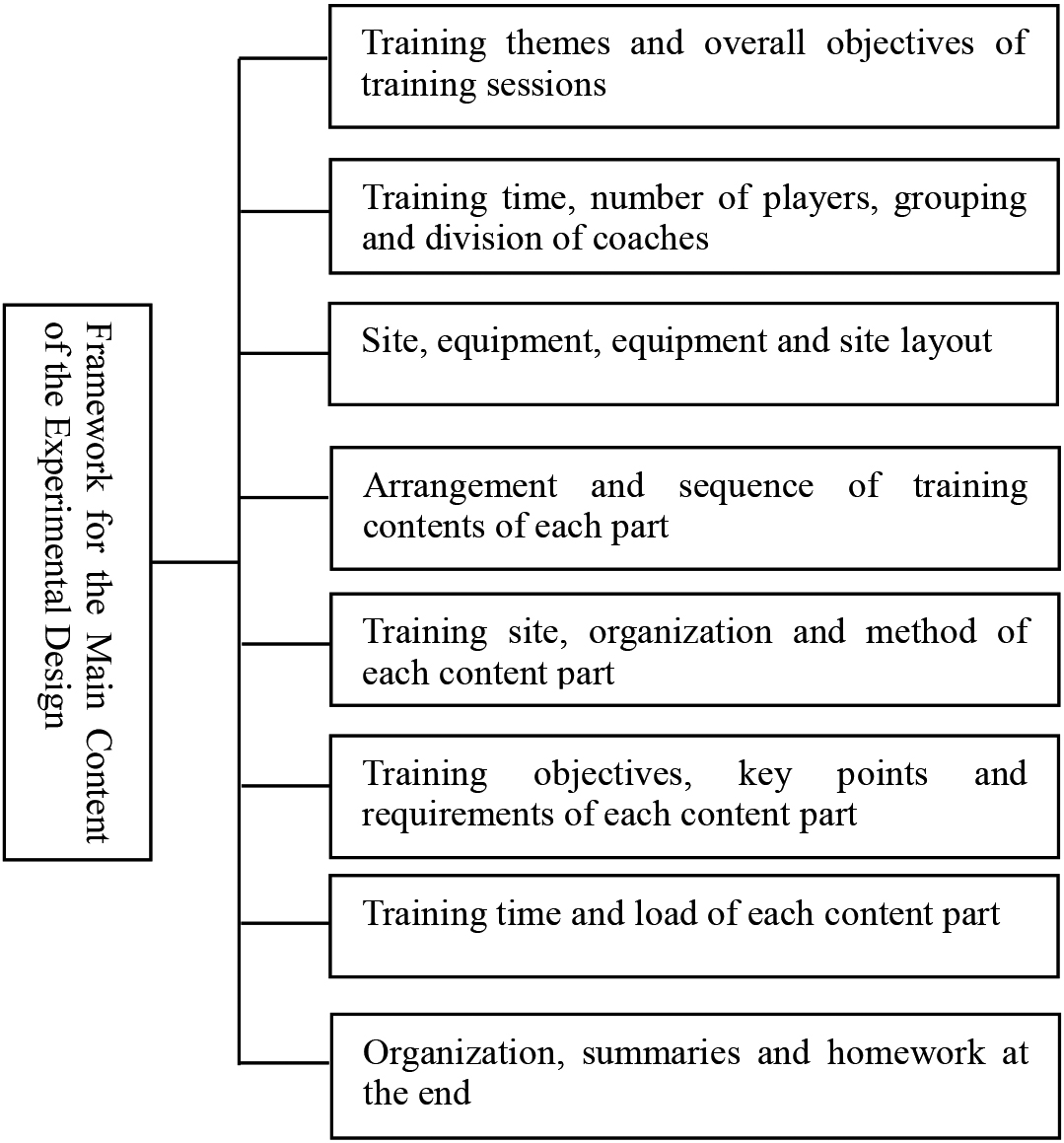
Insufficient number of samples and lack of relevant subject literature.
Results and analysis
Comparative analysis of student opinion results
Comparison of students’ love and recognition of teaching
Comparison of students’ love and recognition of teaching
From the overall situation of the scores of the experimental group and the control group in each round of experiment (Table 3), we can see that in the longitudinal time sequence, the average scores of the experimental group in the three rounds of experiment are gradually higher than the control group, which indicates that the teaching design for both the experimental group and the control group has been constantly improving. In addition, the gender and number of students in each round of experimental opinion survey are different, but the content of the questionnaire survey is exactly the same, that is to say, the same questionnaire is used in the three rounds of survey, and the results of love and recognition show that students of different times and genders are more positive about the teaching plan of the experimental one.
Comparison and analysis of technical statistics in competitions
Competition ability is the key element for athletes to mobilize and release their competitive level to the maximum extent in the best state. After testing, the execution deviation rate of players with strong cognitive decision-making ability is 15%, while that of players with poor cognitive decision-making ability is as high as 25%. Strong cognitive decision-making ability can effectively improve players’ understanding of space and time in the tactical system. The comparison of technical statistics between the experimental group and the control group is an important basis for judging the advantages and disadvantages of the two groups’ teaching programs. In the three rounds of experiments, two in-class competitions were arranged for technical statistics, which were four-person competition in the middle of teaching and six-person competition at the end of teaching. Both competitions adopt simplified methods that are conducive to the development of students’ skills. The competition requires the participation of all the experimental and control groups. In order to ensure the validity of the content and the reliability of the method of technical statistics, the statistical indicators should be considered to be consistent with the teaching content and progress, and be compatible with the students’ football foundation and ability. Last but not least, the statistical methods should be unified and simple. Only in this way can accurate technical data be obtained and reliable comparison results be obtained.
In the three-round experiment, four-person and six-person in-class competitions were organized between the experimental group and the control group respectively. The four-person competition was arranged in the middle of the teaching, and the six-person competition was arranged before the end of the teaching. On the premise of ensuring the reliability and validity of the technical statistics in the two competitions, the comparison of the technical statistics data between the groups is the basis of the experimental demonstration. The technical statistics of each round of experiments adopt the same form, content and method. Because the gender, football foundation and number of students are different, the statistical comparison can prove the wide applicability of the teaching program at the same time. In the middle of teaching and before the end of teaching, two competitions with different complexity and difficulty are arranged for four-person system and six-person system. Its technical statistics can not only verify the difference of technical level between the two groups in different periods, but also play a role of repeated testing. The comparison and analysis of the technical statistics of the competition are correspondingly divided into two themes: one is the comparison and analysis of the technical statistics of the four-person match; The second is the comparison and analysis of the technical statistics of the six-person match. As is shown in Table 4.
Description of contents and methods of technical statistics of competition
Description of contents and methods of technical statistics of competition
4.2.1.1 Comparison and analysis of technical statistics of four-person match
The technical statistics comparison of the four-person match in the middle of the three-round teaching experiment reflects the technical mastery and teaching effect of the experimental group and the control group in the first half of the teaching, which is to demonstrate the stage teaching results. The technical statistics of the four-person match can be used as the basis for demonstration. The technical data can be compared and analyzed from different angles. The following are two titles: One is the comparison and analysis of the victory and defeat of the game and the goal. The second is the comparison and analysis of the overall technical statistics of the match.
(1) Comparison and analysis of winning and losing matches and goals
Table 5 is the data comparison of the winning and losing of the four-person match between the experimental group and the control group in three rounds. The data show all the data of 16 matches in the first and second rounds and 32 matches in the third round, which can reflect the overall technical performance and strength of the experimental group and the control group in each round. The data are mainly the comparison of the number of winning, shots, goals and the scoring rate. The results showed that the statistical data of the experimental group were significantly better than those of the control group, indicating that the overall strength of the students in the experimental group was significantly stronger than that of the control group. Before the experiment, the football foundation and various qualities of the experimental group and the control group were at the same level. Taking this as a reference, it can be explained that the teaching of the experimental group in the first half of the teaching has received better teaching and training, which has greatly improved the students’ competition ability. The technical statistics of many international authoritative football organizations regard the winning or losing of matches, the number of shots, the number of goals and the scoring rate as the basic criteria for verifying the strength of the team. It is also feasible for these indicators to be used in the experimental test of football general course teaching.
Comparison of winning, losing and scoring between the experimental group and the control group in the three-round experimental four-person match
The comparison of the winning or losing of the match, the total number of goals and the scoring rate is the basic index to judge the strength of the team. The four-person match method designed by the subject has been repeatedly discussed and revised by experts, and the validity and reliability of the match statistics have been tested repeatedly in advance. The above basic index can objectively reflect the strength difference between the experimental group and the control group. In particular, this simplified four-person match can greatly increase the number of shootings and goal success, which is more conducive to reflect the whole strength of the two groups of students. The comparison of the winning and losing and the difference of goals in each round of the experiment prove that the experimental group has stronger competition strength, on the other hand the new teaching mode is superior to the traditional teaching mode.
(2) Comparison and analysis of the overall technical statistics of the competition
Table 6 is a comprehensive technical statistical comparison between the experimental group and the control group in the three-round four-person match. Statistical indicators include six attack techniques,
Comparison of overall technical statistics between the experimental group and the control group in the three-round experimental four-person match
Note: The “proportion” in the table refers to the percentage of success in the application of each technique in the competition.
such as catching, control, fake action, breakthrough, passing and shooting. Each indicator calculates the number of times to complete the technique and the “ratio”, namely, the six indicators are divided into 12 groups of comparative data in the table. Obviously, the data reflect the differences between the experimental group and the control group more comprehensively, carefully and accurately from a technical point of view. The subdivision of statistical indicators and the refinement of data processing itself have increased the validity and reliability of the comparison, which make more comprehensive and detailed judgments from the technical performance and their application. The results show that: the average value of the 12 groups of data in the experimental group is significantly higher than that in the control group. By comparing the data of multiple indicators, it shows that the students in the experimental group not only have obvious advantages in overall strength, but also have better proficiency, rationality and field awareness in the use of specific techniques. In addition, more detailed analysis can be made from the specific application of each technology. Take an unsatisfactory data as an example: in the first round of experiment, the experimental group is obviously superior in the number of breakthroughs, but the rate of the success breakthroughs is not obvious. However, from the average number of breakthroughs completed by the control group, the contingency of success breakthroughs is very high in the case of only 2 times per game. In a sum, the statistical comparison still shows that the experimental group has a comprehensive and obvious advantage. From the analysis of four-person match, we can find that the teaching effect of the first half of the experimental group has achieved the expected results and is better than that of the control group.
The six statistical indicators of attack techniques in the four-person match in the middle of teaching are selected by experts. The selection of indicators is based on the principle of adapting to the competition system and giving full play to students’ technical abilities. At the same time, it should be able to reflect the overall technical level and competition strength of students. Technical statistics is to record the number of technical applications and the success or failure of each competition. Finally, the average number of times and success rate of each technique in the experimental group and the control group were obtained. In this way, the statistical indicators are subdivided into six items, which can carefully analyze the application of the specific techniques of the two groups of students. At the same time, the summary of the indicators is also a reflection of the overall strength of the two groups, combined with the data comparison of the number of winning games and shooting times between the two groups. It can further explain the overall strength and football quality of the students in the experimental group. However, the degree of difference in technology and strength between the experimental group and the control group still needs to analyze the details of the completion of technology and its causes, and needs to analyze comprehensively and deeply the role and impact of teaching on students. According to the technical statistics of the match, in each round of experimental group, the students touched the ball more frequently, used various techniques to control and handle the ball with a higher success rate, which showed that the teachers in the experimental group had a better control of the training methods and key points in the special skills training, and that the students could possess the technical advantages of the competition. It is in teaching that teachers exert more influence on students in technical details and put forward more reasonable requirements. The conception of “Details determine success” is also applicable to the teaching of football general course, since the success of the experimental group is that the teachers have a better grasp of the operation of many teaching details [12].
4.2.1.2 Comparison and analysis of technical statistics in six-person match
The technical statistical comparison of the six-person match before the end of the three-round teaching experiment reflects the technical mastery and teaching effect of the whole teaching process between the experimental group and the control group. It is necessary to complete the test and demonstration of the whole teaching through statistical comparison. In the six-person match, it increases the defensive stealing technology; a goalkeeper was added to the game; the size of the venue is close to a quarter of the standard 11-person match venue; the goal is the width of the standard 11-person match. The above changes in the venue and personnel arrangement are closer to the real game scene, and maintaining the width of the 11-person goal can give the dominant side more chances to shoot and win. But on the whole, the competition method is still simplified, and the technical statistics are also conducive to comprehensively and carefully reflect the competition strength differences between the experimental group and the control group. The following comparison and analysis are divided into two titles: one is the comparison and analysis of the winning and losing matches and goals; The second is the comparison and analysis of the overall technical statistics of the competition.
(1) Comparison and analysis of winning and losing matches and goals
Table 7 is a comparison of the technical statistics of the winning and losing of the six-person match and goals between the experimental group and the control group in the three-round experiment. In each round of the experiment, each of the three teams in the experimental group and the control group played each other, then there were nine games between the two groups in total. The comparison of all competition statistics shows that the winning and losing times, shooting times, goals and scoring rate of the experimental group were significantly better than those of the control group before the end of the three rounds of experimental teaching, which indicated that the experimental group maintained a great advantage in the overall strength of the game. In the final stage of teaching, the number of players, the scope of venues and the division of positions were increased. The environment and conditions of the competition have also increased the complexity, so that the six-person match gets much closer to the scene of the formal match, and the technical statistics of the competition are more holistic and comprehensive. Although the addition of goalkeepers in matches makes it more difficult to score goals, the design of “small field and big goal” gives the experimental group students more opportunities to show their advantages.
Comparison of winning and losing matches and goals between the experimental group and the control group in the three-round experimental six-person match
The purpose of enlarging the field, increasing the number of players and adding goalkeepers in the six-person match is to investigate strength gap between the experimental group and the control group more comprehensively and objectively. Generally speaking, the closer the football match is to the formal 11-person match, the less significant the strength gap between the two teams will be. Obviously, the increase of the venue will reduce the number of times students touch the ball in the match. The increase in the number of players makes the game more complicated, and the addition of goalkeepers makes it more difficult to shoot and score goals. The football match itself is difficult to score, so the closer the form of the game is to the formal game, the more difficult it will be for the dominant side to play and score. Although the experimental group has obvious advantages in the number of wins and goals, if compared with the four-person competition, the advantages are weakened. The data comparison shows that the number of wins and losses and goals of the experimental group is still significantly higher, indicating that the experimental group still maintains the overall competitive strength until the end of teaching. It can be proved that the experimental group has received better teaching results.
(2) Comparison and analysis of the overall technical statistics of the competition
Table 8 is a comprehensive technical statistical comparison between the experimental group and the control group in the three-round six-person match. On the basis of the six indicators of the four-person match, a defensive stealing technique is added, that is, seven indicators are subdivided into 14 groups of comparative data. The 12 groups of comparative data in the table also reflect the technical differences between the experimental group and the control group in a comprehensive, detailed and accurate way. In addition, the average data and success rate of defensive steals are 10.9 times in the first round of the experimental group, and the success rate is 63%; 6.1 times in the control group and the success rate is 37%. In the second round, the experimental group is 12.7 times, and the success rate is 59%; the control group is 5.6 times, and the success rate was 42%. In the third round, the success rate was 71% in the experimental group (10.3 times) and 45% in the control group (4.9 times). The results show that the average data of 12 groups representing the application of offensive technology in the experimental group are significantly higher than those in the control group, and the data of 2 groups representing the application of defensive technology in the experimental group were also significantly higher than those in the control group, indicating that the experimental group had the overwhelming advantages in terms of the number of technical applications and success rate. Therefore, from the comparison of the technical statistics of the four-person match in the middle of teaching and the six-person match before the end of teaching, we can see that the experimental group and the control group are in dynamic changes in the whole process of football general course, and the experimental group is always at a better level than the control group, which proves that the teaching plan and its implementation of the experimental group are more excellent.
Compared with the data of four-person match, the number of technical applications and the success rate of six-person match have declined to a certain extent, which is directly related to the increase of venues and the number of players. The reason is that the change of competition environment and conditions makes it more difficult for students to display their skills. For example, the expanding of venues reduces the frequency of students’ technical application; the increase of the number of players makes the competition process more complicated, which makes the students in the general football course feel uncomfortable with the alternation of the space and the scene. Moreover, more defenders also make it more difficult to use the technology, so that the frequency of using the technology of the experimental group has reduced as mistakes amount. However, from the comparison of technical statistics, we find that the number of times and success rate of technical application in operation control, fake action, fast transport or breakthrough, passing, catching, shooting and stealing in the experimental group were significantly higher than those in the control group. From the two aspects of attack and defense, the technical level of the experimental group was significantly higher than that of the control group.
Special skill test is to select typical technical content that can reflect students’ skill level, Sever as a technical assessment for students in experimental group and control group before the end of
Comparison of overall technical statistics between the experimental group and the control group in the three-round experimental six-person match
Comparison of overall technical statistics between the experimental group and the control group in the three-round experimental six-person match
Note: The “percentage” in the table refers to the percentage of success in the application of each technique in the competition.
teaching, as well as one of the methods to test the teaching plan. The special skill test is mainly to examine the standardization and effect of students ‘completion of technology. It is to score students’ technical performance according to certain standards and requirements. In addition to considering the standardization and rationality of technical movements, technical scoring also includes the factors of speed, coordination and rhythm of completing technical movements. The comparison of the examination scores reflects the differences in the standards and proficiency of the students in the experimental group and the control group. It is an important basis for considering the advantages and disadvantages of the two groups of teaching programs. The following elaboration is divided into two questions: one is the description of the content and method of the special skill test; the second is the comparison and analysis of the special skill test.
(1) Content and standard description of special skill test
The special skill test is to test the same technical content and method between the experimental group and the control group, and to judge which group’s teaching plan is better by comparing the score differences between the groups. The formulation of test content and standard is based on the traditional teaching examination method, which will be adjusted partly according to the teaching practice. Through the tests, the skill level of the students in the three rounds of teaching experiments will be scored and evaluated before the end of the teaching.
The special skill test includes 5 m
(2) Comparison and analysis of special skills test
The special skill test of the three rounds of experiments is completed before the end of the teaching, and then the average score of each skill test is compared. The special skill test of the three rounds of experiments is exactly the same content, method and standard, but the subjects of each round of experiments vary in terms of students’ football foundation, gender and the number of students. That is to say, the specific skills test of the three-round experiment is to test different kinds of subjects in the same way. In this way, the special skill test has multiple effects on the demonstration of the research results: first, the test of each round of experiment can be used as the common basis for every round of experiment; Secondly, the same test method can not only show that it has a wide range of applications, but also examine the differences in the level of special skills of different subjects at the end of their studies. Thirdly, the special skill test can be used for comprehensive analysis by combining with the statistical test of the competition, expert investigation and test.
It can be seen from the comparison of the special skill test in Table 9 that the average scores of the three technical contents of the experimental group were significantly higher than those of the control group in the three special skill scores measured in the three-round experiment. From the perspective of traditional evaluation, the special skill level of the students in the experimental group after the experiment was significantly higher than that of the control group. From the students’ mastery of special skills and the difference between the two groups of skills, we can also deduce from the causal logic relationship that the reason why the students in the experimental group can master special skills better is that their study must be supported by a good starting point and process of teaching, and a good teaching implementation must have its excellent teaching design and implementation methods.
Comparison of three special skill tests between the experimental group and the control group in the three-round experiment
From the overall situation of the special skill level reached by the experimental group and the control group in each round of experiment, the special skill level of those two groups in the three rounds of experiment shows an overall improvement trend, which is consistent with the technical statistics of the previous competition. Both the experimental group and the control group showed a dynamic trend of gradual improvement. It shows that the teaching construction and teaching links of the whole football general course are healthy. Meanwhile, according to the results of the special skill test comparison of the three rounds, it proves that the teaching plan of the experimental group is more excellent.
Through the teaching experiment, it is feasible to use the competition lead-in mode, and has achieved good teaching results, which is more conducive to the improvement of students’ technical and tactical level than the traditional football teaching. The comparison of the data of the three rounds of technical statistics in the four-person competition shows that the average value of the 12 groups of data in the experimental group is significantly higher than that in the control group. By comparing the number of technical times and success rate of many indicators, it fully shows that the students in the experimental group are obviously better than those in the control group at the proficiency, rationality and awareness of technical application in the middle of teaching. The comparison of the technical statistics data of the three-round experiment of the six-person match shows that the experimental group is significantly higher than the control group in 14 groups of data of 7 indicators. It shows that the experimental group has an obvious advantage in the number of technical applications and the success rate. The comparison and analysis of the data of the three rounds of experimental tests show that the test scores of the experimental group are significantly higher than those of the control group, indicating that the students in the experimental group have a better mastery of special skills than those in the control group.
Footnotes
Funding
This work was supported both by China Guangdong Province Joint Construction Project of Philosophy and Social Science Discipline (GD20XTY04) and General Project of Humanities and Social Sciences Research of the Ministry of Education of China (19YJA890017).