



Abstract
In order to improve the quality of millimeter wave communication in indoor environment and ensure the maximum use of link resources. It is proposed to construct indoor communication transmission characteristics through multi sphere link model and indoor millimeter wave reflection blocking model. At the same time, the improved PMVC algorithm and CTRA algorithm are used to optimize the resource scheduling of links in indoor central scenes and edge scenes respectively. The simulation results show that compared with the original PVC algorithm and greedy algorithm, PMVC has a maximum link throughput of 5.01 Gbps under the optimized scheduling of the improved vertex coloring algorithm, while the maximum throughput of the traditional vertex coloring algorithm and greedy algorithm are 4.73 Gbps and 4.57 Gbps respectively. In the case of fixed link transmission beam width, as the number of link flows increases, the slot throughput of the link decreases continuously. Under the width of 30, the maximum slot throughput of PMVC algorithm is 2.75 Gbps, and the maximum slot throughput of greedy algorithm is 2.48 Gbps; When the beam width is 60, the maximum slot throughput of PMVC algorithm and greedy algorithm is 2.25 Gbps and 1.55 Gbps respectively. The proposed PMVC resource scheduling method can effectively alleviate the shortage of indoor spectrum resources and reduce indoor transmission interference of millimeter wave.
Introduction
With the increasing user base of intelligent devices, the application of millimeter wave technology has certainly eased the situation of tight frequency resources. However, in the complex indoor environment, there are still few methods for D2D (Device to Device) communication resource scheduling [1]. The core idea of D2D communication is that when the adjacent users have business function requirements, the data of two parties can be directly transmitted through the link by bypassing the core equipment and intermediate equipment, thus reducing the transmission pressure of the core network in the communication system [2]. However, in the research of indoor environment of link propagation, the exploration of conventional blocking and self-blocking is still in its infancy Therefore, this time we will explore from the link communication blocking and link communication reflection in the indoor environmentThe resource scheduling of D2D communication in domestic and foreign research status is to balance the traditional cellular communication and D2D communication, so as to find the best resource allocation scheme or improve the resource allocation efficiency of D2D communication block, and achieve greater transmission rate and throughput. The innovation of this research is that the application scenario of indoor D2D millimeter wave is segmented [3]. The purpose of this research is to solve the problem of spectrum resource shortage by optimizing the link resource scheduling of the indoor Haotouchbo transmission model and algorithm. The application of the expected method can improve the link throughput in the indoor environment and reduce interference.
Related works
Mittra et al. [4] summarized the traditional mmWave phased array design for 5G applications and thus propose a two-dimensional (2D) scan-capable array system. This technology has shown good prospects in developing 2D scanning. Fan et al. [5] provided a multifunctional metamaterial absorber for indoor propagation scenarios of millimeter waves. When the receiver of this material structure is applied to millimeter wave transmission detection, the pyroelectric crystal and special structure can effectively increase the detection area. Experiments show that the receiver provides an excellent detection platform for realizing new millimeter-wave sensing and imaging. Nahar and Rawat [6] put forward the method of gain antenna in communication conditions to reduce the loss of millimeter wave in the transmission process, and improve the signal quality through this efficient line. Papazafeiropoulos et al. [7] found that the way to reduce the radio frequency chain in the millimeter wave hybrid transmission process also has the problems of hardware damage and large thermal noise. Therefore, they analyzed the degradation of spectral efficiency by redesigning the hybrid precoder and combiner. Li et al. [8] proposed a new strategy of co-replacement of trivalent ions in tungsten bronze structural ceramics, so that the millimeter-wave platform can maintain stable transmission performance under high temperature working environment. Saraereh and Ali [9] integrated millimeter waves technology and electromagnetic wave orbital angular momentum modeling system to solve the problem of transmission scheduling difficulties caused by the growing number of network users. The simulation results show that the proposed system model is an effective way to improve the system capacity. Noh et al. [10] discovered that the Reconfigurable Smart Surface (RIS) technology has good beamforming gain capability in assisted wireless communication, and thus applied it in millimeter-wave channel estimation. Experiments show that combining the two can lead to technical improvements in addressing technical challenges, trade-offs, channel estimation frameworks, and training signal design.
In the field of shading problems, vertex shading methods are mostly used in sensor technology. Arivudainambi and Pavithra [11] proposed a sensor placement algorithm based on sequential vertex shading (SVC-SP) to determine the required number of sensors and their optimal locations to meet coverage quality requirements. Simulation results show that, after optimization by genetic algorithm, the performance of this method is higher than other existing algorithms in sensor location search. Wang et al. [12] solved the vertex coloring problem by optimizing the molecular operation of DNA computing. The optimized DNA algorithm is a new attempt and application to solve the uncertainty polynomial (NP) problem, which provides clear evidence for the ability of DNA computing to perform such difficult computational problems in the future. Zhang et al. [13] designed a Joint Sensing and Communication Integrated System (JSCIS) and proposed the CTRA algorithm in a pure-policy Nash equilibrium. The results show that the proposed CTRA algorithm can improve the total radar mutual information by 26%. Wang et al. [14] studied the spatial and frequency broadband effects in large-scale MIMO systems from the perspective of array signal processing. An efficient uplink and downlink channel estimation strategy is developed. Mishra et al. [15] considered the application of millimeter wave technology to short-range radar, and discussed the use of multiple-input multiple-output (MIMO) signal processing technology to achieve a balance between communication and radar functions. Banerjee et al. [16] designed a FL-Sleep algorithm applied to network sensors. The algorithm is designed to increase sensor lifetime and link stability by scheduling sensor sleep and wake-up activities. Experiments show that after the method schedules sensor activities, the service life of the sensor is increased by 247.11% on average, and the algorithm shows better performance in terms of packet transmission rate, energy efficiency and the number of active nodes in the network.
To sum up, the optimization and improvement direction of millimeter wave at home and abroad mostly exists in the materials and structures of equipment, while the introduction of millimeter wave application scenarios and the indoor scene division of link scheduling have not been paid attention to. Therefore, the research will provide relevant research results by establishing a random reflection blocking model to characterize the transmission of the enclosed indoor area.
Indoor mmWave communication resource optimization method with improved PMVC and CTRA Algorithms
Indoor mmWave scene modeling
Because the transmission of millimeter waves between indoor smart devices will be blocked by reflections from walls and ceilings and indoor obstacles, the data throughput of network transmission is often reduced due to interference during the communication process [17]. The indoor millimeter-wave D2D communication resource optimization method in this study firstly builds a reflection blocking model for indoor millimeter-wave transmission, and represents the communication characteristics in the indoor scene through modeling. The indoor millimeter-wave link blocking reflection scenario is shown in Fig. 1.
Link blocking reflection scenarios for indoor millimeter waves.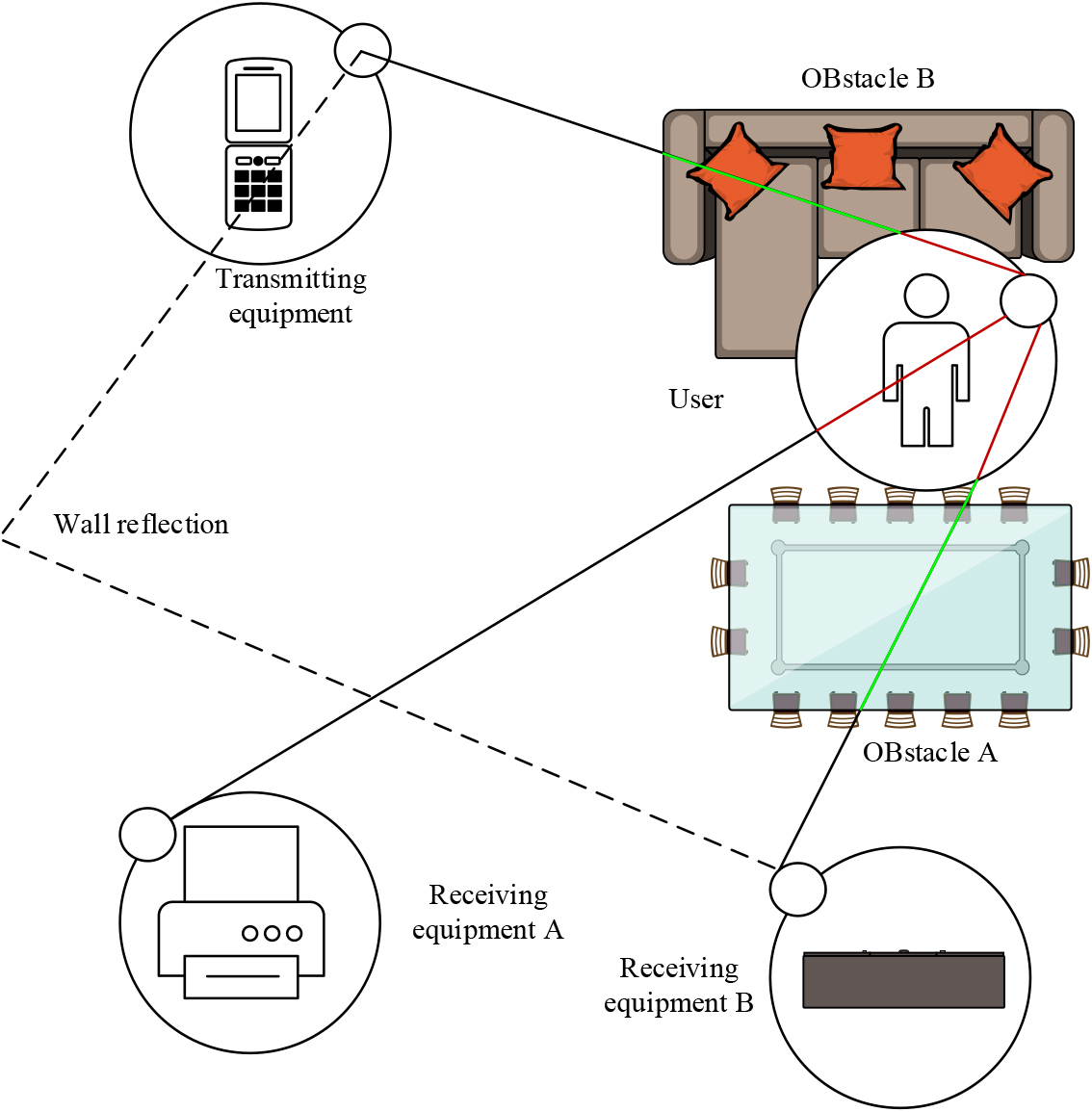
In the indoor millimeter-wave transmission diagram in Fig. 1, the circles outside the equipment and users represent the volume of the equipment and the user’s home province. The solid black line segment in the figure represents the transmission link of the device, and the black dotted line segment represents the reflection link [18]. The red line segment represents user self-blocking, and the green line segment represents conventional obstacle blocking. Building a reflection model for indoor millimeter waves requires determining the link length, incident angle, and reflection coefficient [19]. At the same time, the four walls and the ceiling are used as reflection surfaces and expressed as an index
In Eq. (1), the
In Eq. (2), it
In Eq. (3), it
In Eq. (4), it
In addition to self-blocking, the link also has conventional blocking conditions. Self-blocking occurs when the angle of the transmitter is not directly facing the receiver, but any other angle has the potential to cause regular blocking. In the case that there is no obstruction between the transmitting device and the receiving device, the receiver is
In Eq. (6), it
In Eq. (7), it
In Eq. (8),
In Eq. (9),
In Eq. (10), it
The communication model of indoor millimeter wave is the premise of optimizing interference. Although the original PVC algorithm can handle the conflict problem in each slot, it still has the problem of low efficiency [20]. Because each slot allocation is full of uncertainty and randomness, not all slots are active. In other words, some timeslots are allocated more traffic, and the possibility of encountering conflicts is greatly increased; At the same time, other timeslots may not be allocated with traffic flow [21]. However, timeslot is a rare resource, which needs to be fully utilized to maximize throughput. Therefore, we propose an optimization scheme of Powell Vertex Coloring (PVC) algorithm based on maximum priority, namely PMVC algorithm [22]. After the modeling is completed, link resources are allocated through the improved Powell Multi Vertex Coloring (PMVC) algorithm. In indoor environment, millimeter wave transmission has different performance at different locations [23]. Therefore, link resource allocation scheduling is divided into center location and edge corner location. In the central environment, when multiple links transmit, dense links interfere with each other. Therefore, the PMVC algorithm aims to reduce interference and improve the utilization of link resources. First, the data rate that can be obtained through transmission is expressed as Eq. (11) by Shannon capacity formula
In Eq. (11), the
In Eq. (12),
In Eq. (13), it represents the
Vertex coloring method.
As shown in Fig. 2, the optimized vertex shading algorithm preferentially shades vertices with the most edges. The ultimate goal of shading is to make the number of vertices of each color roughly even, so as to evenly distribute resources between devices. In the edge corner locations of the indoor environment, the transmission performance of the link is different from the central environment. The purpose of link resource scheduling optimization in indoor edge locations is to improve the average network throughput, and in the edge environment, the optimization problem is transformed to improve the maximized total capacity, so the objective optimization is expressed as Eq. (14).
In Eq. (14), it
Edge vertex partition set method of CTRA algorithm.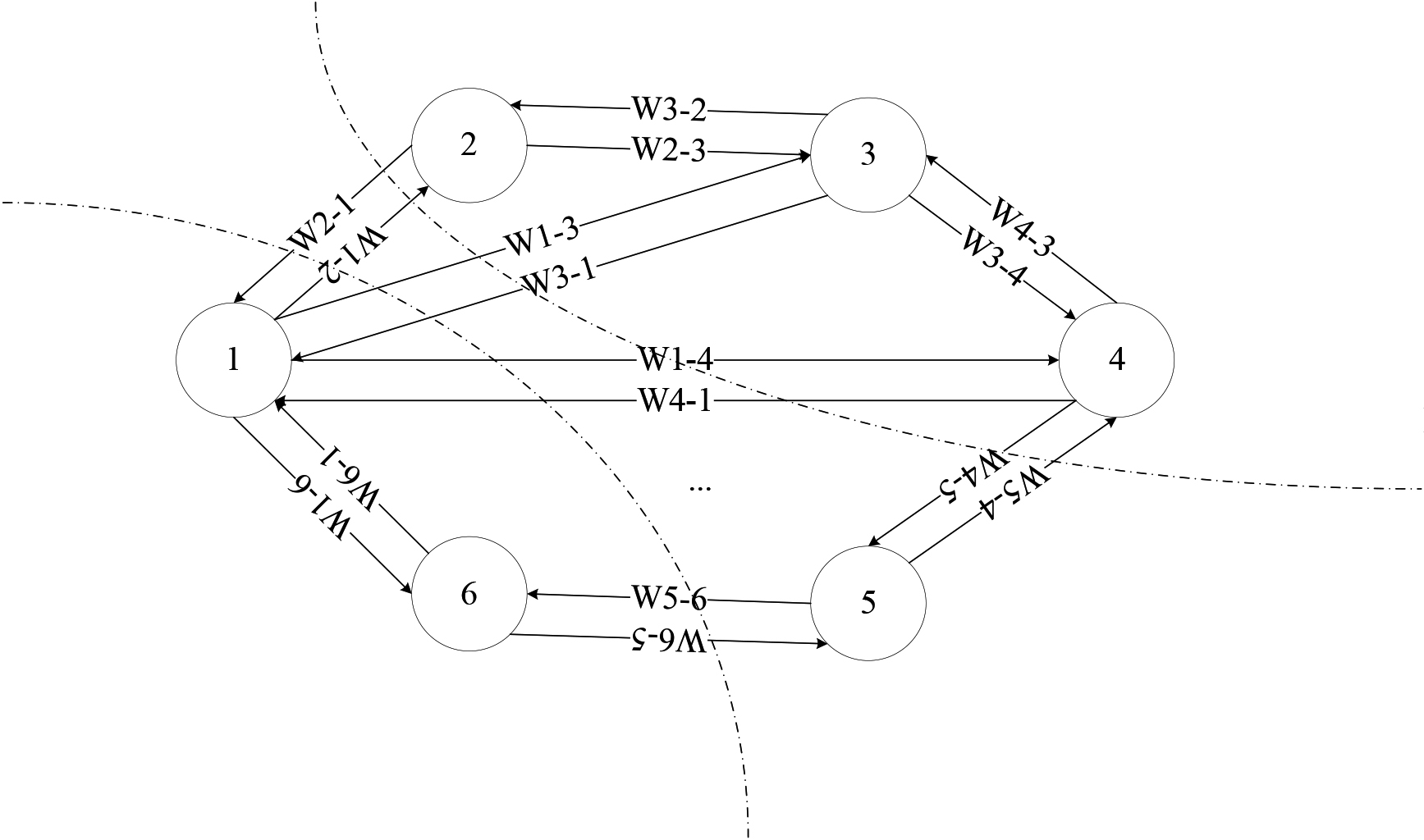
In Fig. 3, the circles represent the transmitters and receivers at the corner vertices of the indoor edge, the realization represents the link between the devices, and the dashed line represents the CTRA (Combinational Temperature Random Algorithm) set division. After the combination of resource allocation is completed, the random temperature algorithm is an optimization of the objective function, that is, the maximum capacity of the link is updated with an appropriate probability to ensure that the average throughput of the link is maximized while maintaining the stability of the link. A variable temperature factor is set, and the temperature factor parameter is amplified in a standardized way, so that the greater the maximum capacity, the greater the link update probability. At the same time, the maximum temperature threshold of a link is set, the temperature factor is reset after one round of updating, and the iteration is stopped after the current temperature exceeds the temperature threshold. After the resource allocation optimization of the link is completed, the performance analysis of the link is carried out by calculating the signal-to-noise ratio. At the millimeter-wave receiving end, the formula for calculating the signal-to-noise ratio is shown in Eq. (15).
In Eq. (15),
Algorithm flow of indoor millimeter wave D2D communication resource optimization.
As can be seen from Fig. 4, the optimization of indoor millimeter-wave transmission link resource scheduling in this study is based on the modeling of link reflection and blocking problems, and the spherical link is obtained by analyzing and eliminating self-blocking and conventional blocking conditions. The transmission is not blocked within the threshold range of the beam width, and the transmission efficiency is higher, so the range threshold of the beam is calculated. In the indoor specific scene application, the PVCM algorithm and the CTRA algorithm are used to optimize the link resource scheduling for the center scene and the corner scene respectively. Figure 4 mainly shows the threshold calculation process of the vertex shading algorithm. The first step is to sort the number of vertices (that is, the number of connected devices) on the device from more to less, the second step is to color the device, and the third step is the i-th After the color, judge whether there is a connection between the colors of the devices. If yes, go to the fourth step, otherwise, go to the fifth step. The fourth step is to set the color in the
Application simulation experiment of millimeter wave indoor scene modeling
Aiming at the transmission performance at different locations in indoor scenes, this paper proposes a stochastic model to capture the characteristics of high-density enclosed indoor areas. Due to reflections from indoor walls and ceilings, the probability of blocking the propagation performance will fluctuate to some extent. We model interior reflections by considering first-order reflections from walls as well as ceilings. At the same time, considering that the human body is the main obstacle other than conventional obstructions in indoor scenes, in order to capture the conventional obstructions and human features in indoor scenes, this paper also combines the Line of Sight (LOS) model with the autonomic Blocking model combined. A self-blocking model is used to capture the influence of the human body, while a multi-LOS link state model is used to describe traditional blocking to build a complete indoor blocking model. Combined with the reflection model and the blocking model, this paper characterizes the indoor scene more comprehensively and specifically. According to the parameters of intelligent transmitting equipment and receiving equipment in service, under the synthesis of SINR expression and conventional expression summarized in the research method model construction process, the parameters of the construction algorithm and model are shown in Table 1.
Parameter table
Parameter table
According to the parameters that have been determined in the table, in order to verify that the reflection blocking model proposed in this study has practical analysis value for the propagation of millimeter-wave indoor equipment, and at the same time, it has an effective optimization effect on dividing the indoor environment into central scenes and edge scenes. The research will test the transmission success rate of the link and the signal-to-noise ratio of the link under different parameter environments. First, the success rate of device signal transmission in different scenarios is shown in Fig. 5.
Success rate of equipment signal transmission in different scenes of the enclosed indoor model.
As can be seen from Fig. 5(a), the average transmission success rate of the millimeter wave signal of the device in the center scene is only 0.592, while in the indoor corner scene, the transmission success rate of the link is 0.789. Therefore, the performance achieved when the reference link is close to the corner is better than its performance in the center of the chassis space. Because the reflection of the required signal in the corner will improve the success rate of transmission, while the obstacle in the center and the user’s body will cause the blockage rate to rise sharply. As can be seen from Fig. 5(b), under the same parameter environment, the success rate of the ceiling reflection of the device transmitting the link signal is only about 70%, while in the interference reflection of the ceiling, the success rate is as high as 99%. Due to the increased transmission rate due to excessive interference reflections from the ceiling
As shown in Fig. 6, when the distance between the obstruction and the device is set to 0.1 m, the transmission success rate decreases as the density increases. Figure 6(a) shows that with the continuous increase of the communication signal-to-noise ratio, the indoor space coverage of the link continues to decrease. When the density of obstructions is small, the coverage of the link drops to 0 after the signal-to-noise ratio of the link reaches 10 db. However, when the density of obstructions is high, the coverage rate of the link drops to 0 after the signal-to-noise ratio of the link reaches 15 db. As can be seen from Fig. 6(b), the area spectral efficiency of the indoor link keeps decreasing as the signal-to-noise ratio keeps increasing. When the density of obstructions is small, the area spectral efficiency of the link decreases to 0 after the signal-to-noise ratio of the link reaches 12 db. However, when the density of obstructions is high, the area spectral efficiency of the link drops to 0 after the signal-to-noise ratio of the link reaches 18 db. At the same time, it can be seen from the actual data analysis and model analysis results in the figure that whether the density of the blockage is 1/m2 or the larger 2/m2, the actual analysis results are similar to the model analysis results, which proves the construction of this research. The indoor propagation model of the link is consistent with the characteristics of mmWave.
After verifying the application value of intra-scenario modeling, this experiment further conducts simulation experiments on the link resource optimization scheduling algorithm. By comparing different optimization methods and resource scheduling methods, the improved PMVC algorithm and CTRA algorithm proposed in this study are verified. performance. The parameters of the construction algorithm and model are presented in Table 2.
Parameter table
Parameter table
Indoor link signal transmission under different blockage density parameters.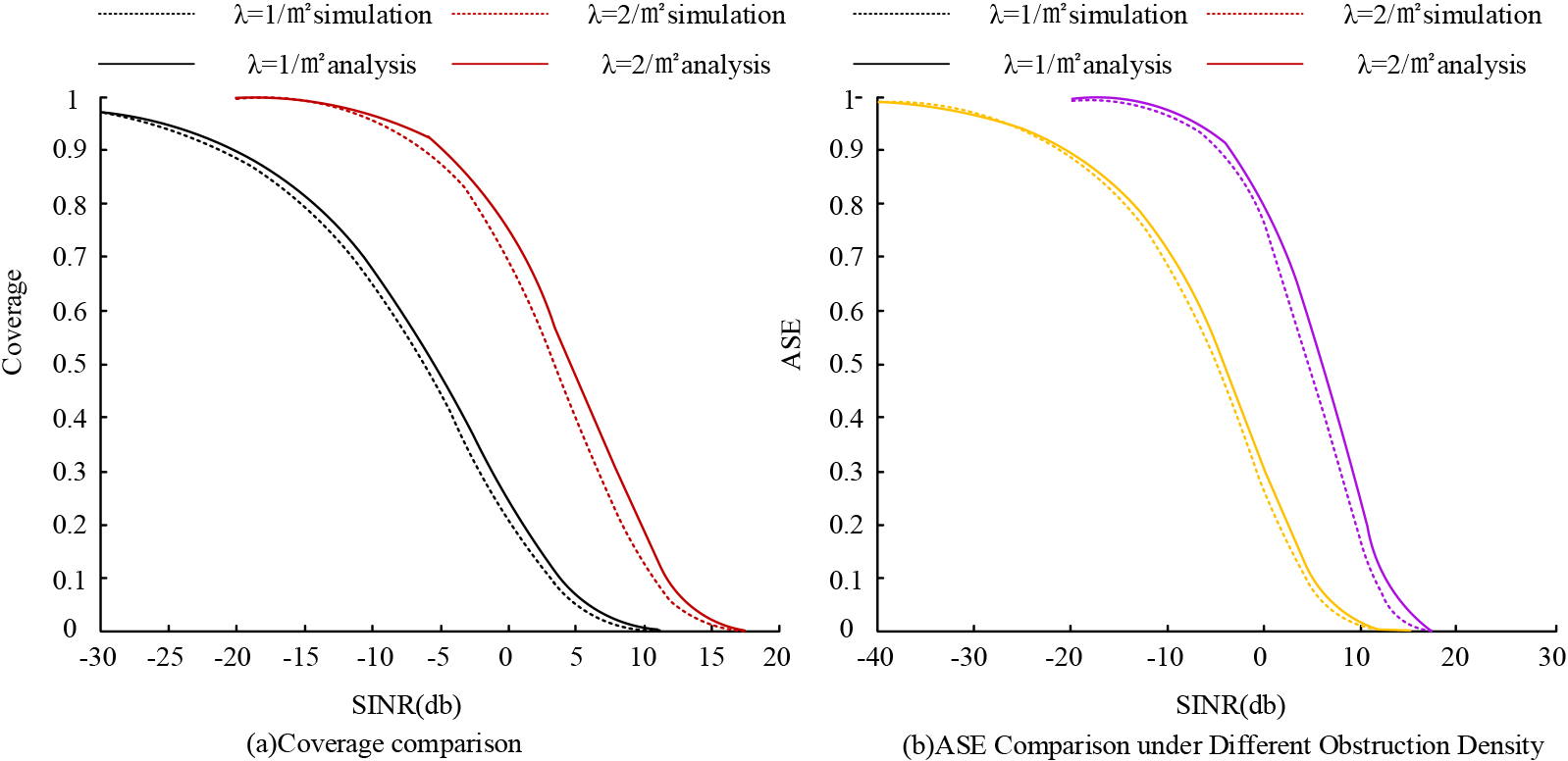
According to the above parameters and the improved algorithm proposed by the research, this experiment gives the data analysis results as a reference on the one hand, and compares the improved resource block allocation method with the traditional greedy algorithm on the other hand. The throughput graph with distance as the independent variable is drawn by the software, PMVC is used to represent the improved vertex coloring algorithm based on priority sorting, PVC is used to represent the traditional vertex coloring algorithm, and GA is the greedy algorithm. The experimental results are shown in Fig. 7.
Throughput comparison with distance as independent variable under different optimization algorithms.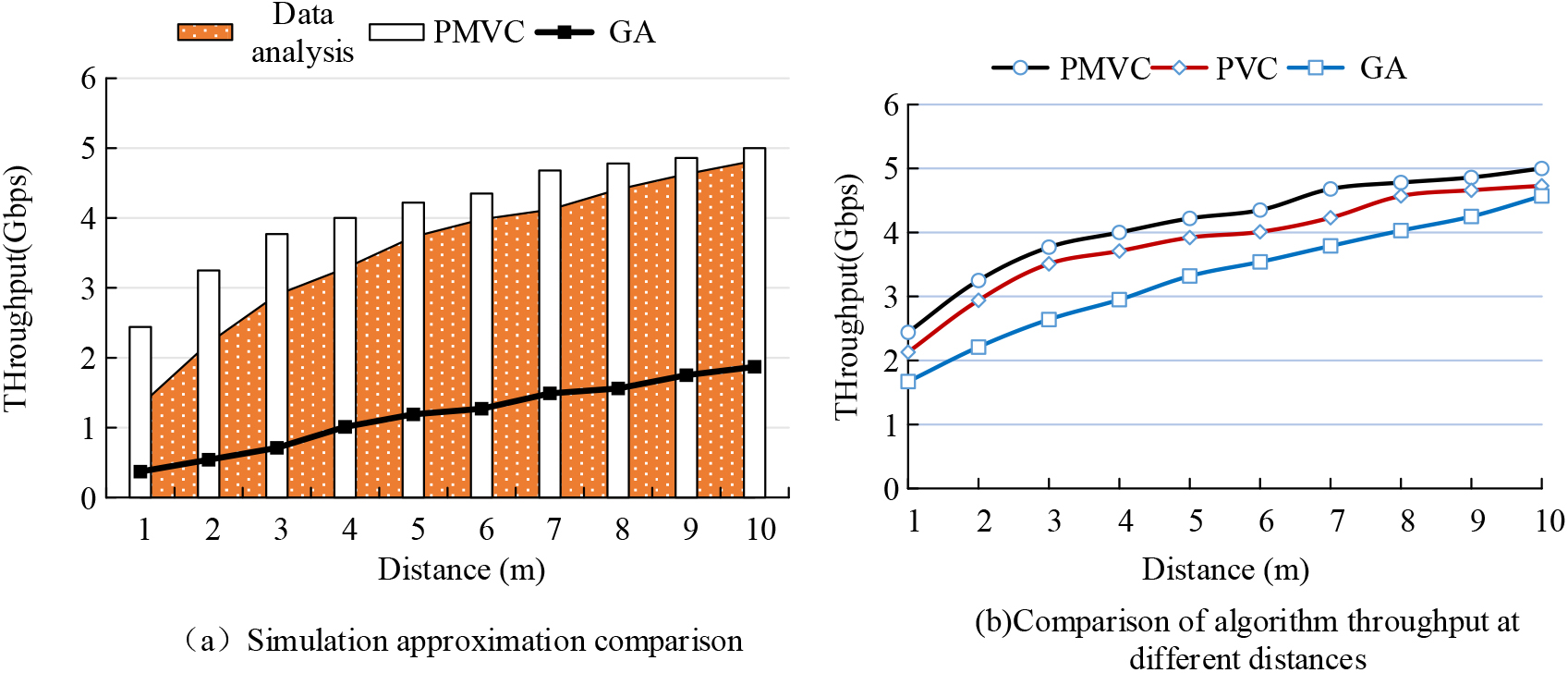
As can be seen from Fig. 7(a), the performance of the greedy algorithm is far less than that of our proposed algorithm. Compared with the data analysis results, the proposed PMVC scheme is more accurate, while the traditional greedy algorithm is too different from the data analysis results and is not accurate enough. Figure 7(b) shows that under the optimized scheduling of the improved vertex shading algorithm, the maximum link throughput is 5.01 Gbps, while the maximum throughput of the traditional vertex shading algorithm and the greedy algorithm are 4.73 Gbps and 4.57 Gbps, respectively. Obviously PMVC is better than PVC and greedy algorithm, because PVC algorithm only realizes to avoid the interference of the same time slot, but it will lead to uneven allocation of time slots, causing some time slots to be allocated a large number of flows, while other time slots are allocated too little flow. The difference is that in addition to avoiding interference, the PMVC scheme will try to average the flows in each time slot as much as possible, so that the number of flows allocated to each time slot is not very different. After comparing the maximum throughput of the link under different scheduling algorithms, the beamwidth of the transmitting device and the number of communication flows are used as independent variables to compare the link throughput of the PMVC algorithm and the GA algorithm under different flow numbers and different beamwidths and amount, as shown in Fig. 8.
Link throughput under different streams and beam width under PMVC and GA algorithm scheduling.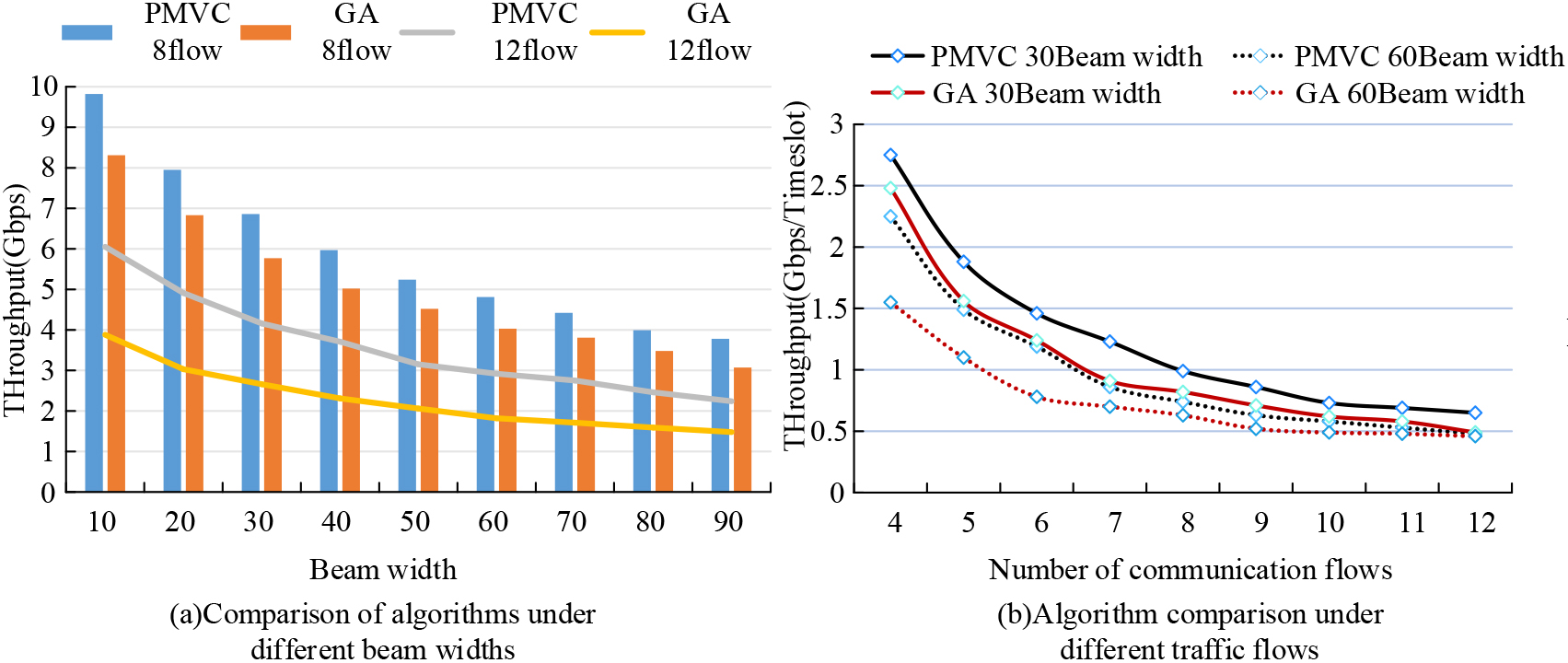
As can be seen from Fig. 8(a), for indoor resource allocation, as the beamwidth increases, it means that the coverage of each signal expands. As a result, the probability of the reference transmitting device encountering interference also increases, resulting in a reduced probability of transmitting multiple streams at the same time slot. Different flow numbers in the figure show different drop rates: it means that the more flows, the faster the drop. As can be seen from Fig. 8(b), when the beamwidth is given as 30 degrees and 60 degrees, the per-slot throughput as a function of the number of streams is plotted. As the number of streams increases, the throughput per slot decreases accordingly. However, it can still be seen that the PMVC scheme is still better than the greedy algorithm, that is to say, the PMVC scheme can support the transmission of a larger amount of data with the same number of streams. In the process of implementing PMVC, the simulation experiment reduces interference and distributes as many streams as possible in the same time slot, thereby reducing the probability of uneven resource allocation.
High complexity, high density, multi-transmission, and multi-interference characteristics of millimeter-wave transmission in indoor scenarios, the transmission optimization problem model and constraint expressions are researched and constructed. And in order to solve this optimization problem, a PMVC algorithm is proposed to reduce the interference while enhancing the system throughput. In the simulation experiments, PMVC is compared with the original PVC algorithm and the greedy algorithm respectively. Under the optimized scheduling of the improved vertex shading algorithm, the maximum link throughput is 5.01 Gbps, while the maximum throughput of the traditional vertex shading algorithm and the greedy algorithm is 4.73 Gbps, respectively. Gbps and 4.57 Gbps. It is obvious that the PMVC algorithm exhibits better performance in terms of throughput. In the case of a fixed transmission beam width of a link, as the number of link flows increases, the time slot throughput of the link decreases continuously. With a width of 30, the maximum slot throughput of PMVC algorithm is 2.75 Gbps, and the maximum slot throughput of greedy algorithm is 2.48 Gbps; while in the case of beam width of 60, the maximum slot throughput of PMVC algorithm and greedy algorithm scheduling. The amount is 2.25 Gbps and 1.55 Gbps respectively. Experiments show that, in the process of implementing PMVC, the simulation experiment reduces interference and distributes as many streams as possible in the same time slot, thereby reducing the probability of uneven resource allocation. The disadvantage of this experiment is that there is no practical application of the algorithm and model, and all data empirical analysis only stays in the simulation experiment, and further confirmation is needed in two important areas: algorithm scheduling performance and model link feature expression performance.