



Abstract
This paper firstly introduced the traditional classroom teaching mode, proposed the massive open online courses (MOOC) online teaching platform, and combined it with the traditional teaching mode for the teaching of ancient literature course. In case study, 200 students from Ningbo University of Finance and Economics were divided into a control class and an experimental class. The control class was taught by the traditional mode, while the experimental class was taught by the new mode combining traditional with MOOC. The final results showed that there was little difference in the grade distributions of the control and experimental classes before the respective instruction (the
Introduction
Education is an essential undertaking for the development of the country and nation, bearing the responsibility of passing on knowledge and cultivating outstanding talents. The excellence of education will greatly affect the development potential of a country. In the education business, there are various directions for talent cultivation. This paper mainly focuses on ancient Chinese literature education [1]. Ancient Chinese literature is the excellent traditional cultural content of China, and it is also the main curriculum item for the language and literature major in universities. An excellent ancient literature course can enable students to grasp the relevant knowledge better so as to achieve the inheritance and development of excellent traditional culture, and one of the characteristics of an excellent course is that it is attractive to attract students and make them focus on the knowledge taught in the course [2]. The unchanging teaching mode of the course will gradually lose its attractiveness to students, so the teaching mode needs to be reformed and innovated in order to ensure the attractiveness and effectiveness of the course to students [3]. The emergence of the Internet has made the exchange of information more and more convenient and provided a way for the innovation of the course teaching mode - the online open course of ancient literature. Taking advantage of the convenience of the Internet, teachers make the lecture content of the ancient literature course in the form of videos, PPTs, documents, etc. and upload them to the relevant teaching websites so that students can study the course content according to their interests and review the important knowledge points in the process of study. The Internet-based teaching mode is free from time and space constraints and enhances students’ interest in learning. Mohamad et al. [4] studied the factors that can motivate teachers to use online teaching tools and found that the factors that influence teachers’ motivation to use online teaching tools included knowledge, cognition, and skills. Pan et al. [5] evaluated the performance of online teaching with quantile regression analysis and neural networks and found that the two methods were effective. Mercado-Varela et al. [6] explored the role of tutors in Massive Open Online Courses (MOOCs) with questionnaires and found that collaborative construction of knowledge between tutors and students in MOOCs was the most widespread strategy to promote learning connections. This paper briefly introduced the traditional teaching model of the ancient literature course and the new teaching mode combined with the Internet MOOC and carried out an analysis with 200 students at Ningbo University of Finance and Economics. The novelty of this paper lies in the use of an online teaching platform to improve the traditional teaching mode, thus making up for the shortcomings of the traditional teaching mode for students’ after-class learning and further enhancing students’ independent learning ability. The contribution of this paper is to use MOOC as an online teaching platform to supplement and improve the traditional classroom teaching mode and provide an effective reference for improving students’ performance in the ancient literature course.
The open course of ancient literature in the context of the Internet
Traditional teaching mode
The traditional teaching mode of the ancient literature course is similar to the basic teaching process of other courses, which is generally divided into three stages: preview before class, classroom teaching, and after-school review [7]. In the stage of preview before class, teachers define the scope of the content on textbooks that will be taught in the next class according to the teaching plan, and students do preliminary pre-review according to the scope; in the classroom teaching stage, teachers teach students about ancient literature in the classroom according to the teaching plan [8], and students passively receive knowledge. In the stage of after-school review, teachers assign homework to students to consolidate their knowledge according to their progress in the classroom and explain the assignments in the next round of classroom teaching [9].
The traditional teaching mode is teacher-oriented, and its one-way and one-to-many teaching approaches are efficient in disseminating conventional basic knowledge. In the period when education is just starting and the average knowledge level of the nation is low, the teacher-oriented one-to-many traditional teaching mode is more efficient in the dissemination of basic knowledge [10]. However, because of the teacher-based teaching process in the traditional teaching mode, students usually do not have the opportunity to express their demands for knowledge focus to the teacher and are more likely to receive cramming education. The defects of the traditional teaching mode are as follows. The first defect is limited teaching objectives, i.e., focusing only on the transfer of knowledge and ignoring the cultivation of students’ independent learning ability [11]. The second defect is limited teaching resources, i.e., updating teaching resources is not rapid in the modern information society. The last one is the single and old teaching methods. Although multimedia is also applied, the original document courseware is simply transformed into multimedia courseware, i.e., only the carrier has changed.
Teaching mode based on the Internet
The traditional teaching mode has been briefly introduced above, and the defects in the traditional teaching mode have also been pointed out: too much emphasis on the main position of teachers, too much emphasis on the one-way transmission of knowledge, and curbing the independent learning ability of students [12]. With the development of society, the country needs more talents who can innovate independently and think independently, so the traditional teaching model can no longer adapt to the current educational needs. The emergence of the Internet and its development have provided new ways for the teaching mode of the ancient literature course. The open Internet makes the information flow huge and quickly updates various teaching resources, and the Internet, as a modern tool, is also quite attractive to students and can guide them to retrieve information resources independently [13].
An ancient literature course on the MOOC platform.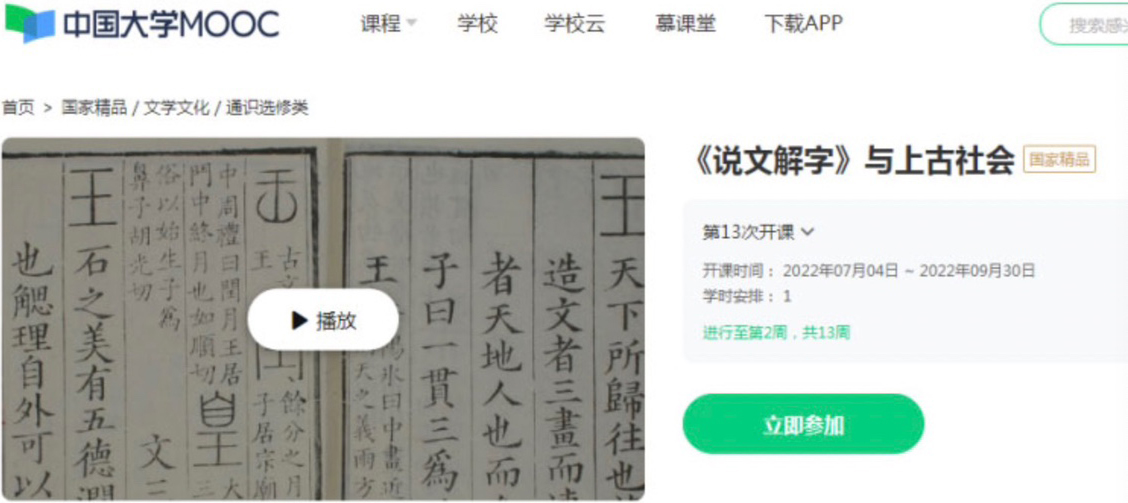
MOOC is an open teaching course platform based on the Internet. The scope of MOOC courses is almost the same as traditional courses, covering various disciplines and having a complete and progressive course chain. The ancient literature course is also included, as shown in Fig. 1 (from
Although teaching ancient literature with the MOOC platform can be independent of time and space and guide students to think independently, it also has disadvantages. On the one hand, videos on the MOOC platform were recorded in the past, leading to no interaction between teachers and students. Even if the videos are live, teachers can not fully confirm the students’ learning state, which is not as good as the traditional teaching mode. On the other hand, the MOOC platform cannot constrain students to learn, so students may not stay focused on the teaching resources for a long time when using the platform.
Therefore, the MOOC platform reforms the teaching mode without completely abandoning the traditional teaching mode. The overall framework of the MOOC platform-improved teaching mode is similar to the traditional teaching mode, i.e., it also includes preview before class, classroom teaching, and after-school review, but the difference lies in the inclusion of MOOC teaching in all three stages. First, in the preview before class, teachers will tell students the preview scope according to the teaching plan, provide students with relevant course links on the MOOC platform, and encourage students to search for the data of relevant knowledge points independently. Then, there are online teaching and offline teaching in the classroom teaching stage. Offline teaching is almost the same as the traditional teaching mode. Online teaching uses the live space on the MOOC platform as the online classroom. In online teaching, students are selected to answer questions by calling their names, and the students who are called will be displayed on the live screen simultaneously. In addition, all students can discuss freely on the same screen. In the after-school review, teachers will assign relevant exercises on the MOOC platform, and students can also use the communication software to ask teachers questions; for students who still have energy left, they can expand their learning projects through the recommendation function of the MOOC platform [15].
Subject of analysis
Two hundred students at Ningbo University of Finance and Economics, including 100 male students and 100 female students, were divided into two groups, control classes and experimental classes according to their academic performance. The distribution of scores of the two groups was kept as similar as possible (as verified in the subsequent experimental comparison results). The number of males and females was the same in the two classes. The control class adopted the traditional teaching mode, while the experimental class adopted the traditional
The students who participated in the experiment were tested before receiving instruction in ancient literature, and the test results showed that every student’s performance in ancient literature was comparable.
Teaching plan
Traditional teaching mode: ordinary classroom teaching, i.e., the teachers explained the difficult points and knowledge points in the textbook according to their understanding and organized classroom tests; ⟁ the teachers assigned matching homework after class and explained it in the next class.
The traditional
Teaching effectiveness test
Midterm and final tests were the most intuitive to evaluate students’ learning effectiveness under two teaching modes, but it is difficult to measure students’ learning effectiveness by the two tests alone. Therefore, in addition to the two tests, daily assessments were conducted during the teaching period. The daily assessment included daily homework, classroom interaction, attendance, and classroom tests, and the specific grading methods and weights are shown in Table 1, which also includes the midterm and final tests. The weight of every examination item was jointly formulated by ten experienced teachers.
Teaching effectiveness test content
Teaching effectiveness test content
The standard teaching method of the new teaching mode combined with MOOC.
The performance of students in the ancient literature course before teaching, in the middle of the term, and at the end of the term was measured by paper tests, and the distribution of students in different score bands is shown in Table 2. It was seen from Table 2 that the distribution of students in different score bands in the control class was nearly unchanged, while in the experimental class, the percentage of students in the high score bands gradually increased as the teaching mode progressed, i.e., students in the experimental class performed better in the ancient literature course.
Distribution of students in different score bands in the control and experimental classes before and after teaching
Distribution of students in different score bands in the control and experimental classes before and after teaching
It would be one-sided if the midterm and final test scores before and after teaching were compared only. The purpose of improving the traditional teaching mode with MOOC was to cultivate students’ independent learning ability, and the improvement of ancient literature course performance was only one of the manifestations. So when testing the effect of the new teaching mode in improving students’ independent learning ability, daily performance was also taken into account. In addition to the midterm and final tests, the evaluation results of daily homework, classroom interaction, attendance rate, and classroom tests were also used to measure the improvement of students’ learning ability in the teaching process, and they were given corresponding weights.
Comprehensive evaluation results of the control and experimental classes in one semester before and after teaching
Table 3 shows the comprehensive evaluation results of the control and experimental classes in the semester before and during teaching with the new mode. Table 3 shows that the overall evaluation of students in the control class was 77.2 in the semester before adopting the new teaching mode and 76.8 in the semester while adopting the new teaching mode; the overall evaluation of students in the control class was 76.85 in the semester before adopting the new teaching mode and 95.75 in the semester while adopting the new teaching mode.
The overall evaluation of the control class was not significantly different from the experimental class in the semester before adopting the new teaching mode, including the daily evaluation and the midterm and final evaluations. However, in the semester while adopting the new teaching mode, the experimental class showed a significantly improved performance in the daily test and the midterm and final tests, but the control class that was taught by the traditional teaching mode showed no significant change in the daily test and the midterm and final tests and a slight reduction in the overall evaluation.
Ancient literature is an excellent traditional cultural content of China, and it is also the main curriculum item of language and literature majors in universities. An excellent ancient literature course can enable students to better grasp the relevant knowledge so as to achieve the inheritance and development of excellent traditional culture, and an excellent course needs to have enough attraction to students. The traditional teaching mode focuses on the classroom and is teacher-led, and students can only passively receive knowledge in the classroom more often than not. Although this teaching mode is convenient for teachers’ management, it is tedious for students, and it is difficult to mobilize learning enthusiasm effectively and cultivate students’ independent learning ability. With the popularity of the Internet, online teaching platforms have emerged. Compared with the traditional teaching mode, the online teaching mode has the advantage of not being bound by teaching time and location. At the same time, in the online teaching mode, the teacher is no longer the dominant one in teaching but encourages students to find teaching resources in the platform according to the topics proposed by the teacher, which can cultivate students’ independent learning ability. However, compared with the online teaching mode, the traditional teaching mode is not without advantages. The single online teaching mode overemphasizes students’ independent learning ability, but students with good self-discipline in the actual learning process are usually the minority. The online teaching model eliminates the constraints of time and place, but it also eliminates the supervision of students’ learning. In the traditional teaching mode, classroom instruction and after-school assignments can be used to monitor students.
As mentioned above, the traditional teaching mode and online teaching mode each has its own advantages and shortcomings. The traditional teaching mode can play a supervisory role for students but suppresses students’ independent learning ability greatly, while the online teaching mode can cultivate students’ independent learning ability but lacks effective supervision for students. Therefore, this paper combined the traditional teaching mode and the online teaching mode to make up for the shortcomings of each. The MOOC online teaching platform was used to assist students in addition to traditional classroom teaching. In order to verify the effectiveness of the new teaching mode on the ancient literature course for college students, a case analysis of the teaching mode was conducted, and the results are shown above.
In the case study, 200 students in Ningbo University of Finance & Economics were divided into a control class and an experimental class. The control class was taught by the traditional teaching mode, while the experimental class was taught by the new teaching mode. The
After the teaching of ancient literature, the
Conclusion
This paper briefly introduced the traditional teaching mode of the ancient literature course and the new teaching mode combined with Internet MOOC and then analyzed 200 students at Ningbo University of Finance and Economics. They were equally divided into ten classes. Five classes were control classes, which were taught by the traditional teaching mode, and the other five classes were experimental classes, which were taught by the new teaching mode. The daily performance and the midterm and final test performance were tested in the semester before and during adopting the new teaching mode. (1) Before the teaching mode test, the control class and the experimental class had nearly the same distribution of grades in the ancient literature course; after teaching with different teaching modes, the distribution of grades in the midterm and final tests in the control class remained nearly unchanged, while the students with lower scored in the experimental class tended to have higher scores, indicating an improvement of the performance. (2) In the comprehensive evaluation that included daily, midterm, and final tests, the control class did not change much before and after the teaching mode test but had a slight decrease, while the experimental class had a significant increase after the teaching mode test.