



Abstract
The application of computer information management system (IMS for short here) in university management faces problems such as incomplete system software and complex system design. Applying clustering algorithms (CA for short here) to computer student IMS can help optimize the system’s overall effectiveness. This article constructed a computer student IMS based on computer technology and applied it to the management of college students. This article also combined CA to conduct relevant effectiveness tests on the system, in order to optimize the overall effectiveness of the system. Under the algorithm in this article, the average connection speed for each user accessing the system was 9.17 Mbps. The average reaction time was 0.34 seconds, the average security level was 92.47%, and the highest memory usage rate of the system was 34.27%; Under the decision tree algorithm, the average connection speed of each user accessing the system was 8.82 Mbps, and the average reaction time reached 0.64 s. The average security level was 88.41%, and the highest memory usage rate was 42.58%. Under the artificial neural network algorithm, the average connection speed of the system was 8.47 Mbps, the average response time was 0.86 s, and the highest memory usage rate was 45.97%. Analyzing the data reveals that the algorithm introduced in this paper significantly enhances system connection speed and reduces reaction time. This improvement not only enhances security measures but also minimizes memory usage, effectively optimizing the overall efficiency of the system.
Keywords
Introduction
Many universities have also integrated this technology to build computer IMS, which are used in university management work to improve the efficiency of management work. In the actual application process of this system, there are also many problems, such as incomplete system software, vulnerabilities in the system itself, and security risks in network software. The existence of these problems seriously restricts the development of computer IMS. It is necessary to combine relevant technologies and methods to effectively optimize the effectiveness of the system to improve its security and operational efficiency, so that the system can better serve the management work of universities.
The information system is composed of computer hardware, computer software, information resources, etc. It is mostly used to process various data information flow. The research on information systems is also emerging in endlessly. Guha, Samayita explored the application of big data (BD) analysis in the fields of information systems, operations management, and healthcare, and also discussed the future potential and related challenges of BD applications in these areas. He proposed a framework for applying BD in the fields of information systems, operations management, and healthcare [1]. Paustian, Keith pointed out that two countries, Australia and Canada, are based on soil information systems and use soil science and soil carbon quantification methods to support China’s climate change policies to promote soil carbon sequestration in agricultural land. He also outlined a quantitative system and pointed out that it can serve as a core component of the new global soil information system [2]. Al-Okaily, Aws used DeLone and McLean information system success model to explore the effectiveness factors of Accounting information system. He used a partial least squares structural equation model to collect information data from 117 chief financial officers of Jordanian listed companies to test the research model. The results indicate that information quality, service quality, and training quality have significant positive contributions to organizational efficiency [3]. Karjalainen, Mari analyzed the reasons for employees’ participation in information system security behavior and pointed out that the dynamic nature of information system security behavior has not been sufficiently considered in information system security research. He proposed the use of inductive methods to explore the theoretical understanding of the process of information system security behavior changes, which was inspired by dialectical thinking [4]. Brooks, Nita G. focused on assessing the skill requirements for information system security positions to understand the expectations of security work. He emphasized issues related to course management and analyzed 798 job advertisements, including exploring soft skills related to the field, as well as degree and certification requirements. He also discussed the meaning of information systems courses and provided some suggestions for future research [5]. However, these scholars’ research on information systems is not comprehensive enough and further exploration is needed.
Information systems belong to human-machine integration systems that support the input, storage, processing, output, and control of information. Other scholars have different views on the research of information systems. Al-Qaysi, Noor searched and analyzed 2382 articles using information systems to test education and information system theories/models, and selected 122 articles for further rigorous analysis. The research results indicate that the use and satisfaction theory and social constructivist theory are considered the most widely used educational theories in social media. These results contribute to a better understanding of social media research related to education and information system theory/models [6]. Zeiss, Roman proposed a new research direction for information systems to address the issue of neglecting the sustainability potential of information systems in establishing circular material flows, which is how information systems can help understand and develop circular material flows to enhance and expand the use of products and components [7]. Astuty, Widia conducted a questionnaire survey on the employees of Indonesian public enterprises in charge of managing Accounting information system, and analyzed the data using partial least squares method. The research results emphasize the important role of enterprise resource planning in managing the quality of accounting information system. Enterprise resource planning is likely to improve the reliability, efficiency and flexibility of the quality of accounting information system in Indonesian public enterprises [8]. Overall, there is not much research related to information systems. In order to improve the research on IMS, it is necessary to study the application of computer IMS in universities in the information age.
This article provides a specific analysis of the security issues in university computer IMS, and proposes corresponding solutions to address these issues. By analyzing the current application status of this system in university management, it is found that there are certain shortcomings. This article proposes an optimization method for the application path of this system in university management. This article also integrates computer technology to construct a computer student IMS, designs multiple functional modules, and provides a detailed description of the content of each module. It improves the overall efficiency of university management by applying the system to university management.
Computer IMS and application in universities
University computer IMS
The operation of various activities in universities cannot be separated from the support of computer IMS [9]. If there are security issues with computer IMS, the implementation of many educational activities would be affected to a certain extent.
System security issues
The problems in the computer IMS of universities mainly include the following points:
(1) Network software poses security risks
When applying computer information network technology in universities, network intrusion can easily bring certain risks to information security. Illegal elements use network intrusion to attack the school’s network system and disrupt the normal operation of teaching and management work. There are various risks in the computer network system, including computer virus infection. Virus infection can directly cause computer paralysis, system malfunction, and damage or direct loss of information and data in the system. The risk brought by computer virus infection, which is extremely destructive and has a wide range of impact, and the loss to users is enormous.
(2) The system itself has vulnerabilities
The computer system itself has some vulnerabilities, which provide certain convenience for hackers to attack. By leveraging computer vulnerabilities, hackers can invade computer systems and use programs similar to trojans to paralyze them. The computer information system stores a large amount of data information. If the data is lost, it would undoubtedly be a great damage for the school, and student information would also be leaked, making it easy for criminals to use. The paralysis of the system can also have adverse effects on the teaching of universities. Currently, many courses in universities require the use of computers for teaching. If the system is damaged, data loss would have a serious impact on teaching, and the course learning process would also be hindered.
(3) The constraints of the system itself
Usually, computer IMS have the function of installing security software, and the system itself also comes with some security programs. From the current perspective of the computer system market, due to the generally low security level of software, some universities may even choose systems with low security effectiveness to reduce costs. Although these systems can meet the requirements of normal operation, some software has low compatibility, which can easily cause serious security risks and have poor antivirus capabilities. When entering information, for the sake of simplicity and convenience, relevant staff may sometimes fail to comply with relevant information management regulations, which also poses significant risks to system security.
Measures to improve the security of computer IMS
(1) Ensure the scientificity of system design
To ensure the security of computer IMS, when designing the system, it is necessary to strengthen the system’s security defense effectiveness and develop a comprehensive preparation plan for unexpected needs [10]. During the process of data transmission on the network, it is easy to face some dangers, such as malicious interception and tampering of data. In order to avoid the problem of data being intercepted or tampered with, it is also necessary to improve the confidentiality technology of data transmission, which can be protected by physical or logical segmentation methods.
(2) Strengthen scientific management of the system
Strengthening scientific management of the system can reduce the occurrence of security issues. Employees can set user access permissions during the application process to improve system security. In order to more effectively identify the user’s identity, methods such as fingerprint, facial recognition, and voice recognition can be used to detect the user’s identity, in order to prevent illegal user intrusion.
(3) Install antivirus software in a timely manner
In the actual operation process, the system would face various security issues, mainly because the system is susceptible to virus infection. In order to reduce the occurrence of system security issues, it is also necessary to install some antivirus software in the system to reduce virus infection. By using antivirus software, staff can discover viruses and vulnerabilities in the system in a timely manner, and repair these viruses and vulnerabilities in a timely manner to reduce their losses.
Application of computer IMS in university management work
Application status of the system in university management work
(1) Incomplete system software
Nowadays, education and teaching in universities are constantly undergoing reform, and the current computer IMS is difficult to effectively meet the needs of various educational reform work in universities [11]. The flexibility of the system is not strong, and the internal structure of the system is relatively complex, with weak integration. These factors all constrain the overall development of computer IMS. Due to the relatively long development cycle of the system, it also faces many problems during the development process. Some developers mainly develop software based on existing development projects and goals, and do not carry out targeted software development work according to actual educational needs. This has led to the uncoordinated development of software projects with the needs of the current education reform, and there are more and more function problem. For example, the existing software functions do not support the implementation of teachers’ needs for flipped classrooms, process assessments, remote evaluations, etc., which greatly weakens the educational and management value of the system. The existing systems in universities are applied between different departments, and their compatibility is not strong, making it difficult to effectively support different departments in completing corresponding management tasks. This leads to the poor flow of data and information in departments, which would to lead to the anomie of data and information. Due to the fact that many systems are developed based on the internal network environment of schools, it has to some extent constrained the progress of university management work and is not conducive to the realization of the goals of networked and intelligent management in universities.
(2) The design of the system is relatively complex
Many IMS in universities are designed to be more complex, and the human-machine interface of the system has not been optimized, which can affect the user experience [12]. The direct interface can be said to be a key link in the data interaction of IMS, which would have a crucial impact on user experience and work quality, and transmit data information to university managers, enabling them to use advanced information functions to perfect its quality. In the actual design process, developers and functional designers have focused on the functional application of the system, lacking attention to the human-machine interface. This would lead to a complex user operation process, low user convenience, and correspondingly increased labor and time costs for teaching management work. When users use the system, they may also develop a certain level of resistance, which may have a negative impact on the later management work.
Role of system application in university management work
(1) Improve computer management information system
In order for computer IMS to provide more convenient and efficient services for university management work, developers must change the traditional system development mode and optimize and adjust the existing system software according to practical needs to meet the needs of university teaching reform. During the development process, university managers should also actively participate in the software system development process and have sufficient communication and discussion with developers. Developers can also have a clear understanding of the current situation, goals, and needs of university management work. Only in this way can developers develop and design software more targeted to ensure the rationality of the management system’s functional design. In terms of compatibility, universities should provide software developers with specific information about each department, so that software developers can design corresponding management modules based on the management nature and characteristics of different departments. Resource integration and sharing of multiple management modules can be achieved according to the management needs of the administrative department.
(2) Enhance the customization function of the system
Universities also need to strengthen the research on the application skills of custom technology, design the system interface according to the workflow of teaching management, in order to improve the scalability of the system. In this process, universities also need to develop a scientific approval process based on the relevant situation of the system platform, which can provide convenience for education managers to carry out related work and provide strong support for reducing the maintenance costs of the system in the later stage. In terms of platform expansion, university teaching management personnel also need to design future applicable software and system functions on account of the current development direction of technology and the actual needs of teaching management.
(3) Reasonably plan the human-machine interface of the system
In university computer IMS, the human-machine interface has a great influence on the user experience and application level [13]. Therefore, universities need to strengthen the optimization of the human-machine interface of the system when building it. Optimizing the human-machine interface can better meet the different needs of managers and users for system applications, and enhance their user experience. Universities should also strengthen the division and management of system functions, dividing management work according to different teaching management content and user needs. The interface layout should be as simple and elegant as possible, and different levels of interfaces can be set, such as first level, second level, and third level pages, to meet the needs of different users.
Design of college computer student IMS
Overall system structure design
Through a thorough system analysis, it is possible to segment the system into multiple subsystems based on pertinent functional requirements. This involves a scientific configuration of machinery, establishment of data storage protocols, and a rationalized blueprint for the overall system implementation. This can develop a system implementation plan to achieve the overall goal. The structural framework design of the university computer student IMS is displayed in Fig. 1.
Design of the structural framework of the computer student IMS in universities.
The college computer student IMS consists of five functional modules [14]. The following article provides a detailed analysis of each module:
(1) Login module
Before entering the system, it needs to log in to the system, and the login module is responsible for authenticating the user’s identity. According to the authentication information, the system would allow users of different roles to enter the corresponding system interface, which also provides certain convenience for users to perform related operations. In the college computer student IMS, users are divided into a total of 5 categories, and each type of user has different permissions. Different users also have separate username and password, which allows them to enter the designated management interface and perform related operations. The login module is important in the system, and the login interface of the system is displayed in Fig. 2.
System login interface.
(2) Student information management module
Different users can log in to the corresponding information management interface for related operations. For student users, logging in to the system allows them to query and browse their basic information. This information mainly includes student ID (identification), name, department, home address, major, class, grade, grade information, and ongoing courses. The student information management module also supports editing, deleting, and adding student information.
(3) Course information management module
The course information management module mainly provides services for students and teachers, and students can choose the courses they want to learn in this module. Teachers can schedule courses in this module. Administrators can edit and modify course information in this module, and also support adding new courses for students to choose from. The course information mainly includes course name, lecturer, class time, etc. This module also supports operations such as editing, deleting, and adding course information.
(4) Score management module
The grade management module is mainly responsible for recording students’ grades and GPA (grade point average) scores. Teachers can input students’ grades and grade points into the system in this module, and can also modify the scores. Students can only query their grades and print their transcripts. The score information mainly includes scores, grades, rankings, etc. This module also supports operations such as adding, editing, and querying grade information.
(5) Training plan management module
The training program management module is mainly responsible for organizing and summarizing the course information selected by students, and timely recording the completion progress of the corresponding training program courses for students. The training plan information mainly includes plan number, course content, expected training objectives, etc. This module also supports editing, deleting, and querying the training plan information.
CA
CA can filter and classify large-scale data, gather similar data together, classify them, and perform data mining analysis on them [15]. Applying CA to the student IMS, the algorithm would collect student information with similar features and group students who choose the same course according to the corresponding learning objectives. This can facilitate the effective management of student information by the system, thereby improving the management efficiency of the system and achieving the goal of optimizing system effectiveness.
Assuming that the sample data in the computer student IMS is represented as
Among them,
Calculate the student data class in the student IMS using the formula:
Among them,
In the CA, an iterative method is used to partition the data in the student IMS and calculate the objective function. The formula is:
Clustering distance matrix can be expressed as:
Among them,
Among them,
By dividing the distance between different student objects, it can be concluded that:
By dividing the distance between different student objects, the data information of different students can be effectively classified to improve the effective management of student information in the student IMS. This could increase the system’s operational effectiveness to have a good optimization effect on system effectiveness.
In order to verify that CA can effectively optimize the effectiveness of computer student IMS, this article takes a computer student IMS in a certain university as the research object, and combines CA to conduct experimental tests on the relevant effectiveness of the system. This article also conducted comparative experiments on the system using decision tree algorithm and artificial neural network (ANN) algorithm, and the experimental results are displayed below.
Connection speed test
In order to compare the differences in optimizing system effectiveness among different algorithms, this article conducted experimental tests on the access of each user to the system in terms of system connection speed, as displayed in Fig. 3.
Connection speed test of the system under different algorithms.
After logging into the student IMS, users need to perform relevant operations in the system, which requires ensuring the operational efficiency of the system. There is a close correlation between operational efficiency and system connection speed. The faster the connection speed, the higher the operational efficiency of the system. From the data in Fig. 3, it can be seen that different algorithms have different connection speed tests for each user accessing the system. Under the algorithm in this article, the overall connection speed of each user accessing the system exceeds 9 Mbps. The connection speed reached the highest when User 3 accessed the system, at 9.36 Mbps. When User 6 accesses the system, the connection speed reaches its lowest at 9.05 Mbps, and the average connection speed for each user accessing the system is 9.17 Mbps. Under the decision tree algorithm, the connection speed of each user accessing the system may be slower, generally below 9 Mbps. The highest connection speed can reach 8.91 Mbps and the lowest is 8.73 Mbps. The average connection speed for each user accessing the system is 8.82 Mbps. Under the ANN algorithm, the connection speed of each user accessing the system would be slower, with a minimum connection speed of 8.37 Mbps and a maximum connection speed of 8.59 Mbps. The average connection speed for each user accessing the system is 8.47 Mbps. From the above data, it can be seen that under the algorithm in this article, the connection speed when users access the system is faster, indicating that this algorithm can effectively improve the operational efficiency of the system.
In order to further compare the differences between different algorithms, this article also tested the access of each user to the system in terms of system reaction time, and the test results are displayed in Fig. 4.
Response time testing of the system under different algorithms.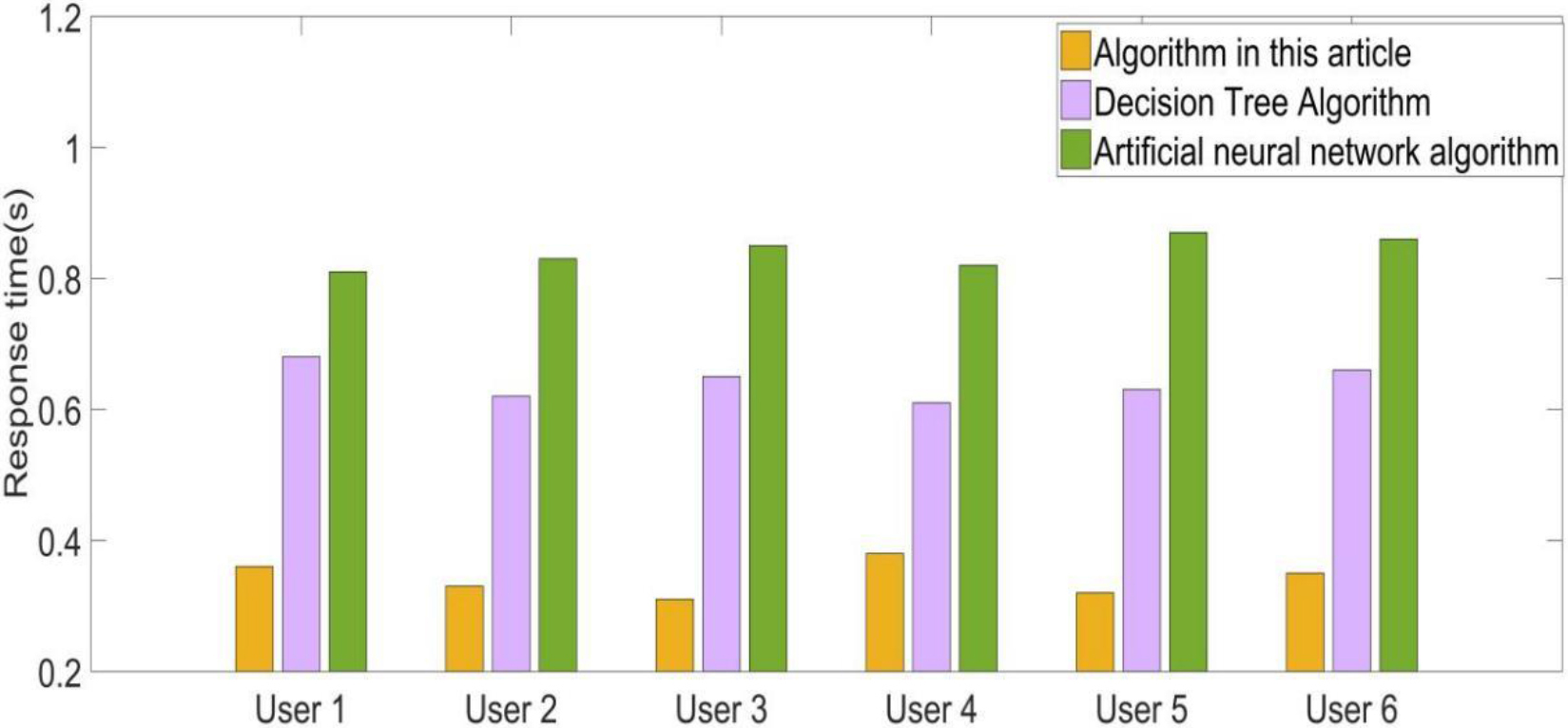
In the student IMS, users need a certain reaction time to complete corresponding tasks when accessing web pages, downloading data information, and other related operations. The shorter the reaction time of the system, the higher the operational efficiency of the system. From the data in Fig. 4, it can be seen that under different algorithms, there are significant differences in the reaction time of the system when each user performs related operations. Under the algorithm in this article, when each user operates on the system, the reaction time of the system is relatively short, and the overall control is within 0.4 seconds. When user 3 performs related operations, the system’s reaction time reaches the shortest, 0.31 seconds. When user 4 performs related operations, the system’s reaction time reaches the longest, 0.38 seconds, and the average reaction time is 0.34 seconds. Under the decision tree algorithm, the reaction time would be relatively longer for each user when performing operations. The maximum reaction time reached 0.68 seconds, the minimum reached 0.61 seconds, and the average reaction time reached 0.64 seconds. Under the ANN algorithm, the reaction time would be longer when each user performs related operations, with the longest reaction time reaching 0.87 seconds and the shortest being 0.81 seconds, and the average reaction time reaching 0.84 seconds. In summary, under the algorithm proposed in this article, the reaction time of the system is the shortest when each user performs related operations in the system, demonstrating that the algorithm can successfully reduce the system’s reaction time and increase its operating efficiency.
In order to comprehensively compare the differences in system effectiveness optimization between different algorithms, this article also conducted testing experiments on the security of the system, as displayed in Fig. 5.
Security testing of systems under different algorithms.
From the data in Fig. 5, there are certain differences in the security test results of users when using the system for different algorithms. Under the algorithm in this article, the overall security level of the system is relatively high for each user when performing related operations, basically maintaining over 90%. The highest and lowest security level of the system can reach 93.45% and 91.58%, with an average security level of 92.47%. Under the decision tree algorithm, when each user operates in the system, the security level of the system is relatively low, and overall, it does not exceed 90%. The lowest security level of the system is 87.49%, and the highest is 89.27%. The average security level of the system is 88.41%. Under the ANN algorithm, the security of the system would be lower when each user performs related operations. The lowest system security level is only 84.19%, and the highest is only 86.23%, with an average system security level of 85.24%. By analyzing the above data, it can be seen that under the algorithm proposed in this article, the system’s security level would be higher, indicating that this algorithm can effectively improve the system’s security effectiveness and ensure the information security of students.
To continually assess the system’s performance, this article integrates diverse algorithms and performs experimental tests on memory usage under varying user loads accessing the system. The experimental results are displayed in Fig. 6.
Memory usage test of the system under different algorithms.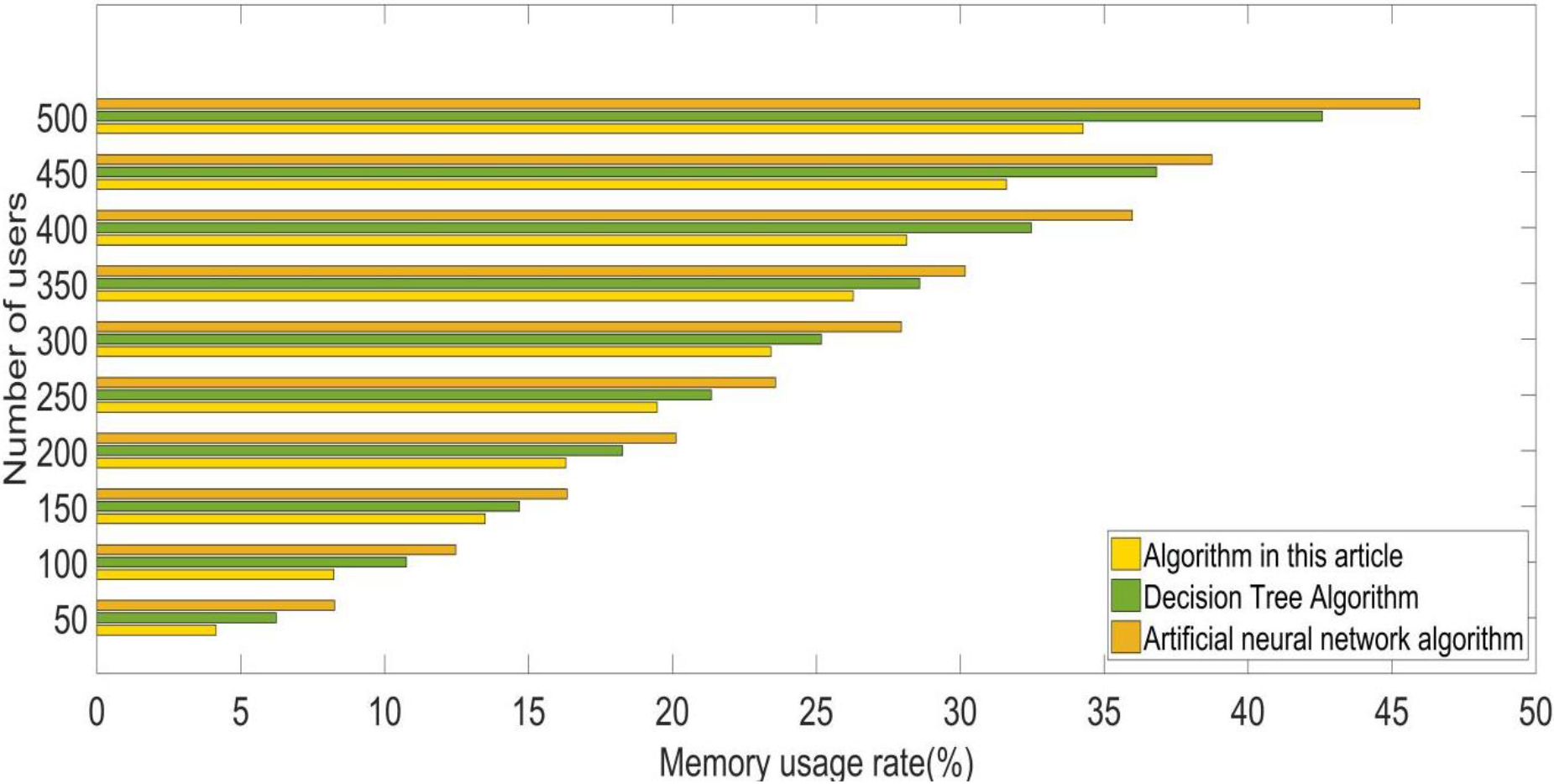
When multiple users log in to the student IMS at the same time, it would occupy a certain amount of system memory. As the number of users logging into the system continues to increase, the system would also occupy more and more memory. The higher the memory usage rate of the system, the lower the operating efficiency of the system, which has a negative impact on its operation. From Fig. 6, it can be seen that under the algorithm proposed in this article, as the number of users simultaneously logging into the system continues to increase, the system’s memory usage also continues to rise. When there are only 50 users, the system’s memory usage is only 4.14%. When the number of users increased to 500, the system’s memory usage increased to 34.27%. Under the decision tree algorithm, the memory usage of the system continues to increase as the number of users increases. When the number of users is 50, the system’s memory usage rate is 6.23%; When the number of users increased to 500, the system’s memory usage increased to 42.58%. Under the ANN algorithm, the memory usage of the system is also continuously increasing. When there are only 50 users, the memory usage of the system is 8.26%. When the number of users reaches 500, the memory usage of the system is as high as 45.97%, accounting for nearly half of the system’s memory. In summary, under the algorithm proposed in this article, the memory usage of the system would be lower. It shows that the algorithm can optimize the memory usage of the system and improve its operational efficiency.
The application of computer IMS can effectively improve the efficiency of management work, but there are also many problems. This article analyzed the current application status of this system in university management. In response to its current application status, some solutions have been proposed. This article also constructed a university computer student IMS based on computer technology, and provided a detailed description of each module of the system. This article also combined CA to conduct relevant testing experiments on the effectiveness of computer student IMS. The experimental results show that under the algorithm proposed in this paper, the system has faster connection speed, shorter reaction time, higher security, and lower memory usage. It indicates that the algorithm can effectively improve the system’s operational efficiency and overall effectiveness. Due to limitations in experimental conditions, this experiment only conducted experimental analysis on connection speed, response time, security, and memory usage, and did not conduct research on other aspects. In future research endeavors, Continuous Assessment (CA) must consistently evolve to align with the evolving application requirements of the student Information Management System (IMS) in university administration, thereby enhancing its efficacy. This adaptive approach will offer more effective support in advancing the development of diverse management activities within universities.