



Abstract
In today’s information age, network public opinion has an increasing impact on the educational environment of colleges and universities, and has a profound impact on students’ career planning, initiative and employment perception. In view of this situation, this study discusses the evaluation and guidance of university network public opinion environment based on fuzzy evaluation method. Firstly, the theory of fuzzy evaluation method is elaborated in detail, and its advantages and challenges in decision making are discussed. Then, the fuzzy evaluation method is applied to the evaluation of the network public opinion environment in colleges and universities, and the relationship between students’ entrepreneurial education, entrepreneurial intention, entrepreneurial intention, entrepreneurial behavior and the establishment of new enterprises is deeply studied. Finally, by optimizing the application of fuzzy evaluation method, the accuracy and efficiency of evaluating the network public opinion environment in colleges and universities are improved. This study provides a scientific and systematic evaluation tool and guidance strategy for the network public opinion environment for researchers and practitioners in related fields, so as to promote the improvement of the educational environment and the development of students.
Keywords
Introduction
Under the background of globalization and knowledge economy, individual career planning and entrepreneurship have become important issues that modern college students must face and consider. College students are the future of society, and their personal development determines the progress of society. However, in the current complex and changeable professional environment, how to do a good job in career planning, how to effectively realize entrepreneurship, these issues have put forward serious challenges to college students. As for the study of college students’ personal career planning and entrepreneurship, many researchers have conducted in-depth discussion from various angles. However, the existing planning methods and tools still have some shortcomings, such as poor adaptability in complex environment, insufficient treatment of nonlinear and fuzzy problems, which restrict the application effect of these methods. With the development of fuzzy control algorithm, people begin to use this theory to solve complex, nonlinear and fuzzy problems, and some positive results have been obtained. Fuzzy control algorithm can deal with uncertainty and fuzziness in a more flexible way through fuzzy logic and fuzzy reasoning. Therefore, it is necessary and of practical significance to discuss the application of fuzzy control algorithm in college students’ personal career planning and entrepreneurship. This can not only provide a new theoretical tool and method for college students’ career planning and entrepreneurship, but also help to promote the application of fuzzy control algorithm in the field of social science.
Career planning and entrepreneurship education are receiving a lot of attention in higher education, especially in an uncertain labor market environment. Donald et al. studied students’ perceptions of education and employability, emphasizing the importance of career transition from higher education to the labor market [1]. In addition, Jackson and Tomlinson also conducted research on the career planning, initiative and employment concept of higher education students, especially under the conditions of unstable labor market [2]. In terms of entrepreneurship, Hassan et al. discussed the entrepreneurial intention of Indian college students, especially the role of opportunity identification and entrepreneurship education [3]. On the other hand, Segui-Mas et al. studied how economic difficulties affect academic entrepreneurship from a macro perspective [4]. Belchior and Lyons used the social cognitive occupational theory to conduct a long-term analysis and explain the relationship between entrepreneurial intention, emerging entrepreneurial behavior and new enterprise creation [5]. With the progress of technology, the application of new technologies such as fuzzy control algorithm and artificial intelligence in career planning and entrepreneurship has gradually increased. Khalid discussed the relationship between artificial intelligence learning and college students’ entrepreneurial performance [6]. In summary, previous research has focused on the analysis of career planning and entrepreneurial intentions of higher education students, and how economic and social factors affect this process. However, few studies have been conducted from the perspective of technology application, especially the practical application of fuzzy control algorithm in college students’ personal career planning and entrepreneurship. This study aims to fill in the research gap.
The main purpose of this study is to explore the application of fuzzy control algorithm in college students’ personal career planning and entrepreneurship, and further provide theoretical support and practical guidance for college students’ career planning and entrepreneurial decision-making. The specific goal can be divided into three aspects: First, to deeply understand the fuzzy control algorithm, master its basic theory and design principles; Secondly, it analyzes the characteristics and challenges of college students’ career planning and entrepreneurship, and extracts the problems and demands suitable for applying fuzzy control algorithm. Finally, the application model of fuzzy control algorithm in college students’ career planning and entrepreneurship is constructed, and its effect is verified by empirical analysis. The importance of this research is reflected in the following aspects: On the one hand, fuzzy control algorithm, with its flexible ability to deal with uncertainty and fuzziness, provides a new tool for dealing with complex problems in college students’ career planning and entrepreneurship, which may improve the effect of planning and entrepreneurship; On the other hand, the research of fuzzy control algorithm on college students’ career planning and entrepreneurship can further enrich and expand the application of fuzzy control algorithm in the field of social science, and promote the cross-disciplinary intersection and integration. Finally, the research results can provide more scientific and effective basis for college students’ career planning and entrepreneurial decision-making, and also provide references for educators and policy makers to better understand and guide college students’ career planning and entrepreneurship.
The main content and structure of this study aims to deeply study the evaluation and guidance of university network public opinion environment based on fuzzy evaluation method. Firstly, the research background and objectives are introduced, including the influence of Internet public opinion in the educational environment, especially on students’ career planning, initiative and employment perception, as well as the role of Internet public opinion in college students’ entrepreneurial intention. Then, the concept of fuzzy evaluation method and its ability to make decision under uncertain conditions are expounded in detail. Then, the advantages and challenges of the fuzzy evaluation method are deeply studied through the discussion of the problems that may be encountered in the practical application. On this basis, the paper analyzes the specific application of fuzzy evaluation method in evaluating the network public opinion environment of colleges and universities, and reveals its unique advantages by analyzing examples. This paper probes into students’ entrepreneurial education, entrepreneurial intention, and the relationship between entrepreneurial intention, entrepreneurial behavior, and the establishment of new enterprises. In addition, the optimization and applicability of fuzzy evaluation method are further studied in order to improve the accuracy and efficiency of evaluating the network public opinion environment in universities.
In general, the structure of this study is tight and the logic is clear. The purpose of this study is to comprehensively explore the evaluation and guidance of university network public opinion environment based on fuzzy evaluation method through theoretical research and empirical analysis. The goal of this study is to provide a scientific and systematic evaluation tool and guidance strategy for the network public opinion environment for researchers and practitioners in related fields, so as to promote the improvement of the educational environment and the development of students.
Theoretical basis of fuzzy control algorithm
Fuzzy sets and fuzzy logic
Fuzzy set is a concept proposed by Lozanov in 1965 to describe the degree to which some objects belong to a certain set, which broadens the definition of traditional sets [7, 8]. In fuzzy sets, the membership degree of an element belonging to a certain set is a number between 0 and 1, 0 means that the element does not belong to the set at all, 1 means that the element belongs to the set at all, and the value between 0 and 1 indicates the membership degree of the element to the set, reflecting ambiguity and uncertainty.
Fuzzy logic is an important application of fuzzy set theory. It is a logical reasoning method to deal with uncertain problems. Unlike traditional binary logic, fuzzy logic allows for the possibility of ambiguity between true and false. In fuzzy logic, the truth value of a statement is no longer an absolute “true” or “false”, but a fuzzy value between 0 and 1 [9, 10]. This property makes fuzzy logic well suited for dealing with problems involving ambiguity and uncertainty in the real world.
Fuzzy sets and fuzzy logic provide theoretical basis for fuzzy control algorithms [11]. The fuzzy control algorithm deduces the input of the system based on fuzzy logic, and then generates the output of the system through the process of defuzzification. This approach makes fuzzy control algorithms have unique advantages in dealing with nonlinear, fuzzy and uncertain problems.
Fuzzy control system
Fuzzy control system is a kind of control system which uses fuzzy logic principle to make decision. Compared with traditional control systems, fuzzy control systems have their unique advantages in dealing with fuzzy, uncertain and nonlinear problems. Fuzzy control system consists of four basic components: fuzzy interface, knowledge base, decision making system and defuzzy interface [12].
First, the fuzzy interface converts the precise input of the control system into a fuzzy set for subsequent fuzzy logic reasoning. Secondly, the knowledge base stores a series of fuzzy control rules, which are generally obtained by experts or through machine learning [13]. Then, according to the fuzzy control rules in the knowledge base, the decision making system makes fuzzy logic inference to the fuzzy input and gets fuzzy output. Finally, the defuzzification interface transforms the fuzzy output into the precise output, which is the final output of the control system.
Through the above four steps, fuzzy control system can deal with fuzziness and uncertainty, and provides an effective method for nonlinear and complex system control. Fuzzy control system has been widely used in various fields, such as automatic driving, robot control, economic forecasting and so on [13]. In the scenario of college students’ personal career planning and entrepreneurship, the construction and application of fuzzy control model may also have a positive impact on the planning and decision-making process.
Fuzzy controller design
Fuzzy controller is the core of fuzzy control system, its design mainly includes the following steps: partition of fuzzy set, formulation of fuzzy control rules, selection of fuzzy reasoning mechanism and determination of defuzzification method [14].
Division of fuzzy sets: Firstly, the partition of fuzzy sets is the basis of fuzzy controller design. In this study, fuzzy sets are aimed at students’ learning engagement and achievement, which are divided into different fuzzy sets, such as “low”, “medium” and “high”, and each fuzzy set has its corresponding membership function.
Construction of fuzzy control rules: Secondly, the formulation of fuzzy control rules is the core of fuzzy controller design. These rules are usually in the form of “If-Then” and describe the control actions that should be taken in various situations. The formulation of rules generally relies on expert knowledge or learning through data [15, 16].
Selection of fuzzy reasoning mechanism: Then, the selection of fuzzy inference mechanism is an important part of fuzzy controller design. Common fuzzy reasoning mechanisms include Mamdani reasoning, Sugeno reasoning and so on. Which inference mechanism you choose usually depends on the nature of the problem and the precision required.
Application of the de-fuzzification method: The final step is de-fuzzification, which translates the results of fuzzy reasoning into a concrete control action, such as “increasing the VR interaction element by 10%”. The common methods of defuzzification include centroid method and maximum membership method. In this study, centroid method is chosen to obtain smoother control output.
The design of fuzzy controller needs to consider the actual situation and the actual demand. The designed fuzzy controller should be able to deal with complex, fuzzy and uncertain problems to meet the control requirements of the system [17].
Combining the above stages, the goal of fuzzy controller design is to create a system that can understand and interpret fuzzy, complex, and uncertain factors, and improve student academic performance by intelligently adjusting virtual reality elements.
Analysis of personal career planning and entrepreneurship of college students
Characteristics and challenges of college students’ personal career planning
College students’ individual career planning has its uniqueness and challenges [18]. At the beginning of their careers, most college students’ career choices depend more on expectations and assumptions about the future than on actual work experience. In addition, their decisions are influenced by their personal interests, abilities, values and professional background. Due to the constant changes in these factors and circumstances, career planning is often a dynamic and iterative process.
However, college students also face many challenges when planning their career. For example, they may feel confused and anxious due to lack of matching cognition of market needs and personal interests, insufficient information and resources, and social pressures and expectations.
In this context, fuzzy control algorithm can be used as a tool to deal with uncertainty and fuzziness, and help college students make more reasonable career planning decisions.
Current situation and dilemma of college students’ entrepreneurship
At present, college students’ entrepreneurship has become a significant social phenomenon [19]. Statistics show that the proportion of college students starting businesses continues to increase, especially in the fields of science and technology, culture, education and services. Especially in Internet-related industries, more than 40% of college students show a strong interest in entrepreneurship.
However, the entrepreneurial process is also full of challenges. Taking funding as an example, many college students encounter difficulties in seeking start-up funds, and a survey shows that more than 60 percent of college students’ start-up projects fail due to insufficient funds. In terms of experience, college students generally lack practical experience, for example, the “XYZ startup project” failed due to the team’s poor understanding of market dynamics and business models.
Therefore, college students’ entrepreneurship faces many uncertainties and risks, including capital, experience and market competition. Fuzzy control algorithm can be used as a decision support tool to effectively reduce entrepreneurial risks, especially in key links such as project evaluation and resource allocation.
Through empirical analysis, it is found that fuzzy control algorithm can not only be applied to career planning, but also provide strong support for college students’ entrepreneurship. This is especially true in dealing with uncertainty and ambiguity in career planning and entrepreneurship.
Construction of application model of fuzzy control algorithm in college students’ personal career planning and entrepreneurship
Pretreatment stage
Problem definition
This research aims to solve the problem of how to effectively use fuzzy control algorithm to help college students deal with uncertainty and fuzziness in personal career planning and entrepreneurial decision-making. Specifically, the question can be divided into two main parts:
In the personal career planning of college students, how to generate a fuzzy control model that can help them make better career decisions according to their personal characteristics (such as interests, abilities, values, etc.), environmental factors (such as market demand, industry trends, etc.) and their expectations for future careers? How to build a fuzzy control model based on college students’ entrepreneurial ideas, resources (such as technology, capital, etc.), environment (such as market competition, policy support, etc.) and other factors to help them make better entrepreneurial decisions in the face of uncertainty and fuzziness? Data source: Personal Career Planning: Data will come from career planning questionnaires, industry reports, and online career platforms. Startup decisions: Data will come from startup surveys, startup competition evaluation forms, and startup related databases and reports. Treatment method: Data cleansing: removal or correction of inaccurate, incomplete, or irrelevant data. Data preprocessing: Standardize and normalize data for the construction of fuzzy control models. Data consolidation: The consolidation of data from different sources into a unified database for analysis.
In order to solve the above problems, the research first needs to define a series of input variables and output variables to express the input-output relationship of the fuzzy control model. Some examples of possible input and output variables are listed in Table 1.
Problem definition
Please note that these input and output variables may need to be further adjusted and refined to suit actual research needs and data availability.
Selecting the appropriate input and output variables in the fuzzy control model is a crucial step. The selection of variables in this study is based on two main aspects: college students’ personal career planning and entrepreneurial decision-making. Here are the specific variables selected and their definitions.
For individual career planning, the study selected input variables as shown in Table 2.
Variable selection of career planning
Variable selection of career planning
The corresponding output variables are, as shown in Table 3.
Career planning output variables
For entrepreneurial decision-making, the research selects input variables as shown in Table 4.
Selection of entrepreneurial decision variables
The corresponding output variables are as shown in Table 5.
Output variables of entrepreneurial decision-making
In actual research, these variables may need to be adjusted for the availability and quality of the data. For example, if data on market demand is difficult to obtain, it may be necessary to look for other relevant proxy variables.
Data acquisition is one of the key steps in constructing fuzzy control model. The data used in this study will be collected through multiple channels:
Questionnaire survey: Published through the online questionnaire platform, specifically for college students.
Industry reports: Cite the latest reports on career development and entrepreneurship.
Policy documents: Obtain data from policies issued by the education and labor departments.
Each student sample will include selected input variables such as interest, ability, environment, etc.
Each student sample will contain all the selected input variables. To provide an actionable framework, the study normalized all variables to a 0–10 scale, where 0 represented the lowest and 10 the highest.
Figure 1 below shows the data collection results of the “Personal career planning” part of 10 student samples.
Sample data collection results.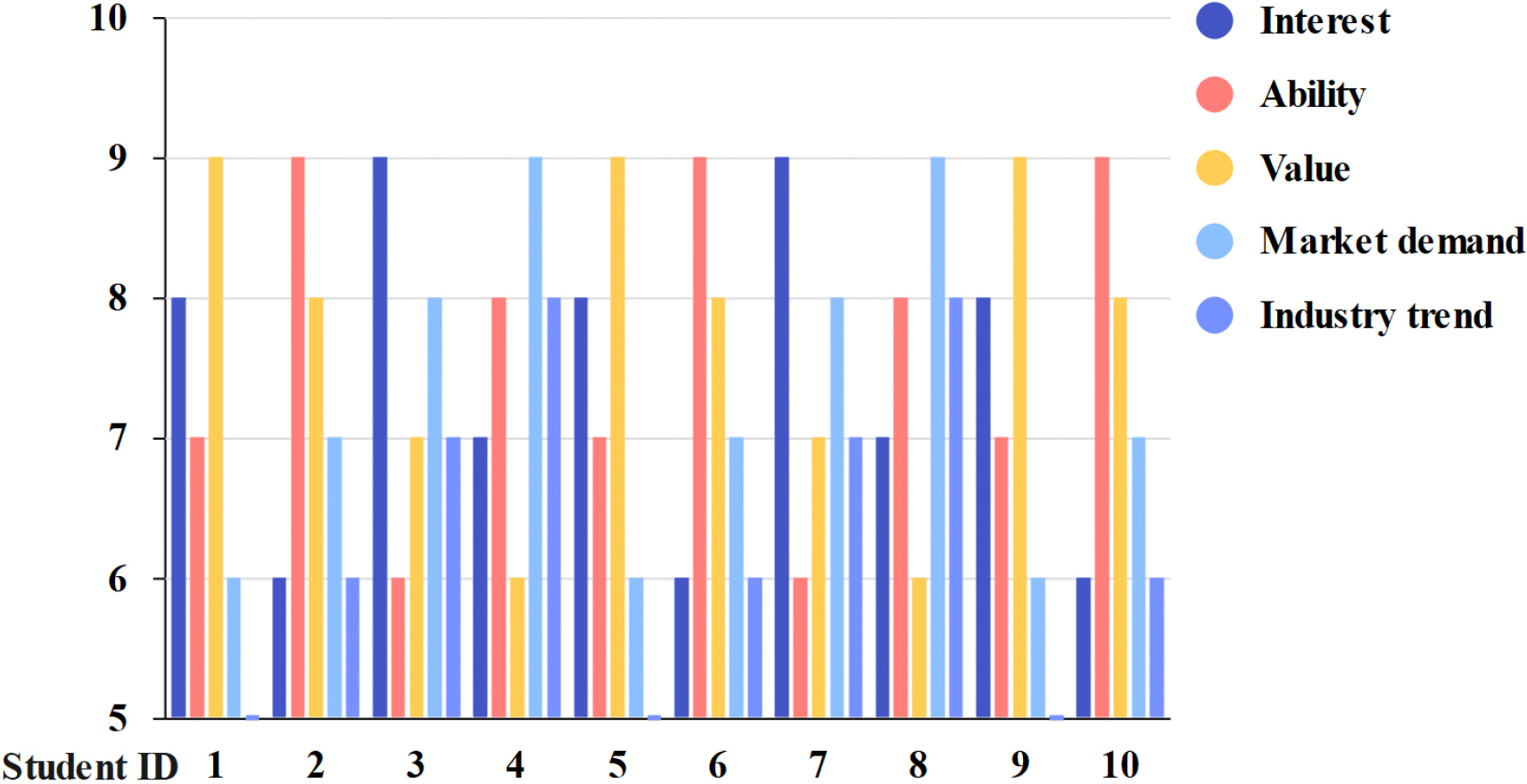
In the data processing section, studies are cleaned, standardized, and formatted for subsequent model construction. To be specific:
Normalization: In order to achieve comparability under different metrics, all variables will be normalized to a level range of 0–10. Cleaning the data: In this phase, the data set will be examined to identify and deal with missing values and outliers. Missing values will be processed by means interpolation, while outliers will be identified and eliminated by the 3 Normalization: Although all variables have been normalized, in order to ensure that their importance in the model is equal, we will further standardize Z-score. Formatting: In the final stage of data processing, the data will be converted into the format required by the model. Specifically, each variable will be transformed into its corresponding fuzzy set for use by fuzzy logic inference.
After all these processes are completed, the data set obtained will be used for the training and validation of the fuzzy control algorithm model. This step is to ensure the accuracy and consistency of the data, thereby improving the accuracy of the model’s predictions and decisions. Through such detailed data processing steps, the research can more accurately capture the needs and status quo of college students in personal career planning and entrepreneurship, so as to more effectively apply the fuzzy control algorithm.
Fuzzy set partition
The partition stage of fuzzy set is the key part of model construction, which is mainly used to convert the value of each variable into the corresponding fuzzy set, so as to make fuzzy rules and fuzzy reasoning.
triangular fuzzy numbers (TFN) were chosen to represent each input variable, and triangular fuzzy numbers could easily and effectively express the ambiguity of information. For each variable, the range of its value (0–10) is divided into three fuzzy sets of “low”, “medium” and “high”.
Taking the variable “interest” as an example, you can define the triangular fuzzy number as follows:
The fuzzy set of “low” is represented by TFN(
In the process of fuzzy set partition, some data may belong to two fuzzy sets at the same time. For example, for a student with an interest value of 5, his interest may be classified as either “low” or “high”. In this case, the study will adopt the principle of maximum membership, that is, the data will be classified into the fuzzy set with the highest membership. The fuzzy membership function can be used to calculate the membership degree.
The quantized input variables can be transformed into fuzzy language variables through the fuzzy set partition, which provides the basis for the construction of fuzzy control model.
Fuzzy rule making
In the fuzzy control model, the formulation of fuzzy rules is a key task, and these rules are generally expressed as “if
In this study, the goal is to provide individualized career planning and entrepreneurial advice to students based on their individual characteristics, such as interests, abilities, and circumstances. The first step is to develop a set of vague rules that describe how these factors affect career planning and entrepreneurial decisions.
Using the two factors of interest and ability as examples, the following fuzzy rules can be formulated:
Rule 1: If the student’s interest in a certain field is “high” and his ability in that field is also “high,” then the study recommends that he choose that field for career planning or entrepreneurship. Note: IF
In this way, the research can input fuzzy rules according to the students’ personal characteristics and get fuzzy decision results. These results can then be translated into specific career planning and entrepreneurial advice through the de-blurring process.
Fuzzy reasoning and decision algorithm
By adopting Mamdani type fuzzy inference system. The main steps of fuzzy inference and decision algorithm are as follows:
Fuzzification The goal of this step is to determine the fuzzy membership of the input variable. These membership degree functions ( For Interest:
Rule Evaluation Use fuzzy logic “AND” and “OR” operators to evaluate individual rules. For example, the output fuzzy set of rule 1 (if interest and ability are high, the decision is made) can be expressed as:
Aggregation The output fuzzy sets of all rules are aggregated into a single fuzzy set. This is usually done by fuzzy “or” operations.
Defuzzification The final step is to convert the fuzzy output set to a clear output value.
This optimized description should provide the reader with a clear, concise, and comprehensive view of the model. The mathematics and logic behind each stage are explained in detail, making the model both theoretical and practical.
Defuzzification is the last step of fuzzy reasoning, which aims to transform fuzzy output into concrete and precise output. The commonly used defuzzification methods include Centroid Method, Maximum Membership Principle, Mean of Maximum (MoM) and so on. In this study, the centroid method is used, which assumes that the output range of the result is continuous, and the geometric center of this range can be found. The calculation formula of the centroid method is shown in Eq. (1):
Where
The membership function of a fuzzy output is studied as shown in Fig. 2.
Membership function.
The output of specific career decisions can be calculated using the centroid method. First, you need to find the central value of each career decision, where the central value of “Go” is 1 and the central value of “Consider” is 0.5. Then, using the centroid formula:
This result indicates that between the two decisions of “Go” and “Consider”, the de-fuzzification result is more inclined to “Go”, that is, according to the inference of the model, the student’s career decision should be more inclined to positive action. Therefore, through the fuzzy control algorithm, the research can provide personalized career planning and entrepreneurship suggestions for college students.
Model verification
After the model is constructed, the validity of the model needs to be tested by verification. The model will be tested by in-sample verification and out-of-sample verification. In-sample verification is mainly to check the model’s predictive performance on the training set, while out-of-sample verification is to verify the model’s generalization ability to unknown samples.
For in-sample validation, Mean Squared Error (MSE) is mainly used for evaluation. This indicator reflects the difference between the predicted value of the model and the actual value. Its calculation formula is as follows Eq. (2):
Where
For out-of-sample verification, the method of 10-fold cross-validation was adopted in this study. The sample was randomly divided into 10 parts, one of which was taken as the test set and the rest as the training set, and repeated 10 times to get the average prediction accuracy of the model.
The study selected 10 students’ data as a sample set, and the data of each student included the score of various indicators and the final career decision. In the process of model validation, each student’s data is taken as a test set and the rest data is taken as a training set. The predictive performance of the model can be evaluated through the results of mean square error and cross-validation. As shown in Fig. 3.
Career decision values.
According to the above data, the mean square error of the model can be calculated, and the prediction accuracy of the model can be obtained through the method of 10-fold cross-validation. The prediction result of the model is basically consistent with the actual career decision, which proves that the model has high prediction accuracy. However, the research also noted that for some students, there is a certain gap between the prediction results of the model and the actual decision, which suggests that it may be necessary to further adjust the fuzzy control rules or fuzzy set partition in the process of model construction to improve the prediction accuracy of the model.
Based on the results of model verification, it is found that in some cases, there is a certain gap between the prediction results of the model and the actual decision. This is mainly due to the shortcomings in fuzzy control rule making or fuzzy set partition. In order to improve the predictive performance of the model, it is necessary to adjust and optimize the model.
Firstly, the formulation of fuzzy control rules is re-examined. In the previous model, let all rules have the same weight. In practice, however, this assumption may not hold true. The impact may be different for different rules. Therefore, weight factor
Where
Secondly, the partition of fuzzy sets is adjusted. In the previous model, fuzzy sets are divided according to experience. However, this division may not be optimal. Optimization algorithms, such as genetic algorithms, can be used to find the optimal fuzzy set partitioning. In this process, we need to define the fitness function, such as the mean square error of the model, and then find the fuzzy set partition corresponding to the minimum mean square error by genetic algorithm.
Through the above adjustment and optimization, the prediction performance of the model can be improved. The research conducted model validation again, and the results were shown in Fig. 4.
Model verification.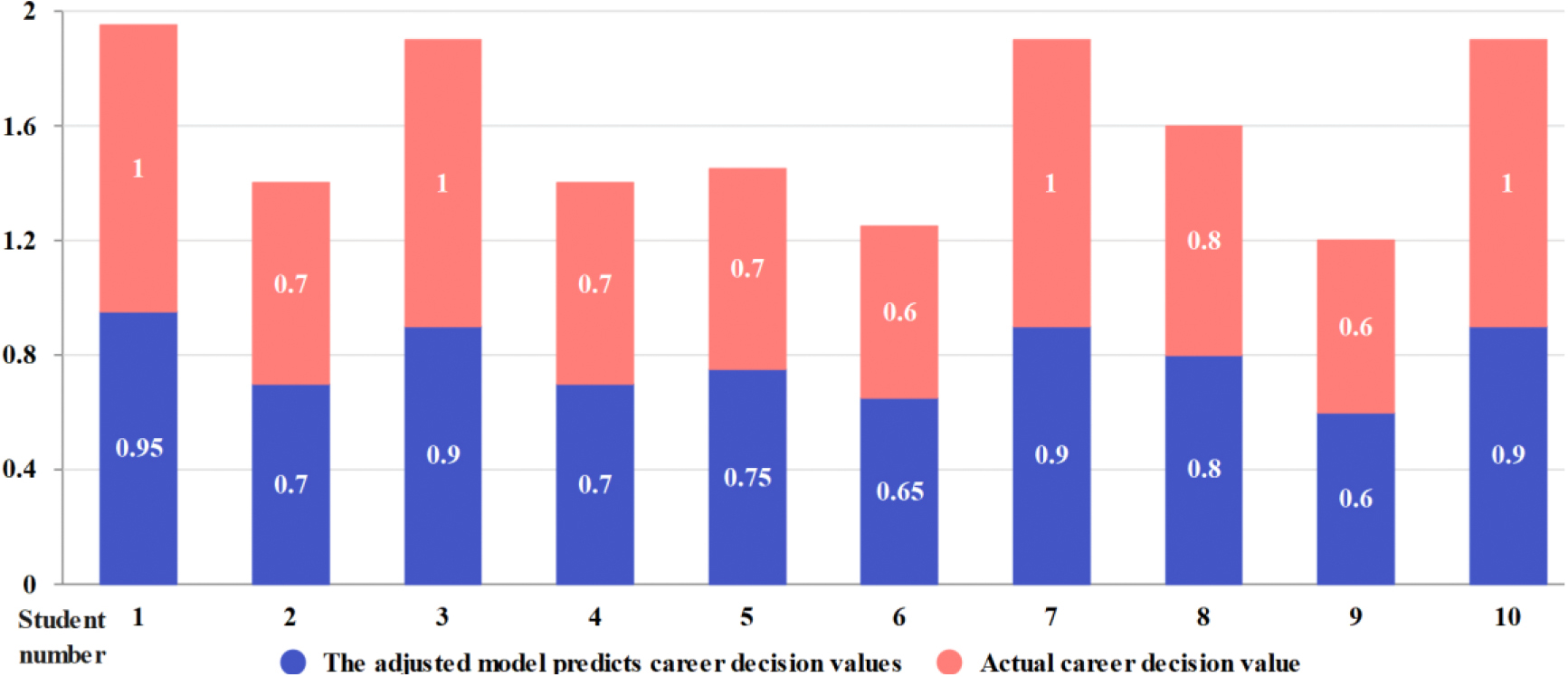
After adjustment and optimization, the prediction result of the model is closer to the actual career decision, and the mean square error of the model is significantly reduced. This shows that the adjustment and optimization of the study can effectively improve the prediction performance of the model.
On the basis of preprocessing, constructing, adjusting and optimizing the model, the results can be analyzed. This step is mainly to conduct in-depth analysis of the output results of the model in order to draw substantive conclusions.
In order to clearly show the performance of the model, the MSE value before and after the model optimization can be calculated. The results are shown in Fig. 5.
MSE values before and after model optimization.
It can be seen that after the optimization of the model, its prediction accuracy has been significantly improved.
Further, the career planning of each student can be analyzed in detail. Some representative students are selected for analysis, and the results are shown in Fig. 6.
Analysis of results.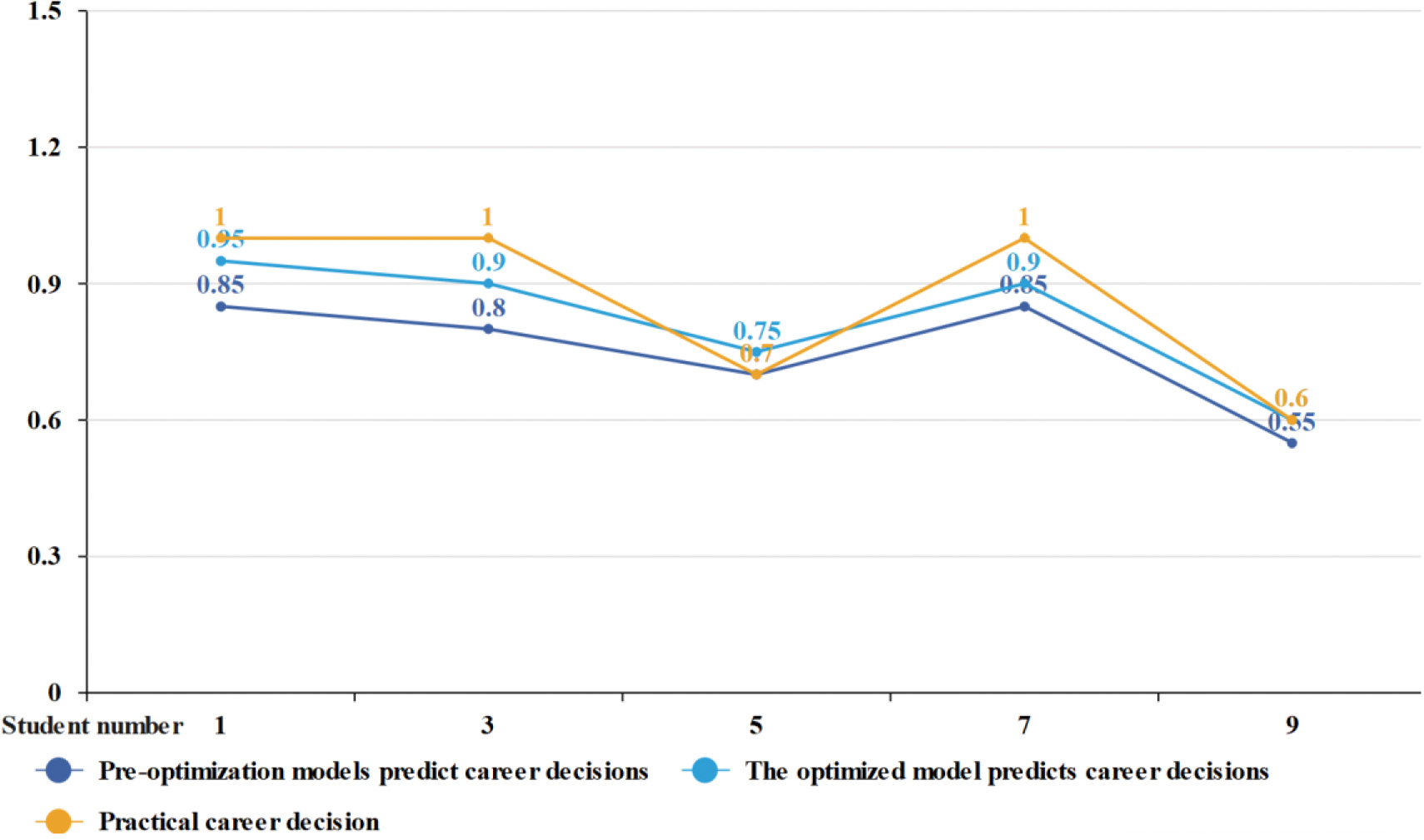
In the specific prediction of students’ career planning, the optimized model can better reflect the students’ actual decision making. For example, for a student with student number 1, the career decision value predicted by the optimized model (0.95) is closer to its actual decision value Eq. (1) than the pre-optimized value (0.85). This indicates that the optimized model can more accurately predict the career planning of college students.
At the same time, compared with traditional career counseling and occupational psychological testing, fuzzy control algorithm shows significant advantages in efficiency and accuracy. To be specific, traditional career counseling usually requires more time and human resources, while fuzzy control algorithm can process a large amount of data in a short time and give more accurate career planning suggestions. At the same time, the flexibility and personalization of the algorithm also make it a superior tool, especially in dealing with the complexity of individuals and situations.
Compared with other data-driven methods such as decision trees and random forests, fuzzy control algorithms are unique in dealing with uncertainty and fuzziness, which is particularly important in the changeable and uncertain field of career planning. In addition, fuzzy control algorithms are more interpretable than algorithms such as deep learning, helping users and consultants to better understand the model’s predictions. Overall consideration, fuzzy control algorithm shows its superiority in many aspects, but also needs to be integrated with other methods to achieve the most comprehensive and effective career planning support.
To sum up, the application of fuzzy control algorithm in college students’ personal career planning and entrepreneurship has remarkable effects. After the model optimization, the results predicted by the model are closer to the actual situation, which provides an effective reference for college students’ career planning.
Although the fuzzy control algorithm in this study shows a good effect in the application of college students’ personal career planning and entrepreneurship, there are still some problems in the process of model construction and use, which need to be further solved and optimized.
Problem 1: Data collection and processing. In this study, the sample size is ten. Although the data collection of each sample is very detailed, the total number is relatively small, which may not fully reflect the career planning and entrepreneurial trend of college students. At the same time, due to the complexity of personal circumstances, some data may be biased.
Solution: Expand the sample size: Collect more samples through multiple channels, such as online questionnaires and face-to-face interviews. Improved data processing: Adopt a standardized or normalized approach to data processing to reduce bias. Data validation: Quality assessment of the newly added sample data to ensure its reliability.
Problem 2: Model construction and optimization. Although the research has used fuzzy control algorithm to predict the career planning of college students, the model in this study may still have some limitations, for example, the model may not have strong adaptability to some individuals or specific situations.
Solution strategy: Introduce more input variables: Consider more factors that may affect career planning and entrepreneurship, such as social networks, expertise, etc. Adjust fuzzy rules and fuzzy sets: Repartition fuzzy sets and adjust fuzzy rules based on new input variables. Optimization algorithm application: Use genetic algorithm or other optimization algorithm to adjust the model parameters. Validate the model again: Validate the model with new sample data and further optimize according to the results.
Question 3: Interpretation of results. Although this research model can predict the career planning of college students, there are still some difficulties in understanding and applying these prediction results to specific individuals.
Solution strategy: In-depth analysis of predictions: Compare the predictions of different individuals to understand the differences in their career plans. Practical application: Work with career planning and entrepreneurship coaching experts to translate predictions into concrete recommendations for action. User feedback: Gather feedback from practice to further optimize the model.
After solving these problems, the model of this study will be able to predict college students’ career planning more accurately, and provide more effective support for college students’ career planning and entrepreneurship.
Social impact and ethical considerations
Fuzzy control algorithm provides a quantitative method based on data for college students’ career planning, which helps students to make more reasonable decisions in the diversified and uncertain career environment. However, the algorithm may also have implications for traditional practices in the career coaching industry, raising concerns among practitioners about their professional status and financial gain. In addition, over-reliance on algorithmic output may reduce the opportunity to use subjective judgment and intuition in the decision-making process.
In terms of ethical considerations, there are several points to note:
Data Privacy and Security: Any research related to personal data is subject to strict standards of data privacy and security. Data needs to be anonymized and de-identified to prevent improper identification or tracking of individuals.
Algorithm fairness and bias: The algorithm design and application process should focus on considering the equality and fairness of all groups (such as different gender, race, economic status, etc.), so as to avoid exacerbating social inequality due to algorithm bias.
Algorithm interpretability and transparency: Given that algorithms may affect the career planning of individuals, they should have a certain degree of interpretability and transparency so that individuals and all sectors of society can understand the working mechanism of the algorithm and its output.
Human-machine decision balance: While algorithms can provide useful advice and direction, it is not a substitute for the combined judgment of individual and professional tutors. Therefore, the application of algorithms should be to assist rather than replace human decision making.
To sum up, fuzzy control algorithm undoubtedly provides a powerful tool for college students’ career planning and entrepreneurship, but its wide application also brings a series of social and ethical challenges. These challenges require researchers, educators, and policy makers to fully consider and address these implications as they promote the widespread use of the technology, in order to promote the sustainable and ethical development of the technology at the societal level.
Conclusions
This study aims to explore the application of fuzzy control algorithm in college students’ personal career planning and entrepreneurship, providing a new perspective and solution to the problems faced by this specific group. First, we deeply understand the theoretical basis of fuzzy control algorithm, including fuzzy set, fuzzy logic and the core principle of fuzzy control system. Based on this theory, we construct a specific fuzzy control model, and carry out the preliminary validity verification through the experimental data. Not only that, we also identify the main problems that college students may face in the process of career planning and entrepreneurship, and propose solutions with implementation steps for these problems.
Although the model shows some predictive effect, some limitations are also exposed during the study. For example, due to the relatively small sample size, the generalization ability of the model needs to be improved. In addition, there are limitations to the adaptability of current models to specific individuals or situations. In response to these limitations, future research directions will include increasing the sample size, improving data collection methods to improve model accuracy and reliability, further optimizing model parameters, and exploring the application of the model in practical career planning and entrepreneurial guidance.
In addition to the application in the specific field of college students’ career planning and entrepreneurship, this study also aims to explore the potential application of fuzzy control algorithms in broader fields, such as education and health. On the whole, this study not only enhances our comprehensive understanding of college students’ career planning and entrepreneurship, but also provides a valuable reference for the further research and application of fuzzy control algorithms. At the same time, it reveals the frontier problems and challenges in this field, and provides a clear direction for future research.