




Abstract
College students are learning a foreign language must know how to translate the spoken or written content from the respective language into English. These approaches do not help the college students to develop the capacity for rational thinking and adequate the motivation for the English translation. The educational principles are not in line with the qualities of the students in the typical English translation classroom teaching, and the teaching methods are out-dated. In the older process of the teaching English translation, many unreliable, vague aspects need to be considered, such as recognizing students’ fundamental English knowledge, unique circumstances, language proficiency, cultural differences, and the ambiguity of the source language. The main issue with the current English translation evaluation methodology is that it cannot be easily to deal with thecomplex fuzzy indices when judging the accuracy of the student translations. An algorithm named FCAM-AHP-ANFIS is proposed to provide an effective and accurate method for evaluating and predicting students’ English translation outcomes to overcome the traditional shortcomings. According to the proposed approach, students can learn about passive translation, but they may struggle to actively improve their translation skills. College students can benefit from the decision-making aid provided by the extensive evaluation technique due to its high availability and precision. The fundamental benefit of the fuzzy technique over more traditional forms of the assessment is that it accounts for the ambiguity and uncertainty of the making judgments at the human level and provides a coherent framework that includes the indistinct findings of the several steps in evaluating an English translation. The Fuzzy Comprehensive Assessment Model (FCAM) is a decision-making method that uses the fuzzy logic to assess the quality of English translations among the college students. The Analytic Hierarchy Process (AHP) is employed to calculate each criterion’s relative importance and determine the optimal weighting for each criterion utilized in the assessment model. The Adaptive Neuro-Fuzzy Inference System (ANFIS) is used to analyze the translated data and generate predictions for the students’ translation outcomes. The experimental outcomes show the accuracy of the English translation assessment scores are 95.6% with 97% precision, 96% recall, and 96.5% of f1-score metric in addition to Root Mean Square (RMSE) and Mean Absolute Error (MAE).
Keywords
Introduction
College English instruction is a cohesive system that incorporates translation, learning, speaking, writing, listening, and teaching. The English translation is essential to English instruction because it is directly tied to the student’s overall English proficiency. Translation education is becoming increasingly crucial to satisfy the demand for developing highly competent translators. The process of translating words that are written or spoken from a single language into English is referred to as translation. It entails accurately translating the source text or dialogue’s meaning, style, and purpose into English. The new teacher-student relationship will increase students’ awareness of independent learning, which can increase student excitement and motivation for studying English translation and progressively develop competence, capacity to learn, and reasoning skills. Students can apply a decision-making process to assess the caliber of their English translations by using the fuzzy comprehensive assessment model for English translation. Accuracy, fluency, clarity, and coherence are only a few of the factors and aspects of the translation process that are considered. Each factor is given a weight depending on its relative relevance. The translation is then assessed using these standards, and the program generates a composite score that reflects the translation’s overall quality. The fuzzy comprehensive assessment approach is a statistical technique built on mathematical theory.
In the usual English translation classroom setting, the educational philosophies and instructional techniques are outdated and do not reflect the individual traits of college students [1]. Discussing translation ideas and practices is a key component of many teachers’ traditional teaching approaches, and the translation curriculum lacks imagination and adaptability. Therefore, significant innovation is required in educational strategies to build students’ translation skills [2]. Colleges and universities should prioritize cultural sensitivity, improve the integration of English translation education when conducting English translation teaching, and encourage English majors to develop their highly skilled practical translation skills. With the aid of situational cognitive research, one must constantly implement the classroom’s optimization and creativity throughout the English translation of instruction in colleges and universities to effectively stimulate students’ interest in learning. A good translation must be close to the best in terms of length and vocabulary. The computer rating system uses the total length of translated statements as an assessment measure, and sentencing guidelines vary for lengthy and brief translated statements [3]. By implementing a data-driven approach for asking, answering, and evaluating questions for English translation among students to assess the presence of the corpus by the teacher, student observation and discussion, student report analysis based on outcomes, teacher’s guidance, consolidation of performance execution, and student/teacher comparison evaluation on translation [4]. The development of an artificial translation grading system based on BP neural networks has improved the quality of the English translation abilities of college students [5]. A fuzzy assessment approach was developed for assessing college English teaching excellence based on the Analytic Hierarchy Process (AHP) technique and grey system theory. This model ensures an intuitive and accurate computation; still, it has shortcomings in that incorrect selection of the decision variables in AHP will lead to various outcomes. The variety of smart fuzzy bureaus determines a hierarchy of machine translation systems to deal with the variation in a statement identifying in the target language. The model checks for generating a specific characteristic and gives them a score based on the text that receives its conceptual significance and prominence [6]. Using a translation task based on the fuzzy semantic optimal solution will increase the efficiency and acceptability of using an English corpus for translation using intelligent registration and feature match computing [7]. The random matrix approach of a fuzzy comprehensive evaluation is utilized to perform extensive analysis and research on assessing foreign language translation proficiency at colleges. A matching framework is created for the automated evaluation of translation stages in college courses [8]. To reduce the evaluation burden of the translation, constructed a neural machine translation model; the computer learns its function automatically, the data is turned into word vectors in a distributed manner, and the translation between the language of origin and the target language may be done directly through the neural network. Still, updating the parameters for assessment is a complex process [9]. However, most of the research currently conducted on the rating scale systems of foreign language translation instruction in secondary schools is irrelevant and unable to assess the efficacy of such instruction in other schools [10]. Therefore, an assessment model is created by a fuzzy logic-based drought index, which analyses its ability to anticipate drought and then evaluates the ANFIS technique performance to enhance the predictions [11]. In the full model of fuzzy mathematics, fuzzy logic is applied to replicate as the human brain processes fuzzy data. It breaks down the items into various separate assessment elements, evaluates every level of factor using fuzzy changes, and then determines the best method to generate an in-depth evaluation from the perspective of evaluation composition [12].
The core tenet of the interactive method is that the real significance can only be communicated through a foreign language. Students are more likely to be successful in learning an additional language when they are exposed to authentic situations where the language is utilized. Students’ communication skills, including their speaking ability and other abilities like listening and reading, were found to improve due to their exposure to the English language. Vocabulary, grammar, pronunciation, understanding, and fluency are just a few of the sub-skills shown to increase. Students taking a foreign language in university should be able to accurately and fluently convert spoken and written material from the target language into English. These methods do not encourage pupils to think critically or work with sufficient enthusiasm to improve their English language skills.
A model for improving sustainability in the sugarcane agroindustry supply chain that is adaptive fuzzy multi-criteria-based FIS is used with initial criteria for evaluation [13]. Aslam [14] applied the hybridized AHP-Natural Breakpoint Method (NBM) method of the fuzzy comprehensive evaluation model to assess the stability before choosing the seven nations of health level for computation and analysis of socio-economic development. Likewise, the assessment model for English translation among college students to improve their professional skills has proceeded further. The major motivation of this paper is to 1) Implement FCAM-AHP-ANFIS for English translation among college students to improve the quality of English translation education and help students acquire the information and abilities required for success with educational and career endeavors. 2) The ideal weighting for every variable in the model is decided using the AHP, which is used to assess the relative significance of each factor. The data is then analyzed to predict the students’ translation results using the ANFIS. 3) The assessment outcome gives the accurate translation scores for the students based on various metrics and predicts their scores using accuracy, precision, recall, f1-score, RMSE, and MAE.
The research work of this paper is categorized into 5 sections. Section 2 summarizes existing relevant research ideas concerning the Fuzzy assessment model for English translation among college students; the 3rd section analyzes the current research work FCAM-AHP-ANFIS model proposed in this paper for college students; Section 4 discusses the implementation part and analysis of the comprehensive assessment model for the English translation, and gives specific result outcomes based on several evaluation metrics; the Section 5 discusses the conclusion of the proposed idea and give future scope related to this research.
Literature survey
Li et al. implemented the Fuzzy evaluated Back Propagation Optimization (FBPO) algorithm to assess the college student English translation education scheme [15]. Fuzzy assessment will be utilized to identify the uncertainties in the English translation, and the soft-max layer of a neural network will be used to categorize these uncertainties. Students’ state of mind and preferences are examined using the questionnaire approach of 2 classes with 60 students in university, predicated on a thorough study of individual parameters. According to the examination outcomes, the proposed comment module’s accuracy has increased by roughly 3% to 5% greater than the existing model. Despite advancements in BP’s dependability and accuracy, the optimization algorithm’s performance remains highly context-dependent, making it difficult to generalize.
Zhang et al. elaborated a model of Neural Network (NN) using Particle Swarm Optimisation (NN-PSO) training to assess the students’ accuracy level in English translation proficiency, which can help teachers in assessing students’ ability of English translation and serve as a guide for subsequent teaching [16]. The study also suggested a technique to enhance the Generative Adversarial Network (GAN) by boosting the knowledge relationship among the discriminator and generator networks based on Convolutional Neural Network (CNN) and multilevel reinforcement learning. The outcomes demonstrate that, with an overall accuracy score over 85% and a 91% overall content retention score, that is significantly higher than the existing models. The main limitation of the proposed PSO algorithm is being easily trapped in a local optimum in high-dimensional spaces.
Sha et al. proposed a Fuzzy Comprehensive Evaluation Model based on an Extreme Gradient Boosting (FCEM-XG Boost) algorithm and technology services’ residual network to evaluate the teaching quality of teachers in preschool; an assessment model for prediction was created and successfully tested through trials [17]. Initially developed an index system for progressive evaluation that is hierarchically organized based on the fuzzy connection synthesis approach. The suggested model’s AUC, accuracy, precision, recall, and F1 values were 93.5%, 91%, 91.4%, 93.1%, and 93%.
Ji et al. suggested the FCEM built on the Bat Algorithm (FCEM-BA) by integrating quantitative assessment with actual indicator facts to efficiently measure the qualitative analysis and offer a practical and convenient system for evaluating the quality of English education [18]. Each factor’s relative weights are determined, decreasing the impact of difficulty levels on this indicator and improving the information of measurable indicators like students’ course scores. The result shows that it improves clustering accuracy by 95% by combining local and global searches and achieving quick convergence. The convergence rate of the bat algorithm is high at first, but it gradually decreases as the program progresses.
Tejedor-García et al. employed the FCEM using the Entropy Weight (FCEM-EW) to assess the groundwater quality [19]. Creating an indicator and evaluation collection, defining the membership operation, the fuzzy matrix, and choosing the set weight, creating an FCEM using the weighted average technique to classify the water quality. The membership measurement and fuzzy transformation are used to quantify the unresolved variables in the groundwater and then to acquire the academic assessment results. The entropy technique has a major gap since it cannot account for the expertise and experience of specialists. The findings indicate that the weighted average principle’s water quality assessment is better than other techniques and shows 0.31% of the acceptable rate.
Zhu et al. evaluated the quality of English teaching using the AHP and fuzzy decision tree algorithms. Fuzzy logic makes it challenging to have precise rules and membership functions. They provided assessed information to university officials to help improve the quality of English teaching in higher education [20]. Establishing a structured analysis-based assessment measure for English teaching is done first. The procedure for the decision tree concept is thoroughly described, and finally, the fuzzy decision tree algorithm is utilized for assessing English teaching quality. An outcome demonstrates that the AHP method’s MAE and RMSE to assess the quality, respectively 0.1% and 0.35%, provide greater accuracy in assessing English teaching quality.
Gong et al. [21] This research takes a big data mining point of view and employs fuzzy comprehensive analysis to solve the issue. Specifically, it suggests a data-driven, intelligent evaluation methodology using fuzzy comprehensive analysis for educational effectiveness. First, timely business data, such as teacher performance, course contents, student feedback, etc., is acquired from online courses. Using the coded design, simulate some tests in which the proposed technical framework is implemented on an existing Web application. The results of the studies show that the proposed method works well for assessing the effectiveness of a course.
The literature review summary gives us a clear idea of earlier technical implementations related to the FCAM-AHP-ANFIS model and its background information. The earlier shortcomings are addressed by this proposed scheme considering challenges faced in English translation studies among college students based on several assessment criteria. The techniques taken for comparison are FBPO, FCEM-XGBoost, FCEM-EW, and NN-PSO models, which entail all the parameters considered for improving the English translation of college students and promoting their life skills. Besides these techniques, the FCEM-BA and Fuzzy decision tree for AHP evaluation are also analyzed for technical study.
Proposed algorithm
The curriculum for English education is varied and has clear social characteristics that comprise several forms of English listening, verbal, reading, writing, translation, etc.; when there are many elements to consider and ambiguity, the fuzzy comprehensive assessment approach is a common decision-making technique. This method can assess the level of English translations produced by college students. The academic community is investigating the use of various methodologies to establish the level of quality in addition to its usual focus on evaluating the impact of quality. English translation instruction is a key way to develop a lot of high-caliber, application-focused English translation skills since it is an essential component of college foreign language education.
Proposed scheme implementation.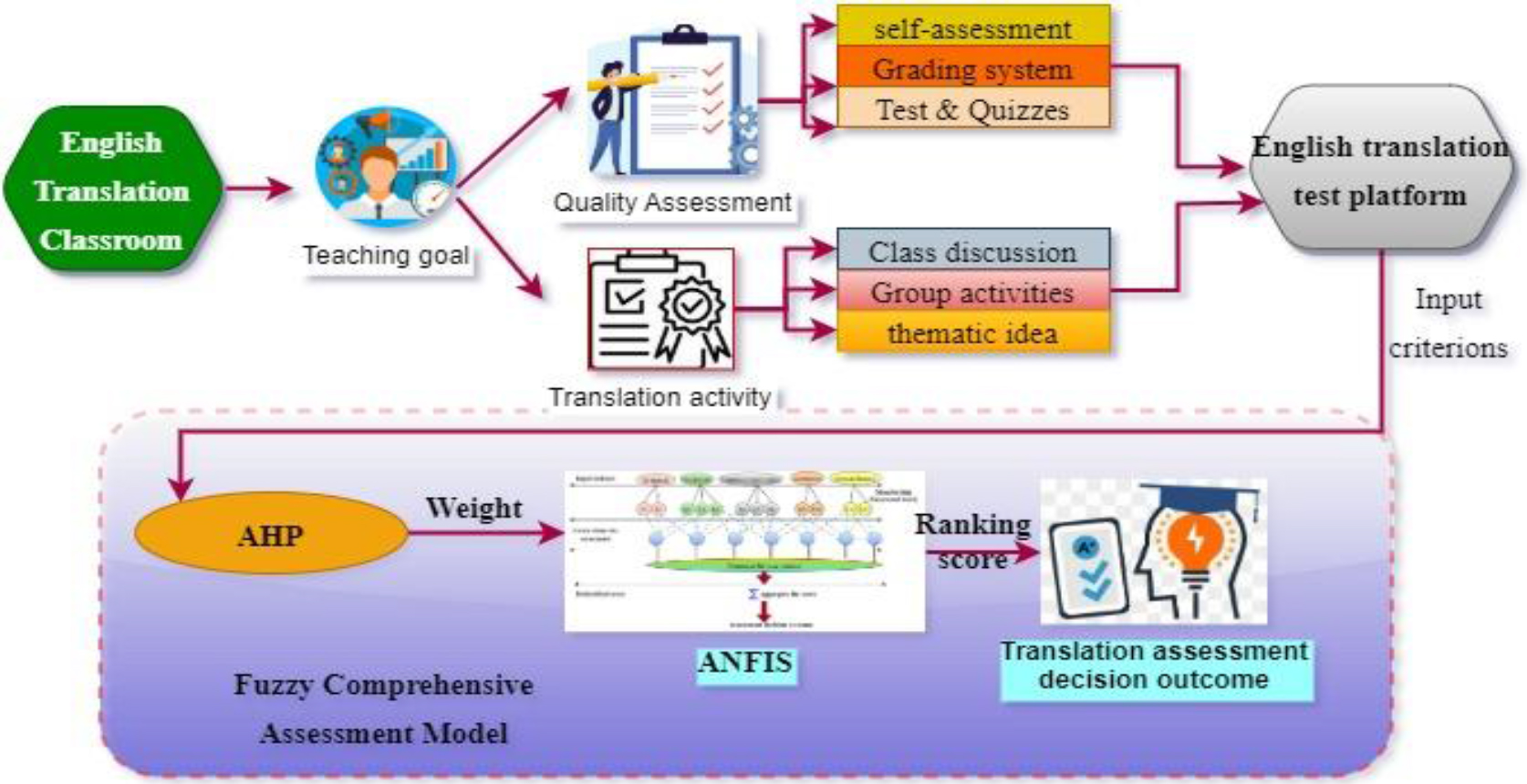
Figure 1 discusses the Fuzzy Comprehensive Assessment Model (FCAM) employing AHP and ANFIS, which provides a reliable and accurate technique for assessing and forecasting students’ English translation outputs. Initially, students’ data from the classroom of the English translation is categorized into the curriculum of the teaching goal where the quality assessment and translation activity are divided into several separate grading systems, peer assessment, and group discussion activities. The input criteria like grammar, vocabulary, sentence formation, coherence, and cultural fluency are chosen as initial first-level indexes. Then, the complexity of the source material, the student’s degree of English ability, and other pertinent variables are some of the various elements that this model seeks to incorporate. The ideal weighting for each factor in the model is decided using the Analytic Hierarchy Process (AHP), which is used to assess each factor’s relative importance. The data is then analyzed using the Adaptive Neuro-Fuzzy Inference System (ANFIS) to predict the students’ translation results.
To improve the collaboration and knowledge of teaching innovation among English translation teachers, the English translation major also develops courses in English translation assessment, stylistics, and contemporary educational technology. The idea behind an English translation curriculum based on fundamental literacy skills is to establish the course’s objectives from both the functional and aesthetic viewpoints of the English translation field.
The following actions can be conducted to evaluate English translations using the fuzzy comprehensive assessment approach:
The AHP technique was employed to determine the weights of the indices utilized in this criteria of the college English translation. This method has the advantages of being simple to calculate, reliable, and having clear physical meaning. College students’ English translation abilities can be evaluated using a fuzzy comprehensive assessment model based on the Analytic Hierarchy Process (AHP). A brief description of the step-wise implementation of the proposed technique is provided below in Fig. 2.
Step-wise implementation of FCAM-AHP-ANFIS model for English translation.
Step 1: Establish the criteria for assessment: The first stage is to establish the standards by which the translation abilities will be judged. Equation (1) defines the first-level criteria: grammar, vocabulary, the structure of phrases, coherence, and cultural appropriateness need to be identified.
Where M1 to Mn are the criteria used for the evaluation indexes of membership function for the 5 linguistic variables representing grammar, vocabulary, sentence construction, coherence, and Cultural fluency are listed in Table 1. Equation (2) represents the determined assessment set factors as follows:
Where
Initial index values
Step 2: Determine each criterion’s relative importance (weight) using the AHP approach. To calculate the weight of each criterion, assign a team of experts to rank the significance of all criteria with a range of scale 1 to 5, as 1 represents the least important and 5 the most important by pair-wise comparison judgments is defined in Eq. (3). Grammar: 0.30, a score of 0.20 for vocabulary, 0.15 for sentence construction, 0.20 for coherence, and 0.15 for relevance to cultural fluency.
Where
Step 3: Create the linguistic variables: The criteria are portrayed as linguistic variables in the fuzzy comprehensive assessment model. The membership function
Step 4: Create an ANFIS model: The fuzzy inference system produced by the ANFIS module for English translation is illustrated in Fig. 3a. The fuzzy comprehensive evaluation uses linguistic information for each sub-criteria and the weights derived from the AHP module as input. Give each linguistic variable a membership function.
Each sub-criterion’s fuzzy rule set can be quantified by using the membership function. Fuzzy information about a linguistic factor can be processed through a precise computational approach to yield a score for that variable. Fuzzy thoroughness is an effective method for addressing both the objectivity of learners and the ambiguity of the objective during the assessment procedure.
ANFIS model implementation for English translation.
Step 5: Fuzzy comprehensive assessment calculation: Calculate the fuzzy comprehensive assessment using the weights produced in Step 2 and the linguistic data received in Step 3. Applying the weights derived from the AHP approach to aggregate the ANFIS results for each sub-criterion. A membership function describes an element’s membership level in a particular set with a ranking matrix. Equation 4 defines the instances of a bell curve with a peak at the value of “good” that would represent the membership function for the term “good”.
Where
According to the number of evaluation indices for college English translation among students by considering the assessment indicators, the Random Index
Where CI represents the maximum eigenvector identified from the assessment indicators of English translation in the classroom by teachers and students, if the condition of the above formula is not satisfied, then the quality assessment value for the English translation of college students does not meet the assessment conditions.
Step 6: Analyse the performance: Assess the translation’s performance using the membership functions and weights set to each criterion. It can be achieved by scoring each criterion and comparing the translation to the linguistic factors. The assessment grade of the assessed entity is decided based on the maximum membership degree. The sample evaluation scores listed below for the “grammar” criterion: Very good: 5 Good: 4 Average: 3 poor: 2 very poor: 1.
Score range allocation of linguistic variables
Score allocation for assessment criteria
Step 7: Score aggregation: Add the scores to achieve an overall translation score. Fuzzy logic, which enables the merging of various scores into a single, comprehensive score, can do this. Utilize the fuzzy aggregation operators like max, min, and weighted average to combine the fuzzy scores for each alternative to create a final fuzzy comprehensive score. The following linguistic categories contribute to the final score: “Very good”, “good”, “fair”, “poor”, and “very poor”. Membership function for the first order indices overall score has been calculated in Eqs (6) and (7) as follows:
Where
Where M1 to M5 is the membership function for the five linguistic variables representing grammar, vocabulary, sentence construction, coherence, and Cultural fluency with corresponding weight values represented as
Step 8: Using defuzzification to change the overall score from fuzzy to crisp, as explained in Eq. (8).
Equation (9) defines the variable
Step 9: Analyzing the Sensitivity: Conduct a sensitivity study to see how well the findings hold up to expert opinions and linguistic terminology changes. Repeat the fuzzy comprehensive assessment after making necessary adjustments to the weights and English language phrases.
Step 10: Making decisions: To decide based on the criteria and aims, use the options’ ranking and the sensitivity analysis’s findings.
The summary of this section explains that applying the fuzzy comprehensive evaluation approach allows for a more thorough and flexible assessment of the quality of English translations produced by college students while considering various factors and their respective weights. This method might help give pupils feedback and direct them toward developing their translation abilities. The quality of English translation instruction can be improved by this FCAM-AHP-ANFIS model, which will benefit all teachers in the translation process among college students. Administrators can comprehend the consistency of teachers’ teaching level and provide adequate support for decision-making while teachers can learn the justifications underlying alterations to assessment scores.
Ideas are introduced, skills are summarized, scenarios are developed, groups evaluate each other, instructors provide comments, and information is retained, among other things, in the course materials. The topological image method is utilized to create an ontology model in the module responsible for context perception. Interviewer judgment is the connotation, the topic viewpoint is the extension, and discussion link logic and temporal control are the application. Figure 3b shows the intricacies of the model’s design. Through the challenge of the activity, kids’ mental initiative is strengthened. With a constant internet connection, you may do instantaneous searches depending on the frequency of search terms. The class uses a series of arbitrary questions to distill search results into keywords and summaries. Teachers will pair students with virtual interviewers based on class size to conduct split-screen discussions using recorded interviews from the school’s network. Through direct interaction, group members learn about one another, share their perspectives, and evaluate their performance. Create a predetermined number of online questions for content-based real-time monitoring using feedback identification. For educators to get an accurate read on how many students miss important information or persons because they don’t recognize their names, this link necessitates real-name responses. A common interview no-no is discussing certain topics. The re-telling of a problem may be subject to a “fuzzy evaluation” due to target modification based on historical statistics findings. Unknown people’s blind spots can also be solved using fixed-point methods.
Schematic structure of proposed model.
Data source Description for English translation among college students
The dataset Language translation consists of English translation courses and their corresponding evaluation methods of student performance level inside the classroom evaluation based on the curriculum questionnaire framed by the university. The first column contains English words and sentences, while the second column has French words and sentences. This data is useful for linguistic translation projects. Different values apply because the same English word has a different French translation. The main attributes for comprehensive assessment are student exam performance, translation capacity, answering tests and quizzes, dictation, and essay writing. The English translation major also develops courses in English translation assessment, stylistics, and contemporary educational technology to foster teacher collaboration and raise awareness and innovation. When comparing the quality of the translation to their expectations, the businesses or clients who engage the students will judge the graduate translator favorably or unfavorably. If the quality is excellent, the translation program can share part of the praise; if the quality is subpar, the student’s education will be called into doubt. Ultimately, teachers who create high-quality exams and expect the best performance from their students will raise the bar for the industry as a whole. The quality assessment criteria include grammar, vocabulary, sentence construction, cultural fluency, and coherence attributes for English translation among college students. Teachers also perform assessments like student self-tests, peer, grading, placement, portfolio, process, and summative types within a particular period, providing a Likert scale of 0 to 5.
Since the teacher has decided to place less importance on mechanics than on the other categories, the total score for the translation will be higher than 23. A grid assessment helps pupils discover where they excel and need improvement. In certain classrooms, teachers thoroughly explain the significance of each cell’s numerical value. If a student gets a 5, for instance, on the Fluency rubric, they will know that their work is nearly at the level of a native speaker and features a wide range of sentence structures. A learner can rework the translation more clearly using detailed comments like the ones provided below. Communication and education scholars agree that descriptive comments are analogous to messages.
Results and discussion
A sample scenario for Assessment of English Translation in a college classroom:
A college language professor gave the students an English translation assignment and asked them to convert a German sentence into English. The teacher evaluates the translations after the students have turned in their assignments and offer suggestions or decision based on their performance for their professional improvement.
Original text in German: “Der Hund rannte durch den Wald und bellte fröhlich”.
English translation: “The dog ran through the forest and barked happily”.
Discussion
The educational ideas and teaching methods used in the normal English translation classroom are outdated and do not correspond to the qualities of students. There are a lot of unreliable, imprecise factors to consider in the traditional method of instructing English translation, such as taking into account students’ pre-existing knowledge of English, their situations, their level of language ability, cultural variations, and the ambiguity of the source language. English translation assessment models have a basic problem: they cannot easily deal with complex fuzzy indices for judging the quality of student translations. An algorithm called FCAM-AHP-ANFIS was suggested to address these issues to evaluate and forecast students’ English translation outputs. College student English translation quality can be evaluated with the help of the Fuzzy Comprehensive Assessment Model (FCAM), a decision-making approach that employs fuzzy logic. The relative importance of each criterion and the ideal weighting for each criterion used in the assessment model are determined using the Analytic Hierarchy Process (AHP). Students learn about inactive translation from their teachers but cannot hone their translation skills on their own. The great accessibility and precision of the full assessment approach might aid the choice of English translation among college students. One major benefit of the fuzzy method over more traditional evaluation methods is that it provides a unifying framework for the indistinct findings made at various points while evaluating an English translation. Based on the results of the evaluation studies, the proposed technique FCAM-AHP-ANFIS outcome can aid teachers in evaluating their students’ English translation competency and provide students with a standard against which to improve. The methodology outperformed all previous attempts at improving students’ ability to translate English into other languages to boost their productivity in a professional setting so that they can participate in curriculum creation on a global scale. As a result, the model’s overall performance is improved by reducing the prediction error utilizing RMSE and MAE in the scoring process.
Conclusion
Most traditional translation courses use the teacher-focused evaluation technique of translating skills. Aiming at the challenges of the current work, the proposed work of FCAM-AHP-ANFIS provided an efficient and accurate assessment of the English translation model of college students and promoted their decision skills. Under the direction of their teachers, students gain knowledge about inactive translation but cannot actively develop their translation abilities. The great accessibility and precision of the comprehensive assessment approach can help in the decision-making of English translation among college students. The main advantage of the fuzzy method over conventional assessment approaches is that it captures the fuzziness and uncertainties accompanying human decisions and offers a unified structure that incorporates the hazy conclusions from many stages of an English translation assessment procedure. The future scope may involve the online fuzzy-based machine English translation score system implemented by advanced NLP techniques for college students.
The accessible and precise complete assessment approach might help college students choose English translation. The fuzzy method’s key benefit over conventional evaluation methodologies is that it captures the fuzziness and uncertainties of human judgments and provides a coherent structure that integrates the hazy results from several phases of English translation assessment. However, this method (AHP) has some drawbacks, including its high computational cost for small tasks, subjective nature and reliance on emotions to be converted to numerical evaluations, and the increased time and effort required for more pair evaluations.
Footnotes
Step-by-step assessment process
Grammar: The teacher assesses the student’s use of grammar in the translation by examining the sentence structure, subject-verb agreement, and verb tenses. The grammar and syntax of the translation are accurate. The statement is clear and well-structured. Vocabulary: In evaluating the student’s translation, the instructor looks for acceptable word choice and phrase usage. The translation uses appropriate vocabulary that is consistent with the original text. The words “forest” and “barked” are good choices that accurately convey the meaning of the original German. Sentence Construction: The teacher checks the student’s translation for accuracy and appropriateness of meaning before marking it to construct a perfect sentence formation. The translation captures the style and tone of the original text. The language used is simple, which is appropriate for the subject matter. Coherence: The translation accurately conveys the meaning of the original text. The verb “rannte” is correctly translated as “ran”, and the adjective “fröhlich” is accurately translated as “happily”. Cultural sensitivity: The translation is culturally sensitive and appropriate for the target audience. No cultural nuances in this particular sentence would require special attention.
Peer assessment: Students are put into pairs and asked to review and give each other feedback on their translations. They must assess the translations following the standards stated in the evaluation criteria and offer detailed recommendations for improvement.
Discussion in class: The instructor facilitates a discussion about the translations the students have turned in. The talk focuses on typical errors and misunderstandings and offers advice on where work needs to be done to improve.
Assessment feedback or Decision outcome: The ranking categories are usually used by the instructor to provide suggestions to students on their performance and to help students identify areas for improvement in their English translation skills. The instructor assesses the student’s sentence and comments on its accuracy and effectiveness. The translation effectively conveys the original text’s meaning and intent to the target audience. The sentence is clear and concise, effectively communicating the dog’s action in the forest. The teacher gives the students general criticism on their translation, pointing out their strong points and areas for development. Overall, this translation meets the evaluation criteria and would likely receive a high grade in a college translation class.
The final goal of an English translation assessment is to provide a clear, unbiased assessment of the student’s translation proficiency and to assist the student in developing their knowledge and abilities in English translation.
Utilized metrics for the accurateness of the proposed model
| Metrics | Formula & eqn no. |
|---|---|
| Accuracy | (10) |
| Recall | (11) |
| Precision | (12) |
| F1-Score | (13) |
Accuracy measure (%)
According to Table  , the evaluation criteria of the fuzzy comprehensive assessment model, “the number of correct translations” in Eq. (10) defines calculation of accuracy in which the total number of translations that accurately transmit the meaning of the original text. “The total number of translations” refers to all the translations completed by the study’s collegiate participants.
Recall measure (%)
Equation (11) defines the term “number of correct translations” denotes the number of translations that the fuzzy comprehensive assessment model determined to be accurate based on the evaluation criteria. “overall number of accurate translations in the text refers” to all of the translations made by college students using the fuzzy comprehensive assessment model that was faithfully translated from the source text.
Precision (%)
The “number of correct translations” in this Eq. (12) refers to the number of translations the fuzzy comprehensive assessment model determined to be accurate based on the evaluation criteria. The “total number of translations generated by the model” includes all of its output, including accurate and inaccurate translations.
F1-Score (%)
Recall and precision are computed earlier by Eqs (11) and (12); similarly, the F1 score is a statistic that combines precision and recall into one metric, giving both metrics a fair rating in Eq. (13).