



Abstract
To improve the current source-grid, load-storage microgrid coordinated optimal scheduling method, which is not ideal in terms of efficiency and effectiveness, the study combines convolutional neural network, variational modal decomposition, and long and short-term memory neural network to realize the short-term prediction of microgrid electric load. Based on this, a mathematical model having source-grid, load-storage coordinated optimal scheduling and an improved particle swarm algorithm are proposed for it. Compared with the particle swarm backpropagation model, the proposed microgrid power load short-term prediction model reduces the average absolute percentage error and root mean square error by 0.38% and 39.5%, respectively. In addition, the economic cost of the proposed power grid coordination and optimization scheduling model based on improved particle swarm optimization algorithm (IPSO) is lower, at $3954.3, and the load fluctuation is less, at 56.6 W. This indicates that the model proposed by the research institute helps to achieve self-sufficiency of electricity within the microgrid and mutual assistance between microgrids, thereby tapping into scheduling potential, and also helps to achieve economic electricity scheduling strategies, avoiding unnecessary thermal power generation and carbon dioxide emissions, and improving reliability. Therefore, the scheme proposed in the study can effectively realize the coordinated and optimal dispatch of source-network load and storage beneficial to the power enterprises.
Keywords
Introduction
With the continuous adjustment of global energy structure, the proportion of clean energy is gradually increasing, and the coordinated optimal dispatching of source-grid load and storage of power systems directs the research [1]. The traditional source-grid load-storage optimal dispatching methods often require many resources, and it is difficult to realize large-scale and real-time optimal dispatching [2]. To solve this problem, intelligent optimization algorithms have been explored to perform coordinated optimal scheduling of source-network load and storage [3]. Among them, Particle Swarm Optimization (PSO) can solve complex optimization problems with the advantages of fast, efficient, and stable [4]. However, the traditional PSO converges slowly and easily falls into local optimality [5]. Therefore, it is necessary to improve PSO in order to enhance its application in source-network load-storage coordinated optimal scheduling. To address the above problems, Variational Mode Decomposition (VMD), Long Short-Term Memory (LSTM) and Convolutional Neural Network (CNN) are implemented. Then, we construct a source-grid load-storage coordinated optimal scheduling model based on the power load prediction data, and propose a strategy to improve PSO, and use the improved PSO to realize the coordinated optimal scheduling of source-grid load-storage microgrid. This algorithm can find the optimal solution in a short time, and has advantages in stability and convergence. The research results provide a method for the coordinated and optimal scheduling of source-grid, load-storage. There are two main innovations in the research, the first one is to combine VMD, LSTM and CNN to construct a VMD-LSTM-CNN electric load short-term prediction model; the second one is to propose an adaptive inertia weight adjustment strategy to improve PSO and enhance the PSO global optimization performance. Study has four parts. The first part is a comprehensive compilation and discussion of current research literature on optimal grid dispatch and PSO; the second part is to propose an optimized dispatching strategy based on improved PSO for source-grid-load-storage coordination; the third part is to analyze the effect of the proposed strategy; and the last part is a summary of the whole research content.
Related works
Grid optimization scheduling refers to the process of improving the stability, reliability and economy of the power system by making scientific and reasonable arrangements and scheduling. Optimizing power grid dispatch holds immense importance in maintaining the secure and stable functioning of the power system, enhancing its efficiency, and cutting down on costs [6]. Therefore, how to optimize grid scheduling to sustainably develop power system has become the research direction. Yoon et al. proposed a DC microgrid power scheduling method based on quadratic planning, thus realizing the optimization of energy management of microgrids and satisfying the additional demand of users on the basis of securing the profit of power enterprises [7]. Quan et al. addressed the issue of heating and ventilation and Air Conditioning (HVAC) power system, an optimal system power scheduling method based on multi-period optimal tides was proposed, thus effectively reducing energy losses in HVAC power systems [8]. Naval et al. addressed the problem that fluctuations in electricity prices tend to affect Spanish irrigation systems by designed a virtual power plant optimal dispatch model with large-scale and small-scale distributed renewable energy generation, thus effectively reducing power costs [9]. Lin et al. introduced a decentralized method to solve the AC optimal tide coordination optimization problem in integrated transmission and distribution networks and demonstrated the effectiveness through simulation experiments [10]. Wang et al. introduced a resilience index for the adaptability evaluation of power systems in different environments, and constructed an elasticity-constrained economic dispatch model in power system operation based on it. Experimental results show that the transmission in the power system can be effectively dispatched under this model, thus reducing the risk of power outages in the grid [11]. Zhao et al. introduced an improved quantum PSO algorithm by Differential Evolution Algorithm (DE) and used this algorithm to dispatch the microgrid economic environment dispatch model to solve it so as to optimize the unit output and reduce the pollutant gas emission [12]. Huang et al. designed a distributed economic dispatching scheme considering network attacks to reduce the operating cost of the grid while ensuring its safe operation by addressing the vulnerable communication network [13].
PSO improves machine learning, image processing, target tracking, function optimization, etc. because of its simple structure, wide applicability and good optimization effect. Mai et al. combined interval type 2 semi-supervised likelihood fuzzy c-mean clustering algorithm with PSO algorithm to achieve accurate analysis of satellite images, showing an accuracy of 99% [14]. Xia et al. combined PSO algorithm with genetic algorithm (GA) to achieve optimal control of shift quality in powershift transmissions, thus avoiding power cycling during shifts and improving shift quality and driving safety [15]. Chen et al. proposed a new improved meta heuristic algorithm to provide higher quality parameters for the power grid. The results showed that the voltage waveform became smooth, achieving a reasonable balance between voltage waveform and network loss [16]. Singh et al. proposed a simplified mathematical model for hybrid energy systems, including power and hydrogen management, to evaluate the potential of hydrogen based energy systems [17]. Zheng et al. introduced a strategy to improve the PSO algorithm for its shortcomings. The structure of a wearable medical robot was optimized for medical services quality [18]. Ramli et al. improved the PSO and proposed a linear programming method that considered multiple characteristic curves, and combined the above two methods to achieve optimal coordination of directional overcurrent relays, which improved the performance of directional overcurrent relays [19]. Zhang et al. addressed the current problem of artificial neural networks (ANN) based on networks (ANN) based yarn strength prediction method is not ideal in terms of accuracy, and proposed a strategy to optimize ANN by combining expert weights with PSO algorithm. Experimental results showed that prediction accuracy increased significantly after optimization of ANN, which confirmed the effectiveness of this optimization strategy [20]. Wen et al. developed a deep recurrent neural network model with Long short-term memory cells to predict the total power load and photovoltaic power generation in the community microgrid. The results indicate that the coordinated charging mode between EES and electric vehicles can promote peak shifting and valley filling [21].
In the above results, it can be seen that the research related to both grid optimal dispatching and PSO is very popular, with more productive research results. A part of scholars apply PSO to grid optimal dispatching to improve the grid optimal dispatching effect. However, due to the shortcomings of the PSO algorithm, there are still some improvements of the current PSO-based optimal grid dispatching effect. Thus, the research proposes strategies to improve it and apply it to source-grid-load-storage microgrid optimal scheduling, so as to better enhance the effect of grid optimization and scheduling and reduce the grid operation cost, improving the economic efficiency of power enterprises.
Optimized scheduling of source-network load-storage coordination by improved PSO
In order to improve efficiency and reduce operating costs, the optimized scheduling of source grid load storage microgrids has received widespread attention. This study proposes an optimization scheduling method for source network load storage microgrids from two dimensions: load forecasting, scheduling model construction, and solution, in order to improve the optimization scheduling effect of microgrids.
VMD-LSTM-CNN based microgrid day-ahead load prediction model
Due to the inherent nonlinearity of power loads, prediction models based on statistical methods have low prediction accuracy, and even small prediction errors may cause significant economic losses. Faced with factors such as climate change and seasonal effects, statistical methods cannot provide ideal performance, while neural network-based prediction models still have high-performance modeling capabilities in the face of the nonlinearity and complexity of load time series. The study proposes a combination of VMD, LSTM, and CNN to construct a microgrid load forecasting model to provide data support for the subsequent optimal scheduling of microgrids. CNN is one of the most widely used neural networks, and its general structure is shown in Fig. 1.
The approximate structure of CNN.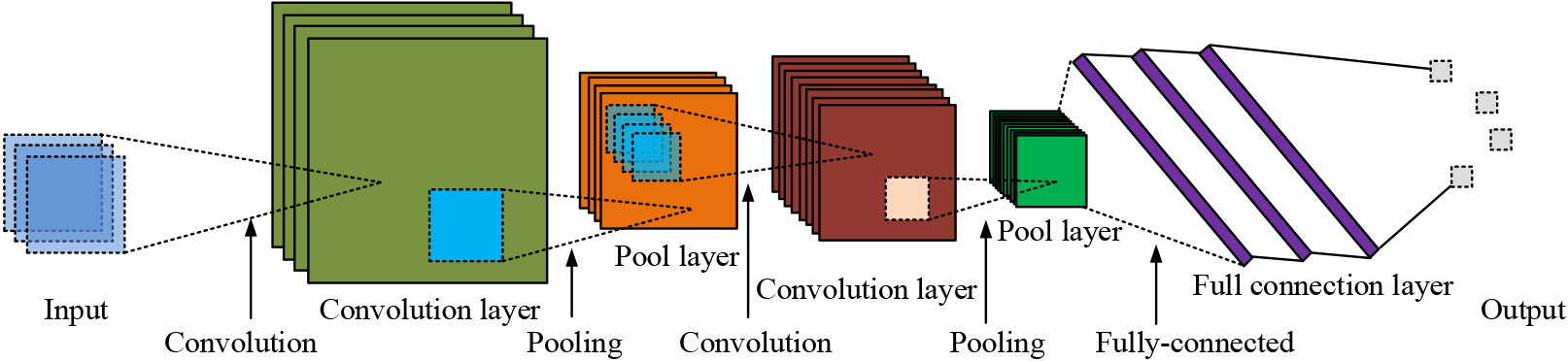
CNN is generally composed of an input layer that completes information input, multiple hidden layers, flat layers, fully connected layers, and an output layer that implements feature output. In CNN architecture, pooling layers are generally connected after convolutional layers. Pooling layers typically use average or maximum pooling methods to perform downsampling operations, preserving useful features of the output feature map while reducing its dimensionality. After pooling, they are passed through a flat layer to the fully connected layer to obtain the final output. The flat layer is used to expand the multidimensional output of the convolutional layer one-dimensional without changing the parameter values of the output features. In CNN, the convolutional layer is one of the most basic and important structures, which enable the extraction of local features from input data, output them as the input of the next convolutional layer by convolutional operation, and finally obtain the output feature map by a nonlinear activation function to calculate. The process of local feature extraction by convolution kernel is shown in Fig. 2.
The process of extracting local features using convolutional kernels.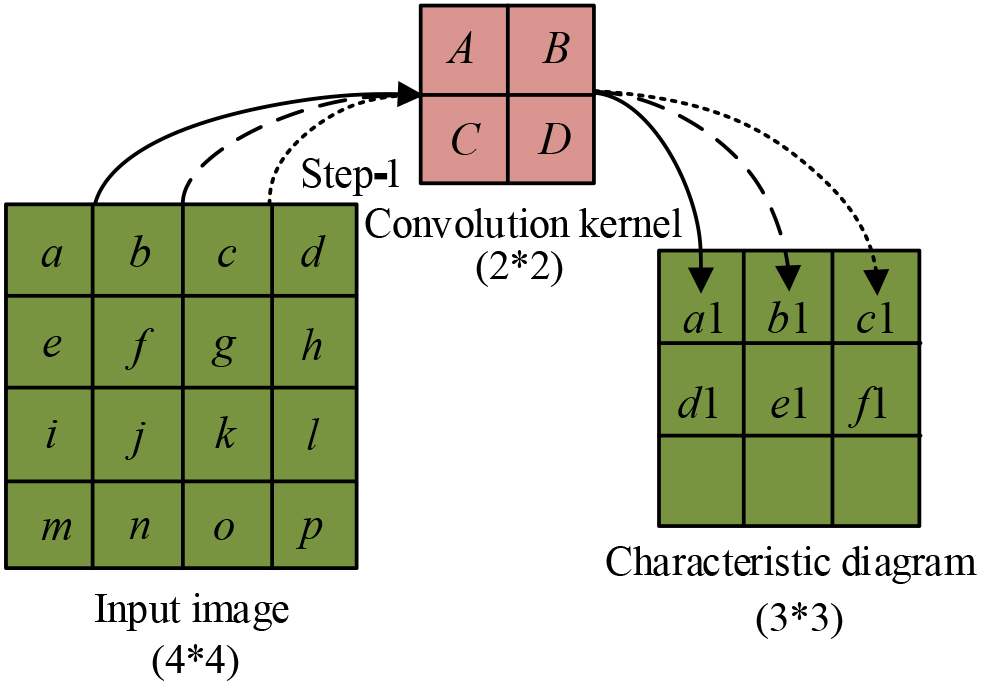
As shown in Fig. 2, in CNN, an image feature of size 4*4 is input. If the convolutional kernel size is 2*2, and move from left to right on the radar map, the move step length is 1. Finally, we get a feature map with the size of 3*3. Using Recurrent Neural Network (RNN), LSTM has a better performance in time series data, as shown in Fig. 3.
The basic structure of LSTM.
As shown in Fig. 3, within an LSTM cell structure, there are forgetting, input, and output gates. Among them, forgetting gate is to selectively forget the hidden state information of the previous cell; Input gate is to input the unforgotten information to the current cell and obtain a state vector; and the output gate is to output the information to the next cell. In this case, the forgetting gate is expressed as Eq. (1).
In Eq. (1),
In Eq. (2),
The output gate is expressed as Eq. (4).
In microgrids, short-term power loads are strongly associated with factors such as weather, holidays, and electricity price periods. Therefore, VMD is used in the study to decompose the data related to the above factors and add the modal components with the strongest correlation to the microgrid electric load to the input sequence. VMD is able to decompose the input signals to obtain different intrinsic modal functions. VMD can decompose the temperature signal, load signal, etc. to obtain the corresponding intrinsic modal components and calculate their Hilbert transforms, and then the prediction of the component bandwidths is performed by Gaussian smoothing for minimizing the sum of modal bandwidths, as shown in Eq. (5).
In Eq. (5),
In Eq. (6),
The operating cost of microgrid mainly includes two parts, namely deterministic and uncertain costs. Among them, deterministic cost refers to the installation cost and start-up and shutdown cost of various types of equipment. Uncertain costs include grid operation costs, fuel costs, environmental pollution, equipment maintenance and other costs. In the above, the study completes the short-term prediction of microgrid electric load. Thus, the mathematical model of coordinated and optimal dispatch of microgrid is constructed, as shown in Fig. 4.
Microgrid model structure.
First, a mathematical model is constructed to minimize the electricity production cost, as shown in Eq. (7).
In Eq. (7),
In Eq. (8),
In the mathematical model shown in Eq. (9), both the operating cost and operating stability are considered. The particle swarm optimization algorithm is well-known and applied by most scholars due to its simple and easy implementation, fast convergence speed during iteration, and fewer preset parameters. After establishing a mathematical model for a complex system, particle swarm optimization algorithm is used to obtain the optimal solution or solution to the problem. The PSO algorithm can realize the coordinated and optimal dispatch of source-grid-load-storage. In PSO, the iteration can be stopped when the maximum iteration limit is reached or the optimization result accuracy reaches the target value, which is expressed as Eq. (10).
Improve the basic process of PSO.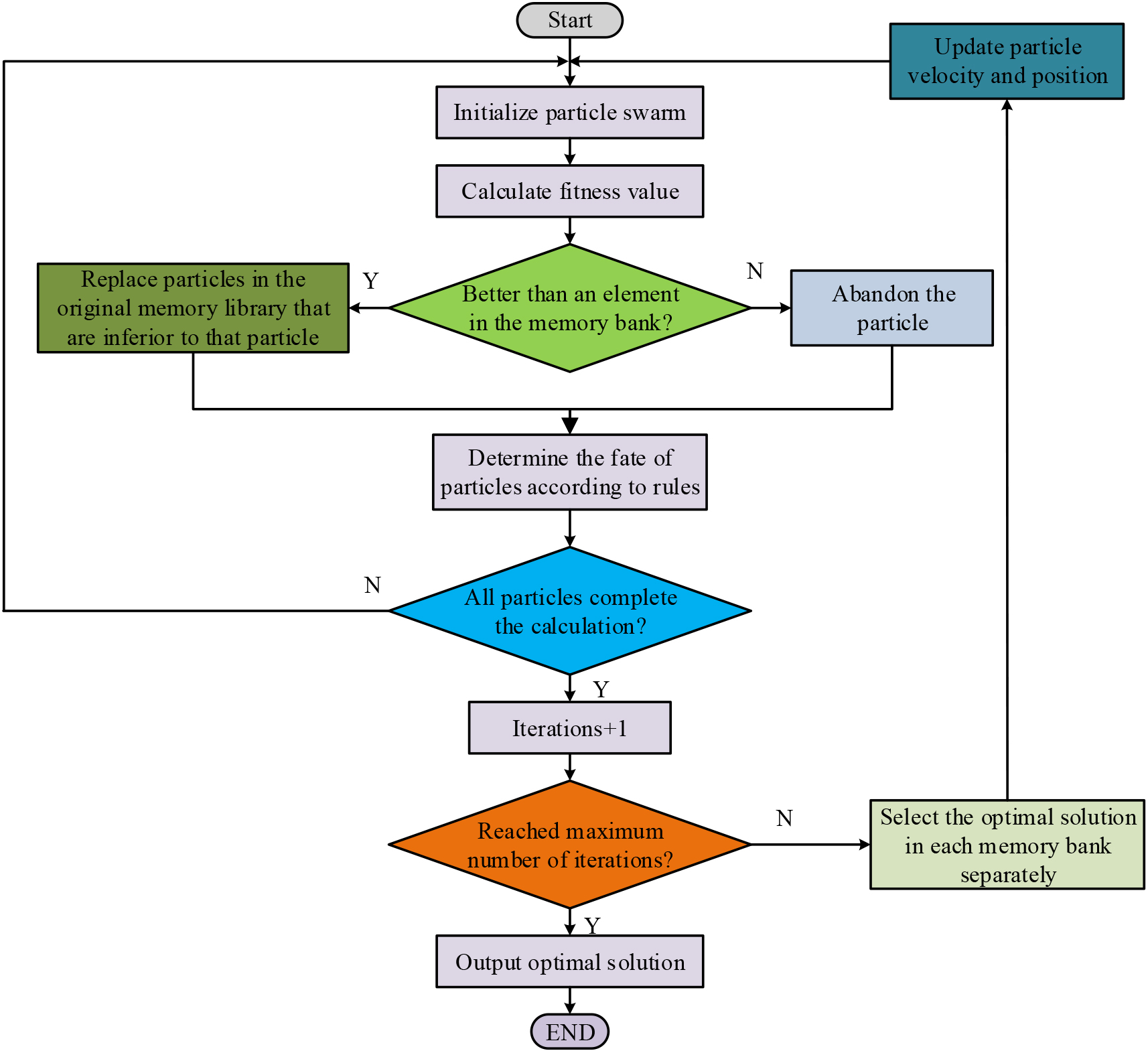
In Eq. (10),
In Eq. (11),
In Eq. (12),
In Eq. (13),
In Eq. (14), the meanings of
The improved PSO can be used to solve the mathematical model of coordinated and optimized microgrid dispatching, which can realize the coordinated and optimized dispatching of microgrid, reduce microgrid cost, improve the economic efficiency of microgrid, and positively effect the development of power enterprises.
To realize the coordinated optimal dispatch of source-grid load-storage microgrid, the study obtains the historical data of microgrid power system from the management system of a power company after obtaining the consent of the managers, so as to analyze the effectiveness of the coordinated optimal dispatch strategy.
Analysis of load forecasting error test results
First, the performance of the VMD-LSTM-CNN microgrid short-term load forecasting model proposed by the study is investigated. The current advanced short-term power load forecasting models include PSO-BP neural network (BPNN) and Dropout-LSTM. The historical data of the power system obtained from the study has training and testing sets in the ratio of 7:3. After the training of VMD-LSTM-CNN model, PSO-BPNN model and Dropout-LSTM model is completed, the short-term power prediction effects of VMD-LSTM-CNN model, PSO-BPNN model and Dropout-LSTM model are compared. The performance of the three models was analyzed using historical data from the power enterprise management system for a day in July 2022, and the load forecasting errors of the three models for that day are shown below. The deviation between the predicted and actual values of PSO-BPNN and Dropout-LSTM is larger during the peak electricity consumption period, while the prediction error of VMD-LSTM-CNN is smaller. Overall, the VMD-LSTM-CNN model has the smallest error, the PSO-BPNN has a higher prediction error than the VMD-LSTM-CNN model but lower than the Dropout-LSTM model, and Dropout-LSTM has the largest prediction error. The VMD-LSTM-CNN prediction error is 25.3 W on average, which is higher than that of the PSO- BPNN model and Dropout-LSTM model were 242.6 W and 417.3 W lower, respectively (see Fig. 6).
Load forecasting error.
Comparing the MAPE and RMSE of the VMD-LSTM-CNN model, PSO-BPNN model and Dropout-LSTM model. In Fig. 7(a), the MAPE of VMD-LSTM-CNN model is 0.20% on average, which is 0.38% and 0.74% lower than that of the other two, respectively. In Fig. 7(b), the RMSE of VMD-LSTM-CNN model is 15.4 on average, which is 39.5 and 61.3 lower than that of the other two, respectively.
MAPE and RMSE of several models.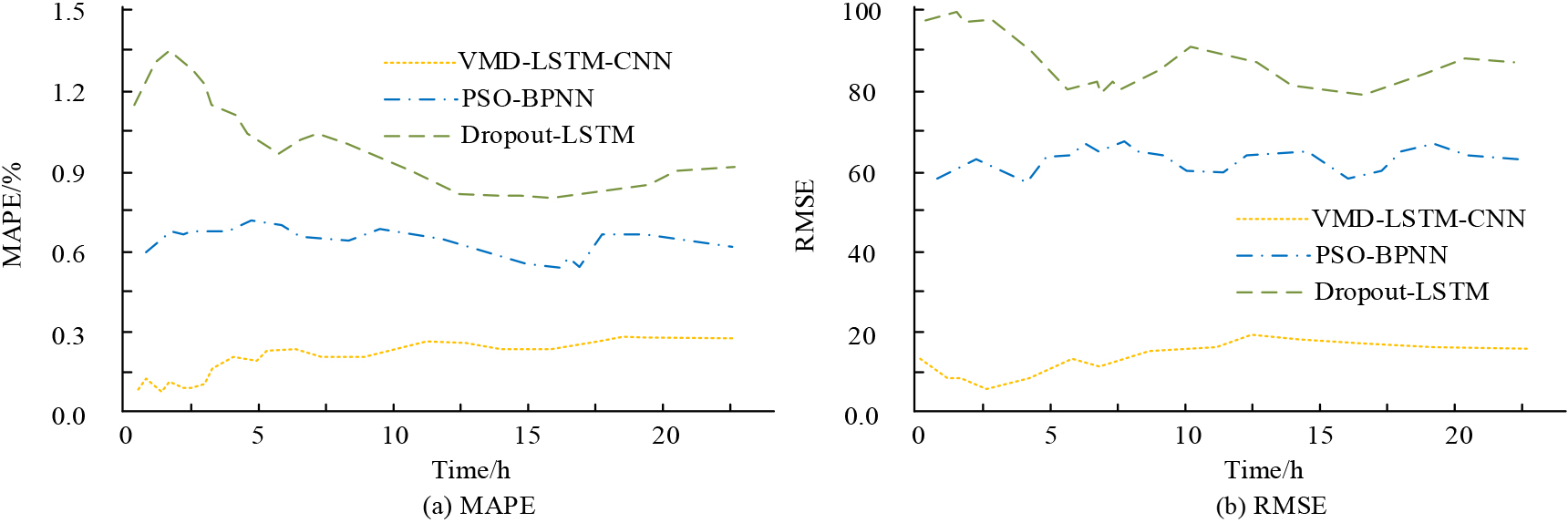
The accuracy and Recall values of VMD-LSTM-CNN, PSO-BPNN model and Dropout-LSTM model were compared using the data from the test set. To avoid the error, each model is tested 40 times and the average value is recorded every 10 times. In Fig. 8(a), the accuracy value of the VMD-LSTM-CNN model is 98.2% on average over 40 experiments, which is 1.05% and 1.34% higher than the PSO-BPNN model and the Dropout-LSTM model, respectively. In Fig. 8(b), the Recall value of VMD-LSTM-CNN is 96.8% on average over 40 experiments, which is 1.58% and 4.72% higher than the PSO-BPNN model and the Dropout-LSTM model, respectively.
Accuracy and recall of several models.
The AUC values of the VMD-LSTM-CNN model, PSO-BPNN model and Dropout-LSTM model were tested using the data from the test set, and ROC of VMD-LSTM-CNN model, PSO-BPNN model and Dropout-LSTM model are shown in Fig. 9. AUC value of VMD-LSTM-CNN reaches 0.984, which is 0.012 and 0.023 higher than that of PSO-BPNN and Dropout-LSTM, respectively. Synthesizing the above, proposed VMD-LSTM-CNN can effectively make accurate prediction of the short-term power load, thus providing data support for the subsequent data support for coordinated and optimal scheduling of microgrids.
AUC of several models.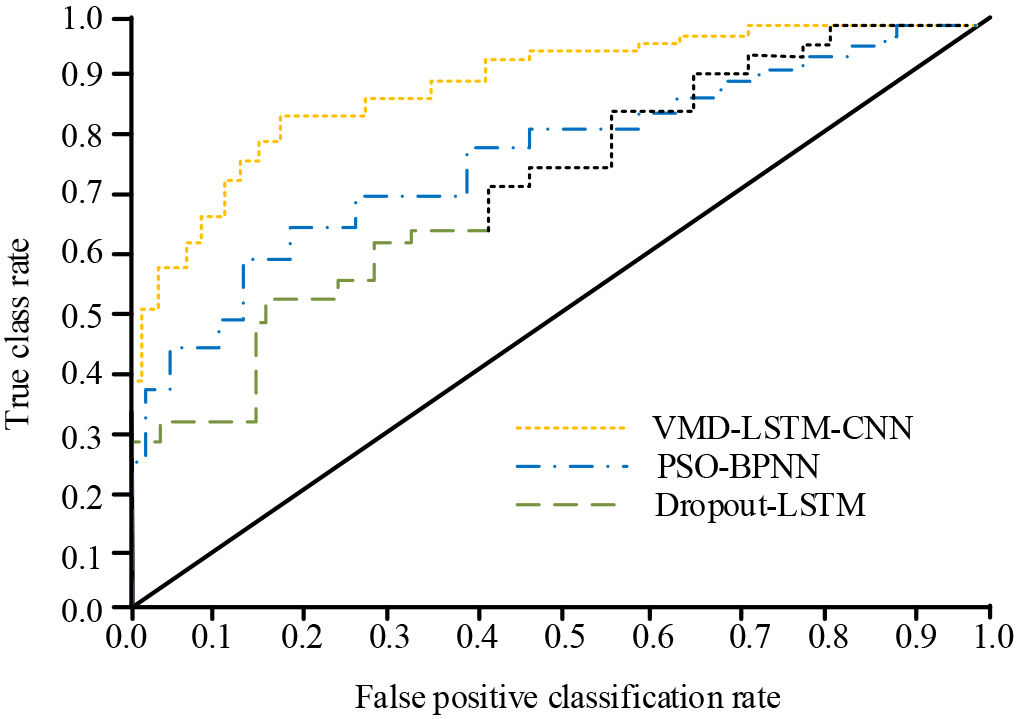
The study constructs a coordinated optimal scheduling mathematical model of source-grid-load-storage microgrid using the short-term prediction results of the microgrid electric load, and proposes an introduction of an adaptive inertia weight adjustment strategy to optimize the PSO, and then uses IPSO to perform the solution of this mathematical model. The more advanced optimization algorithms are Sparrow search algorithm (SSA) and Whale Optimization Algorithm (WOA). To verify proposed IPSO’s performance, the performance of IPSO algorithm, SSA algorithm, and WOA algorithm were compared. The variation of the fitness values and error values of several algorithms are shown in Fig. 10. The IPSO fitness value is 4000, which is 102 and 122 lower than SSA algorithm and WOA algorithm. The IPSO error value is 0.02, which is 0.01 and 0.02 lower than SSA algorithm and WOA algorithm.
The AUC values of several algorithms are shown below. AUC value of IPSO reaches 0.994, which is 0.015 and 0.017 higher than that of SSA algorithm and WOA algorithm, respectively (Fig. 11).
Economic costs and load fluctuations of different schemes
Changes of fitness and error values of several algorithms.
AUC values of several algorithms.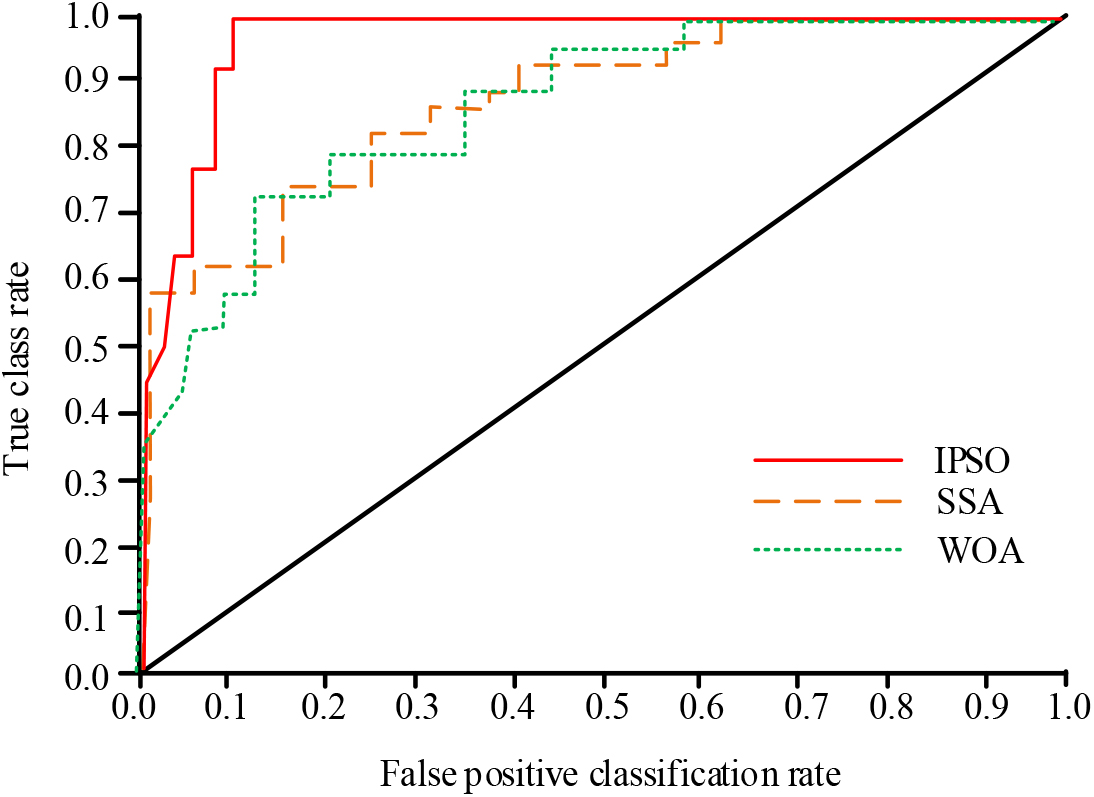
The economic costs and load fluctuations of the coordinated optimal scheduling scheme of the source-grid-load-storage microgrid obtained under different algorithm solutions are shown in Table 1. The solution results are taken from 10 tests to eliminate chance errors. As seen in Table 1, the economic cost of the scheme obtained by the IPSO algorithm solution is $3,954.3 and the load fluctuation is 56.6 W, both of which are significantly lower than the SSA algorithm and the WOA algorithm. In summary, the source-grid-load-storage coordinated optimal scheduling strategy proposed in the study can effectively reduce the operation cost of microgrid, improve the stability and safety of microgrid system, and have a positive effect on the development of power enterprises.
Conclusion
The coordinated optimal dispatch of source-grid-load-storage microgrid is important for both industrial and livelihood development, so the study proposes a VMD-LSTM-CNN model to predict the microgrid compliance and an IPSO algorithm to realize the coordinated optimal dispatch of microgrid. Compared with the PSO-BPNN model and Dropout LSTM model, the VMD-LSTM-CNN model proposed by the research institute is at lower values in terms of prediction error, MAPE, and RMSE indicators. In terms of accuracy and recall rate, the corresponding indicator values of the model proposed by the research are higher than 95%. In addition, in terms of economic costs and load fluctuations, the IPSO based power grid coordination model is lower than the SSA and WOA algorithms. In summary, the source-grid-load-storage coordinated optimal scheduling strategy proposed in the study can effectively reduce the microgrid operation cost, improve the stability and safety of its system, and have a positive effect on the development of power enterprises. The research results are not deep enough, and the life cycle and cost loss of the grid equipment need to be considered in the future to ensure the practicality of the research strategy.
Footnotes
Funding
The research is supported by: Science and technology innovation demonstration project of the State Power Investment, Huolinhe Circular Economy “Source-Network-Load-Storage-Use” Multi-energy Complementary Key Technology Research and Application Innovation Demonstration Project, (No. 2021-MT-NMNY-0000-1-0101-1/21).