



Abstract
Mountain is the most traditional tourism destination in China. On the basis of analyzing the particularity and its spatial differentiation of human-environment relationship in mountain tourism destination, this paper conducts empirical analysis in Yulong Snow Mountain by land use type classification. Firstly, ENVI is used to preprocess the Landsat-8 images of the research area. Then the visual interpretation is performed by ArcGIS to classify land use types. Based on the above, the differentiation status of human-environment relationship is analyzed. It concluded that: (1) Under the influence of natural factors such as piedmont, climate, altitude, gradient, slope, geological environment, and geomorphic characteristics, the uneven spatial distribution of human-environment relationship in mountain tourism destination is greatly affected by vegetation, rainfall, heat distribution, wind direction, suitability for human activities, and especially the topography; (2) The Yulong Snow Mountain forms three distinct levels of spatial differentiation in human-environment relationships between the east and west slopes, between high, medium and low elevations, and between different gradients.
Keywords
Introduction
As a typical landform with high gradient effects [1], mountain has diverse, unique, complex, and niche tourism resources due to their vertical differentiation characteristics, which can meet the various needs of different tourists [2]. Mountain is the second largest type of tourism destination in the world besides the seaside, and has great development potential [3]. The coordination of human-environment relationship in mountain tourism destination is a measure of tourism development and also an important standard to ensure its sustainability.
The theory of human-environment relationship is a grand topic in geography. As its connotation and extension continue to deepen and expand with the development of social economy, this theory has been explored from different aspects [4, 5, 6]. The regional system of human-environment relationship has different spatial scales. In recent years, large-scale regional research has achieved certain results [7]. The small and medium-scale regional researches mainly focus on the relationship, interaction, and state between people and environment [8, 9, 10]. However, there is relatively little research on the differentiation of human-environment relationships in specific regional systems, including mountain tourism destinations [11]. This paper aims to explore the special spatial differentiation and formation principles of human-environment relationship in mountain tourism destinations, enrich the empirical analysis of human-environment relationship types according to regional functions, and provides an important basis for the transformation process, pattern, and development strategies of human-environment relationship in tourism destinations.
The particularity and formation principle of spatial differentiation of human-environment relationship in mountain tourism destinations
The distribution of tourism resources determines the main areas where direct human-environment interaction in tourism destinations under the driving force of tourism. The development and mechanism of the human-environment relationship also need to be judged based on the types of tourism activities.
Significant unevenness in human-environment relationship
Firstly, the unevenness of human-environment relationships in mountain tourism destinations is reflected in the uneven distribution of tourism resources. The zones in the tourism destinations are mainly based on tourism resources and functions, and in mountain destinations are more dominated by the factors such as elevation, area and scale of mountain, terrain structure, latitude, and rainfall [3]. Due to the differences in temperature, humidity, wind force and direction, sunlight, and heat at different altitudes in the mountain areas, the distribution of natural tourism resources, mainly composed of biological, soil and geomorphic environments, and human tourism resources, mainly composed of human production and living, not only follows the laws of horizontal and vertical zonality, but also depends more on the small environment formed by the mountain landforms. The attraction of tourism resources is the objective premise of tourism. The unique physical geography environment of mountains and the resulting humanistic environment, as the main components of its tourism attraction [3], are the key for tourism and its effects, which makes the human-environment relationship have an obvious geographical dominated tendency in mountains.
Secondly, human activity spaces, including tourism, also have significant limitations in mountains. The population area tends to be flat, warm and humid, according to the superior natural conditions. In order to obtain a large and flat land and avoid water using difficulties and wind hazards, the mountainous residents are less distributed on the mountaintops and more in the middle and lower parts of the mountain, especially in the gentle foothills and intermountain basins. Most of the social activity venues and tourism facilities are also located in relatively flat areas.
Lastly, the tourism elements increase the regional differentiation of human-environment interactions in mountains. The roads are not entirely limited by the terrain, especially those built for the tourism development specially. It is not only to consider geological and ecological safety, convenience of construction, but also to view the mountain scenery expediently and minimize the damage to the overall landscape. Although flight bases and other facilities reduce tourists’ stay time in mountain, they also increase the types of tourist experiences and opportunities for direct contact with natural elements. From a spatial perspective, most mountain tourism resources belong to point distribution, transportation belongs to linear distribution, entertainment and service facilities belong to area distribution. These tourism elements and their functions increase the main interaction mode and uneven distribution of human-environment relationship in mountain destinations.
The formation of human-environment relationship is more closely related to terrain in mountain destination
Compared with tourism destinations such as cities and rural areas, mountains have various terrain, obvious vertical zonality and diverse elements, forming differentiation with significant geomorphic dependence and correlation.
The complexity and diversity of mountain ecological environment have certain regularity. At the same relative elevation, the altitude and latitude of the piedmont are inversely proportional to the number of vertical bands, and the area and scale of mountains are proportional to the diversity of the ecological environment. In addition, the impact of human activities on mountains can also disturb the vertical and secondary band spectra, mainly manifested by significant changes in the boundaries and ecological processes of the vertical band spectra, the almost disappearance of a certain vertical band spectrum, or the generation of new vertical band spectra. The gradient formed by the combined action of many factors makes mountain tourism resources diverse and unique, and suitable mountain tourism activities vary greatly in different altitudes, gradient, and terrain (Table 1).
Suitable types of mountain tourism activities under different altitude and gradient
Suitable types of mountain tourism activities under different altitude and gradient
Note: The geographical characteristics of mountains at the same altitude in different latitudes and climate zones are different. The lower the latitude of the piedmont, the warmer the climate; the larger the relative height difference, the more significant the vertical band spectral differentiation; the higher the altitude, the lower the temperature, and the more obvious the freeze-thaw effect; the larger the gradient, the more unstable the material on the slope. Therefore, based on the two most typical characteristics, altitude and gradient, taking mountain in the temperate humid climate as an example, mountain tourism activities can be distributed as shown in the above table. This table is compiled and analyzed based on the book “Theory and Practice of Mountain Environment”.
There can be more diversified tourism activities carried out in the mountains below 3,500 meters above sea level and within gradient of 25∘, and the human-mountain interaction mode is also more diverse (Fig. 1).
Adaptability of tourism activities under different altitude and gradient.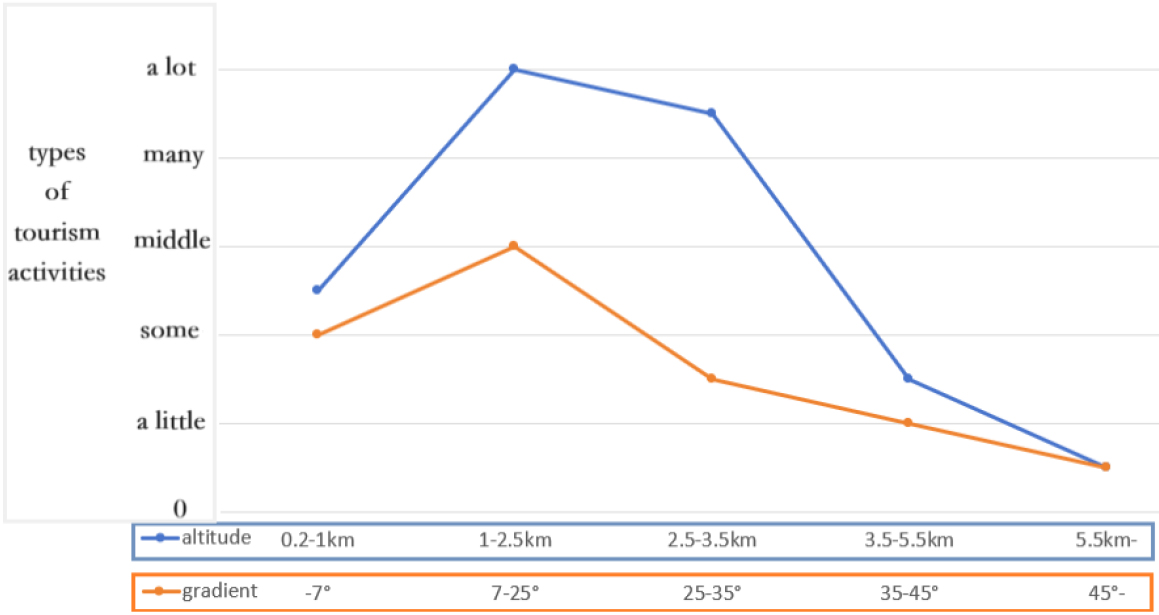
In addition, people’s behavior and decision-making may vary with subjective cognition, which also has an impact on tourism activities. Tourism project will form different tourism products based on tourists’ psychology and market demand, but cannot cross the dominant role of natural factors, especially terrain. Therefore, the formation of the human-environment relationship in mountain tourism destinations is closely related to the terrain.
Located in Yulong County, Lijiang City, Yunnan Province, Yulong Snow Mountain is one of the earliest mountain tourism destinations in China. In the past thirty years, a number of high-quality scenic spots and tourism shows have been developed, including Ganhaizi, Glacier Park, Blue Moon Valley, Spruce Flat, Yak Flat, Golf Course, Impression Lijiang, etc., forming a comprehensive mountain destination that integrates sightseeing, vacation, entertainment, sports and leisure, science popularization, study tourism and other functions. A sustainable development trend tends to be fully functional, market stable, tourism elements continuously improving, and social economy and environment gradually harmonizing. It should be noted that, regardless of whether there were humans residing before, the tourism exploration and the tourist activities can affect the original environment of mountain, which is a manifestation of human impact on the environment. So, the humans-environment relationship is common in tourism destinations.
The Yulong Snow Mountain ranges from the Jinsha River valley of more than 1600 meters to the Shanzidou peak of 5596 meters. The vertical elevation difference is nearly 4000 meters. There are vertical climate zones such as cold zone, sub cold zone, cold temperate zone, temperate zone, subtropical zone, etc., which makes this case have better typicality in altitude, base zone and climate zone. The tourism resources include various types such as mountain landforms, water bodies (including glaciers), flora and fauna, climate and environment, human history, ethnic culture, etc., which can fully reflect the diversity, uniqueness, and breadth of tourism resources in mountain destinations. In the process of tourism exploration of Yulong Snow Mountain, targeted differentiated strategies were adopted for different regions. The impact of tourism and its related activities on the geographical environment was quite different, and the temporal and spatial differences in the evolution of human-environment relationship were obvious and prominent, having typicality and representativeness. So, the conclusions drawn in this article are mostly applicable to other mountains.
This paper uses land use types to determine the spatial differentiation of human-environment relationship. The data processing is as follows:
Data sources In order to reduce the impact of cloud cover, increase accuracy, and facilitate vectorization, we select the satellite image on January 2, 2020 (Table 2). Source of satellite image
Data preprocessing
ENVI, the remote sensing data processing software, is used for radiometric calibration of Landsat series data, FLAASH atmospheric correction is performed in sequence, and finally vector cropping of the research area is carried out.
Visual interpretation
The vectorization process is mainly completed through the editor tool in ArcGIS, which can be divided into 3 steps: defines the scope of the research area, constructs vector maps by visual interpretation, and outlines land use shapes. Then the land use type vector map of the Yulong Snow Mountain Scenic Area is completed (Fig. 2).
Land use type of the study area (2020). Note: According to the “Classification of Land Use Status (GB/T21010-2017)”, there are 12 primary categories of land use status. According to the “Classification of Land Use Status (GB/T21010-2017)”, there are 12 primary categories of land use status, of which the changes in Yulong Snow Mountain due to tourism development mainly involve arable land, forest, grassland, commercial land, residential area, waters and other land. Commercial land mainly relates to retail, catering, hotels, entertainment and tourism construction, et al. (uniformly referred to as construction land for tourism), while other land mainly includes idle land, bare land, and bare rock (uniformly referred to as unused land). 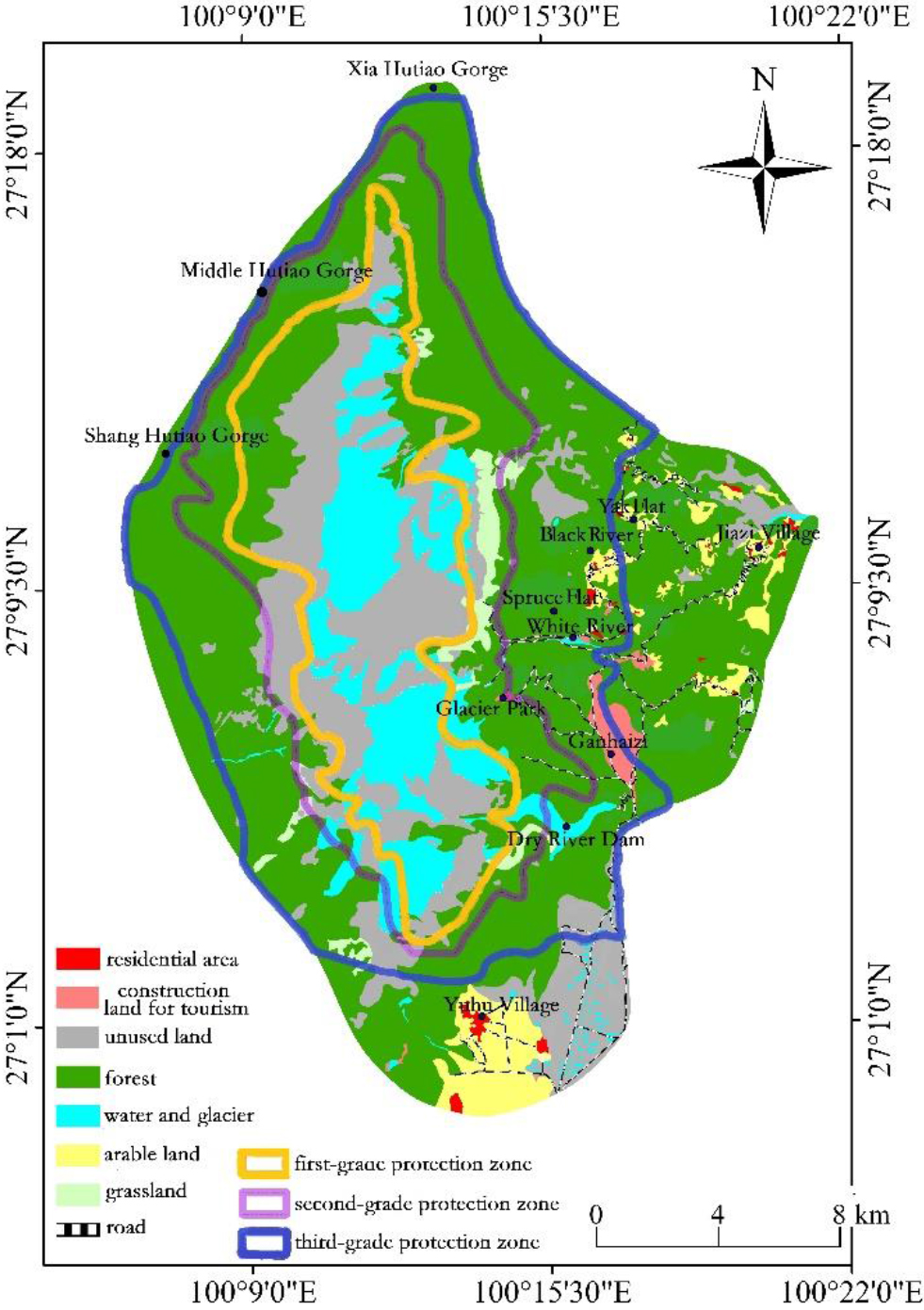
It can be seen from Fig. 2 that the construction land for tourism of Yulong Snow Mountain is mainly concentrated in the middle of the east slope and the southern foot of the mountain, and the road is concentrated between the construction land for tourism and the two villages. While the Hutiao Gorge section is relatively independent with little construction. Therefore, there are few tourism activities on the western slope, most of which belong to the protected area and are less driven by tourism. Production and living activities, including tourism, are mainly distributed on the eastern slope of the mountain. And tourism has a significant driving effect on its human-environment relationship. Non construction areas are also indirectly affected by tourism activities, such as villagers reducing their logging of trees due to the benefits of tourism development. Yulong County and Lijiang City have also been affected by the tourism development of Yulong Snow Mountain, which are not within the scope of this study.
The blocking effect of mountains, especially high mountains, on airflow can cause different vegetation types on the windward and leeward slopes by temperature, rainfall, wind force, and other factors, as well as differentiated landforms and biological landscapes formed due to various degrees and directions of erosion. These all play a fundamental role in the distribution of tourism resources and project construction, making the direct impact of tourism on the geographical environment and changes in human-environment relationship mainly concentrated on slopes with abundant biological and water, with fine natural environments, and suitable for tourism activities.
The direct impact of tourism focuses on the construction land for tourism and the road, which are located in central part of the eastern slope and the southern foothills of the Yulong Snow Mountain. It is obvious that the driving force of tourism on the eastern slope is significantly greater than that on the west. This forms the first level of spatial differentiation of human-environment relationship, that is, the difference between the east and west slopes.
Differentiation of altitude and elevation difference
As the glaciers in Yulong Snow Mountain belong to marine glaciers with relatively low latitude, the frozen weathering zone and the major tourism resources are higher than that of the alps. The scope of Yulong Snow Mountain Nature Reserve is centered on glaciers and extends to the east and west slopes and the south and north piedmont. The elevation decreases from high to low, and the level of the protected area decreases from first-grade to third-grade (Fig. 2). The majority of the mountain is located within the scope of natural reserves, which limits the tourism development and to some extent protects the fragile ecological environment, keeping them in their original state before tourism exploration. In order to highlight the uniqueness of glacier resources, the Glacier Park has been extended to the first-grade protected zone and eliminated the direct contact between tourism activities and glaciers through cableways and boardwalks. It has achieved a balance between the economy and environmental protection.
High altitude may lead to altitude sickness due to the thin air, which is not conducive to tourists’ experience. The impact of tourism activities on this area is not significant, and the original human-environment relationship has changed little. Except for Glacier Park with an altitude of over 4,500 meters, tourism projects such as Ganhaizi, Yak Flat and Spruce Flat are mainly between 3,400 meters and 4,200 meters. There are many tourism activities in the middle and low altitude areas, which are obvious zones where tourism plays a role in the change of human-environment relationship. This has led to the second differentiation of the human-environment relationship in the mountain due to altitude and elevation difference.
Differentiation of gradient
The larger the mountain gradient, the more unstable the slope material, the greater the difficulty of construction, and the more safety hazards. So, the areas with gradient of more than 25∘ in Yulong Snow Mountain are covered with original vegetation and undeveloped, combining the protection and sightseeing utilization.
Mountain areas with gentle slopes, especially intermountain basins, are the fine places for project construction and tourism activities. The interaction between human and environment is relatively intense, and the driving effect of tourism is obvious. While mountain areas with large gradient are mainly suitable for sightseeing and niche exploration tourism that have little direct impact on human-environment relationship, and the driving force of tourism is not significant.
The west slope of Yulong Snow Mountain is obviously eroded by rivers and has a large gradient. While the eastern slope is relatively gentle, and people’s production and living are mainly distributed here. The flat in front of the mountain is poor in tourism resources, but suitable for the construction of golf courses, hotels, etc. It has become the most obvious area for transforming an original ecological area into tourism destination. Therefore, gradient is the main factor for tourism construction in mountain, and promotes the third level of spatial differentiation of Yulong Snow Mountain human-environment relationship.
Conclusion
The formation of human-environment relationship in mountain destinations driven by tourism is more closely related to terrain. Because of its geographic environment, mountain has formed a regional system with diversified resources, abundant tourism products, and complex human-environment mode of action. This feature is greatly affected by factors such as mountain base zone, climate type, altitude, gradient, slope aspect and geomorphic characteristics, which result in the unevenness of terrain, vegetation, rainfall, heat, wind and suitability for human activities. So, the distribution and suitability for tourism are highly uneven, and tourism plays a driving role in the human-environment relationship through tourism activities and project construction.
There are obvious spatial differences in the human-environment relationship between the east and west slopes, between high, medium and low elevations, and between gradients of Yulong Snow Mountain. The natural environment between the east and west slopes is quite different due to rainfall, wind direction, river and other effects, which makes the human- environment interaction concentrated on the east slope, and leads to the first level of differentiation. The geographical conditions at different altitudes form areas with tourism and commercial purpose at medium and low altitudes, as well as areas for glacier protection and sightseeing, leading to the second level of differentiation in human-environment relationship. The gradient makes the human-environment relationship in Yulong Snow Mountain have the third level differentiation through the tourism suitability and the restrictions of construction. These fully reflect the geographical dominant nature and multi-level unevenness in the spatial differentiation of human-environment relationships in mountain tourism destinations.
Some special influencing factors, such as the types of land, mainly affected the relationship between human and environment through policies, individual decisions, and unexpected events, etc. For example, cultivated land, forest land, and basic farmland are mainly influenced by national policies, and the type of land further affects tourism activities. Indeed, policies are an important influencing factor of land use types. But a reasonable policy is based on considerations of mountain natural environment. There are also some cases of unreasonable policies, which can be further explored in the future.
Footnotes
Acknowledgments
This research is financially supported by the National Natural Science Foundation of China (No. 41961021), Fund of Guangxi Education Department (No. 2021KY1936 and No. YXXH2021011).