



Abstract
Since the beginning of 2021, the importance of the development of “Industrial Internet” and “Metauniverse” has been mentioned many times in many important documents such as the outline of the 14th Five-Year Plan and the 2021 government work report. Under the background that the industrial Internet has replaced the consumer Internet as the main direction, with the change of digital electronic information technology and the huge demand of the market, the new engineering electronic information specialty will face great opportunities and challenges. Education needs to cultivate a large number of differentiated talents and individualized skilled talents. Therefore, vocational education is the guarantee of social talents in the process of promoting modern industrialization. Therefore, it is necessary to focus on the major strategy set by the state, closely connect with industrial upgrading, grasp the trend of technological change, promote the integration of production and education, and thoroughly implement the vocational skill grade certificate system. Moreover, the comprehensive education mechanism of “post-class competition certificate” should be promoted. Under the above background, aiming at the demand of electronic information major in new engineering, this paper puts forward the curriculum system reform of “post-class competition certificate”, and analyzes the practice process. On this basis, it completes the integration of teaching content and post work cases, realizes the docking of teaching mode and post work process, and finally realizes the matching of course examination and professional grade certificate standard. Besides, it can also improve curriculum resources, improve the composition of teaching staff, create high-quality curriculum training conditions, etc., and finally promote the rapid development of electronic information industry.
Introduction
Research background analysis
Since October 2021, the concept of meta-universe has attracted much attention, and meta-universe is an important carrier of information technology development. Under this objective and realistic requirement, it is also urgent to simultaneously promote the training of new engineering digital talents. The training of new engineering electronic information professionals should pay more attention to the docking and collaborative innovation with the market, and gradually establish a multi-level, diversified and highly customized digital talent training system [1]. Under the environment of national and even global industrial upgrading, higher vocational education must actually change its training ideas, break through the links of talent training and job requirements, and build a talent training system of “on-the-job competition certificate” that matches the market demand from the aspects of training mode, teaching content and evaluation standards. At the same time, the vocational education reform program guides the curriculum system reform of electronic information major in new engineering [2]. That is to say, in April 2021, the National Vocational Education Conference pointed out that it is necessary to design the training system of vocational education in secondary, higher vocational and undergraduate schools in an integrated way, deepen the reform of “three education”, and comprehensively educate people with “post-class competition certificate” to improve the quality of education. According to the national policy guidance, the new electronic information major of engineering implements the integration of production and education and school-enterprise cooperation, allowing enterprises to participate in the skills training process of curriculum setting, textbook development and instructional design, so that the post requirements are integrated into the curriculum content and the post qualification standards are integrated into the curriculum evaluation standards. The advantages of school and enterprise complement each other, forming a benign ecological system of production and education, and speeding up the construction of a vocational education system with socialist characteristics [3]. In May, 2020, Guangdong Provincial People’s Government’s opinion on cultivating and developing strategic pillar industrial clusters and strategic emerging industrial clusters emphasized that Guangdong’s industrial cluster development has a certain foundation, and ten strategic pillar industrial clusters such as the new generation of electronic information, smart home appliances, software and information services have a solid development foundation and growth trend, which is an important foundation and support for Guangdong’s economy [4]. Under the protection of many government development strategies, the new engineering electronic information major takes the lead in the reform of the four-dimensional integration curriculum system of “on-the-job competition certificate”, which effectively improves the connotation construction and professional characteristics construction of electronic information major. It is necessary to keep pace with the times and reflect the development of industry and region in terms of teaching content and teaching mode, so as to ensure the employment rate of students and industrial structural unemployment [5].
On-site investigation
In the curriculum scheme, the curriculum setting can directly reflect the problems existing in the curriculum structure, and also directly affect the realization of the training objectives [6]. This paper analyzes and compares the proportion of courses in a school’s curriculum setting, and in order to find out whether the curriculum structure can reasonably meet the needs of students and the employment requirements of vocational schools, interviews are conducted with school leaders and group interviews are conducted with students in teacher training schools. The survey results are as follows: By consulting the training program of sub-information major in Tianjin Polytechnic Normal University, we know that all courses in the school are mainly divided into general courses, basic courses, professional courses, normal courses, practical courses and quality development courses according to the nature of the courses [7]. There are some differences in the names of schools according to their training characteristics. Among them, theoretical courses include general courses, professional basic courses, professional core courses and normal courses [8]; The practice links are mainly practical training, practice and normal skills training [9]. Because the study of mathematics courses can consolidate the foundation of engineering courses, different schools classify higher mathematics as general courses or professional basic courses.
Proportion of courses in colleges and universities
Proportion of courses in colleges and universities
The professional practice links in the system mainly include curriculum practice, textual research training, professional practice and teacher training links, etc. For example, in the curriculum training scheme of Tianjin Polytechnic Normal University, among the 70 credits in the practice link, the professional experimental practice course accounts for 36 credits, and the teacher training link course accounts for 14 credits, leaving only 20 credits in this major course, accounting for 26.1% [10].
Academic value of project
Guide the upgrading of vocational education system
Practically enhance the adaptability of vocational education, speed up the construction of modern vocational education system, and gradually cultivate more technical and skilled talents with high quality, strong technology and ability, so as to provide strong talents and skills support for building a socialist modernized country in an all-round way [11]. In the modern society with the rapid development of information technology, schools should closely unite with industry enterprises, social forces and corresponding government departments to participate in running schools, set up specialties according to local development needs, form a professional system that closely connects with the industrial chain and innovation chain, and actively build vocational education infrastructure and training bases with industry-leading enterprises [12]. To promote the diversified pattern of running schools, it is necessary to carry out a new exploration of the theoretical research perspective of “four-dimensional integration of post, course and competition certificate”, promote the optimization and upgrading of industrial structure, promote technological innovation and the transformation of technical achievements, actively explore and encourage students to participate in the revitalization of their hometown and the development of rural vocational education, so as to gradually form and implement a pilot project of vocational education system construction in a skilled society.
Guiding ideology of reshaping vocational education
The change of talent demand will inevitably lead to the change of talent training mode. Therefore, it is necessary to strengthen theoretical and academic guidance. While inheriting and developing the traditional “work-study combination” training mode [13]. It is necessary to update the theoretical reform, deepen and refine the guiding ideology of “on-the-job competition certificate”, constantly supplement and improve the reform theory of four-dimensional integration curriculum system of new engineering electronic information, reshape professional teaching standards and professional curriculum standards, and reshape the school-enterprise cooperative development mechanism and compound talent training mode.
Overall framework
The four-dimensional integration curriculum system of “on-the-job competition certificate” for new engineering electronic information majors is set up in this project, and the whole system is constructed with the talent training concept of “employment-oriented, skilled talents as the goal, and practice and innovation ability as the focus”. The overall design framework is as follows [14]: “Post” is the standard of professional orientation, and the professional curriculum setting needs to benchmark the job tasks and professional abilities of the post, determine the training objectives according to the professional posts, set the curriculum according to the job tasks, develop the curriculum content according to the professional abilities, and establish the teaching organization according to the work items [15]. At the same time, the course content should be incorporated into the new knowledge, new processes, new specifications and typical production cases of the industry development, and teachers’ teams should be encouraged to use loose-leaf textbooks and workbook textbooks according to the industry and local construction; “Course” is the core of teaching reform, a framework formed by the organic combination of post tasks and post professional abilities, a model based on the integration of theory and practice, and a means of learning by doing. “Competition” is the display of curriculum teaching [16]. By establishing a national, provincial and school competition mechanism, a normalized teaching reform environment is formed to promote learning, teaching and construction by competition, and the demonstration project teaching is promoted. “Certificate” is the standard of industry verification. By developing and integrating many kinds of 1
Specific content and result analysis of the project
The preparatory work of the four-dimensional integration curriculum system of ‘on-the-job competition certificate’
Position orientation
First of all, hire a number of post experts from different enterprises, and put forward the positions that the majors may face as required. Then summarize the posts listed by the post experts. According to the actual situation, select the distribution frequency of graduates’ posts in the last 3–5 years to determine the post requirements. For example, for digital media major, due to the difficulty of courses and the order of courses, the general employment rate of students is film editing and film post-production, so whether the main direction of the follow-up major should focus on film production is a question that needs careful consideration [18].
Secondly, investigate the current situation of talent supply and demand, the level structure and standards of vocational qualification certification and the competition standards of national vocational skills competition. This kind of data is an important basis for judging the talent demand of enterprises. The survey can be conducted by consulting the recent data of supply and demand in the labor market, or by going directly to the human resources department of enterprises after graduation.
Finally, the trend of future talent demand of each position is analyzed, and the employment positions that this major should face are selected. When it is necessary to pay attention to the professional orientation, we should comprehensively analyze the local economic characteristics, the situation of teachers in schools and the equipment conditions of training rooms, as well as the development of this major in other colleges and universities, and think deeply about the characteristics and development of our own major.
Basic procedures of post positioning.
The career development path of digital media technology majors.
Work task is the content of post occupation activities. The task is the detail part that connects the individual with the post, and the task is an important link to realize the docking between the course content and the post ability. Therefore, first of all, the tasks are sorted and decomposed, and clear logical clues are summarized. That is, it is beneficial for students to grasp the workflow of a specific industry, for teachers to systematically teach, and for students to connect the learning contents of multiple courses. Based on this, it is necessary to avoid the overlap between tasks, and there can be no overlap between tasks at the same level. Finally, we should also pay attention to the balanced relationship of tasks, that is to say, the tasks at the same level should be relatively balanced in size, and there should be no such situation that some tasks have a relatively large scope while others are very small.
Career ability planning
Professional ability is the basic basis for determining the course content, and the analysis of professional ability and job task is carried out simultaneously. After completing the job task analysis, it is necessary to analyze the professional ability. The analysis of professional ability is different from the analysis of job tasks. The purpose of professional ability analysis is to obtain the ability requirements of people for job competence. It should be carried out in combination with job tasks, and the actual ability should be described instead of abstract and generalized concepts. The description of professional ability should be carried out separately for each work task, and multiple work tasks cannot be integrated for analysis. Therefore, effectively determining the course content according to the professional ability can play a significant role, and at the same time, it can divide the professional ability and work tasks, and combine the professional ability and work tasks to maximize the effectiveness.
Take the course ‘E-commerce Scene Making’ as an example, which is a course design activity based on e-commerce product map, e-commerce IP role scene, e-commerce scene product map, e-commerce poster design map and e-commerce page scene map. In order to train students to master the selling points of e-commerce products, accurately restore the product structure and materials, and complete professional core competencies such as high-quality products and IP role renderings, product drawings with scene atmosphere, and e-commerce page scene drawings. All-round talents who cultivate rigorous logical thinking design ability, keen creative insight, team coordination ability, lifelong learning ability and provide technical skills for social development.
The reform method of four-dimensional integration curriculum system of ‘post course and competition certificate’
First of all, teachers have determined the concept of curriculum setting strictly according to tasks, and according to the tasks in the “Analysis Table of Work Tasks and Professional Abilities”, they have finished the discussion from top to bottom, and determined the curriculum setting one by one. Secondly, according to the basic principles, the work tasks are reasonably summarized and analyzed, and some vague work areas should be split in combination with the project to get several targeted courses. Only by setting targeted courses in the reform of the four-dimensional integrated curriculum system of “post courses and competition certificates” can we clarify the direction of reform and change it into “professional core courses
According to the common task and ability, on the basis of the original specialty setting, the corresponding direction is divided, which makes the curriculum system change from the original “professional basic courses
Finally, the course name should highlight the professional characteristics and post task characteristics. In this way, we can clearly reflect the learning objectives of the course, and try to avoid taking the vocational qualification certificate as the course name directly. While carefully sorting out the logical sequence of courses, special attention should be paid to properly grasp the course capacity. It is suggested that the best class hours for each core course should be about 100 hours, and the class hours for basic courses should be about 64 hours. According to the fit between the course and the competition content.
The course assessment method can be appropriately integrated with the competition, which is conducive to improving students’ learning interest and sense of achievement, promoting students to construct knowledge and skills according to the working logic, and meeting the changeable working environment and theoretical knowledge needs of their future employment. Specialty characteristics and post task characteristics are a basic prerequisite for setting up courses. Learning objectives can be displayed in front of students, so as to standardize course capacity, control core course time, set standards in combination with course and competition content, and improve students’ learning interest and sense of achievement. At the same time, students’ interdisciplinary thinking and ability can also be cultivated by offering elective courses and interdisciplinary project practice.
According to the ability requirements of enterprises for new engineering electronic information personnel, aiming at the cognitive characteristics of higher vocational students, combining with the situation of new engineering electronic information majors, the project design and development are carried out in cooperation with industry enterprise experts, highlighting the students’ teaching main role, attaching importance to the cultivation of professional ability, and fully embodying the professionalism, practicality and openness of classroom teaching. For example: We can adhere to the idea of curriculum reform taking digital electronic technology as an example, and reconstruct the curriculum module for the professional post group. Moreover, we can subdivide the professional post-oriented ability requirements into the relevant teaching modules of digital electronic technology, and reconstruct the traditional chapter structure according to the training idea from basic ability to special ability to comprehensive and innovative ability, combined with the students’ learning cognitive law. At the same time, it is necessary to connect with professional standards, highlight skills training, break down knowledge points and implement classroom teaching based on the actual production projects of enterprises. Based on the working process, it is also very important to innovate the teaching mode. Based on the real working process of electronic development and design in enterprises, the tasks are decomposed by benchmarking, and the implementation process of tasks is divided according to standards. It is also necessary to attach importance to the development of “online
Set up sub-training projects based on workflow.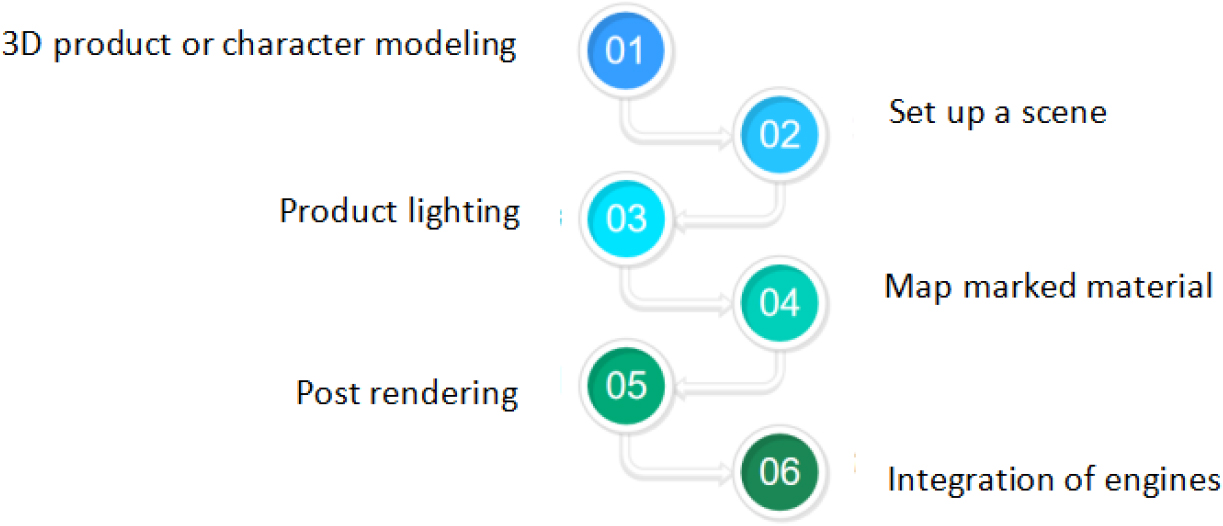
Teaching flow of subprojects.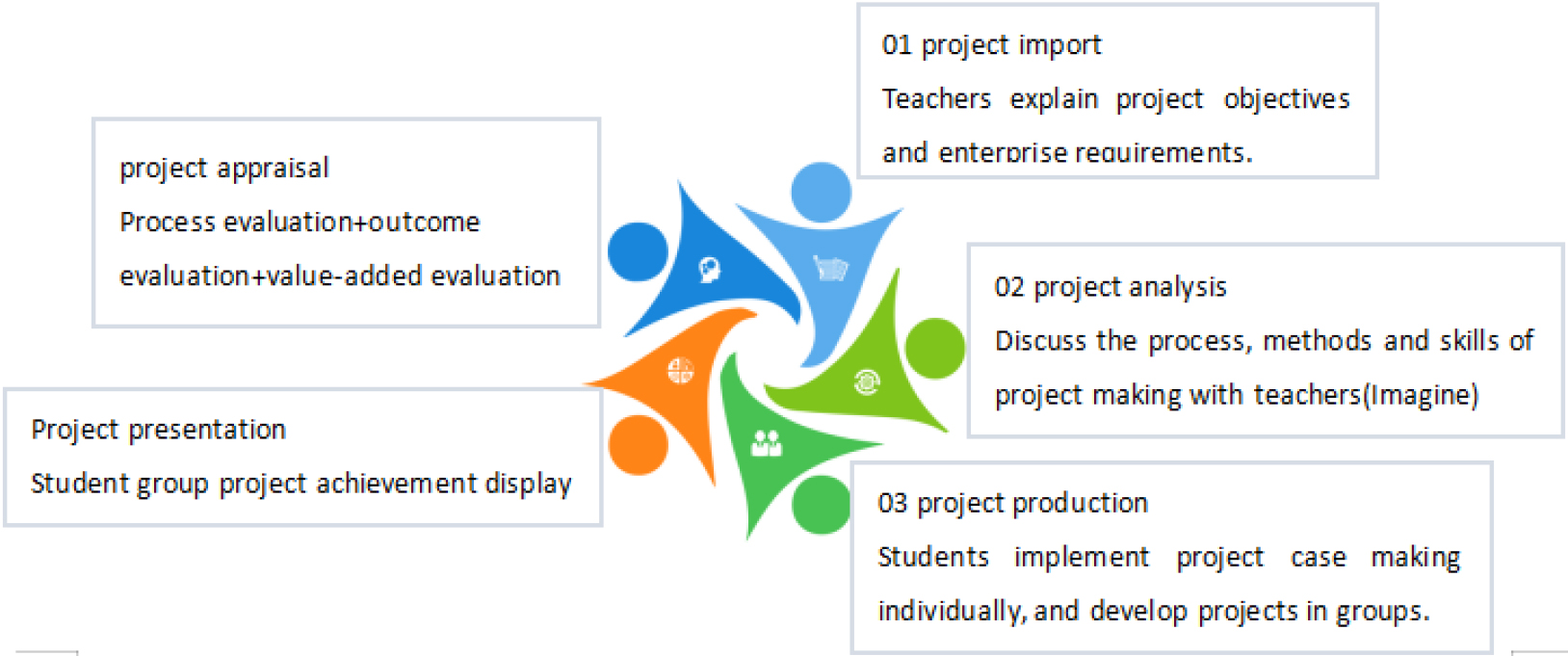
O2O interactive teaching mode
Relying on the superstar teaching platform, the online teacher-student interaction space of the e-commerce scene making course is realized. Teachers and students publish the course tasks through the open teaching resource platform, and students learn relevant content independently according to the learning objectives and learning tasks set by teachers.
Theory-practice integration teaching mode
According to the training goal of e-commerce scene making course, the teaching resources are re-integrated, and the theoretical classes such as e-commerce scene layout methods are directly moved to the practice site. While the theoretical explanation is carried out, the practical operation training of e-commerce scene is conducted directly. Meanwhile, the real “Double Eleven” domestic brand enterprise project of Yufeng Zhilian is introduced in the course training process to boost the cultivation of students’ practical application ability.
Project-based teaching mode
Under the guidance of double tutors, the “Double Eleven” domestic brand enterprise project will be introduced, which will be implemented by students in groups. Students will be trained to understand and master the whole process of e-commerce scene production through project theme selection, team building, project planning, effect evaluation, achievement display and other project contents, tap creative potential in the process of project promotion, and improve students’ comprehensive ability to analyze and solve problems.
1
X vocational skill level certificate
The teaching standards and requirements in the 1
Evaluation system of four-dimensional integration curriculum system of ‘post-class competition certificate’
Curriculum evaluation is a process of judging the effect of teaching content and teaching process used according to clear objectives. To evaluate courses, we must establish evaluation indexes. If there is an evaluation, there must be an evaluation index system. Therefore, the setting of the index system must meet the validity requirements of the evaluation, that is, it can objectively reflect the curriculum quality level of a major. It is also helpful to make an objective judgment according to these indicators. This project will adopt vocational education curriculum evaluation according to the nature of vocational education curriculum evaluation, taking the course ‘E-commerce Scene Making’ as an example. The specific curriculum evaluation.
Evaluation system of E-commerce scene making course
Evaluation system of E-commerce scene making course
Remarks: “Taking the certificate as the test substitute”: The 1
Set up the evaluation system of e-commerce scene making course, including three main contents: process evaluation, result evaluation and value-added evaluation. For the process assessment, it includes classroom learning, theoretical knowledge and project assignments. It is a systematic assessment process, which assesses the comprehensive quality of students in the learning process, and can examine each student’s classroom questioning, discussion, attendance, classroom performance, etc., and grasp the actual learning situation of students. For the result evaluation, we should focus on the group teaching mode, improve students’ creative production ability, guide students to conduct self-evaluation and mutual evaluation, and urge each student to realize their own shortcomings, master the shortcomings and realize self-improvement. For value-added evaluation, students can be arranged to participate in competitions to improve their comprehensive ideological quality. Whether the reform of the four-dimensional integration curriculum system of “on-the-job and competition certificate” for new engineering electronic information majors can achieve high-quality curriculum results depends not only on whether the curriculum ideas and methods have been clearly expounded enough, but also on whether the curriculum development process can be effectively organized and its quality can be controlled. The curriculum reform is relatively more complicated than the teaching reform, and it requires a variety of subjects’ actions that can have an overall impact. Therefore, we must not only master the curriculum ideas and methods themselves, but also skillfully apply them to the curriculum reform and practice, so as to gradually build a brand of vocational education with China characteristics.
Adopt the mode of “project
studio
micro-specialty” to steadily promote the cultivation of innovative talents
The “project
Build a collaborative innovation center and create a technical skill platform together
Build service centers for key industry projects, build common technology research centers of professional groups, and explore the path of cultivating masters. At the same time, industry qualified engineers and key teachers cooperate to serve the high-end demand of the supply chain industry, carry out research and development and application of new products, new technologies and skills, promote the spirit of artisans, guide teachers and students skills contest, social services.
Create a sharing platform for school-enterprise innovation and form a closed-loop management
Build a practice platform for innovation and sharing between schools and enterprises, introduce brand enterprises, and build a number of product R&D centers and media production training studios integrating production and education. The Industry-University-Research project is introduced into the course teaching, and the teaching results are put on the platform for output, so as to realize the commercialization of the teaching results. It is helpful to cultivate a new type of enterprise with market orientation, matching supply and demand, accurate service and standardized operation, promote multi-level exchanges and cooperation with influential brands, and realize the running of strategic emerging industries.
Curriculum system satisfaction survey.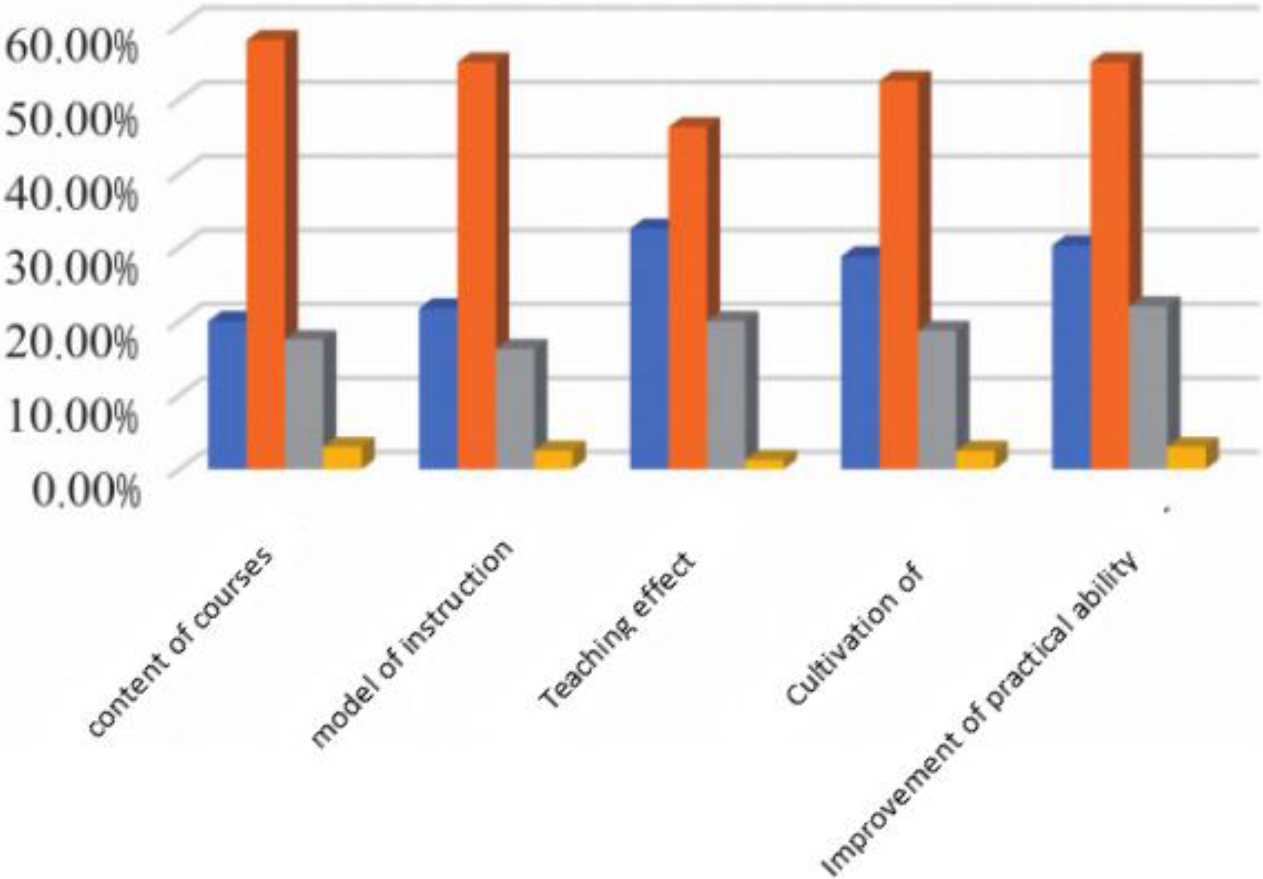
Line chart of comparison between ordinary classes and reformed classes over the years.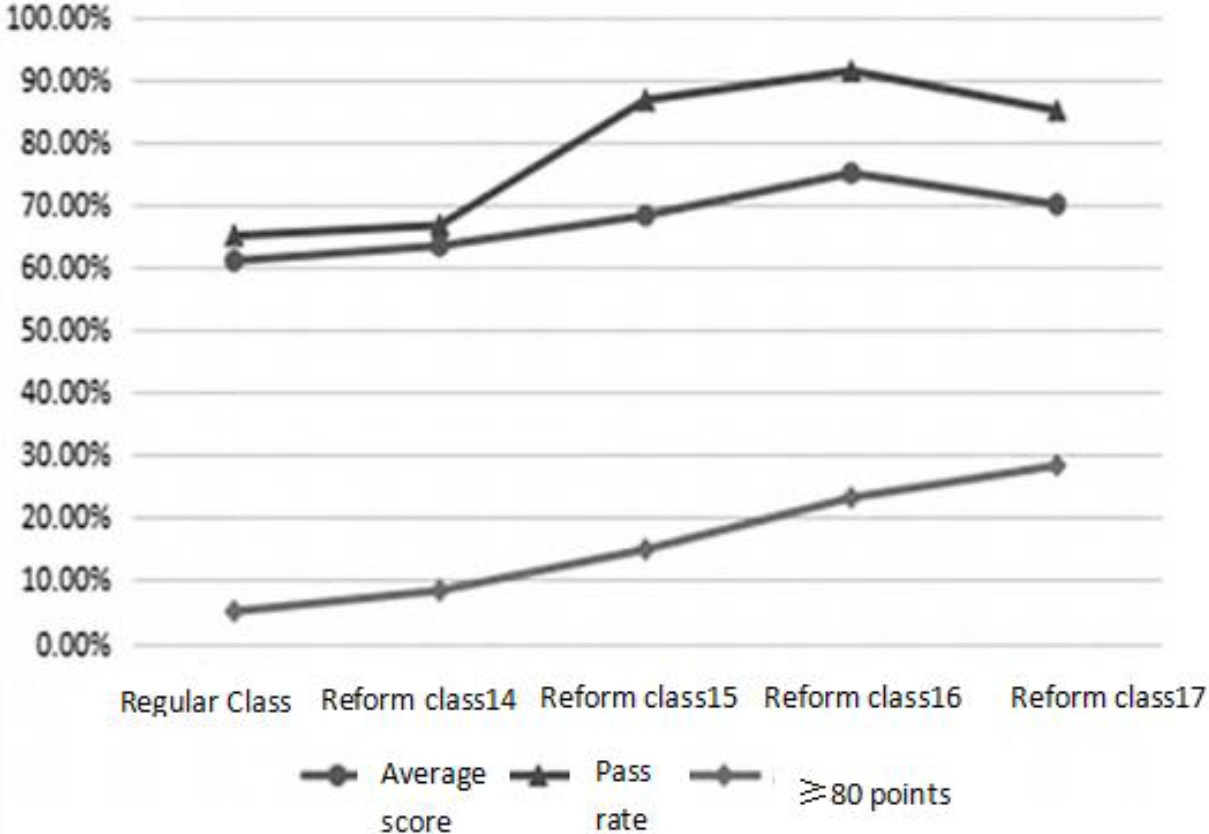
Through continuous exploration and improvement, the teaching effect of the course has been significantly improved, which is mainly manifested in that students have a systematic cognition of the four-dimensional integration course of electronic information specialty and “on-the-job competition certificate”. At the same time, their autonomous learning ability and comprehensive practical application ability have been greatly improved. In the survey on the satisfaction of the teaching content, teaching mode and teaching effect of the course system for the cultivation of innovative practical ability of electronic information students (mainly in grades 2016 and 2017), 81.25% of the students are satisfied with the cultivation of innovative ability, and 85.25% are satisfied with the improvement of practical ability (Fig. 5).
At the same time, compared with traditional teaching, students’ professional course scores have been significantly improved. Taking “Principle and Application of Single Chip Microcomputer”’ as an example. For the regular class and the reform class, the starting point is relatively low. After analyzing the results, it is found that after the implementation of the reform curriculum, the average score and passing rate of the reform class have obviously improved, even reaching 76.00% and 90.00% at the highest value. And, the results show that the number of students with 80 points or above has obviously increased, indicating that students’ autonomous learning ability and comprehensive application ability have been exercised and effectively improved (Fig. 6).
Conclusion
The improvement of the four-dimensional integration curriculum of information specialty needs to focus on the concept of “new engineering” engineering education, with the goal of “consolidating the knowledge base, strengthening the practical ability and enhancing the innovative consciousness”, so as to exercise the professional innovation ability and practical ability. At the same time, based on the four-dimensional integrated basic curriculum system of “on-the-job competition certificate”’ for electronic information majors, this paper explores and innovates from the aspects of optimizing curriculum system, strengthening practice and improving teaching mode. In the process of perfecting the four-dimensional integration course of “on-the-job competition certificate”, it is necessary to achieve the coordinated development of ideological and political education and professional teaching. Through practice, summary and improvement, it has been proved that the four-dimensional integrated course teaching mode of “On-the-job Competition Certificate” can meet the needs of teaching and the laws of education. Moreover, this four-dimensional integrated course teaching mode can really improve students’ engineering practice ability and cultivate their innovative and adaptable ability. It has a high practical significance in the cultivation of innovative and applied talents in “New Engineering” and will be continuously explored and optimized in the follow-up.
To sum up, in order to realize the implementation of the four-dimensional integration course of “on-the-job competition certificate”, it is necessary to do a good job in post positioning, choose the course setting order according to the actual situation, determine the difficulty of the course, investigate the current supply and demand of talents in each post, and think deeply about the characteristics and development of their own majors. In addition, it is necessary to set up a decomposition task according to the standard and sum up clear logical clues, so that students can connect the learning contents of multiple courses. On the basis of the above, teachers determine the concept of curriculum setting strictly according to tasks, and divide the specialization direction on the basis of the original professional setting according to the common tasks and abilities, and should also highlight the professional characteristics and post task characteristics, and finally really improve students’ learning interest and sense of achievement. Of course, in the future, it is necessary to promote O2O interactive teaching mode, theory-practice integration teaching mode and project-based teaching mode. The implementation of these modes can fundamentally improve students’ basic learning ability, improve students’ learning thinking, tap their creative potential and enhance their comprehensive ability of analyzing and solving problems. In the future development, we should steadily promote the cultivation of innovative talents, firmly grasp the mode of “project