



Abstract
The traditional paradigm of visual communication design education is encountering significant challenges in aligning with the dynamic learning preferences of contemporary students. This paper delves into the limitations of conventional educational approaches, particularly their inadequacy in delivering personalized content and hands-on learning experiences. In response, we propose a groundbreaking collaborative teaching model, seamlessly integrated with Artificial Intelligence (AI) technologies. This model emphasizes the transformation of visual communication design education by introducing an AI-enhanced task allocation framework tailored to the course’s specific needs, coupled with a comprehensive scheme for the fusion of knowledge and skill acquisition. Our research not only pioneers a novel direction in teaching visual communication design but also serves as a valuable reference for educational reform across various disciplines, leveraging the potential of AI to enrich learning outcomes and foster a more engaging, customized, and practice-oriented educational environment.
Keywords
Introduction
In the contemporary era, AI’s rapid evolution is reshaping our lifestyle and professional practices in profound ways [1, 2]. This transformation has significantly influenced the educational sector, particularly disciplines that align closely with technological advancements, such as visual communication design [3, 4, 5, 6]. Faced with such dynamic shifts, traditional educational methodologies are becoming increasingly inadequate for addressing the needs of today’s learners. Consequently, there is a growing recognition among educators and academics about the critical need to innovate and revamp teaching strategies to thrive in this era marked by challenges and opportunities.
The collaborative teaching model of visual communication design courses needs further innovation and reform, mainly because traditional teaching methods cannot fully meet the individualized learning needs of students and the requirements to quickly adapt to technological developments. By integrating AI, it is possible to provide each student with customized learning paths and resources, thereby improving teaching efficiency and students’ innovative capabilities, to meet the constantly evolving educational needs in the field of visual communication design. Visual communication design stands at the forefront of fields that thrive on technological reliance and innovation. It necessitates an educational approach that is in sync with contemporary technological advancements, thereby reforming pedagogical practices. Integrating AI into the educational framework serves dual purposes: it not only elevates teaching efficiency by offering tailor-made learning experiences and hands-on practice [7, 8, 9, 10, 11] but also fosters a culture of collaboration among students, enhancing their all-round capabilities and spirit of teamwork. Investigating an AI-enhanced collaborative educational model could spearhead advancements across the educational landscape [12].
Despite visual communication design’s established pedagogical history and the accumulation of experiences over the years, traditional teaching methods primarily focus on disseminating knowledge, often neglecting the cultivation of practical and innovative skills [13]. Moreover, these methods usually fall short in accommodating diverse learning preferences and needs, presenting a significant challenge in effectively melding advanced AI technologies with educational practices [14, 15].
Addressing these issues, this study introduces two pivotal themes: firstly, examining a collaborative educational approach alongside developing a task allocation model tailored for visual communication design education, ensuring a beneficial and effective learning journey for every student; secondly, crafting a scheme that merges knowledge impartation with AI-enhanced learning for visual communication design courses, aimed at delineating the most efficient learning trajectories for students. Through these initiatives, this research endeavors to revolutionize visual communication design education and offer insights for pedagogical reforms in various other fields. This research has significant practical engineering implications, as it optimizes the allocation of educational resources, improves teaching efficiency, and enhances students’ learning outcomes by constructing a task assignment model and an integrated knowledge and skills plan for visual communication design courses. Meanwhile, the application of AI in the educational process provides an innovative educational model for the engineering field, which helps to cultivate more professionals who can meet the future technological development needs.
Enhancing collaborative education through strategic task management
In traditional educational settings, the distribution of teaching resources often falls short of optimal efficiency and reasonableness. The paradigm of collaborative teaching moves beyond mere knowledge transmission or skill instruction, focusing instead on nurturing students’ holistic abilities and fostering a culture of teamwork. The introduction of AI-driven task management methodologies enables the provision of learning tasks that are more aligned with each student’s needs, thereby promoting collaborative skills and innovative thought processes. Figure 1 illustrates the breakdown of course tasks specific to visual communication design.
Diagram of course task decomposition of visual communication design.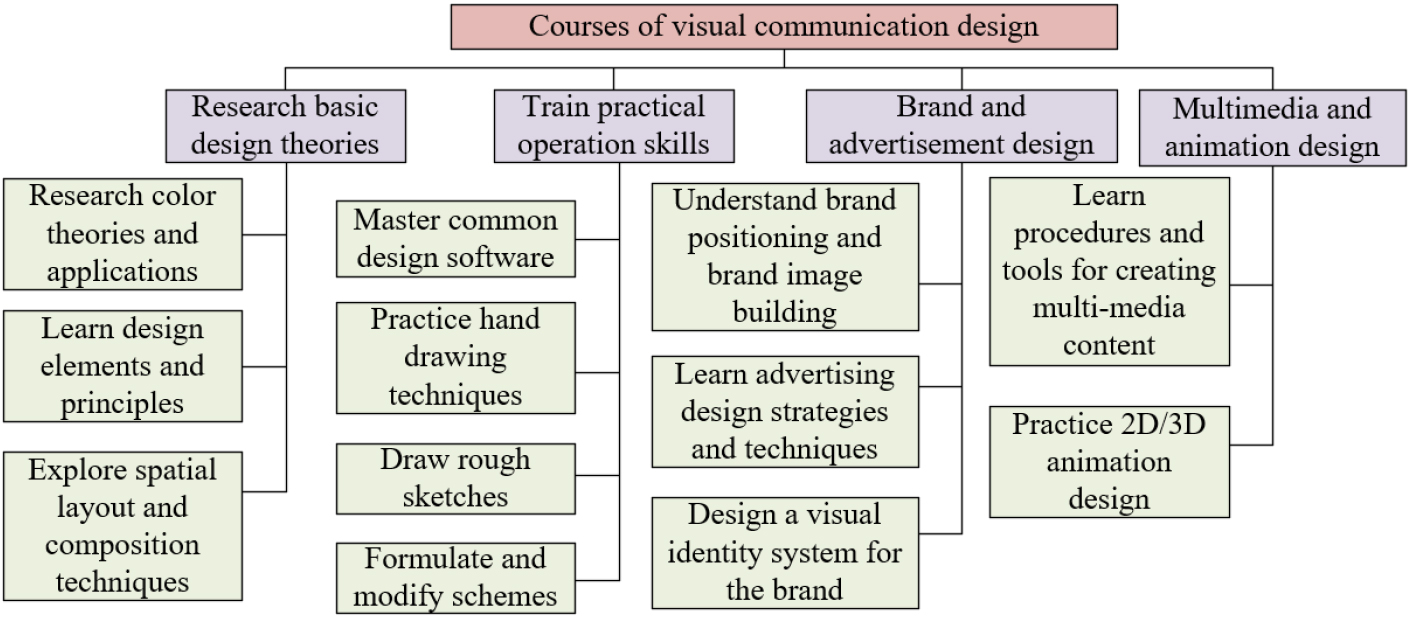
Prior to developing the proposed model for course task distribution, this study undertook an analysis to assess the compatibility of course tasks with individual students. Recognizing the distinct learning capacities, interests, and backgrounds of each student is crucial for ensuring that everyone receives the most beneficial and effective learning experience possible. Therefore, task allocation was meticulously designed to reflect the unique characteristics of each learner, with the assessment of task-student compatibility serving as a foundational step for implementing such personalized task distribution. The hypotheses of this research firstly assume that by thoroughly researching and applying the collaborative teaching mode, the task assignment model constructed for visual communication design courses can effectively improve teaching management efficiency and students’ learning experience. Secondly, it is assumed that the integrated knowledge and skills plan, which combines teachers’ teaching knowledge with AI-assisted teaching, can provide students with optimized learning paths, thereby significantly improving students’ learning outcomes in visual communication design courses. Figure 2 presents the framework of the course task distribution model.
Architecture of the course task allocation model.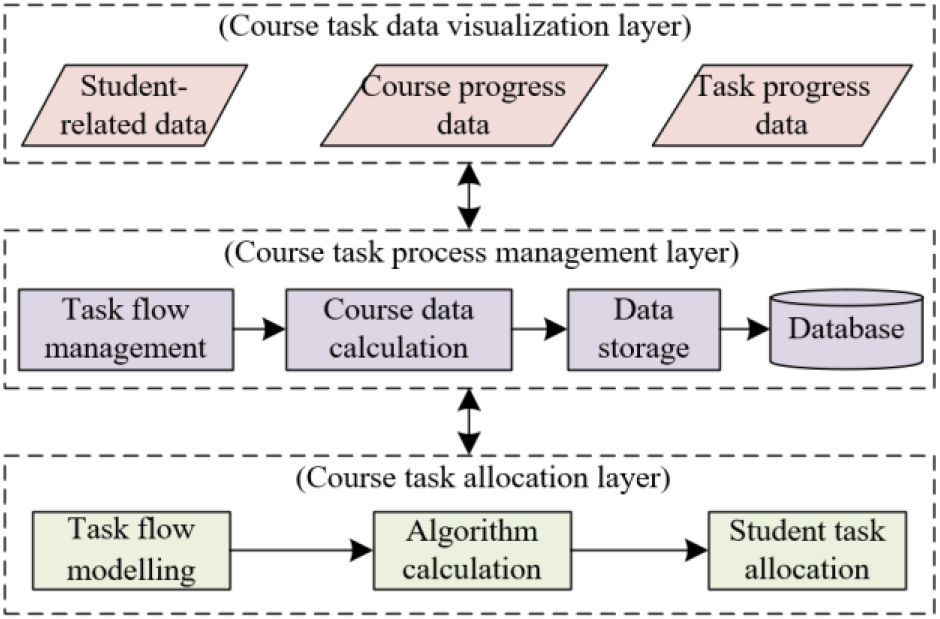
The database of AI-assisted course task management system records data about the completion of every course task, according to the data of course tasks and student participation, the matching degree of all students with respect to course tasks of different types at the current moment can be calculated. Assuming:
After the matching degree was calculated, some variables of the course task allocation model were defined:
A course can be decomposed into There are Work load of each task is set in advance, measured by time, and the time arrangement of task The matching degree of student If a task Students with different levels of learning ability are divided into several sets, which are represented by All ongoing course tasks of each time moment is called a course task set, and the set of tasks of time moment The start time of task The estimated length of execution time of task The unit learning efficacy of student
When constructing the task allocation model, an important thing is ensure effective, reasonable, and efficient task allocation, and there are constraints formulated from four dimensions:
Tasks in the task flow of each course should conform to time constraint and smake sure that the start time
At any given moment, a student is allocated to only a single task within the task sequence across various courses. This approach guarantees that the student’s focus and time are not fragmented across multiple tasks, enabling a concentrated effort on the sole task at hand until its completion. This strategy effectively minimizes the potential for task-related confusion and conflict. The mathematical formulation of this principle is presented below:
For every designated task, a minimum of one student is allocated, guaranteeing the completion of all tasks without omissions. This allocation strategy also promotes equitable distribution of workload among students, ensuring each participant has the chance to engage in and fulfill task requirements. The mathematical depiction of this allocation rule is outlined as follows:
The aggregate number of students engaged in any given task sequence remains within the total enrollment of the class, ensuring that no student is tasked with simultaneous assignments. This system ensures that each student is dedicated to a singular task at any point, facilitating ample learning opportunities without the burden of juggling multiple tasks. Let
The course task allocation model can be constructed from two aspects of “minimizing the course task completion time” and “minimizing the number of student participants”.
In courses of visual communication design, the projects usually have deadlines, so time is a critical factor. By minimizing the task completion time, students can complete the projects faster, thereby leaving more time for practice, feedback, and iterations, and they can learn how to manage time effectively, and this is a key skill in the visual communication design industry. In this study, assuming the matching degree of course tasks is the only factor affecting students’ learning efficacy, the
Assuming:
Reducing the number of students per task allows for more personalized attention and instruction, thereby enhancing the quality of the coursework. With fewer students, teachers can offer more nuanced feedback and guidance to each individual. A smaller student group also elevates each participant’s role and impact on the task, potentially boosting their motivation and engagement. The following objective function, MINd2, is designed to ensure an optimal number of students involved:
In the model, the goal of reducing task time and the number of students is determined through an in-depth analysis of visual communication design teaching needs and student learning efficiency. This approach ensures that each student can receive more focused and in-depth guidance in less time, thereby improving teaching quality and student learning efficiency. This directly serves the core objectives of visual design education, namely, cultivating students’ innovation abilities and practical skills.
The teacher-AI collaborative teaching mode.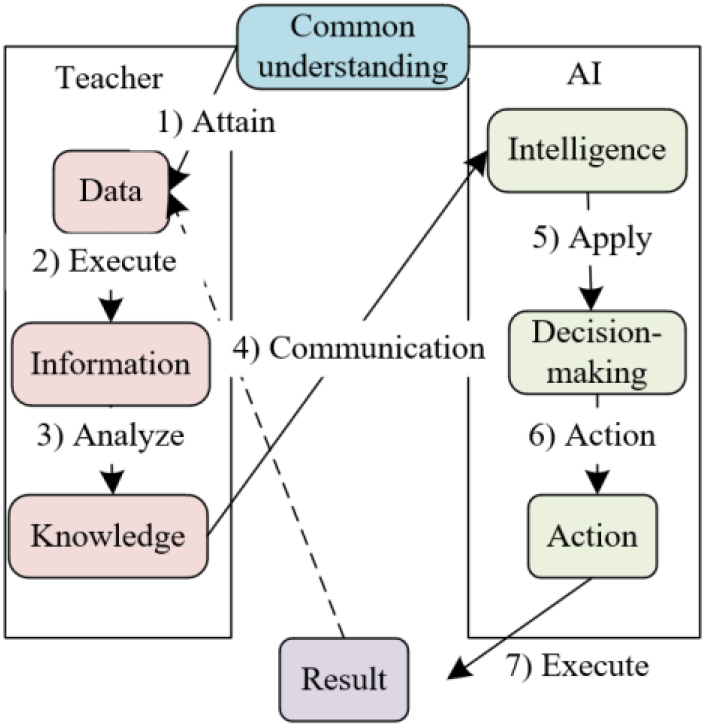
Existing literature on collaborative teaching models and visual communication design education mostly focuses on theoretical discussions and preliminary applications of teaching methods, lacking in-depth development and systematic evaluation of specific course task assignment models and integrated knowledge and skills plans. In contrast, this paper not only delves into the application of collaborative teaching models in the field of visual communication design but also innovatively proposes an integrated knowledge and skills plan that combines teachers’ teaching knowledge with AI, offering more concrete and practical solutions to enhance teaching effectiveness. AI’s capability to sift through extensive data sets enables the tailoring of educational experiences to individual student profiles, recognizing distinct learning patterns, strengths, and requirements. This personalized approach is complemented by AI’s dynamic adjustment of course materials, ensuring an optimal learning milieu that bolsters teaching efficacy. In the realm of visual communication design, where a diverse array of knowledge and competencies is paramount, the melding of AI with traditional pedagogical strategies guarantees a curriculum that is both current and responsive to the evolving demands of students and the sector. This ensures a holistic and structured learning trajectory. Figure 3 depicts the integration of AI with traditional teaching methodologies.
The core premise of this strategy for reforming collaborative education through knowledge and skill integration is the harmonization and consolidation of disparate knowledge structures from traditional and AI-assisted pedagogies, prioritizing elements with high synergistic potential. Analyzing various knowledge components to coalesce similar and complementary subjects strengthens their interconnectivity. During this synthesis, minimizing the impact of extraneous, potentially distracting elements, while amplifying the coherence among integrated knowledge facets, is crucial. Such refinement fosters tighter connections within knowledge clusters, thereby elevating pedagogical outcomes. This refined, teacher-AI collaborative approach not only becomes more effective and tailored but also enhances learner satisfaction. This paper demonstrates how AI can play a key role in visual communication design education through the proposed integrated knowledge and skills plan, especially in strengthening the cultivation of students’ practical skills. AI-assisted teaching can provide personalized learning materials and practical exercises based on students’ learning progress and capabilities, thereby enhancing their practical skills. This enables students to more effectively master the application of visual design and improve their ability to solve problems creatively. Figure 4 showcases the criteria for managing synergy within and across knowledge domains, with the data points and the symbol “
Control principles of inter-category and intra-category synergy degree.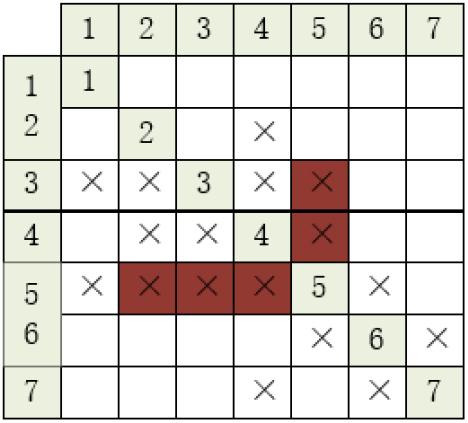
The implementation of a teacher-AI collaborative framework transforms the student learning journey, necessitating an assessment of the synergy between human and artificial instructors to maximize educational benefits. This research introduces three pivotal matrices:
The Knowledge Acquisition Dependency Matrix (AD Matrix): This tool charts the pathways through which learners assimilate knowledge in a hybrid teaching setting, pinpointing the origins of knowledge segments – whether through human instruction or AI – and their intersections. The Knowledge Transformation Dependency Matrix (TD Matrix): It outlines the conversion of acquired knowledge into practical skills or advanced understanding, distinguishing the transformations facilitated by either teacher input or AI assistance, and their collaborative influence on student learning progress. The Knowledge Acquisition-Transformation-Synergy Domain Mapping Matrix (ATS Matrix): Linking the knowledge acquisition and application phases to collaborative teacher-AI activities, this matrix aids in identifying how these joint efforts impact student knowledge development across key areas.
To focus on how students acquire knowledge in the said teacher-AI collaborative teaching environment and identify which knowledge points are attained through teachers or via AI, and how these two parts complement or overlap with each other, at first, this study used the TD matrix and the ATS matrix to identify and calculate the degree of synergy between teachers and AI. Assuming: FAL represents the dependency matrix, RFLL represents the domain mapping matrix,
Should the synergistic endeavors of two course tasks influence a single student’s knowledge acquisition processes, it signals a collaborative synergy between the instruction delivered by educators and the insights offered through AI-enhanced teaching. Under these circumstances, the formula in question can be condensed as follows:
To focus on how students transform the acquired knowledge into practical applications or deeper level understandings, it’s necessary to identify whether students rely more on teacher instruction or AI assistance during the knowledge transformation process and figure out how the two complement each other. This study further used the TD matrix and the ATS matrix to identify and calculate the degree of synergy between teachers and AI. Assuming:
When the synergistic activities from two distinct course tasks affect the same student’s knowledge transformation process, this indicates a collaborative dynamic between the educational content delivered by instructors and that facilitated by AI-supported instruction. Consequently, the relevant equation can be streamlined as follows:
To comprehensively evaluate the synergy degree between teachers and AI during the process of knowledge acquisition and transformation, and figure out how students benefit from teacher-AI collaboration during the said process and how the two complement each other in the entire knowledge chain, this study used the AD matrix, TD, matrix, and ATS matrix to identify and calculate the degree of synergy between teachers and AI. Assuming:
Overall speaking, each combination provides a unique perspective that allows us to gain insights into how teachers and AI collaborate at different stages and evaluate the overall influence on students’ learning process.The development process of the knowledge integration strategy first involves a deep analysis of existing teaching methods and student learning outcomes to identify deficiencies and potential areas for improvement within the current educational model. Following that, by introducing AI as an auxiliary tool and combining it with teachers’ expertise and experience, an innovative plan aimed at optimizing students’ learning paths is designed. This ensures a high degree of match between teaching content and students’ individualized needs, thereby enhancing the overall teaching effectiveness and students’ learning experience.
This paper, through its constructed teaching model and integration plan, considers the allocation of resources during implementation, potential obstacles encountered, and the applicable scale, ensuring the feasibility of its implementation. Firstly, by utilizing existing teaching resources and AI technology, resource allocation is optimized, while identifying and proposing solutions to overcome technical and practical educational challenges that may arise during implementation. Secondly, the design of the model and plan takes into account the scale and capabilities of different educational institutions, ensuring efficiency and operability from small-scale pilots to large-scale rollouts, thus achieving reform and improvement of visual communication design education in various educational settings. In designing the model and integration plan, significant consideration was also given to ethical issues such as bias, privacy, and autonomy, ensuring that the application of educational technology is both fair and respectful of students’ rights. Firstly, the adoption of transparent algorithms and data processing methods is employed to reduce potential biases in AI-assisted teaching, while ensuring the secure handling of students’ learning data to protect their privacy. Secondly, the model encourages students’ autonomous learning by providing personalized learning paths and granting students the right to choose their learning content and pace, thereby promoting their active learning and self-development.
This paper designs related experimental research to test the effectiveness of the proposed task assignment model and integrated knowledge and skills plan for visual communication design courses. Participants include a certain number of students specializing in visual communication design, who are randomly assigned to either the experimental group (using the new model and plan) or the control group (using traditional teaching methods). The experimental process involves assessing the knowledge and skills of both groups of students at the beginning and end of the course, as well as monitoring the interaction, engagement, and satisfaction during the learning process. Measures include students’ academic performance, improvement in innovative capabilities, and feedback from both students and teachers, to comprehensively evaluate the effects of the new teaching model.
This investigation delved deeply into the collaborative teaching framework, culminating in the creation of a tailored course task distribution model that aligns with the unique dynamics of visual communication design courses. This model is adept at orchestrating educational tasks to ensure each student is afforded an enriching learning journey, anchored by two pivotal objectives: reducing the timeframe for completing course-related tasks and diminishing the tally of students involved in each task. Displayed in Fig. 5, we articulate the first goal as “cutting down on task completion times” and the second as “limiting student numbers per task,” with the blue markers mapping the outcomes across various strategic approaches to task allocation, elucidating the interplay between these goals.
The graphical representation reveals a trend: a progression from the top left towards the bottom right, underscoring a scenario where an increase in task completion times (objective function 1) is inversely related to the count of student participants (objective function 2). This suggests that achieving quicker task completions might necessitate broader student involvement, whereas extending task timelines could allow for a leaner student engagement. Notably absent are any outliers along the axes, implying the impossibility of favoring one goal without considering its counterpart – essentially, underscoring the necessity for a harmonized approach. The clustering of dots indicates the potential existence of an “ideal” zone where the dual objectives might achieve a balanced efficacy.
From these observations, it becomes evident that navigating the collaborative teaching landscape requires nuanced trade-offs and compromises to meet the dual aims of streamlining course task completion times and managing student participation numbers effectively. It is clear that an educator’s pursuit of one goal should not overshadow the other. Given the variability in outcomes based on different task allocation strategies, which could affect both the speed of task completion and the volume of student participation, educators are encouraged to weigh both objectives with equal consideration and opt for a strategy that promises the most comprehensive learning experience for all students.
PareAo solution set values
PareAo solution set values
The PareAo solution set.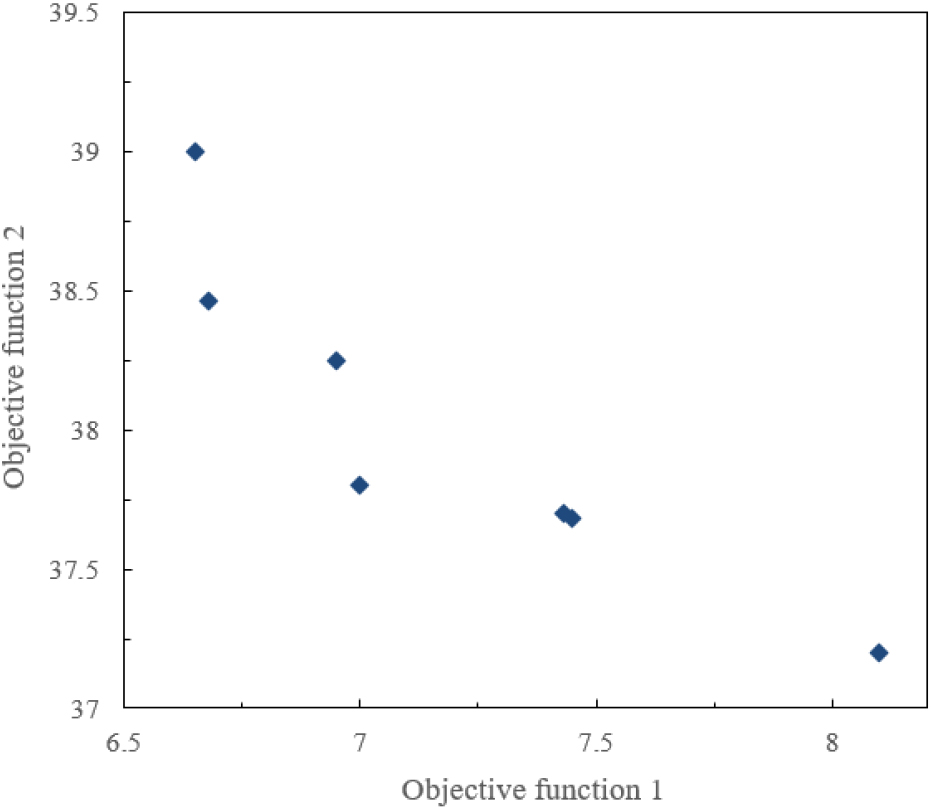
Table 1 delineates seven Pareto optimal solutions pertaining to objective function 1 (aiming to reduce the time needed for course task completions) and objective function 2 (aiming to lower the student engagement numbers per task). This table illustrates the critical balance required in collaborative teaching scenarios, where educators must judiciously optimize both objectives without favoring one to the detriment of the other. Specifically, solution set 5 outlines an approach where the most expedited completion timeline is achieved at the expense of involving the highest number of students. It’s imperative for educators to grasp this trade-off in practical application to guarantee every student benefits from an ideal learning scenario.
Course task arrangement of student participants of solution set 1
Specific time moment of tasks in solution set 1
Further examination of the course task configuration and the timing details provided by solution set 1 is facilitated by Tables 2 and 3. Table 2 outlines the designated sequence of course tasks for each student, while Table 3 specifies the commencement and conclusion times for these tasks. From this data, we observe that certain students, such as student S9, were allocated tasks (A2, A11, and A20) that are sequenced to allow for continuous engagement without idle periods, indicating an efficient use of time where tasks dovetail neatly. However, an analysis of tasks A18 and A6 assigned to students S10 and S4 reveals discrepancies in sequence and an overlapping timeframe, necessitating further clarification to prevent role confusion and ensure task coherence. This arrangement underlines the model’s capacity to facilitate parallel task execution, thereby streamlining the overall completion timeframe. The approach to student task assignment underscores the emphasis on collaborative effort, enabling students to tackle successive tasks efficiently. This necessitates a clear delineation of responsibilities among students assigned to the same task to preclude potential overlaps.
Comparison of objective function 2.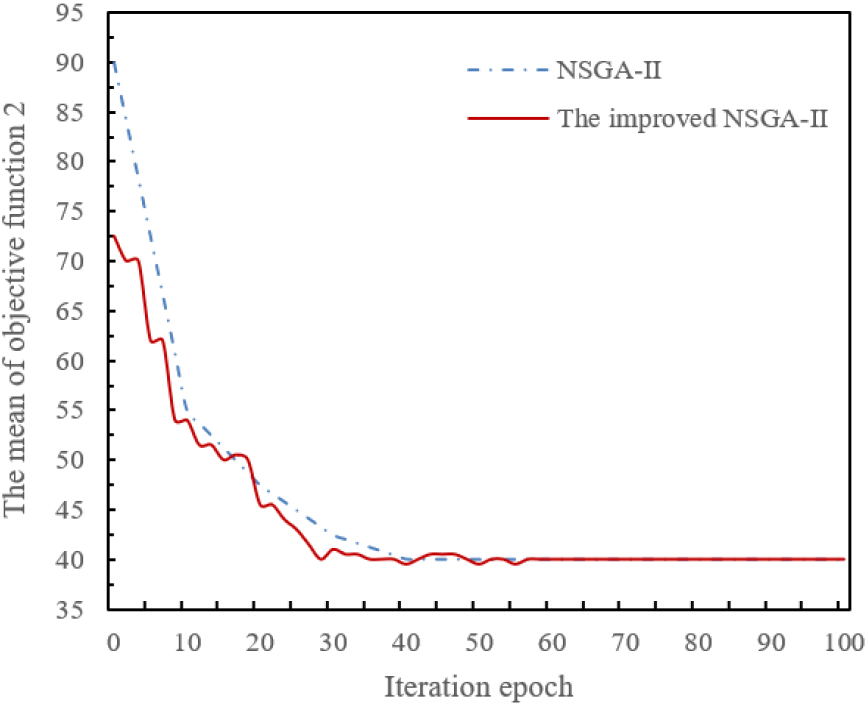
Figure 6 offers a comparative analysis of the NSGA-II algorithm and its optimized counterpart across increasing iteration epochs. Initially, the performance of both algorithms is comparable, with the optimized NSGA-II showing a slight advantage. As iterations progress, a decline in performance indicates an active search for more optimal solutions, with the optimized NSGA-II demonstrating a quicker decline, consistently outpacing the original NSGA-II. Around the 40-epoch mark, the optimized algorithm achieves stabilization at a notably lower value compared to the original NSGA-II, which finds its equilibrium after approximately 70 iterations. Post the 100-epoch milestone, the optimized NSGA-II substantially surpasses the performance of its predecessor.
For educational objectives in visual communication design courses, this research introduced an approach that merges knowledge impartation with skill development, leveraging AI to complement traditional teaching methods, thus crafting an ideal learning trajectory for students. Displayed in Fig. 7 are comparative analyses between conventional teaching techniques (illustrated in blue) and the newly developed knowledge-skill integration approach (depicted in red), evaluated across four distinct metrics. The comparison reveals that, while both methods are effective in enhancing “comprehensive ability,” the integration approach slightly surpasses the conventional method. Notably, in “practical operation skill” enhancement, the integration method excels significantly, demonstrating a clear lead over traditional techniques. Regarding “short-term efficiency,” both strategies saw a slight decline, yet the reduction was less pronounced with the integration approach, which maintained a commendable score. Moreover, “continuous learning motivation” saw substantial gains with the integration method, outshining the traditional approach considerably. This evidences the integration method’s superior performance across key metrics, particularly in boosting practical skills and sustaining student motivation. The integration of teacher-delivered knowledge with AI-supported instruction offers students enriched and more effective educational pathways, as evidenced in the graphical representation.
This paper first conducted statistical analysis to verify its research outcomes by collecting and analyzing data on student performance before and after instruction, comparing the learning outcomes between the experimental group (using the collaborative teaching model and integrated knowledge and skills plan) and the control group (traditional teaching methods). Appropriate statistical methods, such as
Pre- and post-
Comparison of pre-test and post-test performance of the experimental class.
While the statistical data reported indicates significant effects of the course reform plan in most course tasks, its limitation lies in the possibility that data may only pertain to a specific experimental class or learning environment, without considering the general applicability and long-term effects under different educational backgrounds. When compared with other survey results in the field, it is necessary to further verify the universality and stability of the research results to ensure that the observed improvements are not unique to a specific sample or experimental conditions, but can be replicated and implemented in a broader educational environment.
In summary, the research results of this paper successfully demonstrated that through the co-teaching model and integrated knowledge and skills plan, the teaching quality and students’ learning outcomes of visual communication design courses can be effectively improved. This directly addresses the initial research questions and objectives: how to optimize task allocation and integrate teaching resources to ensure that students receive the best learning experience. These achievements validate the application value and effectiveness of the innovative teaching model and plan in actual teaching, reflecting the importance and urgency of introducing AI and collaborative teaching concepts in visual communication design education.
The core aim of this research is to introduce an innovative AI-enhanced cooperative teaching approach tailored for visual communication design courses, incorporating a meticulously developed task distribution model along with a strategy for merging knowledge with practical skills. The findings underscore the importance of educators adopting a holistic view, specifically targeting the reduction of task completion times and the optimal number of student engagements to ensure the most effective learning outcomes. This study delves into the configuration of tasks and precise timing within the first solution set, providing insights into the Pareto optimal solutions. An evaluation of student performance before and after the experiment highlights notable enhancements in three out of four course tasks, post-integration, barring “research basic design theories.”
The model proposed in this paper, through personalized task assignment and an integrated knowledge and skills plan, can flexibly adapt to the needs and abilities of different learners. Utilizing AI-assisted teaching technology, this model can analyze students’ learning progress and outcomes in real-time. Based on this analysis, it can adjust teaching content and difficulty, providing each student with a customized learning path that matches their individual learning pace and interests, ensuring all students can optimize their learning outcomes under the most suitable conditions.
The integration of instructional content with AI-supported methods has markedly enriched the pedagogy of visual communication design courses. This approach, aside from the area of “research basic design theories,” has shown significant post-test advancements in the remaining tasks, affirming the real-world educational efficacy and statistical significance of these improvements. Such results emphatically validate the practical applicability and potential transformative impact of the proposed model on design education. Despite the innovative teaching model and integration plan proposed in this paper within the field of visual communication design education, its limitation lies in the research’s focus on theoretical construction and model design, which may lack extensive empirical research and evaluation of long-term effects. Therefore, future research should focus on the practical implementation of these models and plans in actual teaching, conducting long-term follow-up studies with large-scale and diverse samples to verify their applicability and effectiveness in different educational environments. This would further explore the in-depth application of AI in the field of education.
Footnotes
Acknowledgments
This paper was funded by 2021 Social Science Development Research Project in Hebei Province: Research on the Design and Development of Intangible cultural heritage Cultural Creative Products in Hebei Province under the Digital Economy (Grant No.: 20210301196).