



Abstract
After entering the new millennium, the computing capacity of information terminal has shown a rapid development. This progress has caused cross generational changes in various fields, especially in the field of communication technology, which directly spawns a new field. Compared with the development speed of information terminal, the development of communication technology is always in the position of “catch-up”, and the main work performer is the traditional data form. This backward leads to the primitive evaluation of Ideological and political education. This paper mainly studies the application of improved machine learning algorithm and voice technology in the teaching evaluation of Ideological and political education. The weighted naive Bayesian algorithm is applied to the teaching evaluation of Ideological and political education creatively. By inference of hypothesis model, the intervention curve of various conditions on the evaluation results is verified. The influence of class attribute probability on condition assignment is obtained, and it is used as a calculation tool for our evaluation of Ideological and political education teaching. The experimental results show that the improved weighted naive Bayesian algorithm can better integrate the speech technology and improve the evaluation accuracy.
Introduction
At present, the teaching evaluation mode in Ideological and political education is still an obsolete model with student examination results and teachers attendance as the main body. It has been criticized by all walks of life for lack of dynamic investigation in the teaching process of students. In the information age, the production and collection of educational data and text enrich the process information in teaching, which is conducive to the development of personalized evaluation scheme [1]. But how to play the role of these data has not been studied in a proper system. Therefore, construct the dynamic inspection process based on scientific algorithm and big data analysis has become the key issue of deepening the reform of higher education. As we all know, the key factor is to improve the teaching quality of Ideological and political courses. Compared with the traditional teaching evaluation methods, the timeliness and profitability are obviously enhanced [2]. At the same time, the arrival of big data era has great impact and challenge to all industries, but opportunities also follow, especially in the education industry.
To evaluate teaching, there must create a set of teaching evaluation data. However, the teaching evaluation data is special and private for all colleges and universities. There is no open data of teaching evaluation in Colleges and universities. Therefore, there are few researchers who study the direction of Emotional Analysis on teaching evaluation [3]. However, there are already many scholars at home and abroad who have collected a lot of text data on other platforms, such as microblog, post bar and e-commerce platform, and based on these data, they have carried out research work related to text emotion analysis, and they are doing some research. The main methods used in the research are based on different schools based on different construction basis. Emotion dictionary, traditional machine learning and deep learning technology are the most popular three construction bases at present.
The traditional teaching evaluation model has many shortcomings, such as one-sided function, single content, lack of scientificity, which may lead to misjudgment and misjudgment of students’ ideological and political education effect evaluation, and can not timely propose customized learning efficiency improvement according to students’ shortcomings plan. This paper wants to carry out deep mining of the existing data, and explore the interrelationship between the teaching effect and the factors that can influence the teaching level. The evaluation index system is optimized. Through the upgrading of machine learning algorithm and other programs, we can create an efficient teaching evaluation system, and make the evaluation results more realistic and objective to reflect the teaching quality of teachers, lay a foundation for the sustainable development of Ideological and political science.
Teaching evaluation based on machine learning
Principles of teaching evaluation of Ideological and political courses
In the subject of Ideological and political, the evaluation of students is different from other scientific standards. This standard system is called the principle of Ideological and political teaching evaluation, which greatly externalizes the aesthetic orientation of the evaluation system of Ideological and political courses [4]. In high school education, teaching evaluation should take the establishment of morality as the basic task, and focus on improving the core quality of students’ political discipline as the leading task, and at the same time follow the principles of development, thought and comprehensive teaching evaluation.
(1) Development
The purpose of constructing scientific evaluation system is promote the sustainable development of Ideological and political teaching, so the construction of the new system must also emphasize respect for development [5]. The so-called development of evaluation system has three levels of interpretation in the contemporary era. First, the promotion of teaching activities means that “teaching learning” is all in the process of dynamic change [6]. This makes the subject of both sides of teaching have great potential to tap [7]. Therefore, in the evaluation activities, we should grasp the current state and potential of the future development of teachers and students, and cannot limit them to the performance of teachers and students at a certain point. In particular, we should abandon the unilateral evaluation of the separation of the relationship between the two sides in the traditional evaluation system. Secondly, any teaching evaluation is carried out in order to promote the improvement of teaching quality better [8]. That is, only the teaching evaluation carried out in the center of improving teaching quality is a high-quality teaching evaluation. Only by building the evaluation system of the center of teaching quality, and then looking at the improvement of knowledge level and the change of moral behavior of teachers and students in teaching evaluation with the development and dynamic perspective [9].
Third, teaching evaluation and teaching work are not opposite, but communicate with each other and coexist harmoniously. The construction of teaching evaluation system must be combined with teaching work and effectively link the two. In this way, the principle of development can be better implemented.
(2) Ideological
As the name implies, the key point of Ideological and political lesson is to educate students about politics and ideology so as to guide them to firmly determine their political direction. Enhance students’ ability to distinguish and understand complex social phenomena. Therefore, the teaching evaluation of Ideological and political course must also strictly abide by this criterion, and take direction guidance and value cultivation as the focus of Ideological and political courses, and treat and analyze social phenomena from the historical and dialectical perspective [10]. In order to understand the true meaning of Chinese characteristics with the spirit of advancing with the times, our ideological and political education will be attributed to its origin [11]. The ability of students to solve situation problems can gradually improve the core level of students’ discipline from facing simple situation problems to challenging and complex problems. Accordingly, the evaluation system of Ideological and political course should include the key contents such as political recognition and value discrimination, so as to enhance the students’ Ideological and political level [12].
(3) Comprehensiveness
The overall development of human is a very important aspect in Marx’s thought system. He even pointed out in particular that people should be people of all-round development [13]. And the overall development of human beings, education should take important responsibility. This has brought us scientific enlightenment to our ideological and political lesson: First, the content of teaching evaluation should be comprehensive. The small test can only test the students’ knowledge level of this class, but it can not reflect the overall performance of students in the classroom. The complete teaching evaluation system can cover every level of teaching activities [14]. Second, the teaching evaluation information should be comprehensive, mainly considering the sufficient information collection, both the constraints of the realization conditions and the methods [15]. That is to say, the traditional way of Ideological and political teaching evaluation is realized through mutual evaluation between teachers and students in the classroom teaching process. Although this way is relatively direct, it can not objectively respond to the real situation of the classroom, but a mode of combining interview and observation [16]. That is, the development of teaching evaluation should involve all levels of teaching activities. In this way, we can make a fair and objective evaluation of teaching evaluation [17, 18].
Evaluation method based on weighted naive Bayes
(1) The algorithm of determining the weight of evaluation attribute
Weighted naive Bayesian classification algorithm is based on its contribution to class variables. This deformation not only keeps the calculation efficiency of the algorithm, but also avoids the negative effect of the over large imaginary assignment range of attribute variables [19, 20]. The formula is as follows.
Based on the above formula, we can get this algorithm strengthens the relationship between the various factors so that they are no longer independent individuals [21].
(2) Specific steps of algorithm
The first step is to make statistics on all collected data samples, calculate the number of categories, and record the number of samples assigned in the statistical table. The second step is to learn the relevant probability parameters [22]. The data information which is well counted in the first step is sorted out, and then input them into the Eqs (2) and (3). The third step is to learn the weight parameters and learn the prior probability. According to the class number information, the prior probability of all class labels is calculated. At the same time, the conditional probability of all attributes is calculated and the results are saved [11, 12]. Compared with the original naive algorithm, the weighted naive Bayes method has a higher accuracy rate and a smaller requirement for a set of values.
This chapter proposes a BP neural network algorithm with an improved incentive function to predict the evaluation of ideological and political education and improve the accuracy.
The excitation function affects the error situation and convergence degree of the BP neural network. During neural network training, the incentive function will have a more intense impact on the BP network as the training intensity increases, resulting in faster changes in the error of ideological and political education evaluation.
Therefore, slowing down the curve change of the excitation function is a BP neural network tuning method. In order to slow down the change of the excitation function, first define the function as:
The excitation function defined in this paper can guarantee the accuracy and stability of the BP neural network algorithm during training. At the beginning of training, since the excitation function defined in this paper is steep enough, D in the formula can keep the BP network in a good state as a whole, and will not be biased towards a certain part of the solution. When the training of the BP neural network is about to end, the stability of the network can also be quickly controlled.
Experimental environment
The experimental environment of this paper is windows7 operating system, and python3.8 is used as the language of the algorithm in eclipse
Data source
The text data used in this article comes from the educational administration system of a certain university in this city, and contains the teaching quality evaluation data of the past two years and four semesters. Including text, video and voice data. The data set the statistics of the number of courses, students and teaching quality evaluation of each semester. We take the four semester teaching evaluation information as the initial corpus of the experimental part of this paper.
Data preprocessing
The purpose of data preprocessing is to reduce miscellaneous data, filter out redundant data, and obtain data that is more in line with actual characteristics for experimentation. Through data preprocessing, interference and duplicate data can be removed, and the experimental results are more accurate. Through operations such as word segmentation and feature extraction, experimental data can be used directly.
(1) Data cleaning
After word segmentation, the number of words in the text after the words are removed from the repeated words shall be calculated. If the number of words is less than 3, the words shall be filtered directly; after word segmentation, the proportion of words calculated as one word shall be calculated; If more than 80%, the words shall be filtered directly.
(2) Chinese participle
There are many tools and methods that can be used in Chinese word segmentation. In this study, we have an experiment to explore the influence of different segmentation tools on classification performance. In this step, we first use Jieba participle to show the effect of segmentation [8]. As mentioned above, the word segmentation method of Jieba is mixed, and after segmentation, invalid data is filtered by the rules formulated in the previous step. The purpose of using Chinese word participle is to determine the frequency of each factor, so as to estimate its weighting coefficient.
(3) Filter inactive words
The term “stop” refers to words that do not have specific effects in language. No matter what language, omitting the words of discontinuation in compound sentence pattern will not have a serious impact on its practical significance. The application environment is different, and the actual situation of the word will also have some differences. In the field of evaluation system of Ideological and political course, the determination of the inactive words is to calculate and assign the inverse text frequency to all the word frequencies in the evaluation results [9]. According to the method of high frequency to low frequency calculation and low assignment of inverse text frequency calculus, the words that should be designated as the inactive words are selected.
(4) Text representation and feature extraction
The end step of the data preprocessing in this experiment is text representation and feature extraction, that is, how to train and weight the feature vector. The text extraction of this experiment is based on gensim, the third-party open source library in Python. The corresponding features in the review data set are assigned in the form of 100 full score through word2vec model. Then, the TF IDF values of all the features in each comment data are calculated by sklearn, and the feature weighting is performed for each comment according to TF IDF weighting method.
Accuracy comparison experiment
(1) Comparison between naive Bayesian method and weighted naive Bayesian method
As a member of the clustering algorithm, the naive Bayes algorithm is mainly used to distinguish various types of arrays. The weighted naive Bayes algorithm is also used for clustering, which is generally used in subject evaluation and fire detection classification. In order to ensure the authenticity of the data obtained in the experiment, the data selected in this experiment are randomly taken from the evaluation database. The specific steps are to randomly select 240 comments as training data in the evaluation database, and 80 data as test data. The data obtained from the two sides are compared. The accuracy of the classification of naive Bayesian and weighted naive Bayesian algorithm is measured by many tests.
Among the two, the former is often used when it is impossible to judge the status of each influencing factor; The latter is to determine the status of each factor by carrying out weighted experiments on various factors. The shortcoming of the naive Bayes method is that the relationship between the various factors is separated, and the calculation speed is fast, while the weighted naive Bayes method is to determine the weight of each factor through multiple measurements, so the calculation time is longer.
The positive impact of improving accuracy and efficiency on teaching evaluation of ideological and political education includes both teachers and students. First, after the accuracy and efficiency are improved, students’ learning effects can be evaluated in a timely and accurate manner, so that students’ learning conditions can be correctly evaluated; second, teachers can obtain teaching evaluation information faster and in a timely manner. own teaching quality information, so as to formulate a more efficient teaching plan.
(2) BP network and weighted naive Bayesian comparison
BP network is mainly used for prediction. Compared with the traditional method, the method in this paper has a significant effect in improving the efficiency. The BP neural network algorithm controls the value range to [0, 1], and establishes the prediction model of new sample data evaluation level.
The data required by this algorithm far exceeds the weighted naive Bayes method, and the more intermediate data, the more accurate the result. The BP network further strengthens the connection between the various factors. Although the calculated results are more accurate, the amount of calculation is too large, and the requirements for various types of data are also more. The Naive Weighted Bayes’ rule is to focus on the evaluation.
Simulation results
Comparison of naive Bayesian method and weighted naive Bayesian method
From the Fig. 1, it can be seen that the average accuracy of Weighted Naive Bayesian algorithm is 0.04 units higher than that of naive Bayesian algorithm. This shows that the experiment improves the accuracy of the algorithm to some extent.
Comparison of classification accuracy between NB algorithm and WNB algorithm.
As shown in Fig. 2, the weighted naive Bayesian method is used to evaluate the results, and the number of excellent grades obtained is more than that of traditional BP model, and the difference between them will change with the different data selected. The results of this experiment show that the weighted naive Bayesian algorithm is more accurate than the traditional BP algorithm. The accuracy has a positive effect on the evaluation of ideological and political education and has important guiding significance for the follow-up ideological and political education.
Comparison of classification accuracy between BP algorithm and WNB algorithm.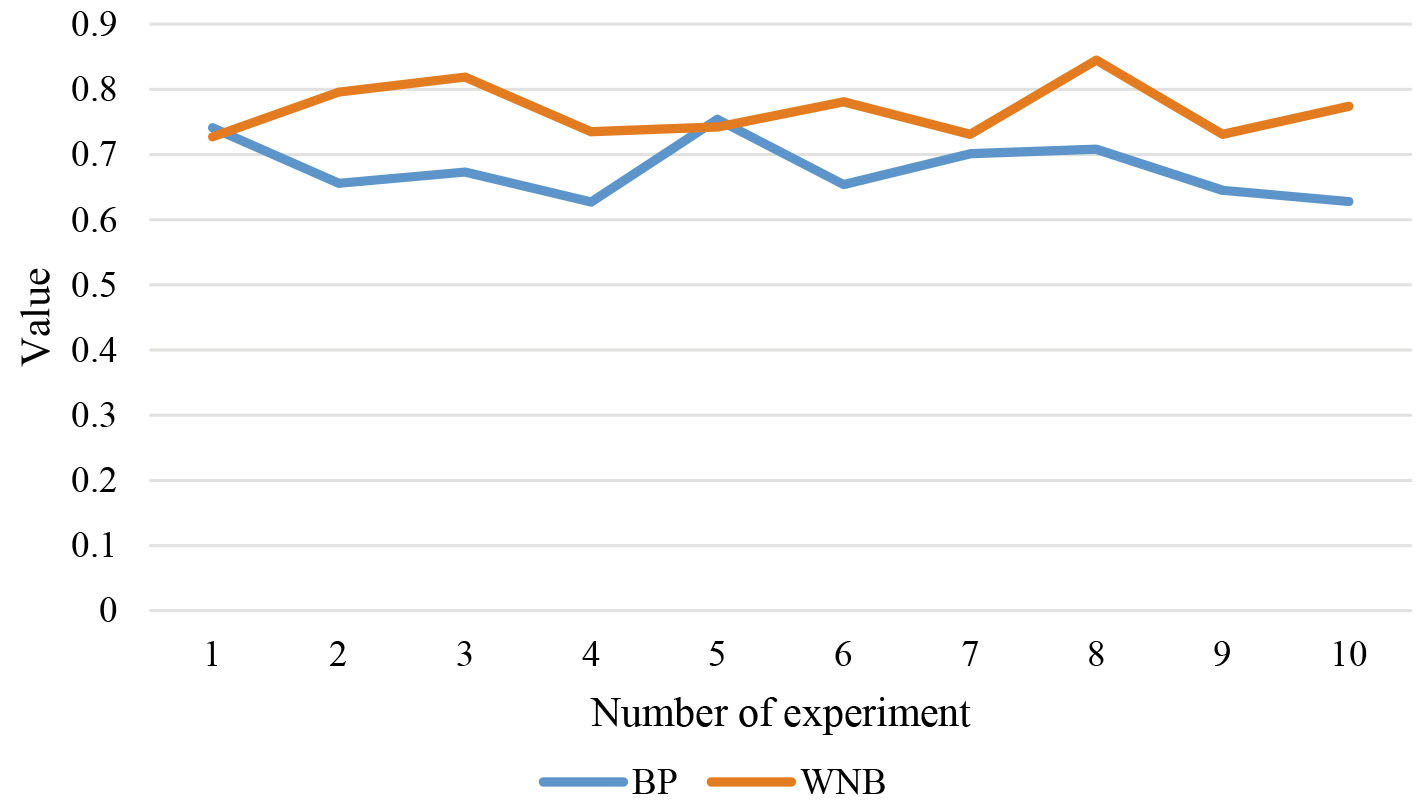
Teaching quality evaluation is an important resource for colleges and universities. Colleges and universities can understand students’ attitudes and opinions on teaching arrangements from teaching evaluation, which has an important reference role for the teaching reform of colleges and universities. It mainly includes: data preprocessing, correlation analysis method, classification algorithm and incremental learning method. This paper expounds the establishment process of traditional classroom teaching evaluation system, and uses the classification algorithm of machine learning in the construction of evaluation model, so as to further improve the scientificity and feasibility of teaching evaluation. Machine learning algorithms and voice technology have played an active role in the evaluation of ideological and political education, making the evaluation results more scientific, objective, and accurate, with guiding significance and practical value. The history and characteristics of political learning can predict the learning status of students in the future, so as to formulate targeted learning plans for students’ ideological and political learning in the future. There is a relatively subtle relationship between various factors. The Naive Bayes method is used to calculate, which obviously breaks the objective relationship between these factors. Therefore, this paper selects the weighted naive Bayes method that can better reflect the factor relationship for evaluation.
Footnotes
Funding
Provincial General Project of Teaching Reform Research in Higher Education of Jiangxi Province, JXJG-20-40-4, “Research on the Ideological and Political Design and Implementation Approach of Nursing English Course under the Guidance of Xi Jinping’s “Four Truths” Concept”.