



Abstract
The gradual shortage of consumable industrial resources has brought some problems to traditional industries, such as slow technological renewal, decline of pillar industries, population outflow in the cities where they are located, and relatively weak natural and cultural resources. Therefore, it is urgent to apply cross-border thinking to give vitality to the innovation of traditional industrial culture and promote the expansion of traditional industries to cultural industries. Based on the research on the IP empowerment advantages, the identifiable, marketable, authorized and transformable industrial culture IP will be used as the guide to promote “cultural innovation” and “digital innovation” as the internal driving force of industrial development, and the industrial development model of “IP
Keywords
Introduction
In 2021, eight ministries and commissions such as China’s Ministry of Industry and Information Technology jointly issued the Implementation Plan for Promoting Industrial Culture Development (2021–2025), which specifically expounded the significance of all-round development of industrial culture for high-quality industrial development, indicating that industrial cultural resources have received unprecedented attention. Due to the numerous industrial resources and complete categories in China, the development of industrial cultural resources will enhance the economic, social and environmental benefits of the industry, especially for the transformation of traditional industries. However, the transformation of industrial cultural resources into economic resources that can be realized requires a systematic top-level design of industrial culture, personalized and diverse creative guidance, a market communication mechanism that needs accurate docking, interaction with the Internet, big data, artificial intelligence and other new technical means, and the wall-breaking integration between different industries. Whereas, IP has such advantages as top-level design, self-contained flow characteristics, guidance for product innovation and development, high degree of identification, good interaction with network technology, strong liquidity penetration ability, and long liquidity periodicity, which have become important methods and approaches to promote the development and application of industrial culture.
In view of the fact that the traditional industrial transformation needs a large number of cultural and creative industries and digital industries, it is the concrete practice of “industrial culture” and “industrial digitalization” to take industrial culture IP as the top-level design and transformation driver of industrial structure adjustment [1]. In this paper, the IP of industrial culture is used to aggregate traditional industrial producers, online platforms, offline entities, customers, fans, related industries, etc. to help optimize and upgrade industrial cultural resources from planning, design to operation and sales. In this way, the construction and guidance of industrial culture IP will promote the diversification of industrial culture resources and cross-domain product research and development, enhance the comprehensive economic value and social value of traditional industrial areas, and promote the transformation of cities where traditional industries are located from single-function cities to complex-culture cities. Finally, the transformation and development of traditional industries will be instigated by industrial culture IP, and a new path of transformation and development will be formed by shaping offline cultural economy and expanding online digital economy. Eventually, the above-mentioned measures will promote the traditional industries to catch up with the fast development of the Internet and the new economy and realize the transformation and development of the traditional industries.
Historical evolution of traditional industrial transformation and development
In the 1950s, due to the impact of the third scientific and technological revolution, the transformation and upgrading of traditional industries, which mainly focused on resource consumption, was first initiated in the industrialized countries of Europe and the United States. The main transformation modes can be summarized as follows:
New format transformation of traditional industries
In 1955, Michal Rix, a British historian of industrial architecture, defined the knowledge of British industrial revolution relics as industrial archaeology for the first time, thus starting a large-scale and systematic investigation and protection of British industrial relics [2]. The two most important academic achievements of industrial archaeology are the transformation and reuse of industrial heritage put forward by British Industrial Archaeology Research Committee [3], and the public benefits and economic value of industrial heritage put forward by Miles Oglethorpe and Shane Gould, that is, industrial heritage tourism [4]. Britain timely carried out the research on industrial archaeology to better protect and develop the British industrial heritage and make it the country with the largest number of industrial heritage in the world at present, as shown in Fig. 1. Up to 2010, there were 54 world industrial heritage sites by country, including 2 jointly owned by Italy and Switzerland, and the actual number of industrial heritage sites was 52.
Statistics of the number of world industrial heritage sites. Source: UNESCO (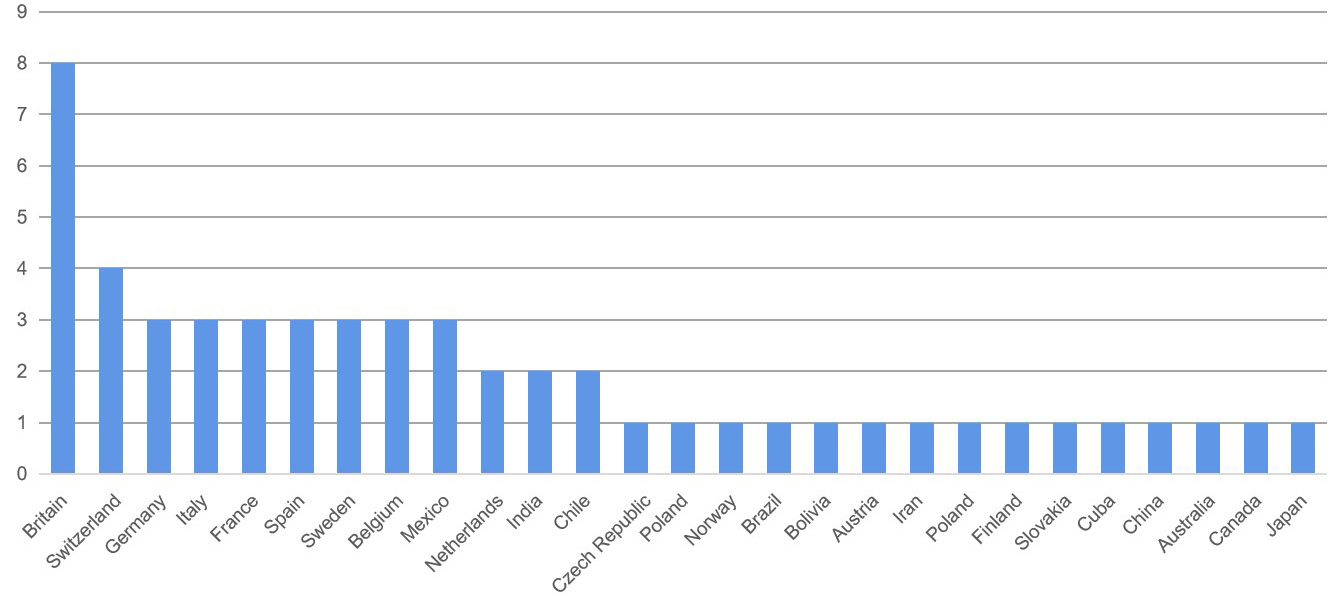
In the middle of last century, David L. Smith, an American scholar, put forward the theory of urban comfort in view of the transformation of traditional industrial cities in Europe and America, and believed that urban comfort is impetus to promote urban development under the new technology because it can attract talents and capital [5]. As a result, the cities represented by Chicago, the largest industrial city in the United States, have structurally transformed the industrial areas of traditional industrial cities located in scenic spots under the guidance of the urban comfort theory by shaping the image window of cities, improving the investment environment of cities and vigorously developing the tertiary industry to realize the transformation from industrial economy to service economy.
Cultural industry transformation of traditional industries
Britain, as the birthplace of the industrial revolution, once stagnated in economy because of the decline of traditional manufacturing industries. In 1990s, John Howkins, a British cultural industry scholar, creatively combined creativity with economy, which was first used as the source of industrial development [6]. Subsequently, Britain became the first country to use public policies to promote the development of cultural and creative industries. The cultural and creative industry represented by “Cool Britain” has gradually replaced many traditional industries in Britain, and successfully realized the transformation from a “world factory” dominated by manufacturing industry to a “world creative center” dominated by cultural industry.
Technological innovation of traditional industries
The Kitakyushu Traditional Industrial Zone, which is representative in Japan, is actively linked with academic institutions to rely on science and technology to promote the upgrading of traditional industries to high-tech industries, to focus on the transformation of traditional industries into advanced equipment manufacturing industries such as electronics, robotics and biotechnology, and to rely on the dominant innovation of traditional industrial technologies to revitalize the industry and the city [7].
Ecologicalization of traditional industries
In China, under the background of green development with circular economy and low-carbon economy as the main contents, industries such as green products, characteristic planting, health care and medical care are developed guided by “lucid waters and lush mountains are invaluable assets” proposed by the General Secretary, Xi Jinping, with the green transformation of traditional industries as the way out and ecological industries as the driving force, avoiding the “first development, then governance” model of developed countries [8].
To sum up, the relevant research on the transformation of traditional industries is mainly conducted from the 1950s to the beginning of this century, with numerous successful cases, mainly focusing on the promotion of the transformation and development of traditional industries in the information technology era through measures such as the protection and reuse of industrial relics, urban space reconstruction, cultural and creative industries, and industrial technology renewal. With the advent of the digital technology era, science and technology are undergoing modern innovations, and new technologies and new business models will correspondingly emerge in the transformation and development of traditional industries. In the “digital cultural economy era” characterized by customer customization, digital collaboration and national creation, “cultural innovation” with digital technology and “digital innovation” with cultural content will surely become the trend of the transformation and development of traditional industries in the future [9]. However, the current research on this content is relatively lagging behind. Especially, there are few researches on the application of “IP-based whole industrial chain operation” with industrial culture as the main body in the development of traditional industries. In this paper, how to shape the cultural value, social value and commercial value of industrial culture IP is discussed from the perspective of industrial culture IP in order to use industrial culture IP with both cultural and technological advantages to lead the integration and innovation of traditional industries, tap new economic growth points of industrial culture, and further cultivate new formats and modes of traditional industries. The industrial culture IP will be used to leverage the industry’s “IP-based offline real economy” and “IP-based online economy” to achieve mutual support and common development of traditional industries online and offline [10].
IP’s industry dynamics and empowering advantages
IP’s industry dynamics
IP, short for Intellectual Property, has been generalized and abstracted in the Internet era, and goes beyond the original copyright content, including the ability to transform popularity into all tangible and intangible assets with commercial value, and a business model that can optimize and integrate resources [11]. According to License Global, the output value of IP industry in the world shows a rising trend year by year, and the global retail sales of IP licensed goods exceeded US$ 292.8 billion in 2019. The copyright industry started late in China though, it showed the vitality of rapid growth. In 2018, Tencent first proposed the definition of “new cultural and creative industries” in the context of pan-entertainment, that is, the production mode of culture in the new era will focus on IP construction. According to the statistics of the SIPO, the added value of China’s copyright industry increased from 546 million yuan in 2016 to 732 million yuan in 2019, representing a 34% increase in industry scale. Up to 2019, China’s copyright industry accounted for 7.3% of GDP. The development of cultural production mode with IP as the core kinetic energy will prompt China to produce more cultural symbols with extensive influence, as well as the design, production and business mode with IP as the core.
IP’s empowering advantages
Although IP is widely used in publishing, film and television, digital content services, entertainment and tourism and other fields, it is also applicable to combine with traditional industry and help its high-quality development as a creative economic form with development and realization value.
The overall layout of industrial culture development empowered by the IP-based strategic planning
For the strategic planning of IP, firstly, it is the overall and macro development and deployment of the resources to be developed with IP characteristics, so as to plan out the product content and commercial form to be presented in the future through in-depth excavation and interpretation of the characteristics and cultural connotation of IP resources, which can be a role, a story, a concept, a commercial entrance, a symbolic industry, etc., and secondly, it is to construct an IP symbol that can endorse the development content and have the same emotion with the target user group after clarifying the user group, product positioning and realization path [12]. The principles of its construction mainly include four points, one is to clearly define the IP positioning and target users, the other is to highlight the IP value proposition and arouse aesthetic empathy, the third is to create an independent IP personality to make it unique, and the fourth is to conduct AB testing 1
AB test is to make two (A/B) or more (A/B/n) versions for the Web or App interface or process, so that groups of visitors (target groups) with the same (similar) composition can randomly access these versions in the same time dimension, collect user experience data and business data of each group, and finally analyze and evaluate the best version for formal adoption.
IP strategic planning, as a unity of development resources development planning and public cognition planning, is a development process from inside to outside, which determines what the development object is and what it will become. The development of industrial cultural resources should start with IP strategic planning, locate the industrial cultural resources from the perspective of top-level design, determine its development model and implementation path, and build an industrial culture IP that contains world outlook, outlook on life, values and vision based on the tonality of industrial culture. Successful IP strategic planning will be beneficial to the accurate positioning of industrial cultural products and is the key to the development of industrial cultural resources and their sound development.
With the rapid development of the mobile Internet, IP with popularity, topic and emotional resonance had a strong influence on fans’ economy. A high-quality IP with fans and traffic can not only help the transmission grow exponentially, but also improve the its own value as it expands. As a symbol and emotional symbol, IP carries information that not only has commercial attributes, but also indirectly reflects fans’ inner world and values. The fans of IP can be described as super users, who will accept the products derived from IP values in disguise, and will become IP disseminators and content producers. Therefore, the popularity and user stickiness generated by IP far exceed that of non-IP information. The spreading power of IP is to achieve accurate and efficient dissemination by identifying the audience, displaying high-quality content that meets the psychological demands of the audience and making information touch points, which can be expressed as:
IP Spreading Power
For example, the Aranya Library, located in Nandaihe, Qinhuangdao, has aroused some abstract emotions in people’s minds from anonymity at the initial period to the popularity in the name of “China’s loneliest library” on the Internet, and achieved 540 million hits in a very short time by visiting in fans and sharing with many creative articles. At present, the location of Aranya Library already has perfect supporting facilities, and gradually becomes a complete and mature cultural and entertainment community, becoming a well-known cultural beach and “spiritual refuge” in China.
Aranya library (Source: Network).
High-quality IP has many advantages, such as accurate positioning, symbolization, fan effect, and extensibility. These advantages are particularly applicable to the integration of resources across Internet platforms. Nowadays, Internet platform companies, as a typical representative of data-driven business model, play a very important role in data. Our Internet platforms link massive amounts of user data and fully realize the value of the data by building a data-driven business model. For example, Alibaba, as the representative of super platform, is an integrated digital economy with online business platform as the core, covering many other areas such as cloud computing, digital media and entertainment. Jingdong is a leading technology-driven e-commerce company and one-stop e-commerce platform in China, and is about to transform into a leading provider of supply chain technology and services in China. This paper explains the important value of “online platforms” and the necessity of operating IP products on online platforms with five important Internet e-commerce platforms in China.
The SG&A fees and data assets of Internet companies could show the important value of the Internet platform. SG&A fees uses the “perpetual inventory method” to estimate the value of personal data assets in an enterprise. Reduce the nominal SG&A expense of each period to the actual value as data asset investment value, which is added to the depreciated data asset value in the previous stage, and the result is the data asset in this stage [14].
In Eq. (1),
In Eq. (2),
Annual SG&A expenses of 5 domestic Internet platform enterprises (unit: 100 million yuan). Data source: The statistics and accounting of personal data question by Xu Xianchun and others.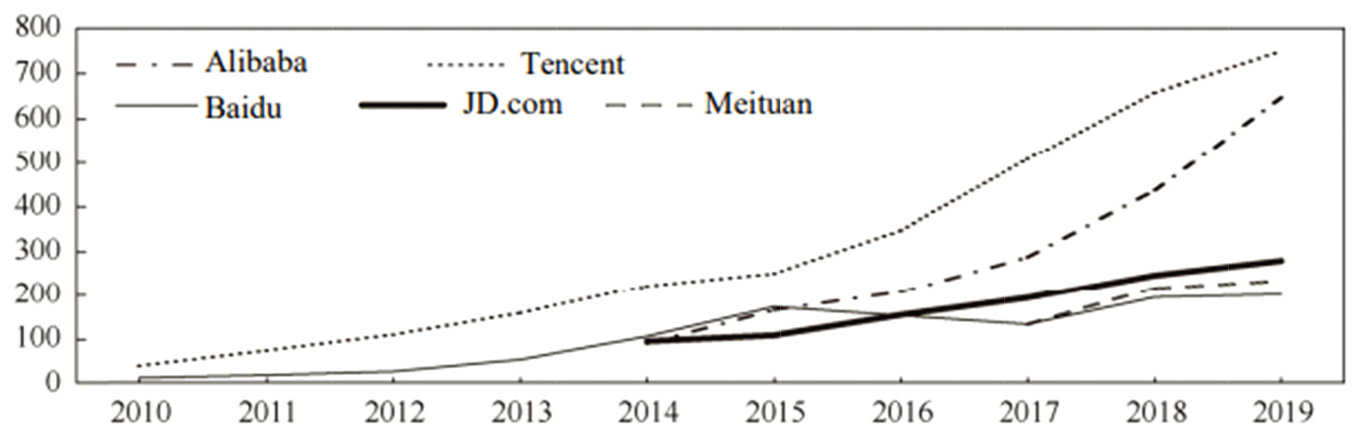
According to the above model, this paper estimates the data assets value of companies, such as Alibaba, Tencent, Baidu, JDcom, and Meituan, etc. (see Fig. 4). It uses annual data of all financial report of these enterprises since they have listed during the valuation process.
Data assets value of 5 domestic Internet platform enterprises (unit: 100 million yuan). Data source: The statistics and accounting of personal data question by Xu Xianchun and others.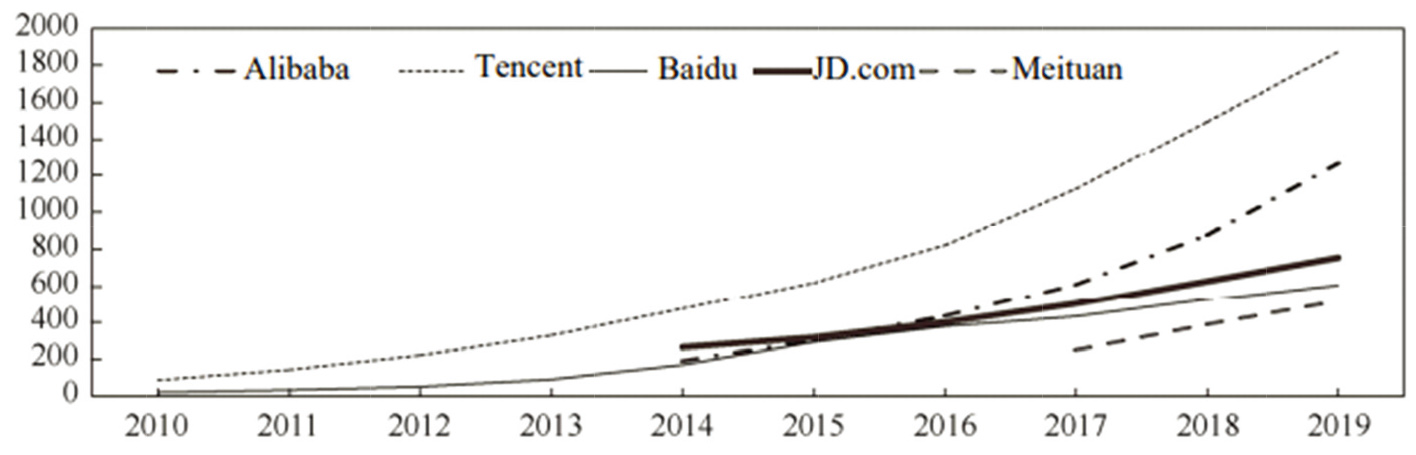
From what mentioned above, it is clear that development trend of Internet platforms shows the promising future of online sales. Therefore, the products on the basis of IP planning and disseminating are more suitable for the operating and marketing in Internet platforms. First, the accurate positioning of IP is conducive to the integration of design resources. By grasping consumers’ preferences, many design links such as graphic design resources, packaging design resources and product design resources are integrated, and then various new games are applied to give products an accurate design positioning and trend characteristics, so that each link of product design closely focuses on the theme and further strengthens the content characteristics of IP. Secondly, the strong content characteristic of IP symbolization is beneficial to the integration of communication and marketing resources. The IP values, vision and content are presented in symbolic form, forming an IP with super-strong content characteristics, which is suitable for spreading on the new media platform of the Internet and marketing images, contents, activities and events in the process of spreading, so as to increase the exposure of IP intensively and massively, gather with audience and achieve sales. Therefore, the effective communication of IP is also a process of high-quality marketing. Communication and marketing complement each other and develop together. Thirdly, the popularity of IP is conducive to the integration of channel resources. At present, since the use of various online platforms for brand or product sales has become an indispensable way, the channel side also hopes to improve the level and quality of the channel platform through high-quality IP products. The popularity of IP and its fan base make sales channels more willing to work with it, resulting in effective integration of various sales channels. Therefore, it is undoubtedly the preferred method to promote the dissemination, operation and sale of industrial cultural resources in the digital age by constructing an IP with high quality content and connecting all kinds of new media communication platforms and sales channel platforms on the Internet.
Industrial cultural resources, including industrial heritage, industrial museums, industrial tourism, industrial research, arts and crafts, industrial cultural and creative products, all belong to industrial culture, but with different contents and media presented [15]. While IP can link and integrate them, so that different media and different media can interactively narrate around IP, and promote the contents in different fields to form a unified force, so as to systematize the originally scattered cultural resources or contents, provide the audience with the experience of intertextuality, and constantly improve the components of the industry, thus expanding the scale of the industry and forming economies of scale [16]. With values, content stories, roles and concepts as the basic elements, IP naturally has the advantage of cross-border integration and can carry almost any carrier. Through IP licensing or cross-border integration between identical IP, the scope and field of the industry will be further expanded, the vitality of IP development and the diversity of products will be enhanced, and the benefits of forming different cultural products from one cultural resource in different links of the value chain will be realized [17]. Therefore, the cross-border advantage of IP has formed the scaling of industry, increased the turn of product realization, prolonged the realization cycle, realized the expansion of industrial chain, and is of great significance to incubating new formats and new modes of industry.
The path of IP-oriented transformation and development of traditional industries
The research on the advantages and empowerment of IP can help to deeply tap the guidance, driving force and innovation of industrial culture IP for the development and construction of traditional industries, product design, online development, creative communication, industrial integration, incubation of new business types, and establish the transformation and development model of “IP
Industrial culture IP condensation and its value system shaping
IP molding is carried out on the original, scarce and symbolic regional traditional industrial culture to build an industrial culture IP that is easy to create, super attractive and can realize with a complete value system. First of all, it is necessary to deeply explore the traditional industrial culture and regional culture, and comprehensively sort out the production history, industrial products, innovative technologies, major events, related figures, and corporate spirit of traditional industries as the genes, contents, elements and inspiration of IP construction. Secondly, the cultural gene formed in the accumulation of nearly a hundred years of industrial development are summed up and redesigned with modern design methods to form cultural gene symbols, so as to further create the traditional industrial connotation, production history, enterprise spirit, important events, core figures, etc., and form a gene pool of industrial cultural symbols, which can be used as design materials [18]. Thirdly, cultural producers deconstruct the cultural meaning through the analysis of industrial cultural characteristics in different regions, dig deeply into the cultural connotation.
Aesthetic spirit and creation concept contained in different industrial cultures, and design and transform the information in the cultural symbol gene bank by means of metaphor, abstraction, combination and deconstruction, and extract the “common value symbol” and “emotional element symbol” with industrial culture IP characteristics. Finally, the industrial culture IP is designed and developed according to the comprehensive information provided by big data and the symbol and aesthetics of the times, and its cultural value, social value and economic value are shaped to form an industrial culture IP with scarcity, uniqueness and interactivity, as shown in Fig. 6. In the process of building industrial culture IP, we should not only follow the design process, but also think about what the industry IP represents and what it will be in the future, so as to endow IP with vitality, vision and three views. In addition, attention should also be paid to the cross-domain capabilities of image or content in building industrial culture IP, so as to reserve development space for IP authorization in the future.
“IP-based traditional industries” to create “cultural driving force” of offline industries
Industrial culture IP leads the deep implantation and penetration of culture into the traditional industry, forming a new offline industry development model with culture as the “internal driving force” and realizing the cultural transformation of the traditional industry. Most of the traditional industries have a long history and are the important historical symbols of the cities where they are located, carrying a lot of humanistic memories and emotions. “IP-based traditional industries”, as an important way to realize the transformation and development of traditional industries, is to further condense history and emotion, and is also a practice of “industrial culture”, which promotes the development of cultural value of traditional industries and expands the dimension and space of industrial development.
The construction of industrial culture IP has a forward-looking prospect for the traditional industrial transformation and the future development direction [19]. The economic transformation of industrial culture is achieved by the top-level design of industrial development through industrial culture IP, which builds the cultural value of traditional industries and promotes the deep integration of traditional industries with the surrounding related industries, especially with cultural industries, by using the fusion power of industrial culture IP [20]. The innovative power of industrial culture IP is used to promote product content innovation and production mode innovation. Through the derivative power of IP, it helps IP content to continuously create, diversified development, experience economy and consumer goods derivative, and incubates new economic growth points of the industry. With the industrial culture IP covering the whole industry, it will gradually develop into a super IP with high identification, self-contained traffic and super development ability [21]. Self-sustained renewal formed by the derivation and re-creation of super IP will further expand the field and innovation space of industrial derivation, thus forming an offline
The condensation and shaping of industrial culture IP. Industrial culture transformation under the guidance of industrial culture IP.
Industrial culture IP-led industrial digital transformation.
traditional industrial IP operation mode of “IP development
The development of internet technology makes the construction of new media platform an indispensable link in the process of traditional industry digitalization. The promotion of the online new media platform of industrial culture IP can guide the offline industry to accurately adjust and plan the information fed back by big data, and is conducive to the optimization and upgrading of the transmission path, transmission speed, product production and product update of the traditional industrial culture and economy, and will promote the digitalization process of the whole industry with the integration of virtual economy of industrial culture and real economy online.
Industrial culture IP online economic materialization mainly generates industrial cultural resources as production factors of data asset form through digital technology, digital creativity, digital communication, digital products and other forms to realize digital creation, production, marketing, communication, experience, management and other across-industry platforms. The dissemination and sale of industrial culture IP and products as data assets in new media platforms will greatly shorten the process of product entry into the market, reduce costs, and get the approval of fans by delivering high-quality content, and promote the fission dissemination of IP content by fans twice or even three times. Therefore, it is necessary to strengthen the management and interaction of fans, encourage and guide fans to generate users, and enrich the content production of IP and innovative forms of products in the process of marketing products, so as to promote the sale of off-line products and guide the further cultural innovation and new industry development of off-line traditional industries through on-line mature development of industrial culture IP [22]. The on-line digital creation, marketing, transformation and dissemination guided by industrial culture IP, combined with off-line real estate intelligent industry APP, H52
H5, the abbreviation of HTML5, is a language description method for building Web content, the next generation standard of the Internet, a language method for building and presenting Internet content, and is considered as one of the core technologies of the Internet.
The refining, shaping and application of industrial culture IP will help to form a new transformation and development model of “IP
Metaverse is a new Internet application and social form that integrates many new technologies and blends virtuality and reality. It is a virtual world that maps and interacts with the real world through linking and creating by means of science and technology and has a digital living space of a new social system.
Footnotes
Acknowledgments
This study was supported by the Social Science Fund of Liaoning Province, “Research on upgrading and Development of Liaoning Cultural Industry with Cultural IP as the Core” (Project No.: L20GBL048). This research is supported by the Project of Liaoning Education Department. “Jade culture industry IP multi-media visual development design research and practice” (Project No.: 2020FWDF10).