



Abstract
Studies on tourism experience frequently emphasize antecedents, neglect consequences, and lack systematisation, which motivated us to explore an application of semantic co-word analysis based on the hierarchy of needs theory in the systematic research of tourism experience. We collected the texts of visitors’ online comments of the China Block Printing Museum at Yangzhou and conducted an empirical research, the results indicated that tourists’ activity-environment needs had three levels; experience of the tourism setting was positive overall; the experience of tourism activities required improvement; and the benefits of the tourism experience were unfavourable. The museum should enhance the ‘participation-dynamic setting’ to create an experience space for tourists, improve ungazed spaces to enhance leisure benefits, innovate the museum guide system to facilitate educational benefits, and develop an ‘exploring-expanding setting’ to create unique all-for-one tourism products. The innovation of the combination of theoretical tools and computational methods in this study is a necessary exploration to use qualitative materials to objectively reveal the operation mechanism of tourism experience.
Keywords

Introduction
With functions of collection, research, adequate display, and education being extended to aesthetics, leisure, and entertainment, museums are shifting their focus from object orientations to human orientations [1]. Specifically, tourist orientations have become the main topic in museum research. Studies on the museum tourism experience include antecedent research (e.g. the generation of experience) and consequence research (e.g. the relationship between experience and revisit rate) and tend to address impact factors revolving around degree of satisfaction with the experience [2, 3]. Davies and Prentice [4] discussed the influence of services provided in museum settings, such as electronic tour guides and introduction systems, on the tourism experience. Schouten [5], Nowacki [6], Li [7] and He et al. [8] used research instruments such as SERVQUAL, two-factor theory, and online text analysis and identified overall setting, exhibits, and service levels of a museum as the main factors that influenced the tourism experience. Stephen [9] argued that museum architecture can also affect the tourism experience. Prentice [10] and Su et al. [11] have discussed how the ‘authenticity’ of a museum setting affects tourist experiences.
According to relevant research, the influence of a museum setting on the tourist experience is based on people’s activities within and their interaction with the setting. Chen [12] asserted that a museum space can be regarded as a performance stage, where exhibits interact with the audience to form open-ended narrative texts and sensory liminal experiences. Shan [13] noted that a comprehensive tourism experience requires viewing, communication, and entertainment. However, most museums offer only static displays, which only satisfy the viewing aspect of the experience, rendering the communication and entertainment of the tourism experience unaccomplished. Song and Kang [14] proposed an aesthetic approach to the tourism experience in a museum. Yu and Yuan [15] put forward suggestions on the innovation of museum tourism experience from the perspective of cultural relic activation.
Experience can produce corresponding benefits. Researchers have focused on the cultural and educational benefits delivered by museum tourism to individuals and society. Zuo and Zhou [16] held that professional navigation can clearly convey educational information to tourists, helping enhance the tourism experience and tourist knowledge and, in turn, form cultural identity. Wen and Liu [17] reported that the more engaged tourists are, the more unforgettable the memory is, and that various experience-based activities designed by a museum guarantee the realization of tourism benefits.
In addition, with the continuous development of digital technology and Internet life, the object of museum tourism experience research has gradually shifted from physical museums to virtual museums [18].
The majority of studies on museum tourism experience have focused on the antecedent relationship, with relatively few studies discussing consequences and almost none based on a systematic framework. This study attempted to discuss the museum tourism experience from a systematic perspective by adopting the inherent logic of hierarchy of needs theory. According to the results, development suggestions are proposed.
Analytic framework: The hierarchy of needs
ASEB – the acronym of activity, setting, experience, and benefit – is a theory for continuous and progressive hierarchy of needs proposed by Haas based on an analysis of the hierarchy of needs for outdoor recreation [19]. Hierarchy of needs theory divides leisure needs into four successive levels. The first level is the need to engage in a certain ‘activity’. The second is the need to engage in the activity in a certain ‘setting’. The third level is the need to ‘experience’ when engaged in the activity in that setting. The fourth is the need to ‘benefit’ from the experience. An experience-based setting is both objective and subjective. Activity depends on setting, and experience is determined by the interaction between an activity and its setting. The nature and quality of the experience determine the type of benefits people can obtain. The hierarchy of needs reveals the internal mechanism of the tourism experience and can provide a theoretical basis for systematic tourism experience research. Figure 1 presents the analytic framework of the hierarchy of needs of the tourism experience.
Analytic framework of the hierarchy of needs of the tourism experience.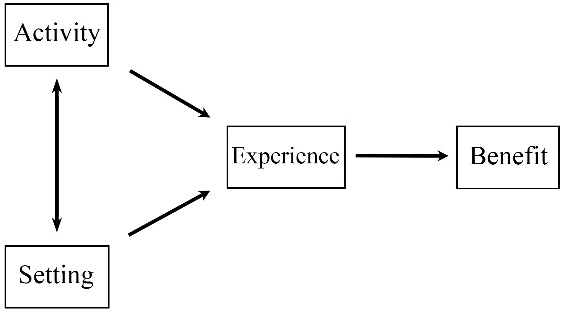
Combining this theory with the ‘strengths, weaknesses, opportunities, and threats’ (SWOT) technique, Beeho and Prentice [20] developed a tourism experience management model. However, application of the theory of hierarchy of needs is limited to classification, without considering the hierarchy of needs and the internal connections. The resulting matrix resembles a system, but the 16 units are independent of one another. On the one hand, it greatly detracts from the value of the hierarchy of needs theory, on the other hand, because the model fails to demonstrate the internal logic of the tourism experience, most studies applying the model have focused only on phenomenal aspects, based on qualitative evaluation, therefore, failing to address the root cause of problems and producing one-sided evaluations. In view of this, this research takes the hierarchy of needs theory as the logical framework of analysis, and uses the scientific calculation method of text to quantify this framework, and conducts an empirical study on the tourist experience of tourists in China Block Printing Museum at Yangzhou.
Akbari et al. [21] argue that e-WOM is one of the useful digital marketing elements for any organization, it plays a significant role in a firm’s performance. Direct and authentic, online reviews are reliable materials for cultural tourism experience research [22]. Co-word analysis is a bibliometric method with the premise that the cooccurrence frequency of word pairs for different topics is proportional to the correlation between topics. The knowledge structure of a certain field may be described by analysing the cooccurrence of words [23]. As an essential means of content analysis, co-word analysis can achieve a more accurate and in-depth description and analysis of texts, but it has not been applied in tourism experience research. This study applied co-word analysis to mine the relationship between needs at various levels of museum tourism experience.
Multidimensional scaling analysis is a technology that reduces the dimension of data and projects it in a two-dimensional coordinate system by calculating the distance between data to realize data visualization. This technology can visualize the relationship between data, which is convenient for researchers to discover and understand the underlying themes and structures hidden in the data [24]. This method is widely used in library information and language and literature research to discover potential themes in texts. In experience research, Ribeiro and Chick [25] used this method to extract the recognition of related cultural domains in hedonistic tourism experience. Zhang et al. [26] used this method to summarize the 7 factors that constitute the consumption experience attributes of takeaway catering. Proximity in distance may indicate similarity or correlation [27, 28]. Wang et al. [29] logically constructed the results of MDS based on the “Antecedents-Processes-Outcomes” (APO) analysis paradigm, established the “Context-Theoretical connotation-Interventions-Mechanisms-Outcomes” (CTIMO) knowledge framework of responsible innovation. This construction is a progress in the application of MDS, but it is still in the stage of logical thinking and lacks quantitative basis.
This study attempts to innovate the application of this method in another direction, that is, to analyze variables with relevant hypotheses under the guidance of existing mature theories to verify the hypotheses and reveal their relationship patterns. This study attempts to rely on the hierarchy of needs analysis framework, on the basis of co-word analysis, and use MDS method to describe the internal spatial structure of activity-environment, activity-experience, environment-experience, and experience-benefit one by one. Verifies the explanatory power of the hierarchy of needs theory, reveals the operation mechanism of the museum tourism experience, and shows the current situation of the tourism experience of the China Block Printing Museum at Yangzhou. The innovation of the combination of theoretical tools and computational methods in this study is a necessary exploration to use qualitative materials to objectively reveal the operation mechanism of tourism experience.
Research procedures
Sample selection
Established with 300,000 pieces of ancient woodblocks collected by (the former) Yangzhou’s Guangling Publishing House, the China Block Printing Museum at Yangzhou is a collection centre, academic research centre, and citizen cultural and leisure centre housing Chinese block engraved antique prints. The China Block Printing Museum is a significant tourist attraction at Yangzhou museum tours.
We used the websites of Chinese travel service providers Trip.com Group Limited (
Using GooSeeker software and the keyword ‘China Block Printing Museum at Yangzhou’, we conducted sample website crawling to extract data posted by users between February 2, 2015, and February 2, 2020. A total of 358 reviews were retrieved. Reviews unrelated to China Block Printing Museum at Yangzhou, repeated reviews, and reviews with no substantial value were filtered out; a total of 262 valid reviews (comprising more than 17,000 words) were extracted. This amount of data is considerable for a non-heritage museum in a second-tier tourist city, affirming the validity of the research. Nonetheless, a nonnegligible difference exists between this museum and other large-scale comprehensive museums, which emphasizes the necessity of the research.
The procedure for co-word analysis is well developed, with the key steps being: identifying high-frequency words – building a co-word matrix – statistical analysis – result interpretation. Referencing the source context, we used GooSeeker software to perform preprocessing such as word segmentation and screening of the sample data.
Hierarchy of needs categories
We used GooSeeker software with the sample data to calculate word frequencies. Based on a comprehensive investigation of the cumulative percentage of word frequency and feature saturation, the first 150 high-frequency words were compiled (Table 1) to represent the tourist experience of China Block Printing Museum at Yangzhou. The first 150 words were mainly noun, verbs, and adjectives which described experience-related targets such as exhibits and setting (described by nouns), activities and tourism benefits of the museum (described by verbs), and tourists’ experience (described by adjectives).
According to the hierarchy of needs analysis framework, the 150 words were classified to determine the basic unit of co-word analysis. Analysing the meaning of the words from the source context, the
Hierarchy of needs categories for tourists who visited the china block printing museum at Yangzhou
Hierarchy of needs categories for tourists who visited the china block printing museum at Yangzhou
two authors coded independently, and the consistency of the main category attained was 90.41%. After further evaluation of the codes, the hierarchy of needs categories for tourists who visited the China Block Printing Museum at Yangzhou were obtained and compiled (Table 1).
An analysis of the hierarchy of needs categories reveals that tourist perceptions of the China Block Printing Museum at Yangzhou centred on the dimension of ‘setting’, which accounted for 92.73% of the total frequency of occurrence. Under the category of setting, ‘internal setting’ comprising dimensions of facility, atmosphere, and service management had the highest frequency of occurrence (43.87%). Consisting of dimensions of exhibit and display and contributing to 27.79% of the frequency of occurrence, ‘object of appreciation’ was an essential aspect of the development of museum tourism and the core of the tourism activity organization [30]. Comprising dimensions of urban background, location, and transportation, ‘external setting’ accounted for 19.24% of the frequency of occurrence, clearly exerting a substantial influence on travel-related decision-making. Tourist perception of time was divided into three aspects, namely duration of visit (e.g. hour), timing of travel (e.g. New Year’s Day), and management system (e.g. closed on Mondays).
Category analysis indicated that tourists engaged in knowledge-seeking (65.2%) and leisure activities; 93.93% of tourist experiences was positive, and tourists mainly gained educational benefits from museum tours, with 94.12% of the reviews referencing benefits.
Based on the theoretical model, we conducted co-word analysis of activity-setting, activity-experience, setting-experience, and experience-benefit to explore relationships among the categories. First, we used GooSeeker software to identify the high-frequently co-occurring word pairs and calculate their cooccurrence frequency to form a co-word matrix. Second, we used the Ochiia coefficient to transform the co-word matrix into a similarity matrix. The calculation formula of Ochiia coefficient is as Eq. (1):
Among them, Oab denotes the correlation coefficient between words
Correlation analysis indicated that in the activity-setting relationship, ‘tourism’ and ‘woodblock’ were highly correlated, which reflects the core of the tourism activity organization. In the setting-experience relationship, ‘printing technique’ and ‘fun’ were highly correlated, indicating that tourists were interested in the theme of experience; ‘woodblock’ was highly correlated with ‘personal feeling’ and ‘experience’, implying that block printing was considered the core experience by tourists; both ‘unforgettable’ was highly correlated with ‘on-site’, ‘craftsmanship’, ‘demonstration’, and ‘shifu’ and ‘disappointment’ was highly correlated with ‘craftsmanship’, ‘demonstration’, and ‘shifu’, reflecting that on-site demonstration of block printing craftsmanship by a shifu invited by the museum left a deep impression on tourists and was directly correlated with travel experience quality. The high correlation between ‘shifu’ with ‘amusing’ and ‘surprise’ reflects the significance of dynamic display in an intangible cultural heritage museum. The high correlation between ‘special exhibition’ and ‘surprise’ reflects the highly positive experience tourists perceived from elaborately organized exhibitions. Finally, the high correlation between ‘New Year’s Day’ and ‘amusing’ indicates that the museum’s special holiday events were attractive. In the experience-benefit relationship, ‘broaden the horizon’ was highly correlated with ‘surprise’, ‘unforgettable’, and
Intercategorical highly correlated word pairs
‘disappointment’, demonstrating that many museum visitors wished to enhance their knowledge. No highly correlated related word pair was observed in the activity-experience relationship, which indicates that overall tourist experience with the museum activities was not impressive. Lastly, we subtracted the Ochiia coefficient by 1 to convert the correlation matrix into a dissimilarity matrix and performed a multidimensional scale analysis to explore the internal structure of the relationships between categories.
We employed SPSS 23.0 to conduct a multidimensional analysis of the dissimilarity matrix comprising activity-setting, activity-experience, setting-experience, and experience-benefit cooccurring keywords. The results were as follows.
Activity-setting relationship analysis
Multidimensional scaling of the activity-setting cooccurrence keywords yielded Stress
Activity-setting relationship map.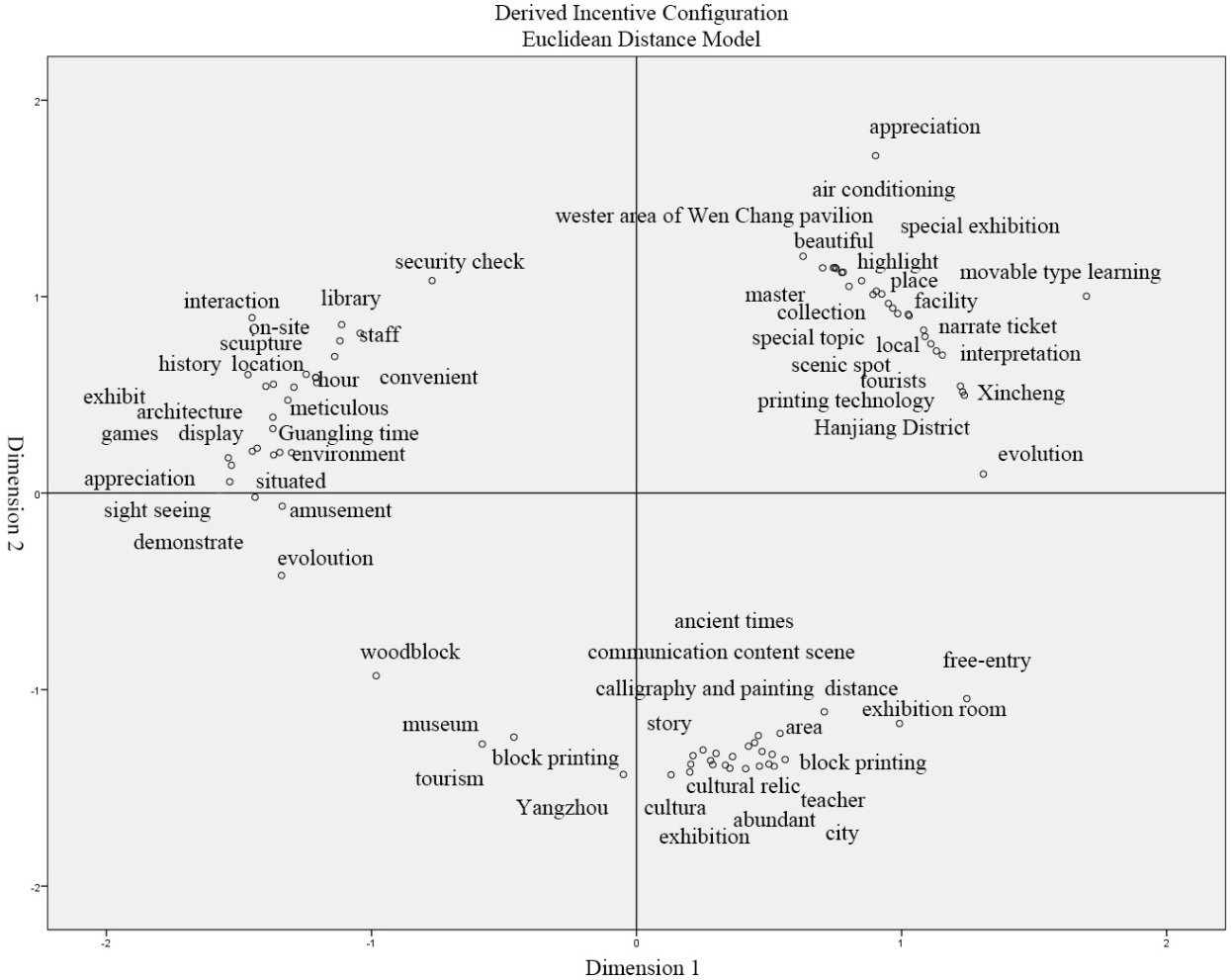
Activity-experience relationship map.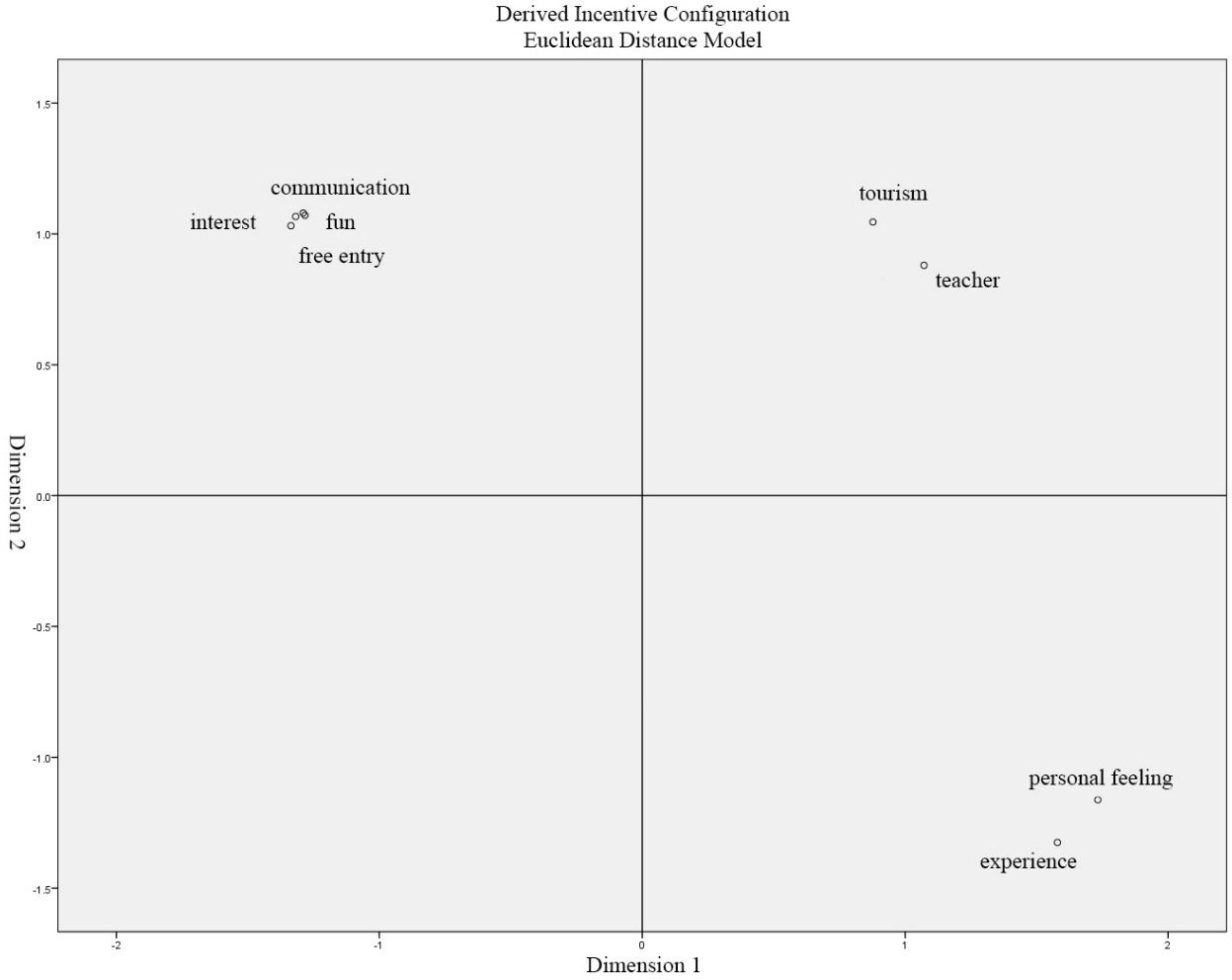
Setting-experience relationship map.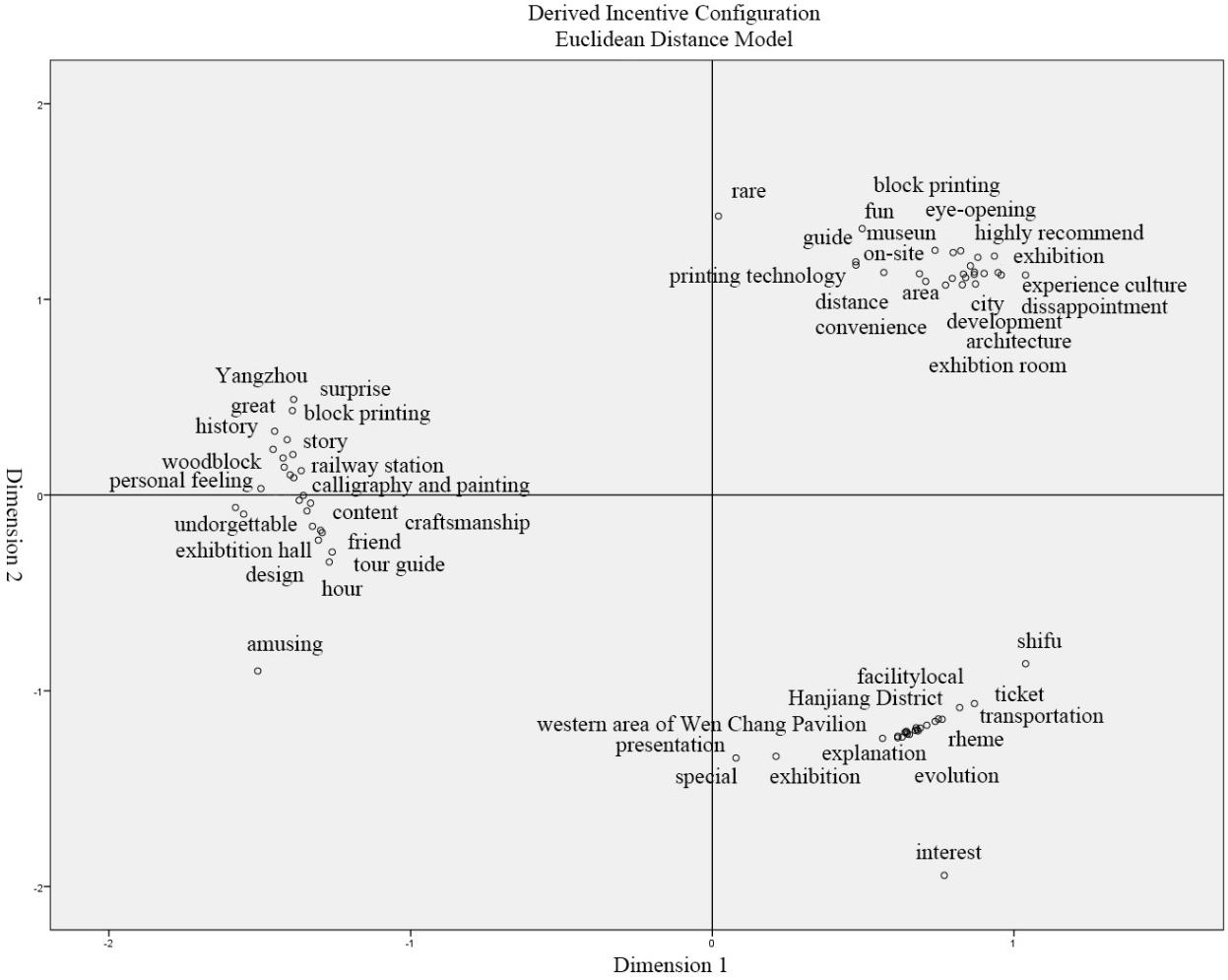
Experience-benefit relationship map.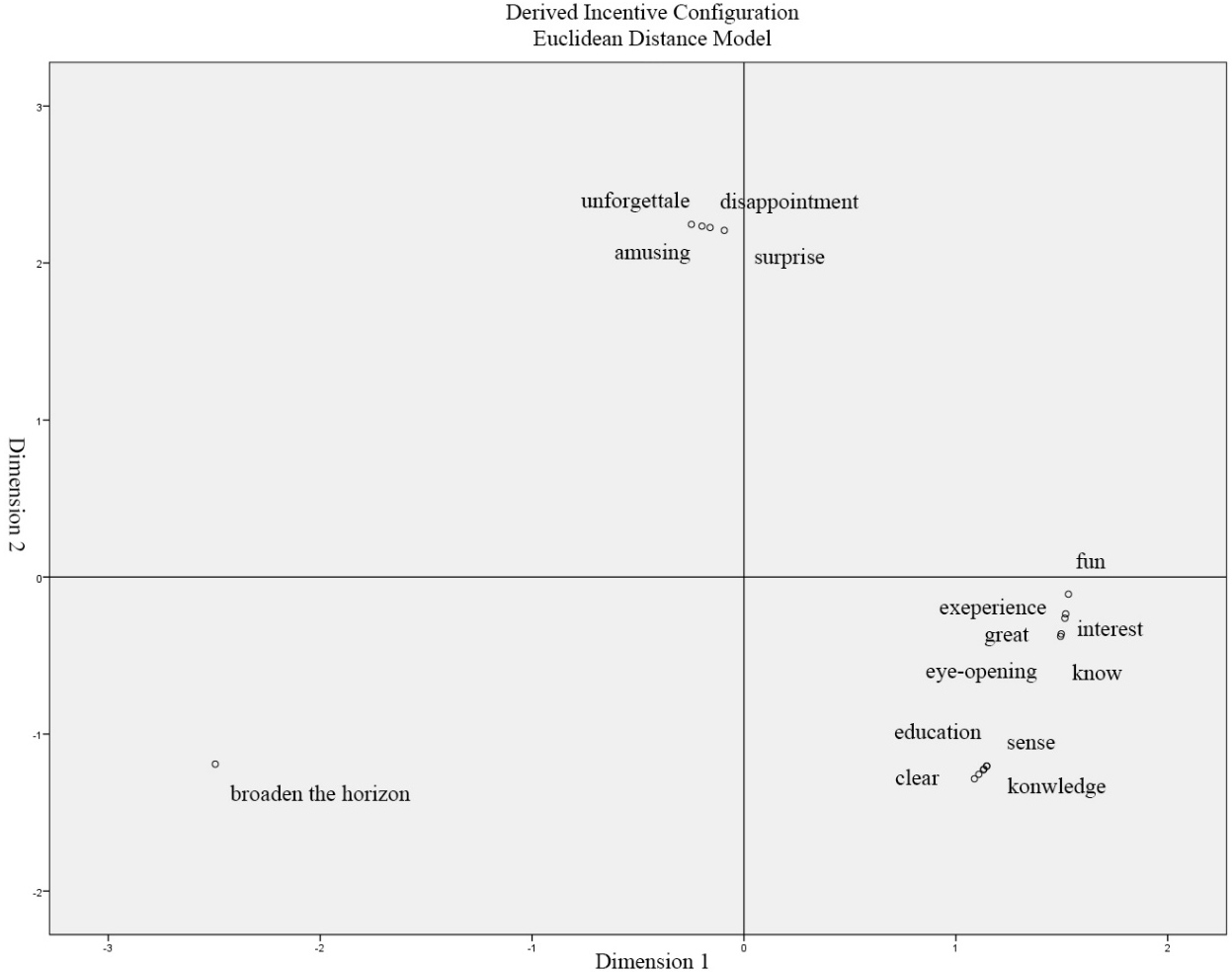
The keyword group in the first quadrant reflects basic activities and settings in museum tourism, which tourists value the most. Examples of such keywords include those in leisure and knowledge-seeking activities (e.g. ‘appreciation’ and ‘learning’) and those representing attractions and urban settings (e.g. ‘printing technique’, ‘collection’, ‘special exhibition’, and ‘local’). The second keyword group, mainly observed in the second quadrant, extends from the second to third quadrant and reflects the present activities and settings which are less valued but have great developmental potential. Examples of such keywords include those concerning participatory activities (e.g. ‘game’ and ‘interaction’) and those in the categories of atmosphere, attractions, facility, and location and transportation (e.g. ‘history’, ‘exhibit’, ‘architecture’, ‘time’, ‘display’, and ‘location’). The third keyword group, predominantly in the fourth quadrant, extends from the fourth to the third quadrant and reflects rarely valued activity and setting needs. Examples of such keywords include those concerning knowledge-seeking activities (e.g. ‘teacher’ and ‘exchange’), attractions, atmosphere, facility, and background setting (e.g. ‘woodblock’, ‘culture’, ‘area’, ‘city’, and ‘scene’). Of marginal status, these keywords reflected museum tourism needs lacking sufficient attention.
Multidimensional scaling of the activity-experience cooccurrence keywords yielded Stress
Two activity-related keywords in the first quadrant and two experience-related keywords in the fourth quadrant formed independent groups, implying a low overall correlation between tourism activities and tourism experience. In Fig. 3, the activity-experience relationship group is located in the second quadrant, which indicates that activities are not the main source of the museum’s tourist experience, but this type of experience has great developmental potential. Keywords of ‘interest’ and ‘fun’ reflect that the museum’s current activities failed to provide intense experiences to tourists.
Setting-experience relationship analysis
Multidimensional scaling of the setting-experience cooccurrence keywords yielded Stress
The keyword group in the first quadrant reflects the primary setting-experience relationship, the prominent or typical images provided to tourists. Examples of such keywords include ‘museum’, ‘block printing’, ‘culture’, ‘city’, and ‘exhibition’, which demonstrates that primary tourism experiences were obtained from basic parts of facilities, attractions, atmosphere, and background. The keyword of ‘disappointment’ reflected negative experiences with basic settings’ deficiencies. The second keyword group spans the second and third quadrants, implying that the setting-experience relationship requires further improvement. Demonstrated by keywords such as ‘Yangzhou’, ‘history’, ‘printing’, ‘tour guide’, ‘train station’, and ‘hour’, external setting, atmosphere, collections, service management, time, and other extensive settings are the sources of this type of experience. The keyword group in the fourth quadrant reflects aspects of the relationship which are of marginal status. Keywords such as ‘special exhibition’, ‘demonstration’, and ‘local’ indicated that this type of experience originates from dynamic displays, urban background, and other settings. This type of setting can arouse tourist interest but fail to provide them with intense experience.
Experience-benefit relationship analysis
Multidimensional scaling of the experience-benefit cooccurrence keywords yielded Stress
The four experience-related keywords in the second quadrant form an independent group. The one benefit-related keyword in the third quadrant failed to form a group, and the experience-benefit keywords in the fourth quadrant were loosely correlated. Accordingly, the overall correlation between tourism experience and tourism benefit was low.
Discussion
Improve ‘participation-dynamic setting’ to create a space for tourists to experience in person
The museum may make sufficient use of the cultural venue on the east side of the museum’s first floor, where block printing activities can be held regularly, to enrich the tourist experience. Targeting local tourists, a series of hands-on block printing lessons can be developed, where the craftsmanship can be deconstructed into steps to facilitate learning. Tourists may make reservations to participate in these lessons through the museum’s website. This activity could enhance the tourist experience, enable them to gain educational benefits, and increase the number of museum visitors. For visitors from outside of Yangzhou, the museum can simplify the block printing craftsmanship to facilitate on-site learning and practice in a short period of time, which would enable these visitors to create personalized block prints as their own exclusive souvenir of the trip. This activity would offer visitors intense, positive experiences – a sense of accomplishment. Moreover, the exclusive souvenirs would enable visitors to establish a personal emotional connection with the museum and extend the travel experience after the end of the tour, both of which would increase the revisit rate.
Improve ungazed spaces to enhance leisure benefits
The tourism experience is composed of a supportive experience and a peak experience. The two dimensions complement each other and are mutually transformable [31]. In museum tourism, a peak experience is developed by viewing objects of appreciation (e.g. exhibits) and is mainly education-based. A supportive experience is developed from reception facilities and services (i.e. settings which are not objects of appreciation) and is mainly leisure-based. The China Block Printing Museum at Yangzhou can improve tourist leisure benefits by taking the following two measures. First, it can improve current reception facilities which tourists often complain about, such as through regular maintenance of air conditioners and toilets. The museum can also provide tourists with convenience services including free storage lockers, a device charging service, wheelchairs, and umbrellas. Second, it can rigorously configure children’s play areas, dining and recreation areas, souvenir shops, and performance venues; Henri Lefebvre identified the spatiality in objects as well as the continuous growth in spaces. The dual relationship between objects and space creates new spaces for self-reproduction [32]. The production of leisure space and the development of leisure activities are symbiotic, which guarantees visitors leisure benefits. In addition, ungazed spaces are required for museums to optimize their income revenue.
Innovate the museum guide system for educational benefits
The museum guide system is of great significance to the realization of museum tourism benefits. Museums usually use object labels to introduce their exhibits and place different introduction labels depending on the target audience. Based on the introduction labels, free brochures, audio and video guides, smart guides, and other forms of introduction can be developed to provide additional information to visitors with prior knowledge, help those without prior knowledge to understand the content of the exhibition, and arouse the interest of children to visit the museum. The gallery introductions in the audio guide system should be updated regularly according to the progress of research and to tourist needs. Professional terms should be used sparingly to facilitate comprehension. Museum docents should be trained on a regular basis to develop personalized narrations suitable for different target audiences and exhibits. Only when visitors comprehend an exhibition can they gain knowledge and cultural identity, thereby resulting a win-win outcome concerning the individual and social benefits of tourism. Moreover, the museum’s role of protecting intangible cultural heritage and inheritance can be realized.
Develop setting expansion to create unique all-for-one tourism products
In addition, the museum should improve setting expansion based on the collection and research of cultural relics, thereby increasing the amount of information and expressiveness of its settings, providing guidance to tourists, and satisfying their exploratory activity needs at the museum. The ‘all-for-one’ tourism concept can serve as a basis for the museum to strengthen cooperation with relevant scenic areas, thereby creating unique all-for-one tourism products. For example, the museum can collaborate with Guangling Publishing House and travel agencies to develop printing- and publishing-themed urban itineraries which involve visiting former public, commercial, and private block printing studios (e.g. the Yangzhou Poetry Office of Tianning Temple and Jienan Bookstore) to meet tourist needs for in-depth exploration of Yangzhou’s block printing history and culture. The Block Printing Museum at Yangzhou, located in New Western District, is distant from other popular attractions (e.g. Slender West Lake, Dongguan Street, and Geyuan Garden) and is thus often neglected by tourists when planning itineraries. The development of all-for-one tourism products would be conducive to addressing this problem.
Conclusion
Three types of tourist activity-setting needs
An analysis of tourist activity-environment needs indicates that tourist activities interacted closely with the museum settings, and these needs can be roughly divided into three types. The first need, ‘visit-basic setting’, involves fundamental settings such as exhibition display and receptions to provide tourists with leisure and knowledge-seeking activities which were of upmost significance to them. The second need, ‘participation-dynamic setting’, refers to dynamic settings for participatory activities, which though of less significance to tourists have developmental potential. The third need, ‘exploration-setting expansion’, involves deeply and extensively relevant settings to offer exploratory activities which were least significant to tourists.
Improvement required for tourism activity-related experience
Our analysis of tourist activity-experience needs suggests that the effects of museum tourism activities on the tourist experience require improvement. Specifically, the experience of activities was of secondary significance to tourists and did not leave a strong impression on them. These phenomena remind the museum that participatory activity development requires urgent improvement.
Tourism setting-related experience was overall positive
The analysis of tourist setting-experience needs signifies that tourist perception of the museum setting was closely related to their experience, and the overall experience was positive. The museum’s basic display and reception settings were the most crucial experience to tourists. The basic setting of the museum provided visitors with an intense and mainly positive experience. Individual negative experiences reflect a deficiency in some reception facilities. Second, the extensive museum settings delivered positive, intense experience to tourists, but the experience was of secondary significance and required further development. Finally, the museum’s dynamic settings provided tourists with a positive but not intense experience of marginal status. This conclusion concurs with the aforementioned activity-experience research conclusion and reveals flaws in the design of the museum’s dynamic settings.
Tourism experience-related benefits were unfavourable
The results of the experience-benefit relationship analysis indicate that the benefits of the tourism experience were unfavourable. Specifically, the correlation between tourism experience and tourism benefits was low; the tourism experience delivered only educational benefits, not leisure benefits, and the educational benefits generated by the tourism experience exhibited marginal distribution.
Footnotes
Acknowledgments
This work was supported by the Jiangsu University Philosophy and Social Science Fund Project, China (Grant Number: 2020SJA0544). We also thank the anonymous reviewers for their valuable comments, which greatly improved the manuscript.