



Abstract
Considering the influence of new energy vehicle enterprises innovation input is affected by a variety of non-linear and uncertain factors, an automatic coding machine mixed with RBF neural network model is presented in this paper, and the Gaussian distribution of training data optimization method and the Gaussian transfer function training module are put forward to make innovation input higher prediction precision and stronger universality. By comparing the prediction data of the proposed model with that of the traditional neural network model, the accuracy of the improved model is verified. Therefore, the proposed model can provide theoretical basis and decision support for technological innovation decision-making of new energy vehicle enterprises.
Introduction
Energy crisis and environmental pressure can be effectively alleviated by new energy vehicles because of its energy-saving and environmental protection characteristics, which has become a new direction for the transformation and upgrading of the automobile industry and economic growth. At present, the main reason for limited development of new energy vehicles in China is low technological level and lack of core technology. The Development Plan for The New Energy Vehicle Industry (2021–2035) has clarified that to tackle key technology and improve technological innovation capacity are the development ideas of the new energy vehicle industry. New energy vehicle enterprises are main innovative subjects of industry [1]. Continuous R&D investment is the basic guarantee of enterprises’ innovation [2] and its technological innovation level plays a key role in industrial development. R&D input is a prerequisite for technological innovation of new energy vehicle enterprises and it is of great significance to improve technological innovation capacity and industrial growth rate [3] and relative R&D efficiency [4]. Insufficient R&D input will definitely bring negative effects [5].
Accurate prediction of innovation can provide scientific decision support for new energy vehicle enterprises, reduce innovation risk and promote innovation efficiency. The empirical formula about technological innovation process of enterprises is usually expressed in the form of power law function. Regression analysis is usually used to study innovation input [6]. Detailed analysis is made on the influencing factors such as subsidy intensity [7], enterprise size [8] and profitability [9]. The factor of lag period was also considered into the model to dnamically study the influencing mechanism for overcoming endogenous problem [10, 11]. Human experience is usually introduced to set parameters and hypothetical conditions by constructing nonlinear equations of technological innovation. New mathematical model is constructed due to small changes caused by different external conditions and influencing factors. The results of regression analysis has certain errors and solving process is complicated. It is difficult to accurately describe the process of innovation.
The influence mechanism of technological innovation of new energy vehicle enterprises is complicated [12], so it is difficult for traditional regression methods to accurately simulate the whole process of technological innovation. The shortcomings of traditional methods can be solved by machine learning in model selection, parameter setting and solution process. RBF neural network is characterized by simple structure and fast learning convergence [13]. It can approximate any nonlinear function since its parameters are not randomly initialized. RBF neural network is superior to other machine learning algorithms in approaching ability, classification ability and learning speed. It is a special three-layer feed-forward neural network. RBF neural network has been widely used in financial management [14], quality prediction [15], resource scheduling [16] and other aspects. Compared with BP neural network, RBF has stronger fitting performance in the prediction of innovation input [17] and was more suitable for the research in the field of technological innovation. The research of RBF neural network in enterprise management and prediction provides ideas for the application of innovation forecasting research. Cloud model [18], intelligent algorithm [19, 20] and SVM [21] were used to improve RBF neural network for further performance.
The existing prediction methods provide a research basis for prediction of enterprises’ technological innovation. The algorithm setting of RBF neural network for innovation prediction also takes less consideration of data distribution characteristics. However it is easy to fail to approximate the mapping relation between input and output signals of RBF neural network for the system with strong nonlinear and complex variable coupling. A hybrid neural network model of automatic encoding machine and RBF is proposed, and a training data optimization method based on Gaussian distribution is designed to predict the innovation investment of new energy vehicle enterprises.
The contribution of this paper is to design a high precision and universal innovative method for prediction. It can overcome the policy failure caused by the information asymmetry between government and enterprise to the maximum extent and then effectively promote the technological innovation of new energy vehicle enterprises.
An improved hybrid RBF neural network model is proposed to accurately predict the innovation input of new energy vehicle enterprises. The input layer data of the innovation prediction model is set from the perspectives of technology, market and policy, and the R&D input capital is taken as the output layer data. Then the model is trained. By comparing the simulation results with the traditional RBF neural network model, the effectiveness of the proposed model is verified. The specific process is as follows.
Research process.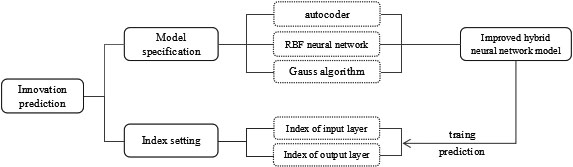
Extract index of the characteristics of high accuracy is necessary because there is a high coupling relationship between R&D input and impact indicators as well as between different indicators. Automatic coding machine is a kind of unsupervised neural network model, which can not only achieve feature dimension reduction but also feature extraction. Therefore, a hybrid neural network model of automatic coding machine and improved RBF is designed in this paper. The advantages of the two neural networks are coupled to achieve accurate modeling effect.
Model structure
The structure of the model proposed in this paper is shown in Fig. 2. An automatic coding machine and an improved RBF neural network are contained in this model. The input layer of automatic coding machine receives information of N variables, namely the key variables affecting the technological innovation of new energy vehicle enterprises. The hidden layer contains 10 neurons for unsupervised training. The output layer contains N neurons, which represents the importance of the N input variables. The variables in the input layer are weighted multiplied by their corresponding importance, and the input data transmitted to the RBF neural network is the result of the multiplication. Double hidden layer structure is used in the improved RBF neural network, each hidden layer contains 10 neurons for feature learning. One output layer neuron represents the innovation input of new energy vehicle enterprises.
Structure of model.
Automatic coding machine is composed of an input layer
Since the automatic encoder is a symmetric network, the value of the input layer node can be calculated from the hidden layer node in the back propagation, as shown in Eq. (2):
Where,
Unsupervised training is used by automatic encoding machine to extract feature. In the training process of network. The weight is updated by Eqs (3) and (4).
Where,
In the process of innovation prediction, the input of automatic coding machine is the N initial variables that affect the innovation of new energy vehicle enterprises. Feature extraction of each variable is carried out by Eqs (3) and (4), and the importance features of each variable are finally calculated as the input layer data of RBF neural network.
Gaussian distribution is a natural law. In order to ensure the accuracy of training effect, it should be assumed that the collected data conform to the characteristics of Gaussian distribution. However, in order to further conduct sample feature processing and anomaly detection on training data, avoid interference of abnormal data on training model and reduce accuracy, a training data screening method based on Gaussian distribution is proposed in this paper. The calculation process is as follows.
First, K groups training data are selected. It is assumed that the data satisfies multivariate Gaussian distribution.
Where,
Where,
Then, the other data of the training group is put into Eq. (5) respectively to verify whether the data conforms to the current Gaussian distribution. The data is retained if yes, the data is abnormal if no and needs to be deleted.
The influencing factor data of innovation of new energy vehicle enterprises can be trained and optimized by this method. And the collected data is validated effectively, which provides basic guarantee for successful training of intelligent model.
Sigmoid transfer function is used in traditional neural networks. However, the transfer function easily leads to weight aggregation of neural network and it is easy to fall into local minimum. Gaussian function is used as transfer function by radial basis function neural network. It can overcome the local minimum problem because its parameters are not randomly initialized.
According to the above analysis, it is beneficial to fast convergence and improve accuracy of network when the weight of the neural network adjusts to the direction of Gaussian distribution. Therefore, Gaussian Function is taken as transfer function, an improved Gaussian Function RBF (GF-RBF) neural network model is proposed to improve network training effect. The calculation formula is as follows.
Where,
Prediction index of new energy vehicle enterprises technological innovation
Theoretical analysis of technological innovation of NEV enterprises
New energy vehicle enterprises have the industry particularity of facing the dual risks of market and technology, and their R&D activities are high risk inputs with positive externality and capital intensity. At the same time, the new energy vehicle industry has typical policy-driven characteristic.
Market risk is reflected in the market uncertainty faced by the innovation activities of new energy vehicle enterprises. Profitability is the ability of new energy vehicle enterprises to obtain profits [20], which is the the most effective and core element resource to deal with market risks. Enterprises with different profitability are difference in R&D input. Profitability is an important factor determining the frequency and intensity of innovation activities of new energy vehicle enterprises [21] and enterprises with high profitable invest more in R&D [22]. Competition theory and monopoly innovation theory propose that enterprises with different sizes have different resource advantages, and there are differences in market risk response capabilities. Enterprise scale is the basis for new energy vehicle enterprises to conduct R&D activities. Enterprises of different sizes have different innovation resources [23] and choose different innovation modes. So there is great differ about R&D input.
Technological risk is the core link for new energy vehicle enterprises to carry out R&D activities. Only technological breakthrough can promote the upgrading of the new energy vehicle industry in a real sense. Innovation ability is the key for new energy vehicle enterprises to cope with technological risk. Knowledge stock is the sum of resources that can bring innovative knowledge owned by new energy vehicle enterprises at a certain point in time. It can reflect the innovation ability of new energy vehicle enterprises. New energy vehicle enterprises with high knowledge stock carry out technological innovation by R&D input to achieve technological breakthroughs and upgrades and reduce technical risks. On the contrary, new energy vehicle enterprises with low knowledge stock face higher technical risks, and their R&D activities are limited by their own innovation ability.
Policy support is indispensable for R&D activities of new energy vehicle enterprises [24]. Policy support helps new energy vehicle enterprises to successfully complete the concentration of innovative resources and promote R&D input. Tax and subsidy policies are the most direct policy tools to promote innovation of new energy vehicle enterprises. Subsidy policy can make up for the inadequacy of innovation input, reduce cost and risk and have a positive impact on innovation decision [25]. There is a complex linear and nonlinear relationship between R&D input and subsidy of new energy vehicle [11]. R&D input of new energy vehicle enterprises can be encouraged effectively [26]. Compared with subsidy policy, tax policy is more targeted for innovation incentives of new energy vehicle enterprises, which will not waste funds. Therefore, the incentive effect of tax policy is better [20].
Relationship between influencing factors of R&D investment in new energy vehicle enterprises.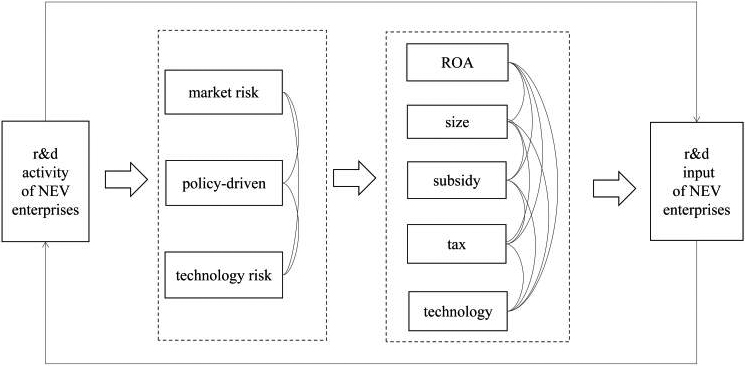
While each factor directly affects the R&D input of new energy vehicle enterprises, there is also a complex and uncertain nonlinear relationship among them (Fig. 1). The indicators of the two layers are in different “black boxes”. The first “black box” illustrates the coupling of policy, market and technological risks. Market and technical risks can be regulated and warned by policy. Market risk and technology risk interact with each other and have high synergy degree. The second “black box” reflects mediating role of enterprise size, knowledge stock and profitability [27]. New energy vehicle enterprises with large-scale can gather more innovative resources to carry out R&D activities. Enterprises with high knowledge stock have stronger innovation ability and can effectively use R&D subsidies for technological innovation [28]. Tax policies can increase corporate profits and improve corporate profitability. The phenomenon of “advantageous enterprise support” is prominent in the new energy vehicle industry.
Based on the above analysis and research of Xiong Yongqing [29], Li Xu [23] and Ma Wencong [30], five indicators are selects in this paper, including enterprise size (c1), knowledge stock (c2), profitability (c3), tax incentives (c4) and fiscal subsidies (c5), which are taken as the predicted input indicators of innovation input of new energy vehicle enterprises (Table 1).
New energy vehicle enterprise innovation investment forecast index
New energy vehicle enterprise innovation investment forecast index
Note: Patent data come from the official website of the State Intellectual Property Office in China, other data can be collected from the annual reports of listed companies on Juchao network.
This paper selects the “concept of new energy vehicles” as the financial search item in Shanghai and Shenzhen stock markets from 2015 to 2020. 135 new energy vehicle enterprises are selected as the research object in the paper on Wencai.com (www.iwencai.com). Enterprises with the main business of non-new energy vehicles are eliminated. The annual reports of the sample company are downloaded from Juchao Information (www.cninfo.com.cn) as the original data. Data missing and ST enterprises are eliminated though data pre-processing and 30 enterprises with complete data indicators from 2010 to 2020 are retained. Enterprise scale, knowledge stock, profitability, tax incentives, fiscal subsidies and R&D input of enterprises are included in these data, which cover all links of the new energy vehicle industry chain. Test results of D’Agostino and Pearson show that the sample data are consistent with Gaussian distribution. Some data is shown in Table 2.
Training sample data of neural network model
Training sample data of neural network model
Prediction data comparison of different neural network models.
Experimental results and analysis
In order to verify the effectiveness of innovative prediction of improved hybrid RBF neural network model in this paper, the prediction process of hybrid neural network model was realized by Matlab simulation experiment, and the prediction results were compared with those of traditional RBF neural network model. The training and testing data of this paper are derived from the data of 30 new energy automobile industry in the past 11 years, and the total sample number is 330. The first 300 pieces of data are used as training samples to complete the training of the proposed neural network model, and the last 10 pieces are used as test sample data. Meanwhile, the traditional RBF neural network model is trained based on the above training sample data. The parameters of the neural network are set as follows: hidden layer number of the automatic coding machine is 1, neuron number of hidden layer is 10 and 20 iterations. Hidden layer number of RBF neural network is 1, neuron number is10 and 100 iterations. The training accuracy of the two networks is set 10
Comparative analysis of errors
Comparative analysis of errors
As shown in Fig. 3, the prediction accuracy of the hybrid neural network model is significantly better than that of the RBF neural network model. It shows that the proposed model can improve the prediction accuracy of the traditional RBF neural network model for the system with strong nonlinear and complex variable coupling relationship.
Average absolute percentage error (MAPE) and its extended index SMAP are widely used error evaluation indexes in the world, which can be used to measure the deviation between the real value and the predicted value. The smaller the deviation is, the more accurate the result will be. Therefore, this paper adopts these indexes to analyze the prediction error of different models. The calculation formulas are as follows:
Where,
The error calculation results show that the MAPE of RBF neural network is 0.174, while the model proposed in this paper is 0.092. The SAMP value also decreases from 0.091 to 0.053. The two indexes show that the algorithm proposed in this paper has good fitness, faster convergence, stronger global search ability and higher prediction accuracy. This further indicates that the improved RBF neural network model has a more efficient and accurate training data screening method. The training effect of neural network can be improved by using Gaussian function as transfer function. The validity of the proposed model in innovation forecasting is verified.
In real situations, there are many different distribution forms. While the new variables obtained will eventually present Gaussian distribution when a large number of random variables with different distributions are summed up. The hybrid RBF neural network model proposed in this paper has strong adaptive and learning ability. Compared with the traditional RBF neural network, the error is significantly reduced and it has better data fitting ability. This prediction method can provide basis for policy making and encourage enterprises to carry out technological innovation. It is more suitable for innovation prediction of new energy vehicle enterprises.
For the innovation prediction of new energy vehicle enterprises, the hybrid neural network model proposed in this paper integrates the advantages of automatic coding machine and improved RBF hybrid neural network model. The training data optimization method of Gaussian distribution and the training module of Gaussian transfer function are proposed to improve the prediction accuracy. Compared with the prediction data of the traditional neural network model, the proposed neural network model has higher prediction accuracy and reduces the model convergence time. The method proposed in this paper can provide better reference for new energy vehicle enterprises to make innovative decisions. The model proposed in this paper is also suitable for the prediction of highly coupled influencing factors and data in accordance with the characteristics of Gaussian distribution. It has certain universality.
Prediction of innovation with general law can be solved by the neural network proposed in this paper. The prediction method for sample data with multi-feature distribution will be solved in the further research.
Footnotes
Acknowledgments
Education science 13th five-year plan project of Liaoning province, China (JG20EB078)
Humanities and Social Sciences Fund of Liaoning Engineering Vocational College, China (ZYL201901)
Scientific research project of Liaoning Engineering Vocational College, China (LGY202102)