



Abstract
From contactless payments to remote car unlocking, many applications are vulnerable to relay attacks. Distance bounding protocols are the main practical countermeasure against these attacks. In this paper, we present a formal analysis of
Introduction
Cryptography sees many applications in the world of smart-cards, from the more and more sophisticated NFC bankcards to the simpler RFID access cards. But the security protocols implied (e.g., protocols for ATM systems) are vulnerable to relay attacks or to more general forms of man-in-the-middle attacks. Relay attacks have already been mounted against bankcards [21]. In access control applications, it is not guaranteed that the card computing the responses to the reader’s challenges is indeed the one requiring access [30]. Similarly, car manufacturers use RFID protocols to unlock and even start their vehicles (see, e.g., [25]). However, these protocols may unfortunately be compromised by relaying [26]. The most interesting cryptographic solution to these threats seems to be based on distance-bounding [21].
In [12], Brands and Chaum introduced distance-bounding (DB) protocols, based on some original idea by Beth and Desmedt [6]. They are employed so that a prover may demonstrate his proximity to a verifier as well as authenticate this honest prover to the verifier.1
In this paper, we consider authenticated distance-bounding. Namely: protocols where both participants use a pre-established secret.
The terms “mafia-fraud” and “terrorist-fraud” were introduced in 1988 by Desmedt [19]. Although confusion-prone, these are the ones still used in the literature.
Ad-hoc countermeasures protecting against one or several such attacks have sometimes been provided [1]. It has also been claimed [33] that DB protocols in their commonly known form cannot protect against all three frauds at a time. Unfortunately, these frauds have become even more dangerous through recent generalisations [18,22]. Nonetheless, DB protocols will most probably soon be implemented by car manufacturers or bank payment companies in their products, as platforms for such deployments arise [38]. In these contexts, security proofs and clear, solid security models become of paramount importance. However, unitary security models and respective compelling security proofs have not yet been formulated with respect to this class of protocols. In the following, we endeavour in overcoming this shortcoming, providing a comprehensive security model for distance-bounding protocols and constructing practical and provably secure protocols in the model herein.
More precisely, in this paper we provide a formal analysis, for
The SKI protocols were first presented at FSE’13. The name “SKI” comes from the first names of the authors:
Distance bounding – Informal and semi-formal approaches
In this section we provide details on the practical requirements (i.e. tolerance to noisy conditions) for secure distance bounding protocols, review the related work in distance bounding and finally discuss its connection to location based cryptography.
Tolerance to noise
Since distance-bounding protocols operate under time-critical constraints and with rapid-bit exchanges, they are likely to be subject to noise, i.e., to noisy communication channels. So, these protocols often tolerate a few faulty iterations, in such a way that honest executions would succeed with high probability. Of course, noisy, rapid-bit exchanges are a reality of applied cryptographic protocols. However, many research results on DB assume noiseless conditions [1,14,17,45]. In this paper, noise will be taken into consideration in our security assessments.
DB protocols and attacks amendments
Many DB protocols [32,34,39,46] consist of a data agreement phase or initialisation phase and a distance-bounding phase. The distance-bounding phase is time-critical and it normally imposes very fast computation, typically of less than a single clock cycle per round. (Light travels one meter within about three nanoseconds. So, every bit must be treated on the fly, upon arrival, with no delay, and there is no part for any time-consuming computation.) Nevertheless, even if the time-of-flight is critical, some DB protocols are not secure against terrorist-fraud: an attacker can find ingenious ways to collude with provers, defeating DB; an example of the sort is the terrorist-fraud, recently shown against the Bussard and Bagga [13,14]. Hancke and Kuhn [29], Munilla and Peinado [35], Kim and Avoine [33] and Reid et al. [39] proposed follow-ups of each others’ schemes, addressing either a better protection against terrorist-fraud or mafia-fraud, or a better suitability to practice, or a more formal description, etc. In general, attempts to construct secure distance-bounding protocols such as [34,43,46] have been proven flawed [36,37]. In fact, Kim et al. state [33] that there is no DB protocol, which has one-bit challenges/responses per iteration in the distance-bounding phase, resisting all three attacks (i.e., distance-, mafia-, and terrorist-frauds) with a significant probability. In [10,11, Table 1], the popular distance-bounding protocols and their vulnerabilities as best-known up to that point (2013) are reported. That table shows a dire situation, so the question of provable security against all frauds mounted has been standing prominently. Since, two (classes of) protocols (one class in [10] and one protocol in [24]) which are provably secure have been published.
Moreover, more general attacks have been recently described. In [18], Cremers et al. described distance-hijacking as an extension of distance-fraud, yet as an attack that is close to terrorist-fraud at the same time; the fraud involves one dishonest, far-away prover and several honest provers, without the latter colluding with the former. Impersonation (a type of man-in-the-middle) is presented in [22]. In the current work, our threat model also incorporates these latter, powerful attacks.
In [2], a targeted protocol-analysis is carried on the TDB protocol by Avoine et al. They especially address the protection against terrorist-fraud for the Hancke and Kuhn protocol, using secret sharing schemes. However, [2] does not state the sound, (necessary and) sufficient assumptions for combating terrorist-fraud. This will be amended and taken further in this paper; we generalise the underlying idea of using a secret sharing scheme [2] and introduce a taxonomy of security-enforcing conditions (some of which are linked to secret sharing).
Recently, Hancke [28] observed that terrorist-frauds could also be mounted, by simply abusing the aforementioned, noise-tolerance property required from DB. Basically, a malicious prover could help an adversary to answer most challenges and not leak to this adversary the secret key but only a noisy version of the secret key. Also, this leaked information is such that it does not give the adversary any significant advantage in later attacks onto the scheme, i.e., the coerced prover mounts a valid terrorist-fraud. Similar to TDB and the protocols herein, there is the recent protocol in [49]; however, unlike the protocols herein, the protocol in [49] does not resist these new terrorist-frauds in noisy conditions by Hancke [28]. As a matter of fact, all but two protocols allegedly resisting the classical terrorist-frauds as they were known before Hancke’s observation would now collapse under terrorist-frauds executed in this new scenario of Hancke’s (at least, cf. to [10,11, Table 1]). The protocols left standing in front of this attack are the
Position-based cryptography and distance bounding
Position-based cryptography (PBC) [15] becomes possible through secure positioning (SP), which involves a set of verifiers ensuring that a given prover is indeed at some claimed position. In other words, in PBC a verifier within the network not only estimates the distance to another device but is also helped by, e.g., trusted base-stations that offer position-data for coordinate-triangulation in his final decisions. In SP, this assistance by, e.g., base-stations can happen repeatedly, to defend against malicious behaviour. This is not the case in DB, where the verifier is on his own, with his much simpler measurements at hand. However, distance-bounding protocols could potentially be used as building blocks for SP.
The model needed to achieve PBC bears similarities with the one to follow, yet distance-bounding is a weaker requirement than secure positioning. DB informally implies one prover proving to one verifier only that the former is close enough to the latter, using the time-of-flight of their exchanges. Thus, while the “geometry” needed for achieving distance-bounding is much simpler, the notion of time is of greater importance for distance-bounding.
State-of-the-art: Towards provable DB security
DB formalisations
In [1], Avoine et al. give a complete but rather informal model for distance-bounding. Herein, we will refer to this line as to the ABKLM model. They define distance-bounding as the combination of authentication and distance-checking. They further carry on a tentative analysis of the Munilla–Peinado protocol [35]. As we will further discuss below, [1] does not clearly state the exact assumptions needed on the underlying primitives in order to achieve the alleged security.
So far, the most promising model for distance-bounding was presented recently by Dürholz et al. in [22]. We refer to it as the DFKO model. This model does not provide a clear communication model and its notions of time or distance are only implicit. It requires to specify protocols by explicitly distinguishing a lazy phase and a time-critical one. The DFKO model formalises the three classical types of frauds and an extra notion of impersonation fraud. The attackers are very specific, presented in terms of protocol session interleaving. Maybe due to this specificity or to their requirements which may be too strict, the model is too strong, fact admitted by its authors in [23]. In this model, certain insecurities (impersonation or terrorist-fraud) are hard-to-defend claims, leading to no convincing attack. Fischlin and Onete later proposed a secure protocol, proven secure in a new, clearer, game-based security model advanced at the same time. This recent protocol is discussed and compared with
Security shortcomings in DB
Practical DB should also be attack-proof. But, from the above, one can conclude that provably secure DB is still in the making. When security is rarely attained/proved against one fraud, another resistance is diminished [48]. But, more seriously, some of the literature on distance-bounding uses either unsupported claims of the form “if f is a PRF, then this protocol is secure against…”. In fact, in the line of Boureanu et al. [7], it was proven, by the technique of PRF programming, that if PRFs exist, then these results are incorrect. When employed with some specific PRFs, the TDB [2] protocol, an enhancement of the Kim–Avoine protocol [22], Hancke and Kuhn’s [29] protocol, Avoine and Tchamkerten’s [3], Reid’s et al. [39] protocol, and the Swiss-Knife [34] protocol, they were all shown to be indeed vulnerable to distance-fraud and/or man-in-the-middle attacks. The DB security claims recently disproven by Boureanu et al. [7] seem to come from a mis-use of PRF techniques: replacing a PRF (in security arguments) by a random function at a place where the adversary has access to the PRF key or at a place where the PRF key is simultaneously used at other places in the protocol. In a parallel line, [34] proved that many existing distance-bounding protocols are also subject to mafia-fraud. And, in [4], it is revealed that public-key techniques do not necessarily protect against terrorist-fraud. Also therein, a family of protocols is exposed to generalised mafia-fraud attacks. Finally, Hancke [28] shows that noisy communications and tolerance to them must also be addressed in the security analysis. So, the technicalities of the model to be presented herein, to assure a solid provable security framework, are of utmost importance.
Contributions
In the context of the shortcomings above, our main contribution is three-fold:
We present a formalism for distance-bounding, which includes a sound communication and adversarial model. In these latter models, we incorporate the notion of time-of-flight for distance-based communication.4
We further formalise security against distance-fraud, man-in-the-middle (MiM) generalising mafia-frauds, and an enhanced version of terrorist-fraud that we call collusion-fraud. As practice dictates, our formalisations take noisy communications into account.Mainly in the context of security against generalised mafia-frauds (when TF-resistance is also enforced), we introduce the concept of circular-keying security to extend the security of a pseudorandom function (PRF) f to its possible uses in maps of the form
We analyse variants of the
Note: The
We consider a multiparty setting where each participant U is modelled by a polynomially bounded interactive Turing machine (ITM), has a location
As aforementioned, we model a generic two-party communication protocol by the interactive system run by ITMs [27]; we now fix the notations.5
We use standard notations for ITMs. Namely, random coins are separated from other inputs by a semicolon or omitted for simplicity. Inputs consist of the initial input and the variable number of incoming messages.
Bound on the distance
To our modelling, we add a fixed integer constant
This estimation is based on round-trip time, i.e., each response ought to be received before V has
The crux of proving the security of DB protocols lies in Lemma 3.1, stated below.
Informal formulation of Lemma 3.1
By Lemma 3.1, we informally mean the following: if V sends a challenge c, then the answer r from a close-by participant
In more details, in computing such an answer,
The use of Lemma 3.1
We will use this lemma every time when a too-long-distance has an implication on the data-flow. We believe such a clear-cut formalisation eases the proofs. For instance, in the DFKO model [22], the implicitness of timed communications requires an effective distinction between a lazy and a time-critical phase in the runs of the protocols, which may in turn hinder the construction of clear security proofs. The DFKO model also requires to define exhaustively which data flows are allowed (the tainted sessions) for each security notion.
Another way to go about this would have been to introduce a full model in which such a lemma holds; in fact, we do so in Appendix A. Or, yet another way would have been to simply state the text of the lemma and take it axiomatically. Instead, we took the approach of enunciating it formally and proving it.
Assume an experiment
w.r.t. the model in Appendix A
We first assume a single participant in
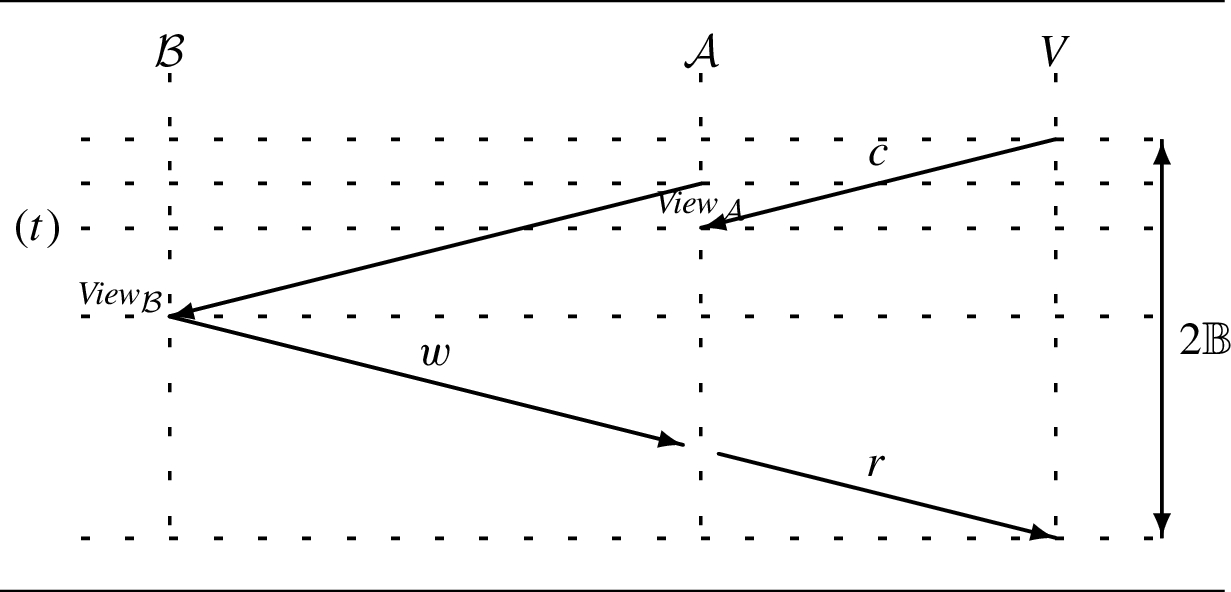
Adversarial communication flow over time.
With several participants in
When modelling distance-bounding protocols, we consider provers, denoted by P and verifiers, denoted by V. We let
(Distance-bounding protocols).
A distance-bounding (DB) protocol is defined by a tuple
We denote this output as
Termination:
In the above, only the termination of V is of interest, since it is only the verifier who has a meaningful output.
p-Completeness:
Throughout, “
DB concurrency
Our model implicitly assumes concurrency involving participants not sharing the secret inputs amongst them. In security definitions, these extra participants are implicitly universally quantified. When several provers using the same input x appear in experiments, they will be explicitly mentioned. I.e., several instances of the same participant at different location and/or time.
The security requirements of DB protocols, i.e., the resistance to the different DB threats, are formalised in the definitions to follow. The parameters used therein, α, β, γ,
(Generalised) distance-fraud
(α-resistance to distance-fraud).
Informal explanation of Definition 3.2. The above definition states, in our modelling, the notion of resisting to distance-fraud: i.e., a participant
Relation with other formalisms. In a 2-party setting, the above definition corresponds to the one of the ABKLM model [1]. When α is negligible, our security notion becomes equivalent to the one in the DFKO model [22].
Relation with distance hijacking [18]. Due to our concurrent setting, Definition 3.2
captures the notion of distance hijacking in [18], i.e., an experiment in which a dishonest far-away prover
(Generalised) mafia-fraud
(β-resistance to MiM).
Informal explanation of Definition 3.3. In man-in-the-middle (MiM) attacks or generalised mafia-frauds as above, we consider that during a learning phase, the attacker interacts, in parallel, with
By the learning phase, Definition 3.3 models practical threats. For instance, an attacker would have cloned several tags and would make them interact with several readers with which they are registered. From such a multi-party communication, the attacker can get potentially more benefits, in a shorter period of time. Of course, an attacker can in fact set up this learning phase as he pleases, to increase his gains. So, we can even imagine that he places prover-tags close to verifier-readers, even if being an active adversary between two neighbouring P and V is technically more challenging than interfering between two far-away parties. E.g., in this scenario, the adversary could interfere with the initial frequency synchronisation phase so that the
In any case, note that the learning phase is not obligatory in our setting (m and z can be 0). Indeed, we further consider mafia-frauds as a specialisation of the above, where no learning phase is present. But, if and when a non-trivial learning phase is present, it renders a stronger threat model and proven resistance to such attacks entails better security.
Relations with mafia-fraud and other frauds
The classical notion of mafia-fraud (the one from the ABKLM model [1]) corresponds to
The classical notion of impersonation for identification schemes corresponds to
Relation with other formalisms
The DFKO model [22] of mafia-fraud already includes the above general extension since concurrent settings are implicit in the DFKO model.
Non-narrow attackers
We will now describe a special type of (MiM) attackers, following a notion introduced in [47]. Thereby, a (MiM) attacker is non-narrow if he can learn the bit that the verifier outputs. A way in which this can be trivially formalised is by adding a return channel to the communication, here denoting that the verifier V sends
It is pertinent to formalise such an attacker: intruders learn obviously more information by looking also at whether the run was successful or not. Indeed, in the generalised MF presented in [4], it is this sort of return channel that facilitates the attacks. To avoid defining a new class of attacks (as done in the literature [47]), we define this as a property of the protocol. A distance-bounding protocol is called non-narrow if it terminates by V sending (Non-narrow MiM).
(Generalised) terrorist-fraud
(
-resistance to collusion-fraud).
Definition 3.3 defines MiM attacks as using an honest
Informal explanation of Definition 3.5. Definition 3.5
expresses the following. Consider a prover
In practice,
Note that collusion frauds are non-falsifiable. However, this is inherent to terrorist frauds.
Relation with terrorist-fraud. Collusion-frauds are more general than terrorist-frauds. The classical notion of terrorist-fraud corresponds to a specialised case of Definition 3.5: the one where
Relation with other formalisms. In the ABKLM or DFKO models, only the specialised case of collusion frauds mentioned above, i.e., the traditional terrorist-fraud, is considered. In the DFKO model [22], the formalisation of terrorist-fraud further considers
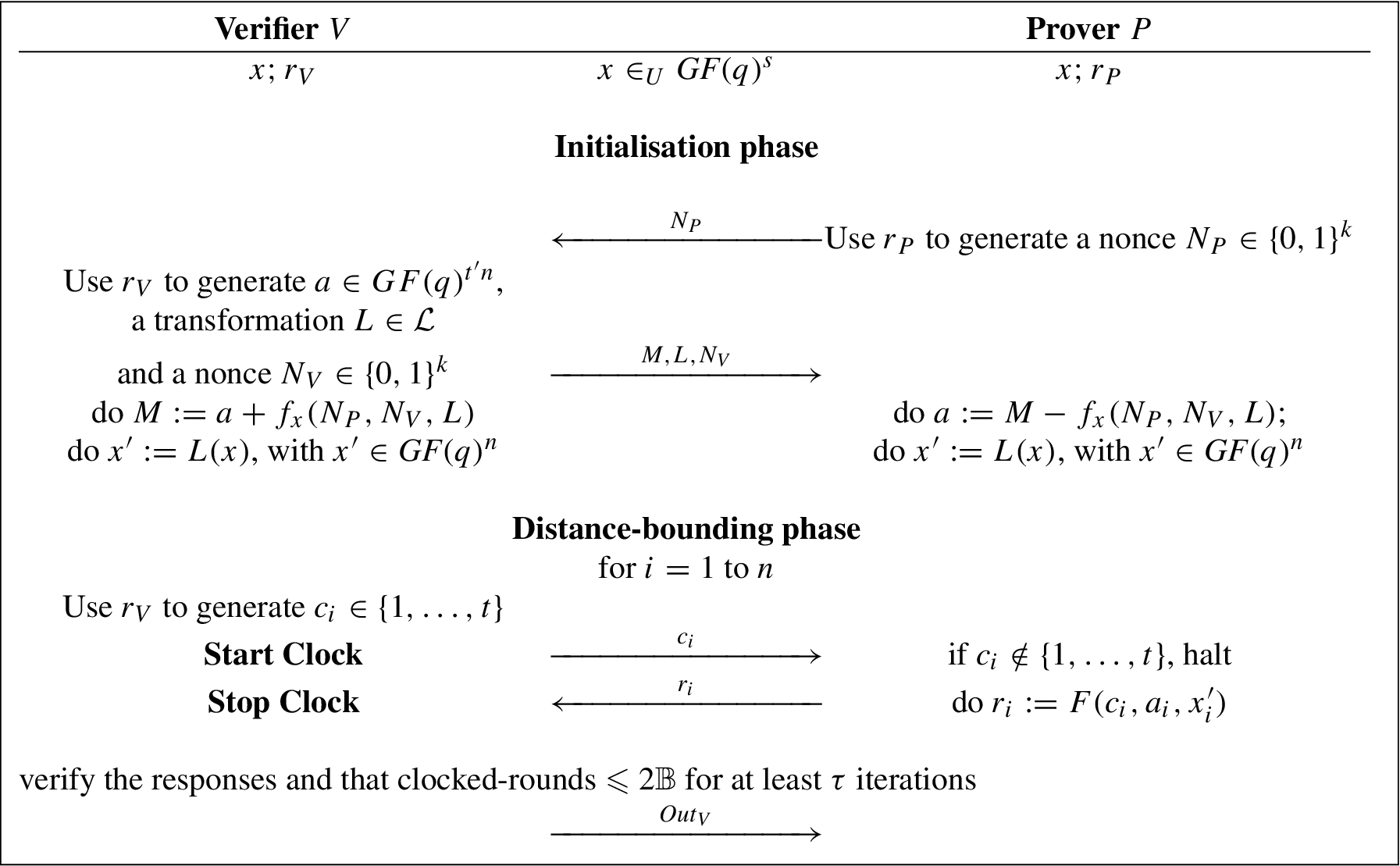
The
SKI : Description and completeness
At a high level, the protocol schema
The
This will be called the F-scheme and it will incorporate requirements towards (generalised) DF-, TF- and MF-resistance.
SKI instances
We first depict
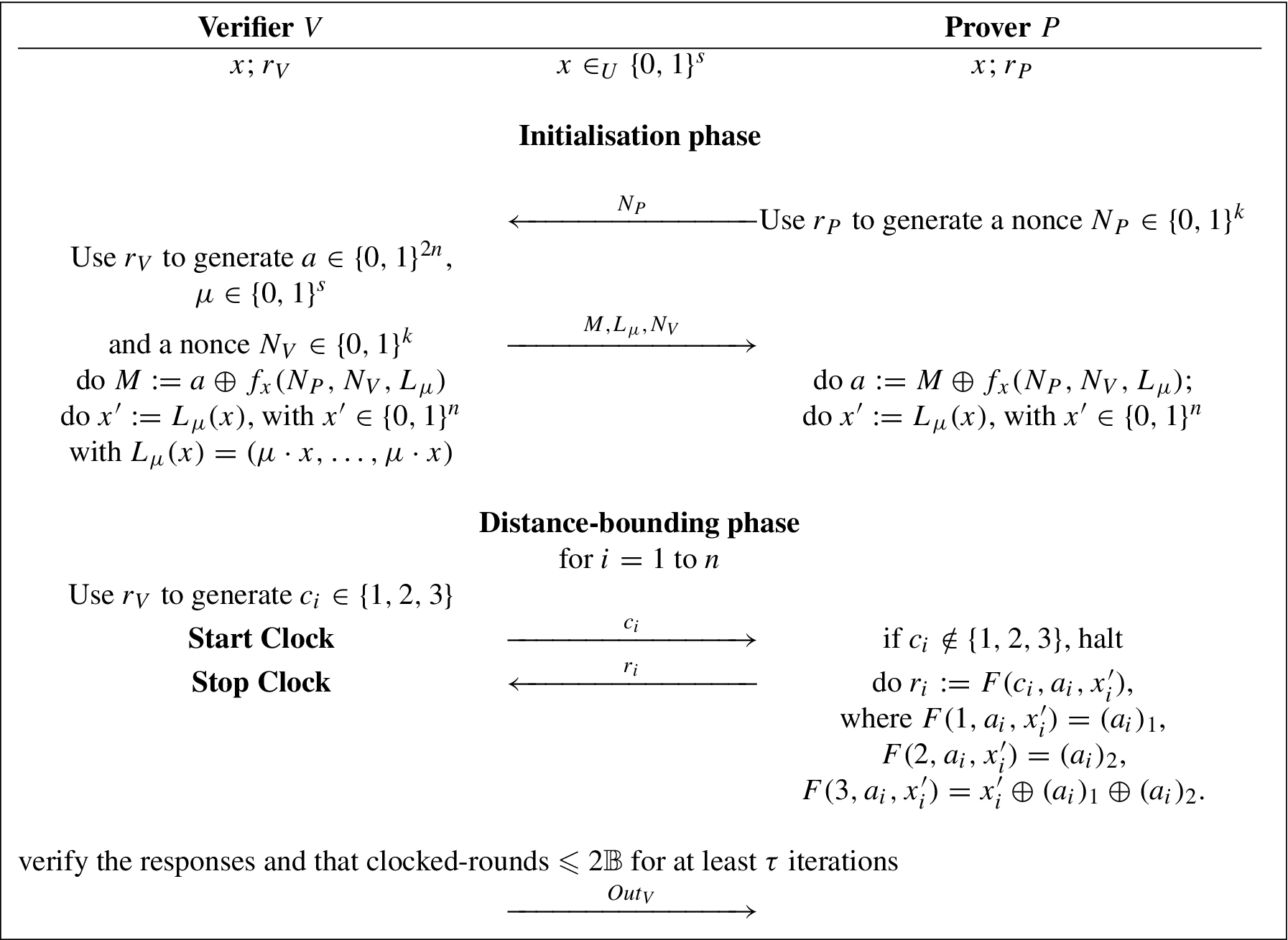
The
In fact, in Boureanu et al. [10,11], several variants of
Namely, note that
We note that both instances are efficient. Indeed, we could precompute the table of
However, in our design, we need the reuse of x for protection against terrorist-fraud and/or collusion-fraud. Along these lines, the
In Appendix B, we consider other variants of
SKI completeness (in noisy communications)
We would like to investigate the suitability of the selected parameters. More precisely, we verify for which parameters,
Each
It is natural to choose τ (and other parameters) such that we operate with correct DB protocols, cf. with Definition 3.1. I.e., the protocol is complete: honest communications succeed with high probability.
Let
Due to the Chernoff–Hoeffding bound [16,31],
In practice, we may use a constant
In this subsection, we discuss the design choices that we made in order to render the instances of
PRF masking
Importantly,
We introduce PRF masking to protect against the class of attacks in [7]. I.e., Without PRF masking, M is not used (or equivalently, M is always set to 0). Then we could construct [7] a PRF such that, e.g., for all x and
F-scheme
In our way to prove security, we need some notions related to the response-function F; these characterise the concept of F-scheme. At the same time, these concepts give the sufficient conditions to protect against all three frauds possible against the concrete
(F-scheme).
Let We say that the F-scheme is linear if for all challenges We say the F-scheme is pairwise uniform if
We say the F-scheme is t-leaking if there exists a polynomial time algorithm E such that for all Let
Informal explanation of Definition 4.1. The pairwise uniformity and the t-leaking property of the F-scheme say that knowing the complete table of the response-function F for a given
The σ-boundedness of the schemes says that the expected value (taken on the choice of the subsecrets
We have
In relation with the definitions of the F-schemes above, we now prove the following lemma.
The F-scheme used in
This lemma extends to Lemma B.1 given and proven in Appendix B.
Leakage scheme
We can consider several sets
More formally, we introduce the following notion.
Let
Informal explanation of Definition 4.2. Intuitively, this means that based on r values of L and a noisy
We define
We consider the leakage scheme
The following lemma is trivial.
For all constant
Circular-keying security
On our way to prove the security of the Let s be some security parameter, let b be a bit, let We define an oracle
We note that it is possible to create secure circular-keying in the random oracle model (ROM) [5]. This is a “sanity check” for our circular-keying notion. Indeed, any “reasonable” PRF should satisfy this constraint. Only special constructions would not. E.g., the ones based on PRF programming from [7].
Let
Let
By taking
Now, in the random oracle model,
We proceed with inspecting the rest of the security requirements on these protocols.
The
A B B
C
The proof of Theorem 4.1.B′ is similar (and simplified) as the one of Theorem 4.1.B. So, we prove the A, B and C parts only.
In the noiseless case (i.e., with
For each key
We recall that if the F-scheme is linear, then
If
Thanks to PRF masking, the distribution of the
To establish the probabilities
Tightness
The above result is tight as the following attack shows. It is thus the best distance fraud. We consider a malicious (far-away) prover who follows normally the initialisation phase. For the distance bounding phase, he anticipates the challenge
In the next,
We use the game-reduction methodology [42] to prove this lemma. Let
Below we consider a prover
We apply a reduction by failure-event to prove that the game
Assume that F is the event that at least a collision as above happens, i.e.,
Since the F-scheme is linear, we can write
From here, we use a simple bridging step to say that the adversary
So, the probability p of
Tightness
The above result is tight as the following attack shows. It is thus the best MiM attack. We consider an adversary who first relays the messages between the (far away) prover and the verifier during the initialisation phase. Then, he simulates a distance bounding phase with the prover to learn some
Assume as per the requirement for resistance to collusion-fraud that there is an experiment
Let
For terrorist-fraud resistance, we would also like that – in the second, MiM experiment – the adversary
So, if we were to pick a set of challenges such that
We use
By applying the leakage scheme decoder e on this oracle, with u samples, it can fully recover x, with probability at least
Tightness
For our
During the collusion fraud, the adversary passes each round such that
Thus, under the circumstances where protection against terrorist-fraud and/or collusion-fraud13
It is clear that these
SKI ’s parameters
Let
According to the data in the table above, we must take
By changing the F-scheme, we can decrease the value
If we require TF-resistance (as per Theorem 4.1.C), we also get a constraint of
The contributions of the
Provable security
As we discussed in Section 2.1, most distance-bounding protocols, new or old, do not enjoy formal security proofs. On the contrary, most have been proven vulnerable to various attacks (see [10,11, Table 1]). The only two, recent protocols which amend this and come with a formal security model and adjacent security protocol are the
The two formalisms are different; the FO model is game-based, the current one being based on simpler experiments run by interactive Turing-machines. Throughout the paper, for each formulated definition where it was pertinent, we discussed the link with the FO model. We remind that the FO recent protocol is discussed and compared with
Efficiency
The
Conclusions
In this paper, we have specified distance-bounding protocols and their security requirements, i.e., resistance to (generalised) distance-fraud, man-in-the-middle, terrorist-fraud attacks, in a general formalism for modelling location-driven security protocols developed herein. We also proposed the formal proofs for a provably secure class of practical protocols for distance-bounding, by identifying the requirements on the building blocks (i.e., the F-scheme, the leakage scheme, PRF masking, and the circular-keying security). Thus, these protocols are practical, efficient and provably secure against all frauds and their generalisations, even in noisy conditions. As a by-product, we introduced (at least) a new security notion, i.e., circular-keying for pseudorandom functions (PRFs); this models the employment of a PRF, with possible linear reuse of the key.
Footnotes
A communication model
We introduce a model for distance-bounding protocols. We first specify the main ideas at a high-level and then, in Section A.2, we formalise our communication and our threat model.
SKI variants
Our F-scheme can be instantiated to produce different
As formalised above, to attain security, the idea behind such an F-scheme is that it should be a secret sharing scheme in which the response to the
Note that the function
In our numerical studies, we actually look at three specific F-schemes dictated by the functions above, giving three specific
In relation with the definitions of the F-schemes and protocols above, we prove the following lemma.