



Abstract
Distributed information systems are prevalent in modern computing but difficult to build securely. Because systems commonly span domains of trust, host nodes share data and code of varying degrees of trustworthiness. Modern systems are often open and extensible, making security even harder to reason about. Unfortunately, standard methods for software construction do not help programmers enough with ensuring their software is secure.
Fabric is a system and language for building open, distributed, extensible information systems that are secure by construction. Fabric is a decentralized system that allows nodes to securely share both data and code despite mutual distrust. All resources are labeled with confidentiality and integrity policies that are enforced through a combination of compile-time and run-time mechanisms.
The Fabric language offers a high-level but powerful model of computation. All resources appear as objects in the language, and the distribution and persistence of code and data are largely transparent to programmers. Fabric supports both data-shipping and query/RPC styles of computation: computation and information can both move between nodes. Optimistic, nested transactions ensure consistency across all objects and nodes. Fabric programs can securely share mobile code across trust domains, enabling more reuse and evolution of code and supporting new kinds of secure applications not possible in other distributed systems. Results from applications built using Fabric suggest that Fabric enforces strong security while offering a clean, concise, powerful programming model with good performance. An open-source prototype is available for download.
Introduction
Standard programming abstractions are ill-suited to the task of building modern applications securely, providing little or no assurance that the resulting systems will use information in a secure way. Yet distributed information systems developed using these abstractions are deeply integrated into many activities where security and privacy are crucial. It should be unsurprising that there are so many serious system compromises and privacy violations.
Because current programming languages and abstractions are deeply implicated in the insecurity of modern systems, it suggests that a new programming model is needed for securely implementing distributed systems. But this goal comes with some major challenges. First, before a system can be verified to enforce security requirements, these security requirements must be specified. With current standard programming models, such specifications are absent, too weak, or too onerous for developers to use. Second, security verification methods are needed. And to be effective, these verification methods should be integrated into the programming model, so that developers receive feedback and guidance as they construct the system. It is not enough to leave security as an afterthought for enforcement at run time – a way is needed to design systems to be secure.
This paper describes the Fabric programming system, a clean-slate programming model for building distributed systems that are secure by construction. Fabric is both a programming language and a system that implements this language in a decentralized way. Fabric offers a high-level, object-oriented programming abstraction that differs from typical object-oriented languages such as Java in that information security policies – and some features of the distributed computing environment – are explicitly visible in Fabric code. At compile time, developers can verify that all information flows in their code are secure; at run time, host nodes participating in distributed Fabric computations further check code before running it, to verify that it will enforce information security. An open-source prototype implementation with example programs is available for download [4].
This paper offers the first integrated presentation of Fabric. It expands on previous peer-reviewed publications [3,74], and includes details (drawn from dissertations [46,73]) on node authentication (Section 6.2), dynamic authorization (Section 6.4), the security cache (Section 6.7), writer maps (Section 6.8), and distributed transactions (Section 6.9). The evaluation results in Section 9 were previously published [75].
Federation and decentralized security
Fabric provides a shared computational and storage substrate implemented by an essentially unbounded number of Internet hosts. As with the Web, there is no notion of an “instance” of Fabric, and there is no centralized control over admission to Fabric. New nodes – even untrustworthy ones – can join the system freely, and begin interacting and sharing information with other nodes without prior arrangement. Interactions between nodes in this decentralized system are made secure by limiting the exchange of information and computation according to the trust that nodes have expressed (or have not expressed) in each other.
Because Fabric is fully decentralized in design, it is able to address an important security challenge: the need for systems that integrate information and computation from independent administrative domains. Such systems are federated: each domain has its own security and privacy requirements, but does not fully trust other domains. Integrating information and code in this setting of heterogeneous trust is attractive – it enables new services and capabilities including mashups, multi-cloud applications, and distributed web services. Because Fabric does not assume any central authority, it can be used to construct various kinds of federated systems while enforcing security and privacy on behalf of all participants.
To illustrate the challenges of building federated systems securely, consider the scenario of medical institutions that want to securely and quickly share patient information – with each other, with their patients, and with the patients’ insurance companies. In fact, incomplete patient information is a leading cause of the more than 44,000 deaths that result annually from preventable medical errors in the United States alone [64]. However, information sharing must respect the security and privacy policies of the two institutions, as mandated by law in many countries. Current information systems lack a principled way to share medical information under verifiable security and privacy guarantees.
We take a holistic view of security: all participants’ security requirements must be enforced. But in a federated system, some host nodes are at least partly distrusted by some participants. What does it mean, then, to correctly enforce security? Our guiding principle for security is that one’s security should never depend on components of the system that one does not trust. We call this the decentralized security principle. More precisely, it says that the enforcement of a given security policy should not depend on the behavior of any component that is not trusted by the owner of the policy.
Fabric enforces information security through a combination of mechanisms at the language and system levels. To decide whether these mechanisms enforce security in accordance with the decentralized security principle, we need to know what security policies are supposed to be enforced and which host nodes are trusted to enforce which policies. Therefore, Fabric makes both policies and trust explicit in the programming model. With policies and trust made explicit, the decentralized security principle becomes a valuable guide for understanding where enforcement mechanisms are needed, and where they are not.
Mobile code
Data is exchanged between trust domains rather freely in modern computing systems. So is code. This mobile code adds new challenges for making distributed systems secure. Web applications have made mobile code a part of everyday life: visiting a web page typically loads JavaScript code from multiple providers into your browser. In fact, many web pages are already federated systems! Web services such as Facebook allow third parties to provide applications that are dynamically combined with their core functionality. And even traditional desktop applications dynamically download plugins from external providers.
Over the past few years an ecosystem of mobile-code development has sprung up in which web programmers reuse and customize JavaScript code found on the Web for their own purposes. Sometimes programmers simply copy code and modify it for their purposes; web applications commonly import large JavaScript libraries such as JQuery [61] via URLs. Other mobile-code web platforms such as ActionScript, used by Flash, are not fundamentally different. While JavaScript is the most common mobile-code system, studying mobile-code security in the clean-slate setting of Fabric has the advantage of addressing a more general, abstract instantiation of the real problems. The solutions should be correspondingly more reusable.
The benefits of freely sharing mobile code come at a cost: dynamically combining code from multiple sources might yield an insecure application. On the Web now, the main security safeguard is the same-origin policy [130], which attempts to limit web applications to communication with their originating website. This policy prevents many useful applications yet also fails to address all the ways that untrusted code can create security vulnerabilities [12]. Limitations on expressive power force developers to work around the same-origin policy, potentially introducing additional vulnerabilities [56].
Fabric supports free and flexible distributed sharing of code and data that developers clearly want, while enforcing information security. Confidentiality and integrity of information are protected even when sharing happens between nodes lacking mutual trust. Not only is each individual application component secure, but assemblies of code and data from various providers also satisfy all participants’ security requirements.
The Fabric programming model
Most distributed systems code is currently written using low-level abstractions that obscure application logic, leading to bugs and vulnerabilities. An essential part of the Fabric philosophy is to raise the level of abstraction so programmers can focus on the core application logic, including its security implications.
Central to this abstraction is the representation of many entities as objects that can be used by Fabric code in a uniform way. These objects may be persistent or nonpersistent. They may be stored locally on the same node, or stored elsewhere in the distributed system. Host nodes, principals, and code are all represented at the language level as objects. This uniform representation allows the same security reasoning and mechanisms to be applied throughout the system.
The Fabric programming language is an extension to the Jif programming language [86,90], which is in turn based on Java 1.4 [48]. Like Jif, the Fabric language has built-in security mechanisms centered around information flow control. In the context of Fabric, these security mechanisms keep untrusted nodes from violating confidentiality and integrity. All objects in Fabric are labeled with policies from an extended version of the decentralized label model (DLM) [87]. In this model, security requirements are captured by information flow labels expressed in terms of principals (e.g., users and organizations). Information flow control based on these labels allows principals to control the extent to which other principals (and nodes) can learn about and affect their information. A node that is not trusted by a given principal is prevented from compromising the security policies of that principal.
Despite its high-level programming model, Fabric supports a variety of ways to organize distributed computation and storage for good performance. Fabric supports both data shipping, in which data moves to where computation is happening, and function shipping, in which computation moves to where data resides. Data shipping enables Fabric nodes to compute using cached copies of remote objects, with good performance when the cache is populated. Function shipping enables computations that span multiple nodes; like database server queries, computations can be shipped to the node where the data is stored persistently. To simplify reasoning about complex computations involving multiple nodes, Fabric provides strong consistency. Inconsistency is prevented by performing all updates within distributed, linearizable transactions.
Of course, there has been much previous work on making distributed systems both easier to build and more secure. Prior mechanisms for remotely executing code, such as CORBA [119], Java RMI [57], SOAP [123] and web services [17], generally offer only limited support for information security, consistency, and data shipping. J2EE persistence (EJB) [36] provides a limited form of transparent access to persistent objects, but does not address distrust or distributed computation. Peer-to-peer content-distribution and wide-area storage systems (e.g., [32,42,67,101]) offer high data availability, but do little to ensure that data is neither leaked to nor damaged by untrusted users. Nor do they ensure consistency of mutable data. Prior distributed systems that enforce confidentiality and integrity in the presence of distrusted nodes (e.g., [25,27,133,136]) have not supported consistent computations over persistent data.
Threat model
Fabric makes few assumptions about attackers, which yields stronger security assurance. In particular, host nodes in Fabric may be malicious and can behave arbitrarily. They are not assumed to behave in ways allowed by the Fabric programming language, and they need not faithfully follow the distributed protocols by which Fabric nodes communicate. Fabric principals are able to express complete or partial trust in Fabric nodes. If a principal expresses trust in a node, the compromise of that node might harm the security of that principal. The goal of Fabric is to ensure that the degree of trust expressed in a node bounds the degree to which security might be violated from the perspective of that principal.
The runtime exposes more information than what is available at the language level, such as object identifiers and cryptographic keys, which malicious nodes can misuse. However, without the appropriate cryptographic keys, nodes are assumed to be unable to learn encrypted content or forge digital signatures. Because Fabric uses TLS [38] for communication between nodes, we also assume that adversaries cannot tamper with network messages and that they do not learn anything about the contents of network messages unless they control the intended recipient.
A network adversary might use traffic analysis to infer something from the existence of a message, its source and destination, its size, or its timing. We ignore these traffic analysis channels, as do most systems. Fake traffic, predictive mitigation [134], and onion routing [39] might mitigate these channels, though at a cost. Network adversaries can also prevent the delivery of messages. The availability of services written using Fabric depends on an assumption that network messages are eventually delivered.
Fabric also does not handle abort channels, a side channel arising from the interaction of transactions at different security levels, in which a higher-security transaction can cause a lower-security transaction to abort [110]. Abort channels are not observable to programs written in the Fabric language but could be exploited by a malicious node that shares access to an object on which transactions conflict.
Like almost all work on distributed system security, Fabric largely ignores some challenging side channels, arising from timing, termination [105], and progress [7]. Termination and progress channels usually have low bandwidth, but timing channels can have high bandwidth [98]. There are two kinds of timing channels: external and internal [106]. We do not attempt to control covert external timing channels in this work: adversarial nodes are assumed not to time when messages arrive. Run-time mitigation methods (e.g., [65,134]) may be useful for limiting the bandwidth of external timing channels. Internal timing channels arise when code running within the system measures time, either explicitly or implicitly by constructing a race among concurrent threads. Fabric does not support fine-grained concurrency; a top-level transaction must be sequential. Races between threads therefore involve external communication with a store, and can be considered external timing channels. Resource exhaustion attacks (e.g., by allocating large objects on remote hosts) are also not addressed, although one instance is studied in [76].
Contributions
Fabric integrates many ideas from prior work – including compile-time and run-time information flow, access control, and optimistic transactions – while solving problems that arise from the interactions between these ideas. In fact, it does not seem feasible to provide a high-level programming model like that of Fabric by simply layering existing abstractions. Several new ideas make Fabric possible:
A programming language that integrates information flow, persistence, transactions, and distributed computation.
A system that enforces the decentralized security principle by connecting principals and nodes to the security policies (labels) they are trusted to enforce.
An integration of function-shipping and data-shipping models of computation that enforces secure information flows within and among network nodes.
A way to manage transactions that affect objects at mutually distrusting nodes while enforcing confidentiality and integrity.
A method for verifying information flows created by partially trusted mobile code, by integrating the label of the code itself into information flow checking.
A mobile-code architecture in which partially trusted code becomes a persistent resource that is published and managed by the system.
Mechanisms for secure evolution of code and code assemblies, and associated persistent data.
Fabric is a mostly clean-slate approach to developing secure systems, and there is work left to be done on interoperability with existing standards. However, Fabric does not require application developers to abandon other standards and methodologies; Fabric can interoperate with other standards. In fact, Fabric already interoperates with existing Java application code, and a library for building web services with Fabric already exists. Other standard abstractions and APIs can be implemented using Fabric. It also seems feasible to implement Fabric nodes by encapsulating other services such as databases. Other than its support for language-based security policies, the Fabric programming model should be familiar to users of existing, popular object-relational mapping frameworks such as the Java Persistence API (JPA) [16] or Django [40]. It provides transactional access to distributed, persistent objects, with stronger guarantees.
Overview
The rest of the paper is organized as follows. Section 2 introduces a running example. Section 3 presents the key programming abstractions of the Fabric language. Sections 4 and 5 discuss the language support for information-flow security and secure mobile code. Section 6 describes the design of the Fabric runtime system. Some details of the Fabric implementation are discussed in Section 7. Except for certain features mentioned in Section 7, the design described in this paper has been implemented in an open-source prototype [4]. We report on our evaluation of this implementation, including results for the expressiveness of Fabric (Section 8) and the performance of a substantial application built using Fabric (Section 9). Related work is covered in Section 10, lessons learned and future work are discussed in Section 11, and Section 12 concludes.
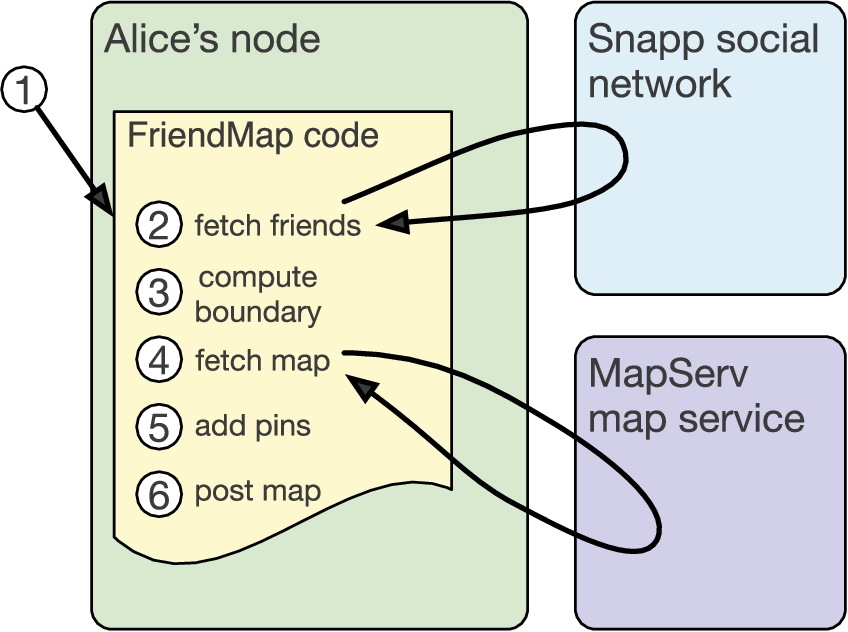
The FriendMap social mashup.
We introduce a running example to illustrate the security challenges faced by applications running in a distributed system with heterogeneous trust. It is an application that we might expect to be able to easily construct in today’s web, but cannot. This application, which we call FriendMap, is a mashup that allows a user to create a map displaying the location of their friends. The locations of the friends are obtained from a social network, and the map on which to display these locations is obtained from a mapping service. If Alice or her friends do not fully trust either the social network or the map service, they will have reason to be concerned that the application might violate their privacy.
Figure 1 shows the sequence of events as the FriendMap application is run. First, the FriendMap application code is downloaded and executed (1). The application FriendMap fetches the locations of Alice’s friends (2) from the social network application, which we call Snapp. These locations are used to compute the geographical area that will be displayed (3). Then a bounding box for this area is sent to a mapping service (MapServ), which constructs a map of the area (4). The blank map is returned to Alice’s client, and the application places her friends’ locations onto the map (5). Alice may then share the annotated map with her friends on the social network (6).
Security considerations
Even this simple example has complex security requirements because the principals may trust each other to differing degrees. For example, suppose Alice trusts MapServ to learn some information about her friends, but her friend Bob does not trust MapServ at all. In that case, FriendMap must avoid using Bob’s location to compute the map request.
Similarly, although Bob trusts Alice to see his location, he may not trust Alice’s friends with the same information. If so, FriendMap must either avoid posting the resulting map where Alice’s friends can see it or omit Bob’s location from the map.
In real applications, policies are more nuanced than lists of entities allowed to learn information. In the FriendMap example, Bob may consider his exact location confidential, but be willing to release some information about where he is, such as the city he is in. Alternatively, he may not mind letting the public know where he was yesterday, but may wish to keep his current location secret.
These more complex policies for allowed information flows can be modeled as a controlled downgrading of the information security policy: Bob is willing to declassify his location information if its precision is truncated, or if it is more than 24 hours old. In general, downgrading is implemented by application code, and it is critical that the code be authorized to do the downgrading. Any code that declassifies Bob’s location must be either provided by or endorsed by Bob.
Enforcing security becomes even more challenging if none of the involved principals trust the provider of the FriendMap code – if the code is downloaded from an untrusted site, much like JavaScript code is in many current web pages. In this case, a mechanism is needed to ensure that the downloaded code enforces all principals’ policies; any principal who controls this mechanism or the node on which it operates must be trusted to enforce these policies. In this example, Bob trusts Alice to enforce the confidentiality of his location. Alice’s node is therefore responsible for this enforcement, even if the FriendMap code tries to violate it.
Compositionality of information flow
Standard security mechanisms are not compositional, and therefore fail to meet the security requirements of modern applications, which, like FriendMap, often need to share information across security domains. Isolation mechanisms such as the same-origin policy (SOP) [130] and software fault isolation (SFI) [124] are secure but prevent sharing. For instance, the SOP would prohibit FriendMap from accessing the locations of Alice’s friends, since the locations are hosted by Snapp.
Since isolation makes intended functionality impossible, programmers must open channels for communication across isolation boundaries, which can reintroduce vulnerabilities. The next step is to try to control these channels using access control mechanisms such as capabilities. But these attempts seem doomed to fail, because access control is not compositional. Applied to FriendMap, once Alice’s client is able to see her friends’ locations, access control would not prevent the application from leaking the data to MapServ, her personal bulletin board, or even FriendMap’s developers. Access control mechanisms do not take into account what information is being communicated – any communication is allowed, as long as it is performed by an authorized principal.
In contrast, information flow control is inherently compositional, making for an appealing security mechanism. When system components that independently enforce information flow policies are combined, the combination also enforces those policies across the whole, as long as policies agree at the interfaces where information crosses between components. Additionally, information flow mechanisms can be proved to ensure strong, extensional security properties such as noninterference and robust declassification [105].
The benefits of compositionality have led to the use of information flow control mechanisms and policies for enforcing confidentiality and integrity in some previous decentralized systems [88,89,104,131–133,136]. However, these systems do not support secure sharing of mobile code, and they provide a lower-level programming interface.
Software construction and evolution
Modern applications are built from components developed by different organizations and upgraded on different schedules. In a decentralized environment, different principals may trust different software developers and providers, making the challenges even greater. Every user must have confidence that the integrity of the data that they care about is maintained, even if the software manipulating that data comes from an incompletely trusted source.
These requirements conflict with the ability for applications and open services to be upgraded over time. For instance, in the FriendMap example, a service provider like Snapp should be able to update its service to add and remove features and to fix bugs, without coordinating with the open-ended set of application developers using the platform. Similarly, FriendMap should be able to upgrade their software to make use of new features as they become available, without having to coordinate their upgrades with all of the APIs that they rely on.
Components that make up today’s software are typically gathered together at least twice: once by the developer for compilation and testing, and once on behalf of the end user for execution. Programs in more dynamic systems – like JavaScript libraries on the Web – may be refetched and reassembled every time a page is displayed. In fact, because such code may be cached, one cannot even be sure that all of the components of the application were fetched at the same time. While this approach allows software to be upgraded piecemeal over time, it can also break assumptions developers have made about the software, potentially creating vulnerabilities.
Fabric provides software interoperability and evolution while enforcing end-to-end information security policies on users’ data against any parties these users do not trust. Fabric does this by tracking the provenance of code in the system through integrity labels on the code. Code may also be assigned a confidentiality label by its developers. Such policies allow developers to protect the confidentiality of code and the results computed from it. For instance, the computed results might reveal information about the confidential code itself. Prior information flow systems ignore these kinds of information flows.
The Fabric language
The interface between the Fabric system and application developers is the Fabric programming language, a high-level language for building secure distributed programs with mobile code. The Fabric language extends Jif [86,90] with four major features:
Nested transactions ensure that computations observe and update objects consistently, and provide clean recovery from failures.
Remote method calls (remote procedure calls to methods) allow computations that are distributed.
Remote objects are accessed transparently, as if they are local objects.
Mobile code allows program components to be dynamically downloaded and executed.
While these features are fairly unusual, individually they are not unique to Fabric. Argus [71] has the first two, for example. The contribution of Fabric is in integrating these features with information flow security. This integration is difficult because new mechanisms are needed to ensure that the underlying implementation of the high-level programming model does not create security vulnerabilities. For example, transactions should not leak confidential information, and remote calls must be properly authorized.
This section presents the key programming abstractions of Fabric, but discussion of language support for information-flow security and for secure mobile code is deferred until Sections 4 and 5, respectively.
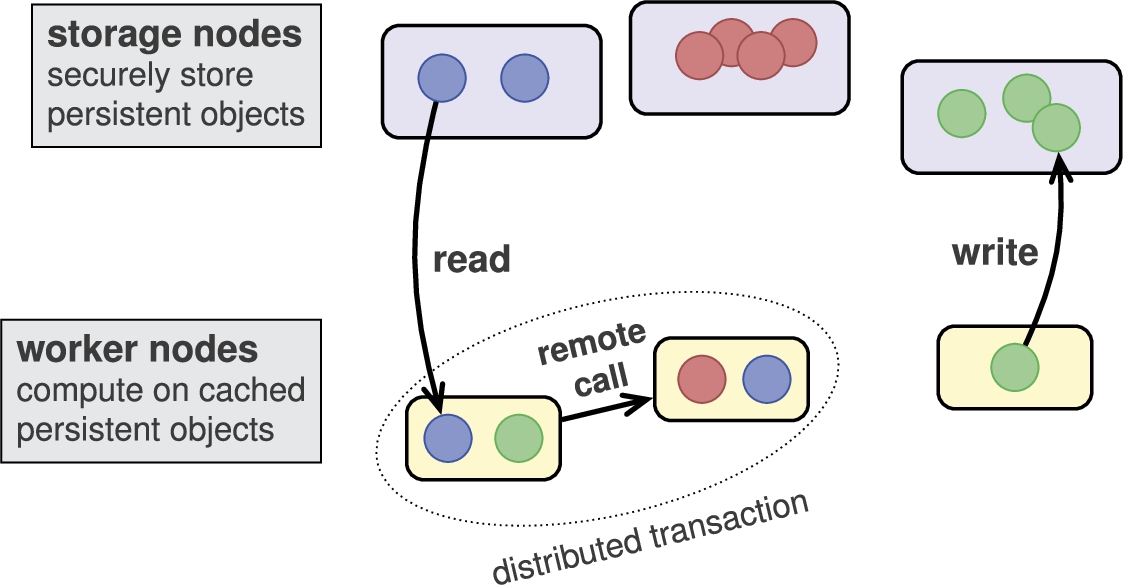
Fabric architecture.
Fabric presents to the programmer a two-tier system model, illustrated in Fig. 2. The system has two kinds of nodes. Storage nodes (or stores) are the data repositories in the system. They persistently store data objects and are responsible for the security of those objects. Computation in Fabric is performed by worker nodes (or workers), using both their own objects and possibly cached copies of objects from other nodes.
Object model. Fabric uses objects to represent all code and data in the system, including security principals, information flow labels, remote nodes, local and remote data, and mobile code. Like Java objects, Fabric objects maintain state in mutable fields and have a name that other objects can refer to. But unlike Java, object names in Fabric are not capabilities, because objects have explicit security policies governing their use. Object names can therefore be published outside Fabric – for example, as URLs.
Fabric objects are persistent and distributed: each object is stored on a named host, the storage node of the object. Fabric does not provide persistence by reachability [10] because it can lead to unintended persistence. Instead, invocations of class constructors are annotated to indicate the store on which the newly created object should be made persistent. The syntax
Computational model. Unlike most previous languages for distributed programming, Fabric aims to support multiple styles of distributed computation. A single Fabric computation can span multiple workers, access objects from multiple stores, and dynamically download and execute code. This model is more general than web applications, for example, in which computations cannot span multiple clients.
Subject to security constraints, any Fabric worker can use any object, regardless of where the object is stored. When a computation requires an object, a copy of the object is sent to the worker; when the computation completes, updates to the copy are pushed back to the store that holds the authoritative version of the object. Thus, the default mode of computation in Fabric is data shipping, in which data moves to the hosts where computation is happening.
However, Fabric programs can also explicitly transfer execution to a different worker by making a remote call. The syntax
Neither the local calling host nor the remote callee worker
The remote call implicitly starts its own nested transaction, in which the entire method call is executed. The effects of this transaction are not visible to other code running on the remote node until the commit of the top-level transaction containing the nested transaction.
Remote method calls are subject to authorization checks. The caller checks that the callee is trusted enough to enforce security for the method; the callee checks that the calling node is trusted enough to invoke the method and to see the results of the method. Further details on these checks are deferred to Section 4.7.
One important use of remote calls is to invoke an operation on a worker colocated with a store. Since a colocated worker has low-cost access to persistent data, this kind of remote call can improve performance substantially, and is analogous to database queries and stored-procedure calls in conventional database applications. However, remote calls in Fabric have the advantage that they can run arbitrary Fabric code, which can make further remote calls. Moreover, Fabric enforces information flow security throughout the distributed computation.
Together, function and data shipping can model a variety of architectures used for distributed software. In the FriendMap example, Alice’s worker initiates and coordinates the computation. Data shipping allows the worker to use objects stored on Snapp and MapServ. To improve performance, the application makes a remote call to the MapServ worker to generate maps. The data structure representing the resulting map is fetched by Alice’s worker as FriendMap processes it for display.
Transactions
A key challenge for distributed systems is how to provide efficient access to remotely located, mutable data. For low-latency access to data, it is desirable to cache or replicate data widely; however, making sure that the various caches or replicas stay in sync involves relatively expensive distributed protocols. For this reason, many recent distributed storage systems provide only weak consistency guarantees (e.g., [35,68]).
Despite the recent popularity of weak (e.g., eventual) consistency, we believe that strong consistency is important for building high-level abstractions about which programmers can reason correctly. Weak consistency makes weaker guarantees about what happens when data is read or written, which means programmers have to reason more carefully about whether their code works correctly in all possible program executions. Perhaps as a consequence, exploration of stronger consistency guarantees has been a popular theme of recent research on distributed storage systems (e.g., [31,41,77,114,126,127]).
Therefore, Fabric provides transactions with strong consistency guarantees; our expectation is that when Fabric programmers actually want weak consistency, such as when building a low-latency georeplicated system, they will implement weakly consistent replication on top of the strong consistency provided by Fabric. This strategy is likely simpler than trying to build strong consistency above weak consistency, and also offers a cleaner programming model. It may make sense to integrate some form of weaker consistency into Fabric, but we leave this to future work.
Transactions are indicated in the Fabric language by marking blocks of code
Linearizability allows programmers to program as if theirs is the only program in the world that is executing for the duration of a transaction. Reasoning about correctness is greatly simplified when programmers can rule out interference from concurrent computations accessing the same data. Linearizable transactions are also important for security: our information flow analysis relies on the fact that when a program dynamically performs label comparisons, the results of that comparison are meaningful. Linearizability ensures that the results of security-critical label comparisons and dynamic authorization checks are correct at the time they are performed by the transaction, and remain correct during the remainder of the transaction as long as the transaction does not itself change the outcome of these checks by modifying trust relationships among principals.
To cleanly handle application-defined failures, transactions may be aborted by exceptions. If a transaction body throws an exception, the transaction is considered to have failed, and is aborted by rolling back its side effects. Failure due to conflict with other transactions causes the atomic block to be retried automatically with exponential back-off.
Transactions can be nested, so atomic blocks may be used even during a transaction. Not only do nested transactions allow for finer-grained rollback, but they also make code compositional: programmers can enforce atomicity at any layer of abstraction within a system. In contrast, transactions that do not support nesting can only be used at the “top level” of the program. Object fields may be read outside of transactions, but updates must occur within transactions; a field update that occurs outside a transaction is automatically wrapped in its own top-level transaction.
Computing with remote calls results in a transaction that spans all workers involved, with each remote call in its own subtransaction. The Fabric runtime system ensures that when multiple workers use the same object within a transaction, updates to the object are propagated between them as necessary.
Individual transactions are single-threaded; new threads cannot be started inside a transaction. This choice was made largely to simplify the implementation, though it maps well onto the OLTP-style1
OLTP (Online Transaction Processing) applications handle online transaction requests from external clients.
However, Fabric workers are multithreaded and can concurrently serve remote-call requests from other workers. Applications can also start transactions that run concurrently. To increase the effective size of the worker’s cache, these concurrent transactions share access to the same underlying cached objects. Interference between concurrent transactions at the same worker is prevented using reader–writer locks.
The features of the Fabric language can significantly simplify code. As an example, consider the FriendMap application described in Section 2. Atomic transactions and transparent distribution allow its code to be written in a way that is very similar to what would be written for a nondistributed, nonpersistent version of the same application.
The core computation of the application needs to aggregate all the locations of the user’s friends into a bounding box. Ignoring security concerns for the moment, this computation can be written very simply, even though it accesses data (the friends’ locations) that is stored at a remote node. No explicit communication or data conversion is needed:

Once the boundary has been computed, a remote call is used to ship this data to the map service, which runs on a worker node referenced by the variable

Finally, we augment the map with the friends’ locations. This computation also transparently uses remotely stored information:

This code is much shorter and simpler than the equivalent code that would be needed for other distributed computing frameworks.
However, the code as written is not yet secure: additional checks must be added to the code to make sure that the friends accept having their location leaked to the map service, and that they are okay with having their location marked with a pin in the application output. In Section 4.9, we show how the security aspects of the Fabric language force the programmer to add dynamic checks that ensure the friends’ privacy is in fact not violated.
Java interoperability and FabIL
Fabric applications can be written using a mixture of Java, Fabric, and FabIL (the Fabric intermediate language). FabIL is an extension to Java that supports transactions, remote calls, and access control. A key difference between Fabric and FabIL is that FabIL does not enforce information flow security.
More concretely, FabIL supports the features described in this section: it provides
FabIL and Java code is considered trusted, and workers only execute trusted code that is stored on their local file system. This design is compatible with the decentralized security principle because the effects of trusted FabIL and Java code are confined to principals that already trust the nodes running the code.
FabIL can be convenient for code whose security properties are not accurately captured by static information-flow analysis, making the labels of the full Fabric language inconvenient. One example is code implementing cryptography, where the annotation burden of labels is not worth the cost; a second example is the code implementing internals of Fabric, such as its built-in label and principal objects.
Information flow security
Fabric allows information security policies to be expressed directly within programs. It uses information flow control to protect the confidentiality and integrity of information flowing through Fabric programs and across the Fabric system. Principals and labels describe the security requirements on data within the system, enabling reasoning about whether programs are secure. Many aspects of the model and language are inherited from Jif, but Fabric adds a new trust ordering on labels. Fabric’s language also has novel features to enforce the security of remote calls and to prevent side channels caused by its distributed implementation.
Background
Principal model. Like Jif, Fabric uses abstract principals to represent entities that can trust or be trusted, such as users, roles, groups, organizations, and privileges (and Fabric nodes). In the FriendMap example,
Principals express their trust relationships through the acts-for relation [89]. If a principal p acts for a principal q (written
There is a top principal ⊤ that acts for all principals,2
The top principal does not correspond to any physical entity. Indeed, there is never really a top principal, since the maximum authority at a given node is that node itself.
While the acts-for relation represents complete trust, programs can create auxiliary principals to represent finer-grained notions of trust. Delegations from these auxiliary principals encode which other principals are sufficiently trusted to carry out certain actions. For example, each user principal in the FriendMap application has an associated 
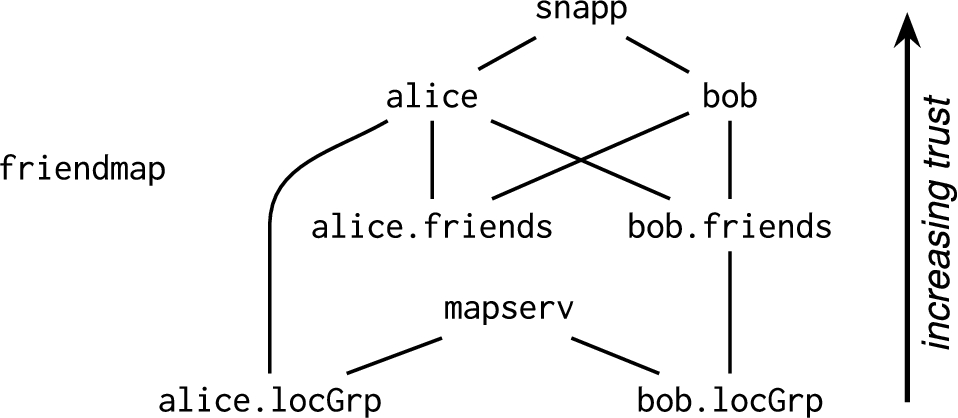
Trust relationships in the FriendMap example.
Label model. Fabric programs express security policies using labels, which are drawn from the decentralized label model (DLM) [89]. Each label is a set of policies that are expressed in terms of principals. Labels are decentralized: each policy is owned by a principal, and the policies in a label can have distinct owners. This keeps track of whose security is being enforced, which is useful for Fabric, where principals need to cooperate despite mutual distrust.
For example, Bob might protect information about his location with the confidentiality policy
The policy
The policy
A label is written as a set of confidentiality and integrity policies, such as
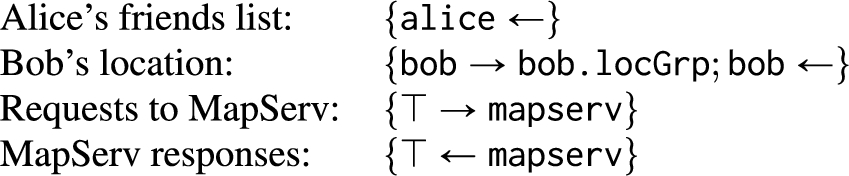
Labels in the FriendMap example.
Fine-grained principals like a user’s friend group enable dynamic control over the meanings of policies by changing the principal hierarchy. For example, in Fig. 3, Bob has allowed all of his friends to read his location by making the
Flows-to relation. Labels are part of types in the Fabric language. The label in a program variable’s type bounds the information that has affected the value of the variable. As part of type checking at compile time, label checking ensures that the information flows in the program are safe according to an information flow ordering on labels. When flow from label
Confidentiality policies allow public data to affect secret data. For example, we have
The following code illustrates these rules. The assignment from
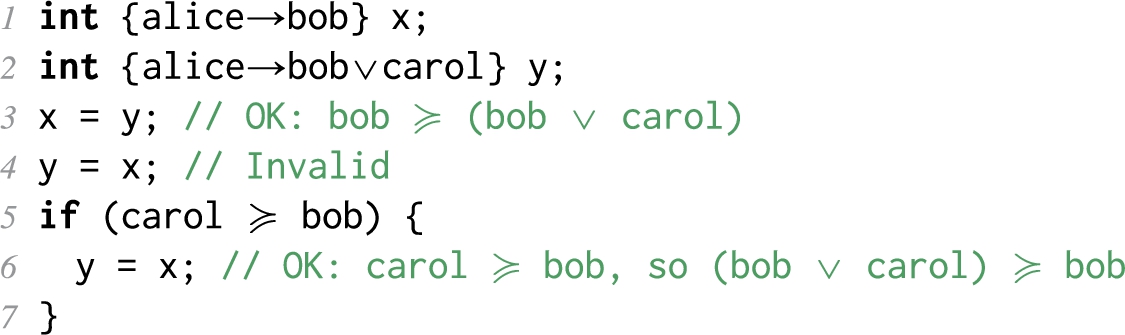
The flows-to relation is a preorder on labels. We can construct an information flow lattice by defining an equivalence relation
The label
Implicit flows. Information can be conveyed by program control flow. If not controlled, these implicit flows can allow adversaries to learn about confidential information from control flow, or to influence high-integrity information by affecting control flow.
Fabric controls implicit flows through the program-counter label, written pc, which captures the confidentiality and integrity of control flow. The program-counter label works by constraining side effects; to assign to a variable x with label
Implicit flows cross method-call boundaries, both local and remote. To track these flows, object methods are annotated with a _begin label_ that constrains the program-counter label of the caller, as well as the effects of the method. The pc of the caller must flow to the begin label, which in turn must flow to the label of any variables assigned by the method. This ensures that the caller’s pc can flow to the method’s assignments. Implicit flows via exceptions and other control-flow mechanisms are also tracked [86].
Authority and downgrades. In general, the flows-to relation ⊑ only approximates the true information security requirements of an application; sometimes it prevents flows that applications need. Like other systems with information flow control, Fabric allows these flows using downgrading operations. Declassification is a downgrading operation that reduces confidentiality; endorsement is one that boosts integrity.
Downgrading can be dangerous to security, so the syntax of Fabric makes all declassification and endorsement explicit. Additionally, all policy-downgrading code must possess the authority of a principal that authorizes the downgrade. This principal must act for the owner of any policy that is weakened. Further, declassification and endorsement may only happen in code whose control flow is unaffected by low-integrity information. This restriction enforces robust downgrading [8], which prevents the adversary from causing these operations to be misused.
Code can obtain the authority of a principal p in two ways. First, a class can declare it has the authority of p by using a clause
Principals have both identity and state (such as their delegation information), so at the language level, Fabric represents principals as objects that may be persisted on stores. If the FriendMap program refers to
Fabric nodes are also principals. At the language level, a Fabric node is a first-class object that can represent the node as a principal in labels and security checks. For example, a storage node might be represented as a variable
Principals control their acts-for relationships by implementing a method
In general, worker nodes may have different partial views of the acts-for relation. The monotonicity of the label system ensures that security decisions based on these partial views are sound: adding more acts-for relationships to a worker’s partial view would only make the worker’s security decisions more permissive [89].
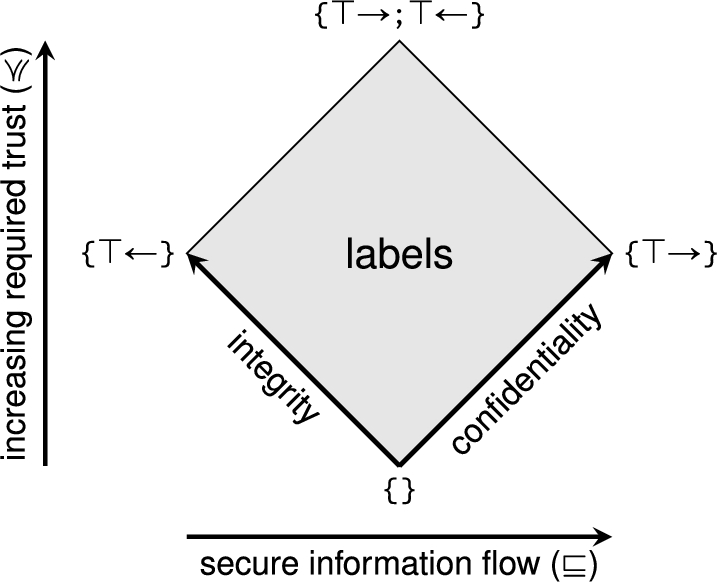
Orderings on the space of labels.
Fabric extends the DLM by defining a second ordering on labels, the trust ordering, which is also derived from the acts-for relation. This ordering is useful for reasoning about the enforcement of policies by a partially trusted platform. A label
Figure 5 depicts how the two label orderings relate. In the diagram, information flows rightward and required trust increases upward. The least label
Enforcing labels
Every Fabric object has an associated update label that summarizes the trust needed to enforce the object’s security. Because the security requirements of every field must be enforced, the update label is the trust join of the labels of the object’s fields. The update label acts as an access control policy, determining which nodes can securely read, write, and persistently store the object. An object may be securely stored on a storage node only if the node is trusted to enforce the update label. A worker wishing to read and directly compute on an object only needs to be trusted to enforce the confidentiality half of the update label; to update an object, a worker must be trusted to enforce the integrity half.
Recalling that nodes are principals, we say a principal p enforces a label ℓ, written
This is notationally consistent with the acts-for relation and the trust ordering, because transitivity still holds when the three relations are combined: if
In the FriendMap example, if Snapp were untrustworthy, it could release the locations of the users to third parties. This is a risk that the users are willing to take. In Fig. 3, Bob designates this by declaring 
Taking the trust join of the fields’ labels is a conservative choice for the object’s update label. As part of our recent work on abort channels [110], the compiler in the latest Fabric release [4] recovers per-field precision by performing object splitting – a level of indirection is added to the object graph, so that the fields of each object in the system have the same label.
The decentralized security principle says that security of a principal does not depend on any part of the system that it considers to be an adversary. However, who the adversary is depends on whom you ask. From a principal p’s perspective, the adversary is some untrusted principal 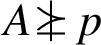 . In the FriendMap principal hierarchy in Fig. 3, Alice and Bob both treat the FriendMap application provider as an adversary since they don’t trust it. Similarly, Snapp and MapServ do not delegate to anyone, so they consider everyone to be adversaries. For simplicity, we assume that Alice and Bob delegate to Snapp, so Snapp is not an adversary for them.
The system should be secure from the perspective of every participating principal, so any principal may be considered an adversary. Fabric’s security mechanisms are designed to enforce security regardless of the choice of adversary. Therefore, we analyze security with respect to arbitrary adversary principal A.
Our goal is to allow secure interaction despite distrust, so adversaries are able to read and update certain objects stored at trustworthy nodes. A node n allows a node A to read an object with a low confidentiality label ℓ; that is, if
In a decentralized system like Fabric, there is no global _trusted computing base_ (TCB). In fact, the decentralized security principle generalizes TCBs, because each label ℓ has its own trusted computing base, consisting of the enforcement mechanisms on nodes n where
Access labels
When following a reference to a Fabric object, the worker may need to fetch the object from its store. This means that the store may learn that the worker is accessing the object, which may reveal information about the pc at the point of dereference. We refer to this kind of covert channel as a read channel [131].7
While read channel is the name used in the literature, it refers to information that can be leaked by any observable access to objects, including both reads and writes.
The update label does not prevent read channels since it only protects the information in the object itself. To prevent read channels, we need to protect information in the context that is accessing an object. In other words, we need to ensure that the store of the object is permitted to see the pc. This means that the compiler needs some static representation of what store will be contacted when a remote reference is followed.
This representation appears in the language as a second, confidentiality-only label on each object field, called the _access label_. It ensures that the field is stored on a node that is trusted to learn about all the accesses to it, and it prevents the field from being accessed in a context that is too confidential. The access label has no integrity component – Fabric does not consider an integrity dual to read channels, though enforcement of referential integrity in a distributed system may lead to such a dual [76].
A field’s access label is written as part of the field’s type declaration. A label annotation
Both the flow and the trust joins coincide here, since access labels do not have integrity components.
Access labels require two static checks in Fabric code. First, to prevent accesses from leaking information, all reads and writes of fields must occur in a context whose label flows to the access label. Specifically, the program-counter label pc must flow to the access label (
Second, an object may only be allocated on a store trusted to enforce the object’s access label. To allocate at a node n an object with access label
The compiler additionally requires that
For example, the following class contains public information in a field
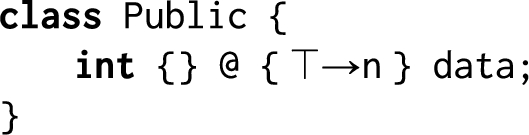
Even though the information is public and untrusted (update label
A remote call in Fabric.
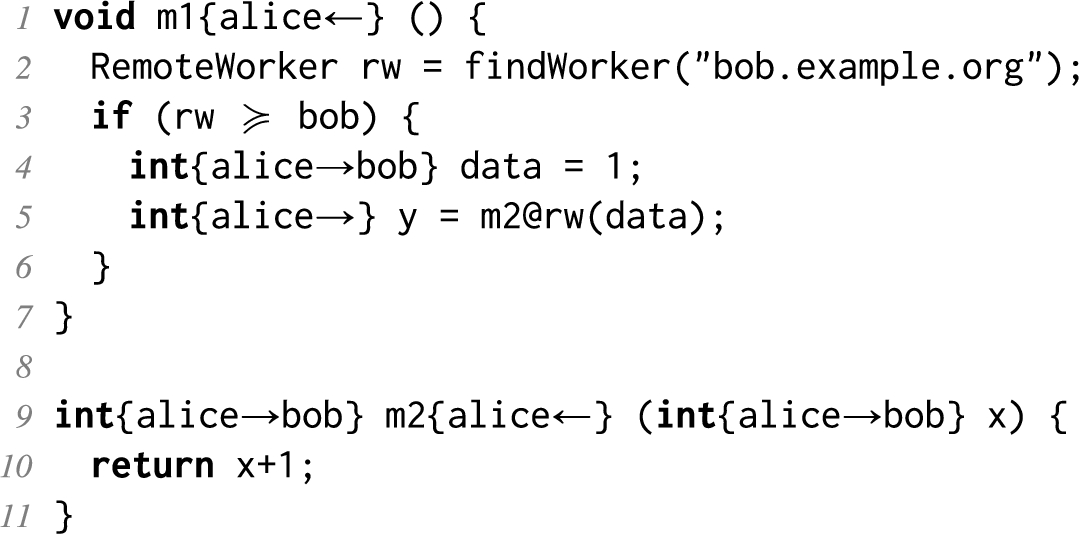
Fabric programs use remote calls to explicitly transfer execution between workers. Figure 6 shows an example in which a method
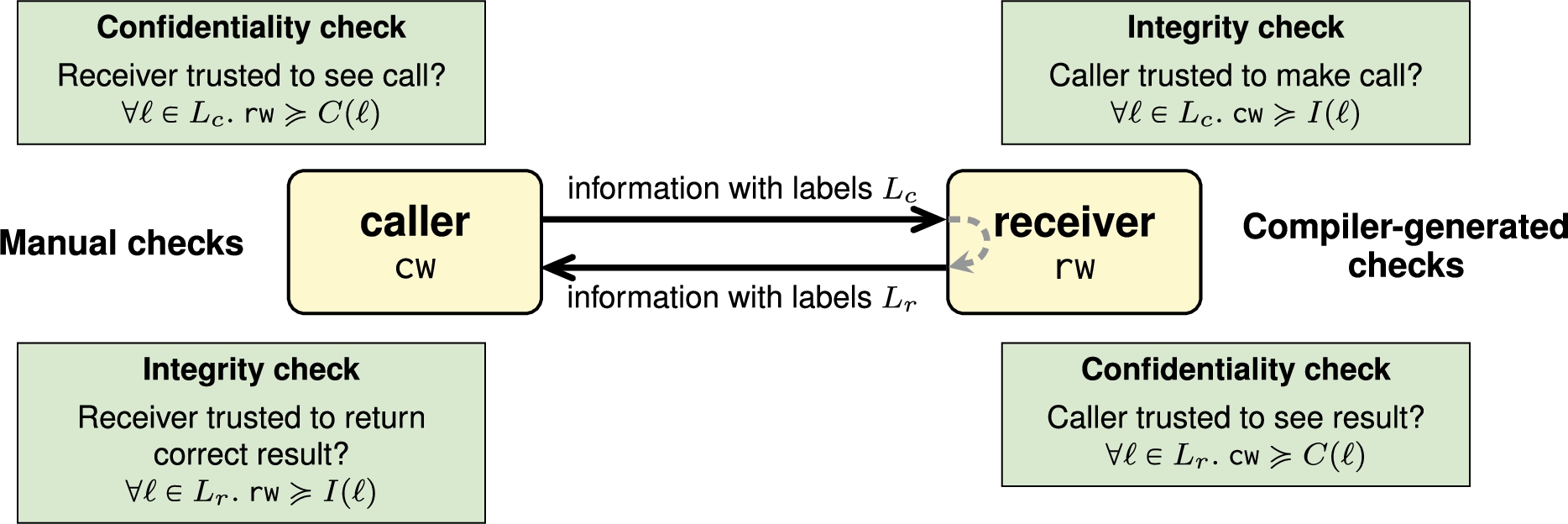
The left side of Fig. 7 shows that the compiler permits a remote call only if it can determine that the call is secure from the perspective of the caller. This requires that the receiving worker
For example, in Fig. 6, the method parameter
Manual and compiler-generated checks for remote calls.
The right side of Fig. 7 shows the two kinds of receiver-side checks that
Fabric supports the revocation of acts-for relationships. Revocation creates a trade-off between security and performance (or availability), often encountered in the design of public-key infrastructures [115]. To make sound authorization decisions, revocations should rapidly propagate to all who might rely on the revoked authority. However, rapid propagation comes at a performance cost, and the propagation mechanism itself can be vulnerable to denial-of-service attack.
Fabric does not guarantee immediate notification of revoked acts-for relationships, so revocations generally do not take immediate effect. Suppose a principal p keeps the state of its delegations in an object d. A worker that has cached d will not see a revocation of “q acts for p” until it receives an updated copy of d. The worker might not receive this update until a transaction attempts to commit, after having made authorization decisions based on the revoked acts-for relationship. For instance, the worker might allow a remote call to another worker that is no longer trusted, creating flows of information that would not otherwise be permitted with an up-to-date copy of d. This has implications for confidentiality: the remote worker might no longer be permitted to learn the information embodied in the remote call. Integrity is maintained, however, because the transaction will be rolled back and retried with the new version of d, just like any other transaction that observes stale data. Confidentiality guarantees could be improved, at the cost of increased latency, by immediately checking the freshness of the objects used by the transaction before each remote call, but this is not currently done in Fabric.

An important part of the FriendMap code. Some details have been changed for clarity (e.g., Fabric does not currently support Java’s enhanced
We now revisit the key code from the FriendMap example of Sections 2 and 3.3, to illustrate how Fabric’s security features help the programmer write secure code. Recall that the application runs on Alice’s worker, and integrates code from FriendMap, MapServ, and Snapp with data from Snapp and MapServ. Figure 8 shows the entirety of the
The method takes the dynamic labels 
The
In addition to these dynamic checks, this code requires further relationships between various labels in order to be considered secure. These relationships are demanded by the
For example, the first clause (on lines 3–4) is concerned with information from three sources: the code itself (labeled
Provider labels are described in more detail in Section 5.1.
Fabric requires the FriendMap developers to insert these checks. Without them, the application would fail to compile, and thus users would not be able to execute the code. Indeed, omitting any of the
The challenge of supporting mobile code in Fabric is maintaining both strong and decentralized security guarantees while giving adversaries the power to upload and execute mobile code. Local code written in Fabric, FabIL, or Java is presumably trusted, but Fabric workers only execute mobile code if it is written in Fabric.11
It would also be consistent with the decentralized security principle for workers to download and run code written in other languages if it is signed by a node that the worker trusts.
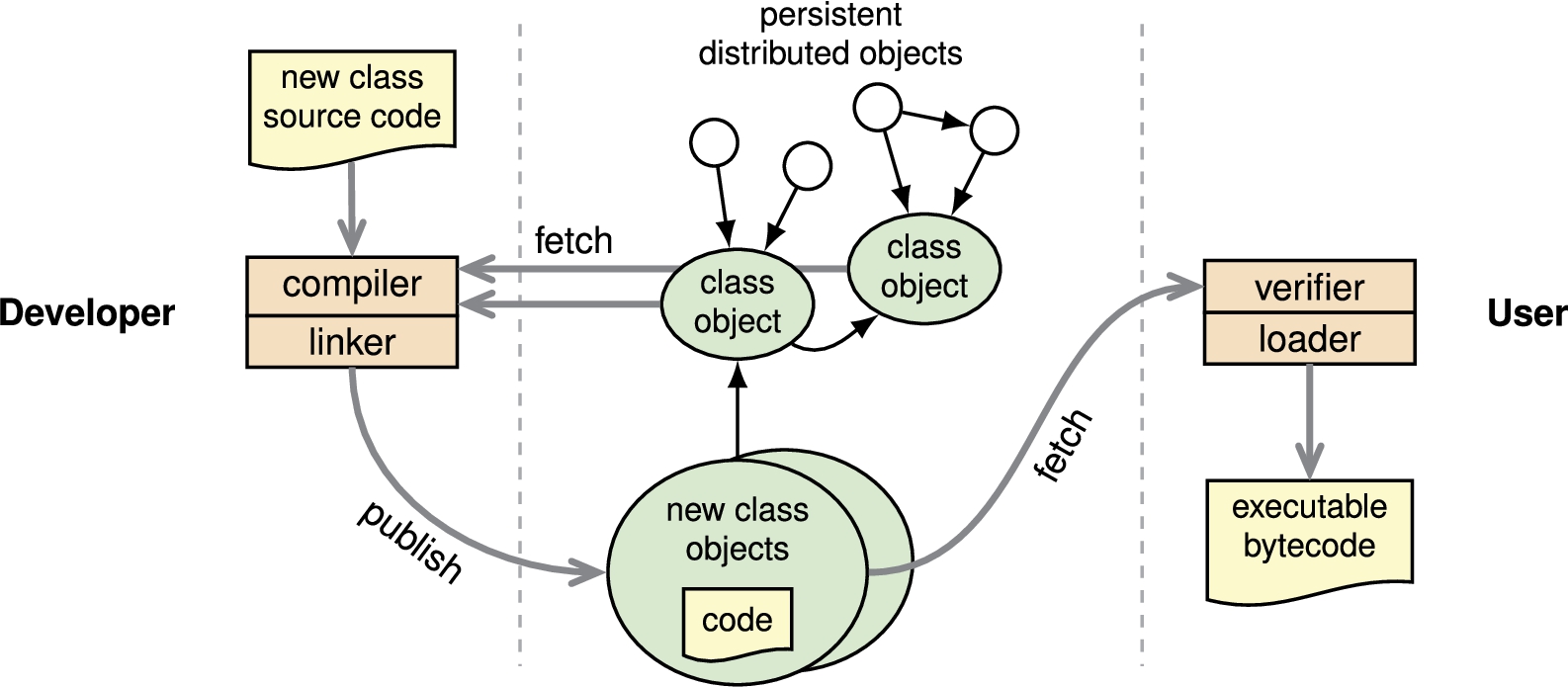
Like any other persistent information in Fabric, mobile code is stored in persistent objects: class objects, shown in the middle of Fig. 9. Fabric class objects should not be confused with Java class objects. A class object defines the structure and behavior of a mobile Fabric class, including the relevant security policies, and also contains references to the class’s dependencies. The Fabric compiler and linker verifies and publishes new class objects by using a Fabric worker to create new objects on a designated store. This process is depicted in the “Developer” portion (the left side) of Fig. 9.
Compiling, linking and loading mobile code.
Each Fabric object contains a reference to its class object. When a worker encounters an instance of a mobile class, it uses this reference to fetch the corresponding class object, as shown in the “User” portion (the right side) of Fig. 9. Once it has the class object, the worker verifies the information flows within the class’s code. Finally, it converts the class into executable bytecode, enabling the invocation of class methods.
All modern languages suffer from the problem of version conflict between program components. This occurs when two components used by a program require different versions of a third component. A common approach to avoiding such errors is to deploy each component in a package that specifies the required versions of the component’s dependencies. These specifications make it possible to determine the compatibility of two components before they are loaded.
While this approach is an adequate solution for some systems, it does not address the case where a system needs to interact with multiple versions of a component. This case is particularly important for decentralized, persistent object stores like Fabric’s since the lifetime of objects may span multiple releases of their dependencies, and remote hosts may be running different software versions.
Fabric’s approach builds on existing approaches to component distribution by publishing linking specifications called codebases with all mobile code. Instead of requiring programmers to develop these by hand, the Fabric compiler generates them automatically during the publishing process. Furthermore, developers are able to interact with multiple versions or implementations of components using explicit codebases while keeping their namespaces isolated. These features allow developers to use user-friendly class names without worrying about namespace collisions or specific version requirements.
Importantly, name resolution and namespace isolation in Fabric are orthogonal to security enforcement, unlike in systems such as Java, JavaScript, and SPIN [51]. Many security mechanisms based on namespace isolation have proved fragile, requiring ad hoc mechanisms to prevent security vulnerabilities [82]. In Fabric, access to resources is restricted by information flow control rather than by limiting the ability to name those resources. Linking against high-integrity, high-authority code requires no special privilege; instead, label checking ensures the end-to-end security of linked code.
Insecure and secure versions of a mobile change-password method. Confidentiality components of labels are elided.
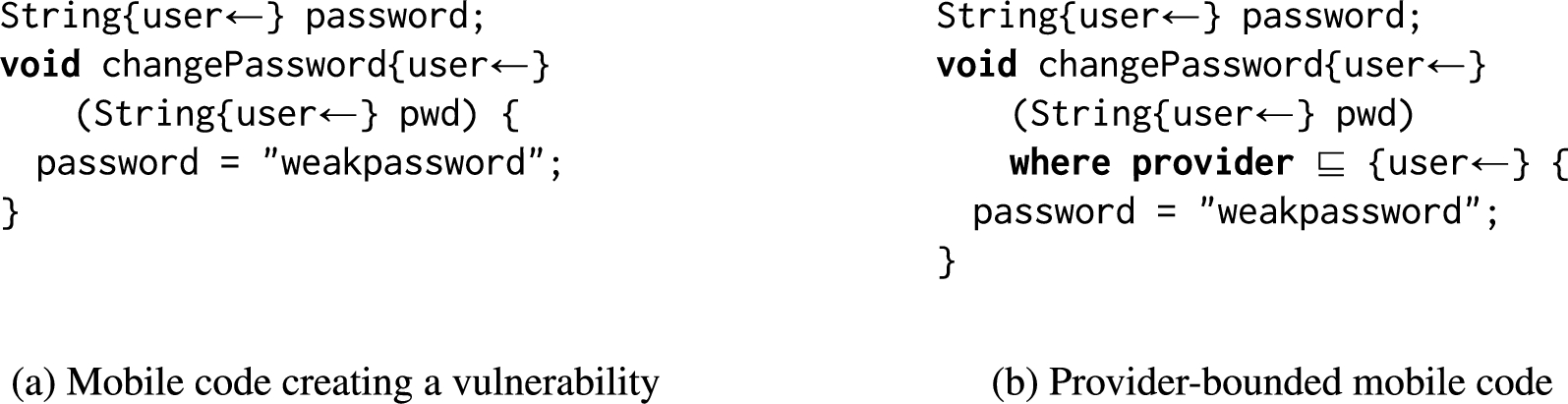
For local code, label checking of the sort performed in previous languages such as Jif is enough to ensure that all flows in code obey the information flow ordering. However, Jif-style label checking is not enough to stop adversary-provided code from introducing vulnerabilities. For example, Fig. 10(a) demonstrates how integrity could be harmed if label checking worked the way it does in Jif and prior information-flow mechanisms. The method
Fabric eliminates such vulnerabilities by treating the code itself as information that taints the results it produces. Like other objects stored in Fabric, each class object is given an update label. We refer to this label as the class’s provider label. Class source may explicitly refer to the provider label of any class, including its own, using the name classname.
If classname is omitted, it defaults to the enclosing class.
When label-checking code, we taint the pc label with the provider label. This makes sense because the code provider affects the statements that are executed. If the code of Fig. 10(a) is provided by an adversary, its low-integrity provider label will effectively make the pc label low-integrity, preventing any assignments to high-integrity variables such as the password. We refer to this analysis as provider-bounded label checking. This approach also preserves important features of the Fabric programming model like polymorphic labels in method signatures. A more direct approach to provider checking, such as ensuring the integrity of begin labels are bounded by the provider label at load time, would require method signatures to be concrete.
Figure 10(b) demonstrates the use of the provider label in a
As an additional benefit, the provider label makes a new feature possible using the same mechanism: confidential code. By creating code with a high-confidentiality provider label, code publishers can safely put code into Fabric that contains sensitive information such as proprietary algorithms.
A confidentiality label on a class object prevents untrusted nodes from viewing that code directly. Provider-bounded label checking enforces a stronger notion of security, however: it prevents any data affected by the code from flowing to untrusted nodes. Furthermore, it ensures (via access-label checks) that objects accessed by confidential code must be at least as high as the confidentiality of the code. These checks strictly protect the confidentiality of code by default, but providers of the code may explicitly declassify results or accesses when desired.
The provider label also enforces robust downgrading since it prevents the adversary from exploiting downgrading to affect confidentiality and integrity. A provider label with low integrity prevents the adversary from using declassification and endorsement in provided code directly; it also prevents the adversary from indirectly influencing declassification and endorsement occurring in other code not provided by the adversary.
Another curb on the misuse of downgrading operations is the requirement that code possess the authority to perform these operations. Code cannot weaken a confidentiality or integrity policy through declassification or endorsement, unless the principal whose policy is being weakened grants the code that authority.
Authority placed in mobile code cannot exceed the authority of the code developer. This is expressed using a check on integrity: for code that claims the authority of the principal p, Fabric ensures the condition I(
Fetching a mobile Fabric class on demand introduces a new kind of read channel. Therefore, the class object of a persistent object must be stored on a node that is trusted to enforce the object’s access label. To satisfy this requirement without unnecessary restrictiveness, we can ensure that when an object is created on a node, its class object is stored at a suitably trusted node. Since the node storing the object itself must be such a node, the class object can be replicated onto the same node as the object if necessary. Since class objects are immutable and distinguished by their fingerprints (Section 6.5), their replication is harmless in Fabric.
Mobile classes are identified by their class object. However, instead of requiring programmers to insert Fabric references (i.e., URLs) to class objects directly into their source code, we allow programmers to name classes using the familiar Java naming scheme of qualified identifiers. To map class names to mobile classes, the compiler is provided with a codebase object, which serves a role similar to that of a Java classpath. A codebase maps from qualified class names to global, persistent references to published class objects.
Each mobile class is published with a reference to its associated home codebase, which the compiler uses to resolve the direct dependencies for that class. This mechanism enables independent nodes to resolve external dependencies in a uniform way without resorting to a global namespace. In contrast, Java offers no guarantee that the class linked by the JVM at run time is the same class the code was compiled against.
Because Fabric types include security policies, it is important that hosts agree on the type signature of a remote call or persistent object. Resolving names dynamically could result in errors that are difficult to diagnose. For example, a client could experience a run-time error because objects created by remote hosts resolved names differently. Furthermore, resolving names statically removes the possibility that name resolution could be used as a covert channel. Thus, mapping class names to type signatures statically is important for the security and programmability of Fabric programs.
This approach also ensures a kind of backward compatibility: new code cannot break existing instances of persistent objects. Class objects and codebases are immutable, so codebases bind class names to specific, fixed versions of the linked libraries. Similarly, once an object is created, its class is fixed to a specific class object. Hence, the object remains associated with the class version it was created with. New code must be backward-compatible when processing legacy objects. To “update” a legacy object to a new class version, a new object must be made. Only source-level names are resolved at compile time, so binding names to types through their codebases does not affect late binding. In fact, method dispatch can cause the fetching, compilation, and loading of code that didn’t exist at compile time, similar to dynamic class loading and linking in Java.
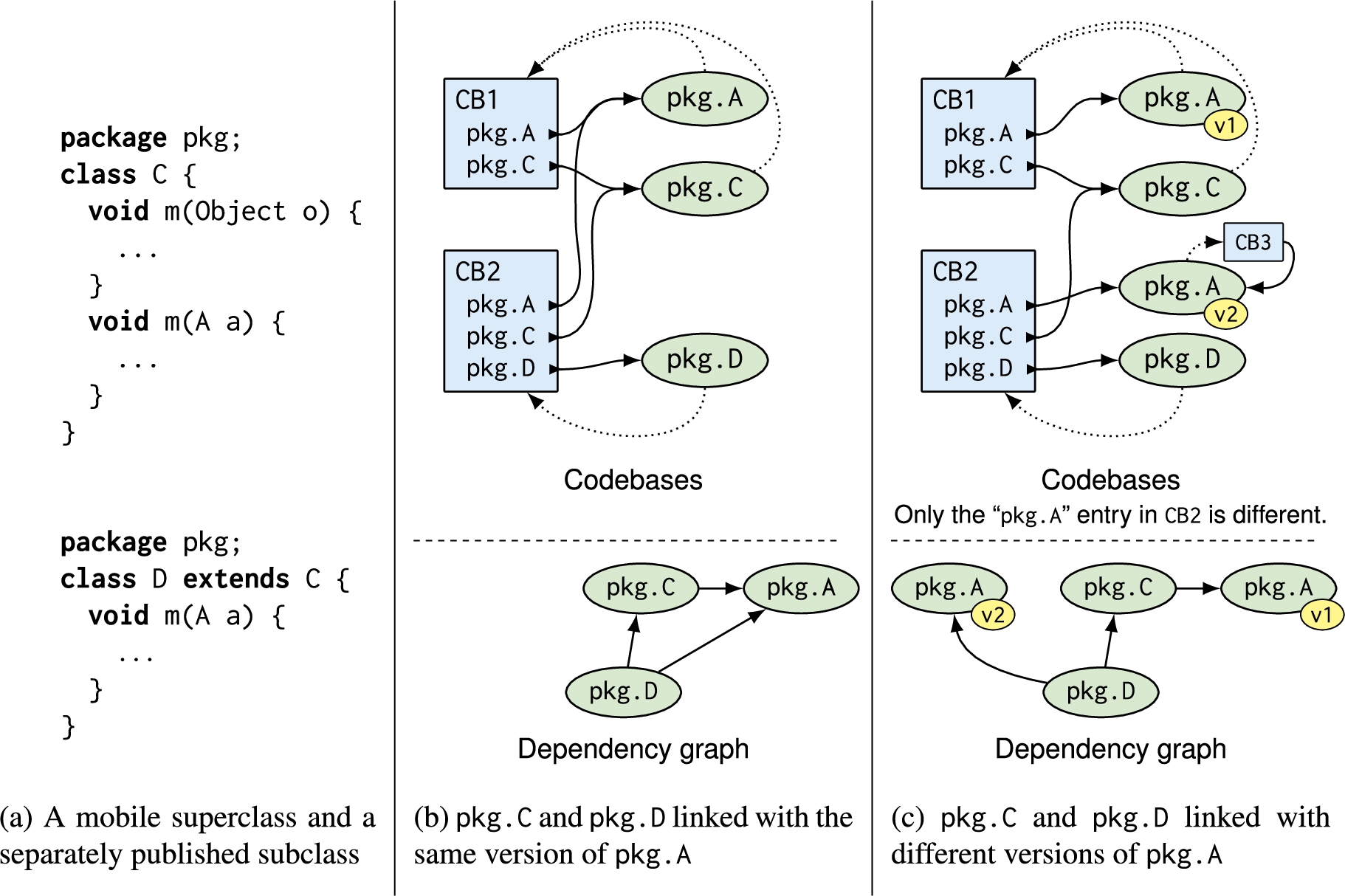
Two classes linked under different scenarios.
Figure 11(a) shows an example of two separately published classes,
Before running the code stored in the mobile class
Classes share the same home codebase when they are published together. In Fig. 11(b),
Rather than forcing developers to create codebases by hand, the Fabric compiler generates a codebase automatically from the classpath and sourcepath specified during publication. This feature makes the potentially complex process of linking and publishing reusable mobile components similar to compiling programs with a traditional Java compiler and linking with local libraries. Usually, classpath entries refer to the codebases of dependencies already published in Fabric, while sourcepath entries refer to local directories containing source that will be published with the new codebase.
To protect the linkage of classes resolved by a codebase, codebases have integrity labels that are at least as high as the provider labels of the classes they are published with. The compiler checks that this invariant holds at link time to prevent an adversary from exploiting codebases that violate the invariant.
Programs are often built from components that share common dependencies. Usually, these dependencies must resolve identically for all components. For instance, a dependency might define an interface through which the components interact. But in some cases, a component’s use of a dependency is isolated from other components. For example, two components might require different versions of a regular expression library for manipulating strings internally. In principle, it should be safe to load both versions, since their usage is isolated. Unfortunately, identifying whether two conflicting dependencies are truly isolated from each other is difficult.
Consider the code fragments shown in Fig. 11(a). Imagine
Allowing programs with inconsistent namespaces could result in subtle and surprising behavior. For example, Fabric, like Java, dispatches calls to overloaded methods based on the static types of their arguments. Consider the code below:
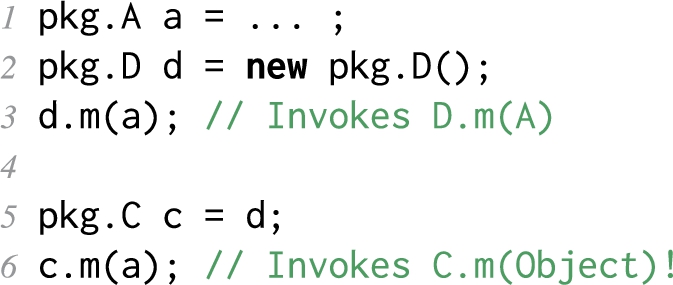
Let us assume that the code is compiled using
Another reason for namespace consistency is to support _external principals_ [28], a feature inherited from Jif that supports principals implemented with the singleton design pattern [45]. Programs mention external principals by class name, so namespace consistency ensures that when two compilation units mention the same name, they are talking about the same principal. Otherwise, information might be implicitly relabeled when it passes between compilation units.
Since errors related to inconsistent namespaces are difficult to detect and debug, we require that the static dependencies of mobile code must have a namespace that is consistent. In the dependency graph of Fig. 11(c), two implementations are reachable for
The consistency constraint applies to the static dependencies of a class and does not constrain the dynamic type of objects beyond normal type safety. At run time, a reference may point to an object whose class type is neither in the codebase of the reference’s type, nor consistent with the program’s namespace. There is no possibility for confusion, because our constraint ensures that dependent code only interacts with the object via an unambiguously resolved supertype.
To avoid publishing code with inconsistent namespaces, the Fabric compiler checks code at publication time for namespace consistency. At run time, the code is checked again for namespace consistency during verification, before being loaded and executed.
Explicit codebases
To support code evolution and reuse, Fabric has explicit codebases, which allow components to refer to multiple implementations of a dependency. An explicit codebase is an alias for a previously published codebase object. A programmer may use this alias to qualify dependencies that should be resolved through the specified codebase rather than through the home codebase of the dependent class. Explicit codebases may appear at the root of any fully qualified type name. When a name is qualified with an explicit codebase, the namespace of the specified dependency is isolated from that of the dependent class. Explicit codebases are resolved when code is published, and are exempt from namespace-consistency checks since the programmer’s intention is unambiguous.
For instance, in Fig. 11(a), to overload
We expect explicit codebases to have two main uses. The most common use is to support evolving published code. Using explicit codebases, classes may provide methods or implement interfaces that preserve compatibility with code and persistent objects from older class versions. A second use for explicit codebases is for composing software components with conflicting dependencies. If software components have conflicting dependencies that do not otherwise affect program functionality, it may be desirable to isolate the namespace of each component using an explicit codebase.
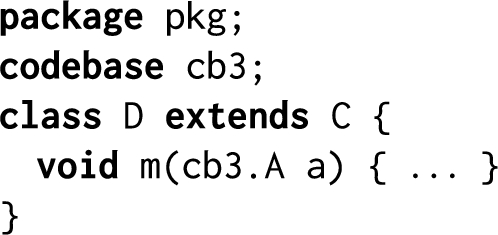
Using an explicit codebase.
Instead of using dynamic linking to evolve software, Fabric relies on the inheritance and subtyping features of its object-oriented language. In Fabric, new versions of classes are stored in separate class objects, so that they can coexist and interact in the same system. If the new versions of classes are backward-compatible, then they should be subtypes of the old versions; this allows existing software that links against the old version to interact with objects using the new version. If the new version is incompatible with the old version, then it should not be a subtype: this forces software that relies on the old functionality to be updated as well. In short, there are no different versions of “the same” class: if two versions of a class are different, then Fabric considers them to be different classes.
To explain the process of software evolution, consider a possible upgrade path for the FriendMap application. Suppose that Snapp decides to extend their service by adding a
At a later time, the developers of FriendMap may wish to release a new version that uses the
One possibility would be to change the FriendMap interface so that it only accepts objects of the new
The key point is that the language forces the FriendMap developers to consider the ramifications of updating their application. They may indicate whether new versions are backward-compatible by subclassing the old versions, or not.
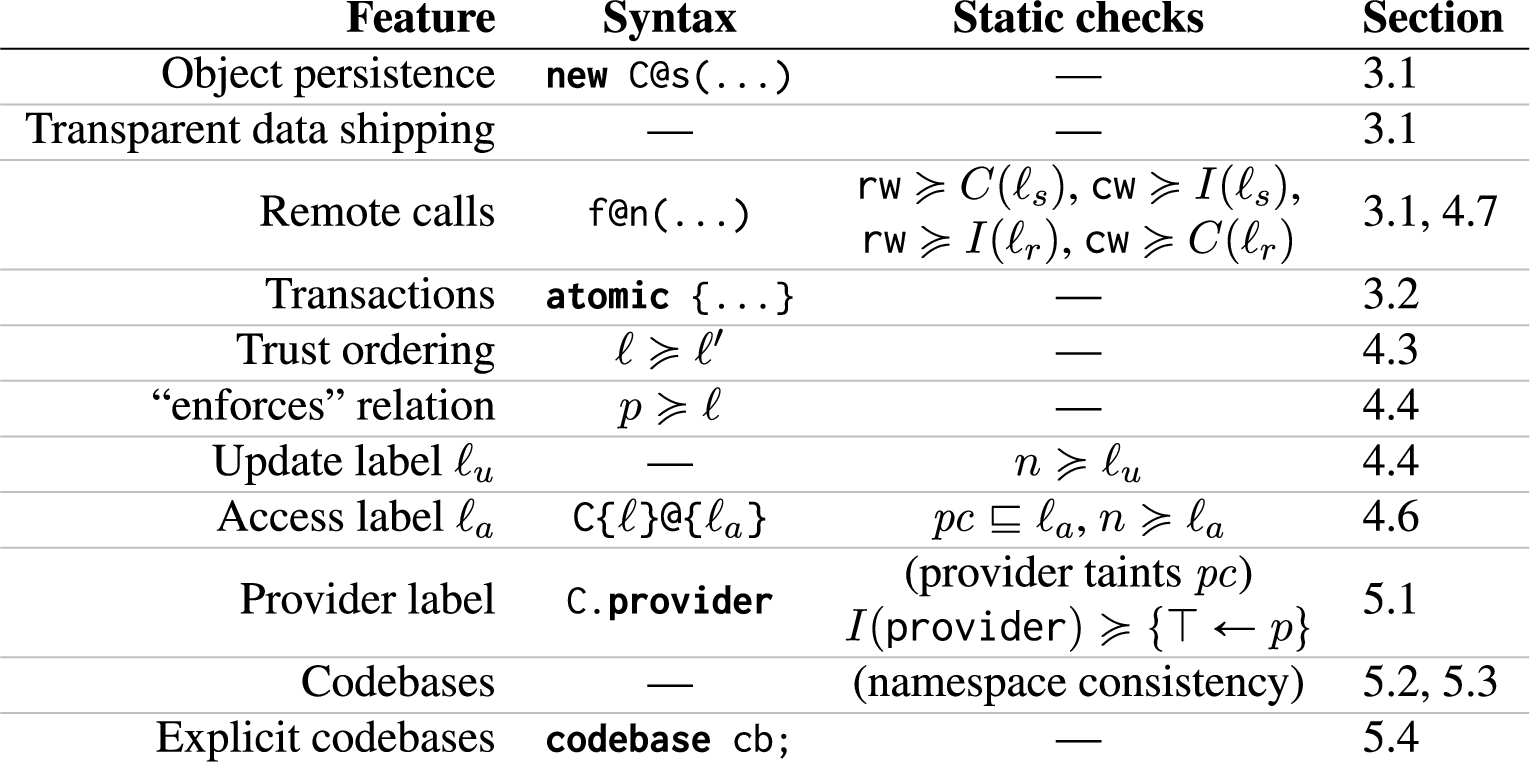
Summary of features that Fabric adds to Jif.
To aid the reader in keeping track of the many language features discussed here, the table in Fig. 13 summarizes the language features, syntax, and static checks that Fabric introduces on top of Jif, along with pointers to the section of the paper discussing each such feature.
System design
So far, we have concentrated on the Fabric programming language abstraction rather than on the system that implements it. Though some aspects of the current implementation have surfaced in this discussion, one could imagine implementing the programming abstraction in more than one way. However, any implementation of the Fabric programming abstraction must enforce the security policies expressed as labels. Enforcing these policies in a distributed system is a significant challenge, since the behavior of implementation-level mechanisms may leak information (thereby violating confidentiality), or may offer adversaries opportunities to subvert code or data (thereby violating integrity).
Fabric programs execute on the Fabric runtime system, shown in Fig. 2. The Fabric runtime is an open distributed system that anyone can join by starting a new node. Each Fabric node is either a store or a worker, though a single host machine can have multiple Fabric nodes on it, often colocated in the same Java virtual machine. For example, a store typically has a colocated worker, allowing the store to invoke code at the worker with low overhead,13
Stores typically invoke Fabric code on a worker when performing dynamic authorization checks, such as when a store needs to determine whether an object’s update label allows a remote worker to modify the object.
Fabric objects are named by object identifiers (oids). An oid has two parts: the name of the object’s store, and a 64-bit object number (onum) that is unique within the store. Object identifiers are global and persistent; they can be exported from Fabric by writing them as Fabric URLs of the form
Each object identifier is permanent in the sense that it continues to refer to the same object for the lifetime of that object, and the identifier can always be used to find the object. If an object moves to a different store, it acquires an additional oid. The original identifier still works as long as the original store keeps a forwarding pointer in a surrogate object.14
Long forwarding chains of surrogate objects can reduce performance and reliability, but path compression can prevent such chains from building up [33,44,62].
Knowing the oid of an object gives the power to name the object, but not the power to access it: _oids are not capabilities_ [37]. If object names were capabilities, then knowing the name of an object would confer the power to access any object reachable from it. To prevent covert channels that might arise because adversaries can see object identifiers, object numbers are generated by a cryptographically strong pseudorandom number generator. Therefore, we assume an adversary cannot feasibly probe for the existence of a particular object, and that an oid itself conveys no information other than the name of the node that persistently stores the object.
Fabric objects can be mutable. Each object has a _current version number_, which is incremented when a transaction that updates the object is committed. The version number distinguishes current and old versions of objects. If a worker node tries to compute with out-of-date object versions, the transaction will fail on commit and will be retried with the current versions. The version number is an information channel with the same confidentiality and integrity as the fields of the object; therefore, it is protected by the same mechanisms.
Fabric programs identify Fabric nodes using DNS hostnames. In the runtime, each node has two additional forms of identity: a public key and a principal object. The public key is used by TLS to establish encrypted communications and to sign certificates. The principal object places the node in the principal hierarchy and is used in dynamic enforcement checks, described in Sections 4.4 and 4.7. Fabric uses X.509 certificates [55] to bind these three identities together. Certificate authorities (CAs) are therefore the roots of trust, as they are in the Web. Whether the certificates of a given CA are accepted is decided by the Fabric node receiving them.
Fabric nodes mutually authenticate when communicating over the network. Authentication establishes the remote node’s principal object, so that it can be used in dynamic checks. Figure 14 shows a protocol sequence diagram for the mutual authentication of nodes
In practice, the server certificate can be part of a certificate chain rooted in a CA.
Every node
After a successful TLS handshake,
In the second phase,
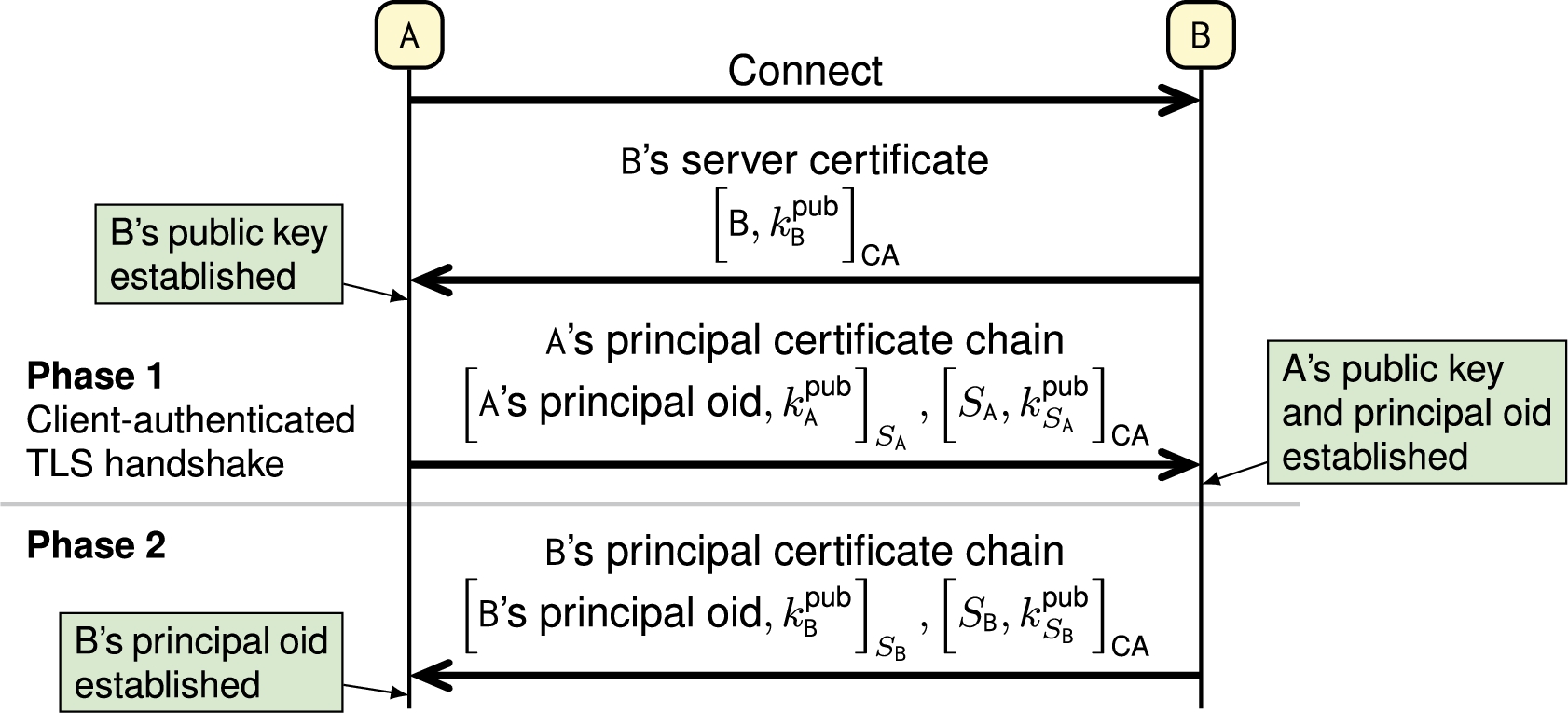
Authentication protocol sequence. For simplicity, only certificate messages are shown in the TLS handshake.

Fabric hierarchy of caches.
When a Fabric program follows an object reference, the worker ensures that there is an in-memory copy of the object for the program to use. It does this through a hierarchy of caches, shown in Fig. 15.
First, it checks to see whether a copy of the object is already present in memory. If not, the worker then consults a local cache of prefetched objects. These are local copies of objects that the worker has received, but not yet deserialized. The worker may have prefetched objects; when it requests an object from a store, the worker receives a group of related objects in an object group, amortizing both the cost of fetching and the cost of performing dynamic authorization checks at the stores.
Storage nodes dynamically construct and cache object groups based on the object graph, update labels, and dynamic access patterns. The binding between an object and its group is not permanent; the store constructs object groups as needed and discards infrequently used object groups. To improve locality, the store tries to create object groups from objects that are connected in the object graph and that have the same confidentiality policy. Having a single confidentiality policy for the entire group allows the store to treat the group uniformly with respect to confidentiality: when an authorized worker requests any member of the group, the store can safely respond with the whole group.
Dynamic authorization
Fabric performs three kinds of dynamic authorization checks when objects are accessed over the network. An example will illustrate these checks. Suppose Alice’s worker runs a transaction that accesses and updates an object with update label
When Alice fetches the object,16
It is actually Alice’s and Bob’s nodes that are performing the actions and observations described, but for ease of exposition, we identify Alice and Bob with their respective nodes.
On receiving the request, Bob examines the confidentiality part of the object’s update label. If Alice is trusted to read the object (
The security of Fabric requires that trustworthy nodes agree on the types of classes. This agreement is especially important when untrusted nodes can provide class objects. Suppose Alice’s worker wishes to make a remote call to Bob’s worker to execute an attacker-provided method  Both of these methods type-check. Alice is willing to make this remote call in a context that would reveal confidential data (
However, if the two implementations can be combined, the type mismatch allows the attacker to trick Bob into revealing confidential information. It is not enough that the methods both type-check in isolation; Alice and Bob must agree on the types.
To ensure that the caller and the receiver of a remote call agree on the types appearing in remotely called methods, a fingerprint [14] is sent with each remote call request. The receiver checks that the invoked method has a matching fingerprint. The fingerprint is computed as a cryptographic hash over the entire source code of the method’s class, including the source code of all superclasses.
Fingerprinting ensures more type agreement than is strictly necessary, but there is no harm in it, since the same fingerprint has other uses. For instance, a similar vulnerability exists if an attacker can cause nodes to disagree about the labels on the object’s fields by changing the class associated with the object. To prevent this attack, each object stores its class fingerprint along with the pointer to its class object. The fingerprint is checked against the class actually loaded to verify that the class accurately describes the object, including security policies on its fields.
Transaction management
Fabric uses a mix of pessimistic and optimistic concurrency control. To coordinate threads running on the same worker, Fabric uses pessimistic concurrency control, in which threads acquire locks on objects. However, in the distributed setting, Fabric is optimistic: worker nodes compute on cached copies of objects that may be out of date, while a distributed two-phase commit protocol [49] ensures consistency at commit time.
Within a single worker, multiple threads may execute concurrently. Every thread in the worker has a transaction manager that maintains the state of the thread’s transaction, and each object in the worker’s cache has a reader–writer lock. During computation, the transaction manager logs the version numbers of objects that are read or written, and the identities of the objects that are created. When a thread reads or writes an object, the transaction manager acquires a read or write lock for the object. The thread blocks if the lock would conflict with another lock held by a different thread.
Updates to objects in a transaction are logged in an undo log: upon the first write to each object during a transaction, the transaction manager logs the prior state of the object in an object history. This is used to restore the object’s state in case the transaction fails.
Transaction logs and object histories are hierarchical because transactions can be nested. When a local subtransaction is created, it inherits the locks held by its parent. When the subtransaction commits, its log is merged with the parent transaction log, and its locks are transferred to the parent transaction. If the subtransaction aborts, it discards its log, relinquishes the locks it has acquired, and restores the state of the objects it has modified.
To reduce logging overhead, the copy of each object at a worker has a reader stamp, which is a reference to the last transaction that read the object. No logging needs to be done for a read access if the current transaction matches the reader stamp. Similarly, each object has a writer stamp for the last transaction that modified the object, and no logging is needed if the current transaction matches the writer stamp. Obtaining the write lock clears the reader stamp.
When a worker commits a top-level transaction, it initiates a two-phase commit protocol with the stores for the objects accessed during the transaction. The information sent to each store includes the version numbers of objects accessed during the transaction and the new data for written objects. For security, the store performs the authorization checks described in Section 6.4 to ensure that the worker is trusted to modify the written objects.
The store also checks that its authoritative version numbers match the version numbers reported by the worker. A mismatch means that another worker has updated an object that was accessed during the transaction. In this case, the transaction fails, and the store informs the worker which objects involved in the transaction were out of date and provides fresh copies of the objects. The worker then replaces the stale objects in its cache before retrying the transaction.
Transactions can also fail if the state of the objects read by the transaction are not mutually consistent. Inconsistent objects might break invariants that the application code relies upon, causing errors in the execution of the application. Errors that lead to incorrectly computed results are not a problem because they will be detected and rolled back at commit time. Errors that cause exceptions are also possible, but as discussed earlier, exceptions also cause transaction failure and rollback. Finally, an application’s computation might diverge rather than terminate. Fabric handles divergence by retrying transactions that are running too long. On retry, the transaction is given more time in case it is genuinely a long-running transaction. By geometrically growing the retry timeout, the expected running time of long-running transactions is inflated by only a constant factor.
The use of reader–writer locks at workers means deadlocks are possible. Fabric implements local deadlock detection and aborts transactions detected to be deadlocked. Though distributed deadlocks may occur in Fabric, there are well-known techniques (e.g., edge chasing [24]) for detecting and avoiding them in a non-federated context. Transactions stuck in distributed deadlocks eventually time out and are retried. We leave to future work the design and implementation of secure, federated deadlock detection.
Security cache
At run time, Fabric applications perform acts-for tests and label comparison tests that are needed for security, but that add performance overhead. Fabric reduces this overhead by memoizing the results of these tests in a security cache. The cache has separate partitions for positive and negative results of acts-for tests and label comparisons, similar to the cache used by SIF [29].
Soundness is maintained in two ways. First, the cache is adjusted when the application changes the principal hierarchy. The negative partition is cleared when a principal delegation is added. Similarly, when a delegation is revoked, any positive-cache entries that depend on that delegation are removed.
Second, the security cache is tied to the transaction manager, so concurrent transactions are isolated. Each transaction has its own security cache, and because transactions can be nested, the security cache is hierarchical. When a subtransaction is created, it inherits the cache entries from its parent. When the subtransaction commits, its cache is merged with the parent cache; if the subtransaction aborts, its cache is discarded. Thus, the security cache of the parent transaction is isolated from changes to the principal hierarchy made within an aborted subtransaction that may have computed trust using inconsistent data.
Writer maps
Remote calls cause transactions to be distributed across multiple workers. Several challenges arise when objects are shared and updated by the workers in a distributed transaction. For consistency, workers need to compute on the latest version of a shared object as it is updated. For performance, workers should be able to locally cache objects that are shared but not updated. For security, a worker should only learn about updates to an object if the worker is trusted with the object’s confidentiality.
Fabric addresses these challenges with writer maps, a cryptographic data structure that allows workers to efficiently check for updates to cached objects, while protecting the confidentiality of those updates. Every transaction has a writer map that associates each updated object with its writer, the worker that last wrote to the object during the transaction. An object’s writer, therefore, stores the definitive copy of the object for the transaction.
The writer map is threaded through the control flow of the distributed computation: it is included in every remote-call request, and is returned with the result of the call. During computation, when a transaction on a worker w accesses an object, the transaction manager checks the writer map. If a writer
If the object is being written, one of two things happen. First, if w can enforce the access label  ), then w buffers its writes to the object, and furnishes its updates to
The worker colocated on the object’s store is the writer if none of the workers in the transaction can enforce the object’s access label.
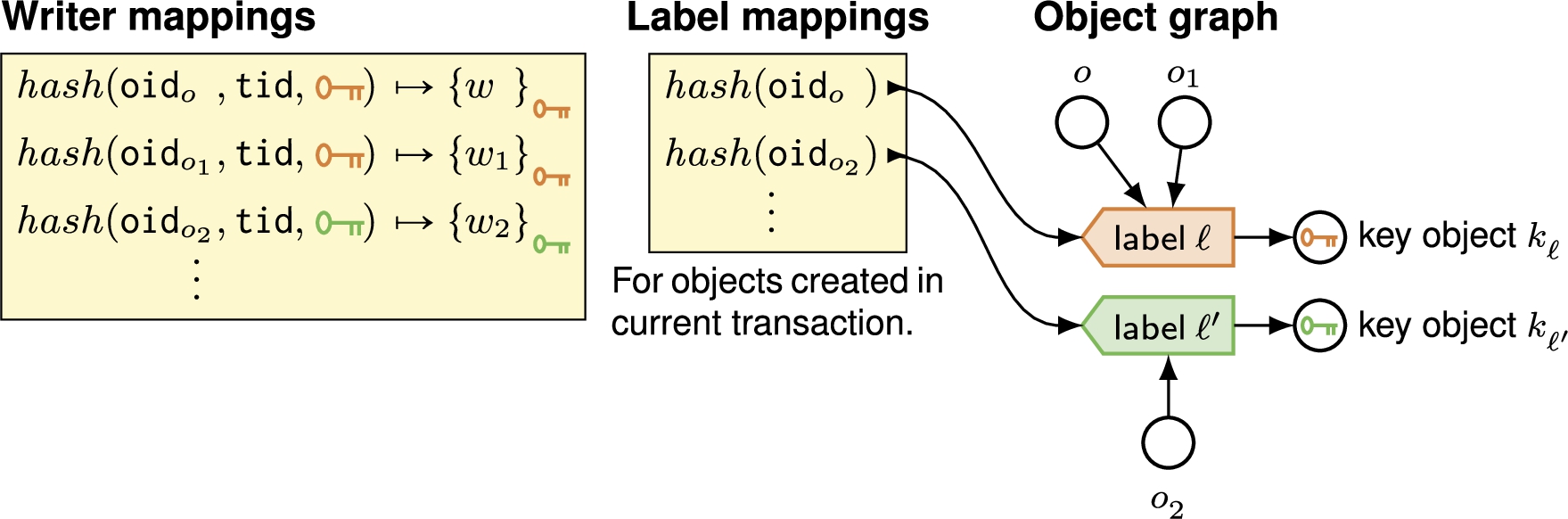
Writer maps.
Writer maps cryptographically associate the oid of each updated object with the object’s writer, as shown in Fig. 16. When a worker w updates an object o, it adds a writer mapping, shown on the left side of the figure. Writer mappings have the form
Transaction identifiers are generated by a cryptographically strong pseudorandom number generator.
A worker in possession of an object’s encryption key can use the writer mapping to learn whether there is an entry in the writer map for that object, and to determine which node is currently the object’s writer. Workers lacking the key cannot exploit these mappings, because the hash cannot be computed without the key. Nor can they watch for the appearance of the same mapping across multiple transactions, because the top-level transaction id is included in the hash.
Encryption keys are stored in key objects, shown in the object graph on the right side of Fig. 16. Key objects are referenced from the update labels of objects. Each instance ℓ of an update label has a different key object
A worker can obtain the key object for an object o by first obtaining the update label ℓ of o, and then following the reference in ℓ. The update label ℓ can be obtained in one of three ways. First, every object has an immutable reference to its update label, so if the worker has o cached, it can simply follow this reference to obtain the update label. This works even when the cache is out of date because the reference is immutable. Second, if o is not cached, but was created in a previous transaction, the worker can obtain a copy of o from its store and then follow the reference in o to obtain the update label.
Third, if o is not cached and was created in the current transaction, then it has not yet been written to a store. To handle this, the writer map contains label mappings, shown in the middle of Fig. 16. The creation of a new object o with oid
To reduce the overhead of checking the writer map, each worker in the computation keeps a local version number for the writer map, which is incremented when the worker receives new writer-map information from an incoming remote-call request or a remote-call result. Each cached object at a worker has a local writer-map stamp, which records the version number of the writer map used during the previous access. No fetch needs to be done if the current writer-map version number matches the writer-map stamp.
The writer map is an append-only structure, so if an untrusted worker fails to maintain a mapping, it can be restored. The size of the writer map is a side channel, but the capacity of this channel is bounded by always padding out the number of writer map entries added by each worker to the next largest power of 2, introducing dummy entries containing random data as needed. Therefore, a worker that modifies n objects leaks
The management of a distributed transaction is itself distributed across the workers participating in the transaction. Each worker maintains transaction logs for the top-level transactions it is involved in. For security, workers are responsible for logging their own actions, because they may contain confidential information that other workers should not observe. For example, in the code below, the existence of

Figure 17 illustrates the log structures that might result during a distributed transaction involving three workers,
In Fig. 17(a), a transaction (
When worker
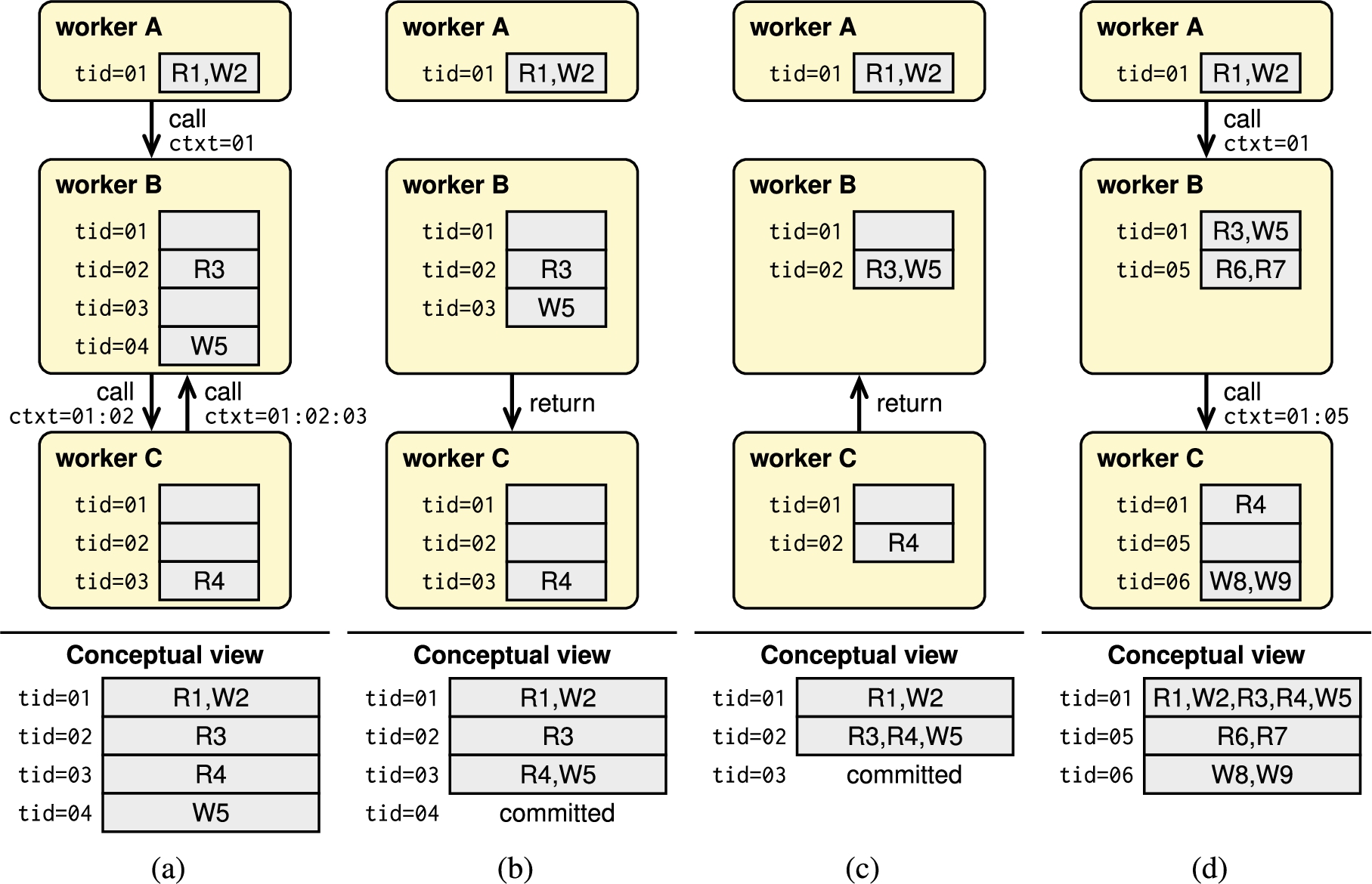
Distributed transaction logs.
Figure 17(c) shows the state of the distributed transaction log after worker
When control returns from a remote call, the worker always commits up to the context in which the remote call occurred. Therefore, when worker
The return from worker
When a worker receives a remote call, it compares its transactional context with the one it receives. The worker synchronizes its transaction log by committing up to the most recent common ancestor of the two contexts, and starting any transactions it has missed. Therefore, when worker
When the top-level transaction commits, the three workers participate in a hierarchical commit protocol to communicate with the stores of the objects they have accessed, using their respective parts of the logs.
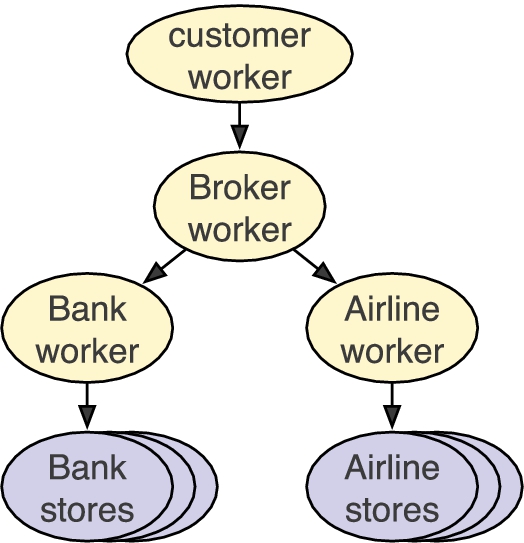
A hierarchical, distributed transaction.
A transaction may span worker nodes that do not trust each other, creating both integrity and confidentiality concerns. An untrusted node cannot be relied to commit its part of a transaction correctly. More subtly, an insecure commit protocol might cause an untrusted node to learn information it should not. For instance, simply learning the identities of other nodes that participated in a transaction may reveal sensitive information. Fabric’s _hierarchical two-phase commit_ protocol addresses these problems.
Consider the transaction shown in Fig. 18, in which a customer buys an air ticket. The bank and the airline do not necessarily trust each other; nor do they trust the customer purchasing the ticket. Therefore some computation is run on workers managed respectively by the bank and the airline. When the transaction is to be committed, some updates to persistent objects are recorded on these different workers.
Because the airline and the bank do not trust the customer, their workers will reject remote calls from the customer – the customer’s worker lacks sufficient integrity. Therefore, this scenario requires the customer to find a trusted third party. As shown in the figure, a third-party broker can receive requests from the customer, and then invoke operations on the bank and airline. Because the broker runs at a higher integrity level than the customer that calls it, Fabric’s endorsement mechanism must be used to boost integrity. This rule is needed because the security policy of the broker says that anyone is allowed to make requests of the broker. It is the responsibility of the broker to sanitize and check the customer request before explicitly endorsing it and proceeding with the transaction.
The commit protocol is a hierarchical version of the usual two-phase commit protocol. The first phase begins with the worker that started the top-level transaction. It initiates the commit by contacting all the stores for whose objects it is the current writer in the writer map, and all the other workers to which it has issued remote calls. These other workers then recursively do the same, so the first phase of the protocol constructs a commit tree, a spanning tree of the transaction’s remote-call graph. This process allows all the stores involved in a transaction to be informed about the transaction commit, without relying on untrusted workers to choose which nodes to contact and without revealing to workers which other nodes are involved in the transaction lower down in the commit tree.
The two-phase commit protocol then proceeds as usual, except that messages are passed up and down the commit tree rather than directly between a single coordinator and the stores. The first phase of the protocol not only constructs the commit tree but also causes each participating store to validate the transaction by checking permissions and comparing version numbers. Each store that successfully validates the transaction prepares to commit it. The second phase of the protocol informs all participants whether the prepared transaction should be committed or aborted.
Of course, a worker in this tree could be compromised and fail to correctly carry out the protocol, causing some stores to be updated in a way that is inconsistent with other stores. However, this worker could already have introduced this inconsistency by simply failing to update some objects or by failing to issue some remote method calls. In our example above, the broker could cause payment to be rendered without a ticket being issued, but only by violating the trust that was placed in it by the bank and airline. The customer’s power over the transaction is merely to prevent it from happening at all, which is not a security violation.
Once a transaction is prepared in the first phase of the two-phase commit, it is important for the availability of the objects involved that the transaction is committed quickly. The transaction coordinator should remain available, and if it fails after the first phase of the transaction, it must recover rapidly. An unavailable transaction coordinator could become an availability problem for Fabric, and the availability of the coordinator is therefore a trust assumption. To prevent denial-of-service attacks, prepared transactions are timed out and aborted if the coordinator is unresponsive. In the example given, the broker can cause inconsistent commits by permanently failing after telling only the airline to commit, in which case the bank will abort its part of the transaction. This failure is considered a violation of trust, but in keeping with the security principles of Fabric, the failing coordinator can only affect the consistency of objects whose integrity it is trusted to enforce. This design weakens Fabric’s consistency guarantees in a circumscribed way, in exchange for stronger availability guarantees.
Implementation
Fabric is implemented using a mixture of Java, FabIL, and Fabric code. Altogether, the Fabric compiler and runtime system contain 45k lines of code.19
In this paper, we exclude comments and whitespace when counting lines of code.
A common base of 11k lines of code supports the worker and store. The worker is written in another 4.7k lines of Java code and 3.7k lines of FabIL code, and the store is an extra 2.6k lines of Java code.
The Fabric compiler is implemented as a source-to-source translation from the Fabric language to Java, using the Polyglot extensible compiler framework [93]. Fabric is translated to Java by way of FabIL. Together, the Fabric and FabIL compilers are 21k lines of code. The FabIL compiler is an extension of the Polyglot base compiler (
We ported some Java and Jif libraries, both to support the runtime system and to aid application development. Partial ports of the GNU Classpath implementation of the
Implementing Fabric in Java has the advantage that it supports integration with and porting of legacy Java applications, and access to functionality available in Java libraries. However, it limits control over memory layout and prevents the use of some useful implementation techniques. In an ideal implementation, the virtual machine and JIT would be extended to support Fabric directly. For example, the worker cache is implemented with Java’s
The store implementation uses Berkeley DB [94] as a backing store in a simple way: each object is entered individually with its onum as its key and its serialized representation as the corresponding value. The performance of this simple approach is reasonable for the applications we have studied, probably because of the use of aggressive caching elsewhere in the system: recall that stores cache both object groups and object versions in memory, and workers cache objects across transactions. For write-intensive workloads, object clustering in the backing store might improve performance, but we leave this to future work.
It is important for performance to keep the representation of an object at a store and on the wire compact. Therefore, references in an object are stored as onums rather than as full oids. A reference to an object located at a different store is stored as an onum that refers to a surrogate object containing a forwarding pointer. This representation is compact if most references are to an object in the same store.
Class loading
Workers load and run mobile code using a custom Java class loader that we implemented in 79 lines of FabIL code. When the JVM requests a new class, the class loader fetches the corresponding Fabric
After fetching a class object, the custom loader invokes the Fabric compiler on the source code to verify the class and generate bytecode. Important context information, such as the worker’s principal, the run-time provider label of the code, and the codebase, are also passed to the compiler. The resulting bytecode is cached locally in memory and on disk, so that compilation can be reused. The custom loader then reads the bytecode from the cache and uses the Java class loader API to load it into the JVM. For bootstrapping purposes, some system classes are treated specially. They are loaded from bytecode on disk, in much the same way as by the default Java classloader.
Memory management
Workers cache persistent objects across transactions, which means that a mechanism is needed to evict objects from cache when they are no longer needed and the memory they occupy is needed for other purposes. The current implementation uses Java’s
Note that the eviction of an object is not observable at the level of the Fabric language, so this eviction mechanism does not create a side channel between different threads at a Fabric worker.
Unimplemented features
Most of the Fabric design described in this paper has been implemented in the currently available prototype. A few features are absent, though no real difficulties are foreseen in implementing them, and their absence should not have any significant effect on the results reported here. Distributed deadlock detection via edge chasing [24], timeout-based abort of possibly divergent computations, timeout-based abort of prepared transactions for availability, class-object replication, and path compression for forwarding chains of surrogate objects [33,44,62] are unimplemented. Full support of run-time enforcement of access labels in multi-worker transactions is incomplete. Workers also do not currently verify that the writers obtained from the writer map can enforce the objects’ integrity (Section 6.8). When an object is fetched from a remote node, a dynamic check is done to ensure that its class is a subtype of the expected type of the reference to the object. Currently this check does not consider parameters of parameterized types. Including these parameters is possible and conceptually straightforward but, in the current architecture, would require a major change to FabIL to better support parameterized types. The check comparing the remote node with the access label, described in Section 6.4, is also unimplemented.
Fabric does not currently support garbage collection for persistent objects. Garbage collection has security implications for referential integrity, studied in [76]. Designing a secure, distributed garbage-collection protocol for the federated setting remains an open problem.
Evaluation: Expressiveness
To explore the expressiveness of the Fabric language, we implemented various programs, including the FriendMap example of Section 2 as well as an example in which agents bid on airline tickets. These applications work correctly on our prototype implementation, demonstrating that it is possible to build interesting code under the restriction imposed by provider-bounded information flow control. Further, codebases enable incremental development of both of these examples.
FriendMap example
The prototype of Section 2’s FriendMap example contains roughly 1,800 lines of Fabric code, about 44 of which implement the extended versions of FriendMap and Snapp described in Section 5.5. We added a second version of the Snapp codebase that introduces a
We also extended the FriendMap application to make use of this added functionality. FriendMap version 2 extends FriendMap version 1, and overrides the implementation of the
BiddingAgent example
In our second major example, a user supplies an agent for choosing between ticket offers made by two different airlines. The choice may depend on factors confidential to the user, such as preferred price or expected service level. Airlines, in turn, supply agents that compete for the best offer to provide to the user, while maximizing profit. This example comprises about 580 lines of code.
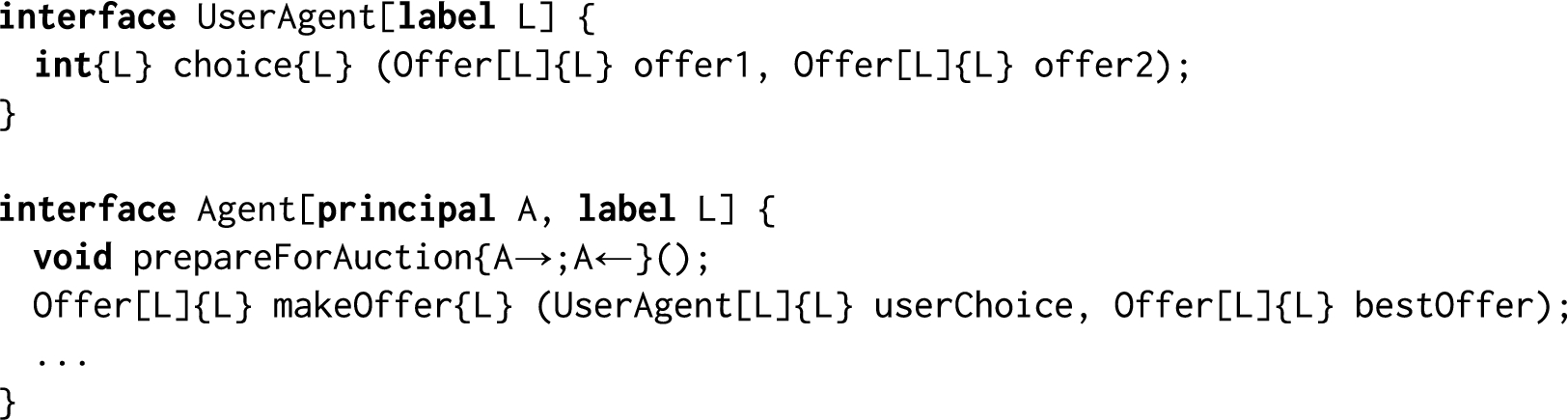
Interfaces provided by
Four parties participate: a trusted broker, two airlines, and the user. They are represented by Fabric principals
To facilitate interaction of different mobile agents, the broker publishes interfaces, illustrated in Fig. 19, for the airlines’ and user’s agents. The interfaces use principal and label parameterization, a Fabric language feature (inherited from Jif) that facilitates modular development and genericity. Interface
Interface
Method

Initializing airline and user agents.
Figure 20 shows how mobile agents are initialized. Line 1 declares a label

Before declassifying the value of
High-level programming abstractions can come at a cost that interferes with building real applications. Fabric imposes several new overheads in various parts of the system: for example, remote calls require dynamic label checks and access to local objects requires transactional logging. On the other hand, because Fabric integrates some system layers more tightly than conventional system architectures do, it also has the potential to improve overall application performance.
We evaluated the performance of the Fabric system using four applications. First, we ported Cornell’s deployed Course Management System (CMS) [18] to Fabric, to evaluate performance on real-world workloads. Second, we implemented the multiuser OO7 benchmark [22] to evaluate system scalability. These first two applications are written in FabIL, and evaluate Fabric without using mobile code. Although FabIL does not enforce information flow security, its applications are transactional and subject to dynamic authorization checks at the stores, and therefore incur much of the same overhead of transaction logging, label creation, and dynamic label checks as Fabric programs do.
Support for mobile code affects the performance of the system in two ways. First, additional work is required to dynamically load and analyze new code. Second, linking with remote classes imposes some execution overhead. To evaluate these effects, we additionally ran the FriendMap and BiddingAgent programs. Measurements from these four applications suggest that run-time performance is acceptable for many uses.
Course management system
To compare the performance of Fabric to current standard alternatives, we ported a portion of the CMS course management system to FabIL. The production version of CMS is a 38k-line Java web application, backed by a conventional SQL database. It has been used at Cornell University to manage course assignments and grading since 2005; at present, it is used by more than 50 courses and more than 4,000 students.
CMS has a model–view–controller architecture. In the production version, the model is implemented with Enterprise JavaBeans (EJB) using Bean-Managed Persistence. For performance, hand-written SQL queries are used to implement lookup and update methods, while generated code manages object caches and database connections. The model contains 35 Bean classes encapsulating students, assignments, courses, and other abstractions. Each Bean class corresponds to a table in a SQL database, and EJB maps instances of these classes to rows of these tables. The view is implemented using Java Server Pages.
EJB programs access persistent Bean instances using an interface based on Java Collections. Porting CMS to FabIL involved replacing this interface with a FabIL collections library based on a port of GNU Classpath. We ported the entire data schema and partially implemented the query functionality of the model. By replacing complex SQL queries with object-oriented code using loops and standard data structures, we were able to greatly simplify the model code; fully porting five of the Bean classes reduced 3,100 lines of code to 740 lines, while the view and controller remained mostly unchanged.
To guide our port, we used the trace from the production CMS server described below. This ensured our port focused on the most important application features: of the 101 types of user requests in the production application, the 11 most popular were fully ported, covering 93% of the requests captured in the trace. Many of the ported request types contain significant computation and data usage. For instance, the “course” request displays an overview of all relevant course information, including announcements, outstanding assignments and their due dates, as well as graded assignments and their grade distributions. The port was completed in less than two months by an undergraduate initially unfamiliar with Fabric. It contains 18k lines of code. These results suggest that porting web applications to FabIL is not difficult and results in shorter, simpler code.
A complete port of CMS to Fabric would have the benefit of federated, secure sharing of CMS data across different administrative domains, such as different universities, assuming that information is assigned labels in a fine-grained way. It would also permit secure access to CMS data from applications other than CMS. We leave this to future work.
Workload. We obtained a trace from Cornell’s production CMS server from three weeks in 2013, a period that encompassed multiple submission deadlines for several courses. To drive our performance evaluation, we took 10 common request types from the trace. Each transaction in the trace is a complete user request including generation of an HTML web page, so most request types access many objects. Using JMeter [59] as a workload generator, we sampled the traces, transforming query parameters as necessary to map to objects in our test database with a custom JMeter plugin.
CMS comparison baseline: Hibernate/HSQLDB
To provide a credible baseline for performance comparisons, we ported our FabIL implementation of CMS to the industry-standard Java Persistence API (JPA) [16], an API for object–relational mapping (ORM) that, like Fabric, offers a transactional programming abstraction with persistent objects. The JPA programming model lacks security policies or security enforcement, and is roughly similar to that of FabIL, though its persistence is not orthogonal and explicit calls to the transaction manager must be inserted to ensure persistence and consistency. At a high level, the JPA code for CMS is very similar to the FabIL code, using essentially the same schema and the same algorithms.
We evaluated performance of this baseline implementation using the widely used Hibernate implementation of JPA 2, running on HyperSQL (HSQLDB), a popular in-memory database. We ran HSQLDB in “
Multiuser OO7 benchmark
The OO7 benchmark was designed to model a range of typical object-oriented database applications. The database consists of several modules, which are tree-based data structures. The leaves of the trees each contain a randomly connected graph of 20 objects. In our experiments we used the “small”-sized database according to the OO7 benchmark specification. Each OO7 transaction performs 10 random traversals on either the shared module or a private module specific to each client. When the traversal reaches a leaf of the tree, it performs either a read or a write action on each of the 20 objects. These transactions are relatively heavyweight when compared to many current benchmarks; each transaction reads about 460 persistent objects and modifies up to 200 of them. If implemented in a straightforward way with a key–value store, each transaction would perform hundreds of get and put operations. Transactions in the commonly used TPC-C benchmark are roughly an order of magnitude smaller [121], and in the YCSB benchmarks [128], smaller still.
OO7 stresses a database’s ability to handle read and write contention, because its transactions are relatively large, and because of the tree structure of the database. However, since updates only occur at the leaves of the tree, writes are uniformly distributed in the OO7 specification. To better model updates to popular objects, we modified traversals to make read operations at the leaves of the tree exhibit a power-law distribution with
Experimental setup
We ran our experiments on two different system configurations: one for demonstrating the performance of Fabric using OO7 and CMS, and another for measuring the performance effects of mobile code using FriendMap and BiddingAgent.
When measuring performance of distributed servers, the choice of load model has been shown to have a large effect [108]. Often performance has been measured with a closed system model, in which the number of clients generating requests is fixed. In an open system model, user requests arrive independently at some average rate. This is usually considered more realistic and a better way to evaluate system scalability because it models the burstiness of requests in real systems. Our OO7 and CMS performance experiments use a compromise that we call a semi-open system model. In the open model, worker nodes execute transactions at exponentially distributed intervals while meeting a specified _average request rate_. Consequently, each worker is usually running many transactions in parallel. Overall system throughput is the total throughput from all workers. Our semi-open model follows the open model, but due to experimental resource constraints, there are a fixed number of workers, each with limited capacity to run concurrent transactions. Under extreme system loads, a worker might be unable to start a new transaction (due to too many concurrent threads), and the load generated would therefore be lower than that of a truly open system. To find the maximum system throughput, the average request rate is increased slowly until the target throughput cannot be achieved.
These experiments are run on a Eucalyptus cluster. Each store runs on a virtual machine with a dual-core processor and 8 GiB of memory. Worker machines are virtual machines with 4 cores and 16 GiB of memory. The physical processors are 2.9 GHz Intel Xeon E5-2690 processors.
The performance effects of mobile code were measured in a non-distributed setting, on an Intel Core i7-860 system with 4 GiB of memory.
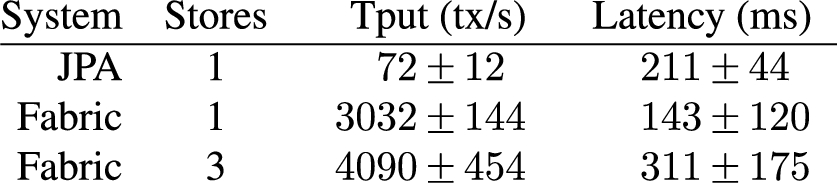
CMS throughput and latency on various systems. Reported results are averaged over 10 s at max throughput, across three runs.
Figure 21 reports the performance of the CMS application in various configurations. In the three-store configuration for Fabric, two stores each held data for multiple courses, while the third store contained metadata. We present results only for a single JPA database instance. Even in this single-store setting, and even with Hibernate running in a weaker-consistency mode (“optimistic locking”), Fabric significantly outperforms it in our experiment. Moreover, because the CMS workload is read-biased, we expect JPA with pessimistic locking to perform even worse [63,113].
Although the JPA implementation enforces weaker consistency, Fabric’s more precise object invalidation helps performance as contention increases. This comparison shows that the performance of Fabric is competitive with an industry-standard framework offering a transactional language-level abstraction.

OO7 maximum throughput on a 2%-write workload as the number of stores increases.
Increases in throughput would be less compelling if they came at the cost of high latency. Figure 21 also reports the latency measured with the CMS workload on the various systems, showing that they are comparable.
We evaluated the scalability of Fabric using the OO7 benchmark with varying numbers of stores. Recall that the OO7 database consists of several tree-like modules: a private module for each client, and a shared module. In our setup, a “shared store” was reserved for the modules’ inner nodes. The leaves of the shared module were also placed on the shared store, while the leaves of each private module were distributed evenly across the remaining stores. Results presented are the average of three runs.
Figure 22 shows maximum throughput in total transactions committed per second by 36 workers, as the number of stores increases. Error bars show the standard deviation of the measurements. The large variation appears to be result of garbage collection. Since the shared store is a bottleneck, this benchmark is decidedly not a best case for measuring scalability. However, Fabric is able to add roughly 130 tx/s per additional store.20
While Fig. 22 shows the system scales roughly linearly with the number of stores, we do not believe this continues indefinitely. Unfortunately, generating sufficient throughput to explore scalability beyond seven stores exceeded our available computing resources.
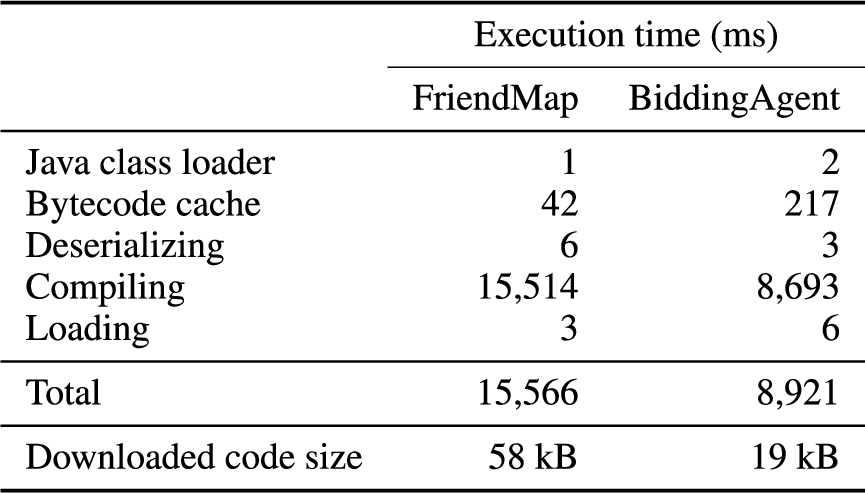
Execution time for the steps required to verify and load dynamically compiled mobile code, averaged over five runs.
To show the effect of mobile code on performance, we break down the execution time of the FriendMap and BiddingAgent examples. Figure 23 gives the execution time of each step required to load the mobile classes from Fabric into the JVM.
As expected, almost all the time is spent invoking the compiler to analyze the code and generate bytecode. Our compiler has not yet been optimized for run-time compilation, so we expect that that time could be reduced significantly. Additionally, a lower-level intermediate representation such as annotated bytecode, would likely support verification with less overhead. Developing such a representation and analysis was beyond the scope of our research goals. More importantly, the analysis can often be avoided entirely – when either the worker has compiled the class in the past and retains a cached copy, or the worker trusts the provider of the code to correctly compile it. The implementation currently only leverages the former case.
To demonstrate this, Fig. 24 shows the time required to load the classes in our examples, in two scenarios: with all classes dynamically compiled at load time, and with all classes pre-compiled and locally cached. We have also written a non-mobile version of the bidding agent example, and give the load time for that as well. These results show that the initial cost of dynamically compiling code is quickly amortized when code is used more than once. Sharing pre-compiled code among trusted nodes would reduce overhead even further.
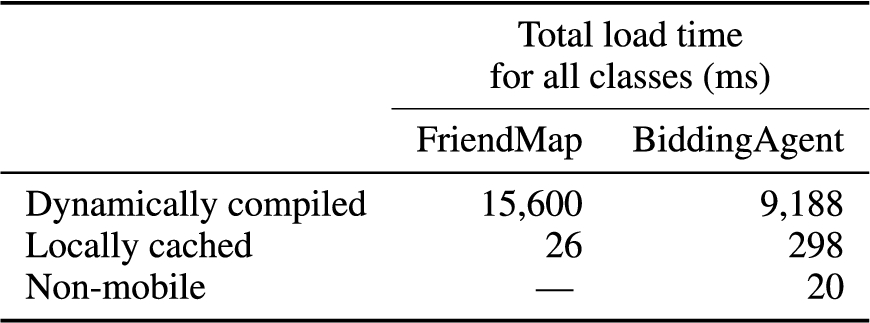
Total time spent in the class loader, under different conditions. We present the mean over five runs.

Running time of the mobile-code examples.
To focus on the run-time overhead of mobile code, we ran the benchmarks both with and without caching compiled bytecode locally. The results of this benchmark are shown in Fig. 25.
For comparison, the second row of Fig. 25 gives the execution time for uncached code, excluding the dynamic compilation time. For both FriendMap and BiddingAgent, this result is less than the cached execution time (second row of Fig. 25). This shows that compiling code has side effects, such as populating the object cache, that would have been performed anyway. The benefits of these compilation effects may vary from application to application, however. FriendMap appears to benefit from compilation effects significantly more than BiddingAgent does.
Fabric provides a higher-level abstraction for programming distributed systems. Because it aims to help with many different issues, including persistence, consistency, security, and distributed computation, it overlaps with many systems that address a subset of these issues. However, none of these prior systems addresses all the issues tackled by Fabric.
Fabric fits into a substantial history of efforts to integrate information flow control into practical language-level programming abstractions; prior systems include SPARK/Ada [11], Jif and Jif/split [86,90,131,136], FlowCaml [112], Laminar [104], Aura [58], Swift [27], LIO [117], Jeeves [129], and Paragon [20]. These previous systems are either not distributed, or provide much more limited control over distributed computation. Many of the contributions of Fabric arise from fully extending information flow methods into the realm of distributed computation over persistent data, where we have encountered new side channels and uncovered new connections between notions of integrity and authority.
OceanStore [102] shares the goal with Fabric of a federated, distributed object store, but focuses more on storage than on computation. It provides consistency only at the granularity of single objects, and does not help with consistent distributed computation. OceanStore focuses on achieving durability via replication. Fabric stores could be replicated but currently are not. Unlike OceanStore, Fabric provides a principled model for declaring and enforcing strong security properties in the presence of distrusted workers and stores.
Jif/split [131], SIF [29], and Swift [27] are prior distributed systems with mutually distrusting nodes, but with more limited goals than Fabric. While these prior systems use language-based security to enforce strong confidentiality and integrity, they do not allow new nodes to join the system, and they do not support consistent, distributed computations over shared persistent data.
DStar [133] controls information flow in a distributed system using run-time taint tracking at the OS level, with Flume-style decentralized labels [66]. Like Fabric, DStar is a decentralized system that allows new nodes to join, but unlike Fabric, it does not require certificate authorities. DStar has the advantage that it does not require language support, but it also controls information flow more coarsely. DStar does not support consistent distributed computations, data shipping, or mobile code. It also has no notion of code integrity or secrecy.
Some previous distributed storage systems have used transactions to implement strong consistency guarantees, including Mneme [85], Thor [72] and Sinfonia [1]. Cache management in Fabric is inspired by that in Thor [23]. Fabric is also related to other systems that provide transparent access to persistent objects, such as ObjectStore [69] and GemStone [21]. These prior systems do not focus on security enforcement in the presence of distrusted nodes, and do not support consistent computations spanning multiple compute nodes.
Distributed computation systems with support for consistency, such as Argus [71] and Avalon [53], usually have not offered single-system view of persistent data, and none enforce information security. Emerald [15] gives a single-system view of a universe of objects while exposing location and mobility, but does not support transactions, data shipping or secure federation. InterWeave [118] is a persistent distributed shared memory system that synthesizes data- and function-shipping similarly to Fabric, and allows multiple remote calls to be bound within a transaction, remaining atomic and isolated with respect to other transactions. However, it does not appear feasible to build a system like Fabric on top of InterWeave, because InterWeave has no support for information security and its mechanisms for persistence and concurrency control operate at the granularity of pages. The work of Shrira et al. [111] on exo-leases supports nested optimistic transactions in a client–server system with disconnected, multi-client transactions, but does not consider information security. MapJAX [91] provides an abstraction for sharing data structures between the client and server in web applications, but does not consider security. J-Orchestra [120] creates distributed Java programs by partitioning programs among assigned network locations. Standard Java synchronization operations are emulated across multiple hosts, but neither security nor persistence is considered. Other recent language-based abstractions for distributed computing such as X10 [107] and Live Objects [97] also raise the abstraction level of distributed computing but do not support persistence or information-flow security.
Some distributed storage systems such as PAST [103], Shark [2], CFS [32], and Boxwood [78] use distributed data structures to provide scalable file systems, but offer weak consistency and security guarantees for distributed computation.
IFDB [109] provides a SQL-based interface to a single persistent database while tracking information flow fully dynamically. It is not a federated system like Fabric, nor does it provide type-level integration in the language.
Many previous languages [60,80,83,84] have explored integrating abstractions for authorization and access control into the programming model. However, these languages do not integrate reasoning about information flow and rely on the programmer to use these abstractions appropriately to enforce security.
UrFlow [26] enforces information flow control in web applications with policies expressed by SQL queries. UrFlow prevents implicit flows in application code, but not those introduced by the queries themselves.
Hails [47] dynamically enforces information flow control for Haskell web applications. Like Fabric applications, Hails web apps compose mutually untrustworthy components that may access persistent data. However, Hails components implement a model–view–controller design pattern and may not invoke each other directly, though multiple view–controllers may share the same model. Hails does not prevent read channels, but does prevent termination and timing channels [116].
Cross-origin resource sharing (CORS) [122] extends the same-origin policy to allow web sites to specify domains that may load resources from other origins. A browser implementing the CORS API performs a “preflight request” to determine what restrictions apply to a resource before fetching the resource. The CORS API does not protect against read channels: preflight requests may leak information from the requesting page.
Fabric’s support for secure mobile code can be compared to proof-carrying code (PCC) [92], a general mechanism for transmitting proofs about code to code consumers. Fabric does not contain a general proof checker; clients check code they receive using the Fabric type system. The Fabric approach is analogous to the bytecode verifier used by Java [70], which similarly type-checks JVM bytecode.
Various attempts have been made to strengthen isolation guarantees for JavaScript. Chugh et al. [30] dynamically check loaded code against statically identified residual information-flow requirements. Conscript [81] applies aspects to JavaScript primitives, isolating loaded scripts in useful ways. Caja [83] provides isolation in web mashups by using capabilities to protect access to resources at a fine granularity. Secure information flow can be enforced by checking capabilities at statically predetermined locations [13], assuming a static analysis of information flow. Hedin and Sabelfeld [52] dynamically enforce secure information flow within a JavaScript DOM tree. Securing mobile code in Fabric has similar challenges to securing JavaScript, but Fabric’s mobile code may express more general computations, including creating and accessing persistent data, and may communicate with arbitrary nodes.
System extensibility and evolution has been explored in many contexts. To our knowledge, Fabric’s mobile code support is the first to address the information security of the assembly and evolution of components in a general distributed setting.
SPIN [51] is an extensible operating system that allows core kernel functionality to be dynamically specialized by modules written in Modula-3. Like Fabric, SPIN leverages language-level features – such as interfaces and type safety – to provide isolation for untrusted system modules. Unlike Fabric, SPIN uses namespace isolation to control access to system resources: capabilities are implemented as references to system resources, with a type capturing access privileges. In contrast, name resolution in Fabric is orthogonal to security, and the security implications of linking with low integrity code are captured by the type system.
Prior work on expressive module systems explored several approaches to component reuse and evolution. Unit [43] and Knit [100] are component definition and linking languages that enable programmatic assembly of components. Composite units are assembled out of smaller ones, and some architectural properties are checked, such as type consistency (in [43]) or user-defined constraints (in [100]). These systems provide more flexible control of namespaces, but they do not address the security of the produced code.
Codebases have similarities to the classpath entries in JAR files [95]. These references are neither versioned nor immutable, so the meaning of Java classes can change over time. JAR files allow packages to be sealed, to control who can insert classes into them. Sealing is orthogonal to our consistency requirements: it does not ensure that classes are named consistently nor that the meaning of code is fixed.
Lessons learned and future work
The Fabric project has aimed to develop a practical and effective language and platform for building secure distributed systems. A large part of our motivation was a desire to learn whether the principles of information flow could be put into practice for building secure distributed systems, and to gain insight about where future work should focus. The project was valuable on both fronts.
We chose to base the Fabric programming language closely on the existing Jif programming language and on its underlying security model, the DLM. By developing Fabric, we deepened our insights into how to design security models and to connect them to a programming language. One key insight was the identification of a trust ordering on labels, along with a trust relationship between principals and labels. This entirely novel ordering simplified our thinking about security enforcement in distributed systems. It also led to the realization that the label model can be simplified by unifying the concepts of principals and labels, as was done in our follow-up work on the flow-limited authorization model (FLAM) [5,6]. This unification also dispenses with an unnecessary distinction between authority and integrity. FLAM would be a simpler and more expressive basis for implementing a system like Fabric.
One challenge of Fabric programming is that Fabric allows the creation of references to objects at less trusted locations – a capability shared by many other distributed systems such as the Web. However, programs are not very robust unless programmers take care to avoid dangling pointers and related security vulnerabilities. In subsequent work [76], we formalized these vulnerabilities and designed a type system to control them.
The decentralized security principle has been invaluable in guiding the design of Fabric. For instance, computing systems – especially distributed systems – tend to be full of side channels. But not all information channels are security vulnerabilities. The decentralized security principle was a crucial guide for distinguishing harmless and harmful side channels. We have largely ignored timing channels in our work on Fabric, but their presence in Fabric motivated subsequent research [9,134,135]. Dynamic authorization checks in Fabric are another form of side channel, which motivated our work to control these side channels in FLAM [5,6]. Careful analysis of the transaction protocols in Fabric showed us that transaction aborts could create an exploitable side channel; recent work has shown how to constrain Fabric transactions to eliminate this side channel [110].
The decentralized security principle also helped us identify situations in which security mechanisms were needed – or not needed, because security already rested on sufficient trust. Of course, such reasoning is only possible because Fabric makes trust policies explicit. Although the decentralized security principle was constantly useful, we still lack a satisfactory formalization for it. This is surely an interesting area for future work.
The programming model of Fabric supports concurrent but single-threaded transactions. This is a good fit for OLTP-style applications such as web applications. By supporting only single-threaded transactions, we avoid the challenges of controlling internal timing channels [106]. However, many modern distributed systems rely on highly parallel computation distributed across many host machines, as in the MapReduce pattern [34]. An interesting direction for future research would be to support such computations while still enforcing strong information security.
In many modern distributed applications, availability and latency are improved by replicating state at widely separated sites. However, performance is improved by weakening consistency guarantees. Fabric provides a strong consistency guarantee, strict serializability. Subsequent work on warranties [75] shows that performance can be improved by enforcing a semantic notion of strict serializability rather than the usual notion of serializability at the level of read and write operations [99]. Fabric also allows applications to replicate data manually by creating multiple copies of objects and synchronizing them. It may be useful to expose weaker consistency models explicitly in the programming model, so that application writers do not need to invent their own consistency protocols. Since weak consistency is used partly to improve availability, it is interesting to contemplate enforcement of not just confidentiality and integrity but also availability. Efforts in this direction [137] have only begun to address the problem.
One obstacle to adoption of Fabric is that its backing store is not compatible with standard SQL-based database administration tools. In principle, a SQL database could be used as a backing store; this change would turn Fabric into a security-enhanced object–relational mapping system. IFDB [109] may be a good starting point for implementing such a system without losing security guarantees at the database layer.
The Fabric intermediate language, FabIL, is very useful for building trusted code but has some limitations that are inherited by Fabric.
A useful research direction would be to design a better intermediate language for distributed programming, perhaps one that supports features such as concurrency, weak consistency, and replication.
Conclusions
We have explored the design and implementation of Fabric, a new, general platform for secure sharing of information and computation resources. Fabric provides a high-level abstraction for secure, consistent, distributed general-purpose computations on persistent, distributed information. Persistent information is conveniently presented as language-level objects connected by pointers. Mobile code can be dynamically downloaded and used securely by applications, subject to policies for confidentiality and integrity. Fabric exposes security assumptions and policies explicitly and declaratively. It flexibly supports a range of computation styles moving code to data or data to code. Results from implementing complex, realistic systems in Fabric, such as CMS and SIF, suggest it has the expressive power and performance to be useful in practice.
Fabric’s security model is based on information flow control, which makes it inherently compositional, even in a decentralized system. Fabric’s provider-bounded label checking preserves this compositional security assurance even in the presence of mobile code. As a result, code and data from different, partially trusted sources can be combined while providing relatively strong security assurance.
Fabric embodies several important technical contributions. Fabric extends the Jif programming language with new features for distributed programming, while showing how to integrate those features with secure information flow. This integration requires a new trust ordering on information flow labels, and new implementation mechanisms such as writer maps, distributed transaction logging, and hierarchical two-phase commit. The mobile-code architecture is an interesting and useful component in its own right; provider-bounded verification should be a useful technique for securing other mobile-code systems.
Fabric goes farther toward the goal of securely and transparently sharing distributed resources than prior systems. While it is already a usable platform that increases security assurance over the previous state of the art, there are still hard problems left to solve. Its security guarantees, particularly those regarding confidentiality, are weakened by the presence of side channels – though these side channels are also present in other systems. And while Fabric is larger than other software systems whose functionality has been formally verified, formal verification represents an important future goal. Despite these limitations, Fabric succeeds in offering both a simple, general abstraction for building secure systems and an implementation that can be used to build real applications with stronger security assurance than in any previous platform for distributed computing.
Footnotes
Acknowledgments
We thank Ethan Cecchetti, Chinawat Isradisaikul, Tom Magrino, Yizhou Zhang, and the reviewers for many helpful suggestions that improved the presentation of this paper. This work was supported by MURI grant FA9550-12-1-0400, by NSF grant 1513797, and by gifts from Infosys and Google.