



Abstract
Context:
In the current era of digital technology, social engineers are using various tactics to undermine human weaknesses. Social Engineers target human psychology to achieve their target(s) which are in the form of data, account details, or IT devices etc. According to our research, one of the first methods social engineers used to target victims is Phishing/Spear Phishing.
Objective:
The objective of this study is to utilize serious game to:
Method:
In order to address the objectives we have:
Conclusion:
From this research study, we conclude that:
Keywords
Introduction
Information security plays a subtle yet significant role in our daily lives. It is of great importance for organizations around the globe to provide effective security protection. From a hacker’s perspective, in any organization, the employees are the critical junction through which information breach can occur. The information system security becomes more important in smart cities where all devices will (potentially) be connected using Internet of Things (IoT) [75], making societies more vulnerable to attacks [36]. Applications and Information included in IoT are more sensitive and need stringent security measures. Various studies show that human are the weakest link [27,34,50,61,63], who are vulnerable to attack, e.g. hospitals I.T systems, smart cars, and smart phones [36,75]. Imagine a situation where an attacker controls a house hold network system by guessing the weak password of the system. He can first lock the house and then increase its temperature or create other pressure-building situations so that the victim necessarily pays the ransom amount which is dreadful to its own right. Today’s technology makes a lot of good things happen such as, mobile payment, social networks, remotely controlling of house and vehicles, etc but, it also empowers malicious attackers which may lead to great harmful consequences without systematic protection. Human is often considered a weakest link in Information security chain and its necessary to aware and educate them.
Social engineering can be defined as “the art of influencing people to divulge sensitive information, and the process of doing so is known as a social engineering attack” [50]. “In information security terms, social engineering refers to an incident in which an information system is penetrated through the use of social methods” [68]. One of the social engineering methods is to use phishing attacks to get the desired information. Phishing [17] is one of the most dangerous threats to the world of information and technology. Phishing can be explained as a fraudulent activity in which attacker gets (secret) information such as user’s identity, account information (debit or credit card), pass-codes, etc. All of these activities are performed through spoofed emails, messages, and websites that seem original to the target victim. Phishing attacks follow deception theory which can be explained as “a message knowingly transmitted by a sender to foster a false belief or conclusion by the receiver” [11,13,44,47]. Generally, spoofed websites and emails are used to deceive and breach valuable information [11,44].
In cyberspace, spear phishing is one of the most severe threats to Internet security around the globe. Attackers aim to get users’ identities such as passwords and financial details by using spoofed emails and messages. The primary concern for companies today is to protect data from cyber-attacks. Recently1
Many researchers across the world are working on mitigating the effects of cyber-attacks. Various studies have been performed where digital games are developed to train people regarding phishing emails [6,70]. Recent3
Games provides scenario that are embedded in our daily lives and a learning experience in which players understand the rules, constraints, and things one should and shouldn’t do. Further, the motivational and game design elements help the participants to take the critical role and make bold decisions without worrying about the consequences [72]. Serious Games have been used as a possible way to engage participants/learners, and to transfer knowledge in a unique and easy way [22]. The effect of game-based learning can be seen in various fields, in various levels of education [72], e.g. maths [37], programming [31], collaborative airport management [28], and cyber security awareness [48,77], etc. Qian et al and Chang et al. from different fields performed experiments and analyzed the effects of game-based learning on students’ performances, they concluded that there are significant positive impact of game-based learning on players’ learning [14,56].
The motivation to design a game for cyber security is taken from the recent portal4
Building a phishing attack repository that accepts crowd reports on phishing emails and phone calls which can be found by searching for Fraudwatch and Millersmiles.
Understanding a phishing security test which would find out whether a given user is phishing prone or not. This would include phishing attempts to test how employees react on receiving suspicious emails and requests which would solicit confidential information. In our study, we have performed a pre-survey to check the initial knowledge level of the participants.
Security education by games that are carefully designed with in-depth knowledge about phishing, to explain the reasons for its effectiveness as an attack technique and to explain the methods used to stop phishing attacks.
The objective of the study is to design a game-based solution to thwart spear-phishing attacks, to create a know-how about the spear-phishing process, to educate people regarding the methods to identify the (signs of) phishing emails, to generate security requirements using phishing emails, and to further educate people regarding online information disclosure. In particular, the PhishI game is designed by using the detailed design findings from the research literature. Also, formulated a game design framework which can be used to extend the game design. Lastly, an empirical evaluation is performed to analyze the effectiveness of the learning activity.

Research protocol of the study.
The paper is divided into six sections. The first section introduces the topic and motivates the research problem. Section 2 further enlightens the game design rationale, the designed and proposed framework for the PhishI game, the various elements used in it, and its game process. Section 3 explains the empirical evaluation conducted to analyze the game effectiveness. Section 4 discusses the observation(s), the case study, and our methodology to evaluate the participants and their discussion. Section 5 explains the related work on phishing awareness and the gaps filled by our game. Lastly, Section 6 concludes our paper. The details can be seen in Fig. 1.
This section explains the game context and game elements as well as the game process for the PhishI game. Furthermore, this section shed light on the win/lose conditions, challenging part of the game from the participants perspective, and important design rationales.
Game elements
Scenario based learning – map/floor plan & assets
Scenario Based Learning is one of the ways where participants create scenarios in an hypothetical (game) scenario and further learn by brainstorming, interaction, and discussion. The same concept is used in building an hypothetical environment using storyline and game map.
Map/Floor plan of the Hospital system is shown in Fig. 2. This map represents one of the site of the hospital where all the offices and important rooms are located. We can further see that in each department one of the human assets is located. A human asset can be a doctor, an IT person, Nurse, patient or intern. Each of the human asset is connected to the virtual world by his/her IT device(s). The blue rectangular box on the top right shows the virtual world which the hospital people use for connecting to the web.
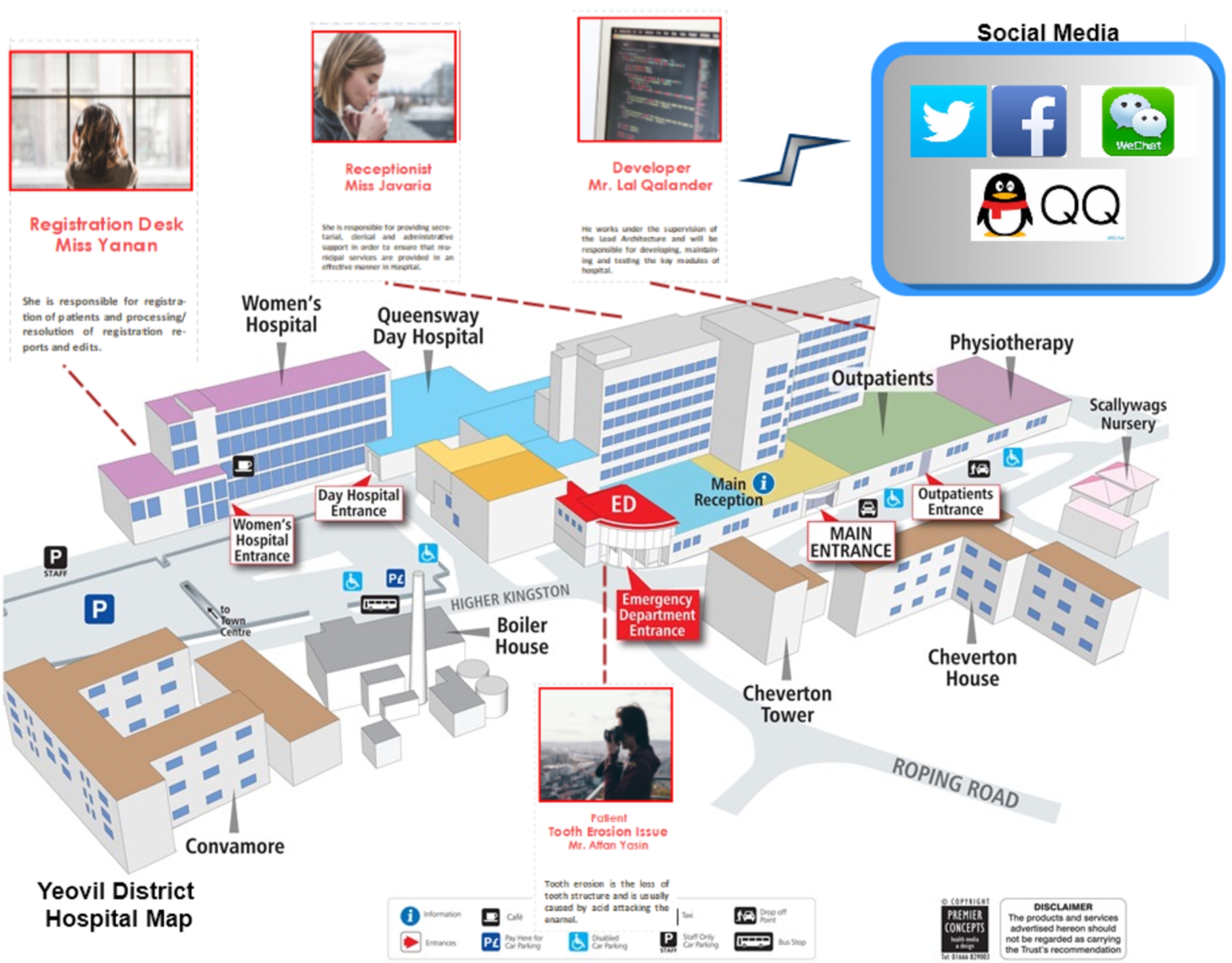
Yeovil district hospital map adapted for game settings.
An Attacker is a person who uses sociological and physiological principles on people to perform actions or to expose their confidential information or use deception via obfuscated image(s) or spoofed GUI component(s) of a computer program. In the game, the player plays the role of an attacker. Badge or Player role represents the character roles of the players in the game. Players role/badge is further motivated from the study [45,66]. As, in our game, we are only focusing on phishing attacks, we have only designed three identity card/badge for players. The motivation for designing this card is so that players can wear the hat of a social engineering attacker and can take actions in the game environment which they can use in real life. Figure 3 represents the role card/badge of the players.

Attacker role card.
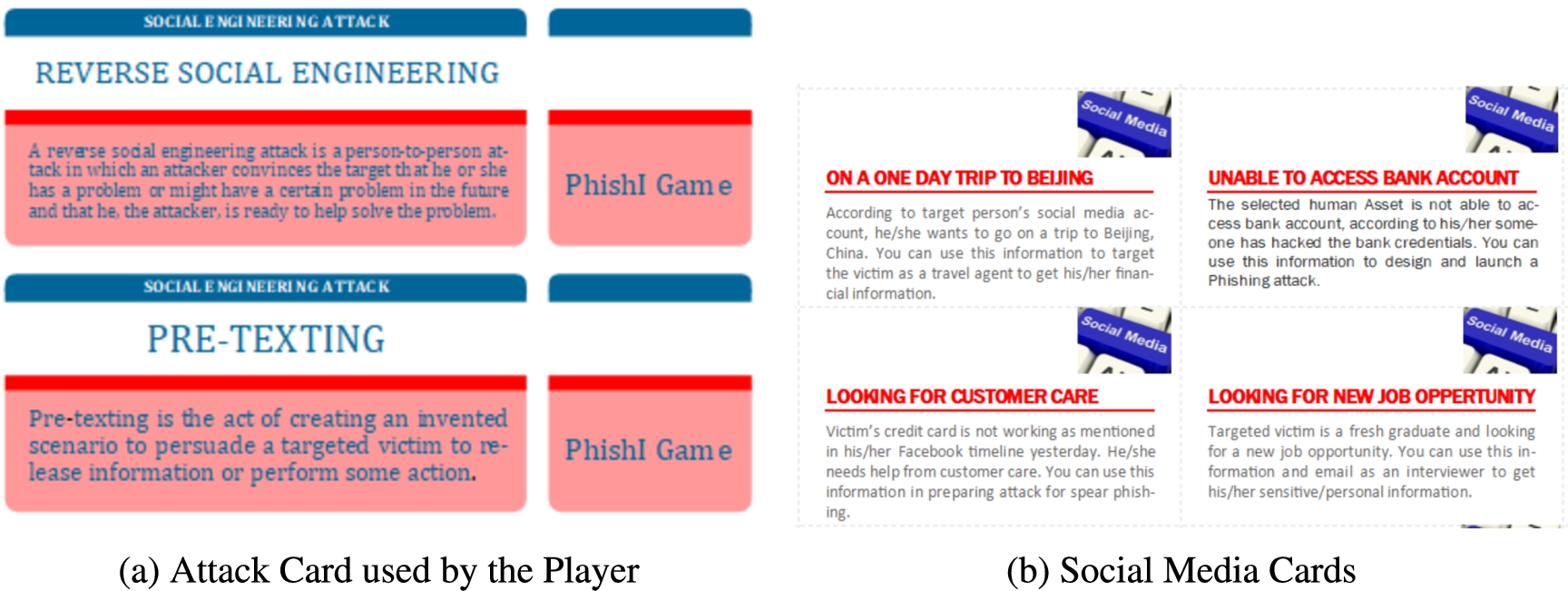
Attack cards and social media cards.
Behind any game, there is a body of knowledge and skills that is being practised. We have used Mouton’s social engineering ontology [50] as the design know-how of the game. As the focus of the game is on Phishing awareness we have only designed the attacks related to phishing. Figure 4a represents the attack cards used in the game, and Table 1 lists the complete set of attacks and possible explanation of each attack.
Attack type used in PhishI from literature
Attack type used in PhishI from literature
Psychology/compliance principles/human behavioral patterns
Social relations is the reasons why a target responds to the attackers’ requests. The reasons include: friendship, scarcity, authority and so on. Attackers used these psychology needs to attack the target victim. Figure 5 shows the compliance principles cards. We have used various compliance principles in our game which are shown in Table 2. One motivation to design this type of cards is that players may learn the psychological technique employed by social engineers.

Compliance principle or psychology to target adapted from [77].
In the game PhishI, we have proposed social media cards which represent social media information (Open Source intelligence) present on various social media channels, e.g. Facebook, Twitter, etc. The motivation of using cards which are not extracted from the database is that the players can enjoy the game irrespective of their ability to use Internet, their access to a social media account, etc. The social media cards represent the information regarding targeted assets. Social media cards can be seen in Fig. 4b.
Game process
The PhishI game has four phases, each phase takes 15–20 minutes.
Phishing message design cards used by players.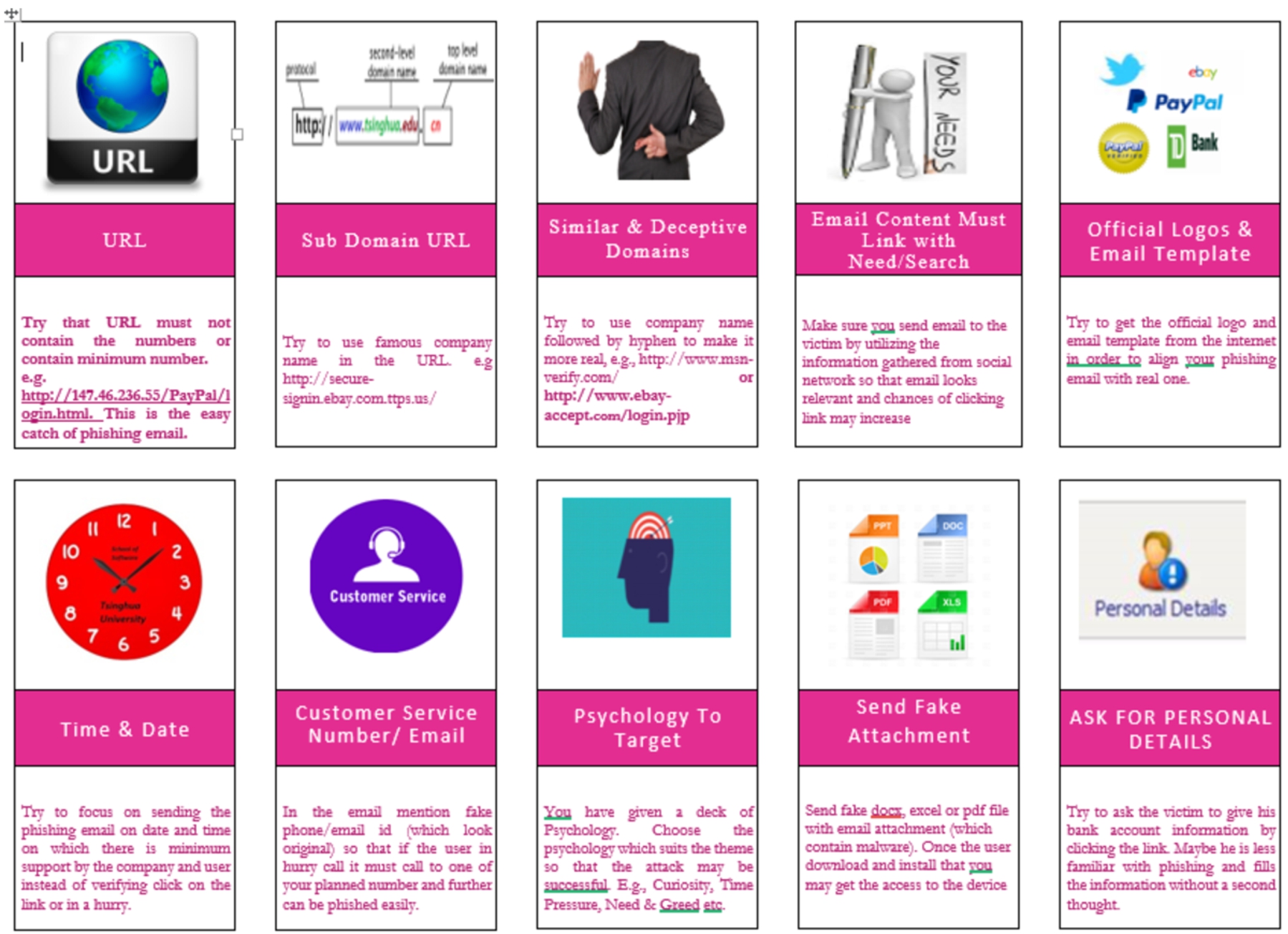
While constructing phishing emails, players refer to the phishing message design cards as discussed below:
The step by step procedure of the game process is described below:
Select a target victim on the map whom you want to attack using phishing email. Note the description of the victim in information gathering for future record. On the virtual space area of the game, select five cards from the social media deck representing about the victim players. Record all the information on the sheet given to the team. Draft an email using the compliance principles/psychology cards. Revise an email and review for possible improvements. Review by the opponent teams. Discussion Session.
Challenges
The players have to collect maximum information from various sources provided in the game. The players have to draft the email which relates to the needs of the target victim and by using various compliance principles. The players have to draft a phishing email with minimum deficiencies.
Win/lose conditions
The scoring system is divided into three areas, such as email structure (2 points), idea/scenario (2 points), and efficient usage of available information in drafting phishing email (2 points). The team which scores the most points wins the game. The decision will be done after the discussion session which is the last phase of the game.
What and where to teach in game:
In Table 3, we have explained which important learning aspects that we have embedded in different phases of the game.
What and where to teach in PhishI
What and where to teach in PhishI
A game design is a function of several areas which together create an environment in which users enjoy and learn. For example, game patterns, user experience, psychological aspects, knowledge base, and learning functions are some factors influencing the learning experience. To design an effective serious game, we have adapted game design patterns and psychological needs [26,58] which are relevant to our game. We have focused on four main areas, which are social engineering domain knowledge, psychological needs of players, learning functions, and human interaction. Table 4 represents the mapping of domains in our game.
Main concepts and embedding in PhishI game
Main concepts and embedding in PhishI game
Phishing attacks generally result in billions of dollars annual losses. To address the issue of phishing and spear phishing, researchers around the globe have been working on various solutions. Two types of techniques are used to test the awareness of participants. One is the test based technique, and the other is the wild technique. For our study, we have used a combination of the techniques adapted from the cyber-phishing platform [33]. We have conducted a controlled test activity and used survey to assess the learning of the participants. In parallel, we have used the observation methodology to evaluate the learning and collect feedback.
Section 3 explains the recruitment process of the participants and describes how we have designed the evaluation and our goals for the study. It also explains the results of the study.
Recruitment process
The game sessions were conducted with multiple sessions on campus. Author of the paper, lab mates, colleagues were invited to take part in the pilot experiment to understand and perform the game. In order to come up with the comparison chart we have used Delphi approach for the conclusion, in case of disagreement. To perform our game activity, we advertised it by posting flyers and by dispatching messages to (different) departmental groups. A total of 63 participants (Masters and PhD students) participated in the activity. With in 63, 40 were male and 23 were females. 63 participants were further divided into thirty teams (three sessions). The participants belong to various department. Some are from school of software, others are from Department of Energy, Department of Computer Science, and Material Science. English language is used as an activity language.
Empirical evaluation design
According to recent studies published in Nature [59] and Springer [4], a same threat can be interpreted differently. In phishing attacks, an identical phishing email sent by an attacker made some of the targets click on the infected link while others ignore it. In this scenario, where different people have different perceptions regarding the same threat, a possible way is to provide an environment where players can learn in a friendly environment. Moreover, they can discuss and share their knowledge and views. Our PhishI game provides this environment to the participants where they design and develop the phishing email and discuss with peers to understand the essence of a phishing email.

Empirical evaluation flow and time division.
Pre-game participants identification of URL
Figure 7 shows the detail of experiment timeline. In Table 5, we have shown the responses of the participants. The participants before the activity tried to identify the URL’s given on the paper sheet. From Table 5, we can see that participants correctly identified the famous URLs such as paypal, ebay but got confused while identifying URLs with numbers or combinations of famous websites. This pre-survey helped us identify the area(s) which need special attention in our game design.
Below are the goals for our study:
After the controlled activity, the players were asked to fill a survey questionnaire. Players were asked regarding the phishing attacks and their possible impacts on the individuals’ lives. For example, we asked: “It is extremely likely that my computer will be infected by a phishing attack in future.” The majority of the respondents’ agreed with the statement. Only one of the respondents disagreed. The diverse responses from the players depict that there is a room for improvement in the game which can be bridged by discussing the latest phishing attacks and their effects. This will, in turn, help the players know the importance of saving themselves from Phishing attacks. In the second question, the players were asked: “My chances of being targeted by phishing attacks are great.” The majority of the players agreed; however, some participants disagreed. This might be because the players trusted their anti-virus software to keep looking for such kind of emails. To account for this, players’ understanding of phishing can be further improved by adding limitations of Anti-viruses in the game. Finally, we asked the players: “I feel phishing attack will infect my computer in the future.” To this statement, players mainly selected the answers lied in the “agree” and “neutral” option.
The URL survey page which was taken before the game playing session was then again used to check post-game learning. Table 6 represents the responses from the participants. We can see that the majority of the participants have correctly identified the answers which represent the overall positive learning of the players. If we compare Table 5 and 6, we can see how the identification of URL improved after playing the game session.
Post-game participants identification of URL
Social media provides an opportunity for people and companies to share ideas and experiences. However, on the other side, they divulge personal as well as public information as well as other’s information. So, information disclosure on social media allows an attacker to access sensitive information from the personal and organizational systems. Currently, companies are using social networking sites for educational, industrial, and marketing purposes. But there is a need to educate general public about online information disclosure as well [49,80]. In PhishI game, using the social media information available to design the phishing email will probably make players think of how their information can be used against them. Furthermore, this will also make them consider disclosure of information online as something that can be dangerous. This insight was also observed during discussion session at the end of the game session.
We have used quantitative approach (survey) to calculate the feedback regarding the game and the already existing phishing knowledge of the participants. The questions of the survey were adapted from the already published literature, as we believe that this will increase the credibility of the obtained results. The post survey was divided into two broad sections: the demographic questions and independent and dependent questions which helped to support the research model. Furthermore, we have adopted 5 points Likert scale to gather the behavioral responses of the participants. In our survey, value five represents (Strongly Agree) and value one expresses (Strongly Disagree). For our research model, we have adapted Technology Threat Avoidance Model (TTAT) from [7] and Technology Acceptance Model from [3]. The post survey questionnaire can be seen in the Table 18. In total, we got 63 responses which, after pre-processing,5
The responses which had missing data, or outliers (the participants selected same scale for all the survey questions), etc. were removed.
Fun to Play has a positive effect on Intention to play.
Ease to Play has a positive effect on Intention to play.
Ease to Play and Fun to Play have a positive effect on Intention to play.
Intention to Play has a positive effect on Game Based Learning.
Phishing Knowledge has a positive effect on Game Based Learning.
Intention to Play and Phishing Knowledge have a positive effect on Game Based Learning.
Game Based Learning has a positive effect on Avoidance Behavior.
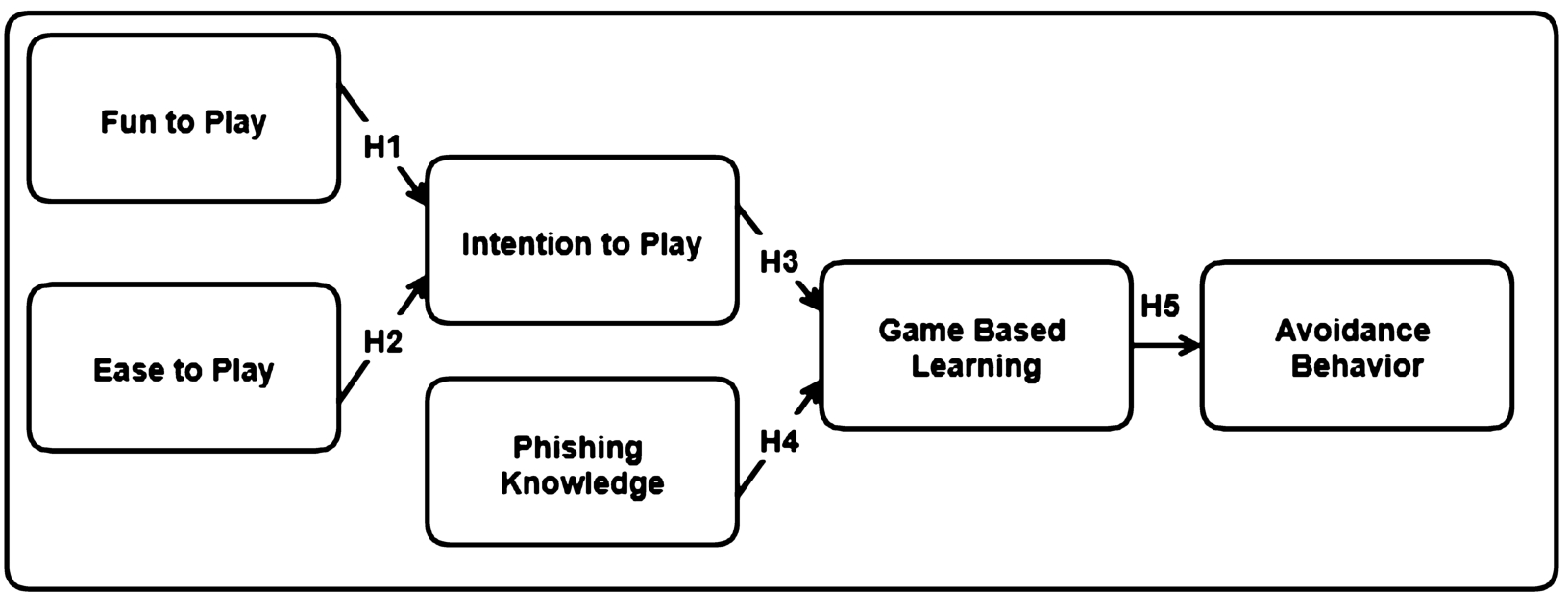
Research model.
Accordingly, we have come up with four linear regression equations:
Graph matrix plots all the scatter plots between the specified variables. This enables us to get a “feel” for the data before any regression analysis.

Graph matrix.
The regression results for our equations are shown in Table 7. From looking at the table, we can see that all7
The coefficient value for Fun to Play in the first equation comes out to be
We had earlier noted that (initially) it was generally hard for people to understand and apply phishing concepts. Although, from the perspective of our model, the level of Phishing knowledge of individuals is exogenously given,8
Lower as compared to other coefficient values in the table.
Regression analysis
Robust standard errors are used wherever the residuals were heteroscedastic.
For example, as an interpretation: a one unit increase in participants’ perception of Ease to Play is associated with a 0.8 unit increase in their Intention to Play, on average.
The correlation matrix for variables is shown in Table 8. For most of the variable combinations, there is a high correlation i.e. when one variable moves in one direction, the other one follows. So, for example, if a participant perceives a game as one that is fun to play, he/she is much likely to perceive it as an easy one too. Hence, when we add both of the variables together in one equation, one of the two turns insignificant once the other is controlled for. Although there is sufficient multicollinearity between our variables, the equations proposed above all are statistically significant at 5% confidence level (overall), which means that our model and the associated trends hold in the larger population.
Correlation matrix
All the variables are highly correlated i.e. participants’ perceptions move together across a range of variables. This will generate a tendency for our regression to suffer from multicollinearity.
Observation
Observation is an important research method it is used when we need to study human behavior, human behavior, body language, facial expressions, etc [43,60,77]. During the game session, two of the researchers acted as the observers. One researcher sat within one of the teams and observed their arguments and discussion points. The other walked around the room for a general and more holistic appreciation of the game sessions. Researchers noted interesting discussion points, such as “Lets phish the nurse as she may not know about phishing,” “Normally doctors have little time in their schedules. Hence, if we try deceiving them via situations built around the persuasion principle of “urgency”, it might work,” etc. From the discussion points, we can conclude that the participants were thinking from the perspective of an attacker, and we can believe that this will help to learn various techniques and strategies used by the social engineers. Some of primary observations on which all the researchers agreed upon are given in Table 9.
Primary observations and areas for improvement
Primary observations and areas for improvement
Players responses during game progression || an instance of game
Developing and reviewing PhishI emails
In this research study, knowledge of the participants were evaluated by various methods and techniques mentioned in research literature. Firstly, we observed the participants knowledge by analyzing the quality of phishing email generated by them. As discussed in game design section, the players have to use the given psychological principles, human weaknesses, attack techniques, and other valuable information to generate deceptive or phishing emails. The players, when generate a phishing email, possess working-knowledge on how any potential social engineer can use various techniques to target humans. Furthermore, discussion session (among different team members at the end of scenario generation session) helps to understand the context and other viable ways of attacks. The quality of phishing emails and discussion and feedback session reflects the learning outcomes of the game session. Some of the phished emails designed by the players during the activity session are shown in Appendix A.
Game feedback & survey [43,60]
To receive feedback related to the game activity, we asked players to fill the post-game survey. The results of the game, as shown in the results section, are overall positive. There is still much room for improvement. The feedback obtained by the researchers will be used to improve the game with the next version.
Limitations and validity threats
Some of the known limitations and validity threats are discussed below:
Related work on phishing awareness techniques
After an in-depth literature review, it can be argued that a significant number of cyber-security studies have been published on the topic of phishing techniques and awareness. If we further categorize these studies, we can see that phishing literature can be categorized into technical and non-technical solutions to counter phishing. Furthermore, many studies showed that computer users are vulnerable to phishing due to many reasons. Some of them are: i) “look and feel” of the fake website is greatly comparable to the original website and hence, could effect user’s ability to identify the difference; [19] ii) end users are not adequately aware of the phishing attacks, techniques, and process; [21] iii) end users don’t observe and pay heed to indications of browser security [74].
Commercial tools and table comparison
PhishI comparison with other similar games
R. Zhao et al. [79], designed a toolkit that could automatically create fraudulent websites which seemed much like their original counterparts. Zhao et al. experimented on 194 users to check the usefulness of this toolkit. After the experiment, the results showed that more than 90% users became a target of illegitimate websites. Zhao et al believes that phishing attacks in future will increase and there is strong need to defend these attacks collectively. In order to minimize the phishing attacks our game offers many aspects as compared to other similar games discussed in Table 11 & 12: i) players adopt the role of attacker in the game environment and think from the view of an attacker, which helps them understand the perspective of the attacker first-hand; ii) team-based learning and discussion helps to better understand the situation and other concepts; iii) our game provides a know-how about persuasion techniques, attack vectors, and human weaknesses which are useful in deciphering phishing emails in real life; iv) the use of social media (cards) to collect relevant information helps players understand how excessive online information disclosure can be utilized by the attackers.
We are living in a world where physical conflicts have now moved to the cyber space, which is becoming an ever more insecure place [46]. In this situation, security awareness is of vital importance. Thus, this makes it more necessary than ever to devise a mechanism for better security awareness [51]. To draw the attention of all user groups, we need a method that is more engaging and easy to use [30]. We know that awareness training methods are only effective if used properly [51]. In the past decades, more and more effort is spent on making the operating system and network environment secure. Due to this, attackers have changed their targets from information systems to human elements to break into organizations. The number of attacks in the recent past include attackers who have used social engineering as their method of invasion in target organizations [2].
This paper introduced PhishI as a systematic approach to design serious games for security education. We define a game design framework that integrates the body of knowledge on social engineering, the psychological needs of organizational players, and the candidate game pattern that serve different needs. We use spear phishing as a key example to show how the proposed approach works, and then evaluated the learning effects of the generated game based on empirical data collected from student activity. In PhishI game participants are required to swap phishing emails and be able to comment on the effectiveness of the attack scenario, the effectiveness of this method can be justified as this method of evaluation is used in recent designed games such as [10,77]. Our results showed that students’ awareness of spear phishing risks is improved and that the resistance to potential first attack contact is enhanced. Furthermore, the game showed positive effect on participants’ understanding of excessive online information disclosure.
In future, we are planning to design and develop an automated tool supporting the game composition process, with knowledge repository of known phishing attack scenarios. Thus, some functionalities as shown by of the game PhishI will be shifted online.
Footnotes
Acknowledgments
Financial support from the Natural Science Foundation of China Project no. 61432020 is gratefully acknowledged. We thank Awaid Yasin for reviewing the paper.
Phishing email generated by players
The players were given a context of a company and according to the situation and various variables such as Human Asset (target asset) responsibility in organization, his/her interest (social media information), compliance principle, players need to generate an email. Below mentioned are some of the phished emails generated by the players during game play. These emails generated by the players are shown in Table 13, 14, 15, 16. 17 for understanding.
Post activity survey
The post survey questionnaire can be seen in the Table 18.