



Abstract
As there is a continuous delivery of big data, the researchers are showing interest in the applications of cloud computing concerning privacy, and security. On the other hand, many researchers and experts of cybersecurity have commenced on a quest for improving the data encryption to the models of big data and applications of cloud computing. Since many users of the cloud become public cloud services, confidentiality turns out to be a more compound problem. To solve the confidentiality problem, cloud clients maintain the data on the public cloud. Under this circumstance, Homomorphic Encryption (HE) appears as a probable solution, in which the information of the client is encrypted on the cloud in such a process that it permits few manipulation operations without decryption. The main intent of this paper is to present the systematic review of research papers published in the field of Fully Homomorphic Encryption (FHE) over the past 10 years. The encryption scheme is considered full when it consists of plaintext, a ciphertext, a keyspace, an encryption algorithm, and a decryption algorithm. Hence, the review mostly concentrates on reviewing more powerful and recent FHE. The contributions using different algorithms in FHE like Lattice-based, integer-based, Learning With Errors (LWE), Ring Learning With Errors (RLWE), and Nth degree Truncated polynomial Ring Units (NTRU) are also discussed. Finally, it highlights the challenges and gaps to be addressed in modeling and learning about competent, effectual, and vigorous FHE for the cloud sector and pays attention to directions for better future research.
Introduction
Over the last decade, cloud computing has presented itself as a dominant computing platform, providing various benefits for both providers and clients [59]. One of the evident major benefits is that consumers may allocate their complicated calculations and gain at low cost from the latest technology and computational powers. The major advantage is that clients can assign their compound computations and it has an advantage over the best models and less expensive in computation power. One of the significant security problems is the security of sensible data. Some of the information leakages leak to tremendous harm to its owners. To encrypt it before maintaining it on a remote cloud server, it is advised for encrypting to save the privacy of the provided data. For preserving data privacy while transferring to the cloud, the traditional encryption models such as2
Advanced Encryption Standard.
Rivest–Shamir–Adleman.
Data Encryption Standard.
For solving the complexity, smart computations need to be performed on encrypted data, and this concept was initially developed by “Rivest, Adleman, and Dertozous” in the year 1978 [45], and those were conjectured the presence of privacy homomorphism. At present, the concept of FHE5
Fully Homomorphic Encryption.
In 2009, an IBM researcher named Craig Gentry has demonstrated the first feasible FHE model [26], which allows ring operations namely ciphertext addition and multiplication [27]. Initially, Gentry introduced the SWHE6
Somewhat Homomorphic Encryption.
The public key is augmented with a big set of vectors in which the encryption algorithms are partially homomorphic but not fully homomorphic. A ciphertext of the underlying scheme can be post-processed using this public key and the post-processed ciphertext can be decrypted with a low-degree polynomial, thereby achieving a bootstrappable scheme. Gentry’s developed FHE consists of several steps: First, it constructs the SWHE scheme that supports evaluating low-degree polynomials on the encrypted data. Next, it squashes the decryption procedure so that it can be expressed as a low-degree polynomial which is supported by the scheme, and finally, it applies a bootstrapping transformation to obtain a fully homomorphic scheme.
In 2010, Marten van Dijk et al. [20] have presented a second FHE scheme, which uses many of the tools of Gentry’s construction, but which does not require ideal lattices. Instead, they show that the SWHE component of Gentry’s ideal lattice-based scheme can be replaced with a very simple SWHE scheme that uses integers. The scheme is therefore conceptually simpler than Gentry’s ideal lattice scheme but has similar properties with regards to homomorphic operations and efficiency. The SWHE component is similar to an encryption scheme. It is not even additively homomorphic, however, it supports only additions, but it can be modified to support a small number of multiplications.
The lattice-based approach has shown a path to pursue in cryptography because it is based on simple mathematical operations, which result in low computational costs. SHE7
Selective Harmonic Elimination.
The comparison of relinearization with the parallel computing acceleration provides good execution efficiency, which has certain practical value and realistic significance. The significant benefits of relinearization with parallel computing are used to improve the execution efficiency of the algorithm, realize efficient encryption and a decryption operation, and effectively reduce the time homomorphic operation. The parallel FHE supports floating-point operation, which can be used to conduct fast and efficient encryption and decryption operations of massive floating-point data. It has high security and practicality, and it applies to the cloud computing scenario. The main purpose of parallel computing is to reduce the time complexity of homomorphic operations in FHE. Compared to the traditional encryption algorithms, this method does not require frequent encryption and decryption operations between the cloud and user, which can reduce the overhead of communication and computation resources. The user’s private data are saved in the form of ciphertext in the cloud, and the service provider cannot know the data content, which can prevent them from exploring the user’s privacy through illegal embezzling and tampering of user data. It has provided a security basis for the users to fully utilize the cloud computing resources to conduct massive data analysis and processing, and in particular, it can be combined with the secure multi-party computation protocol to solve the parallel computing acceleration of privacy security issue when the user outsources the computation service. The multiplication operation creates a significant noise, which is handled by using relinearization and modulus switching. The relinearization operation is reduced to the computation of many polynomial multiplications; a fast large degree polynomial multiplication is the key to achieve high performance.
The contribution of the present paper is given below.
To process the data or product services to the user, a reliable and efficient review of FHE using various algorithms is introduced.
To enhance the performance of FHE models, various FHE-based algorithms such as Lattice-based, integer-based, LWE,8
Learning With Errors.
Ring Learning With Errors.
Nth degree Truncated polynomial Ring Units.
To provide service for large-scale and heterogenous data securely, an efficient performance analysis is done.
To overcome the challenges of existing FHE-based algorithms, a new model needs to be introduced for effective and vigorous FHE for the cloud sector, whose research direction is mentioned.
The organization of the entire paper is designed in the following manner: Section 2 specifies different categorizations of FHE. In Section 3, the literature review on FHE is mentioned. Analysis of diverse FHE models is specified in Section 4. The research gaps and challenges of FHE are shown in Section 5. The conclusion of the paper is given in Section 6.
Fully homomorphic encryption
The title page should provide the following information:
FHE is an encryption technique, which is defined based on mathematical operations such as multiplication and addition. This kind of representation is initially introduced in Gentry’s research work. This FHE model performs basic arithmetic operations that can be done on encrypted information, therefore it is employed as a privacy-preserving approach. Moreover, it also performs arithmetic computations on an unlimited amount of data. In some of the contributions, multiplicative, additive, and XOR models were discussed, whereas the other researchers concentrated on hybrid encryption models that consist of biometric usage and quantum computing while developing the keys. When homomorphic multiplication is performed on the ciphertext, the length of the ciphertext increases. The computation time of homomorphic addition and multiplication is proportional to the ciphertext length. As a result, both time and space complexity grow as the computation with multiplication proceeds because the ciphertext length continues to increase as well.
Bootstrapping and relinearization operations are used only for the maintenance of ciphertext and do not modify the underlying plaintext. All the existing FHE schemes have the same property; every ciphertext includes some amount of noise that grows with every arithmetic operation. To keep the amount of noise within the threshold, we need an operation called bootstrapping to reduce the noise. If the amount of noise reached the predetermined threshold, the decryption result is incorrect. However, bootstrapping takes huge computation time. Bootstrapping involves heavy computation, which takes a few seconds to a few minutes. Owing to this heavy computation, many researchers are trying to build a practical application with a low depth circuit in which the homomorphic operations are completed without invoking the bootstrapping. By performing homomorphic multiplication, the length of the ciphertext increases, and the computation time and memory cost of multiplication also increases. Relinearization approximately involves the same amount of computation cost as that of homomorphic multiplication. A simple strategy to handle the ciphertext length is to relinearize the ciphertext after every multiplication; however, this strategy is not always optimal. The relinearization can reduce the length of the ciphertext but incurs almost the same amount of the cost as that of the homomorphic multiplication. Therefore when comparing bootstrapping and relinearization, bootstrapping is more expensive.
FHE
Categorization of fully homomorphic encryption
As mentioned earlier, FHE is determined by computing the mathematical operations, and it is classified into three types namely Multiplicative HE,11
Homomorphic Encryption.
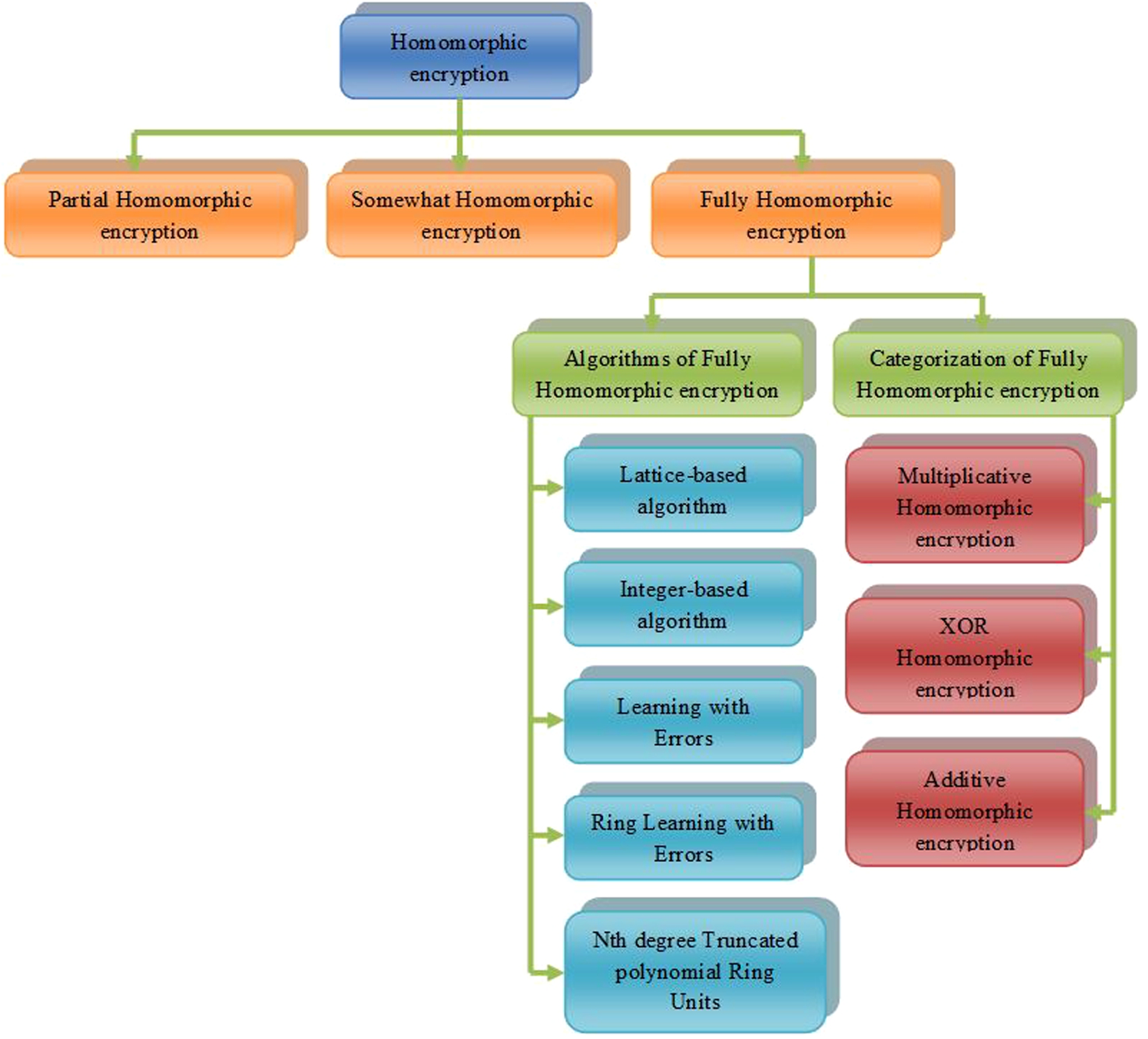
Categorization of fully homomorphic encryption and its algorithms.
In FHE, there are diverse types of algorithms like “lattice-based FHE, integer-based FHE, LWE, RLWE, and NTRU”, which are used in different applications, especially the cloud sector.
Key Generation: This lattice-based FHE determines five integer parameters that are declared as global. The count of coordinates of plaintext vectors is denoted as M, the ring feature over which the coordinates are built is indicated
Assume
A hard noise matrix
Encryption: Initially, the plain text message is developed as the message vector n in
In Eq. (3), the distributed and undistributed halves
This cryptosystem endures lattice-based and the attacks of selected plaintext, thus it ensures the security of data. This system is appropriate for appliances with restricted competencies as of its less complexity.
In the above equation, the term
The public key vector
In decryption, two masks are used for deciphering the text namely secret mask and even masks. The secret mask
Key Generation: Initially, selects
This results in the secret key
Encryption: This process is implemented on the actual image’s secret shares. The public key
The ciphertext as a pair of s and t is obtained for each image pixel. Decryption: The cipher image is recalled, which includes the encrypted pixel and it is indicated by
The result of
Evaluation: To produce a new encrypted image, the homomorphic operations are performed on the encrypted image, whereas the decryption provides the result with similar functionality. This homomorphic operation is subjected to the corresponding pixels of the two encrypted images. Let
The multiplication operation is also performed on the same two encrypted images, which is described as the set of tuples
In the above equation, the term
Key Generation: Consider an element
Encryption: The sample
In Eq. (16), the term
Decryption: To the ciphertext
Key Generation: Select the decreasing series of prime numbers
Encryption: The message is encoded to binary polynomial
Evaluation: It is done in the following steps.
Literature review on fully homomorphic encryption
Lattice-based fully homomorphic encryption
In 2013, Wang et al. [67] have proffered a novel approach called lattice-based linearly homomorphic signature approach over a binary field for designing an effective post-quantum linearly homomorphic signature model with the pre-image sampling function. By using the homomorphism of the lattice-based hash function employed in the developed signature model, linear homomorphism was attained. It has demonstrated that the developed model has fulfilled private property. Also, the proposed model was compared over the presented linearly homomorphic signature model. Here, the developed model has few benefits concerning computational cost, signature length, and size of the public key.
In 2014, Wang et al. [68] have introduced a novel hard issue named Bi-ISIS12
Bilateral Inhomogeneous Small Integer Solution.
In 2016, Singh et al. [62] have distributed decryption servers and a specific threshold count of insiders should cooperate for ciphertext decryption. With the combination of an extra randomized algorithm Tsplit, and threshold public-key encryption was named RTPKE,13
Resplittable Threshold Public Key Encryption.
In 2019, Aung et al. [5] have solved the open issue of designing the FHE model over integers for non-binary plaintexts in for prime Q(Q-FHE-OI) by not having the SSSP14
Sparse Subset Sum Problem.
In 2015, Santos et al. [58] have determined the development of the DGHV15
Dijk, Gentry, Halevi and Vaikuntanathan’s.
Approximate Greatest Common Divisor.
In 2020, Li [39] has constructed two leveled CLFHE17
Certificate Less Fully Homomorphic Encryption.
In 2016, Kim et al. [37] have recommended FHE that was an advanced version of cryptography, which has enabled arithmetic operations directly on the encrypted variables by not performing decryption. However, the proposed model provided many new problems, which were not analyzed for traditional controllers. In many scenarios, an encrypted variable has a limited lifetime, which is reduced as an arithmetic operation that was performed on it. The solution given by the proposed model was to run many controllers and orchestrate them sequentially. Thus, the efficiency of the developed model was demonstrated by considering an example of a quadruple water tank.
In 2019, Song et al. [63] have used the concept of packed ciphertexts for building a multi-bit FHE using a short public key based on the LWE problem. Especially, the proposed FHE model was constructed on the fundamental encryption model, which selected the samples of LWE from the Gaussian distribution, and the error of Gaussian was added to it. It resulted in reducing the count of LWE samples. The authors have confirmed that the proposed FHE model’s security was based on the hardness of the LWE problem and it was feasible. Moreover, a key switching procedure was formed for multi-bit FHE based on the concepts used by Brakerski for the key switching optimization process.
In 2019, Cheon et al. [14] have suggested a novel hybrid of dual and MITM18
Meet-In-The Middle.
In 2016, Ding et al. [21] have developed an approach named non-matrix key switching that consisted of pure key switching and key switching re-linearization. The removal of compound matrix operations of the traditional key switching approaches was done. This key switching approach was merged with modulus switching for constructing a leveled FHE model with bootstrapping from LWE. The proposed model provided complete door operation for making the structure of the circuit layer very clear. To upgrade the arithmetic circuit to any layer, bootstrapping was used, and made the computing ability of the proposed model efficient.
In 2015, Lu et al. [44] have developed encryption related to all the data of phenotype and genotype. FHE model was used for permitting the cloud for performing meaningful calculations for the encrypted data. From the frequency table, for Genome-Wide Association Study (GWAS), the analysis of typical statistics was done. The solution of the proposed model analyzed the frequency tables by considering both clinical and encrypted genomic data as input data. To assess these frequency tables effectively, a packing technique was introduced. Here, chi-square testing and linkage disequilibrium were considered as examples and revealed the idea of how to perform these algorithms effectively and securely in the setting of outsourcing. For secure calculations of GWAS, cryptographic solutions were based on FHE.
In 2015, Chen et al. [10] have utilized FFT19
Fast Fourier Transform.
In 2014, Zhang et al. [73] have introduced an efficient FHE from the assumption of RLWE without employing the bootstrapping, and standard squashing models of Gentry. For enhancing the earlier FHE model of Brakerski, the proposed FHE model was used. For decreasing the ciphertext length, the re-linearization approach was used, whereas for maintaining the noise level and reduce the decryption complexity by not developing the extra assumptions, the modulus reduction approach was employed. Further, the proposed FHE was extended to TFHE20
Threshold FHE.
In 2019, Agarkar and Agrawal [2] have attempted for addressing the problems of privacy and security at the prosumer side of the smart grid network. The proposed model was distinct from the earlier contributions in two approaches. A lightweight encryption-based privacy preservation model named LRSPPP21
Lightweight R-LWE-based Secure and Privacy-Preserving Scheme for Prosumer side network.
In 2019, Jin et al. [33] have designed a new model called RLWE-based HE communication protocol for user authentication and in a cloud computing-based IoT convergence environment, message management is done. A performance evaluation was performed on communication protocol in the conventional IoT environment and the developed communication protocol for ensuring security and safety. The research has verified security and safety by doing a performance evaluation of the present IoT environment and the suggested communication protocol. The research has performed on developed communication protocol’s decoding for verifying that it offered robust security and an equivalent level of effectiveness. Moreover, the communication protocol was designed for a safe communication structure to the user’s data transfer.
In 2017, Jiang et al. [32] have considered two aspects. Initially, a scheme has been shown for representing the testing and training data to perform statistical learning. The developed model initially transferred the data into integers and then encoded them into polynomial thus the decryption, homomorphic operation, and encryption was done effectively. The parameters of FHE was selected from RLWE for reaching the needs of efficiency. The user has to upload the encrypted information to the cloud server, later the server trained and tested the encrypted data that returned the predicted and evaluation outcomes to the user. Further, a comparison model was introduced on the encrypted data that have security on the known plaintext and ciphertext attack.
In 2020, Che et al. [9] have suggested an NTRU-type MKFHE22
Multi-Key Fully Homomorphic Encryption.
Decisional Small Polynomial Ratio.
Low Bit Discarded & Dimension Expansion of Ciphertexts.
In 2017, Chenet al. [13] have constructed QPC-PKC SWHE25
Quadratic Parameters With Correction-Public Key Compression Somewhat Homomorphic Encryption.
In 2016, et al. [7] have developed two architectures of optimized multiplier for a huge integer multiplication process. The first structure was the low-latency hardware of an integer- FFT multiplier. Next, for creating the new hardware design for huge integer multiplication in integer-based FHE models, LHW26
Low Hamming Weight.
In 2018, Gai and Qiu [24] have concentrated on blend arithmetic operations issues over real numbers and a new solution called tensor-based FHE was introduced. To perform blend arithmetic operations over real numbers, the developed model named FHE was employed the laws of a tensor. For revealing the usage of the developed model, both experimental analysis and theoretical proofs were provided.
In 2014, Yang et al. [71] have offered a novel targeted FHE based on the problem of the discrete logarithm. To examine the homomorphic encryption, public-key encryption cryptosystems were categorized. A new technique named “Double Decryption Algorithm” was used in the proposed model for fulfilling the fully or targeted the properties of FHE without using the models introduced by Brakerski like the relinearization model, and the other models developed by Gentry namely somewhat homomorphic and bootstrapping models. The proposed model was inspired by the BGN27
Boneh, Goh, and Nissim.
In 2019, Rahaman et al. [56] have recommended the selection of a privacy-preserving service framework for cloud-based service models. A cloud provider selected the best service from the services set based on QoS28
Quality-of-Service.
In 2020, Alabdulatif et al. [3] have developed a novel framework named privacy-preserving distributed analytics for big data in the cloud. FHE was employed as prominent and powerful cryptography, which can perform analysis works on encrypted data. To split both analysis and data computations into subset cloud computing nodes, which can run independently, the proposed distributed model has scalability. During the high-level analysis preservation accuracy, the proposed model quickly accelerated the encrypted data processing performance. The results have demonstrated that the suggested approach has high efficiency in terms of both accuracy and performance analysis.
In 2015, Chen et al. [12] have kept based forwarded the leveled FHE model RLWE for improving the efficiency of FHE in the future by constantly applying both batches approaches accessible. The proposed model thus permitted several plaintext values that were double packing into each ciphertext for supporting single-instruction-multiple-data-type operations that decreased the ciphertext expansion ratio efficiently. To attain arbitrary homomorphic permutation operations, an efficient evolutionary method was introduced on a packed ciphertext and also provided using multiple given key-switching hints. In 2016, Sun et al. [65] have introduced a leveled FHE based on RLWE by the approximate eigenvector approach under the similar public key that the security was decreased to the shortest vector issue on the ideal lattices in the worst scenario. By the secret key switching, the leveled FHE under discrete public keys was realized without reducing the dimension. The public of the leveled FHE was combined with the identity, and an effective identity-based leveled FHE model was put forward from the assumptions of RLWE. The analysis has shown that the proposed identity-based leveled FHE was outperformed over plaintext attacks.
In 2016, Gupta and Pal [19] have suggested the symmetric FHE model based on polynomial over integer rings, which was termed as SWHE because of noise accumulation after some operations that were made FHE with the process of a refresh. For proper decryption, large ciphertexts were refreshed and this was done after a specific amount of homomorphic operations. Based on the complexity of large integer factorization, the hardness of the model was dependent. Moreover, it was needed polynomial addition that was computationally expensive. The test outcomes were revealed for supporting the proposed claim. In 2019, Mainardi et al. [48] have offered an attack over the primitives of FHE, in which a distinguisher to a single plaintext value was present. Two noise-free homomorphic encryption models that hold the property and offered the complete process of the attack over them. The efficiency and performance of the proposed attacks have validated the implementations of red the prototype of the mentioned models, and recommended a counter metric adapted to the models at hand.
In 2015, Hayward and Chiang [30] have offered processing dispatcher implementation that considered a set of operations iteratively performed on FHE encrypted data and divided them among the count of processing engines. A private cloud was developed for helping the processing engines and by using engines, the processing time was measured. The time employed for transferring the data and the time taken for doing the computations using these four levels of parallelization were given. Moreover, the time taken for computation servers spent in each of the operations such as subtraction, division, addition, and multiplication were deployed. By performing parallel processing, the time taken for the analysis was given. The results have revealed that the developed model enhanced its performance over the computations performed on a single node.
In 2018, Xu et al. [70] have introduced fully DFHMT29
Dynamic Fully Homomorphic encryption-based Merkle Tree.
Streaming Authenticated Data Structures.
In 2017, Harris et al. [28] have considered symmetric models and concentrated on MORE31
Matrix Operation for Randomization and Encryption.
In 2016, Cheon et al. [15] have suggested and evaluated the approximate polynomial common divisor issue that was viewed as a polynomial analogue for the approximate integer common divisor issue. Extensive cryptanalysis was performed as it was new, and it was done by applying discrete known attacks over the structurally same issues. A small root-finding approach was introduced to the multivariate modular equation model and implemented to the developed issue. These evaluations confirmed that the developed issue was complex with suitable parameters.
In 2012, Kaosar et al. [36] have been introduced privacy-preserving data mining algorithms for acquiring the best result during privacy maintenance. To partition the datasets horizontally, both party ARM32
privacy-preserving Association rule mining.
In 2014, Doroz et al. [22] have presented the complete analysis of a huge multiplication model in custom hardware. A new architecture was designed for realizing a million-bit multiplication model based on the Schonhage-Strassen algorithm. By using NTT,33
Number Theoretical Transform.
In 2019, Rajan et al. [57] have introduced a dynamic multi keyword-based search algorithm, which included improved FHE and prims algorithm. Keywords were sorted and constructed searchable index for both files and keywords based on keyword frequency present in the document. By using prim’s algorithm, the dynamic tree was constructed based on file and keyword. With the help of two way Hash table for effective search and document retrieval, the encrypted files in the tree were indexed to keywords. By using modified ring-based FHE, the files were encrypted. The test outcomes have shown that the developed model provided the throughput encryption and decryption that taken less indexing time for the files index.
In 2019, Min et al. [52] have offered a parallel FHE algorithm, which helped floating-point numbers. The developed model not only improved the supported data types with the conventional FHE algorithms but also employed the multi-node features in the cloud environment for performing parallel encryption by performing the ciphertext computation groupwise. The outcomes have revealed that the developed encryption model attained maximum speed with high efficiency.
In 2018, Chen et al. [11] have employed multi-bit plaintext space using fixed-point number encoding. Later, by scaling the fixed-point arithmetic, the bootstrapping algorithm was merged with FHE. For decreasing the plaintext at the time of training, a 1-bit gradient descent approach was employed, whereas, for sigmoid function, a minimax polynomial approximation was utilized. In 2017, Sun et al. [66] have introduced a usual structure of the mobile healthcare network and determined three typical secure medical calculations that consisted of the average heart rate, chi-square tests, and long QT syndrome detection. FHE was leverage for attaining calculations on ciphertext and to encrypt the healthcare sector information. To compute the aforementioned three medical data, an effective Downlin’s FHE model was used. In the proposed model, only one ciphertext was returned to the receiver, thus homomorphic decryption was required only once. Initially, chi-square tests were done using homomorphic additions and multiplications that were employed for knowing whether varicose veins were related to overweight or not.
In 2013, Liang [41] have constructed a the symmetric QFHE34
Quantum FHE.
Quantum One-Time Period.
In 2020, Harris et al. [29] have considered HE for processing over encrypted information for attaining the privacy of the user. Later, a solution was presented, which offered more security to the symmetric HE algorithms. The solution implemented the primitives of dynamic architecture and diffusion, which improved the traditional symmetric HE models to overcome the disadvantages. Based on polynomial computations, Domingo Ferrer was the famous symmetric HE model simultaneously suffered from few risks and particularly sensitive to known plaintext attacks.
In 2017, Krishna et al. [38] have developed a new method for Asymmetric mode encrypting data. To generate a field with more prime numbers, a generator matrix was employed. The ternary vector, generator matrix, and prime number were employed as global variables, which were utilized for computing the subkeys and public key. A digital signature model was introduced by the private key and global variables that supported the feature such as user authenticity. In homomorphic encryption, this method was employed in which the calculations were performed on ciphertext and produced an encrypted result during decryption that matched the outcome of operations done on the plaintext.
In 2015, Liang [42] have suggested the QFHE model that allowed the transformation of arbitrary quantum on any encrypted information. This model has been confirmed as the perfect one for security. The decryption key was discrete from the encryption key in the developed model. However, this encryption was not shown. The evaluation algorithm was unique to the encryption key, thus the proposed model was appropriate in computing among two parties.
In 2020, Amuthan and Sendhil [4] have introduced HGSW-DM-FHE36
Hybrid Gentry, Sahai, and Waters and DM-based FHE.
Fully Homomorphic-Elliptic Curve Cryptography.
In 2019, Prema [55] have enhanced node privacy in vehicular networks by having decreased communication overhead. Homomorphic encryption with pseudonym was employed in VANETs38
Vehicular Ad Hoc Network.
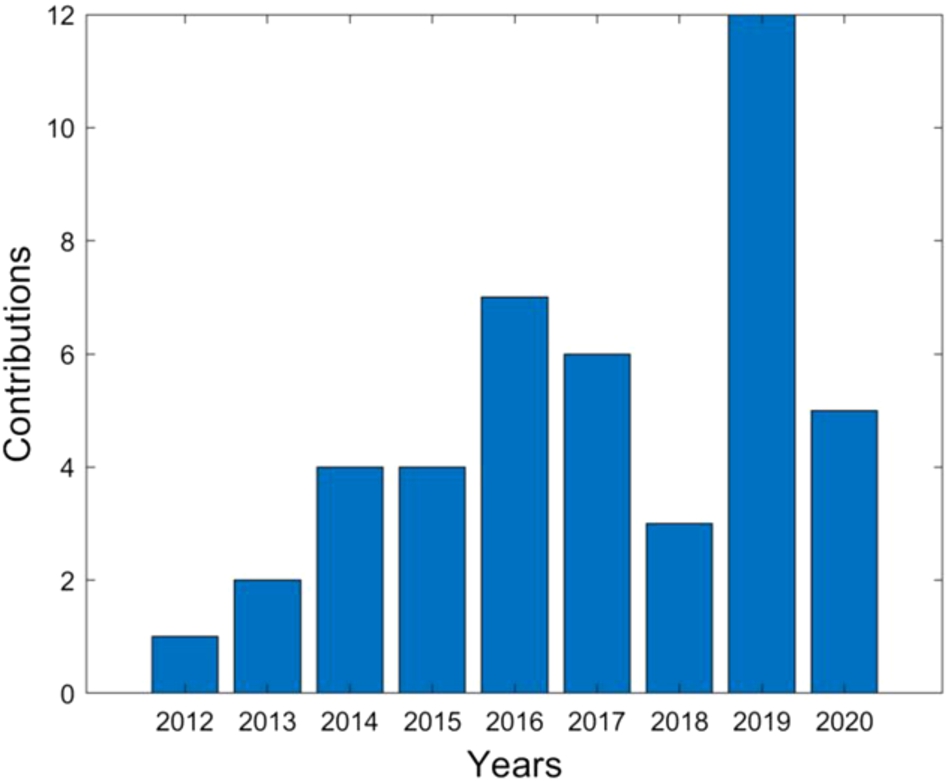
Chronological review of fully homomorphic encryption.
Chronological review
The complete review of discrete algorithms based on FHE is graphically represented in Fig. 2. In the year 2020, the different contributions of FHE are 11.3%. The contributions in the year 2019 seem to be 27.2% for FHE-based algorithms. FHE-based algorithms contributed in the year 2018 is 6.8%. Here, it has been observed that the contribution of various FHE-based algorithms in the year 2017 is 13.6%. Moreover, the contribution in the year 2016 is found to be 15.9% for effective FHE-based algorithms. In the year 2015, and 2014, the contributions of FHE-based algorithms is 9%. The contributions of FHE-based algorithms in the year 2013 is 6.8%. The classification of FHE-based algorithms that are contributed in the year 2012 is 6.8%. Thus, it is seen that the contributions of various FHE-based algorithms in the year 2019 are seemed to be more and the contributions in the year 2012 is seemed to be less and more researches need to be implemented in the upcoming years.
Algorithmic classification and its improvements
The categorization of FHE-based algorithms is shown in Fig. 3, in which different types of methods are used. FHE-based algorithms such as “lattice-based FHE, integer-based FHE, LWE-based FHE, RLWE-based FHE, and NTRU-based FHE” algorithms are commonly used. Some of the lattice-based algorithms are the lattice-based linearly homomorphic structure, lattice-based key extension protocol, and RTPKE. MKFHE algorithm comes under NTRU-based FHE. In RLWE, the algorithms such as GWAS39
Genome-Wide Association Studies.
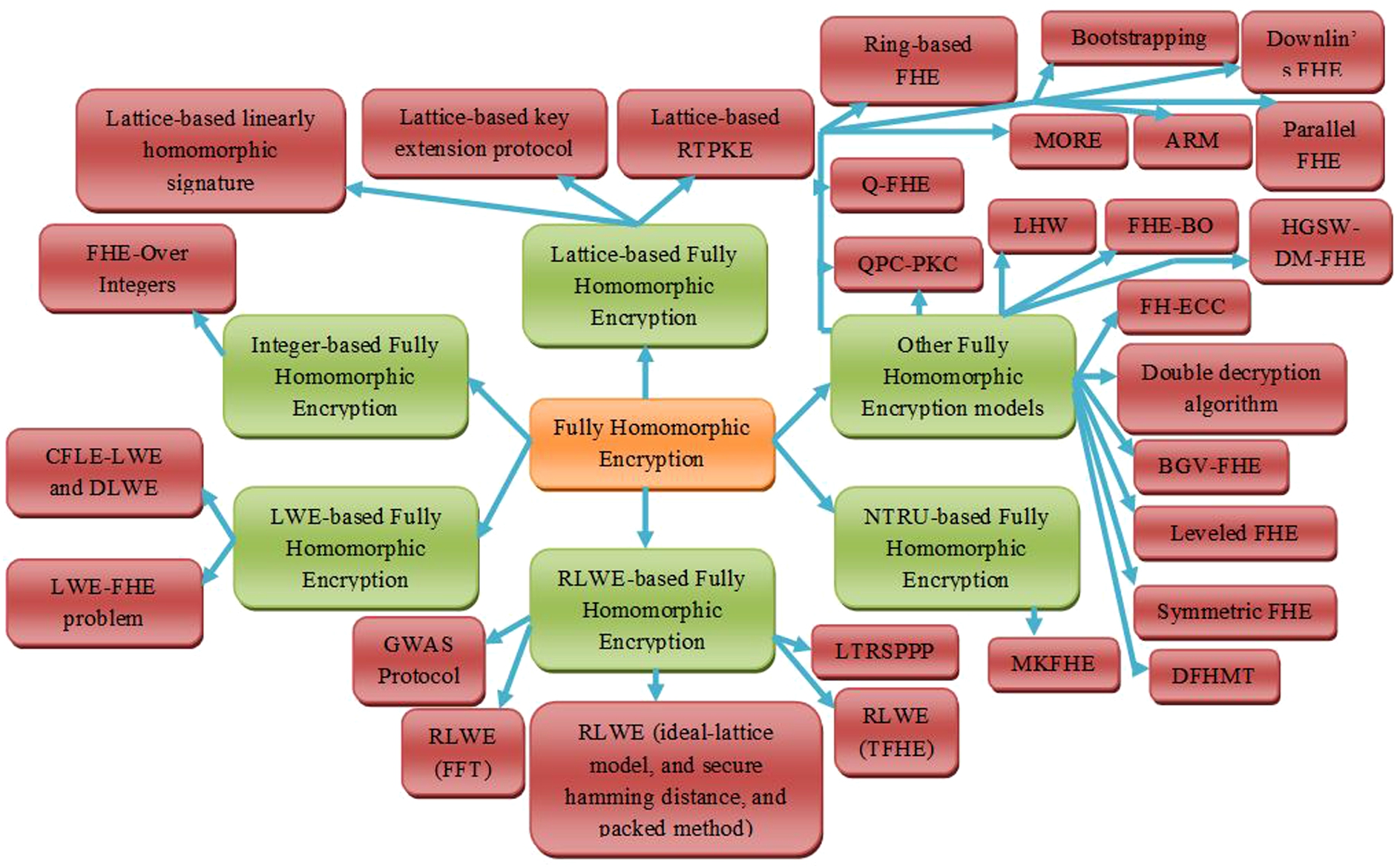
Diagrammatic representation of fully homomorphic encryption-based algorithms.
In Fig. 4, the diagrammatic representation of various environments employed for FHE-based algorithms in the cloud sector is depicted. From the pie chart, the MATLAB is used in 31% of the earlier contribution to implementing FHE.In the earlier contributions, the environment called C programming language is used in 23% of the researches. Moreover, the environment used in earlier researches is 15% for FHE in the cloud sector. The other languages like “Java, Python, Spartan-6, and Google Cloud Platform (GCP)” are used for classifying FHE-based algorithms. From the analysis, MATLAB is frequently employed for executing FHE in the past researches when compared to other platforms.
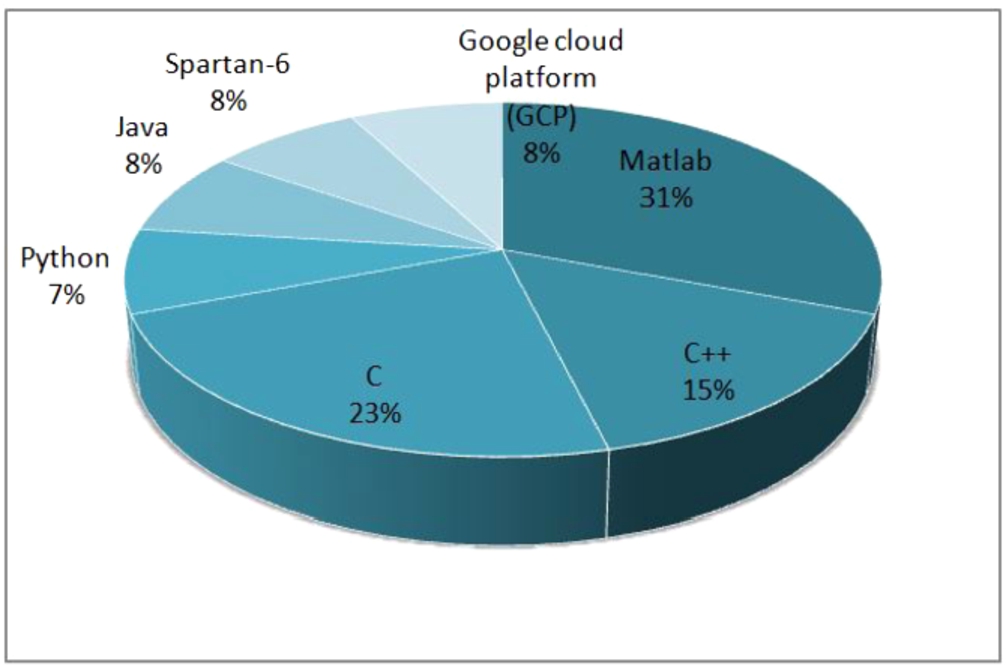
Pie chart representation of platforms used for FHE-based algorithms.
In Table 1, the analysis of performance metrics for FHE-based algorithms is tabulated. Here, the evaluation metrics like “latency, execution time, encryption time, computational cost, and decryption time” are majorly utilized in past researches. The measures which are used at rare are mentioned in the miscellaneous tab. The accuracy is taken in 6.6% of the earlier contributions. The execution time is considered in 51.1% of the earlier researches. Moreover, the encryption time is taken into consideration by 8.8%, whereas decryption time is considered in 6.6% of the earlier research works. The computational time is taken in 4.4% of the past researches of FHE. Hence, it seems that execution time is considered in several research works earlier and it can analyze the efficiency of the FHE-based algorithm.
Analysis of performance metrics concerned for fully homomorphic encryption in the cloud sector
Analysis of performance metrics concerned for fully homomorphic encryption in the cloud sector
In the latest cryptography system, FHE is considered as one of the holy grails [6]. For security and privacy issues in cloud services, it is extremely expected to be a golden key. During the implementation of FHE, there is a major confront, which is that several contributions have employed theoretical notions and those concepts don’t work in reality. Another challenge in this field is the implementation of the bootstrapping procedure. This bootstrapping process has been released by IBM 3 years later after completing the implementation, which is not a trivial activity. By Ducas and Chillotti [17,23], the remaining applications related to bootstrapping are performed, which has implemented bootstrapping only when only one gate is considered for a particular scenario. To model the functions, secure parameters have been used and this makes testing and running complex. For the keys, gigabyte magnitude is required [23]. Some of the existing FHE challenges are mentioned below.
Platform as a Services.
Software as a Service.
Infrastructure as a Service.
Virtual Machine.
Application Program Interfaces.
Generally, the selection of SWHE and FHE is done based on the application, which is required for encrypting homomorphically. There is no doubt about the significance of the FHE-based model, but the confront is that by not doing any modification, these cryptosystems are not so realistic. For instance, the language of the main function used for encryption and decryption, type of plaintext, mathematical operations employed, key size, and size of the text used for encryption. It is quite significant to consider the realistic implementation even these various operations and parameters are used for implementation. Moreover, it should not be forgotten that this compound approach has first relied on SWHE. Thus, a new model needs to be introduced, which should be initially based on the SWHE model. However, there are no issues in the practical implementation of the SWHE model, which doesn’t mean that SWHE is easy when compared to FHE as the developed cryptosystems must ensure some confidentiality, security level, and data integrity. This also remains unchanged for revealing all the conventional attacks over SWHE or FHE models and also for recognizing the attack types. The basic problems can be recognized by the researchers underlying the traditional method’s security like ElGamal and RSA encryption models. The encryption of messages using the FHE scheme may result to suffer from hacking by unauthorized users. This problem is the key subject to another very attractive research area called the encrypted key generation process. It paves the way to promote more security in the cloud sector through the general data sanitization and restoration process. This key-encryption process is hard to achieve in reasonable implementation as it secures the overall data with an encrypted key by a new enhanced algorithm under FHE.
FV-NFLlib [20] is a software library implementing a homomorphic encryption scheme (HE). FV-NFLlib implements the FV45
Fan-Vercauteren.
The present paper has introduced a literature survey of various contributions published in FHE. The evaluation was majorly concentrated on various classifications of FHE models. The classification of FHE such as multiplicative HE, XOR HE, and additive HE was focused and reviewed. By using various methods in FHE such as Lattice-based FHE, integer-based FHE, LWE-based FHE, RLWE-based FHE, and NTRU-based FHE, the contributions were discussed. In addition to this, the performance measures concentrated on diverse contributions were analyzed. Further, the analysis of various platforms that were used for implementing FHE was discussed. Finally, the research gaps and challenges of FHE were given that helps to introduce the best method of FHE for the cloud sector.