



Abstract
A double-authentication preventing signature (DAPS) scheme is a digital signature scheme equipped with a self-enforcement mechanism. Messages consist of an address and a payload component, and a signer is penalized if she signs two messages with the same addresses but different payloads. The penalty is the disclosure of the signer’s signing key. Most of the existing DAPS schemes are proved secure in the random oracle model (ROM), while the efficient ones in the standard model only support address spaces of polynomial size.
We present DAPS schemes that are efficient, secure in the standard model under standard assumptions and support large address spaces. Our main construction builds on vector commitments (VC) and double-trapdoor chameleon hash functions (DCH). We also provide a DAPS realization from Groth–Sahai (GS) proofs that builds on a generic construction by Derler et al., which they instantiate in the ROM. The GS-based construction, while less efficient than our main one, shows that a general yet efficient instantiation of DAPS in the standard model is possible.
An interesting feature of our main construction is that it can be easily modified to guarantee security even in the most challenging setting where no trusted setup is provided. To the best of our knowledge, ours seems to be the first construction achieving this in the standard model.
Introduction
Digital signatures (DS) are a cryptographic primitive that guarantees authenticity and integrity. Security is defined via the notion of unforgeability, which protects the signer (and the verifier in the sens of non-repudiation), but there is no notion of a signer behaving badly. There are however applications in which the signer should be restricted; for example, a certificate authority should not certify two different public keys for the same domain.
Double-authentication-prevention signatures (DAPS) are a natural extension of digital signatures that prevent malicious behavior of the signer by a self-enforcement strategy. A message for DAPS consists of two parts, called the address and payload i.e.,
Certificate subversion. Consider a certificate authority (CA) issuing certificates to different severs. A certificate is of the form
Cryptocurrencies and non-equivocation contracts. In cryptographic e-cash systems (a.k.a. “Chaumian” e-cash), double-spending is prevented by revealing the identity of the misbehaving party [13]. This works well in systems where some central authority (e.g. a bank) can take concrete actions to penalize dishonest behaviors (such as blocking their accounts). In the setting of “cryptocurrencies”, disclosing the identity of users is much harder to implement because of the decentralized nature of these systems, and indeed double-spending is typically prevented by consensus. Transactions are considered effective only after a certain amount of time. This naturally prevents double-spending but induces delays to reach agreement. Using DAPS to sign transactions could provide a strong deterrent to malicious behaviors. Double-spenders would disclose their secret signing keys, which, for the case of Bitcoin, could translate to a financial loss.
Translating to the DAPS setting, the address would be the coin and the payload the receiver when spending it. For cryptocurrencies it is natural to implement this mechanism via DAPS, as digital signatures are already needed to authenticate transactions.
Concretely, one can make non-equivocation contracts (i.e. contracts that allow penalizing parties that make conflicting statements to others, by the loss of money) by combining a DAPS scheme and a deposit. To ensure that an extracted DAPS secret key is a worthy secret, it can be associated to a deposit. Each party is required to put aside a certain amount of currency in a deposit which can be securely retrieved by the owner at the end of a time-locked session if the owner has not made conflicting statements during the session. Otherwise, anyone obtaining the extracted secret key also has access to the funds.
Moreover, by finding the secret key a user can give a fraud-proof against a malicious signer (by getting the access to its deposit) without revealing any information about its claim (as others may also want to copy its claim).
Whether the solutions based on DAPS are effective for the real world problems still has remained to be seen, but the idea itself is interesting from the cryptographic point of view.
Challenges in constructing DAPS
We next discuss some general challenges in constructing DAPS regarding their security, efficiency and functionality. Our aim is to construct a scheme that achieves a good balance among them.
Exponentially large address space. The address part of a message for DAPS typically refers to a user/coin identity. Only allowing a polynomial number of predefined identities [17,28] severely limits the possible applications, while an exponential number of addresses practically amounts to no restrictions, as one can use a collision-resistant hash function to map into the address space.
Security when no trusted setup is provided. DAPS schemes should satisfy two security notions. Unforgeability ensures that signatures from an honest signer (who does not sign compromising message pairs) are secure against an outside attacker. Key extractability requires that issuing signatures on compromising message pairs leaks the signer’s signing key; the notion can be defined with respect to a trusted or untrusted setup. The former assumes that the signer generates its own key material honestly (or by a trusted party) while the latter notion allows for malicious behavior.
The majority of existing DAPS constructions assume a trusted setup [3,17,28,29]. Those that do not are in the random oracle model [30] or have polynomial-size signatures (w.r.t. the length of the address) [6] or only support small address spaces [17,28].
Standard assumptions. While giving reductionist security proofs is the preferred method of gaining trust in a cryptosystem, these guarantees are only meaningful if the underlying hardness assumptions have been well-studied. Moreover, such analyses often rely on idealizations like assuming hash functions are random functions (in the ROM). Our schemes are proven secure from very well-studied assumptions (e.g. RSA, CDH) and we do not make idealizing assumptions in our proofs, i.e., they are in the standard model.
The challenge of realizing DAPS, in the standard model and based on simple assumption, mainly is due to the key extractability property. One may wonder if it is not possible to convert a usual signature scheme to a DAPS. In particular, discrete logarithm based constructions might seem good candidates to also realize key extractability (i.e., beyond unforgeability). Indeed this idea is followed in some DAPS constructions in ROM (e.g., [3] which can be seen as a DAPS version of Schnorr signature) but it seems hard to implement it in the standard model. Beyond the obvious difficulty that no single, stateless, scheme directly relying on the discrete logarithm assumption is currently known [26], another (more subtle) issue comes from the fact that, to prove the key extractability, one should be able to extract the secret key without controlling in any way the public key material. Let us clarify this point more in detail. A typical approach when proving the security of a cryptographic scheme consists in constructing a simulator that given some hard to solve mathematical problem P should be able to turn successful attacks to the scheme into solutions to P. A key aspect of this methodology is that the simulator is allowed to create the (public) key material so to embed the hard problem P into the scheme it wants to prove its security. Such a possibility however is precluded when proving the key extractability as, here, the adversary is the signer itself. This makes standard approaches for proving the security of signatures much harder to implement in the context of DAPS.
Efficient/concrete instantiations. Some prior DAPS schemes [16] that claim short signatures or achieve some of the above properties are black-box constructions from building blocks whose instantiation is often left open. This can be a non-trivial task and leaves the concrete efficiency of such schemes unclear.
Our contribution
In this paper we present new DAPS constructions that address all of the above challenges. Our main contributions are as follows.
Exponentially large address spaces without random oracles
We circumvent many of the difficulties arising in previous works by presenting our DAPS-VC-DCH scheme which combings the vector commitments (VC) [11,24] and double-trapdoor chameleon hash functions (DCH) [8,10]. Our methodology follows the authentication tree approach also adopted in previous work (e.g. [30]): a signature is an authenticated path from a leaf (whose position is the address part of the message) to a given root (the public key).
In previous work, the signer either had to create the whole tree in advance (thus forcing the address space to be polynomial-size) or use the random oracle to be able to deal with exponentially large address spaces. In our construction the signer creates the tree incrementally using the equivocation properties of the chameleon hash. Moreover, we prove our schemes secure by relying on the double-trapdoor property: the simulator will be able to issue signatures by knowing only one of the two trapdoors. If an adversary manages to create a forgery (or if it signs a compromising pair), our reduction uses this information to extract the other trapdoor with non-negligible probability. We moreover use vector commitments [11] to realize a “flat” authentication tree (i.e. a tree with branching degree
Security without trusted setup
Interestingly, our construction can be easily adapted to the setting where no trusted setup is available. This comes at the cost of longer signatures and is in contrast to previous proposals that all rely on trusted setup (or random oracles). The basic intuition here is that double-trapdoor chameleon hash functions can be realized in the untrusted setup setting (we present a candidate construction in Section 4), and substituting the vector commitments with a standard collision-resistant hash function, the construction highlighted above still works. The downside is that the produced signatures are now longer, as more values have to be stored in the authentication chain. Very informally this is because, replacing Vector Commitments with collision-resistant hash functions, leads to a binary (rather than “flat”) authentication tree.
We remark that the DCH schemes originally suggested in [8,10] implicitly assume trusted setup. Here we present a DCH scheme that does not need a trusted setup. While our proposed DCH scheme was informally suggested in [10] (Section 3.1 of the full version), here we present a concrete construction and prove its security for the general setting where no trusted setup is available.
A more general definition
We also propose a slightly more general (with respect to previous work) definition of key-extractability that, we believe, could be useful in other contexts as well. Our definition introduces a predicate
A Groth–Sahai-based construction
As additional contribution of this paper we propose a DAPS construction from Groth Sahai proofs [20] (DAPS-GS), which builds upon a construction proposed by Derler et al. [16]. The latter scheme, which we will refer to as DAPS-DRS, supports an exponentially large address space and is based on NIZK proofs which is reminiscent of the technique used in compact e-cash to trace double-spenders [9]. The authors instantiated their construction in the random oracle model (ROM). We modify their construction so that the NIZK proof system can be instantiated with the Groth–Sahai proof system [20]. This system provides efficient NIZK proofs in the standard model and under standard assumptions (for a restricted class of languages).
An interesting difference between our DAPS-GS scheme and DAPS-DRS is that the latter uses a fixed-value key-binding PRF. We assign this task to a commitment scheme and can therefore relax the requirements on the PRF to standard PRF security. The authors of DAPS-DRS instantiate their key-value binding PRF F with the block cipher LowMC [1]. They thus need to make the (arguably non-standard) assumption that this block cipher is a fixed-value key-binding PRF. The commonality of our DAPS schemes (DAPS-VC-DCH and DAPS-GS) is that they are both in the standard model and support large address spaces. In fact, we instantiate the generic construction of [16] by Groth–Sahai NIZK proof system (as DAPS-GS) to provide a standard-model scheme and compare it against our main, more efficient, DAPS-VC-DCH (DAPS-DCH).
As a final note, we remark that our solutions compare favorably to previous work not only in terms of security guarantees, but also in terms of efficiency. Our most efficient construction (for a large address space) based on vector commitments also provides nice trade-offs between the size of its signatures and the size of its verification keys: verification keys grow with the branching degree q of the underlying authentication tree, while signatures grow with the depth h of the tree. A more precise comparison with previous works is given in Table 1.
Comparison to prior work. Here n is the bit length of the address, written as
for integers h and q; values
and
are LWE parameters, and
denotes the proof size in the underlying NIZK system for statements of length n. Finally,
stands for the size of group elements, and p comes from the order of the group
,
is the bit length of the random oracle/hash function output, and N is an RSA modulus
Comparison to prior work. Here n is the bit length of the address, written as
Ruffing, Kate, and Schröder [30] present a DAPS scheme based on Merkle trees and chameleon hash functions in the random oracle model. Their scheme supports an exponentially large address space by using a flat-tree construction. They associate each leaf with a unique address and some values are assigned on the fly to nodes from a leaf to the root. A signature is an authentication chain. This flat-tree construction and the idea of assigning values on the fly has also been used in other constructions [12,14].
Poettering [28] gives a DAPS scheme based on a three-move identification scheme in the ROM. The scheme only supports small address spaces, essentially because each address is associated with a verification key.
Bellare, Poettering and Stebila [3] propose a similar solution but managed to avoid the restriction to small address spaces by introducing a trapdoor-ID scheme. Their solution still relies on random oracles and requires a trusted setup.
Poettering and Stebila [29] present a DAPS based on extractable 2-to-1 trapdoor functions (2:1-TF) in the ROM. A 2:1-TF is a trapdoor one-way function for which every element of the range has precisely two preimages and holding the trapdoor allows to efficiently invert the function. Again, the scheme requires a trusted setup and the ROM.
Other schemes in the random oracle model are those of Boneh, Kim, and Nikolaenko [6] and Gao et al. [23].
Derler, Ramacher, and Slamanig [16] present a generic DAPS construction from non-interactive zero-knowledge (NIZK) proof systems that supports an exponentially large address space. They instantiate the construction in the ROM using the Fiat–Shamir transformation [18].
NIZK proofs in the common reference string (CRS) model rely on a trusted setup, and so does any DAPS construction based on NIZK.
Preliminaries
Computational assumptions
Here we present the computational assumptions used in the paper. In the following, let The DL assumption states that given The DDH assumption states that given The CDH assumption states that given Let (Discrete Logarithm Assumption (DL)).
(Decisional Diffie–Hellman Assumption (DDH).
(Computational Diffie–Hellman Assumption (CDH)).
(Advanced Computational Diffie–Hellman problem (CDH+)).
Digital signatures
A digital signature (DS) scheme is defined as follows. Later, we present its DAPS variant which prevents signing the compromising messages in a cryptographic way.
(Digital signature scheme).
A digital signature scheme Σ consists of
Double-authentication-preventing signatures
Double-authentication-preventing signature (DAPS) schemes are a subclass of digital signatures where the message to be signed is split into two parts; an address and a payload,2
In [29] these two parts are referred as subject and message, and in [30] as context and statement. Here we follow the terminology from [28].
Informally, compromising messages are (signed) pairs of messages with the same addresses but different payloads.
For a verification key
A key property of DAPS schemes is key-extractability (KE). It requires that no malicious signer can produce a compromising pair of signatures which does not lead to the revelation of a signing key that is compatible with its verification key. To make the definition more general, we allow the adversary to succeed even when it manages to produce compromising messages that do not reveal sensitive information about the secret key (and not necessarily the whole secret key).
This is captured via the
(Key-extractability [29]).
A DAPS scheme is key-extractable w.r.t to the predicate Game for key-extractability of DAPS.
such that 
We say that a DAPS scheme is KE for trusted setups if this holds for the experiment
Since DAPS schemes are a subclass of digital signatures, the standard existential unforgeability (Definition A.1) should also be satisfied for a DAPS scheme. This requires a restriction though, as the adversary could obtain the signing key if it was allowed to query compromising pairs to its signing oracle.
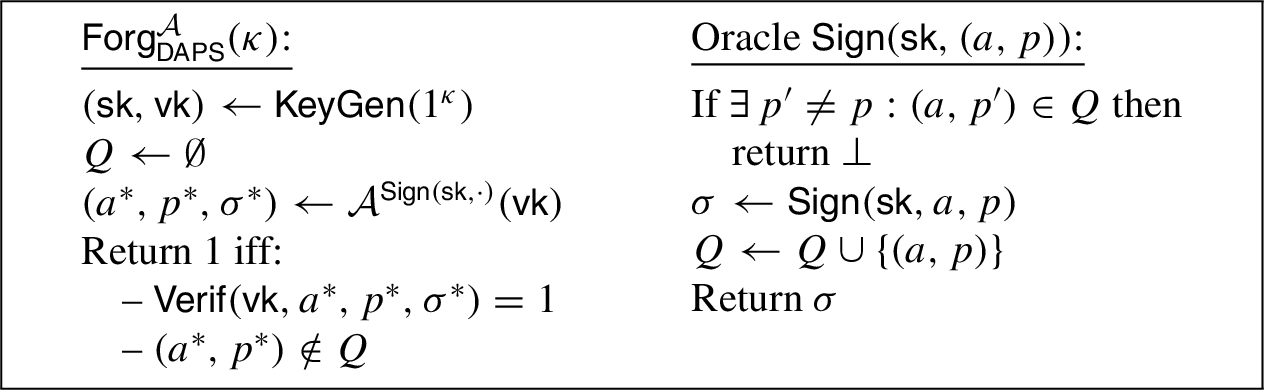
Game for EUF-CMA security of DAPS.
A DAPS scheme Σ is existentially unforgeable under adaptive chosen-message attacks (EUF-CMA) if for all
Vector commitments
A vector commitment (VC) is a primitive allowing one to commit to an ordered sequence of q values, rather than to single messages [11,24]. One can later open the commitment at a specific position.
(Vector commitments [11,24]).
A VC scheme is a tuple of
(Correctness of VC).
A
The security notion for a VC scheme is called position-binding and requires that for any A VC scheme (Position-binding).

Game for position-binding of a VC scheme.
A chameleon hash function is a (collision-resistant) hash function, where given a trapdoor one can find collisions efficiently. A double-trapdoor chameleon hash (DCH) function scheme has two independent such trapdoors.
(DC hash function [10]).
A DCH scheme
In the definition of algorithm We require double-trapdoor chameleon hash functions to satisfy the following properties:
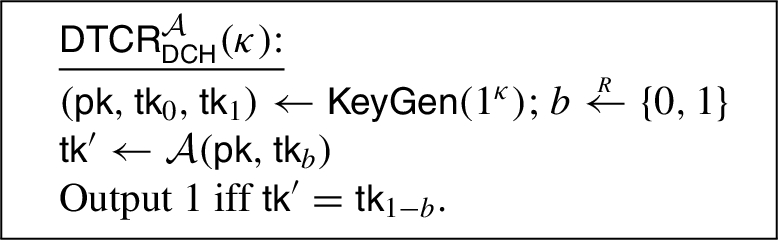
The output of This property alongside the definition of Let Collision-resistance game for a DCH scheme. There exists a
KE game for a DCH scheme. The left game is in the trusted setup and the right game is in the untrusted setup. Game for the distribution of collisions. For r chosen uniformly at random in For every (Security of DCH).
such that 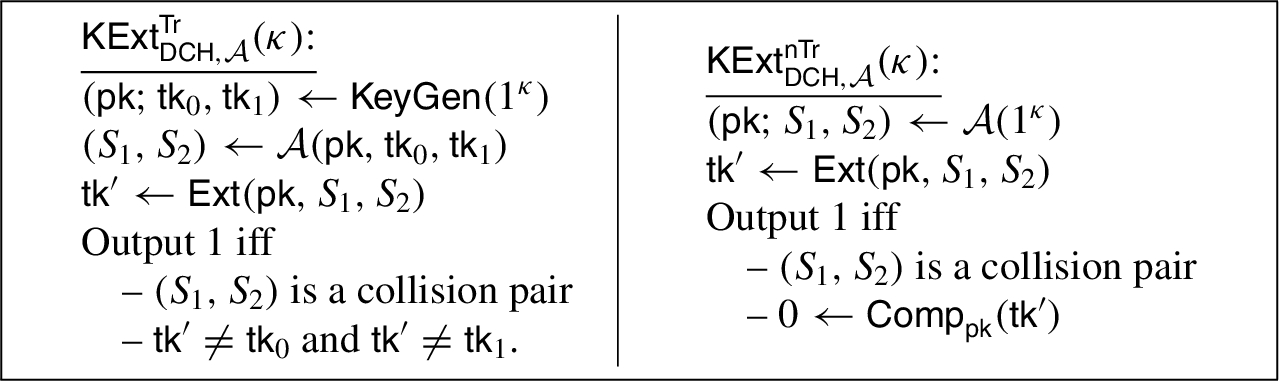
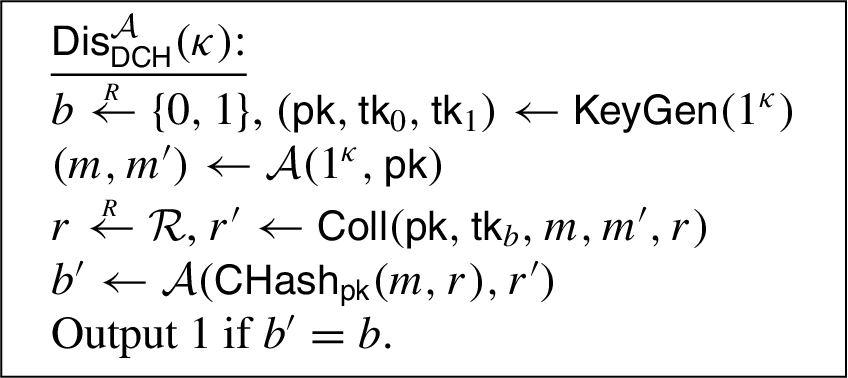
Our definitions above of Key Extractability implicitly assume that some appropriate predicate
We thus assume, unless otherwise stated, that every
Non-interactive zero-knowledge proofs
Let
(NIZK proof system [5]).
A NIZK proof system Π for the language L consists of three
(Perfect Completeness).
For all adversaries
(Perfect Soundness).
For all adversaries
If
Π is a proof of knowledge for relation R, if there exists a knowledge extractor
(Composable Zero-Knowledge).
Π is composable zero-knowledge if there exists a simulator
We may require that even after seeing many simulated proofs, whenever the adversary makes a new proof we are able to extract a witness. This property is called the simulation-sound-extractability (SE) [19], formally defined as follows. Let Π be a NIZK proof of knowledge equipped with (Simulation-sound-extractability (SE)).
A DAPS scheme from VC and DCH (DAPS-VC-DCH)
Construction
In this section we present our DAPS scheme based on vector commitments and double-trapdoor chameleon hash function. Our scheme will make use of a “flat” q-ary tree (i.e. a tree with branching degree q) of height h, which we call the signing tree. The root of the tree will be a public value

The assignment of addresses.
Overview of the scheme. We start with an informal description of the stateful version of our scheme where the signer needs to keep track of the produced signatures. The public key contains the public parameters for a vector commitment scheme
The signature algorithm will “fill up” this tree on the fly. To sign the message
We describe more in detail how the signer creates the authentication chain. Starting from the a-th leaf the signer produces the signature by augmenting the existing tree with the new authentication path. This is done using the following create-and-connect approach. First, the signer generates the possibly missing portion of the subtree containing the a-th leaf. Next, it connects this portion to the signing tree. Creating the missing portion of the tree essentially amounts to creating all the missing nodes. Specifically, and letting
In Fig. 8 we provide a pictorial representation of the key generation phase (for the toy case with branching degree 3). Black nodes indicate values that are obtained as outputs of the (vector) commitment and will not be altered any further in the future. Gray nodes indicate the frontier of the tree, i.e., nodes that are either leaves or roots of subtrees not yet explored (and are visited through their parents i.e., the black nodes). White nodes are the ones which are not visited so far.
Similarly, Fig. 9 pictorially describes (a toy example of) the signing procedure. To sign the message

Generation of the verification key.
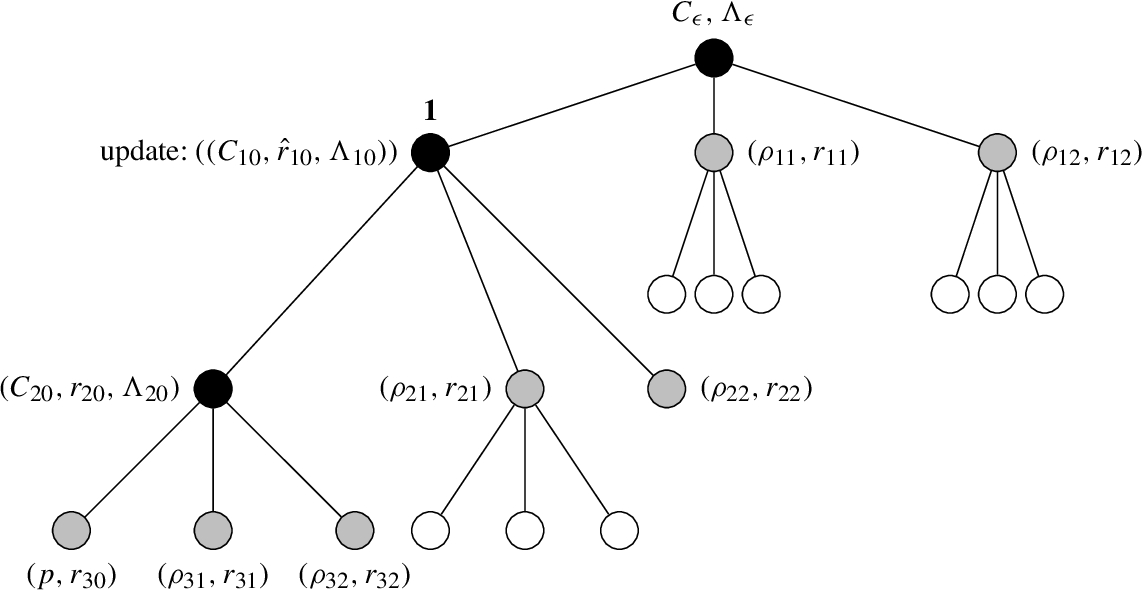
Signature phase.
Formal description of the scheme. We are now ready to present a formal description of our scheme. Let

Our DAPS-VC-DCH scheme.

Detailed figure for the construction and the security proof. Here dotted edges denote operations in a single node.
We use a pseudo-random function F to generate the random values
For DAPS schemes, signing is inherently stateful as the signer needs to remember the signed addresses in order not to sign a compromising pair. This is important for unforgeability rather than for correctness. Keeping track of the signed addresses can be efficiently done using a bloom filter [30]. In our scheme, the signer must in addition remember the payloads that it has signed in the past (but no further information, such as past signatures). This suffices to regenerate the tree during the signing of a new message.
We prove the security of our construction via the following two theorems, first key-extractability (Definition 2.7), then unforgeability (Definition 2.8).
The general intuition of the proof of key-extractability is as follows. Assume that a malicious signer can produce two valid signatures for a compromising pair without leaking the required information on secret keys (as defined by the predicate
For any compromising pair, the authentication path passes through the same nodes to the root and the commitment at the end of the chain is fixed by the verification key. This means the two valid signatures for a compromising pair have a “collision node” on the path, where at and above that node, the commitments of the authentication chains for these two signatures must be equal. Due to the security of hash functions If We prove the theorem via a sequence of hybrid games. Game 0 denotes the original This is the same as Game 0 except that we modify the condition to return 1 in Here we modify the winning condition as follows As before Now we modify the winning condition as follows Under the assumption that the underlying vector commitment scheme is position-binding, Games 2 and 3 are indistinguishable, i.e. Now we claim that, under the assumption that the underlying DCH guarantees Key-Extractability If This concludes the proof. □ If Once again the proof proceeds by a sequence of hybrid games. Game 0 denotes the original unforgeability experiment from Definition 2.8. We denote with This is the same as Game 0 except that we replace the PRF with a truly random function. Clearly the security of the underlying pseudorandom function implies that Here we modify Notice that, in order for the reasoning above to go through the restriction on the signing queries in the unforgeability game (Fig. 2) is crucial: if the adversary could obtain signatures on compromising pairs, then these would reveal Here we modify the condition to return 1 in In this game we modify the winning condition by imposing that we abort if Now we observe that by the uniformity property of The simulator here is the attacker to the security of DCH, the uniformity property. Using the same notation as above, here we further modify the winning condition by explicitly disallowing more forgeries of the form Again let Also let for
We modify the wining condition by disallowing forgeries of the form
Clearly, (since
To complete the argument let us discuss what happens when, by the key-extractability of
Thus, under the collision-resistance of
Using the same notation as above, here we further modify the winning condition by explicitly disallowing forgeries of the form
Under the assumption that
Now we claim that, under the assumption that
We discuss a simple modification of DAPS-VC-DCH that makes it secure when there is no trusted setup. What we mean by this is that, while we might trust standardized hash functions (such as SHA3) to be collision-resistant (CR), and the common choice of public parameters for the underlying assumptions, we might not trust a malicious signer to honestly generate its public key
Under a maliciously generated key, the signer might be able to produce signatures on a compromising pair from which no secret key can be extracted, unless the DAPS scheme satisfies key extractability for untrusted setups (defined via the game on the right in Fig. 2). For this to hold for our DAPS, the underlying primitives need to be secure in untrusted setups. For DCH, a candidate satisfying this was informally discussed in [10] and is explicitly formalized in Section 4. Unfortunately, for VC no instantiations without a trusted setup are known.
We therefore remove the VC scheme (and
Extension to N-times-authentication
Assume that a domain server.com is allowed to participate maximum at
To extend our construction to N-Times-Authentication, we replace each node of the tree with a bucket of size
Instantiations of building blocks for DAPS-VC-DCH
We instantiate the building blocks for our DAPS construction in Fig. 10. We use the VC scheme proposed by Catalano and Fiore [11], presented in Fig. 12 and we propose an instantiation for DCH.

Catalano–Fiore VC scheme [11].
If the CDH assumption holds in group
In Appendix B, we also present an asymmetric version of Catalano–Fiore scheme and prove its security. This makes it more meaningful to compare our DAPS-VC-DCH scheme with the schemes in the asymmetric settings (e.g., DAPS-GS).
A we discussed, our DAPS-VC-DCH construction can be modified to be secure against untrusted setup, if the underlying DCH scheme is secure in the untrusted setup setting. This fact gives a strong argument why we need to realize a DCH scheme in an untrusted setup.
A possible candidate to instantiate the DCH scheme is the chameleon hash given in [8] where
The idea was implicitly given in [10] (Section 3.1, full version). However, since a more efficient DCH with security under a trusted setup was enough for them, they do not detail a construction or the security property. We note that not any arbitrary chaining may work here, and it is important to put the message in the first layer instead of the second layer (see Fig. 13).
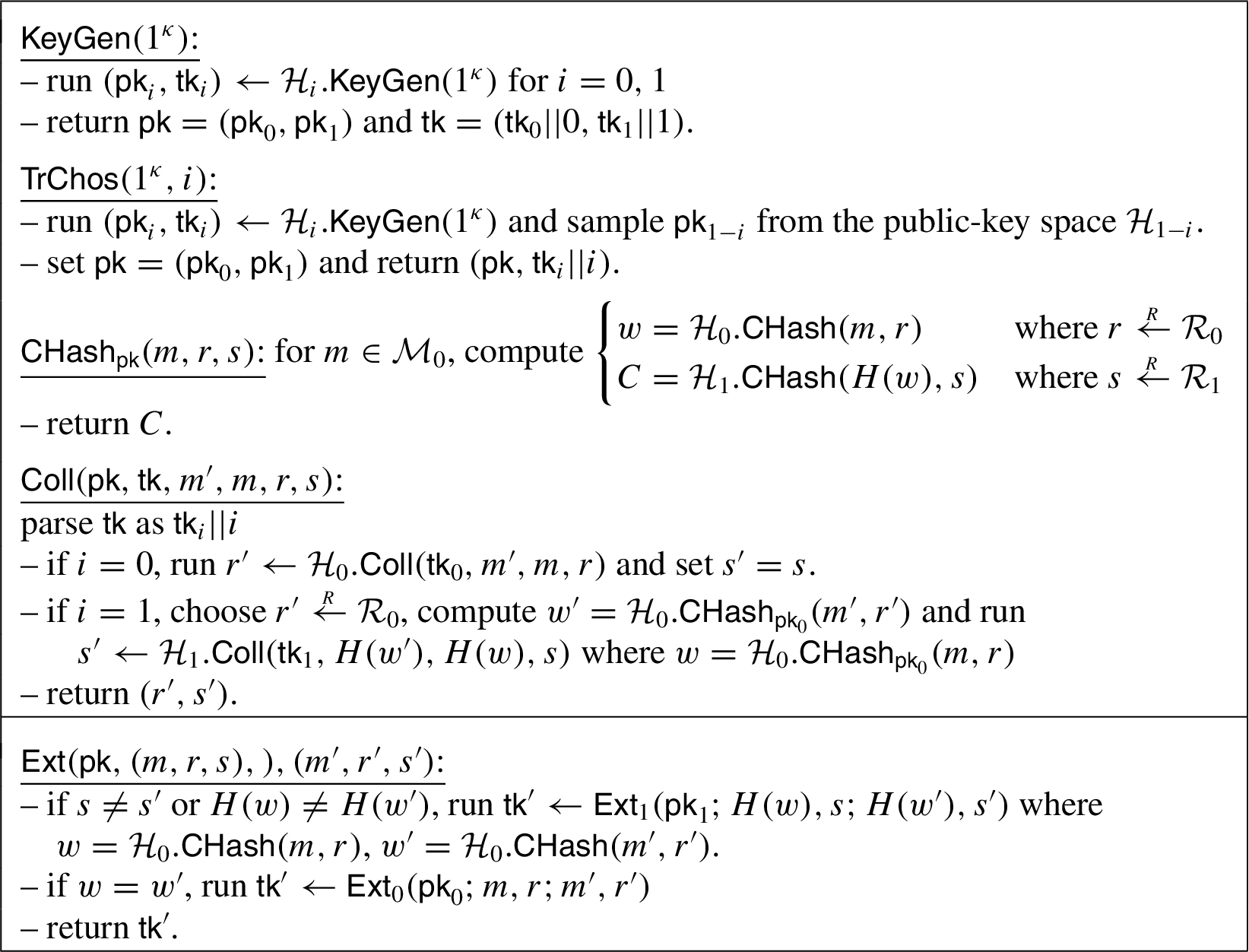
Our DCH scheme.
Let
In the following theorem we consider the predicate
If H is a collision-resistant hash function,
We check the required security properties for DCH.
Let Three following cases are possible where rest (either Notice that, in case 2, if the collision has happened in if the collision has happened in
□
In case 1
The CHF

Pedersen commitment as a CHF scheme [7].
We start with recalling the generic DAPS construction proposed by Derler et al. [16]. Their scheme, which we will refer to as DAPS-DRS, supports an exponentially large address space and is based on (simulation-sound) NIZK proofs of knowledge, which they instantiated using the Fiat–Shamir transformation [18] in the random oracle model. We will give an instantiation without random oracles and from standard assumptions by relying on the Groth–Sahai proof system [20]. This allows us to compare a standard-model version of an existing work to our DAPS-VC-DCH.
In DAPS-DRS scheme a signature contains a value
To “commit” the signer to the values
A DAPS signature on a message
We instantiate the NIZK proofs using the Groth–Sahai system over asymmetric bilinear groups. While the security of this proof system relies on a standard assumption (SXDH, that is, decisional Diffie–Hellman (DDH) holds in
This is the case for the variant [4] of Waters’ signature scheme [31] over asymmetric bilinear groups, which is secure under a variant of the computational Diffie–Hellman assumption, and the Naor–Reingold PRF [25], which is pseudo-random under DDH. Waters secret keys and Naor–Reingold PRF outputs are in
In order to avoid additional assumptions on the PRF, we slightly modify the DAPS-DRS construction [16] (and call it DAPS-GS, see Fig. 15): to bind the signer to the value
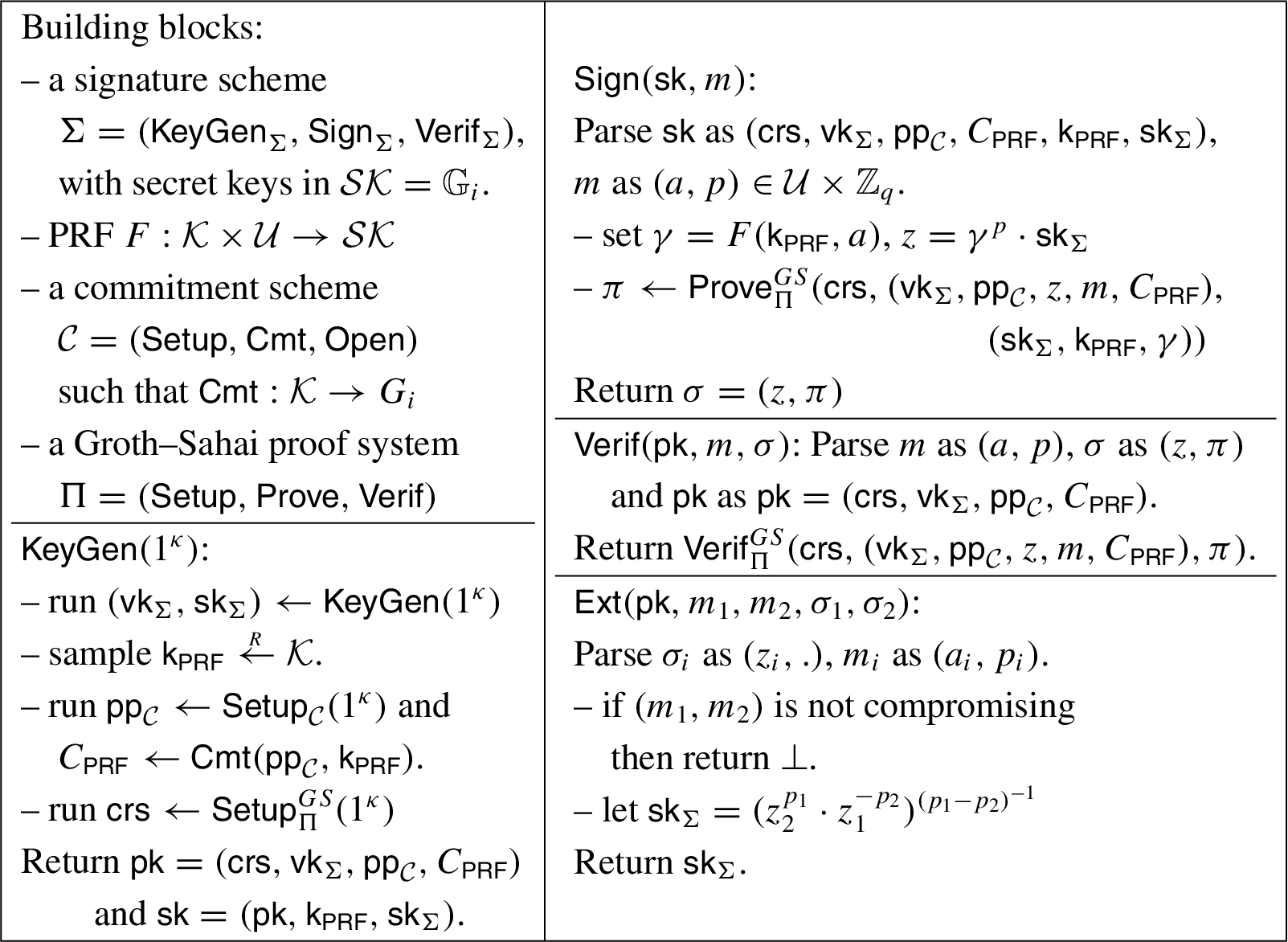
A DAPS scheme based on Groth–Sahai proofs (DAPS-GS).
In our variant DAPS-GS (Fig. 15) the language for the proof system is as follows:
Figure 15 describes our DAPS-GS. In this construction
The following theorems are the straightforward adaptations from the ones in [16].
If the NIZK proof system Π is simulation-sound extractable, F is a PRF, and f is a OWF, then the scheme DAPS-DRS is EUF-CMA secure.
(Key-extractability).
If the NIZK proof system Π is simulation-sound extractable and
An overview of the Groth–Sahai proof system
In this section, we consider three groups
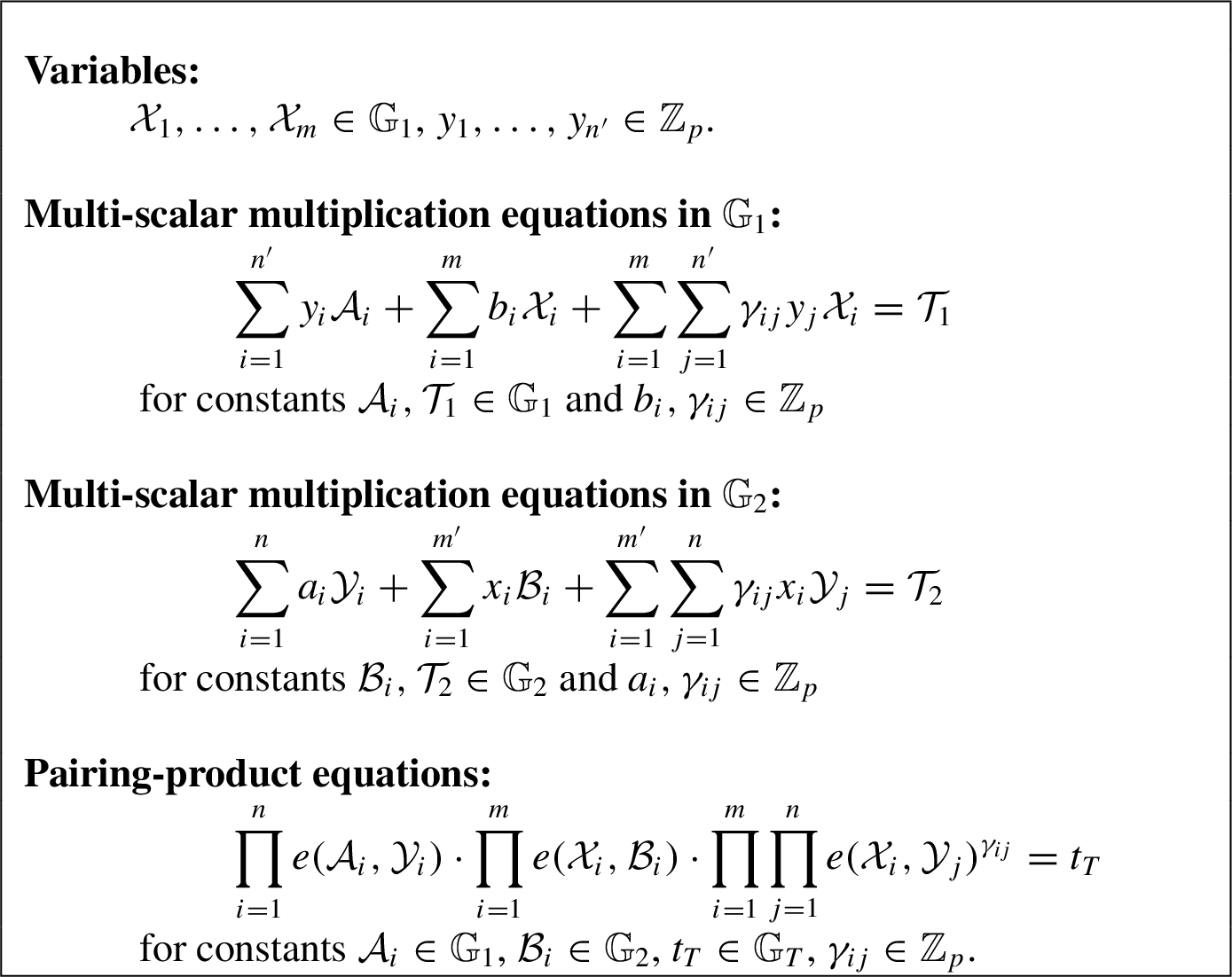
Equations for Groth–Sahai proofs (for our language).
In our DAPS-GS we need a NIZK proof system with simulation-sound-extractability (SE). There are standard techniques for making a knowledge-sound/sound NIZK proof system (unbounded) simulation-sound [2,19]: Let L be an NP language defined via
Regarding the knowledge-soundness of GS-proof we have the following lemma.
([20]).
Let NIZK be the Groth–Shahi proof system for the equations in the form of Fig.
16
, in Definition
2.17
, if the witness is in
Since for the witnesses in
Waters’s signatures (defined below) are defined over bilinear groups so that signatures consist of group elements only. Thus, the scheme can be used to instantiate our DAPS scheme and it also can properly instantiate the simulation-sound-extractable transform just discussed.
To prove a disjunction relation like equation (1) in the Groth–Sahai framework, one needs to represent it as a conjunctions of equations. Groth [19] already suggested an elegant technique for this conversion by adding a variable and equations in a special way (see also Appendix C of the full version [2]). Assume that we want a disjunction relation between some equations of the following form where P and Q are known constants:
Instantiation of DAPS-GS
As we mentioned in the previous section, Groth–Sahai proofs work for statements over bilinear groups. Thus to use Groth–Sahai proofs when instantiating DAPS-DRS, we need to find proper instantiations of the statements over bilinear groups. Here are some theorems regarding such possible instantiations.
(Naor–Reingold PRF [25]).
If the DDH assumption holds in the group
The signature scheme Σ can be instantiated with Waters’ signature scheme since the signatures of this scheme are elements of bilinear groups. The following gives an improvement of Waters’ scheme and its security analysis [21] over asymmetric bilinear maps [4]. The need for an asymmetric variant of Waters’ signature comes from our instantiation for PRF based on DDH and GS- proofs for SXDH assumption.
Let If the (Waters’ signature scheme [4,21,31]).

The commitment scheme in Fig.
18
is perfectly hiding and computationally binding under the discrete logarithm assumption in group Pedersen’s commitment scheme [27].
In Appendix C, Figs 23 and 24 we show how to combine these instantiations together to get a Groth–Sahai compatible system of statements. As mentioned we have 6 group elements for each equation in
Footnotes
Acknowledgments
The first author is supported by the Programma ricerca di ateneo UNICT 2020-22 linea 2. The second author is supported by the Vienna Science and Technology Fund (WWTF) through project VRG18-002. The third author benefited from the support of the Chair «Blockchain & B2B Platforms», led by l’X – Ecole polytechnique and the Fondation de l’Ecole polytechnique, sponsored by Capgemini.
Background material
An asymmetric variant of catalano-fiore VC scheme
To have a meaningful comparison between our DAPS-VC-DCH and DAPS-GS, we bring both schemes in the same setting. In [11], authors present a VC scheme under the CDH assumption, here we extend their construction to its asymmetric variant (see Fig. 21). To do so, we just replicate the public keys
We show that, if one can break the square-CDH+ assumption, then it can break a variant of CDH+ assumption ([4]) where an extra term
Clearly, if CDH++ holds then CDH+ also holds which makes it more reasonable to compare the mentioned schemes in the same setting and based on the same assumption CDH++.
Let
It receives the input
Overview of DAPS-DRS
In Fig. 22 we recall the DAPS-DRS construction.