



Abstract
In 1968, Liu described the problem of securing documents in a shared secret project. In an example, at least six out of eleven participating scientists need to be present to open the lock securing the secret documents. Shamir proposed a mathematical solution to this physical problem in 1979, by designing an efficient k-out-of-n secret sharing scheme based on Lagrange’s interpolation. Liu and Shamir also claimed that the minimal solution using physical locks is clearly impractical and exponential in the number of participants. In this paper we relax some implicit assumptions in their claim and propose an optimal physical solution to the problem of Liu that uses physical padlocks, but the number of padlocks is not greater than the number of participants. Then, we show that no device can do better for k-out-of-n threshold padlock systems as soon as
Introduction
In 1979, in his paper on secret sharing [29], Shamir presented the following threshold problem introduced by Liu in [20, Example 1–11]: Eleven scientists are working on a secret project. They wish to lock up the documents in a cabinet so that the cabinet can be opened if and only if six or more of the scientists are present. What is the smallest number of locks needed? What is the smallest number of keys to the locks each scientist must carry? Liu and Shamir answered this physical problem using mathematics as follows: It is not hard to show that the minimal solution uses 462 locks and 252 keys per scientist. These numbers are clearly impractical, and they become exponentially worse when the number of scientists increases. This is why Shamir proposed to use polynomial and Lagrange’s interpolation to solve Liu’s question. His clever idea is to hide the secret in the constant term of a polynomial of degree
We show that Liu’s problem is solvable using far less locks. Liu and Shamir claim stems from the restriction that there should be a lock for each combination of 6 scientists,
As a warm up, we relax Liu and Shamir’s assumption and design a physical k-out-of-n threshold padlock system. We have build a prototype of this physical device. Our system only requires one padlock and one key per participant, which is practical, when compared to the previous exponential solution.
Then, we establish lower bounds on the number of padlocks necessary for any abstract threshold system.
Specifically, we show that for a 2-out-of-n configuration, less than
Differently, for k-out-of-n configurations with
We discuss more complex access structures, which include for instance ensuring that Alice and Bob can open the lock with any other third participant, but not together. Another possibility is for instance that Alice is highly ranked and can open the padlock by herself but that any others need to be at least two. For this we develop a tentative padlock algebra for logic gates and give associated algorithms. The idea is to combine threshold cryptography and secret sharing with the theory of block designs, packings and Sperner families.
Finally, we propose a recursive algorithm to build larger systems, that requires only a logarithmic number of padlocks. Asymptotically, our algorithm requires only
Lastly, we also show that our physical results do apply to the numerical world by linking the number of padlocks to the size of the finite field used for secret sharing.
Related work
Threshold cryptography in general received a lot of attention recently, since on March 1, 2019 the Computer Security Division (CSD) at the National Institute of Standards and Technology (NIST) published the final version of NISTIR 8214, “Threshold Schemes for Cryptographic Primitives” [33]. This reports explicitly also mentions physical threshold solutions (page 10, line 55): “While we focus on secure implementations of cryptographic primitives, the actual threshold techniques may also include non-cryptographic techniques.” We present existing physical solutions for threshold cryptography, while a survey of cryptographic threshold schemes by Y. Desmedt can be found in [10]. We distinguish two classes of solutions: the first one uses physical keys and padlocks; the second one uses visual cryptography, as introduced by M. Naor and A. Shamir in 1994 [25].
State of the art, using padlocks
A 1-out-of-1 padlock is just one simple physical padlock. There are many systems for 1-out-of-n padlocks, both home made and commercial products. There also exist commercial solutions for n-out-of-n padlocks, which are used by for example by electricians to secure an electrical circuit as explained next.
1-out-of-n locks
In Fig. 1, left, a 1-out-of-2 padlocks is done simply with two physical padlocks. This approach can be generalized to 1-out-of-n as in Fig. 1, right, and is called a daisy chain. We notice that the bottom left yellow padlock was badly placed, and it is useless. In this case the owner of this padlock cannot open the door. We call this the daisy chain attack. For example in Fig. 1, if the owner of the bottom padlock opens it and then locks it upper in the chain, then he excludes all the owners of these padlocks, as they cannot open the door any more.1
A deliberate attack adding an additional chain and padlock to the gate, or even welding padlocks together, is always possible, and out of scope here: we aim to protect against attacks that could be “excused” with a wrong use of the system.
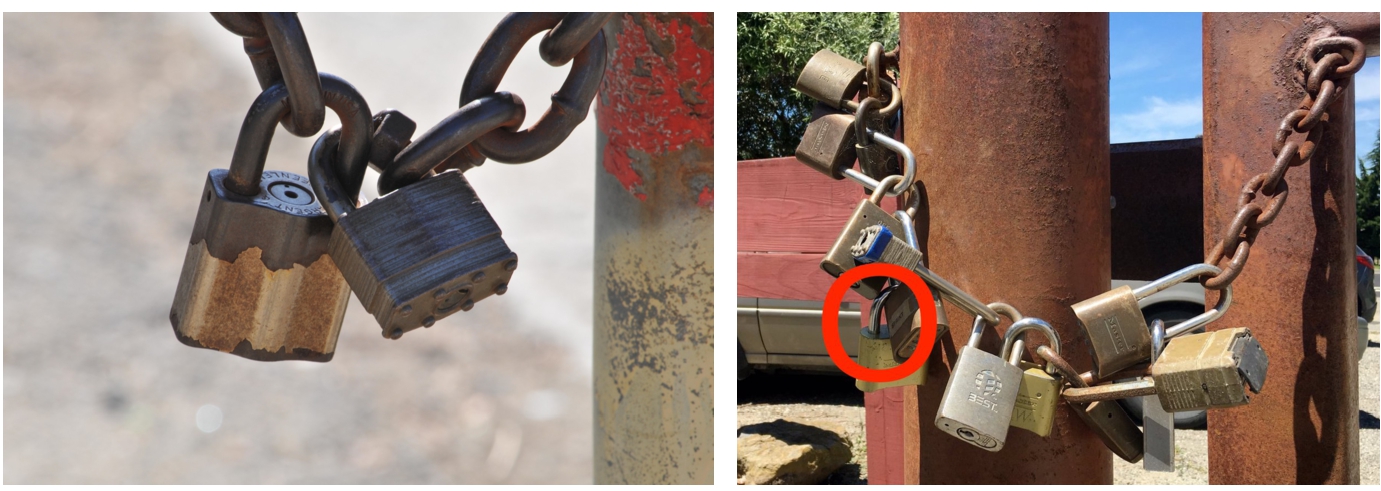
Physical 1-out-of-n padlocks, forming a daisy chain.
In Fig. 2, we can see two different mechanisms that perform 1-out-of-6 padlocks to open the gate of a field. The first one has six padlocks that block the trigger. As soon as one padlock is opened a latch is removed and then the door can be opened. It is the natural extension of the solution of Fig. 1 that avoids the daisy chain attacks. Next, the second picture of Fig. 2, shows a different solution also implementing a 1-out-of-6 padlock, and which is also resistant to the daisy chain attack. In this system, as soon as one padlock is removed, it is possible to turn the circle and then to pass the stick in the corresponding hole in order to open the door.

Two ad-hoc physical 1-out-of-6 padlocks.

Physical 1-out-of-5 padlocks, first by Everlock system, then by Tayhope multi-locking system.
There are also commercial products for 1-out-of-n padlocks. The first picture of Fig. 3 shows a commercial product designed by Everlock Systems: the model SLX2 [11]. The second picture of Fig. 3 shows a commercial product sold by Tayhope Multi-Locking Systems [32]. Everlock Systems has multiple patents on their designs [21–24] and their solution is close to the mechanism proposed on the left side of Fig. 2. Differently, Tayhope mechanism allows the owner of a padlock to remove the metallic stick which enables the opening of the door, by pushing all the padlocks on one side.
Now, if one is interested in reducing the number of padlocks, one can realize a 1-out-of-n threshold system with a single lock: duplicate the key of one padlock n times and distribute the key to all the participants. The obtained system has not all the physical properties of the daisy chain or the systems of Fig. 3 (for instance the latter does not need a trusted third party to setup the chain or to duplicate the keys), but is probably more economical. Overall, we have the following possibilities for 1-out-of-n systems:
A single padlock with n duplicated keys: probably most economical;
A daisy chain: if keys cannot be duplicated;
Systems like those of Fig. 3: they do not require a trusted third party for the setup, as each participant can bring their own lock and key(s).
Finally, there are physical n-out-of-n mechanisms using padlocks that are used for example for operations on high-voltage circuits and transformers. Two examples of 6-out-of-6 padlocks are given in Fig. 4. The idea is that nobody should be able to turn on the electricity while someone is still working on the high-voltage transformer. To achieve this, each technician places a padlock on the main switch before entering the danger zone. This ensures that all technicians have to leave the danger zone before electricity can be restored. The example can easily be extended to a n-out-of-n system.
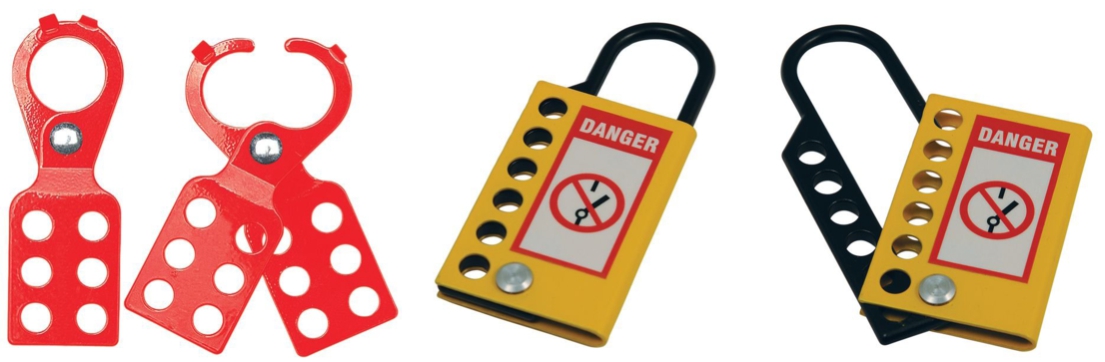
Physical 6-out-of-6 padlocks, by Seton (models SLECO and MANM8).
In 1994, M. Naor and A. Shamir proposed the visual cryptography [25, 26] for black and white images. This was improved in [5] for gray images and in [15] for color images.
The idea is to split a secret into two images printed on transparent paper in a way such that their superposition makes the secret appear. An example is given in Fig. 5.

Example of visual cryptography, superposing the images let the symbol π appear.
For color images, security cannot be perfectly achieved for more than 3 colors [19]. In [34], the authors proposed a generalization of the approach to k-out-of-n images. This can be used as a first physical answer to Liu’s problem. This solution is not really practical since it needs a computer to compute the different images. Moreover in [14], the authors show that it is possible to cheat in visual cryptography by introducing fake shares that change the result. This clearly shows that this solution is not verifiable, which requires the ability to check that shares are valid.
As a natural extension of 1-out-of-n systems, we design a k-out-of-n physical threshold lock that uses n padlocks and works as follows. Each padlock secures one block, with a latch, attached to a sliding bar, which is limited in its sliding movement by the blocks. If sufficiently many blocks are removed, the sliding bar can be moved far enough to open the barrier. In Algorithm 1, we describe our solution in a generic way.
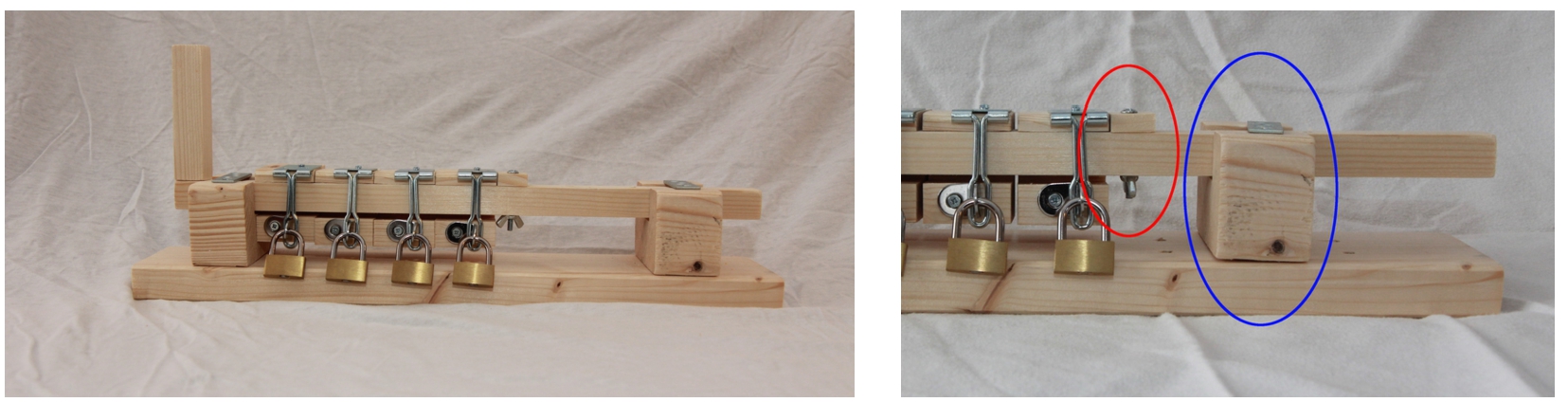
We also have built a wooden prototype that can be configured for different cases, see Fig. 6 for a 2-out-of-3 configuration.
In this example, on the top image, we have 3 padlocks attached to support of size l and the blocker is installed just after them on the initial configuration. The bar is installed in such a way that it over passes slightly more than the size of one padlock support on the right. In the left image, once one padlock and its support is removed then the bar can move to the left but not totally be removed. Finally, once two padlock supports are removed we can open the system.
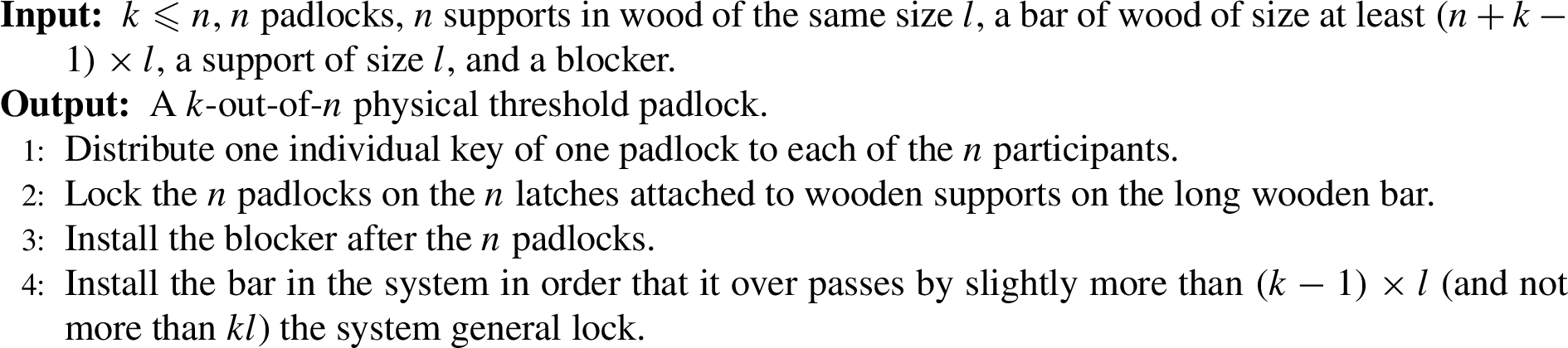
k-out-of-n physical threshold lock
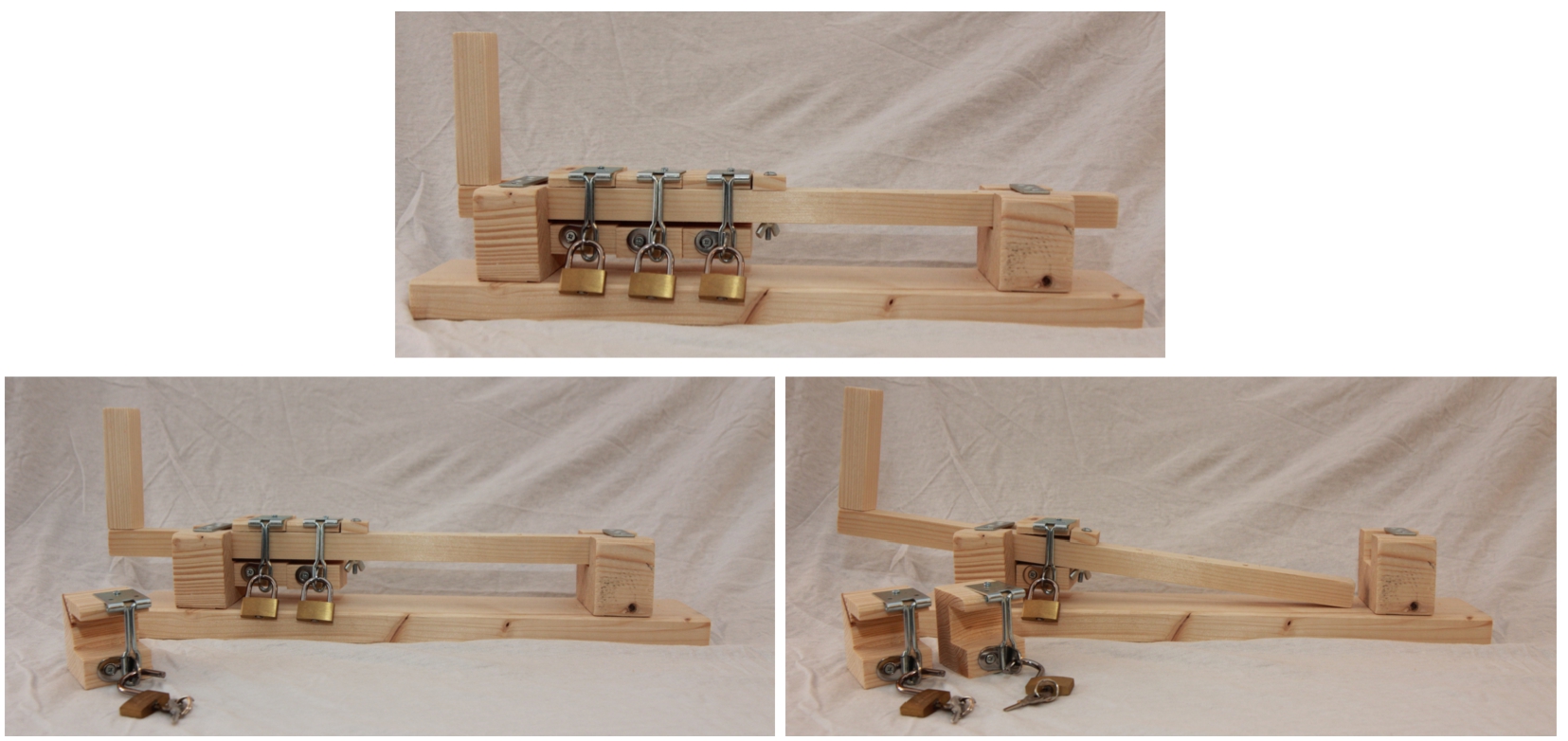
Physical 2-out-of-3 lock.
Figure 7, left, shows our prototype in a 2-out-of-4 configuration. The prototype can be configured for k-out-of-n systems for any
Our technique can also be used to implement weights by using blocks of different sizes. Figure 8 shows an example where either one “master” key (opening the padlock on a larger block) can be used to open the lock, or any two of the other keys (opening the padlocks on the smaller blocks). The same idea can also be used to implement a policy where, e.g., either Alice and one other participant, or any three other participants are required to open the lock. It suffices to give Alice the keys for the larger block, and use a configuration that requires the removal of three small blocks to open.
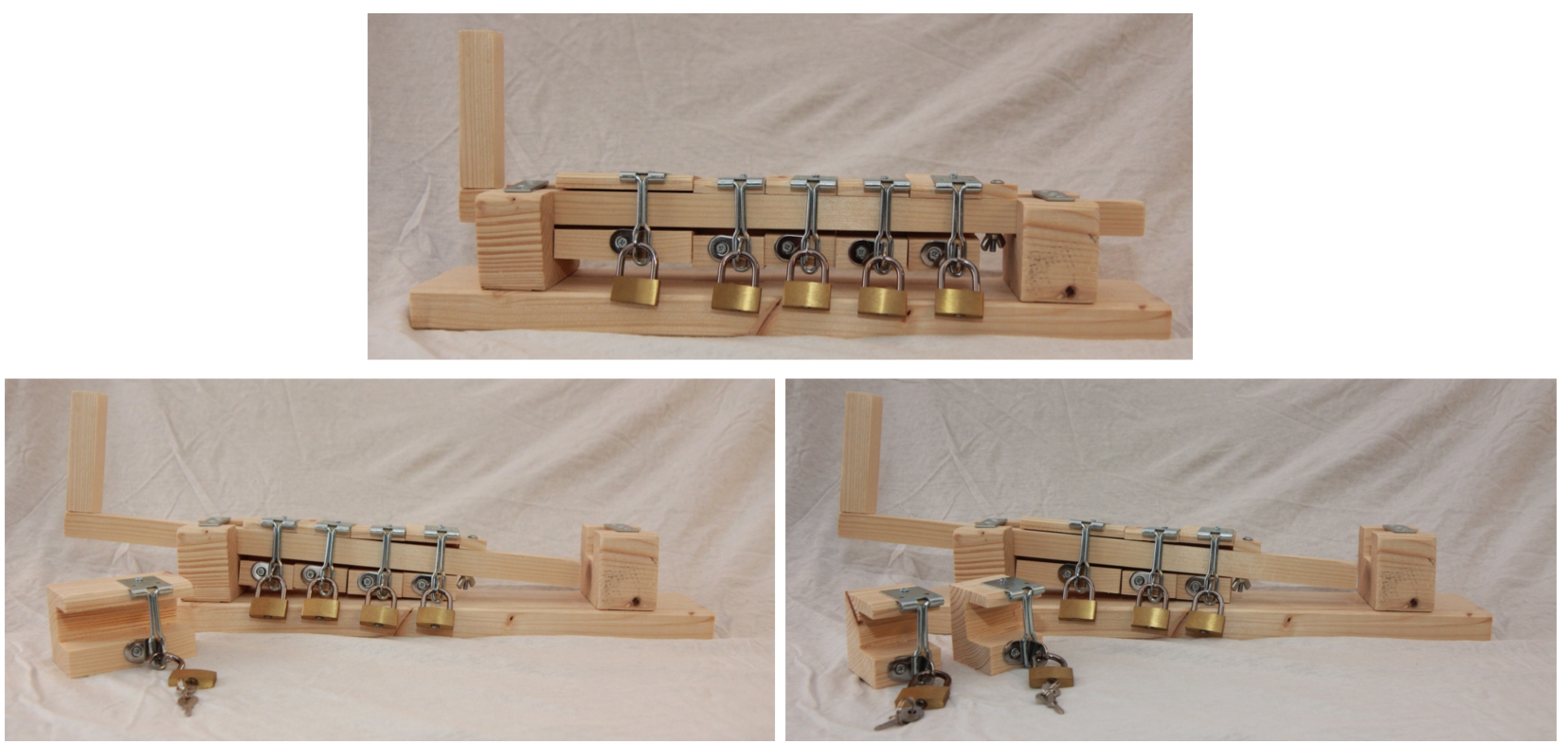
Physical lock with weighted keys.
Our system is ad-hoc since once it is set up, each participant can install their own lock, which avoids having to trust the dealer as in existing cryptographic solutions. Note that to avoid problems during the setup phase, we assume that all participants install their locks at the same time, right after the lock has been set up.
Our solution is also reusable as it can be locked again, unlike for example a solution using cryptographic secret sharing to share a code for a combination lock, where the code would be revealed once and for all: such a lock thus cannot be effectively locked again without changing the code. Note that a system with a combination lock would also require a special procedure or a trusted third party to setup the combination initially. Moreover, our system also protects users against the daisy chain attack as only one padlock can be fitted to the latch of any block.
By construction our solution is verifiable since everyone can check if there is at least one padlock that can be opened with the secret key that he has received. Comparing to the mathematical solution proposed in [13] consisting in giving extra information to each participant to convince him that he received a valid point of the polynomial, our solution does not require any extra material, nor does it require any trusted third party. There are thus at least three direct applications of our physical threshold system:
Our system can be used to construct a physical verifiable secret sharing protocol. As it can also easily be extended to deal with weights, we also have a physical equivalent to the cryptographic protocol given in [3, 12].
Threshold cryptography has been applied to voting, e.g., in [28]. Our system can be used to secure physical pen and paper voting, by ensuring that the ballot box can only be opened if k-out-of-n trustees agree.
As a user never has to reveal his physical key, our mechanism can also be used to design a k-out-of-n authentication mechanism.
We now establish bounds on the number of padlocks required to realize a certain threshold. We assume that padlocks are more expensive than keys, i.e., we will try to implement threshold systems with fewer padlocks, even if this means duplicating some of the keys. We define a padlock system to be any arrangement of padlocks protecting something. For the sake of simplicity, in the following, we consider this to be the possibility to “open a door”.
A padlock is a device requiring a single key to be opened (keys can be duplicated). A padlock-system is a device comprising an arrangement of latches that prevents a door to be opened when some padlocks are attached to some of the latches.
A k-threshold padlock system is a padlock system with an arrangement of padlocks and a distribution of keys that allows any group of k or more participants to open the door and prevents any group of strictly less than k participants to open it.
While directly applicable to physical padlock systems, this definition also applies to some cryptosystems. For instance consider any symmetric or asymmetric cryptosystem with a shared (duplicated) decryption key. Closing a padlock could just be ciphering with an encryption key; setting a padlock-system could just be multiple encryption (even if electronic threshold cryptosystems are more complicated) and opening the door is deciphering. For this example, the only difference with physical system is that the order of encryption must be taken into account for decryption.
Now, most of the lower bounds described in this section only suppose the existence of a threshold system satisfying the above definitions. Therefore those lower bounds also apply to electronic threshold cryptosystem satisfying Definitions 1 and 2.
Let n be the number of players and
For instance, we have that:
Using the fact that all subsets of size k of the n participants can open the door, and no subset of
Suppose for Any of the k people must own at least one of the t keys, otherwise they are not required to open the cabinet and By induction on a subgroup of size
Now, this subgroup of size at most t is thus able to open the door by themselves. But
Second, we see that if the set of keys of a participant is included in another participant’s set of keys, intuitively the first participant is “useless” to achieve the threshold.
Let
Let A have a set of keys included in that of B. As
This shows for instance that each participant must have at least one key. Further, this means that the sets of keys must form a family of inclusion-free subsets. This is called a Sperner family or a clutter [31]. The padlocks can then be seen as the vertices of a hypergraph, where each participant is represented by a hyperedge, the set of its owned keys. The rank is then the maximal cardinality of a hyperedge. Then Sperner’s Theorem combined with Lemma 2, also gives the following lower bounds:
By Sperner’s Theorem [31], the size of any Sperner family with t elements is upper bounded by
By Corollary 1, the only other possibility is
Suppose
We have thus now for instance the following results:
Now we propose, in Algorithm 2, an arrangement for a 2-out-of-n participants threshold system, using no more than n padlocks, and strictly less as soon as
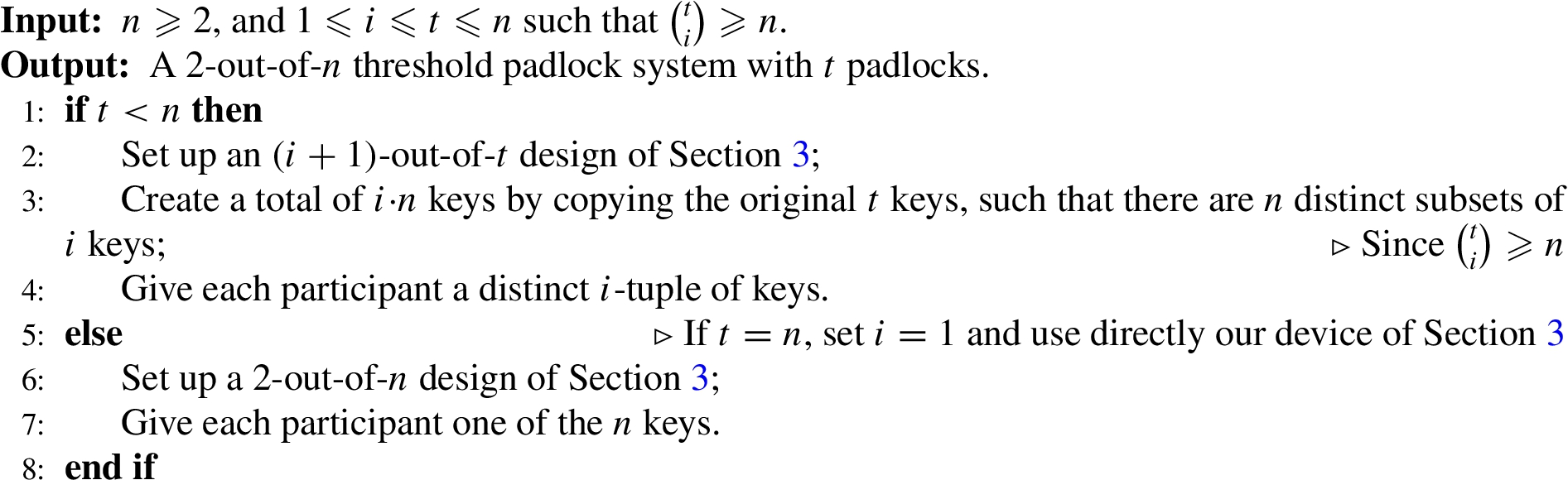
Two-out-of-n threshold system with shared keys
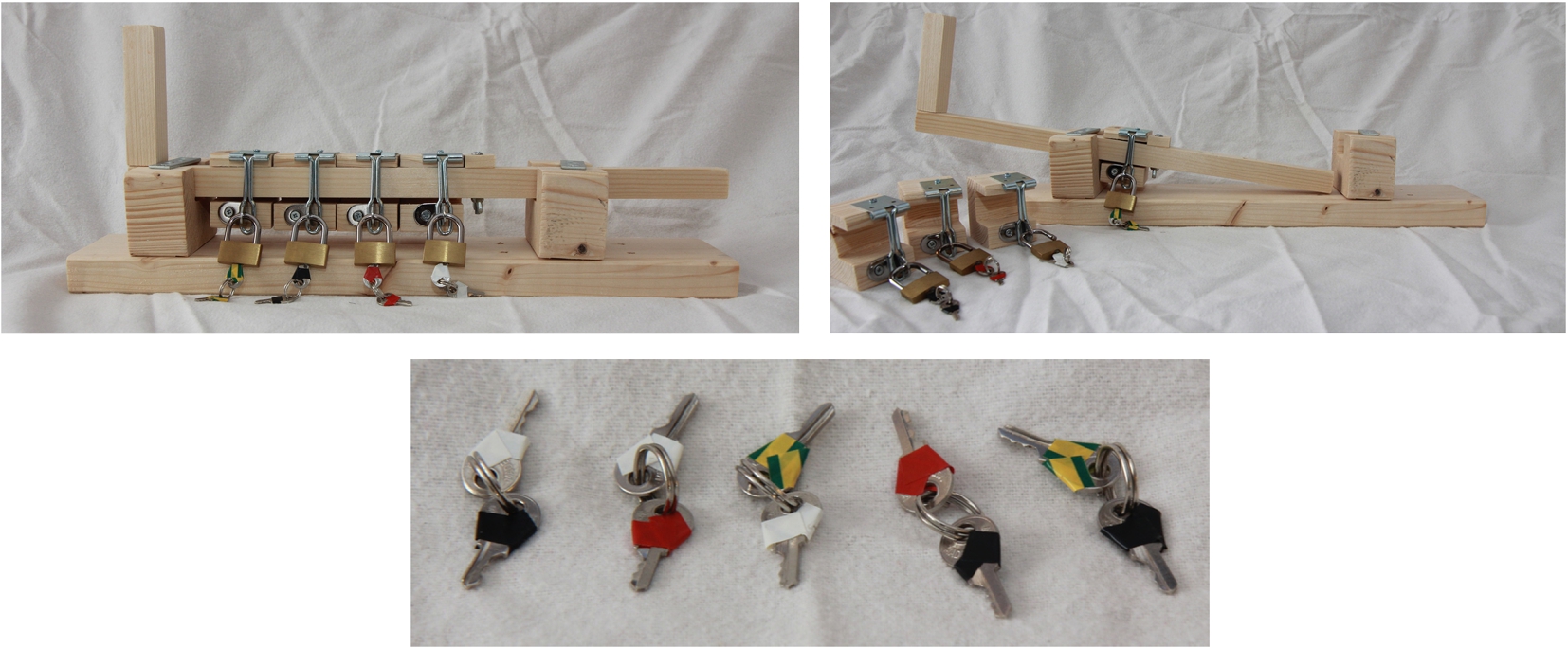
Physical 3-out-of-4 threshold padlock system.
Figure 9 shows our prototype in a 3-out-of-4 configuration. Now, using Algorithm 2, this configuration can also be used to implement a 2-out-of-5 threshold system with only four padlocks by copying keys and distributing them in such a way that each participant has a distinct subset of keys (as stated in Theorem 1). In this example, any two participants together will have at least three different keys, which suffices to open the 3-out-of-4 device. This shows that
The correctness and the optimality of this schemme are proven by the series of results in this section.
First, this scheme settles the small cases:
For any
Let
But, if
Therefore, Equation (1) cannot be satisfied whenever Equation (2) is
But Equation (3) is true for
For
For
Then two participants owns
The remaining case,
This is satisfiable as follows: use a 3-out-of-4 device with our design with 4 padlocks. Then provide the 5 users with distinct pairs of keys. Not a single user can open 3 padlocks. But with distinct pairs of keys all pairs of participants own at least 3 different keys.
Finally, Algorithm 2 gives a solution as soon as t is such that
Second, we give an asymptotic estimate for larger cases: Algorithm 2 makes it possible to implement a 2-out-of-n threshold padlock system with only
Algorithm
2
correctly provides a 2-out-of-n threshold padlock system and for
Consider an
For instance, the first case where triples are better than couples in Algorithm 2 is for
For
The lower bound is given by Corollary 1. For the upper bound consider as in Theorem 1 an
It is possible to directly obtain a 2-out-of-n padlock system with exactly
The first construction is as follows:
Consider 2-out-of-2 devices, similar to those of Fig. 4, and take Attach these Order the participants and give them a distinct number between 0 and
This is a total of
Now the second construction mimics the first one given above, but without any particular device. It is shown in Algorithm 3.

Two-out-of-n double daisy chain with only
First, similarly, each participant alone cannot open the chain, as she cannot open any link, having only one of the two keys required to open one link. Second, similarly also, any two participants having different numbers have at least both keys of one double link and can open the chain and the door.
This is simple and does not require any additional device, apart from
In a secret sharing scheme, a datum d is broken into shadows which are shared by a set of trustees. The family
Towards a padlock algebra with one device per normal form
A generalization of threshold schemes is to be able to implement any access scheme described by a logic formula. This is possible by implementing AND and OR gates, as shown in Proposition 2 and Algorithms 4 and 5, following [4, 16]. A first idea is to use chains so that opening a padlock actually frees a chain that can free several latches. Then a second idea is that 1-out-of-n systems are just like a disjunction while n-out-of-n systems are just like a conjunction.
Algorithm 4 shows how to generate a padlock system openable by any satisfiable realization of a disjunction with t clauses and n distinct variables. For this, a single 1-out-of-t device is set. It will open if any of the t conjunctive clauses is true. Associate each latch of the device to one conjunctive clause. Then associate one padlock for each variable. To simulate the subjection of a clause to a variable, each padlock closes a chain passing through each latch corresponding to a clause containing that variable (and thus preventing the opening of those latches if that padlock is not open).

Physical DNF with one padlock for each variable

Physical CNF with one padlock for each variable
Figure 10 gives an example of Algorithm 4 on the logic formula
Now for conjunctions, we instead use a t-out-of-t master structure and several other 1-out-of-k systems, one for each conjunction in the CNF, as shown in Algorithm 5.
Figure 11 gives an example of Algorithm 5 on the logic formula

Algorithm 4 on a disjunctive normal form: one padlock closing one chain per term and a 1-out-of-4 device using a single latch for each clause, to realize
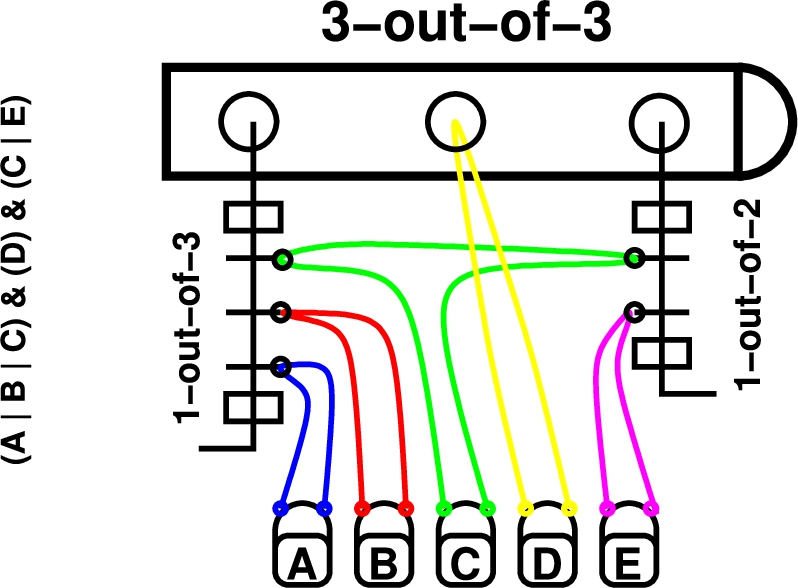
Algorithm 5 on a conjunctive normal form: one padlock closing one chain per term and a 3-out-of-3 device using a single 1-out-of-
Both Algorithms 4 and 5 thus provide a way to build systems with a number of padlocks equal to the number of distinct variables in the normal form. This is Proposition 2.
Any disjunctive or conjunctive normal form with t clauses, m distinct variables and no negation is realizable with m padlocks
First for disjunctive clauses: they require one 1-out-of-t threshold system and m chains, as shown in Algorithm 4. The “door” can be opened only by a satisfiable interpretation where TRUE means opening the padlock and FALSE means letting it closed.
Similarly one can create arrangements for conjunctive normal forms, also with as many padlocks as there are distinct variables as shown in Algorithm 5. □
In Section 5, we show that any access scheme described by a logic formula without negation can be implemented using simple physical devices. In this section, we show some other constructions that can simplify the use of Algorithms 4 and 5 for normal forms. We also show how our physical methods can implement some formulae that are proven impossible with a single secret sharing scheme.
First, to implement Algorithm 5 we need a 1-out-of-
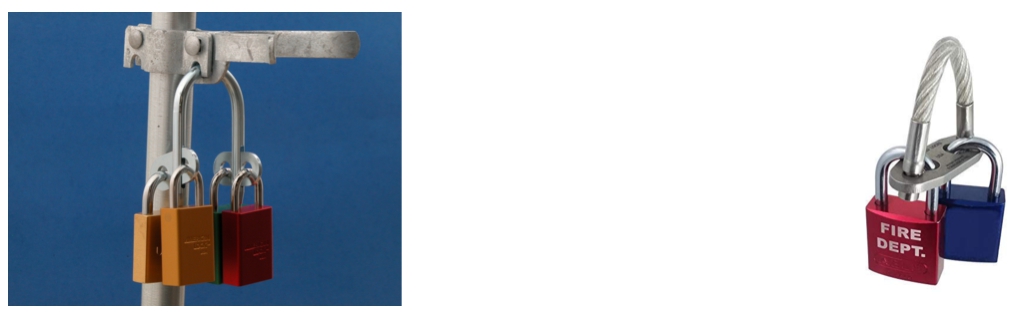
Left, a tree-like disjunctive clauses system by GateKeeper GM P6006 to combine 2, 3 or 4 locks; right, a physical 1-out-of-2 disjunction model Cb2 by Sharelox.
Now, second, we give examples of usage of all our devices and construction. For this we offer physical solutions for two examples, proven unrealisable using a single scheme. Indeed, [4] shows that the two following cases cannot be solved if users must use the same system of shares:
However, with a physical system, we can implement such access schemes with somewhat less devices as we have physical tools to combine conjunctions and disjunctions:
Conjunctions can be implemented with n-out-of-n systems as in Fig. 4;
Disjunctions can be implemented with 1-out-of-n systems as in Figs 2 and 3 or in Section 3.
For the first formula:
Now, for the second formula,

Physical realization with only 4 padlocks of [4, Theorem 3]
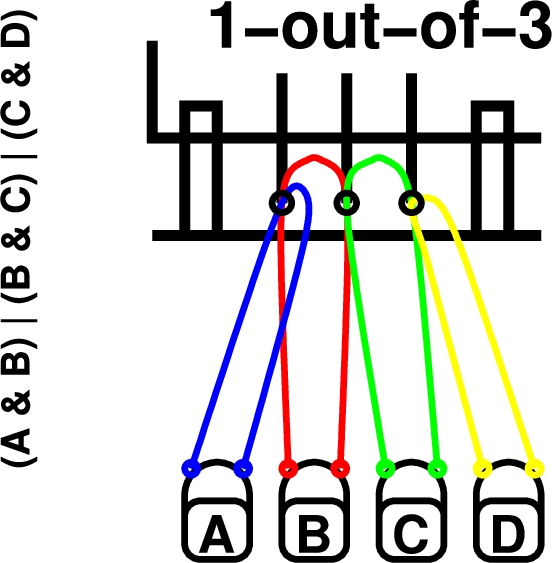
Algorithm 6 on
Finally, note that, with our novel design, Proposition 2 is not optimal. Consider for instance the DNF with a single participant able to open the door or any two among five others:
A post on crypto.stackexchange.com by Ahle [1] hints that one could create k-out-of-n threshold padlock systems using n padlocks and some wire.
His idea is to have the wire securing the door and going around the rings of the padlocks in a certain configuration. If a padlock is opened then it frees his part of the wire and potentially more from other padlocks. The example given is for a 1-out-of-2 system: “Say you have one wire to which the [door] is fastened and two padlocks. You want that if either of the locks are opened, the wire is completely freed. You do this by letting the wire go first clockwise around [the ring of] the first [padlock], then clockwise around the second, then anticlockwise around the first and finally anticlockwise around the second. It can be thought of as
This is a neat idea, which however turns out to not generalize easily to any k out of n system, though.
First, associate a variable from a non-commutative group to each one of n padlocks. To simulate the opening of a padlock set this variable to 1, the neutral element of the group, seen multiplicatively. Suppose that this variable represents one clockwise wrapping of the wire and that the inverse of that variable represents the anticlockwise wrapping. Then, the sequential arrangement of the wrappings of the wire around the rings of the padlocks is a sequential multiplication of these variables and their inverses, just like a Knot group presentation.
For instance, if a clockwise wrapping is directly followed by an anticlockwise wrapping then this is useless and represented by
On the one hand, we see that the equation
If the equations are not independent, then some cancellations can occur. Consider for instance the formula
On the other hand, to represent an AND gate between two independent padlock systems, then simply multiplying both equations suffices, in any order and with any inverse (i.e., independence ensures that
For instance some access structures of the previous subsections can also be realized this way with one padlock per literal:
There is a nice linear setup, for
The knotted padlock system, setup with n padlocks and a wire, and wrapped
Set any subset of size
This setup actually is optimal as shown in Lemma 5
Let
Let
By Lemmas 4 and 5 we have an optimal linear knotted system for
For more generic thresholds we were only able to devise a solution with an exponential number of wrappings, as shown in Algorithm 7, again loosing practicality for most of these knotted systems.

Knotted padlock threshold system
Let
For
For the correctness, we look at the cases. If
The
If
Finally the generic case, with now
Now for the complexity bound with
Otherwise, we have that
Then, second, we refine this analysis by lowering
To realize this solution in practice, one could for instance to use a high security cable seal: once fastened the wire cannot be taken out of the seizing device, see Fig. 14, left. Before closing the seal, wrap it around the door latch clockwise; then install the k-out-of-n knotted padlock threshold system on the wire; finally wrap the wire around the door latch anticlockwise and then seal it. This is shown in Fig. 14, right.
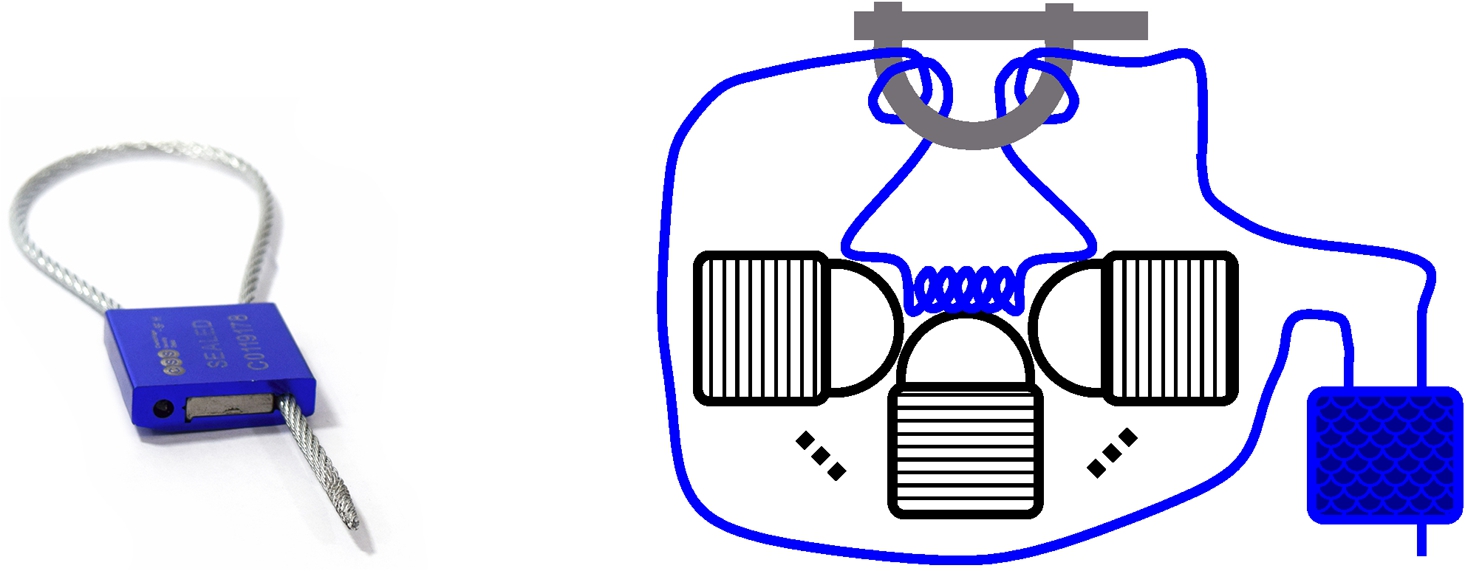
Secure cable wire seal (left) and knotted padlock threshold system (right).
Now, if the latch is smaller than the seizing part and than the padlocks, the door cannot be opened unless all the locks are removed. This can happen if at least k-out-of-n participants open the padlocks: then the other ones are freed by construction.
Unless
Thus, we have another possibility for a k-out-of-n physical threshold system with exactly n padlocks. Unfortunately, we can make it work only with an exponential number of wrappings. For instance, Algorithm 7 requires
We now have tools to deal with larger thresholds. First we give a necessary condition for systems using less than n padlocks. Knotted designs are not needed, but some small access structure arrangements can help. For instance, we can show that our physical device is optimal when k is larger than
A necessary condition and the answer to Liu’s problem
We first begin with a necessary condition, analyzing the set difference cardinality of their sets of keys.
The cardinality of their 2 by 2 set difference is bigger or equal to
Each of them owns at least k distinct keys.
Apart from participants owning the single key of a given padlock, the others own only keys that are duplicated and owned by several users. In the following we say that these duplicated keys owned by several users are shared, and we identify any duplicated keys of the same padlock (we also thus say that shared keys are reused when we encounter the duplicate of an already used key).
We thus consider the subgroup of participants owning only shared keys. First, let
Second, within such a group of participants owning only shared keys, suppose that one participant P owns a number i of distinct keys strictly lower than the threshold k. Then at least one of his keys cannot be reused. Otherwise there exists a group of
We can now fully answer Liu’s question with Theorem 3,
For Now for
A sufficient condition to satisfy Proposition 3 for a 3-threshold system with less than n padlocks is that a given pair of keys is never given to more than one person. Indeed, then, two persons never share a pair of keys and thus if they each own more than two keys, then their set difference is at least
This is thus sufficient for such a system to contain a
(See e.g., [7]).
Let t, k, and p be integers with
With this, we have Johnson’s bound [17], that states that a maximal packing has a number of blocks upper bounded by:
Equation 6 then suggests that systems with
Unfortunately, Proposition 3 is probably not sufficient itself: it might be possible to fulfill its conditions while still having some set of players of size strictly lower than k having the same set of keys as some set of players of size k. However, we can at least prove that for
in a Steiner triad system for a set of keys, no pair of keys is shared by two triads; therefore giving a triad of keys to each player will satisfy the necessary Proposition 3;
then, the following Proposition 4 shows that for the particular case of
finally, with Johnson’s bound, a Steiner triad system with
Any Steiner triad system gives rise to a 3-threshold system.
By construction, a Steiner triad system satisfies the necessary condition of Proposition 3. Second, in order to use it as a 3-threshold system, we need to differentiate triples of triads from pairs of triads (as a two participants should not be able to open the door, but three participants should). On the one hand, all triples that have 7, or more, distinct values all together, cannot be equated by pairs of triads. On the other hand, by the condition on pairs of elements being uniquely found in a single triad, triples of triads have at least 6 distinct values overall. So the only remaining case is to prove that the 6 distinct values of triples of triads with only 6 distinct values, in any construction, cannot be found in pairs of triads of the system.
To have only 6 distinct values, any two of the triple of triads must share one value, and the third one must share a value with each of the two others. W.l.o.g., this is triads
Finally, by setting up a minimal Steiner system for any number of players, for instance using a Bose construction [6], we have the following Algorithm 8 to setup a 3-out-of-n system. This provides an upper bound of
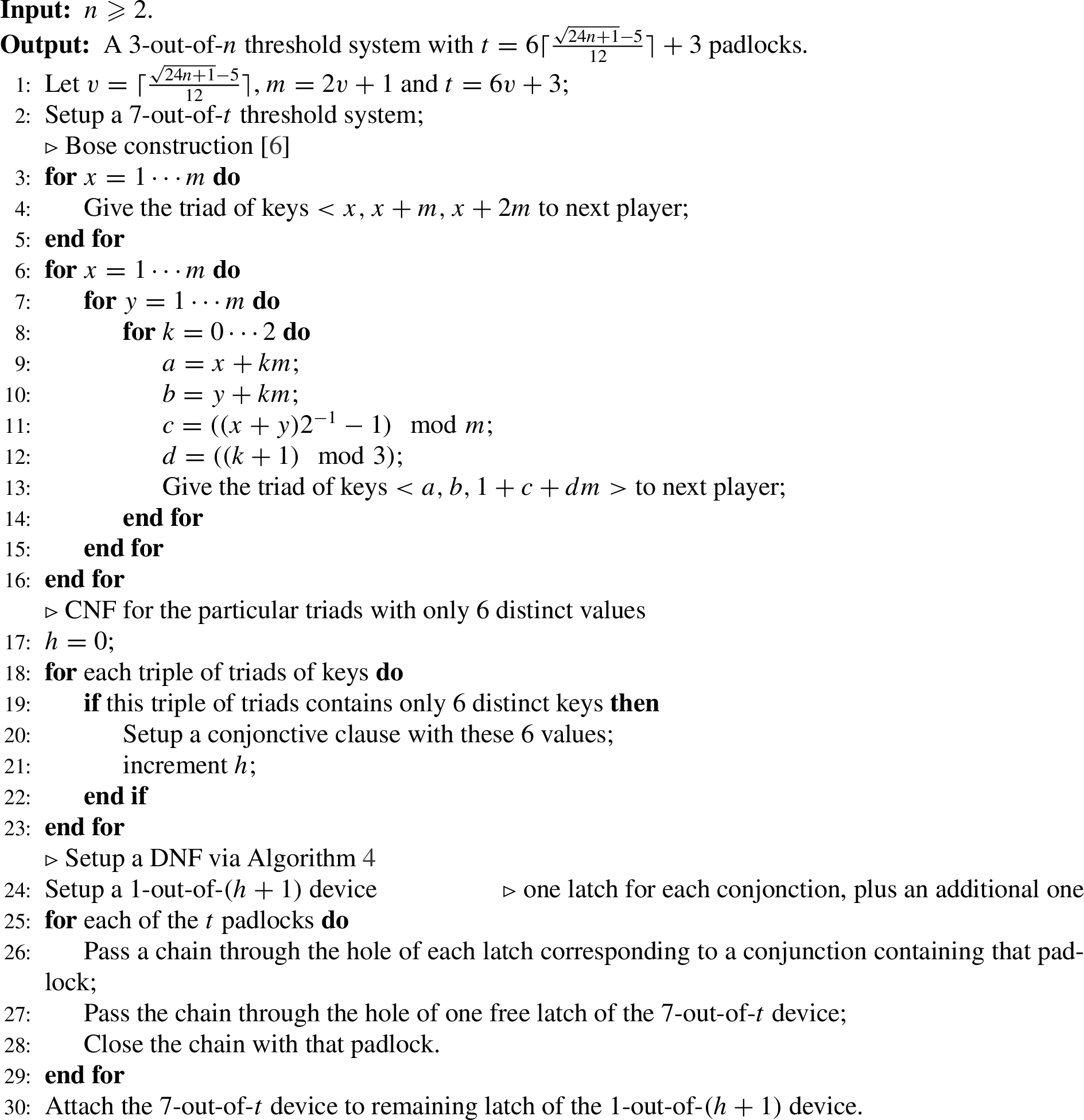
Bose three-out-of-n threshold system with shared keys
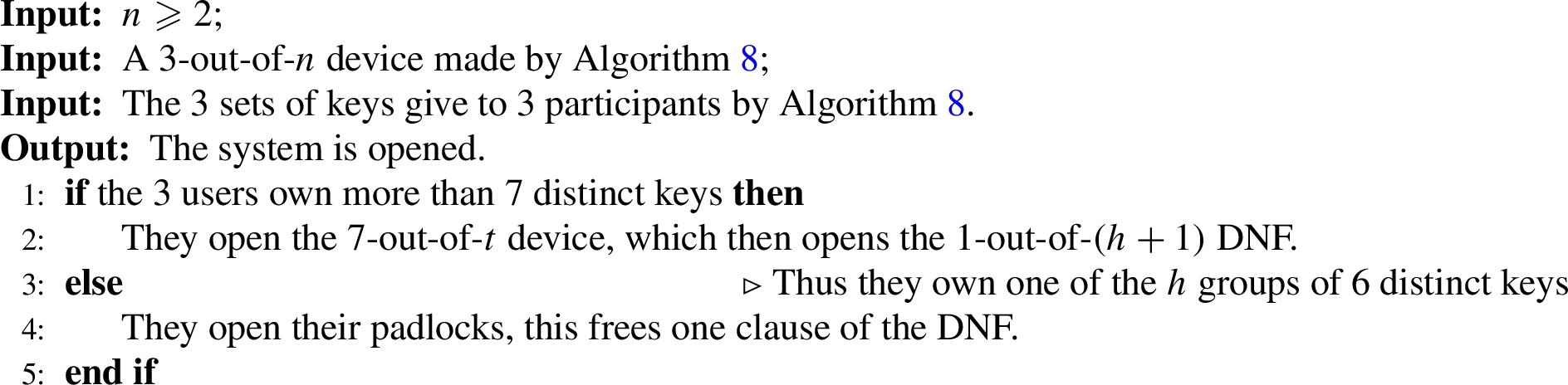
Opening the device of Algorithm 8
Algorithm
8
is correct and
Any construction of a Steiner triad block design works. For instance, the Bose construction [6] provides such a design for any
To achieve the sometimes slightly better bound of the theorem, one needs to use the Steiner triad system construction by Skolem [9, Lemma 2.5]. There use
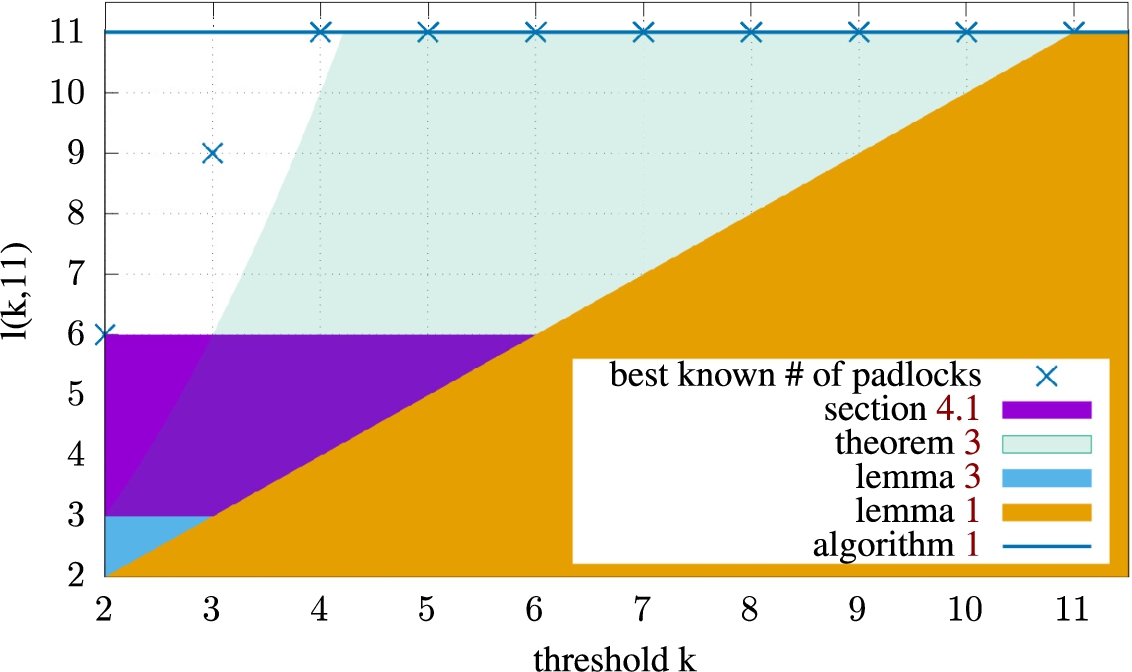
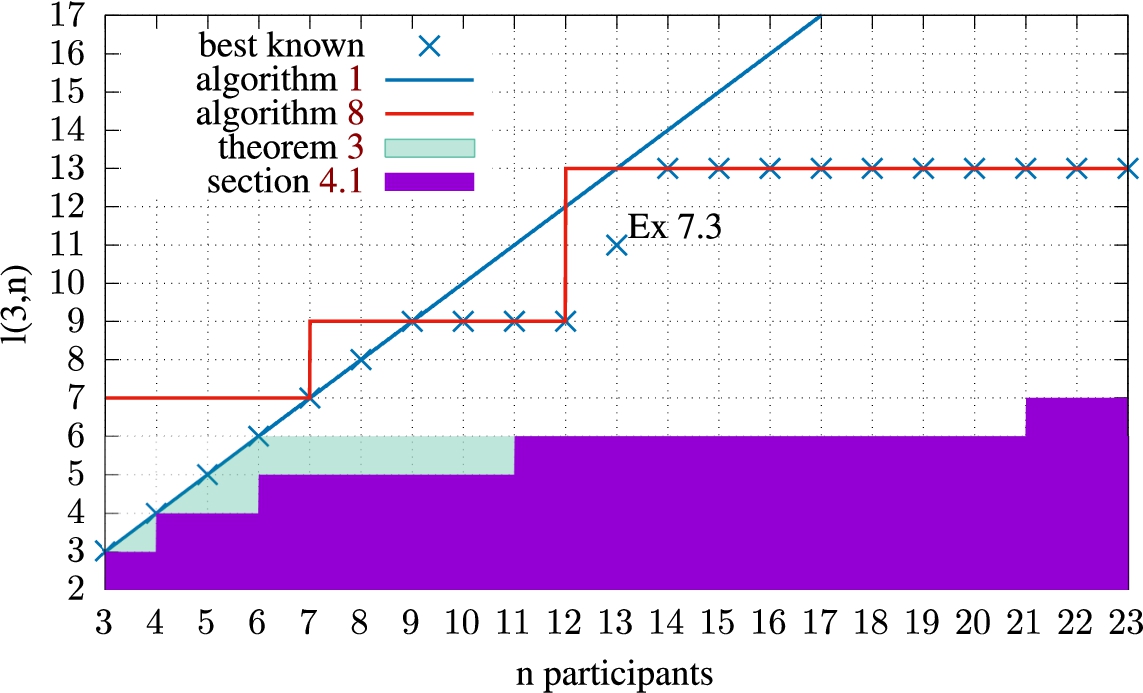
Finally, Fig. 15 summarizes our current knowledge on the example of
We give the smallest example realizing Proposition 4: a 3-out-of-12 system (thus also a 3-out-of-11 system), with only 9 padlocks, 36 keys and 82 latches, and an example using normal forms to reduce the number of latches for a 3-out-of-13 system with only 11 padlocks, 36 keys and 33 latches. Indeed, consider the first terms of Equation 6 for
An example realization of Algorithm 8
The smallest t such that Equation 6 is strictly larger than t is for
A maximal
By inspection, there are 72 triples of triads (so 3 participants owning each 3 keys) with only 6 distinct keys (for instance the triads
Therefore, it is possible to set up a 3-out-of-12 system using only 9 padlocks. The idea of Algorithm 8 is that either a group owns 7 distinct keys or it owns one of the 72 sets of 6 keys not reachable by a pair of participants. Overall, that solution uses 9 padlocks, 9 chains, 36 keys, a 7-out-of-9 and a 1-out-of-73 design (that is
Set up 9 padlocks and make 4 copies of each key;
Give 3 keys to each of the 12 participants following the packing of Table 1;
Set up a 1-out-of-73 design;
Set up a 7-out-of-9 design and attach it to one the latches of the
Use Algorithm 4 to complete the 72 other latches: pass a chain through the hole of each latch corresponding to a disjunction containing that key; close that chain with the associated padlock.
Next, we give a small example where there exists a shortcut to use less latches than with the latter construction. We use some results of Section 5 to help for the construction. For 13 participants, Theorem 4 would provide a system with either
But we even show next a 3-threshold system for 12 or 13 participants with only 11 padlocks, 36 or 39 keys and only 5 additional devices for a total of 33 latches. We give in Table 2, afterwards, a realization of a packing with 3-subsets. Then we proceed by inspection of the triples and pairs of triads of keys. There are
Distribution of 11 keys to 13 participants without any reused pair
Distribution of 11 keys to 13 participants without any reused pair
So, by luck, the following construction realizes a 3-threshold system for 13 participants with 11 padlocks. We need a 7-out-of-11 device as well as a 6-out-of-11, a 5-out-of-7 and a 3-out-of-4 of our designs. Finally a classical 2-out-of-2 device is needed for the
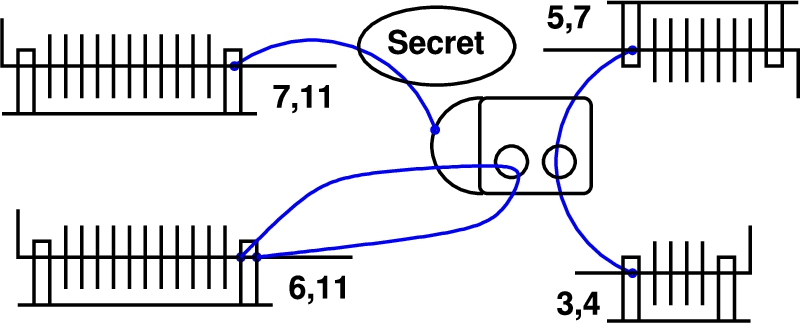
A 3-threshold realization for 13 participants with 11 padlocks. Each participant owns 3 keys with the distribution of Table 2. On the one hand, any 3 participants have either at least 7 distinct keys or if they have only 6 keys then they have at least 5 for padlocks numbered 1 to 7 or at least 3 for padlocks numbered 8 to 11. On the other hand, no pair of participants has a total of 6 distinct keys and either 5 of the first seven ones or 3 for the last four ones.
Each of the eleven padlocks is used once to close a chain as in Algorithm 4. For each padlock its associated chain will go through the hole of each of up to the four devices (the devices
The same system works also for a 3-threshold realization for 12 participants with 11 padlocks. Just use the 12 first triads of keys of Table 2 with the same system. Yet this solution uses more padlocks than Algorithm 8.
Figure 17 summarizes what we know for 3-out-of-n systems. We see that for a threshold of three the minimal number of padlocks is in between
For a larger number of participants, asymptotically, one can reduce the number of padlocks by making subgroups. For instance, consider building a 3-out-of-n system. Create two subgroups G and H of
To count the number of keys and padlocks, we first need Faulhaber’s formula:
Then we need the following formula:
Finally, we need the following variant of the master theorem.
For
Expanding
With these, we can now count padlocks and keys for the strategy with two subgroups of Equation 8:
For
To realize Equation 8 we need 1 padlock for
Similarly the participants of subgroup G get 1 key for
Now, this scheme can be generalized for any threshold k as shown in Algorithm 10.
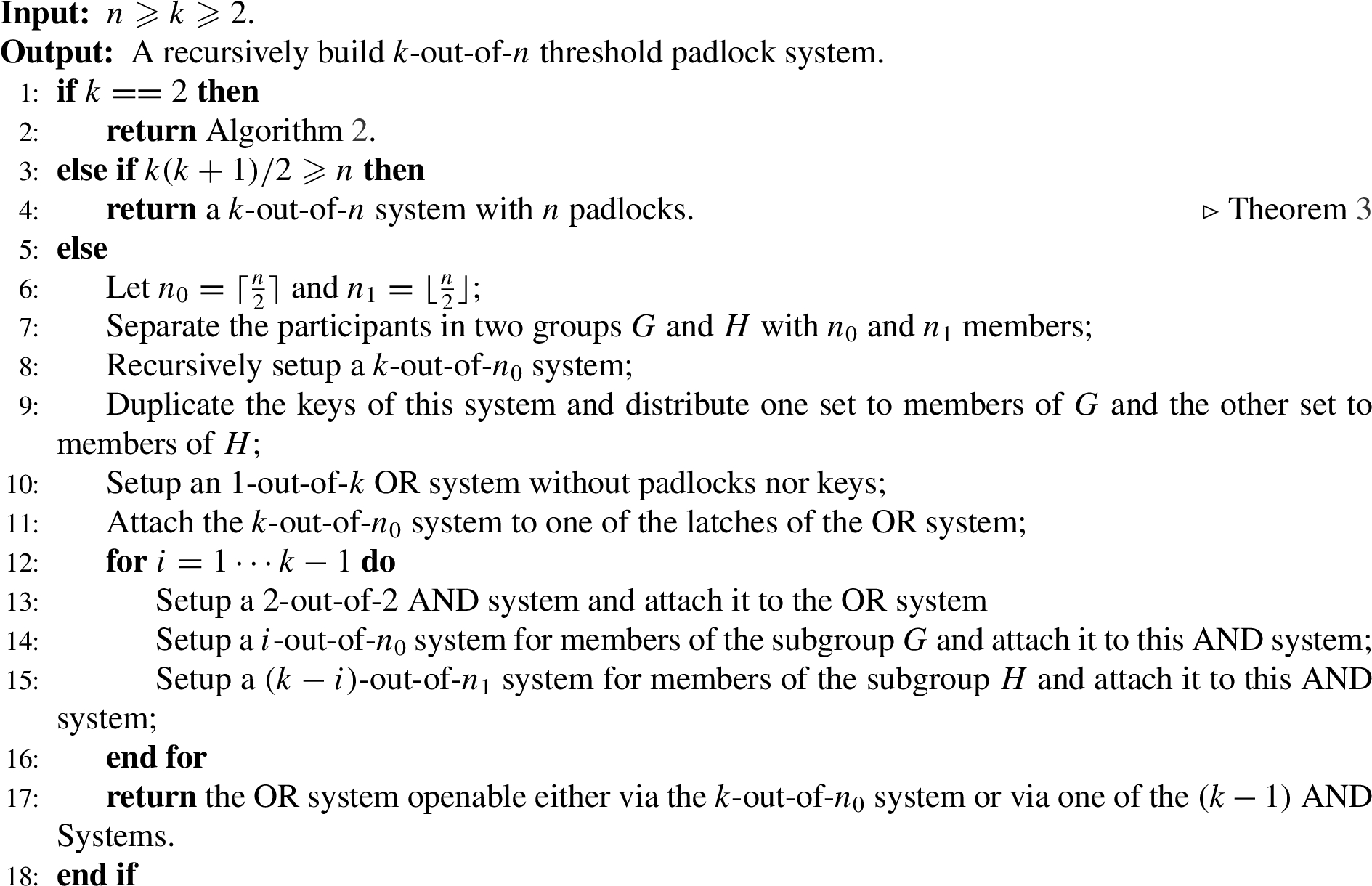
Recursive k-out-of-n threshold system with shared keys
Algorithm
10
is correct and asymptotically requires
For the correctness, consider a group of at most
Now, for the complexity bound, we proceed by induction on
Note that Algorithm 10 is useful only for a large number of participants. For instance with a threshold of three,
Consider Shamir’s secret sharing via interpolation over a finite field. For a secret value within a finite field
We in fact have shown that this is optimal in certain cases, but that one can use smaller fields in others: instead of a degree k polynomial, use a degree t polynomial, where t is the number of padlocks in one of our systems. This number of padlocks t is in fact the number of available evaluation points. Then the identical keys for a given padlock are the evaluations of the polynomial at the points. Thus participants have several evaluations instead of a single one. We have thus proposed a k-out-of-n secret sharing scheme where the field size is reduced. For instance, from Theorem 5, if
Conclusion
We designed a physical k-out-of-n threshold lock that can be used for various applications, including physical access control, voting or secret sharing. Our system only uses n padlocks, showing that previous exponential answers to Liu’s problem were far too pessimistic. For
There are many open questions left, for example we have shown that reducing the number of padlocks is equivalent to reducing the size of the fields for interpolation-based secret sharing, but further exploration of the links with digital systems could be envisioned. Another future work is to find minimal solutions in terms of padlocks for small cases, in particular for k between 3 and
We also devised algorithms that can implement more complex access policies beyond simple thresholds, expressed as disjunctive or conjunctive Boolean formulas. It is yet unclear for us whether there are general solutions using less locks than the number of variables.
We proposed one variant using sealed wire and wrappings to provide an alternative solution to our device with exactly n padlocks. The threshold systems we found with this approach unfortunately use an exponential number of wrappings. It is unclear to us if this could be improved.
Differently, on the asymptotic side, we have found an algorithm, recursively combining several of our devices, requiring only
Finally, if we do not only count the number of padlocks, but more generally the number of keys or of latches, then clearly a lower bound on the number of devices is n: each player must at least have something. Otherwise groups of k players with an empty player would have the same abilities of a group of