



Abstract
Private set intersection cardinality (PSI-CA) and private intersection-sum with cardinality (PSI-CA-sum) are two primitives that enable data owners to learn the intersection cardinality of their data sets, with the difference that PSI-CA-sum additionally outputs the sum of the associated integer values of all the data that belongs to the intersection (i.e., intersection-sum). However, to the best of our knowledge, all existing multi-party PSI-CA (MPSI-CA) protocols are either limited by high computational cost or face security challenges under arbitrary collusion. As for multi-party PSI-CA-sum (MPSI-CA-sum), there is even no formalization for this notion at present, not to mention secure constructions for it.
In this paper, we first present an efficient MPSI-CA protocol with two non-colluding parties. This protocol significantly decreases the number of parties involved in expensive interactive procedures, leading to a significant enhancement in runtime efficiency. Our numeric results demonstrate that the running time of this protocol is merely one-quarter of the time required by our proposed MPSI-CA protocol that is secure against arbitrary collusion. Therefore, in scenarios where performance is a priority, this protocol stands out as an excellent choice.
Second, we successfully construct the first MPSI-CA protocol that achieves simultaneous practicality and security against arbitrary collusion. Additionally, we also conduct implementation to verify its practicality (while the previous results under arbitrary collusion only present theoretical analysis of performance, lacking real implementation). Numeric results show that by shifting the costly operations to an offline phase, the online computation can be completed in just 12.805 seconds, even in the dishonest majority setting, where 15 parties each hold a set of size
Third, we formalize the concept of MPSI-CA-sum and present the first realization that ensures simultaneous practicality and security against arbitrary collusion. The computational complexity of this protocol is roughly twice that of our MPSI-CA protocol.
Besides the main results, we introduce the concepts and efficient constructions of two novel building blocks: multi-party secret-shared shuffle and multi-party oblivious zero-sum check, which may be of independent interest.
Introduction
Motivation
In today’s increasingly electronic world, the easy access of enormous data brings in huge potential in serving people in many aspects. However, the problem of data leakage poses a great threat to the security of all participants. Therefore, it is urgent to strike a balance between efficiency and data privacy simultaneously during the process of collaborative computing. With the increasing dependence on data availability and the emphasis on data privacy, privacy-preserving techniques and applications are springing up at an unprecedented rate. Among them, an interesting problem is how to securely obtain the intersection of data sets from multiple parties without revealing any additional information beyond the intersection. The technique used to solve this problem is called private set intersection (PSI).
Although prior works have yielded some effective PSI schemes, only a few of them have proposed practical solutions for a variant of PSI, namely private set intersection cardinality (PSI-CA). PSI-CA is a cryptographic primitive that enables multiple parties to obtain the intersection cardinality of their private sets without leaking other information beyond the intersection cardinality. PSI-CA can be applied to real-world applications, such as measuring advertisement conversion rate [22]. In this problem setting, a user makes a purchase at the merchant’s store after seeing the advertisement for it. The advertiser and merchant each maintain a private list of users’ identifications: the advertiser knows who has seen the advertisement, and the merchant knows the identities of the users who have made a purchase. The advertisement conversion rate refers to the number of targeted users who have completed one transaction after seeing the advertisement, which can be easily determined using a PSI-CA protocol.
However, the limitation of PSI-CA is obvious, as it is still not sufficient for applications where each data is associated with an integer value (e.g. a payload). For example, consider a scenario in which a single user can contribute multiple purchases. In this case, it is necessary to analyze the total value of purchases from all targeted users, as this reflects the influence of the advertisement [22]. To address this new problem, a variant of PSI-CA has been proposed, known as private intersection-sum with cardinality (PSI-CA-sum) [22]. PSI-CA-sum is designed to output not only the intersection cardinality but also the sum of the associated payloads for all elements in the set intersection (i.e., the intersection-sum).
We have also identified a potential application for PSI-CA-sum beyond measuring advertisement conversion rate. Each voter, denoted as P
i
, can cast a vote for any candidate
However, most existing PSI-CA protocols only work in the two-party setting, while the results of multi-party PSI-CA (MPSI-CA) are either limited by massive computational overhead, or vulnerable to arbitrary collusion (i.e., the adversary can corrupt any proper subset of all parties [32]). Meanwhile, to the best of our knowledge, there has been no work for multi-party PSI-CA-sum (MPSI-CA-sum), not to mention secure constructions for it. Therefore, in this paper, we propose three protocols to address the above problems.
We begin with a semi-honest secure MPSI-CA protocol involving two non-colluding parties, which is especially efficient due to the use of lightweight primitives and an optimized framework. This protocol significantly reduces the number of parties involved in expensive interactive procedures, thereby achieving a substantial improvement in runtime efficiency. In certain application scenarios where performance is a priority, this protocol stands out as an excellent choice. On the basis of it, we present the first MPSI-CA protocol that achieves simultaneous practicality and security under arbitrary collusion. This protocol primarily relies on lightweight cryptographic primitives and works more efficiently than previous benchmark schemes when dealing with large sets. Additionally, we formalize the concept of MPSI-CA-sum and propose the first practical MPSI-CA-sum protocol under arbitrary collusion. Numerical results and theoretical analysis of complexities demonstrate the performance advantages of our protocols.
Related works
Existing constructions of two-party PSI-CA protocols adopt a wide range of techniques. Here, we provide a brief overview of some representative works in the two-party setting. Freedman et al. [14] constructed a PSI-CA protocol based on oblivious polynomial evaluation (OPE) and homomorphic encryption (HE). They further optimized this protocol in their subsequent work [13], ensuring security against malicious adversaries under the random oracle model. Debnath et al. [6] devised a malicious secure fair two-party PSI-CA protocol in the standard model based on the Decisional Diffie-Hellman (DDH) assumption, but it requires a semi-honest arbitrator. Egert et al. [11] introduced a two-party protocol that leverages Bloom filter and the ElGamal encryption scheme. This protocol can estimate the intersection cardinality by applying the number of common zero-bits in Bloom filters into a formula obtained in [1]. Lv et al. [27] employed a commutative encryption scheme to provide a two-party PSI-CA protocol with low communication cost in the unbalanced data setting. However, these schemes heavily rely on a large number of computationally expensive modular exponentiation operations, causing inefficiency when computational resources are constrained. To accelerate the computation, it is a viable alternative to leverage lightweight primitives like oblivious transfer (OT) and its extensions as building blocks of the PSI-CA protocol. Duong et al. [10] presented “Catalic”, a delegated two-party PSI-CA protocol that enables the receiver to delegate PSI-CA computation to c untrusted cloud servers. By distributing the shares of elements to multiple cloud servers and employing an OT-based primitive called oblivious distributed key pseudorandom function (Odk-PRF), the computational burden on the receiver is significantly reduced. Garimella et.al [15] provided solutions for several private set operations, including the two-party PSI-CA. They utilize techniques such as oblivious switching network and oblivious programmable pseudorandom function (OPPRF). Since OPPRF operations can be accelerated using OT-extension [23], the number of public key operations in this protocol is independent of the set size, leading to substantial performance enhancements.
Although there have been some effective two-party PSI-CA schemes, only a limited number of works can deal with the multi-party setting [3,7,24,42]. The existing constructions of MPSI-CA protocols can be classified into three categories: public-key-based MPSI-CA, circuit-based MPSI-CA, and MPSI-CA protocols based on OT and its extensions, such as OPPRF.
Previous MPSI-CA schemes that are secure against arbitrary collusion typically follow the public-key-based paradigm. The computational complexities of these schemes are determined by the number of expensive public key operations involved. Kissner et al. [24] proposed the first MPSI-CA protocol in the semi-honest model based on OPE and HE. This protocol requires multiple rounds of randomizing the encrypted polynomials and obliviously evaluating the encrypted function outputs on each element. The overall computational complexity of [24] is
Debnath et al. [7] presented an MPSI-CA protocol based on inverse Bloom filter (IBF) and HE. In their protocol, each client P
i
(for
The two protocols mentioned above, namely [7,24], have been proven secure under arbitrary collusion. Despite their strong privacy-preserving properties, the computational overhead of these protocols makes them impractical for resource-limited devices dealing with large data sets. To address this challenge, two practical schemes have been proposed. Chandran et al. [3] introduced a circuit-based generic multi-party computation protocol that can be adapted to achieve MPSI-CA by adjusting the circuit design. However, it is important to note that this protocol has only been proven secure in the honest majority model. Additionally, a concurrent work of [42] presented server-aided and server-less OPPRF-based MPSI-CA protocols that rely on the presence of specific non-colluding parties, deviating from the well-known “threshold security”. While leveraging specific non-colluding parties can enhance performance, it is generally believed that achieving “threshold security” aligns more closely with the requirements of most real-life applications.
Therefore, how to design and implement a practical semi-honest secure MPSI-CA scheme under arbitrary collusion is still worth studying.
Our contributions
In this paper, we begin by introducing an incredibly efficient MPSI-CA protocol with two non-colluding parties. Building upon this protocol, we further develop an MPSI-CA protocol and an MPSI-CA-sum protocol, both of which achieve simultaneous practicality and security under arbitrary collusion. Our contributions can be summarized as follows.
By leveraging the element sharing technique, the framework of the protocol is significantly optimized, enabling only two parties to engage in expensive interactive procedures. The computational efficiency of the protocol is enhanced through the utilization of the element sharing technique and lightweight primitives, eliminating the need for public key operations apart from a set of base OTs. Numeric results demonstrate that computing the intersection cardinality for 15 parties with
To the best of our knowledge, this is the first practical realization of MPSI-CA under arbitrary collusion. We have conducted an implementation to verify its practicality (while the previous results under arbitrary collusion only present theoretical analysis of performance without real implementation).
Notably, clients among all participants experience the most substantial performance improvement compared to existing schemes with the same level of security.
In our implementation, a substantial portion of the expensive operations can be shifted to the offline phase, leading to a significant reduction in the running time of the online execution. Numeric results show that even in the dishonest majority setting, involving 15 parties each holding a set of size
Table 1 compares our proposed MPSI-CA protocols with current MPSI-CA schemes in terms of security and computational complexity. On one hand, when compared to existing practical schemes [3,42], our MPSI-CA protocol under arbitrary collusion (Protocol 5.1) is more secure, as [3,42] are not resistant to arbitrary collusion (remark that our protocol is also of practicality which is incomparable to the schemes in [3,42] due to different running frameworks). On the other hand, when compared to the existing schemes secure against arbitrary collusion [7,24], Protocol 5.1 is much more practical, as it adopts symmetric key operations and a set of base OTs to reduce the number of expensive public key operations.
Comparison between MPSI-CA schemes.

Comparison between MPSI-CA schemes.

Multi-party secret-shared shuffle is a primitive that enables multiple parties to collectively shuffle the sum of their input data using an unknown permutation π and obtain additive secret shares of the resulting shuffled data. It is an advancement over the multi-party Permute + Share [29] as it effectively conceals π even under arbitrary collusion. Additionally, our construction is practical as most of its costly operations can be moved to the offline phase, thus reducing the computational burden during online execution.
Multi-party oblivious zero-sum check is a primitive used to securely determine whether the sum of multiple parties’ inputs equals zero without revealing anything else. Our construction of the oblivious zero-sum check protocol utilizes Beaver triples to reduce online computational overhead.
In this part, we present a high-level overview of our MPSI-CA and MPSI-CA-sum protocols. These protocols involve n parties, comprising T leaders
The overall framework of our MPSI-CA protocol with two non-colluding parties is illustrated in Figure 1. In this protocol, it is already sufficient to set the number of leaders (denoted as T) to 2, and designate these two non-colluding parties (denoted as L1 and L2) as the leaders. The whole process is divided into two main phases: element sharing and two-party PSI-CA. In the element sharing phase, clients share their PRF-encoded data sets with the leaders, allowing the leaders to hold both their own data sets and those of the clients. This reduces the original n-party MPSI-CA problem to a two-party PSI-CA with only two leaders. By adopting this approach, the framework of our protocol can be optimized since only L1 and L2 are required to engage in the following interactive procedures: OPPRF, two-party Permute + Share and oblivious zero-sum check. In the first step of the two-party PSI-CA, L1 invokes OPPRFs with L2 on each element

The overview of our efficient and non-colluding MPSI-CA protocol.
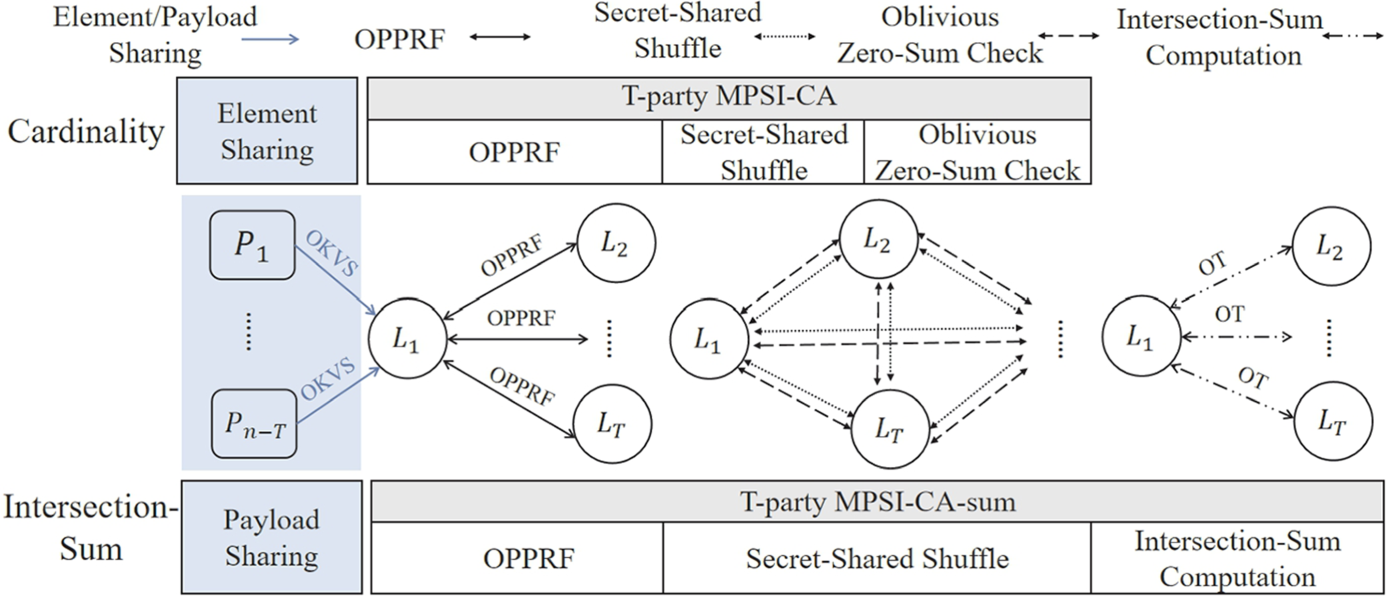
The overview of our MPSI-CA and MPSI-CA-sum protocols under arbitrary collusion.
After that, we extend the aforementioned MPSI-CA protocol with two non-colluding parties to a secure MPSI-CA protocol under arbitrary collusion. As depicted in Figure 2, this extension involves the construction of two new primitives: multi-party secret-shared shuffle and multi-party oblivious zero-sum check. In this protocol, parties first go through the element sharing stage, and for security purposes, the number of leaders needs to be increased to
Our MPSI-CA-sum protocol extends the aforementioned MPSI-CA protocol under arbitrary collusion by introducing a key difference: leaders are now responsible for handling both payloads and elements. In this protocol, parties perform element sharing, payload sharing, OPPRF and secret-shared shuffle on both elements and their respective payloads. Following the execution of the oblivious zero-sum check on elements, the primary leader L1 acquires a binary vector
Section 2 introduces the preliminaries, providing essential background information. In Section 3, we present the notions and constructions of two new building blocks: multi-party secret-shared shuffle and multi-party oblivious zero-sum check. These building blocks are crucial for developing our secure MPSI-CA protocol under arbitrary collusion. In Section 4, we put forward a comprehensive description of our efficient MPSI-CA scheme with two non-colluding parties, which serves as the foundation for the subsequent protocols. Following that, in Section 5 and 6, we propose the practical MPSI-CA and MPSI-CA-sum protocols under arbitrary collusion, respectively. We focus on implementing and analyzing the performance of our MPSI-CA protocols in Section 7. Finally, we conclude our work in Section 8.
Preliminaries
We say that protocol Π securely computes f in the presence of a semi-honest adversary, if there exists a PPT simulator Sim such that for
([12])

Give
A KVS is parameterized by a set Encode takes as input a set of Decode takes as input the object S, a key k and outputs a value v.
For Return ([16])
A KVS is correct if, for all 
The obliviousness of OKVS guarantees that, if the values encoded in the OKVS are random, then the advantage of successfully guessing the corresponding key is negligible for any PPT adversary.
(OPPRF
)
Run Give
For each query
(Two-party Permute + Share
)
Give a shuffled share Give a shuffled share
(Multi-party Permute + Share
)
For each

(Two-party Oblivious Zero-Sum Check
)
Give a binary vector
Two new primitives and constructions
In this section, we present the notions and constructions of two new building blocks for our MPSI-CA and MPSI-CA-sum protocols: multi-party secret-shared shuffle and multi-party oblivious zero-sum check.
Multi-party secret-shared shuffle
In [5], a two-party secret-shared shuffle protocol is proposed to produce additive secret shares of the shuffled sum for two parties, ensuring that neither party knows the permutation. This protocol is similar to the two-party Permute + Share, but differs in that the two-party Permute + Share allows one party to learn the permutation.
In a non-colluding two-party setting, the semi-honest Permute + Share primitive is sufficient for randomly shuffling the sum of inputs. The receiver only obtains random shares of the shuffled sum, while the exact permutation π remains unknown to the receiver. However, this primitive is inadequate in scenarios involving multiple parties, where each corrupted party can freely collude with others. If the Permute + Share protocol [29] is employed as a component in a multi-party protocol, the secrecy of the permutation π is compromised once a corrupted sender (who selects π) colludes with someone.
To overcome this limitation, we propose a new primitive called multi-party secret-shared shuffle. This primitive enables parties to shuffle the sum of their input vectors using an unknown permutation π and obtain random additive shares of the result.
(Multi-party Secret-Shared Shuffle
)
Give each party P
i
(for
((
): Multi-party Secret-Shared Shuffle)
During the i-th ( Party P
j
(for Party P
i
acts as the sender with a random permutation Each party P
j
(for For each
In the i-th round of the protocol, P
i
assumes the role of the sender, inputting a permutation
This protocol (
We exhibit simulator Sim for simulating the views of the corrupted parties (i.e., 
Multi-party oblivious zero-sum check
We present the concept and construction of a new primitive called multi-party oblivious zero-sum check. This primitive allows parties to securely identify which entries in the sum of their input vectors are zero, without disclosing the actual values of the non-zero entries. It will be employed in the final step of our MPSI-CA protocol to determine the intersection cardinality of the shuffled data.
(Multi-party Oblivious Zero-Sum Check
)
Give a binary vector
Parties need to interact with each other in order to acquire their additive shares of the component-wise multiplication product
For each 
For each P
i
locally selects a random vector P
i
computes P
i
reconstructs
Protocol 3.2(
The parties are divided into two coalitions: the corrupted coalition
MPSI-CA with two non-colluding leaders
We begin with an efficient MPSI-CA protocol with two non-colluding parties, referred to as L1 and L2. The remaining parties are represented as
The introduction of this MPSI-CA protocol with two non-colluding parties serves two primary purposes. Firstly, it establishes a foundation for an MPSI-CA protocol that is secure against arbitrary collusion (detailed in Section 5.1). Secondly, it is tailored for specific application scenarios where performance takes precedence. This protocol demonstrates how to compute the intersection cardinality in an exceptionally lightweight manner by providing a weaker security guarantee. This balance between security and efficiency allows for faster computation and reduced communication costs, all while guaranteeing the desired outcomes.
In this section, we begin by revisiting the functionality of MPSI-CA. Subsequently, we introduce a step called element sharing, which aims to reduce the original n-party MPSI-CA to a T-party MPSI-CA involving only T leaders. Finally, we provide a detailed description of our MPSI-CA protocol.
(MPSI-CA
)
Give leader L1 the intersection cardinality
Element sharing
Considering the fact that the overhead of the MPSI-CA protocol tends to increase with the number of parties, it is a logical approach to designate only a small number of parties, known as leaders, to carry out the costly interactive procedures. This is achieved by sharing the PRF-encoded data sets of the remaining parties with the leaders during the first step. This technique, first adopted by [32], is referred to as “element sharing” in this paper.
The functionality of element sharing is as follows: for each element x in the data set
Each secondary leader L
i
, for
The correctness proof of Sub-protocol 4.1 is as follows. If the element x belongs to
If
(Element Sharing)
P
j
sends a random For each element
Detailed protocol
In this part, we demonstrate how the element sharing technique can be integrated with other primitives to construct a secure MPSI-CA protocol. The formal description of this protocol in the balanced data setting is provided in Protocol 4.2. In scenarios with unbalanced data set sizes, we find it advantageous to assign the role of the primary leader to the party with the fewest data. This strategy further reduces the overhead of set intersection cardinality computation.
In the beginning, the parties perform element sharing to reduce the original n-party MPSI-CA problem to a two-party PSI-CA problem between two leaders, L1 and L2. Subsequently, L1 and L2 apply the bucketing technique to insert their sets
Based on the properties of element sharing and OPPRF, we can ascertain if an element in
In order to prevent the leakage of intersection elements, L1 and L2 are required to utilize the two-party Permute + Share protocol and the two-party oblivious zero-sum check protocol. The two-party Permute + Share primitive provides them with random shares of the shuffled vector
The two-party oblivious zero-sum check protocol
(MPSI-CA with two non-colluding leaders)
Sender L2 provides a programmed set Receiver L1 provides b queries For each L2 acts as the sender with an random permutation π; L1 acts as the receiver with the input vector L1 and L2 receive random additive shares of the shuffled vector L2 first applies π to the vector L2 acts as the sender with the input vector L1 acts as the receiver with the input vector
L1 outputs the number of 1s in
Even though the OKVS sent by P1 is not encoded on the key
Protocol 4.2
securely computes
The security proof can be divided into three cases. We construct a simulator Sim to simulate the views of the corrupted parties In step 1, Sim randomly selects In step 2(b), Sim randomly selects In step 2(d), Sim selects a random vector In step 2(f), Sim invokes the simulator of In step 1, Sim simulates the OKVS D
j
from an honest party P
j
by generating an OKVS In step 2(b), Sim randomly selects In step 2(d), Sim randomly selects a vector In step 2(f), Sim samples a binary vector
We argue that the outputs of Sim are indistinguishable from the real view of L2 by the following hybrids:
Since
We argue that the outputs of Sim are indistinguishable from the real view by the following hybrids:
Since
MPSI-CA protocol under arbitrary collusion
The MPSI-CA protocol described in Section 4.2 optimize its computational and communication efficiency by relying on the assumption of two non-colluding parties. Limiting the number of leaders to only two during the OT-based PSI-CA computation stage significantly enhances its efficiency. However, we recognize that in some real-world applications, the assumption of non-collusion may not always be feasible. Therefore, it is essential to adapt Protocol 4.2 to address scenarios with potential arbitrary collusion. This adaptation increases the versatility of our MPSI-CA protocol, making it applicable to situations where the existence of non-colluding parties cannot be ensured.
Our non-colluding MPSI-CA protocol, presented in Section 4.2, serve as the basis for our MPSI-CA protocol under arbitrary collusion. In this section, we outline the major adjustments made to adapt to scenarios with arbitrary collusion and then provide a comprehensive description of our enhanced protocol.
Detailed description
The detailed MPSI-CA protocol under arbitrary collusion is presented in Protocol 5.1. The framework of it is similar to that of Protocol 4.2, with two major adjustments:
The number of leaders should be set to
During the shuffling stage, the two-party Permute + Share protocol is substituted with a T-party secret-shared shuffle protocol. If we continue to use the T-party Permute + Share protocol [29] to help parties shuffle the sum of their inputs, the permutation π will be revealed to
Based on the above analysis, we propose the MPSI-CA protocol under arbitrary collusion (Protocol 5.1). This protocol consists of several steps, including element sharing, bucketing, OPPRF, T-party secret-shared shuffle and T-party oblivious zero-sum check.
After performing element sharing in step 1, the problem of n-party MPSI-CA computation is reduced to a problem involving only T leaders. Each leader now possesses a set of element sharings
(MPSI-CA Under Arbitrary Collusion)
Sender L
i
provides a programmed set Receiver L1 provides b queries For each Each L
i
inputs the vector For L1 outputs a binary vector
L1 outputs the number of 1s in
Protocol
5.1
securely computes
The security proof can be divided into three cases. We construct a simulator Sim to simulate the views of the corrupted parties In step 1, Sim randomly selects In step 2(b), Sim randomly selects In step 2(d), Sim randomly selects vector In step 2(e), Sim invokes the simulator of In step 1, Sim simulates the OKVS D
j
from an honest party P
j
by generating an OKVS In step 2(b), Sim randomly selects In step 2(d), Sim randomly selects Sim samples a binary vector
We argue that the outputs of Sim are indistinguishable from the real view of L
i
by the following hybrids:
Since
We argue that the outputs of Sim are indistinguishable from the real view of corrupted L1 by the following hybrids:
Since
Necessity of oblivious zero-sum check
We emphasize that the step of oblivious zero-sum check is necessary in Protocol 5.1. Consider an alternative approach where, after step 2(d), the secondary leaders send their shares of
MPSI-CA-sum protocol under arbitrary collusion
In this section, we first provide the formal definition of the concept of MPSI-CA-sum. Subsequently, we introduce a technique called payload sharing, which enables clients to securely share their payloads with T leaders. Following this, we extend the MPSI-CA protocol under abitrary collusion (Protocol 5.1) to provide a practical MPSI-CA-sum protocol that is secure against arbitrary collusion.
In the context of MPSI-CA-sum, each element x is associated with a payload. On the side of the leader L
i
, the payload is denoted as
(MPSI-CA-sum
)
Give output


Payload sharing
In our MPSI-CA protocol, we employ the element sharing technique to distribute the PRF-encoded data sets of the clients to the leaders in the first step. This approach helps minimize the number of parties involved in costly interactive procedures. To preserve the association between elements and their corresponding payloads, it is essential for us to handle these payloads in a consistent manner. Consequently, we introduce a technique known as payload sharing, which is designed to share the payloads of clients with T leaders.
The purpose of payload sharing is that: for each element x in the data set
(Payload Sharing)
P
j
chooses random PRF keys For each element P
j
computes the mask P
j
applies For every

First, each client P
j
(for
For
The correctness proof of Sub-protocol 9 is as follows. If
If
Detailed description
The MPSI-CA-sum protocol under arbitrary collusion is presented in Protocol 6.2. In step 4, we reuse the hash table
The analysis of
In order to derive the payload-sum of all the intersection elements, leader L1 needs to determine the shuffled indices of those intersection elements. Recall that in step 3, leader L1 outputs a binary vector
(MPSI-CA-sum Under Arbitrary Collusion)
(In step 3, each leader L
i
(for Sender L
i
provides a programmed set Receiver L1 provides b queries For each bin For each
L1 locally computes L1 invokes Sender L
i
inputs a set of strings Receiver L1 inputs the choice string L1 computes the intersection-sum
The random masks First, each secondary leader L
i
(for Then, each secondary leader L
i
(for Finally, each secondary leader L
i
(for
Protocol
6.2
securely computes
Since the simulation strategies for step 1 and step 3 are provided in Theorem 4 of Protocol 5.1, we will only offer a concise overview of the security proof for the remaining steps, which involve the computation of the intersection-sum. We divide the security proof into three cases. In step 2, Sim randomly samples In step 4(b), Sim randomly selects keys In step 4(d), Sim randomly selects In step 5(b), Sim uses random vectors to simulate the received shares of L
i
, and creates the mask In step 2, Sim randomly samples In step 4(b), Sim randomly selects In step 4(d), Sim randomly selects In step 5(b), Sim first extracts the binary vector
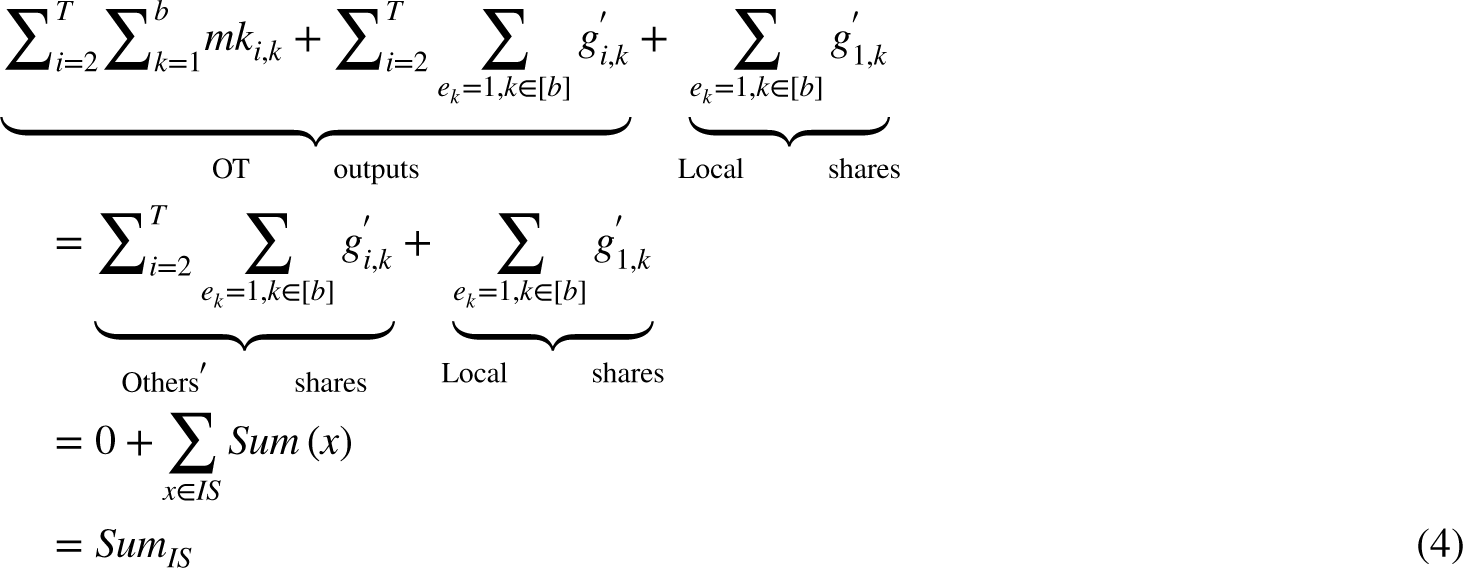
Therefore, the simulated view of
Therefore, the simulated view of
Experimental evaluation
In this section, we evaluate the performance of our protocols. We instantiate the underlying OPPRF and T-party Permute + Share primitives using the realization proposed in [26] and [29], respectively. Since the operations of computing the intersection-sum resemble those of computing the intersection cardinality, the computational complexity of our MPSI-CA-sum protocol is roughly double that of our MPSI-CA protocol under arbitrary collusion. Therefore, in this section, we only focus on evaluating the performance of our MPSI-CA protocols.
Performance of MPSI-CA under arbitrary collusion
The running time and communication cost in our MPSI-CA protocol under arbitrary collusion (Protocol 5.1).
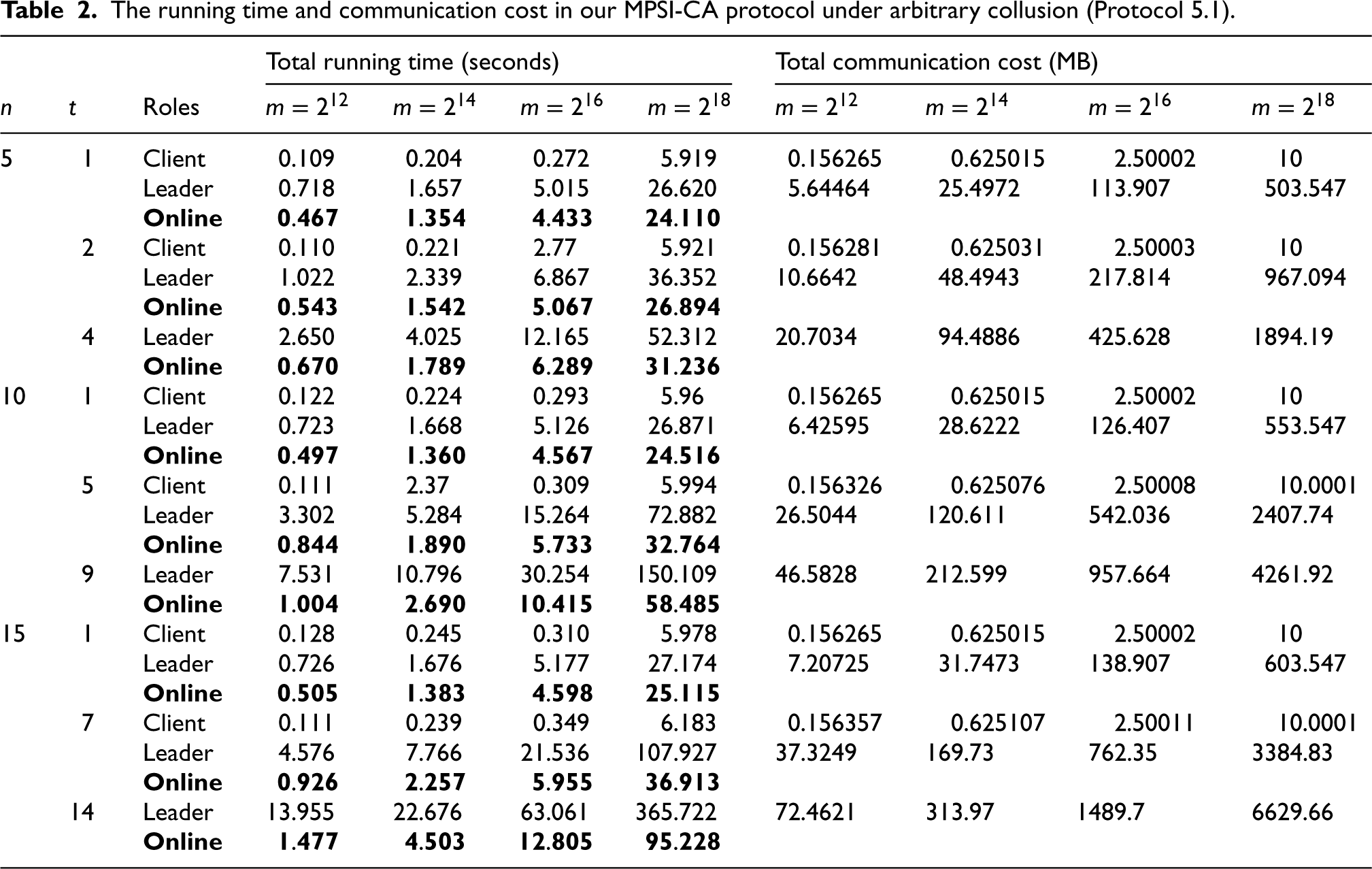
The running time and communication cost in our MPSI-CA protocol under arbitrary collusion (Protocol 5.1).
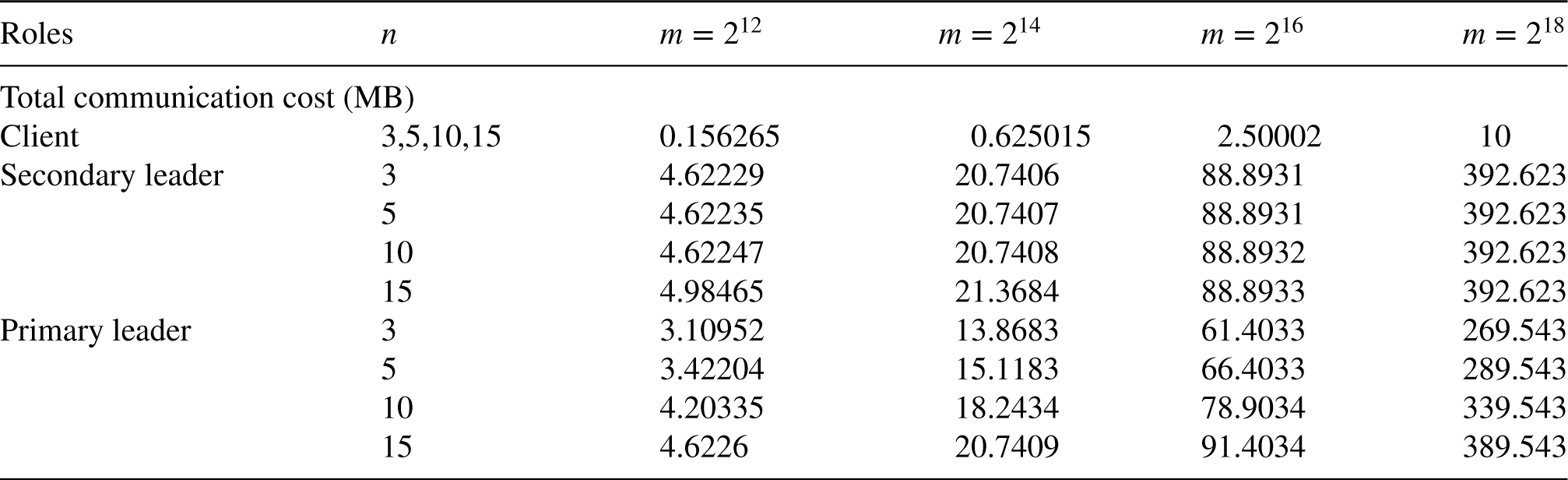
With respect to the communication performance of different parties, the cost of client is nearly independent of n and t. Whereas the cost of primary leader not only depends on n, but is also linear in the number of leaders
The running time of different steps in our MPSI-CA protocol under arbitrary collusion (Protocol 5.1).

Table 4 presents the total running time and communication cost of our MPSI-CA protocol with two non-colluding parties (Protocol 4.2). Its practicality can be verified by our numeric results. As shown in the table, it requires only 0.620 seconds for
Our Protocol 4.2 not only establishes a foundation for designing our MPSI-CA protocol under arbitrary collusion (Protocol 5.1), but also demonstrates a more lightweight approach to computing the intersection cardinality. This protocol provides a weaker security guarantee in exchange for faster computation and lower communication cost when compared with Protocol 5.1. For instance, when
Hence, for application scenarios where performance is prioritized, we believe that Protocol 4.2 will stand out as an excellent choice.
Comparison with other works
To the best of our knowledge, there are only two MPSI-CA schemes [7,24] that are secure against arbitrary collusion in the semi-honest adversary model. However, these schemes only provide theoretical analysis of their performance without any experimental results. Table 5 compares the performance of them and our MPSI-CA protocol under arbitrary collusion (Protocol 5.1) in terms of computational and communication complexities.
Note that t represents the corruption threshold, and it is limited to be no larger than
The running time and communication cost of our MPSI-CA protocol with two non-colluding parties (Protocol 4.2).
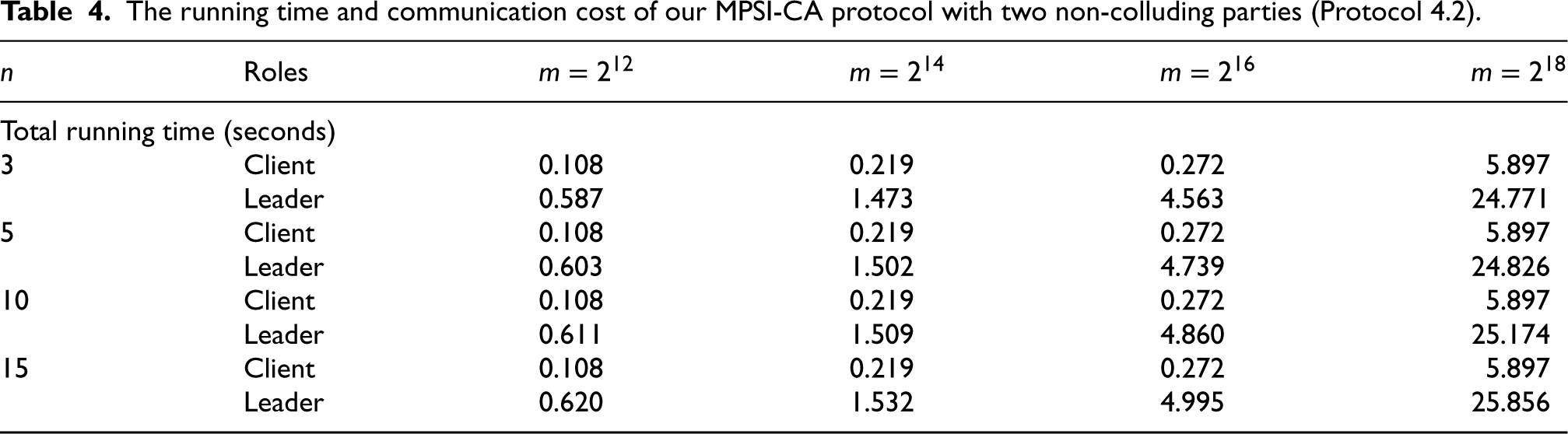
The running time and communication cost of our MPSI-CA protocol with two non-colluding parties (Protocol 4.2).
The computational and communication complexities of MPSI-CA schemes, where k is the ratio of OKVS size to its encoded set size, m is the set size,
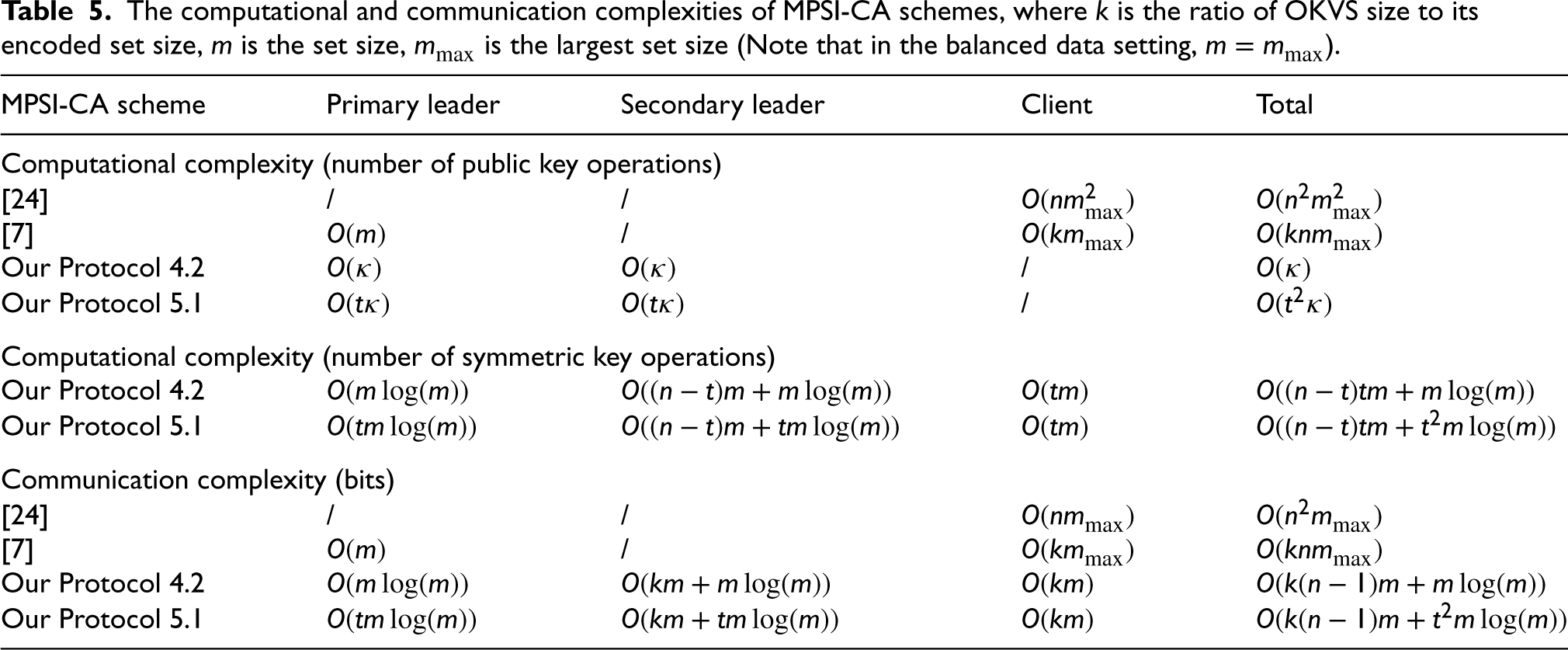
As shown in Table 5, [24] and [7] both rely on a large number of expensive public key operations, which is linear in the maximal set size
By adopting lightweight primitives that do not require any public key operations besides a set of base OTs, the number of public key operations in our MPSI-CA protocols is independent of the set size. In scenarios where the set size is large and the number of parties is small, this leads to a significant performance improvement when compared with [7,24]. At the same time, clients only need to send their PRF-encoded data to the leaders instead of participating in the expensive cryptographic interactive protocols for themselves, so that the total computational complexity can be reduced especially when
In terms of communication complexities, although utilizing expensive HE can reduce the communication cost during the multi-party shuffle stage in [7], we reckon that the gap between [7] and our MPSI-CA scheme can be narrowed in an unbalanced setting by assigning the party with the smallest data set (
In this paper, we first proposed an efficient MPSI-CA protocol with two non-colluding parties. It fully takes advantage of the star like network topology, element sharing technique and OT-extension acceleration to reduce overall computational and communication overhead. Building on this foundation, this paper proceeded to introduce the first MPSI-CA protocol that achieves simultaneous practicality and security under arbitrary collusion, which can resist the collusion of any subset of participants. To achieve this goal, we developed a multi-party secret-shared shuffle primitive to facilitate collaborative shuffling of the sum of participants’ inputs in an unknown permutation. We then demonstrated how to integrate this new primitive with our intuitive MPSI-CA protocol involving two non-colluding parties to propose an enhanced MPSI-CA protocol under arbitrary collusion. This protocol primarily relies on lightweight cryptographic primitives and operates more efficiently than previous homomorphic encryption based benchmark schemes when handling large data sets. Additionally, we defined the problem of MPSI-CA-sum and extended the aforementioned enhanced MPSI-CA protocol to address this scenario. Numeric results and theoretical complexities highlight the performance advantages of our protocols.
Footnotes
Acknowledgments
This work was supported in part by the National Key Research and Development Project 2020YFA0712300.